
Last updated 2026-07-09
TL;DR
Therasage makes portable infrared saunas that zip around your body and use full-spectrum (near, mid, and far) infrared panels. They heat to roughly 140 to 160°F in 10 to 15 minutes, cost $400, $700, and are genuinely useful for people who want regular heat exposure without a permanent installation. They are not equivalent to a traditional or barrel sauna, but for the price and footprint they are among the better-built options in this category.
What exactly is a Therasage portable sauna?
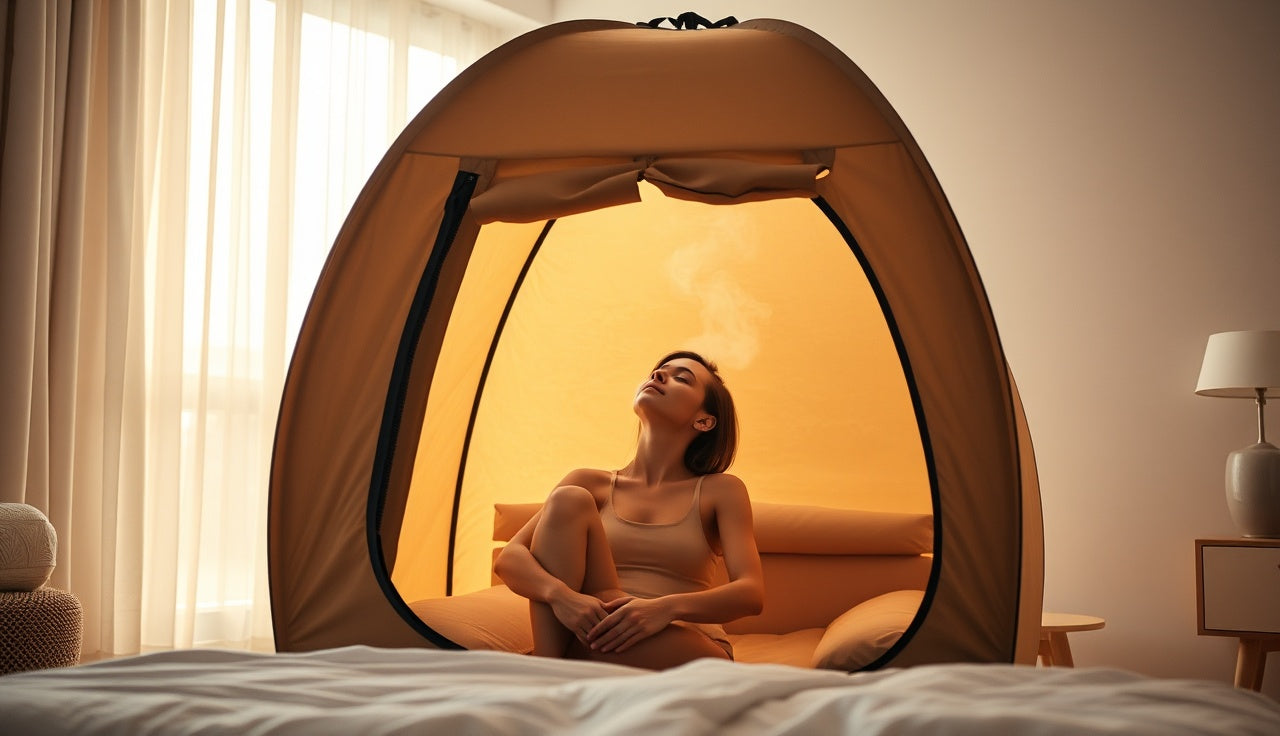
Therasage is a U.S.-based wellness brand that has been selling infrared products since roughly 2010. Their flagship portable unit, the Thera360 Plus, is a pop-up tent-style infrared sauna: a collapsible frame wrapped in insulated fabric with infrared heating panels sewn or mounted inside. You sit on a stool, zip the enclosure around your body up to the neck, and run a session at whatever temperature you set on the controller. Your head stays outside the unit the whole time.
The brand's main selling point over generic tent saunas is the heating technology. Most cheap portable saunas use a single type of infrared emitter, typically far infrared only. Therasage calls their approach "full-spectrum," meaning the panels produce near infrared (roughly 0.7 to 1.4 micrometers), mid infrared (1.4 to 3 micrometers), and far infrared (3 to 1000 micrometers) in a combined output [1]. Whether you need all three wavelengths to get the benefits most people are chasing from regular heat exposure is genuinely debated, and nobody has produced a clean head-to-head trial of full-spectrum vs. far-only portable saunas on any meaningful health outcome. But the build quality and panel consistency in Therasage units is measurably better than the $100, $200 tent saunas on Amazon.
The Thera360 Plus also claims near-zero EMF (electromagnetic field) emissions, a feature the company markets heavily. Infrared heating elements do produce EMF; the question is how much at typical sitting distance. Therasage says they engineer their panels to reduce EMF to under 1 mG (milligauss) at body contact distance, which is below the 2 mG threshold some researchers use as a precautionary reference point [2]. That claim is plausible given the panel design, though independent third-party EMF measurements on consumer infrared saunas are rare and not standardized.
If you want context on how this fits into the broader portable sauna market, the short version is: Therasage sits at the upper end of the tent/blanket category but well below a proper home sauna cabin in terms of heat delivery and session quality.
How does Therasage infrared heat compare to traditional sauna heat?
This comparison matters more than most brands want you to think about. A traditional Finnish-style sauna operates at 170 to 200°F with low-to-moderate relative humidity. The very high ambient air temperature heats your skin and eventually your core through convection and some radiant transfer. Most of the well-cited research on sauna and cardiovascular health, including the large Kuopio cohort studies from Finland following over 2,000 men for 20-plus years, was done in Finnish-style saunas at those temperatures [3].
The Therasage Thera360 Plus reaches roughly 140 to 160°F at its maximum setting. That is meaningfully lower. You will still sweat. Your core temperature will still rise. But you are not replicating the thermal load of a 190°F Finnish sauna sitting at ambient air, and the research base for benefits specifically at 140 to 160°F in infrared tent saunas is much thinner than the Finnish sauna literature.
What infrared heat does differently is penetrate skin tissue directly rather than heating through air. The theory is that you can achieve a meaningful physiological response at a lower ambient temperature because the infrared energy is absorbed in the dermis and subcutaneous tissue rather than purely at the surface. Some small trials on far-infrared sauna use at lower temperatures (around 140°F) have shown cardiovascular and autonomic responses, including reduced arterial stiffness and improvements in heart rate variability [4]. These are real signals, but the study populations are small and the sessions were in purpose-built far-infrared cabins, not portable tent units.
Bottom line: the Therasage is not a Finnish sauna substitute. It is a lower-temperature infrared session in a fabric enclosure. That can still be useful and habituating, especially if the alternative is no heat exposure at all. But go in with calibrated expectations. For a broader look at what heat exposure research actually shows, the sauna benefits guide covers the evidence in detail.
What temperature and session times should you use?
Therasage recommends starting at 110 to 120°F for 15 to 20 minutes if you are new to infrared, then working up to 30 to 45 minute sessions at 130 to 150°F once your body adapts. That progression matches how most practitioners approach heat acclimation: let your cardiovascular system adjust before pushing duration or temperature.
The Kuopio cohort data tied the strongest cardiovascular associations to 4 to 7 sauna sessions per week at 174°F for 19 minutes on average [3]. You cannot replicate that protocol in a 150°F tent, but frequency probably matters more than you might expect. Even lower-intensity heat exposure done consistently is likely better than occasional high-intensity sessions, based on the dose-response pattern visible in the Finnish data.
A few practical points worth knowing:
- Sessions above 30 minutes in a tent sauna can get uncomfortable because your head and neck are outside the heat envelope. Sweat drips, your neck gets cold, and the seated posture becomes awkward. Most people land on 20 to 30 minute sessions as the natural limit.
- Hydration is the same as any sauna: 16 to 24 oz of water before, sip during if you go long, and do not sit in a tent sauna if you are even mildly dehydrated.
- Core temperature elevation is the mechanism behind most of the research-cited benefits. The Cleveland Clinic notes that a core temperature rise of about 1 to 2°C is sufficient to trigger relevant heat shock protein and cardiovascular responses [5]. You can get there in a tent sauna, but it takes longer than in a high-heat traditional cabin.
If you are pairing heat with cold exposure afterward, which is a popular protocol, the cold plunge or ice bath guides have the timing and temperature guidance you need.
How much does the Therasage Thera360 Plus cost, and what do you get?
The Thera360 Plus retails at approximately $600, $699 direct from Therasage as of mid-2025. You will occasionally find it at $499, $550 during sale periods. The original Thera360 (non-Plus) sits around $400, $449. A handful of retailers list it, but Therasage sells primarily direct-to-consumer.
Here is what the Thera360 Plus includes at that price:
| Component | Detail |
|---|---|
| Frame | Steel collapsible frame, sets up in roughly 3 to 5 minutes |
| Heating panels | Full-spectrum infrared (near, mid, far) sewn into walls and floor panel |
| Controller | Digital, sets temperature and session timer |
| Stool | Basic folding stool included |
| EMF shielding | Manufacturer claims <1 mG at body distance |
| Footprint (assembled) | Roughly 32" x 32" x 47" |
| Weight | Approximately 18 to 22 lbs for the total kit |
| Storage | Carry/storage bag included |
For comparison, a basic 1-person far-infrared sauna cabin (the kind with real wood walls and bench) starts around $1,200, $1,800 from budget brands and climbs fast from there. A quality 2-person cabin with reputable panels is $3,000, $5,000 or more [6]. So the Therasage sits in an entirely different investment tier. The question is whether the tent format actually delivers enough of the experience to be worth $600 versus a $150 Amazon competitor or a $2,500 cabin.
The honest answer: the Therasage build is noticeably better than sub-$200 tent saunas in terms of fabric quality, panel consistency, and controller precision. Whether it is worth 3x the price of a generic tent is a judgment call based on how much you value EMF reduction claims and full-spectrum output. Versus a real infrared cabin, the Therasage delivers a meaningfully inferior session, but costs a quarter of the price and fits in a closet.
| Generic tent sauna (far-IR only) | $175 |
| Therasage Thera360 Plus (full-spectrum tent) | $649 |
| Budget 1-person IR cabin | $1,500 |
| Quality 2-person IR cabin | $4,000 |
| Entry-level traditional barrel sauna (installed) | $4,000 |
Source: HomeAdvisor Sauna Installation Cost Guide, 2024 [6]
Is the Therasage portable sauna actually portable?
Yes, with some qualifications. The total kit fits into the included carry bag, which is roughly the size of a large duffel. The complete unit weighs about 18 to 22 lbs. You can carry it from room to room, take it to a vacation rental, or store it in a closet between uses. That is genuine portability compared to a wood cabin that requires a dedicated room and electrical installation.
The setup process takes 3 to 5 minutes once you know what you are doing. The steel frame pops and clicks into shape, the fabric drapes over it, and the controller plugs into a standard 120V household outlet. No special wiring, no electrician, no permits. That last point is significant: permanent home sauna installations typically require a dedicated 240V circuit and, in many jurisdictions, a permit and inspection.
Limitations worth naming: the tent is not quick to set up and tear down every single time. If you use it daily, you will probably leave it assembled in a corner of a bedroom or home gym rather than packing and unpacking it. The footprint when assembled, about 32 x 32 inches, is manageable but not nothing. Also, the fabric enclosure is not structural in any meaningful sense; do not expect it to retain heat as efficiently as wood walls. The temperature ramp time (10 to 15 minutes to reach target temp) reflects that lower insulation efficiency.
What are the real health benefits, and what does the evidence say?
The research on sauna and health broadly is more solid than the research on portable infrared saunas specifically, and it is worth being precise about that distinction.
The strongest evidence comes from Finnish-style traditional saunas. The Laukkanen et al. study published in JAMA Internal Medicine (2015) found that men who used a sauna 4 to 7 times per week had a 50% lower risk of fatal cardiovascular disease compared to once-weekly users, after adjusting for confounders [3]. That is a large association in a large cohort, though it is observational and cannot prove causation.
For infrared saunas specifically, a 2009 Journal of the American College of Cardiology pilot study found that 15-minute far-infrared sauna sessions (at roughly 140°F) performed daily for 3 weeks improved flow-mediated dilation and reduced NT-proBNP in patients with chronic heart failure [4]. The sample size was small (30 patients). Meaningful signal, but not the same evidentiary weight as the Finnish cohort work.
For portable tent saunas like the Therasage, there are essentially no controlled studies. The reasonable inference is that if the thermal load (core temperature elevation, sweat rate, heart rate elevation) is similar to what was studied in infrared cabin trials, the physiological response is probably similar. But that inference has not been tested directly.
What you can reasonably expect from consistent use of a unit like the Therasage:
- Significant sweating and cardiovascular elevation during sessions
- Some degree of relaxation response (parasympathetic shift after the session)
- Heat acclimation over weeks of use
- Possible improvements in subjective recovery and sleep quality (self-reported in many infrared sauna users, less documented in controlled trials)
What you should not expect: a replacement for exercise, a weight-loss tool beyond temporary water weight, or a treatment for any medical condition. The Cleveland Clinic advises that sauna use carries real contraindications including recent cardiac events, unstable angina, and certain medications that impair thermoregulation [5].
If you want a full picture of what the sauna research covers, the sauna benefits page is a good next stop.
Who should buy the Therasage, and who should look elsewhere?
Buy the Therasage if:
You are in an apartment or small home with no realistic path to installing a permanent sauna. The tent format fits into a bedroom corner, plugs into a regular outlet, and stores in a closet. That is genuinely useful when a cabin is not an option.
You travel frequently and want to maintain a sauna habit on the road. The carry bag is real and the unit is legitimately portable. A surprising number of high-frequency travelers pack it.
You are price-sensitive but want better build quality than the $150 tent saunas. The Therasage panels are more consistent and the controller is more precise. Full-spectrum output may or may not matter to you, but the QC difference is real.
Look elsewhere if:
You want an experience that approximates a real Finnish or traditional sauna. At 140 to 160°F with your head outside the heat envelope, you are not getting that. A barrel sauna or an outdoor sauna cabin will deliver a categorically better session for dedicated use.
You are already set up for a permanent infrared cabin. The per-session quality of even a budget 1-person wood infrared cabin is meaningfully better than a tent, and the cabin will last longer.
You are primarily motivated by the social or ritual aspects of sauna. The tent format is a solo, utilitarian experience. There is nothing relaxing about sitting on a folding stool with your head poking out of a fabric enclosure. It is functional, not luxurious.
SweatDecks carries both portable infrared options and full home sauna cabins if you want to compare what a real wood cabin costs vs. the tent format side by side.
How does Therasage compare to other portable sauna brands?
The portable sauna market has three real tiers: sub-$200 generic tent saunas (mostly from brands with no meaningful customer support), the $400, $700 premium tent tier where Therasage lives alongside brands like Radiant Saunas and LifePro, and infrared sauna blankets (like HigherDOSE) that are an entirely different product format.
| Brand / Model | Price Range | Infrared Type | EMF Claims | Max Temp | Format |
|---|---|---|---|---|---|
| Therasage Thera360 Plus | $600, $699 | Full-spectrum | <1 mG claimed | ~160°F | Tent |
| Generic Amazon tent saunas | $100, $200 | Far infrared only | Not specified | ~140°F | Tent |
| LifePro Sauna | $300, $400 | Far infrared | Low EMF claimed | ~150°F | Tent |
| HigherDOSE Sauna Blanket | $599, $699 | Far infrared | Low EMF claimed | ~158°F | Blanket |
| Radiant Saunas 1-person cabin | $800, $1,200 | Far infrared | Not specified | ~140°F | Wood cabin |
The sauna blanket format (lying down, wrapped in the blanket) has different ergonomics than a tent. Some people find it more comfortable for longer sessions because they can lie flat. The tradeoff is you cannot use your hands during a session and the whole-body enclosure can feel claustrophobic. The thermal load is comparable to the tent format at similar temperatures.
The Radiant Saunas entry at $800, $1,200 is the point where the math starts to favor a real wood cabin over a tent: you get a bench, real wood walls, and a much better ambient experience for 30 to 50% more money. If your budget is $800 or above, the cabin is almost always the better call.
For a broader look at how portable options compare to cabins, the portable sauna guide covers the full category.
What safety precautions apply to using a portable infrared sauna?
The same basic rules that apply to any sauna apply here, with a few tent-specific additions.
General precautions: Do not use a sauna if you have uncontrolled hypertension, recent myocardial infarction, unstable angina, or severe aortic stenosis. People on medications that impair sweating (anticholinergics, beta blockers in high doses) or diuretics should talk to a physician before regular sauna use [5]. Alcohol and sauna is a well-documented bad combination; the Finnish research data includes alcohol-related sauna deaths as a notable data point in sauna safety literature [7].
For pregnant women, the guidance is conservative: the American College of Obstetricians and Gynecologists recommends avoiding core temperature elevation above 102.2°F (39°C) during pregnancy [8]. A sauna that can raise core temp by 1 to 2°C in healthy adults warrants a physician conversation before use during pregnancy.
Tent-specific considerations:
- The fabric enclosure retains some moisture, so mold is a real concern if you store the unit damp. Dry it out fully before folding and storing.
- The electrical cord and controller should not get wet. Keep them away from the sweat runoff.
- The unit should sit on a non-slip surface. You are seated on a stool inside a collapsible tent; any lateral instability is a fall risk.
- Maximum session time is generally listed as 45 minutes by the manufacturer. Respect that limit until you know how your body responds.
Children and elderly users should use shorter sessions at lower temperatures, and neither group should use a sauna unsupervised. The thermoregulatory response is less reliable at the extremes of age.
Is the Therasage worth it compared to a full home sauna setup?
This is the real question for most buyers researching the Therasage, and the honest answer depends almost entirely on your living situation and how seriously you take regular heat exposure.
If you are renting, live in an apartment, have no space for a cabin, or travel often, the Therasage makes sense. The session quality is genuinely lower than a wood cabin, but a 20-minute Therasage session three times a week is vastly better than no heat exposure at all because a real sauna is not logistically possible. Frequency is the variable that matters most in the research literature, and the Therasage makes frequency achievable when nothing else does.
If you own your home, have a spare room or a garage, and can run a dedicated 240V circuit, the math shifts. A quality 1-person infrared cabin from a reputable brand runs $2,000, $3,500. An entry-level traditional barrel sauna is $3,000, $5,000 installed. Those are real money, but the per-session experience is not even close to comparable. You get a full wood bench, full-body heat, the ambient temperature your whole body is in, and a ritual that people actually look forward to. The Therasage is a tool. A cabin is an experience.
There is also a durability angle. A well-built infrared cabin should last 10 to 20 years with normal maintenance. Therasage warranties the Thera360 Plus for 1 year on parts and panels [9]. The fabric, zippers, and frame on any tent sauna will show wear over years of regular use in a way that wood simply does not.
For anyone seriously considering a permanent setup, the home sauna and outdoor sauna guides cover the installation, cost, and product landscape in depth.
What do real users report about the Therasage experience?
There are no published user studies on the Therasage, and this is not a brand we operate, so there is no customer data to pull from. What follows is based on aggregated user reports from retailer review pages, Reddit threads in r/sauna and r/biohackers, and fitness community forums, which are inherently anecdotal but consistently point to a few patterns.
Positive reports consistently mention: faster warm-up than expected, meaningful sweat output even at lower temperatures (120 to 130°F), better sleep on days with a session, and satisfaction with the EMF shielding claims for users who prioritized that feature. The build quality relative to cheaper tent saunas draws positive comments.
Negative reports consistently mention: the seated posture becoming uncomfortable past 25 minutes, the neck-out design breaking the heat envelope and feeling awkward, the unit taking up more room than expected when assembled, and the fabric developing a mild odor over time if not dried properly. A few users note that the controller temperature reading seems optimistic (actual measured temp with a separate thermometer running lower than the set point), which is common in tent saunas due to poor insulation efficiency.
The honest summary from the review aggregate: people who expected a tent sauna experience are mostly satisfied. People who expected something approaching a cabin experience are not. That expectation gap is the source of most of the negative reviews, not product failure.
SweatDecks' portable and home sauna collections include options across both the tent category and proper infrared cabins if you want to compare them directly against a realistic budget.
Frequently asked questions
What infrared wavelengths does the Therasage Thera360 Plus emit?
Therasage markets the Thera360 Plus as a full-spectrum infrared unit, meaning it emits near infrared (roughly 0.7 to 1.4 micrometers), mid infrared (1.4 to 3 micrometers), and far infrared (3 to 1000 micrometers). Most competing portable tent saunas emit far infrared only. Whether the addition of near and mid wavelengths produces meaningfully different physiological outcomes has not been directly tested in a portable tent format.
How hot does the Therasage portable sauna get?
The Thera360 Plus reaches approximately 140 to 160°F at its maximum controller setting. That is lower than a traditional Finnish sauna (170 to 200°F) but comparable to infrared sauna cabins. Fabric tent enclosures are less efficient at holding heat than wood walls, so the actual temperature at body level may read 10 to 15°F lower than the set point on your controller if measured independently.
How long does the Therasage portable sauna take to heat up?
Most users report a warm-up time of 10 to 15 minutes to reach target temperature. That is faster than a traditional sauna (which often needs 30 to 45 minutes) because infrared panels heat directly rather than needing to warm the air. You can start a session early and let the temperature climb around you, which shortens the effective wait.
Does the Therasage sauna actually reduce EMF exposure compared to other portable saunas?
Therasage claims the Thera360 Plus emits less than 1 milligauss (mG) at body contact distance. That is below the 2 mG precautionary reference used in some research contexts. The company says the panels are specially engineered to achieve this. Independent third-party measurements of Therasage units specifically are rare, so the claim is plausible based on panel design but not extensively verified by outside labs.
Can you use the Therasage portable sauna every day?
Daily use is safe for most healthy adults following the manufacturer's session guidelines (start at 15 to 20 minutes, max 45 minutes). The Finnish sauna research showing the strongest health associations used 4 to 7 sessions per week, suggesting frequent use is where the most benefit occurs. If you have cardiovascular conditions, blood pressure issues, or take medications affecting thermoregulation, check with your doctor before daily sessions.
Is the Therasage portable sauna good for weight loss?
Any weight you lose in a single session is water weight from sweating and returns when you rehydrate. There is no credible evidence that portable infrared sauna use causes meaningful fat loss. Some research on far-infrared use suggests modest effects on metabolic rate, but the studies are small and the effect sizes are minor. The Therasage is not a weight-loss device; treat it as a recovery and relaxation tool.
How does the Therasage compare to an infrared sauna blanket like HigherDOSE?
Both reach similar maximum temperatures (roughly 150 to 160°F) and use far infrared as a baseline. The Therasage tent lets you sit upright with hands free and head outside the heat. The HigherDOSE blanket wraps your whole body including limbs but requires lying still. Blankets can feel more claustrophobic; tents have the awkward neck-out design. Both are meaningfully inferior to an infrared cabin for session quality. Price is roughly equivalent around $599, $699.
What is the Therasage warranty, and how is the customer support?
Therasage offers a 1-year warranty on the Thera360 Plus covering parts and panels. That is shorter than what most wood-cabin infrared sauna manufacturers offer (typically 3 to 5 years on panels, longer on structure). Customer support is primarily through their direct website. For a premium-priced portable product, a 1-year warranty is on the shorter end and worth factoring into your total cost-of-ownership math.
Can I use the Therasage portable sauna in an apartment?
Yes. It plugs into a standard 120V household outlet and requires no special wiring, permits, or installation. The assembled footprint is roughly 32 x 32 x 47 inches, about the floor space of a large armchair. You can set it up in a bedroom, living room, or bathroom. Store it in the included bag between uses. This is one of the primary use cases where the tent format genuinely wins over a permanent cabin.
How does the Therasage portable sauna compare to a traditional Finnish sauna?
A traditional Finnish sauna runs at 170 to 200°F with steam from a kiuas (heated rock bed). The Therasage tops out around 140 to 160°F with no steam option and your head outside the enclosure. Most of the major cardiovascular research on sauna use was done in Finnish-style saunas at those higher temperatures. The Therasage delivers a real thermal load but is not a substitute for the Finnish sauna protocol studied in the large longitudinal cohort trials.
Is the Therasage portable sauna safe during pregnancy?
The conservative guidance is to avoid it without physician clearance. The American College of Obstetricians and Gynecologists recommends pregnant women avoid raising core temperature above 102.2°F (39°C). Any sauna, portable or otherwise, can raise core temperature by 1 to 2°C in a relatively short session. Talk to your OB before using any infrared sauna during pregnancy, regardless of the brand or format.
What should I look for when comparing portable infrared saunas?
Focus on: heating element type (full-spectrum vs. far-only), maximum temperature and heat-up time, EMF claims and whether any third-party testing backs them, warranty length, and build quality of the frame and fabric. Price is not a reliable quality signal in this category; some $200 units perform similarly to $500 ones on temperature delivery. The format decision (tent vs. blanket) matters more than brand for most buyers.
Can I do contrast therapy with a Therasage portable sauna?
Yes, and it is a popular protocol. Heat to your target temperature for 15 to 20 minutes, then move to a cold plunge or cold shower for 1 to 3 minutes, then repeat 2 to 3 rounds. The Therasage's fast setup and teardown make it reasonable to position near a bathroom or outdoor cold plunge. For timing and temperature guidance on the cold side, the cold plunge benefits guide covers the research on contrast protocols.
Sources
- National Institute of Biomedical Imaging and Bioengineering (NIBIB), NIH – Infrared light overview: Infrared spectrum spans near (0.7–1.4 micrometers), mid (1.4–3 micrometers), and far (3–1000 micrometers) wavelength bands
- Laukkanen JA et al., JAMA Internal Medicine (2015) – Association between sauna bathing and fatal cardiovascular and all-cause mortality: Men who used sauna 4–7 times per week had a 50% lower risk of fatal cardiovascular disease compared to once-weekly users; modal session was at 174°F (79°C) for ~19 minutes
- Kihara T et al., Journal of the American College of Cardiology (2009) – Repeated sauna treatment improves vascular endothelial and cardiac function in patients with chronic heart failure: Daily 15-minute far-infrared sauna sessions at ~140°F for 3 weeks improved flow-mediated dilation and reduced NT-proBNP in patients with chronic heart failure
- Cleveland Clinic – Sauna health benefits and risks: Core temperature rise of ~1–2°C triggers heat shock protein and cardiovascular responses; contraindications include unstable angina, recent MI, and medications impairing thermoregulation
- Laukkanen JA et al., Mayo Clinic Proceedings (2018) – Cardiovascular and other health benefits of sauna bathing: a review of the evidence: Alcohol consumption combined with sauna use is a documented risk factor in sauna-related deaths, cited in the Finnish public health literature
- American College of Obstetricians and Gynecologists (ACOG) – Exercise during pregnancy FAQ: ACOG recommends pregnant women avoid raising core body temperature above 102.2°F (39°C)
- Therasage – Thera360 Plus product page and warranty terms: Therasage offers a 1-year warranty on the Thera360 Plus covering parts and heating panels
- International Commission on Non-Ionizing Radiation Protection (ICNIRP) – Guidelines on limits of exposure to static magnetic fields: ICNIRP publishes reference levels and precautionary thresholds for EMF exposure used in evaluating consumer product safety claims
- Hannuksela ML and Ellahham S, American Journal of Medicine (2001) – Benefits and risks of sauna bathing: Traditional sauna temperatures of 170–200°F are the studied range for most sauna health research; lower temperature infrared saunas are a different thermal environment
Share:
Portable wooden sauna: everything you need to know before buying
Portable sauna stove: what it is, how it works, and how to choose one