
Last updated 2026-07-09
TL;DR
A home sauna costs roughly $1,500 to $10,000 depending on type, size, and whether you hire a contractor. Barrel, infrared, and traditional Finnish steam are the main options. Research links regular sauna use to cardiovascular and recovery benefits, though no sauna cures or treats disease. Most homeowners can install a prefab unit in a weekend.
What types of home sauna are there, and which is right for you?
Four categories cover almost everything you'll shop for: traditional Finnish (dry rock/steam), infrared, barrel, and portable. Each heats your body a different way, costs a different amount to buy and run, and fits a different space. Pick the format before you pick a brand.
Traditional Finnish saunas use an electric or wood-burning heater to warm rocks, which then radiate heat and accept a ladle of water to produce steam (löyly). Air temperatures typically sit between 150°F and 195°F (65°C to 90°C) [1]. This is the format behind almost all the research on cardiovascular and longevity effects.
Infrared saunas, including far-infrared (FIR), use radiant panels instead of heated air. Cabinet air runs lower, usually 120°F to 150°F, because the panels warm your skin and tissue directly. A lot of the infrared marketing runs well past what the evidence supports, so keep expectations grounded. The upside is real: infrared units cost less to buy, cost less to run, and most plug into a standard 120V outlet.
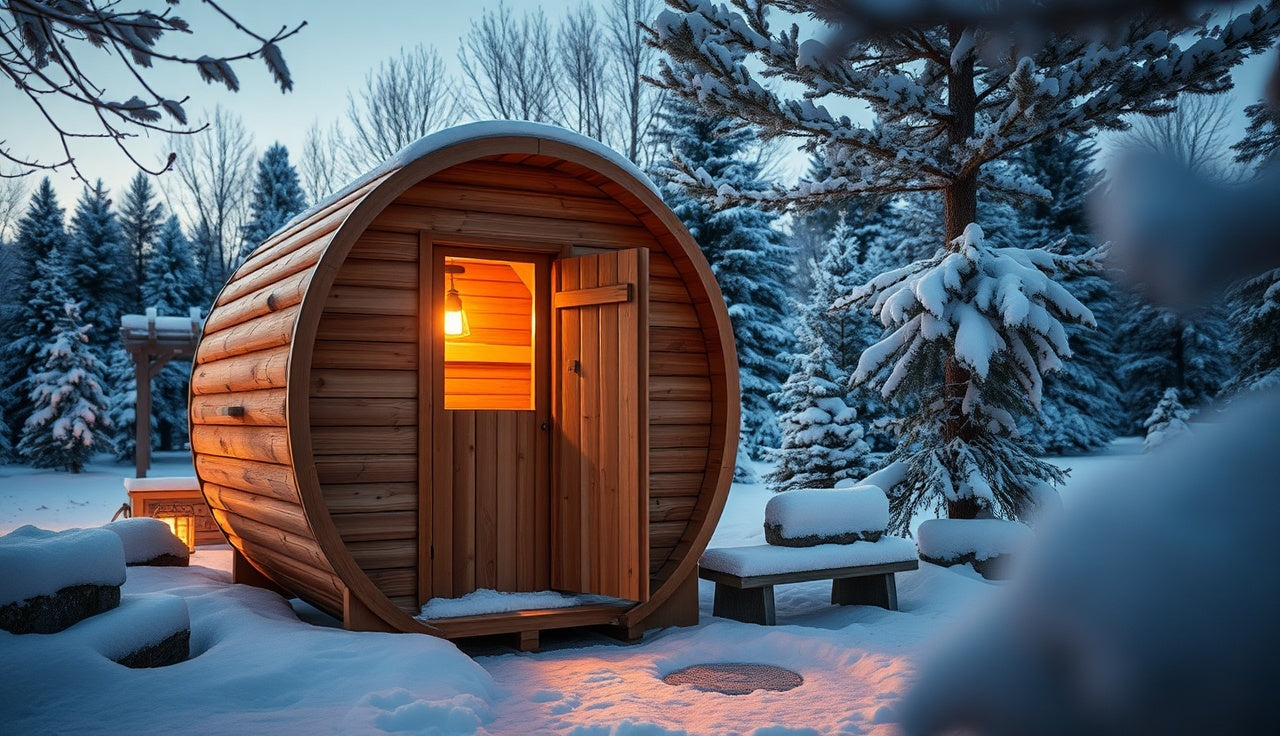
Barrel saunas are a shape and construction format, not a heat type. The cylindrical design lets heat circulate by natural convection, and they're almost always built for outdoor use. Most run a traditional electric or wood-burning heater. They look great and hold up outside. If you want an outdoor sauna, the barrel format deserves a hard look.
Portable saunas (tent-style or folding box units) run $100 to $500. They do raise your core temperature. They feel nothing like sitting in a proper wood-lined room. A portable sauna makes sense if you rent, travel, or want to test heat exposure before committing. Most people who start there eventually want to upgrade.
One more split: indoor versus outdoor. Indoor prefab kits drop into a spare bathroom, basement corner, or garage. Outdoor units need weatherproofing, a dedicated circuit run, and in many jurisdictions a building permit.
How much does a home sauna cost?
A home sauna costs roughly $1,500 to $10,000 for most buyers, and the range is enormous because type, size, wood, and installation all move the number. Here's the honest breakdown by category.
| Type | Entry price | Mid-range | Premium |
|---|---|---|---|
| Portable/tent | $100 | $300 | $500 |
| Infrared prefab (1-2 person) | $1,500 | $3,000 | $6,000 |
| Traditional prefab kit (2-4 person) | $2,500 | $4,500 | $8,000 |
| Barrel sauna (outdoor) | $1,800 | $4,000 | $7,000 |
| Custom-built room sauna | $5,000 | $10,000 | $20,000+ |
Those ranges pull from manufacturer pricing and contractor estimates. The cost drivers are cubic footage (more wood, bigger heater), wood species (cedar and hemlock cost more than pine), heater brand and wattage, and whether installation comes with it.
Running costs matter too. A 6kW electric heater running one hour per session, at the U.S. average residential rate of about $0.17/kWh [2], costs roughly $1.02 per session. A 9kW heater costs around $1.53. Wood-burning heaters cut electricity out of the equation but ask you to source and store dry firewood.
Contractor installation for a prefab kit typically adds $500 to $2,000 depending on the electrical work involved. A 240V dedicated circuit (required for most heaters over 2kW) runs $300 to $800 installed by a licensed electrician, though that swings hard by region and whether your panel has room.
What separates a $2,500 infrared kit from a $5,000 one comes down to a few things: heater quality, wall thickness (1.5-inch tongue-and-groove versus thinner panels), and warranty length. Buying the cheapest box is usually false economy.
What are the health benefits of using a home sauna?
Regular sauna use shows consistent associations with lower cardiovascular risk and lower all-cause mortality in long-term Finnish data, though the strongest studies are observational and can't prove cause. The marketing runs far ahead of the science. The science still points somewhere interesting.
The most-cited work comes from the Kuopio Ischemic Heart Disease Risk Factor Study in Finland, a prospective cohort of 2,315 middle-aged men. The 2015 JAMA Internal Medicine paper by Laukkanen et al. found that men who used a sauna 4 to 7 times per week had a 40% lower risk of all-cause mortality than once-a-week users over a 20-year follow-up [3]. That's observational, so it can't prove causation. Frequent sauna users in Finland also tend to live healthier lives overall. The association is still striking, and it held up in later analyses.
A 2018 systematic review in Mayo Clinic Proceedings summarized the evidence and stated that "regular sauna bathing is associated with a reduction in the risk of cardiovascular disease events" [4]. That review pinned the likely mechanism on acute hemodynamic changes that mirror moderate-intensity exercise: heart rate climbs, blood vessels dilate, and cardiac output rises.
Muscle recovery evidence is thinner. Some small studies suggest post-exercise heat exposure may reduce delayed onset muscle soreness (DOMS), probably through increased blood flow and heat shock protein activation. Most are small and short-term. If you're pairing sauna with cold, our piece on cold plunge benefits covers what the contrast data actually shows.
Mental health is getting more attention. A 2018 paper in Psychotherapy and Psychosomatics found an association between sauna bathing and reduced depression risk in the same Finnish cohort [5]. The proposed mechanism runs through hyperthermia-induced serotonergic and opioid pathways. This one is associational too.
Our sauna benefits guide goes deeper. The short version: real sauna use, done at least 3 to 4 times per week, above 150°F, for 15 to 20 minutes a session, shows consistent associations with cardiovascular and longevity markers. Occasional use shows less. No sauna replaces medical care.
| Portable infrared (1.5 kW) | $8 |
| Infrared cabinet (2.5 kW) | $13 |
| Traditional 6kW electric | $31 |
| Traditional 9kW electric | $46 |
Source: U.S. Energy Information Administration, Electric Power Monthly (citation 2)
What do you need to install a home sauna?
Most infrared units under 2kW run on a standard 120V/20A outlet with no electrician required. Traditional electric heaters and larger infrared units (4kW and up) need a dedicated 240V circuit, usually 30A to 60A, wired by a licensed electrician. The rest comes down to your floor, ventilation, and whether you pull a permit.
Start with power. A 120V/20A outlet is the same circuit as a kitchen appliance, and most 1-person infrared cabinets fall in that bracket. For a 240V circuit, the National Electrical Code (NEC), specifically Article 424, covers fixed electric space heating equipment and applies to sauna heaters [6]. Your local authority having jurisdiction (AHJ) interprets and enforces the NEC, and requirements shift by municipality.
Floor prep matters more than most guides admit. Traditional saunas throw off moisture and high heat. A floating hardwood or laminate floor under the unit will likely warp. Concrete, ceramic tile, or vinyl plank (with proper underlayment) are the right base materials. Indoor kits also need ventilation to manage humidity, usually a low intake vent and a high exhaust vent.
Outdoors, the additions are weatherproofed electrical conduit, drainage (especially if you pour löyly), and in most climates a foundation or elevated base so ground moisture doesn't wick into the wood. Many barrel sauna makers include brackets or deck mounting hardware.
On permits: plenty of homeowners skip them and nothing happens. But if your sauna involves structural changes, a new 240V circuit, or an accessory structure over a set square footage (the threshold is often around 120 sq ft, though it varies [7]), a permit is legally required. It matters at sale time, because unpermitted work can complicate disclosure.
One practical move before you buy anything: find your electrical panel and count the open slots. If you're maxed out, you may need a subpanel, which adds $500 to $1,500 to the project.
Which wood is best for a home sauna?
Western red cedar and Canadian hemlock are the two most common woods in North American sauna kits. Cedar smells great, resists rot, and stays cool to the touch, but costs more. Hemlock is neutral-smelling and better for people sensitive to cedar's aromatics. Wood choice affects feel, durability, and price.
Western red cedar is the popular default. It resists moisture and rot naturally, smells pleasant, and stays relatively cool at sauna temperatures. It's also expensive. A 4-person cedar kit costs noticeably more than a comparable pine kit.
Hemlock (Western hemlock) is tight-grained and neutral-smelling, which wins over people who find cedar's scent too strong. It's a touch lighter than cedar and similarly moisture-resistant. Most infrared kits from major brands use Canadian hemlock.
Nordic spruce is the traditional Scandinavian pick. It's less moisture-resistant than cedar and develops more patina over time, but purists argue it delivers the most authentic experience. Plan to refinish or treat it more often than cedar.
Thermally modified wood (thermowood, or thermally treated aspen and pine) gets kiln-treated at high temperatures to cut moisture absorption and improve dimensional stability. It's showing up more in premium indoor installs.
One wood to skip: dense tropical hardwoods like teak. Beautiful, but they hold too much heat and can burn skin on contact.
For benches, softer low-density woods win because they don't get as hot. Aspen and abachi are common bench choices even inside cedar-walled saunas for exactly that reason.
How hot should a home sauna get, and for how long?
Most research and Finnish tradition run traditional saunas at 150°F to 212°F (65°C to 100°C), with 170°F to 185°F as the sweet spot for most people [1]. Sessions of 15 to 20 minutes, 3 to 7 times a week, capture most of the documented benefit. Temperature and duration are the two variables you actually control.
You can sit low for less heat or climb higher on the benches for more, since hot air stratifies. Small change, real difference.
The Laukkanen et al. cohort found dose-dependent effects: 4 to 7 sessions per week beat 2 to 3, which beat 1 [3]. Most sessions in that study ran about 15 minutes. Fifteen to twenty minutes appears to be the range where most heat-adaptation responses happen without pushing into dehydration.
Infrared saunas can run longer sessions (20 to 45 minutes) because the air is cooler. Whether longer low-temperature exposure produces effects comparable to shorter high-temperature traditional sessions isn't well established. The cardiovascular studies used traditional sauna data almost exclusively.
Cooling off between rounds is standard practice across Finland and Scandinavia. Cold shower, cold plunge, or just stepping outside. If structured contrast therapy interests you, our cold plunge guide covers timing and protocols.
Who should be careful: people with cardiovascular conditions, low blood pressure, or pregnancy should talk to a doctor first. The hemodynamic stress of high heat is real. The U.S. Consumer Product Safety Commission has documented sauna-related injuries and fatalities, most involving alcohol, cardiac events, or falls, and advises against using a sauna alone if you have a known cardiac condition [8].
Does adding a sauna increase your home's value?
A home sauna can help resale appeal and rarely hurts it, but most buyers won't recoup the full cost. It's a differentiator on a listing more than a guaranteed appraised-value bump. Buy it for the daily use, not the ROI.
A 2016 National Association of Realtors survey found that 21% of realtors said a home sauna would increase a property's appeal to buyers, while under 5% said it would hurt [9]. That's a soft metric, but it says a sauna isn't a liability the way a pool with murky permitting can be.
Appraisers generally treat a well-integrated indoor sauna as contributing to finished square footage value (if it's part of conditioned space) or as a personal-property add-on with modest contributory value (if it's a prefab kit). Custom builds in high-end markets where buyers expect wellness amenities recoup more. An $1,800 barrel sauna on a $400,000 house in a mid-tier market probably adds little appraised value but may set the listing apart.
Permits matter here. Permitted work that passed inspection counts as a legal improvement. Unpermitted work that a buyer's inspector flags becomes a negotiating chip.
One honest thing: most people buy a home sauna for the experience, not the return. Judging it purely on resale is the wrong frame. Use it four times a week for ten years and the cost per session is tiny, whatever it does to your Zillow estimate.
Indoor vs. outdoor home sauna: which should you choose?
Both work. The call comes down to available space, climate, and whether you want a quick daily habit or an event. Indoor wins on convenience and daily-use frequency. Outdoor wins on cost per square foot and the ritual of stepping into the cold afterward.
Indoor saunas are more convenient. You don't trek outside in February to use one, which drives up how often you actually go. They heat faster (better insulation, no outdoor differential) and skip weatherproofing. The trade-off is interior square footage and a real need for ventilation so humidity doesn't damage surrounding walls and floors.
Outdoor saunas, including barrel and larger prefab cabin-style units, give you more space for less money per square foot because you're not finishing an interior room. They're the answer if you have no spare indoor room or want a standalone backyard structure. The ritual of going out, heating up, cooling off, and heading back in is something a lot of enthusiasts specifically chase.
Climate drives the outdoor decision more than most guides admit. In Minnesota or Maine, an outdoor barrel sauna heats fine in winter, and stepping into the cold is half the point. In Florida or Arizona, an outdoor sauna baking in summer ambient heat can struggle to hold an efficient differential, and the wood degrades faster.
For a deeper comparison, our outdoor sauna guide covers materials, foundations, and local code.
What are the best home sauna brands to consider?
For traditional Finnish saunas, Harvia and Finnleo (distributed in North America by TyloHelo) carry the longest track records. For infrared, Sunlighten, Clearlight, and JNH Lifestyles cover the price ladder. For barrel saunas, Almost Heaven and Dundalk LeisureCraft are the most referenced North American makers. "Best" depends on what you need, so here's the honest read on each.
Harvia and Finnleo both make well-regarded heaters and complete kits. Ounce for ounce, Harvia heaters tend to cost less. Finnleo kits often sell through dealers who bundle installation support.
On infrared, Sunlighten sits at the premium end and publishes third-party EMF testing data, which some buyers care about. Clearlight (Clearlight Infrared) covers the upper-mid range. JNH is the accessible entry point with reasonable build quality for a starter unit.
Sun Home Saunas (sometimes searched as "sun home saunas infrared sauna") is a direct-to-consumer brand that's grown fast in home wellness. They sell both infrared and full-spectrum infrared models, usually in the $3,000 to $7,000 range. Build quality on their mid-tier units is solid based on available customer data.
For barrel saunas, Almost Heaven Saunas (U.S.-made) and Dundalk LeisureCraft (Canadian) come up most. Dundalk uses clear western red cedar and has a reputation for weatherproofing.
SweatDecks carries a curated selection across these formats if you want to compare specs side by side in one place.
One thing I'd actually do: skip the cheap no-brand infrared cabinet from a marketplace seller. Heater quality control drives both safety and longevity. Look for a UL or ETL listing on anything you buy, which signals third-party electrical safety testing [10].
Can you use a home sauna every day, and is it safe?
Daily sauna use is normal and, for healthy adults, generally considered safe at 150°F to 185°F for 15 to 25 minutes with good hydration. In Finland, survey data suggest roughly 10 to 15 million weekly sauna sessions in a country of 5.5 million people [11]. The research on frequency-dependent benefits argues for regular use, not occasional.
The JAMA Internal Medicine study tracked men using saunas up to 7 times per week and found no signal of harm; the data favored more frequent use [3].
Hydration is the main practical concern. You can lose 0.5 to 1 liter of sweat in a 15-minute traditional session [12]. Replacing fluids before and after, and staying out of the sauna while alcohol-impaired (alcohol blunts thirst and impairs thermoregulation), handles most of the acute risk.
Check with a doctor before a regular routine if you have controlled or uncontrolled hypertension, a recent cardiac event, kidney disease, or a condition affecting sweating. Pregnant women are generally advised to avoid high-heat sauna use, especially in the first trimester, over concerns about elevated core temperature and fetal development [13].
Skin and hair: daily high heat dries both. Moisturizing and rinsing your hair after sessions is a comfort issue, not a safety one.
How does a home sauna compare to going to a gym or spa sauna?
Owning beats paying per visit once you use it consistently. A $4,000 home sauna pays for itself in about 25 months against $160/month in gym or studio access. Gym sauna access runs $30 to $80 per month as part of a membership, or $10 to $30 per standalone session at a day spa or sauna studio.
Go twice a week and you're paying $80 to $320 per month for access. Use the home unit more, and the payback math gets better faster.
Convenience isn't only money. Research on frequency-dependent benefits points to access as the main barrier to consistent use. A sauna at home removes the scheduling friction: no drive, no waiting for it to open, no sharing it with strangers. For long-term habit formation, that probably matters more than the cost math.
Public saunas also carry hygiene considerations a home unit doesn't. Not a deal-breaker for most people, but a real difference.
The case for gym or studio: if you'd realistically go twice a month, buying doesn't make financial sense. Places like Perspire Sauna Studio exist for the occasional user who wants a premium experience without ownership overhead.
For anyone serious about heat as a regular recovery tool, owning wins over a 3 to 5 year horizon. That's my genuine read, based on the math and the habit-formation evidence.
What's the difference between sauna and contrast therapy at home?
Contrast therapy means alternating heat with cold, usually sauna followed by a cold plunge or cold shower. Sauna alone is one-directional heat. Contrast adds the cold shock, which some evidence links to reduced muscle soreness. The practice runs deep in Scandinavian and Eastern European cultures.
Modern interest tracks the same wellness community that pushed ice bath and cold plunge culture into mainstream fitness.
The proposed mechanism: heat drives vasodilation and blood pooling at the periphery, cold triggers rapid vasoconstriction and shunts blood back to the core. Alternating the two creates what practitioners call a vascular pump. The evidence is real but modest. A Cochrane review of contrast water therapy found limited high-quality evidence for recovery, though multiple small studies showed reduced DOMS compared to passive rest [14].
For a home setup, contrast means a heat source and a cold source close together. A cold shower works. A dedicated cold plunge or ice bath tub gives a more controlled, immersive cold stimulus (whole-body immersion at 50°F to 59°F versus a cold shower), which is what most research protocols use.
The typical protocol: 15 to 20 minutes of sauna at 170°F to 185°F, then 2 to 3 minutes in a cold plunge at 50°F to 59°F, repeated 2 to 3 rounds, with rest between. Having both pieces of equipment at home changes the experience against a gym that offers only one or the other.
Frequently asked questions
How long does it take to heat up a home sauna?
Traditional electric saunas typically take 30 to 45 minutes to reach 170°F to 185°F. Infrared saunas warm up faster, usually 10 to 20 minutes, because you're heating the panels and your body directly instead of the whole air volume. Wood-burning saunas take 45 to 90 minutes depending on fire management and insulation quality.
Do home saunas require a lot of maintenance?
Not much. Wipe down benches after use, clean the floor regularly, and inspect the heater and rocks (for traditional saunas) once or twice a year. Cedar and hemlock resist mold naturally if ventilated properly. Most manufacturers recommend replacing sauna rocks every 1 to 3 years as they degrade and fragment with heat cycling. Skip soap and cleaning products inside the sauna chamber.
What size home sauna do I need for two people?
A 4-foot by 4-foot interior works for two people but feels tight. A 5-foot by 7-foot or 6-foot by 6-foot layout is comfortable for two adults with room to lie down on a bench. Most two-person prefab kits fall in the 4x4 to 5x5 range; if lounging matters to you, size up. Add roughly 20% to the square footage for each additional regular user.
Can I put a home sauna in my apartment?
Possibly, with real caveats. You'd need landlord permission, adequate electrical capacity (a 240V circuit for most heaters), and a space that handles humidity without damaging the building. Infrared units plugging into a standard 120V outlet are the most apartment-feasible option. Portable tent saunas are the most realistic choice for renters who want to dodge any structural or electrical complications.
Is a barrel sauna good for cold climates?
Yes. The round profile sheds snow and water, and the convection design means it heats quickly even when it's cold out. Most quality barrel saunas use 1.5 to 2-inch-thick cedar or spruce staves that insulate well. In climates below 0°F, a higher-wattage heater (8kW or above) and an insulated door are worth the extra spend.
Does a home sauna need a floor drain?
Traditional saunas that use a lot of löyly (water on rocks) benefit from a drain, but it's not always required. Most prefab kits skip a drain and assume you'll manage moisture with a mat and regular cleaning. If you plan to use your sauna daily and pour water often, a floor drain makes cleaning far easier and lowers the long-term moisture-damage risk to the surrounding structure.
How much electricity does a home sauna use per month?
A 6kW heater running one hour per day uses 6 kWh daily, or roughly 180 kWh per month. At the U.S. average residential rate of about $0.17 per kWh, that's around $31 per month. Infrared units (typically 1.5 to 3kW) run $8 to $20 per month at similar frequency. These are estimates; your actual rate and session length will vary.
Can I build a home sauna myself, or should I hire someone?
Prefab kits are genuinely DIY-friendly. Most ship with numbered panels, pre-drilled holes, and assembly instructions for two people over a weekend. The electrical work (any 240V circuit) legally requires a licensed electrician in most U.S. states. Custom builds with framing, vapor barriers, and custom benches are a bigger project but well within reach for experienced builders.
What's the difference between far infrared and full spectrum infrared saunas?
Far infrared (FIR) panels emit wavelengths in the 5 to 15 micron range, which penetrate a few millimeters into skin tissue. Full spectrum units add mid-infrared and near-infrared wavelengths. Near-infrared has shorter wavelengths and penetrates more superficially. Most of the near-infrared benefit marketing outpaces the clinical evidence. FIR has a longer research track record and is enough for the vast majority of home users.
Are there risks to using a sauna if you have high blood pressure?
Sauna use causes acute blood pressure changes: pressure typically drops during the session as blood vessels dilate, then may rise briefly afterward. The long-term cardiovascular associations are generally favorable, but anyone with uncontrolled hypertension or a recent cardiac event should consult a physician before starting a regular routine. The JAMA Internal Medicine cohort came from generally healthy men and shouldn't be extrapolated uncritically to people with significant cardiac conditions.
What's the best way to compare home sauna models before buying?
Focus on heater brand and wattage (more than a manufacturer's temperature claims), wood species and wall thickness, UL or ETL safety listing, warranty on heater and cabinet separately (heaters often carry shorter coverage), and whether the price includes a control unit. Verified owner reviews after 6 to 12 months of use beat launch-period reviews, since wood and heater durability issues show up over time.
How do home saunas affect sleep?
Several small studies suggest sauna use 1 to 2 hours before sleep may improve sleep quality, likely because the post-sauna drop in core body temperature mimics the natural decline that signals sleep onset. A 2019 review in Sleep Medicine Reviews noted that passive body heating (including sauna) was associated with improved slow-wave sleep in healthy adults. This is a plausible mechanism with promising early data, not an established medical fact.
Can a home sauna help with weight loss?
Saunas cause temporary water-weight loss through sweating, which reverses once you rehydrate. There's no reliable evidence that regular sauna use causes meaningful fat loss independent of other lifestyle factors. Caloric burn during a session is modest, roughly equivalent to light walking. Claims that infrared saunas dramatically accelerate metabolism or torch hundreds of calories per session aren't supported by well-controlled research.
What should I look for in a home sauna if I want to pair it with a cold plunge?
Proximity matters most. You want the sauna and cold plunge close enough that the transition takes under 60 seconds, since the contrast benefit partly comes from the rapid thermal shift. Outdoor setups often work well here. Make sure the sauna has a reliable temperature controller so you can time sessions precisely. For cold plunge options that pair well with a home sauna, see our cold plunge collection at sweatdecks.com.
Sources
- Finnish Sauna Society, Sauna temperature and humidity guidelines: Traditional Finnish sauna air temperatures typically range from 65°C to 100°C (150°F to 212°F)
- U.S. Energy Information Administration, Electric Power Monthly, Average Retail Price of Electricity: U.S. average residential electricity price approximately $0.17 per kWh
- Laukkanen et al., JAMA Internal Medicine 2015, Association Between Sauna Bathing and Fatal Cardiovascular and All-Cause Mortality Events: Men using sauna 4-7 times per week had 40% lower all-cause mortality vs. once-per-week users in 20-year prospective cohort of 2,315 Finnish men
- Laukkanen et al., Mayo Clinic Proceedings 2018, Cardiovascular and Other Health Benefits of Sauna Bathing: Systematic review stated 'regular sauna bathing is associated with a reduction in the risk of cardiovascular disease events'
- Laukkanen et al., Psychotherapy and Psychosomatics 2018, Sauna Bathing Is Associated with Reduced Symptoms of Depression: Association between sauna bathing and reduced depression risk in Finnish cohort
- International Code Council, International Residential Code, Accessory Structures: Many jurisdictions use IRC thresholds around 120 sq ft to determine permit requirements for accessory structures
- U.S. Consumer Product Safety Commission, Sauna Safety: CPSC has documented sauna-related injuries and fatalities, primarily involving alcohol use, cardiovascular events, or falls; recommends caution for those with known cardiac conditions
- National Association of Realtors, 2016 Remodeling Impact Report: 21% of realtors said a home sauna would increase a property's appeal to buyers
- UL Solutions (formerly Underwriters Laboratories), Product Safety Certification: UL or ETL listing indicates third-party electrical safety testing for sauna units
- Finnish Sauna Society, Statistics on Sauna Use in Finland: Approximately 10 to 15 million weekly sauna sessions in Finland among a population of 5.5 million
- Hannuksela & Ellahham, American Journal of Medicine 2001, Benefits and Risks of Sauna Bathing: Sweat loss of 0.5 to 1 liter per 15-minute traditional sauna session reported in physiological studies
- American College of Obstetricians and Gynecologists (ACOG), Exercise During Pregnancy: Pregnant women are generally advised to avoid high-heat sauna use, particularly in the first trimester, due to concerns about elevated core temperature
- Bieuzen et al., Cochrane Database of Systematic Reviews 2013, Contrast Water Therapy and Exercise-Induced Muscle Damage: Limited high-quality evidence on contrast water therapy; multiple small studies showed reduced DOMS compared to passive rest

Share:
Traditional sauna: what it is, how it works, and whether it beats infrared
Red light sauna: what it is, how it works, and whether it's worth it