
Last updated 2026-07-09
TL;DR
A portable sauna stove is a compact heat source, wood-burning or electric, sized for movable or temporary sauna enclosures. The right unit depends on your enclosure volume, fuel access, and local fire codes. Most home setups run a 6-9 kW electric unit or a small wood-burning firebox. Prices land between roughly $300 and $2,000 depending on fuel and build quality.
What exactly is a portable sauna stove?
A portable sauna stove is a heat source small enough to move, store, or set up without permanent installation. Simple idea. The category, though, covers several very different products.
On one end sit compact electric resistance heaters with integrated rock trays, running on 120V or 240V, light enough to carry in two hands and drop into a tent sauna or a small prefab cabin. On the other end sit miniature wood-burning stoves, called sauna kiuas in Finnish tradition, built from cast iron or steel with a small firebox and a rock tray on top. Both do the same job: raise the air inside an enclosed space to somewhere between 150°F and 200°F (65°C to 93°C) within a reasonable stretch of time.
What makes a stove "portable" is a mix of weight, footprint, and the absence of a hard-wired or built-in flue connection. Most portable electric units weigh 20-50 lbs and plug into a standard or heavy-duty outlet. Portable wood-burning stoves run heavier, often 60-120 lbs, but they use a simple flue collar you connect to inexpensive single-wall pipe rather than a masonry chimney.
These are not the infrared panels you see in many pop-up tent saunas. Infrared heats your body directly and usually never pushes the air above 130°F. A sauna stove heats the air and the rocks, which then radiate heat and let you pour water for löyly (steam). Want the traditional dry-then-steam experience? You need a stove with rocks, not infrared panels.
For a broader look at sauna types, see our guide to portable saunas.
What are the main types of portable sauna stoves?
Three categories matter: electric resistance, wood-burning, and gas. Gas is rare enough that you can mostly ignore it for home use.
Electric resistance portable stoves use heating elements, usually nichrome wire or rod elements, to heat sauna rocks. Power runs from about 4 kW for very small enclosures up to 9 kW for a room-sized tent or prefab cabin. Most 4-6 kW units run on 240V/20A circuits; anything above 6 kW wants a 240V/30A or 240V/40A circuit [1]. You get precise temperature control, no smoke, no ash, and no fire to tend. The catch is you need an outlet and the power draw adds up. A 6 kW heater running 45 minutes per session uses 4.5 kWh, which at the U.S. average residential rate of about $0.17/kWh in 2024 costs roughly $0.77 per session [2].
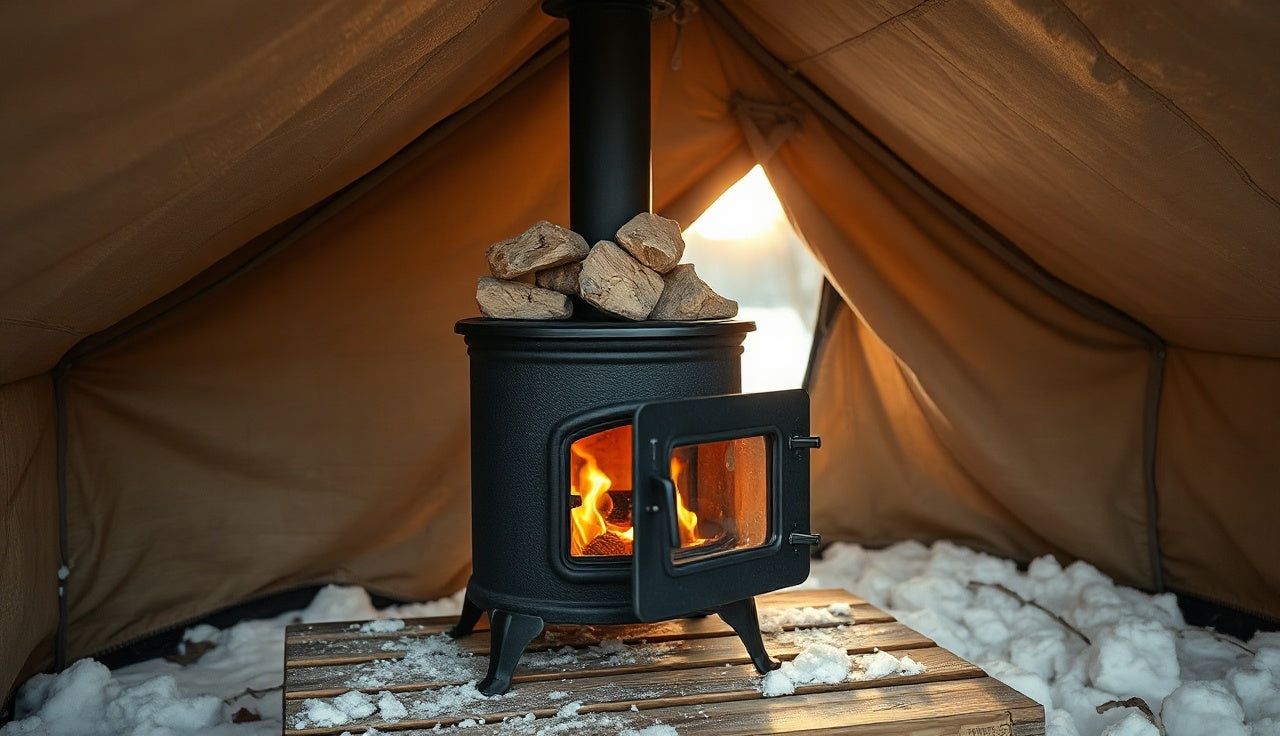
Wood-burning portable stoves are the traditional choice and the heart of Finnish sauna culture. A typical portable wood-burning kiuas has a cast iron or thick-steel firebox (3-8 mm wall thickness is common), a grate, an ash pan, and a stainless or cast iron rock tray on top holding 30-80 lbs of sauna stones. You connect a 4- or 5-inch single-wall or double-wall flue pipe through the tent wall or a prefab panel. Heat-up runs 45-90 minutes, longer than electric, but the heat quality differs: wood burns hotter at the stone surface, and many practitioners say the steam feels softer. The real portability limits are ash disposal and fire code compliance wherever you set up.
Which is better? It depends on where you're using it. For a backyard tent sauna with no outdoor electrical outlet, wood is the only real option. For a garage or deck with a 240V outlet, electric is cleaner and easier. For camping or off-grid use, wood wins almost every time.
A quick comparison:
| Type | Typical power/fuel | Heat-up time | Weight | Cost range |
|---|---|---|---|---|
| Electric (4-6 kW) | 240V, 20-30A | 20-40 min | 20-45 lbs | $300-$900 |
| Electric (7-9 kW) | 240V, 30-40A | 30-60 min | 35-60 lbs | $600-$1,800 |
| Wood-burning (small) | 1-2 pieces hardwood | 45-90 min | 60-100 lbs | $400-$1,200 |
| Wood-burning (mid) | 2-4 pieces hardwood | 60-90 min | 80-140 lbs | $700-$2,000 |
How many kW or BTUs do you actually need?
The sauna industry's rule of thumb, backed by Finnish and North American sauna guidance, is roughly 1 kW per 45-50 cubic feet (1.3-1.4 m³) of sauna volume for well-insulated enclosures, and 1 kW per 30-35 cubic feet for poorly insulated tents or outdoor spaces in cold climates [3].
Run the math on your own enclosure. A typical two-person tent sauna measures about 8 ft × 6 ft × 7 ft, or 336 cubic feet. In a cold outdoor setup, that wants roughly 9-11 kW of electric power, which means most portable electric stoves come up short for large tents in winter. For a small one-person tent (roughly 150-200 cubic feet) in mild weather, a 4-6 kW unit works fine.
Wood-burning stoves get rated in cubic meters. Most manufacturers rate their portable models for something like 2-8 m³ (roughly 70-280 cubic feet). Read those ratings as optimistic for uninsulated tent walls in winter and pessimistic for a well-insulated cedar cabin.
One thing people overlook: the thermal mass of the rocks. More rocks mean more stored heat and softer steam when you pour water, but they also mean a longer heat-up. Most portable stoves take 15-40 lbs of rocks. If you can go to 40+ lbs, do it.
For what sauna sessions actually look like at temperature, the sauna benefits guide covers what the research says about heat exposure and recovery.
| Electric 6 kW, well-insulated, mild weather | 30 |
| Electric 6 kW, tent, cold weather (<30°F) | 60 |
| Electric 4 kW, well-insulated, mild weather | 45 |
| Wood-burning, mild weather | 65 |
| Wood-burning, cold weather (<30°F) | 90 |
Source: North American Sauna Society installation guidelines and manufacturer specifications, 2024
Is a portable sauna stove safe to use indoors or in a tent?
Yes, with the right setup. But the safety details matter a lot, and they vary by fuel type.
Electric portable stoves are the simpler case. They need clearance from combustible materials, which most manufacturers specify at 4-6 inches on the sides and back and around 12-18 inches above the rock tray. The National Electrical Code (NEC) Article 424 covers electric space heating and requires that fixed electric heating equipment be installed per manufacturer instructions [1]. A truly portable unit that plugs in rather than hard-wires usually falls outside the scope of a permanent installation permit, but your local jurisdiction may still require a dedicated circuit inspection. Call your building department if you're unsure.
Wood-burning portable stoves inside a tent or prefab enclosure introduce carbon monoxide risk. This is real and not negotiable. Any wood-burning stove needs a properly fitted flue pipe that exits the enclosure and terminates above the roofline or tent peak. Tent manufacturers sell heat-resistant flue pass-through collars for exactly this. The CDC's carbon monoxide guidance notes that mild symptoms can begin around 70 ppm and that exposure can turn life-threatening at higher concentrations [4]. The Consumer Product Safety Commission recommends a battery-operated CO detector in any space where combustion happens [10]. Use one inside any enclosure where you burn wood. Full stop.
Fire clearance for a wood-burning stove inside a tent also matters. Most manufacturers require 6-12 inches of clearance to combustible tent walls on the sides and rear, and 18-36 inches above the top of the stove before any fabric surface. Read your stove's manual, not generic advice.
Ground surface matters too. Never run a wood-burning portable stove directly on grass, dry leaves, or wood decking without a non-combustible pad underneath, such as a concrete paver or a purpose-built steel floor protector.
One thing that surprises people: portable electric sauna stoves should never share an enclosure with a steam generator or sit anywhere the unit will get splashed directly. The rocks handle water fine. The electrical housing does not.
What do local codes and permits require for a portable sauna stove?
This is where buyers get caught off guard. "Portable" does not automatically mean "permit-free."
For electric units, any new 240V circuit run to a garage, deck, or outbuilding is a permitted electrical job in most U.S. jurisdictions. The International Residential Code (IRC) Section E4002 requires permits for new electrical installations, and most local amendments follow suit [5]. A licensed electrician running a new 240V/30A or 240V/40A circuit costs $300-$800 depending on distance and your area, and the electrician usually pulls the permit.
For wood-burning stoves, fire codes get involved. Many municipalities restrict open burning or outdoor fire devices, and a wood-burning stove in a backyard tent may technically count as a solid-fuel appliance. The International Fire Code Section 315 and related sections address combustible materials and heat sources [6]. Some jurisdictions stay relaxed about this for private property use; others require permits or ban it outright. Check with your local fire marshal before you buy.
HOA rules add a separate layer. If you're in an HOA, open-flame appliances and backyard structures may be restricted regardless of code.
The honest answer: call your building department and fire marshal with the specific stove type and fuel before you spend money. It takes 15 minutes and heads off a lot of grief.
What should you look for in a portable sauna stove? (buying criteria)
Here's what actually matters when you compare models.
Build material. Thick steel (6-8 mm) or cast iron holds heat better and resists warping over time. Thin-walled stoves (2-3 mm) cost less but can warp at the firebox seam after a season or two of heavy use. For electric stoves, look for a stainless steel housing rather than painted mild steel, which rusts faster in the steam.
Rock tray capacity. More is better, within reason. A 30 lb tray is acceptable; 50-80 lbs gives a fuller löyly. The rocks should sit in a proper tray or basket, not loose on top of an element, so water you pour actually hits the rocks and turns to steam rather than splashing the element.
Control type. Basic on/off dial controllers are reliable and rarely fail. Digital controllers with timers and remote apps add convenience and failure points. In a wet, high-heat environment, simpler usually lasts longer.
UL or ETL listing. For electric units, a UL Listed or ETL Listed mark means the unit passed testing to a recognized safety standard [7][11]. This matters for insurance too: some homeowner policies exclude fires from unlisted appliances.
Flue collar size (wood-burning). Standard sizes are 4-inch and 5-inch diameter. Match this to your pipe and tent collar before buying. Adapters work but add a leak point.
Warranty. Entry-level stoves often carry 1-year warranties. Finnish and Nordic-made units (Harvia, Narvi, Helo) typically carry 2-5 year warranties on the firebox and elements. That gap tells you something about expected lifespan.
What to skip. Electric stoves rated below 4 kW, or wood-burning fireboxes narrower than 8 inches, are underpowered for anything but a one-person micro-tent. The cheap 110V "sauna heaters" that plug into standard outlets typically top out around 1.5 kW, which will never bring a real sauna enclosure to proper temperature.
For curated options across the full spectrum, SweatDecks carries home sauna equipment including portable stove options at different price points.
How long does it take a portable sauna stove to heat up?
Real heat-up times swing more than manufacturers admit.
A 6 kW electric stove in a well-insulated 200 cubic foot enclosure at 70°F ambient reaches 175°F in 25-35 minutes. That same stove in a thin-walled tent at 30°F ambient might take 50-70 minutes. Wood-burning stoves in a tent almost always take 45-90 minutes regardless of ambient temperature, because the fire has to establish and the mass of the rocks has to soak up heat before it gives any back usefully.
What slows heat-up the most: uninsulated or thin tent walls, high humidity inside the enclosure before you start, big rock loads that haven't been pre-warmed, and cold ground pulling heat through an uninsulated floor.
What helps the most: a good vapor barrier and insulation layer in the walls. Even throwing a moving blanket over a tent cuts heat-up time sharply.
Some people preheat an electric stove for 15 minutes, pour a small amount of water for an initial steam burst, then let the stove recover for 5 minutes before entering. That trick can make a 35-minute heat-up feel complete in 30.
What kind of rocks should you use with a portable sauna stove?
This matters more than most buyers realize. The wrong rocks can crack, explode, or leach minerals that are unpleasant to breathe as steam.
The best rocks for any sauna stove are dense igneous rocks with low porosity: olivine (peridotite), vulcanite, and diabase are the most commonly sold sauna stones. They take rapid thermal cycling without cracking. Sedimentary rocks like sandstone, limestone, and anything with visible layering or veins can trap water and blow apart when heated. Granite is common, but lower quality granite with mica inclusions degrades faster than olivine.
Size your stones to the tray. Stones 2-4 inches across stack well and give good surface area. Smaller gravel lets water pass through too fast; large boulders don't stack compactly and cut total rock mass.
Replace your rocks when they start to crumble or when gritty powder shows up in the bottom of the tray. That's usually every 2-5 years depending on how often you use it.
Never use river rocks you collected yourself unless you can confirm they're igneous and low-porosity. A cracked rock can send shards flying at high temperature. Not worth the risk.
How do portable sauna stoves compare to built-in or barrel sauna stoves?
The distinction matters if you're deciding between portable and a permanent installation.
Built-in electric sauna stoves, like those in a cedar barrel sauna or a prefab indoor room, are typically hard-wired, bolted to the wall or floor, and sized closely for the insulated volume of that specific room. They run more efficiently because the enclosure is designed around them. A 4.5 kW hard-wired stove in a well-insulated 150-cubic-foot barrel sauna will outperform a 6 kW portable stove in a poorly insulated tent of the same volume.
Portable stoves trade efficiency for flexibility. You can move them, store them, and use them in different enclosures. That flexibility costs you in heat-up time and sometimes in peak temperature.
For wood-burning, the gap narrows. A portable wood stove in a quality canvas tent can perform close to a fixed installation, because the burn generates plenty of heat at the firebox surface regardless of any electrical connection.
If you know you want a permanent home sauna, look at outdoor sauna builds or prefab options. The portable stove makes the most sense for people who rent, travel, or want to test the sauna habit before committing to a fixed build.
You can also weigh the overall sauna experience against other heat options in the sauna vs steam room breakdown.
What are the best wood-burning portable sauna stoves worth considering?
I'll name real brands, but I'm not endorsing any specific model, because pricing and availability shift faster than articles do.
Harvia (Finland) has made sauna stoves since 1950. Their wood-burning models like the M3 series are widely regarded as the benchmark for small wood-burning kiuas. Thick steel construction, good rock tray capacity, and available parts [8].
Narvi (Finland) is another Finnish maker with a long history. Their cast-iron models weigh more but hold heat longer. A good pick if you want longer session times without stoking.
Kuuma (U.S.) makes stainless steel wood-burning sauna stoves that shrug off outdoor humidity. Their "Vapor" models put the firebox outside the enclosure, with only the rock tray and heat surface inside. That layout solves the CO and clearance problem entirely and is worth knowing about for a tent setup.
IKI (Finland) makes precision stoves with large rock capacities and excellent fit and finish. Higher price point.
For electric portable stoves, Harvia again, plus Helo, Tylo (now owned by Harvia), and a few Asian-made OEM brands sold under various labels. The OEM brands can be fine. Check for a UL or ETL listing and read real user reviews about long-term durability rather than first impressions.
The honest word on budget electric stoves: anything under $350 for a 240V unit is almost certainly thin-walled steel with cheap elements. It may run for a year or two. For regular use, budgeting $600-$1,000 buys meaningfully better build quality.
How do you maintain a portable sauna stove?
Maintenance is low, but not zero.
For electric portable stoves: clean the rock tray every 10-15 sessions. Small stone fragments pile up and can drop onto elements. Check the element connections once a year for corrosion, especially if your sessions involve a lot of water. Replace rocks when they degrade (see the rocks section above). Wipe the housing after sessions to keep mineral buildup from the steam off it.
For wood-burning stoves: clean the ash pan every 1-3 sessions, or whenever ash climbs within 2 inches of the grate (packed ash chokes airflow and makes the fire smolder, which produces more CO). Inspect the flue pipe joints at the start of each season. Single-wall pipe in a tent environment corrodes faster than you'd think; replace it if you see rust-through or gaps at the seam. Check the firebox door gasket yearly and replace it once it compresses flat and stops sealing.
One thing people skip: at season's end, store the stove dry. A wood-burning stove left outside in the wet rusts inside the firebox. Bag it, box it, or at minimum keep it under cover.
For both types, check the rock tray welds or brackets now and then. A sagging rock tray is a failure waiting to happen, and it's usually a cheap fix if you catch it early.
Total annual maintenance for a wood-burning portable stove runs maybe 2-4 hours. Electric runs less.
Can you use a portable sauna stove for contrast therapy or cold plunge pairing?
Yes, and this is one of the best use cases for a portable setup.
Contrast therapy, alternating heat and cold, keeps gaining ground among recovery-focused athletes. A portable sauna stove in a tent or small enclosure next to an outdoor cold plunge or ice bath lets you build a complete contrast station in a backyard without a construction project.
The setup that works: a canvas or purpose-built tent sauna with a wood-burning or electric portable stove, sitting within 20-30 feet of a cold plunge tub. Heat for 10-20 minutes, cold immerse for 1-3 minutes, repeat 2-4 rounds. The research on contrast water therapy for muscle soreness looks promising, though the exact mechanisms and optimal protocols are still being worked out [9].
On the stove side, electric has a real edge here: you can leave it running between rounds without tending a fire, so the tent stays warm while you're in the cold plunge. A wood-burning stove loses temperature fast when unattended between rounds unless you stoke it before you step out.
Some people find a well-run portable sauna tent produces better session quality than a single infrared panel wrap or a sweat suit, because the ambient temperature and rock steam come closer to a traditional sauna room.
The cold plunge benefits guide has the specific research on what cold immersion does post-heat if you want to build your protocol around evidence rather than marketing.
Frequently asked questions
Can I use a portable sauna stove inside my house or apartment?
An electric portable sauna stove can work indoors if you have a 240V outlet and adequate ventilation. Wood-burning stoves cannot safely run inside a home without a proper chimney. Even in a basement or garage, a wood-burning stove needs a sealed flue pipe exiting to the outside and a CO detector. Most apartments prohibit both types due to fire code and lease terms.
How much does it cost to run a portable electric sauna stove per session?
At the U.S. average residential rate of about $0.17/kWh in 2024, a 6 kW stove running 45 minutes uses 4.5 kWh, which costs roughly $0.77. A 9 kW unit over the same session runs about $1.15. Costs climb in states like California or Hawaii where rates top $0.30/kWh, and drop in the Southeast and Pacific Northwest where rates fall below $0.12/kWh.
What voltage does a portable sauna stove need?
Most portable sauna stoves rated 4 kW and above need 240V. Units under 2 kW may run on 120V, but they're too weak to heat a real sauna enclosure. A dedicated circuit is standard: 240V/20A for 4-5 kW stoves, 240V/30A for 6-7 kW, and 240V/40A for 8-9 kW. Have an electrician run the circuit rather than relying on an extension cord.
Do portable sauna stoves work in cold weather or winter?
Wood-burning stoves work well in cold weather since combustion throws off a lot of raw heat. Electric portable stoves can struggle in winter with uninsulated tent walls, because heat loss through the fabric outruns what a modestly rated unit can replace. Below 30°F, plan on at least 1 kW per 30 cubic feet of enclosure volume, and a decent insulating layer on the tent walls makes a large difference.
What is the best portable sauna stove for a tent sauna?
For an outdoor tent in a temperate climate with electricity, a 6-9 kW electric stove with a UL or ETL listing and at least 30 lbs of rock capacity is a practical choice. For off-grid or cold-weather use, a Finnish-made wood-burning stove from Harvia or Narvi with 5-inch flue connections and a firebox at least 10 inches wide handles most two-person tent setups reliably.
Can you pour water on a portable electric sauna stove?
Yes, if the stove has a proper rock tray designed for water. You pour water onto the rocks, never onto the heating elements or the housing. The rocks soak up the water and release steam (löyly). Check your model's manual; some entry-level electric stoves explicitly say not to pour water, which means they lack a proper rock tray and aren't suited to traditional sauna use.
How heavy are portable sauna stoves?
Electric portable sauna stoves usually weigh 20-55 lbs depending on power rating and rock capacity. Wood-burning portable stoves run heavier: 60-140 lbs for most models, before stones. Add 30-80 lbs for a full rock load. Two people can move most wood-burning setups, but this isn't gear you'll carry solo on a hiking trip.
Do I need a permit to use a portable sauna stove in my backyard?
Probably not a permit for the stove itself, but likely a permit for any new 240V circuit if you run an electric unit. Wood-burning stoves may need fire marshal approval in some jurisdictions, especially in fire-prone areas or under seasonal burn restrictions. HOA rules can add another layer. Check with your local building department and fire marshal before setup.
How long do portable sauna stoves last?
A well-made stainless or thick-steel wood-burning stove from a reputable maker should last 10-20 years with basic care. Electric sauna heating elements typically last 5-15 years depending on use frequency and how often water hits the elements. Budget-tier electric stoves with thin steel housings often show corrosion or element failure within 2-4 years of regular use in wet steam.
What sauna rocks work best with a portable stove?
Olivine (peridotite) and diabase are the standard picks because they're dense igneous rocks with low porosity that take rapid heating and cooling without cracking. Avoid sedimentary rocks and anything with visible layering, veins, or high quartz content. Purpose-sold sauna stones from sauna suppliers come pre-screened; rocks you collect from rivers or fields carry a real risk of cracking or exploding when heated.
Can I use a portable sauna stove in a barrel sauna?
Yes. A portable stove with the right kW rating for the barrel's interior volume works in a barrel sauna, especially if the barrel has no hard-wired connection. For a typical two-person barrel sauna (roughly 150-200 cubic feet), a 4.5-6 kW electric stove or a small wood-burning unit with an exterior-exit flue works well. Measure the barrel volume and match it to the stove's rated capacity.
What's the difference between a portable sauna stove and an infrared sauna panel?
A sauna stove heats the air and rocks to 150-200°F, so you can pour water for steam. Infrared panels emit radiant heat that warms your body directly without much heating the air, usually staying below 130°F. Traditional sauna users generally prefer the stove for löyly and the authentic heat feel. Infrared runs quieter, uses less power, and heats up in 10-15 minutes, but it's a different product and a different experience.
Is a 4 kW electric stove enough for a two-person sauna?
Possibly, in a very well-insulated small enclosure (under 150 cubic feet) in mild weather. For most two-person tents or prefab cabins in real conditions, 4 kW is borderline undersized. A 6 kW unit is the safer choice for two people, with faster heat-up and better recovery after the door opens. In cold climates or large enclosures, go to 8-9 kW.
How do I safely install the flue pipe on a wood-burning portable sauna stove?
Use double-wall or insulated flue pipe anywhere it passes through or near combustible tent fabric. Single-wall pipe runs hot and can ignite fabric or wood if clearances slip. Use a purpose-built heat-resistant flue pass-through collar for tent installs, seal joints with high-temperature stove gasket cement, and terminate the pipe at least 18 inches above the peak of the tent or enclosure roof. Install a CO detector inside the enclosure.
Sources
- NFPA, National Electrical Code (NFPA 70), Article 424: NEC Article 424 covers requirements for fixed electric space heating equipment including circuit sizing for electric sauna heaters
- U.S. Energy Information Administration, Electric Power Monthly, Average Retail Price of Electricity: U.S. average residential electricity rate was approximately $0.17 per kWh in 2024
- North American Sauna Society, sauna heater sizing guidance: Standard sauna heater sizing runs about 1 kW per 45-50 cubic feet for well-insulated rooms and 1 kW per 30-35 cubic feet for poorly insulated spaces
- CDC, Carbon Monoxide Poisoning: Frequently Asked Questions: CO poisoning symptoms can appear at concentrations as low as 70 ppm and can become life-threatening at higher concentrations within hours
- International Code Council, International Residential Code (IRC), Section E4002: IRC Section E4002 requires permits for new electrical installations including new circuits
- International Code Council, International Fire Code, Section 315: IFC Section 315 addresses combustible materials storage and heat source clearances
- UL, Understanding UL Certification: UL Listed mark indicates the product was tested to a recognized safety standard by a nationally recognized testing laboratory
- Harvia, Company History and Product Information: Harvia has manufactured sauna stoves since 1950 and offers wood-burning kiuas models for portable and fixed installations
- International Journal of Environmental Research and Public Health, Contrast Water Therapy and Exercise Induced Muscle Damage (2013): Research on contrast water therapy shows promising effects on muscle soreness and recovery markers, though optimal protocols are still being refined
- U.S. Consumer Product Safety Commission, Carbon Monoxide Safety: CPSC recommends battery-operated CO detectors in any indoor space where combustion appliances are used
- ETL Listed, Intertek Testing Services: ETL Listed mark indicates product safety testing to North American standards by Intertek, a nationally recognized testing laboratory
Share:
Portable wooden sauna: everything you need to know before buying
Therasage portable sauna: honest review and buyer's guide