
Last updated 2026-07-09
TL;DR
A portable wooden sauna is a prefab or barrel-style unit built from cedar, hemlock, or spruce. Most need no building permit, move with a pickup truck, and run on electric or wood-burning heat. Barrel kits start around $800; insulated cabin units run $4,000 or more. Setup takes a weekend. Heat-up time is 30 to 60 minutes, depending on size and heater wattage.
What exactly is a portable wooden sauna?
A portable wooden sauna is any wood-built sauna you can set up without a foundation and take with you if you move. The term covers a lot of ground. At one end sits a flat-pack cedar barrel that ships in a few boxes and assembles with staves and tension rings. At the other end sits a fully insulated prefab cabin with tongue-and-groove hemlock walls, a glass door, and a built-in 6 kW electric heater. Both count as portable because neither needs a permanent slab, neither bolts to the house, and both come apart or tow away.
What sets a wooden unit apart from the tent-style or infrared fabric boxes is the material. Wood holds heat differently than nylon or polycarbonate. It absorbs moisture during a session and releases it slowly, which gives you that familiar humidity cycle instead of the dry, flat heat of a reflective blanket. If you've sat in a Finnish sauna with a rock heater and a ladle of water, a good wooden portable unit gets you 80 to 90 percent of that experience for a fraction of the build cost.
Trailer-mounted saunas exist too, but those are a different animal in cost and complexity. This guide sticks to the units a homeowner buys, assembles in a backyard, and uses every week.
What wood types are used and does it matter?
Wood species matters more than most product listings let on. The four you'll see are western red cedar, Canadian hemlock, Nordic spruce, and white pine. Each behaves differently under heat.
Western red cedar is the standard everyone measures against. It's light (around 23 lbs per cubic foot per the USDA Forest Products Laboratory Wood Handbook), so it heats fast and won't burn skin on contact [10]. Natural oils help it shrug off moisture and resist cracking through repeated heat-cool cycles. The smell most people picture when they think of a sauna is cedar. The catch is price: cedar units run 15 to 25 percent more than comparable hemlock or spruce.
Canadian hemlock is the workhorse of mid-range electric saunas. It's denser than cedar, nearly odorless, and takes stain well if you want it to match outdoor furniture. Hemlock is fine. It's less forgiving than cedar in wet-dry cycles, so hemlock barrels earn their keep with a proper cover between uses.
Nordic spruce shows up in Scandinavian-designed units. It's light, looks great with a natural finish, and the grain is tight enough to handle humidity. Watch the knots. Cheaper spruce boards carry more of them, and a knot runs hotter than the wood around it, which can cause a contact burn.
White pine is the budget pick. It works, but the resin can make boards weep sticky sap during the first few high-heat sessions. Most makers say this cures out, and it mostly does, but it's messy and the smell is rough for the first two or three uses.
Spending more than $1,500? Insist on cedar or hemlock. Below that, hemlock or spruce is a fair compromise.
What are the main types of portable wooden saunas?
| Type | Typical size | Heat source | Approx. price range | Setup time |
|---|---|---|---|---|
| Barrel sauna kit | 4 to 7 ft diameter, 6 to 8 ft long | Wood or electric | $1,200 to $3,500 | 4 to 8 hours |
| Prefab cabin (flat-pack) | 4x4 to 6x8 ft interior | Electric | $1,500 to $4,000+ | 6 to 12 hours |
| Pod / egg style | 2 to 3 person | Wood or electric | $2,000 to $5,000 | 4 to 8 hours |
| Tent / fabric frame | 1 to 2 person | Electric stove | $200 to $800 | 1 to 2 hours |
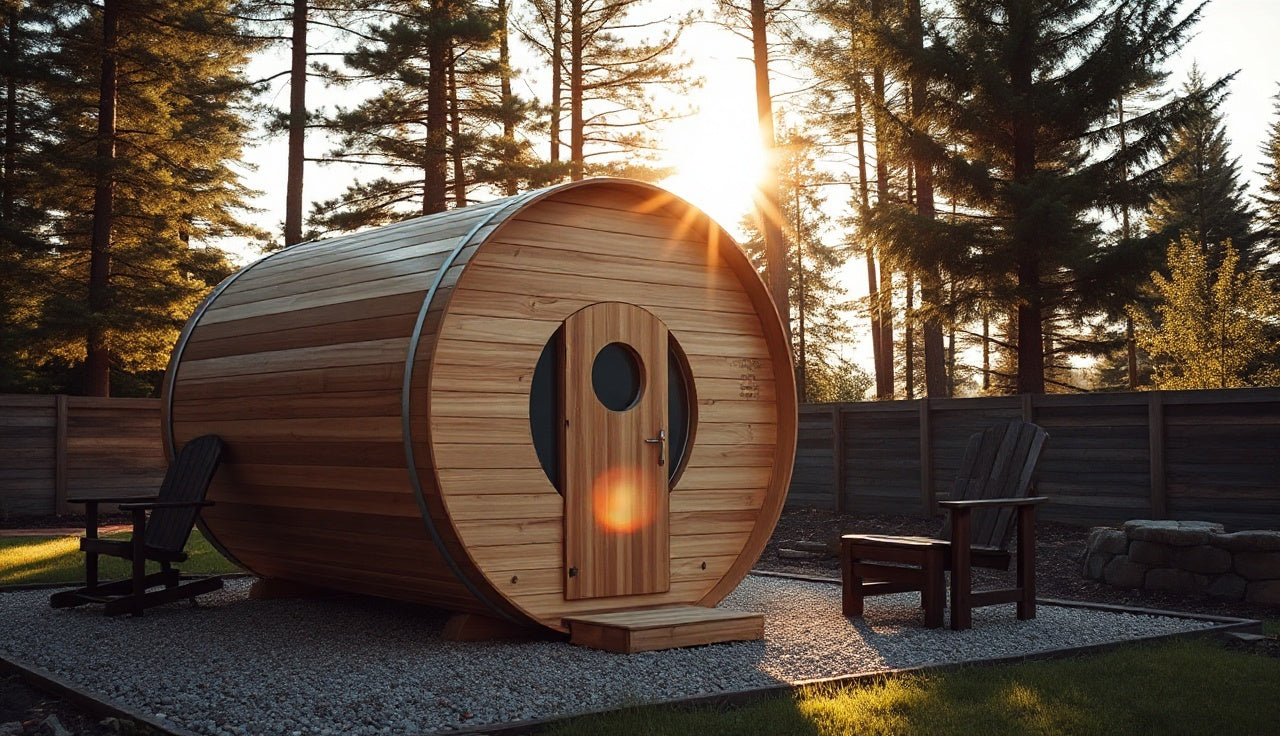
The barrel is the most popular portable wooden option, for two reasons. The round cross-section spreads heat evenly with no cold corners, and the stave construction skips framing, insulation batts, and drywall entirely. You wrap the staves around hoops like a whiskey barrel, drop in a floor tray, and bolt on the end caps. Most first-timers with basic tool skills finish a two-person barrel in a Saturday.
Prefab cabin kits feel closer to a traditional sauna room. They ship as tongue-and-groove wall panels that interlock or bolt together, with a pre-hung door and pre-wired heater. They sit on a flat surface or a simple deck frame. The payoff is interior volume: you can actually lie down in a 6x8 cabin, which no barrel allows.
Pod and egg saunas are the looks-first choice. The curved shell photographs well, heats efficiently, and some models take a wood-burning stove that runs with zero electrical hookup. The premium over a barrel is real, though, and replacement parts get harder to find when a stave or hinge fails.
Fabric tent units are portable, but they belong in a separate bucket. No structural wood means no thermal mass, and the experience shows it. Those are covered at portable sauna.
| Fabric tent sauna | $500 |
| Barrel sauna kit (2-person) | $2,350 |
| Barrel sauna kit (4-person) | $3,200 |
| Prefab cabin (4x4 to 6x8) | $2,750 |
| Pod / egg style sauna | $3,500 |
Source: Industry retail survey, SweatDecks market research, 2024
How much does a portable wooden sauna cost?
Plan on $1,200 to $3,500 for a quality barrel kit with a heater, or $1,500 to $4,000 for a prefab cabin. Those are unit prices only. Then add freight shipping ($150 to $500, depending on your location), a 240V circuit if you go electric ($300 to $800 for an electrician to run a line and breaker), and a base if you don't already have concrete ($0 on an existing pad, $200 to $800 for gravel or pavers).
All in, budget $2,000 to $5,000 for a solid two-to-three-person portable wooden sauna, installed and ready. That still lands well under the $8,000 to $20,000 range for a custom built-in room. That gap is the whole reason portable wooden saunas keep selling.
The cheap end (sub-$800 wooden saunas) is almost always thin pine wrapped around an undersized heater. Skip it. The wood warps, the heater crawls to temperature over 90 minutes, and the hardware rusts. Buy one, replace it 18 months later, and you've spent more than the good unit would have cost up front.
For a broader cost breakdown across every category, the home sauna guide runs the numbers in detail.
Do you need a permit for a portable wooden sauna in your backyard?
Usually not, but call your building department before you buy. This is genuinely jurisdiction-specific, and the structure itself and the wiring are two separate questions.
Most building codes exempt small accessory structures from permit requirements. The International Residential Code, which most U.S. cities adopt with local amendments, sets the thresholds many jurisdictions apply to freestanding structures. Under IRC Section R105.2, one-story accessory structures under 200 square feet are often exempt, though local amendments routinely drop that to 120 square feet or lower [1].
A two-person barrel runs 8 to 9 feet long and 5 to 6 feet in diameter, roughly 40 to 50 square feet of footprint. That's well under most exemption thresholds. A larger prefab cabin might hit 80 to 100 square feet and still clear the exemption in many areas.
Electrical permits are the part people forget. The 240V circuit most electric heaters need almost always requires a permit and inspection whether or not the structure does. The U.S. Consumer Product Safety Commission notes that unlicensed wiring is a fire risk, and an unpermitted 240V circuit is also an insurance headache [8]. Budget $50 to $200 for the inspection and hire a licensed electrician.
Call your local building department before you pour any gravel or order anything. Ask specifically about accessory-structure permits and about the 240V outdoor circuit. Most cities post this on their website. Your county or city office is the right contact, not any state-level resource.
What heater should you use in a portable wooden sauna?
Electric is the right heater for most portable wooden saunas: controllable, clean, and it runs anywhere you can pull a circuit. Your three real options are electric, wood-burning, and propane.
For electric, the sizing rule is 1 kW of heater capacity per 45 to 50 cubic feet of interior volume [2]. A two-person barrel at roughly 200 cubic feet wants a 4 to 5 kW heater. A six-person cabin at 400 cubic feet needs 8 to 9 kW. Undersizing is the classic mistake. The heater runs flat out, its parts wear faster, and the room never quite reaches 170 to 195°F (77 to 90°C), the range most people find worth the trouble.
Wood-burning stoves give you the off-grid option and the most authentic feel. The heat is more radiant and the swings are wider, which some people love. The trade-offs are real: dry cordwood, ash cleanup after every session, and HOA or local fire rules that sometimes ban open combustion in backyard structures. Check before buying a wood-stove unit.
Propane is rare in residential portable saunas. It exists, but combustion byproducts and cylinder logistics make it less practical than electric or wood at home.
Going electric? Look for a heater with UL or ETL listing and at least a two-year warranty on the element. Harvia, Finnleo, and other Finnish brands have built sauna heaters for decades and document their components well. Whatever you pick, confirm it's rated for the exact cubic footage of your unit.
How do you set up a portable wooden sauna outdoors?
Setup runs in four steps: site prep, assembly, electrical, and a cure session. A weekend with a helper covers all four for most units.
Site prep sets everything else up to succeed. You don't need a slab, but you need a level surface that drains. A 4-inch bed of 3/4-inch crushed gravel is the go-to for barrels. Pavers work. An existing concrete pad is ideal. Grass is a bad idea: moisture pools, the ground heaves with the seasons, and the base rots faster. Level within 1/4 inch across the full length, or the door won't close right.
Barrel assembly takes 4 to 8 hours with two people. Raise the cradle frames, lay the floor staves, then build the walls by feeding staves into the cradle slots and snugging the tension bands a little at a time. Repetitive, not hard. Most kits ship decent instructions and all the hardware. Prefab cabins go together more like furniture: bolt the floor frame, interlock the wall panels, hang the door, set the roof.
Leave the electrical to a licensed electrician unless you are one. A 4 kW heater at 240V draws about 17 amps; a 6 kW draws about 25 amps. You need a dedicated circuit, the correct breaker, and weatherproof wiring rated for outdoor exposure. No extension cords, ever.
The cure session is the first burn. Heat the sauna to max with the door open for 30 minutes, then close it and run another hour. That drives residual moisture out of the wood, bakes off manufacturing residue, and lets the staves and joints seat. The cedar or hemlock smell is normal. The first few runs may throw off more resin or vapor than later ones.
How long does it take to heat up and how hot does it get?
A properly sized heater brings most portable wooden saunas to 160 to 180°F (71 to 82°C) in 30 to 45 minutes. A large cabin with an undersized heater might crawl to 60 to 75 minutes and still fall short of target. This is one of the most common complaints in reviews, and it almost always traces back to heater sizing, not the wood or the design.
Traditional Finnish saunas run at 80 to 100°C (176 to 212°F) with low humidity, and loyly (steam from water on the rocks) adds brief spikes in perceived heat, per Harvard Health Publishing [3]. Most portable wooden units reach the lower end of that band comfortably. Hitting 100°C takes a well-insulated unit, a correctly sized heater, and a door that stays shut while it climbs.
Wood-burning units often heat faster, in the 20 to 30 minute range, because a wood stove's radiant output is intense and immediate. The trade-off is that the temperature is harder to hold steady.
Winter works. The wood's thermal mass helps it retain heat. A barrel in sub-freezing air takes 10 to 20 minutes longer to reach temperature than it would at 50°F, but it gets there. In hard cold, pre-loading the stove the night before (if it's wood-fired) or draping a heavy tarp over the exterior during heat-up both help.
What are the actual health benefits of using a wooden sauna regularly?
The research on sauna use is stronger than the evidence behind most wellness gear, with honest caveats about who was studied and at what dose.
The most-cited dataset is a prospective cohort published in JAMA Internal Medicine in 2015 that followed 2,315 middle-aged Finnish men for 20 years. Men who used a sauna 4 to 7 times per week had a 40 percent lower risk of all-cause mortality and a 50 percent lower risk of fatal cardiovascular disease than once-a-week users [4]. The authors flagged that this was observational and that frequent users tended toward other healthy habits. It isn't proof that saunas cause the drop, but the association held up in follow-up work.
The acute physiology is clearer. A 2018 review in Mayo Clinic Proceedings summarized the immediate responses: core body temperature rises 1 to 2°C during a typical session, heart rate climbs to 100 to 150 beats per minute (roughly moderate exercise), and there are measurable bumps in growth hormone and plasma volume [5].
Muscle recovery is thinner ground. A few small studies suggest heat after resistance training can cut delayed onset muscle soreness, but the samples are small and the methods vary. Nobody has clean data on the optimal recovery dose. The closest relevant work points to 15 to 20 minute sessions at 80°C as where most acute cardiovascular responses show up.
Stay conservative with the claims. A wooden portable sauna is a tool for heat exposure. The research on heat exposure is genuinely promising. It's not a treatment for any condition. More on the current evidence at sauna benefits.
Can you combine a portable wooden sauna with cold plunge therapy?
Yes, and this is how most serious users run their setup. The protocol is simple: 10 to 20 minutes of heat, then 1 to 3 minutes of cold plunge or cold shower, then rest, then repeat. Two to three rounds makes a typical session.
The idea behind it is that rapid temperature contrast drives a big cardiovascular response: vessels dilate in the heat, then clamp down in the cold, which works like a training stimulus for your vasculature. A 2021 review in the International Journal of Environmental Research and Public Health found that contrast water therapy (alternating hot and cold) was linked to reduced delayed onset muscle soreness versus passive recovery in athletes, though the effect sizes were modest [6].
A barrel sauna and a cold plunge tub in the same backyard is one of the most useful home wellness setups you can build. The sauna handles heat. For cold, a dedicated cold plunge tub holds water temperature so you're not wrestling ice bags before every session.
SweatDecks stocks both if you're pricing out a full contrast setup. Worth a look while you compare.
Curious what cold exposure does on its own? The cold plunge benefits guide walks through the research.
How do you maintain a portable wooden sauna?
Maintenance is simple, and skipping it causes real damage. The three threats to a wooden sauna are trapped moisture, UV exposure on outdoor units, and mold from poor ventilation.
After each session, leave the door open 30 to 60 minutes so the interior dries. Never seal a hot, humid sauna shut. That trapped moisture is exactly what breeds mold and darkens the wood over time. If the unit has a vent, open it during cooldown.
Once a year, sand the interior benches with 120-grit paper and wipe them with a damp cloth. That lifts the body oil and tannin buildup that makes surfaces look dark and feel grimy. No soap, no chemical cleaners on interior wood. Water does the job.
On outdoor units, a coat of quality clear exterior sealant on all outside surfaces once a year adds years of life. Don't seal the inside. Interior sealants can off-gas at sauna temperatures, so the interior stays raw wood.
Cover the unit when it sits idle for weeks or months. A fitted cover made for your barrel or cabin model is worth the $80 to $150. A generic tarp works but tends to trap moisture underneath unless it fits tight.
The element in an electric heater lasts 5 to 15 years, depending on how often you run it and the water quality on the rocks. Replacement elements for major brands run $100 to $300.
Barrel tension bands need retightening as the wood moves with the seasons. Check them once a year and snug them up if you feel any play in the staves.
How does a portable wooden sauna compare to a traditional built-in sauna?
The gap between the two has narrowed, but it's still real. A built-in sauna room has thicker walls (usually 2x6 framing with insulation), better heat retention, and more design flexibility. It reaches and holds higher temperatures more consistently because it sits inside a heated structure instead of bleeding warmth to the outdoor air. Built-in rooms also add more to a home's resale value.
Portable wooden saunas cost far less to acquire (by $5,000 to $20,000, depending on custom versus prefab built-in), go up faster, and move with you. If you rent, expect to move, or want to try sauna use before committing to a renovation, portable is the clear pick. If you own long-term and want the best possible heat, a built-in room is worth a look.
The outdoor sauna guide digs into the built-in versus portable trade-off, including insulation specs and seasonal performance.
For most people reading this, portable is the right call. The experience is genuinely good, the cost is manageable, and you can always upgrade later.
What should you look for when buying a portable wooden sauna?
Five things matter more than anything in the marketing copy. Get these right and the rest sorts itself out.
First, wood grade and species. Ask specifically for kiln-dried, clear-grade cedar or hemlock. Walk away from listings that just say 'solid wood' with no species named. Knot density and moisture content at manufacturing decide how the unit handles heat over the years.
Second, wall thickness. Two-inch staves on a barrel or 1.5-inch tongue-and-groove on a cabin are the minimums for reasonable heat retention. Thinner than that and you fight heat loss, especially in cold climates.
Third, heater quality and sizing. Find a heater matched to the cubic footage (1 kW per 45 to 50 cubic feet), UL or ETL listed, with a warranty. Skip units where the heater brand is generic or unnamed.
Fourth, ventilation. There should be a low intake vent near the floor and a high exhaust vent near the ceiling. Without real air exchange, CO2 builds up and the session turns uncomfortable or unsafe, especially with a wood stove.
Fifth, return and warranty policy. These ship freight, and any transit damage needs a clear path to resolution. A maker offering a 2-year structural warranty and responsive support earns a small premium.
Some big-box sellers (if you've been checking costco sauna options) hit a few of these criteria but not all. Read the spec sheet, not the marketing copy.
Frequently asked questions
How long does a portable wooden sauna last?
A well-made cedar or hemlock barrel or cabin, maintained properly, lasts 15 to 25 years. The wood itself rarely fails; the heater element, hardware, and tension bands are what need attention. Cheap pine units with thin staves often warp and crack within 3 to 5 years, especially in climates with hard seasonal swings. Annual exterior sealing and keeping the interior dry between sessions are the two biggest longevity factors.
Can a portable wooden sauna stay outside year-round?
Yes, if it's cedar or hemlock with exterior-rated sealant applied every year. Barrels handle freeze-thaw well because the stave-and-hoop build allows minor expansion and contraction. Prefab cabins need their roof seams checked each spring for cracking. In snowy climates, clear heavy snow loads off the roof to avoid structural stress. A fitted cover during idle weeks adds real life to the exterior surfaces.
How much electricity does a portable wooden sauna use?
A 4 kW heater running one hour uses 4 kWh. At the U.S. average retail price of roughly $0.17 per kWh (EIA, 2024), that's about $0.68 per session for a two-person barrel. A 6 kW heater over 90 minutes runs closer to $1.53. Five sessions a week comes to $14 to $30 a month. That's lower than most people expect and far below a gym membership with sauna access.
Is a portable wooden sauna the same as an infrared sauna?
No. A portable wooden sauna heats the air around you with a traditional electric or wood-burning heater and rocks, reaching 160 to 190°F. An infrared sauna uses emitters to heat your body directly at lower ambient temperatures, typically 120 to 140°F. The experiences feel different. Infrared runs cooler and is easier to tolerate longer; traditional runs hotter with more humidity when you pour water on the rocks. Many infrared units use wooden enclosures too, which causes confusion in product listings.
Can I use a portable wooden sauna if I have cardiovascular issues?
Talk to your doctor first if you have cardiovascular disease, arrhythmia, uncontrolled hypertension, or are pregnant. Sauna use raises heart rate and core temperature meaningfully. The American College of Cardiology notes evidence suggests sauna use is generally safe for stable cardiovascular patients, but individual cases vary [9]. Don't use a sauna alone if you're in a higher-risk group, and get out immediately if you feel dizzy, nauseated, or any chest discomfort.
What size portable wooden sauna do I need?
Two-person barrels (roughly 6 feet long, 5 feet in diameter) are the most popular residential pick. They seat two adults and cover the common case: solo use with an occasional guest. Four-person units (7 to 8 feet long) cost $500 to $1,000 more and take longer to heat. If you'll realistically use it alone or with one other person 90 percent of the time, the two-person unit is the smarter buy. Bigger isn't better; heating extra space wastes energy and time.
Can you move a portable wooden sauna to a new house?
Yes, and that's a main reason to buy portable over built-in. A barrel breaks down into staves, hoops, end caps, and cradle frames that fit in a pickup bed or small trailer. A prefab cabin comes apart into panels. Plan on 3 to 4 hours to disassemble and a full day to reassemble with two people. Label and bag all hardware before you move. Crate the heater separately. Reassembly needs the same site prep as the original install.
Do portable wooden saunas hold their value?
They depreciate like any outdoor structure but hold value better than fabric or infrared tent units. A cedar barrel bought for $2,500 in good condition might resell for $1,000 to $1,500 after three years, depending on local demand. In markets where backyard wellness setups are popular, used barrels move fast. Heater condition is the biggest resale factor: a sauna with a failing or replaced heater is worth much less.
What's the difference between a barrel sauna and a cabin-style portable sauna?
A barrel is cylindrical: staves run lengthwise, held by tension hoops. The round shape spreads heat naturally, it assembles without framing skills, and the footprint is small. A cabin is rectangular with flat walls, a traditional bench layout, and usually more headroom. Cabins hold heat slightly better thanks to flat insulated walls but are more work to assemble and harder to move. For a first sauna, barrels are more forgiving. For a more traditional feel, the cabin is closer to the real thing.
How often should you use a portable wooden sauna to see benefits?
The most-cited research (the Finnish cohort in JAMA Internal Medicine, 2015) found the strongest associations at 4 to 7 sessions per week. Most home owners realistically hit 3 to 5 times a week, which still looks meaningfully better than once a week. Sessions of 15 to 20 minutes at 80°C are where most studied physiological responses occur. Daily use is fine for healthy adults; start at 2 to 3 times a week if you're new to heat and build up.
Is it safe to use a wood-burning stove inside a portable wooden sauna?
Yes, if the unit is designed for it and vented correctly. A proper sauna stove combusts cleanly once the fire is established and the stove is sized right. The risk comes at startup and with wet wood, which burns incompletely and raises CO. A wood-burning unit should have a real chimney pipe exiting the roof, a low intake vent for combustion air, and a door-mounted vent. Never run a wood stove in a poorly ventilated or tent-style enclosure.
Can I build a portable wooden sauna myself instead of buying a kit?
You can, and some people do. Cedar staves and sauna lumber are sold by specialty suppliers. A DIY barrel needs a stave jig or very precise cutting, strong woodworking skills, and stainless tension bands you source yourself. Most people who try a full DIY barrel report it taking twice as long as expected and costing 20 to 30 percent less than a comparable kit after lumber and hardware. A prefab cabin is easier to DIY than a barrel since the build is closer to standard framing. Price your own time honestly before you decide.
What accessories do you actually need for a portable wooden sauna?
The essentials are a wooden bucket and ladle for water on the rocks, a thermometer and hygrometer to watch conditions, and a timer. A backrest or ergonomic bench insert matters more than people expect: 20 minutes on a hard flat bench gets old fast. A fitted cover protects the exterior between uses. Nice extras include a eucalyptus or birch whisk, a sand timer, and a small light if the unit lacks one. Skip pricey 'sauna aromatherapy' kits; a few drops of eucalyptus oil in the water bucket does the same thing.
Sources
- International Code Council, International Residential Code Section R105.2 (Work Exempt from Permit): Accessory structures that are one story and under 200 square feet are often exempt from building permits under IRC R105.2, though local amendments frequently lower that threshold.
- Finnleo / TyloHelo, Sauna Heater Sizing Guide: The industry rule of thumb is 1 kW of heater capacity per 45 to 50 cubic feet of sauna interior volume.
- Harvard Health Publishing, Harvard Medical School, 'Sauna Health Benefits': Traditional Finnish saunas operate at 80 to 100°C with low humidity; loyly steam provides brief spikes in perceived heat.
- Laukkanen et al., JAMA Internal Medicine, 2015: 'Association Between Sauna Bathing and Fatal Cardiovascular and All-Cause Mortality Events': In a 20-year prospective cohort of 2,315 Finnish men, sauna use 4 to 7 times per week was associated with 40 percent lower all-cause mortality and 50 percent lower fatal cardiovascular disease compared to once per week.
- Laukkanen et al., Mayo Clinic Proceedings, 2018: 'Cardiovascular and Other Health Benefits of Sauna Bathing': A session in a sauna raises core body temperature 1 to 2°C and heart rate to 100 to 150 bpm, with measurable increases in growth hormone and plasma volume.
- Bieuzen et al., International Journal of Environmental Research and Public Health, 2021: 'Contrast Water Therapy and Exercise Induced Muscle Damage': Contrast water therapy (alternating hot and cold) was associated with reduced delayed onset muscle soreness compared to passive recovery in athletes, though effect sizes were modest.
- U.S. Energy Information Administration, 'Electric Power Monthly: Average Retail Price of Electricity': The U.S. average retail electricity price was approximately $0.17 per kWh as of 2024.
- U.S. Consumer Product Safety Commission, 'Residential Electrical Safety': 240V outdoor electrical circuits require permits and inspection in most jurisdictions; unlicensed wiring is a fire risk.
- American College of Cardiology, Patient Education: 'Sauna Use and Heart Health': Evidence suggests sauna use is generally safe for stable cardiovascular patients, but individual cases vary and physician consultation is advised.
- Forest Products Laboratory, USDA, 'Wood Handbook: Wood as an Engineering Material': Western red cedar has a low density of approximately 23 lbs per cubic foot and natural oils that resist moisture damage and cracking through repeated heat-cool cycles.
Share:
Portable sauna stove: what it is, how it works, and how to choose one
Therasage portable sauna: honest review and buyer's guide