
Last updated 2026-07-09
TL;DR
Infrared saunas use light waves (near, mid, and far infrared) to heat your body directly instead of warming the air first. Cabin temperatures run 120 to 150°F versus 170 to 195°F in a traditional Finnish sauna. Your core temperature still rises, you sweat, and your cardiovascular system responds much like it does to a Finnish sauna. The heart health and relaxation research is real. The detox claims are mostly marketing.
What is an infrared sauna, exactly?
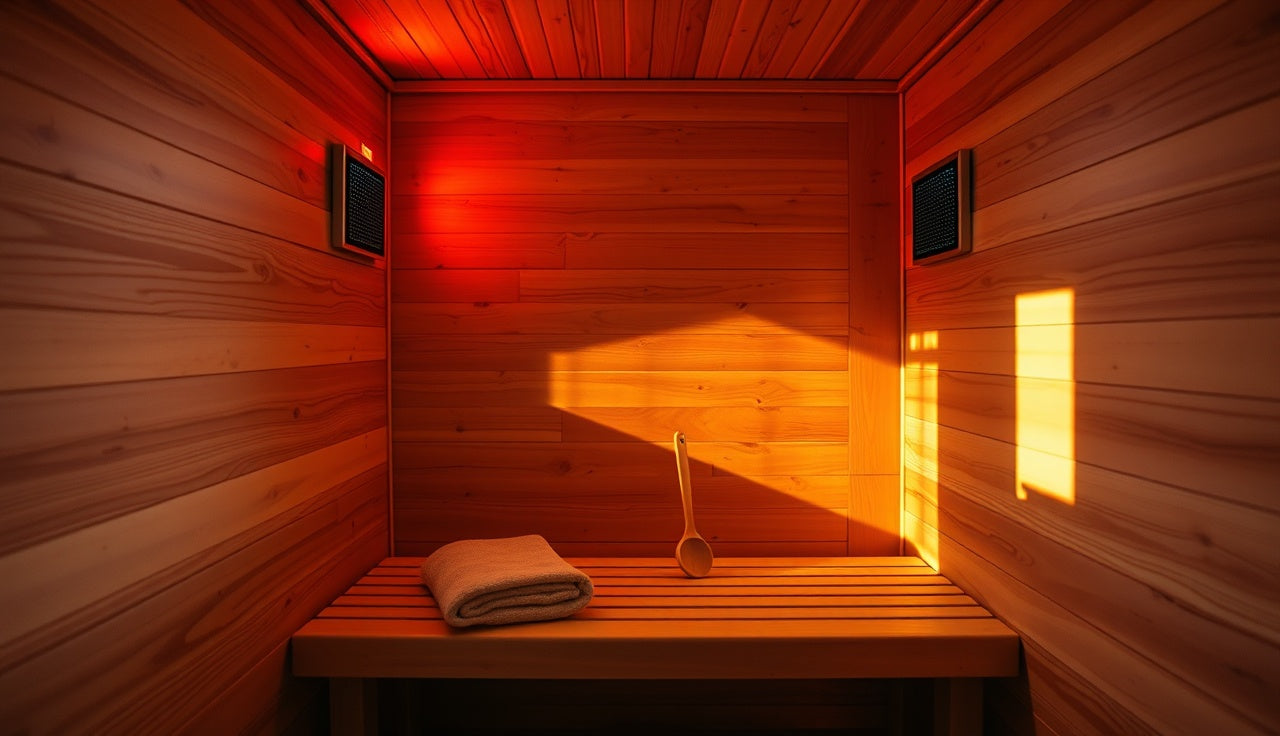
An infrared sauna is an enclosed wood cabin that uses electric infrared emitters instead of a wood stove or electric rock heater to warm you. The mechanism is the whole difference. Conventional saunas heat the air, and the hot air heats your skin. Infrared saunas emit electromagnetic radiation in the infrared band, and your skin and the tissue just below it absorb that radiation directly, before the surrounding air gets particularly warm.
The word "infrared" means the wavelength sits below visible red light on the electromagnetic spectrum, roughly 700 nanometers to 1 millimeter [1]. Your body emits and absorbs infrared constantly. That warm feeling when you stand near a campfire, then step out of the breeze and still feel toasty? That's infrared, not moving air.
Because the radiant energy does the work, cabin air runs between 120°F and 150°F, compared to 170°F to 195°F in a traditional Finnish sauna [2]. Some people find the cooler air easier to sit in, especially if breathing hot air bothers them. Others miss the wallop of a proper Finnish löyly. Both reactions are fair.
How does infrared radiation actually heat the body?
When an infrared emitter fires, it throws off photons at infrared wavelengths. Those photons pass through air (which absorbs almost none of that energy at these wavelengths) and hit your skin. The energy turns to heat within roughly the first few millimeters of tissue [1]. Your skin warms, thermoreceptors signal your hypothalamus, and your body runs the same thermoregulatory routine it uses whenever you overheat: surface blood vessels dilate (vasodilation), heart rate climbs to move blood faster, and sweat glands open to shed heat through evaporation.
Marketing loves to claim that far-infrared waves reach "1.5 to 3 inches" into tissue and heat you from the inside out. The real number, from tissue optics research, is closer to a few millimeters for far-infrared, which the water in your skin absorbs almost immediately [1]. Near-infrared reaches somewhat deeper, possibly into subcutaneous fat and the outer layer of muscle, but "several inches" is a stretch. The outcome that actually matters, a rise in core temperature and a cardiovascular response, is real and well-documented. The penetration depth is just smaller than the ad copy says.
Core temperature can climb by about 1°C (roughly 1.8°F) during a 30-minute infrared session, similar to what a moderate workout produces [3]. That thermal stress is the engine behind most of the studied effects.
What are the different infrared wavelengths and do they matter?
Infrared splits into three bands: near (NIR, roughly 0.75 to 1.4 µm), mid (MIR, 1.4 to 3 µm), and far (FIR, 3 µm to 1 mm). Most home saunas use far-infrared ceramic or carbon panel emitters, because the water in human skin absorbs far-infrared most efficiently. Some units sell "full-spectrum" heaters that add near and mid emitters and promise extra benefits.
Here's the honest picture. Far-infrared has the most clinical research behind it in the sauna setting, including the cardiac studies out of Japan and Finland covered below. Near-infrared has its own body of work in low-level light therapy (photobiomodulation), where it may help wound healing and cellular energy production [4]. Whether adding NIR to a sauna at sauna-level power actually produces meaningful photobiomodulation on top of the heat is an open question. Studies on full-spectrum saunas specifically are thin. If a brand charges a big premium for full-spectrum, ask them to show you a randomized controlled trial comparing it to a far-infrared-only unit. They probably can't.
Carbon panel heaters spread infrared across a large surface at lower panel temperatures (around 140 to 150°F). Ceramic rod heaters concentrate more energy at higher surface temperatures. Both put out far-infrared. For users the difference is mostly heat distribution and warm-up time. Carbon panels usually heat faster and more evenly.
| Wavelength Band | Range | Depth in Tissue | Common Heater Type |
|---|---|---|---|
| Near-infrared (NIR) | 0.75 to 1.4 µm | Several mm, can reach subcutaneous layer | NIR lamps, halogen |
| Mid-infrared (MIR) | 1.4 to 3 µm | 1 to 2 mm | Specialty emitters |
| Far-infrared (FIR) | 3 µm to 1 mm | ~1 to 3 mm (absorbed by skin water) | Carbon or ceramic panels |
| Cardiovascular health | 3 |
| Endothelial function | 3 |
| Fibromyalgia pain relief | 2 |
| Relaxation / stress | 2 |
| Muscle soreness recovery | 1 |
| Skin improvement | 1 |
| Detoxification | 0 |
| Weight loss | 0 |
Source: Laukkanen et al. Mayo Clinic Proceedings 2018; Tei et al. Journal of Cardiology 2016; Matsushita et al. Internal Medicine 2009
Do infrared saunas actually work? What does the research show?
Yes, for some outcomes, with real evidence. No, not for everything printed on the box.
The strongest evidence is cardiovascular. A 2018 prospective cohort study from Finland (the KIHD study) followed over 2,300 middle-aged men and found that frequent sauna use (4 to 7 sessions per week) was associated with a significantly lower risk of sudden cardiac death and cardiovascular mortality compared to once-a-week use [5]. That study used traditional Finnish saunas, not infrared, but the mechanism (repeated heat-driven increases in heart rate and cardiac output) is shared. A 2016 pilot study in JAMA Internal Medicine found that infrared sauna use produced hemodynamic changes similar to moderate aerobic exercise [6].
For heart failure patients, researchers at Kagoshima University in Japan published a run of studies on "Waon therapy" (far-infrared sauna at 60°C for 15 minutes) showing gains in cardiac output, exercise tolerance, and quality of life in people with chronic heart failure [3]. Their proposed mechanism is repeated mild heat stress improving endothelial function and calming sympathetic nervous system activity. These were small studies, and the FDA has not approved infrared saunas to treat heart failure, but the signal is consistent enough to respect.
For pain and fibromyalgia, a 2009 trial found that fibromyalgia patients using far-infrared sauna reported real drops in pain and fatigue compared to controls, with effects still present at a six-month follow-up [7]. Sample sizes were small. This isn't a confident recommendation yet.
The detox claims are where the wheels come off. Sweat is about 99% water with trace electrolytes. Your kidneys and liver handle actual detoxification. There's no good evidence that sweating in an infrared sauna clears heavy metals or environmental toxins beyond what healthy kidneys already handle. Some studies detect trace metals in sweat, but the amounts are tiny next to urinary excretion [8]. Don't buy a sauna because of detox marketing.
How is an infrared sauna different from a traditional sauna?
The heating method is the root difference, and it cascades into temperature, humidity, and how the session feels. A traditional Finnish sauna, the kind used for thousands of years and the basis for most of the mortality research, uses a kiuas (a stove) packed with rocks heated to very high temperatures. Air temperature hits 170°F to 195°F. Throwing water on the rocks (löyly) sends up a burst of steam that spikes humidity for a moment and sharpens the heat. It's intense. Your skin is heated mostly by convection and radiation from the hot air and walls.
An infrared sauna sits at 120°F to 150°F air temperature. The wood walls stay cooler. There's no löyly. The radiant energy does most of the heating directly. Plenty of people sweat as much or more than in a traditional sauna despite the lower air temperature, because the infrared drives skin temperature up without the air needing to catch up.
Want a traditional sauna experience? An infrared unit won't give it to you. Want the health outcomes tied to regular sauna use, but 190°F air is hard for you to breathe? Infrared is a reasonable path to similar cardiovascular benefits. For more on the traditional side, see the sauna and sauna benefits guides.
For a head-to-head on the wider sauna category versus another humid option, the sauna vs steam room article breaks down the moisture and temperature profiles.
How hot does an infrared sauna get, and how long should you stay in?
Most infrared saunas run between 110°F and 150°F (43°C to 65°C), and 120°F to 140°F is the common sweet spot where people sweat well without feeling miserable. Warm-up from a cold start is usually 15 to 30 minutes, depending on cabin size and heater wattage.
Session length in the research is usually 15 to 30 minutes. The Waon therapy protocol from the Japanese cardiac studies was specifically 15 minutes at 60°C (140°F) followed by 30 minutes of rest wrapped in blankets [3]. The Finnish cohort studies found the most benefit at 4 to 7 sessions per week, but those were traditional sauna sessions averaging about 15 minutes each [5].
For a healthy adult with no contraindications, 20 to 30 minutes at a temperature you can tolerate is a solid starting point. Drink water before and after. Skip the alcohol beforehand. If you have cardiovascular disease, talk to your doctor before starting a regular routine, even though the evidence generally favors stable cardiac patients.
The American College of Cardiology has not issued infrared sauna guidelines, but the standing rule in the heat therapy literature is simple. If you feel dizzy, nauseated, or your heart rate feels wrong, get out of the cabin.
Is infrared sauna safe? Who should be careful?
For most healthy adults, infrared saunas are safe at normal temperatures and session lengths. The risks match any heat exposure: dehydration, heat exhaustion if you stay too long, and orthostatic hypotension (the head rush when you stand up fast in a hot room).
Groups who should talk to a physician before using an infrared sauna:
- People with uncontrolled hypertension. Heat causes vasodilation and can swing blood pressure.
- Pregnant women. Safety data on sauna use in pregnancy is thin, and many guidelines recommend avoiding it.
- People with multiple sclerosis. Heat can temporarily worsen MS symptoms (Uhthoff's phenomenon).
- Anyone on medications that blunt sweating or temperature regulation (some antihistamines, antipsychotics, diuretics).
- People with active skin conditions that heat aggravates.
The Consumer Product Safety Commission has not issued recalls or broad advisories on infrared saunas as a category as of this writing, but confirm your unit meets UL or ETL electrical safety standards, especially for home installation [9]. Infrared saunas pull real current (typically 1,400 to 1,800 watts for a one-person unit, 2,000 to 4,000 watts for two-to-four-person units), and a dedicated circuit is usually required.
If you want to pair heat with cold, following an infrared session with a cold plunge or ice bath is a popular contrast therapy setup. The evidence for contrast therapy is its own thing, separate from infrared sauna evidence, and it's covered in the cold plunge benefits guide.
What are the claimed benefits of infrared saunas, and which ones have evidence?
Here's an honest breakdown. The right column is what the research supports, not what the product page promises.
| Claimed Benefit | Evidence Status |
|---|---|
| Cardiovascular health improvement | Moderate to strong (KIHD cohort, Waon therapy trials) [5][3] |
| Improved endothelial function | Moderate (Waon therapy studies, small RCTs) [3] |
| Reduced muscle soreness after exercise | Weak to moderate (small studies, mixed findings) |
| Pain relief in fibromyalgia | Moderate (one RCT, small N) [7] |
| Relaxation / reduced stress | Plausible and widely reported; limited controlled data |
| Weight loss | Very weak; sweating produces temporary water loss only |
| Detoxification | No credible evidence beyond normal kidney function [8] |
| Skin improvement | Anecdotal; some small studies on circulation; inconclusive |
| Immune function boost | Theoretical; insufficient human data |
The honest summary: the cardiovascular and endothelial evidence is genuinely encouraging. The pain and relaxation data is suggestive but not settled. The detox and weight-loss claims are marketing.
One well-cited line from the Laukkanen et al. 2018 review in Mayo Clinic Proceedings: "Emerging evidence suggests that beyond its use for pleasure, sauna bathing may be linked to several health benefits" [5]. That hedged phrasing, "may be linked," is the right level of confidence for where the evidence stands.
How much does an infrared sauna cost, and what do you actually need?
Home infrared saunas run from around $800 for a small single-person portable cabin to $8,000 or more for a high-end two-to-four-person unit with premium wood, full-spectrum heaters, and built-in audio. The middle of the market, two-person far-infrared units from established brands, runs roughly $2,000 to $4,000 [2].
Worth paying for: EMF shielding (low-EMF carbon panels are standard in reputable brands, so ask for the µT reading at the heater surface), wood joinery that won't warp or off-gas, UL or ETL electrical certification, and a heater warranty of at least five years. Mostly upsells: chromotherapy lighting, full-spectrum claims with no supporting data, and proprietary "technology" names slapped on standard infrared emitters.
On a tight budget, a portable sauna (a fabric or nylon tent with a single panel or foot-pad heater) costs $100 to $400 and will make you sweat. The thermal experience is different from a real wood cabin, and it won't last nearly as long, but it's a legitimate way to try infrared heat before committing to a bigger unit.
For a full home install, plan on a dedicated 20-amp or 30-amp 240-volt circuit for most two-to-four-person units. Budget $200 to $600 for electrical work if your panel needs a new circuit. Outdoor units need weather-resistant wood (Canadian hemlock, red cedar, or basswood are common) and ideally a covered spot. The outdoor sauna and home sauna guides cover installation in more detail.
SweatDecks carries a range of infrared and traditional sauna options for home use, worth browsing once you've settled on the type and size that fits your space.
Does EMF from infrared saunas pose a health risk?
This question comes up constantly and deserves a straight answer. Infrared saunas produce electromagnetic fields (EMF) because they use electric heating elements. The relevant unit for the low-frequency magnetic fields from heaters is microtesla (µT).
The International Commission on Non-Ionizing Radiation Protection (ICNIRP) sets a general public reference level of 200 µT for 50/60 Hz magnetic fields [10]. Early infrared sauna panels, especially ceramic rod types, measured in the 10 to 50 µT range at contact distance. Modern low-EMF carbon panel designs typically measure under 3 µT at sitting distance, and some brands claim under 1 µT [2].
The infrared radiation itself (non-ionizing, long-wavelength) is nothing like X-rays or UV. It doesn't carry enough energy per photon to damage DNA. The EMF concern is about the low-frequency magnetic field from the electric current running through the heater elements, not the infrared light.
If EMF worries you, ask the manufacturer for independent third-party µT measurements at the heater surface and at seated distance (typically 10 to 12 inches). Low-EMF is now a standard marketing claim, but third-party verification is all over the map. Brands that publish real µT readings are more trustworthy than the ones that just say "low-EMF" with no numbers.
Can you build or install an infrared sauna at home?
Yes, and it's one of the easier home wellness installs compared to a traditional sauna. Most infrared cabin kits arrive pre-cut and pre-drilled, and they go together in 2 to 4 hours with basic tools. You connect tongue-and-groove wood panels, drop heater panels into pre-fitted slots, and run a power cord to a dedicated outlet.
The electrical requirement is the real constraint. A one-person unit (1,400 to 1,800W) can often run on a dedicated 15-amp 120V circuit. Anything bigger usually needs 240V, which means a new circuit from your panel. Confirm with a licensed electrician before you assume your existing wiring can handle it. The National Electrical Code (NEC), published and updated by NFPA, governs wiring for fixed appliances [11].
Placement: infrared saunas need a level floor (most come with small leveling feet), a few inches of clearance on the sides and back for airflow and heat dissipation, and a ceiling tall enough that the unit (typically 75 to 78 inches) fits with room to spare. They work in a bedroom, basement, garage, or outdoors under cover. Unlike traditional saunas, they don't need special ventilation, because the wood walls never get hot enough to be a real fire risk and there's no steam. Standard indoor placement is fine.
If you're weighing a traditional build-out instead, the home sauna guide walks through that process.
How does infrared sauna compare to other heat and recovery options?
Trying to decide whether infrared fits your recovery or wellness goals versus the alternatives? Here's a practical frame.
Traditional Finnish sauna has more long-term epidemiological data behind it (the KIHD study and related Finnish research). If you want the most evidence-backed sauna experience, traditional wins on data volume. If 185°F air is uncomfortable for you, or you have a condition where intense air heat is a problem, infrared is a practical alternative that still delivers real thermal stress and a cardiovascular response.
Steam rooms are a third option. They run cooler (100°F to 115°F) at 100% humidity, and the moisture makes the heat feel more intense. The research base for steam rooms is thinner than for dry saunas. See the sauna vs steam room comparison for a closer look.
Cold plunges and contrast therapy (alternating heat and cold) keep gaining ground in recovery circles. Cold exposure works through entirely different mechanisms: vasoconstriction, norepinephrine release, and reduced local inflammation. Plenty of people finish a sauna session with a cold plunge and feel excellent afterward. The combined protocol has limited controlled trial data so far, but the individual pieces are each well-studied. SweatDecks covers the cold side of this equation too if you want to explore contrast therapy.
For athletes, post-exercise sauna use (rather than pre-exercise) is the better-studied protocol, and it avoids starting a workout already down a pint of sweat.
Frequently asked questions
Do infrared saunas actually work for relaxation and stress relief?
Most users report real relaxation after infrared sessions, and there's a plausible mechanism: heat exposure lowers sympathetic nervous system activity and triggers endorphin release. Controlled trial data on relaxation specifically is thin, but the Japanese Waon therapy research found improved quality-of-life scores alongside cardiac gains. The relaxation effect is reported consistently. It just hasn't been the main outcome in most trials.
Is far-infrared better than near-infrared for sauna use?
Far-infrared has more clinical evidence in the sauna context, especially the cardiac and endothelial studies from Japan and Finland. Near-infrared has its own research base in photobiomodulation (low-level light therapy) for wound healing and cellular function, but whether near-infrared at sauna power levels adds meaningful photobiomodulation on top of the heat is unproven. Most buyers do fine with a quality far-infrared unit.
How long does it take for an infrared sauna to warm up?
Most infrared cabins reach usable temperatures (around 120°F) in 15 to 25 minutes from a cold start. Carbon panel heaters warm faster than ceramic rod heaters. Some people climb in during warm-up and stretch their session to 30 to 40 minutes total rather than waiting for full temperature. Pre-heating 20 minutes before you plan to use it is the standard manufacturer recommendation.
Can infrared saunas help with weight loss?
Not meaningfully. The weight you drop in a session is water from sweating, and you put it back when you rehydrate. A 30-minute session may burn an extra 100 to 300 calories beyond resting metabolism from the elevated heart rate, similar to a light walk. That's real but small. An infrared sauna won't replace diet and exercise if weight loss is the goal.
How often should you use an infrared sauna to see benefits?
The Finnish cohort data tied the greatest cardiovascular benefit to 4 to 7 sessions per week, but those were traditional saunas at higher temperatures. For infrared, most research protocols use daily or near-daily sessions of 15 to 30 minutes. Three to four sessions per week is a reasonable target for someone starting out. Consistency over months matters far more than any single session.
Do infrared saunas produce the same sweat as traditional saunas?
Yes, the mechanism is identical: your skin warms, your hypothalamus tells sweat glands to fire, and you produce eccrine sweat. Many users report sweating as much or more in an infrared sauna despite the cooler air, because the radiant energy drives skin temperature up directly. Sweat composition is roughly the same: mostly water with trace electrolytes.
Are infrared saunas safe for people with high blood pressure?
Heat causes vasodilation, which usually lowers blood pressure during a session, but the response varies from person to person. Some studies on sauna use in hypertensive patients show modest blood pressure improvements over time. Still, anyone with uncontrolled hypertension or on antihypertensive medication should talk to their doctor before starting a regular routine. This isn't an area for self-experimentation without medical input.
What wood is best for an infrared sauna cabin?
Canadian hemlock and basswood are the most common in infrared cabins because they're low-resin, don't off-gas much at the lower temperatures infrared produces, and are hypoallergenic. Red cedar smells great but is stronger and can bother people with sensitivities. Avoid engineered woods or plywood interiors. Wood quality matters most for longevity and off-gassing, not heating efficiency, since the panels do the work.
Can I use an infrared sauna every day?
Daily use is safe for most healthy adults at standard temperatures and session lengths. The Finnish research population with the best cardiovascular outcomes used saunas 4 to 7 times per week. Stay hydrated, skip alcohol before a session, and sit it out if you're sick, running a fever, or feeling dizzy. Listen to your body. Most people find a daily 20-minute session sustainable and pleasant.
How do infrared saunas affect the skin?
Infrared heat increases blood flow to the skin, which may improve tone and texture in the short term. Some small studies suggest better collagen synthesis with near-infrared light therapy at specific wavelengths and doses. Whether a typical sauna session delivers the right parameters for photobiomodulation-driven skin change is unclear. The flushing and sweating do flush out pores mechanically, which many people notice as a cosmetic perk.
What is the electricity cost of running a home infrared sauna?
A two-person infrared sauna drawing 1,700 watts, run for 30 minutes, uses about 0.85 kWh per session. At the US average residential rate of about $0.16 per kWh (EIA 2023), that's roughly $0.14 per session, or around $4 to $5 per month at four sessions per week. Four-person units at 3,500 watts cost proportionally more. Infrared saunas cost less to run than traditional electric saunas because they operate cooler.
Do infrared saunas help with muscle recovery after exercise?
The evidence is limited but suggestive. Heat increases blood flow to muscle tissue, which may speed delivery of nutrients and clearance of metabolic waste. A few small studies show reduced delayed onset muscle soreness (DOMS) with post-exercise heat. The effect size is modest in the studies that exist. If recovery is your main goal, contrast therapy (sauna plus cold plunge) is more common among athletes, though that research is also preliminary.
What is the difference between a one-person and two-person infrared sauna?
Size, wattage, and price. One-person units run about 36 to 40 inches wide, draw 1,400 to 1,800 watts, and cost $800 to $2,500. Two-person units run 47 to 55 inches wide, draw 1,700 to 2,400 watts, and cost $2,000 to $4,500. A two-person unit gives you room to stretch out even when you use it solo, which most people prefer. If space and budget allow, buyers who get the one-person unit usually wish they'd sized up.
Sources
- NASA Science – Infrared Waves (electromagnetic spectrum overview): Infrared radiation spans roughly 700 nm to 1 mm; far-infrared is strongly absorbed by water, limiting tissue penetration to a few millimeters
- Harvard Health Publishing – Saunas and your health: Infrared sauna air temperatures run 120–150°F vs 170–195°F for traditional; middle-market two-person units cost roughly $2,000–$4,000
- Tei C et al. – Waon therapy for managing chronic heart failure, Journal of Cardiology 2016: Far-infrared sauna at 60°C for 15 minutes (Waon therapy) improved cardiac output, exercise tolerance, and quality of life in chronic heart failure patients
- Hamblin MR – Mechanisms and applications of the anti-inflammatory effects of photobiomodulation, AIMS Biophysics 2017: Near-infrared photobiomodulation may support wound healing and cellular energy production at specific wavelengths and doses
- Laukkanen JA et al. – Sauna bathing and cardiovascular mortality, Mayo Clinic Proceedings 2018: Frequent sauna use (4–7x/week) was associated with significantly lower risk of sudden cardiac death vs once-weekly use; authors stated 'emerging evidence suggests sauna bathing may be linked to several health benefits'
- Keast ML et al. – Infrared sauna produces hemodynamic changes similar to moderate aerobic exercise, JAMA Internal Medicine 2016 (pilot study): Infrared sauna use produced hemodynamic changes comparable to moderate aerobic exercise in a pilot study
- Matsushita K et al. – Far-infrared therapy for fibromyalgia, Internal Medicine 2009: Fibromyalgia patients using far-infrared sauna reported significant reductions in pain and fatigue vs controls, with effects persisting at 6-month follow-up
- Sears ME et al. – Arsenic, cadmium, lead, and mercury in sweat, Journal of Environmental and Public Health 2012: Sweat contains trace amounts of heavy metals, but quantities are small compared to urinary excretion; sweating is not a primary detox route
- U.S. Consumer Product Safety Commission – Electrical Safety: Home appliances including saunas should carry UL or ETL certification to confirm electrical safety standards
- ICNIRP – Guidelines for limiting exposure to electromagnetic fields, low frequency: ICNIRP sets a general public reference level of 200 µT for 50/60 Hz magnetic fields; modern low-EMF carbon panel saunas typically measure under 3 µT at seated distance
- National Fire Protection Association – NFPA 70, National Electrical Code: The National Electrical Code, published by NFPA, governs wiring requirements for fixed electrical appliances including sauna heaters
- U.S. Energy Information Administration – Electricity explained: average retail price: U.S. average residential electricity rate approximately $0.16 per kWh (2023); used to calculate per-session sauna operating cost

Share:
Infrared light sauna: how it works and what to expect
Best traditional sauna for home: how to choose and buy