
Last updated 2026-07-09
TL;DR
Barrel saunas look great and heat up fine, but the cylinder shape costs you. Wood gaps open and close with the weather, the curved ceiling wastes headroom you still pay to heat, the bench space is tight, and the wood mass insulates far worse than a proper box wall. They're rarely dangerous. For the money, a rectangular sauna usually wins on cost and comfort.
What actually makes a barrel sauna different from a regular sauna?
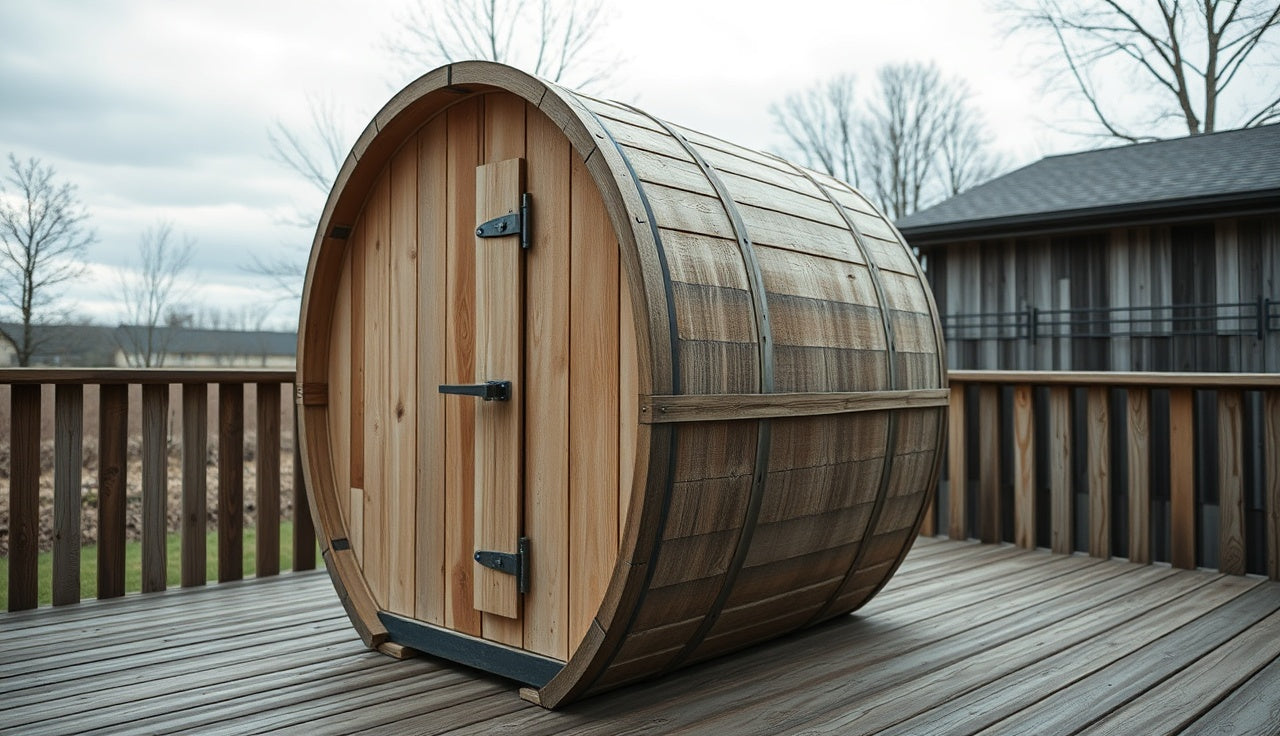
A barrel sauna is a cylinder built from stave-cut wood planks bent into a circle and clamped together with metal bands, the same way a wine barrel goes together. The shape is the whole pitch: no corners, a curved ceiling, and a silhouette that looks great in a backyard. U.S. prices run from about $3,000 for a basic two-person kit to $10,000 or more for larger pre-assembled outdoor units [1].
That cylinder is also where most of the trouble starts. The stave construction that makes the barrel handsome creates engineering tradeoffs a conventional rectangular box never has to deal with. Those tradeoffs are the whole point of this article.
If you're comparing options, see our overview of home sauna types and our guide to outdoor sauna buying considerations.
Do barrel saunas have structural problems over time?
Yes. This is the loudest complaint from people who've owned one for years. The stave-and-band design only stays tight while the wood is slightly swollen with moisture. Heat the sauna, the wood dries and shrinks. Rain or humidity comes, the wood swells again. Run that cycle a few hundred times and the bands loosen, the staves shift, and gaps open between planks.
Small gaps are manageable. You tighten the metal tension bands, and most manufacturers ship adjustment hardware for exactly this. Larger or stubborn gaps are worse: cold drafts, heat loss, then water working its way in and starting rot. The USDA Forest Products Laboratory has documented that repeated wetting and drying is the main driver of dimensional change and checking (surface cracking) in softwood lumber [2]. A barrel stave goes through that cycle every time you fire the heater.
Climate makes it better or worse. A barrel in humid Georgia cycles differently than the identical unit in dry Colorado, and the Colorado one is likelier to open gaps through a dry winter.
This is not a two-year death sentence. A quality cedar barrel, maintained, lasts a decade or more. But the maintenance is higher than an insulated box, and the failure mode is meaner. A box sauna with a cracked panel is a small, local fix. A barrel with several loose staves and a sprung band is a whole-structure problem.
Are barrel saunas less efficient to heat than box saunas?
Generally yes, for two reasons.
The curved ceiling is the first. In a Finnish-style sauna, the hottest air pools at the ceiling and radiates down onto the benches. A flat ceiling keeps that hot layer dense and right over your head. In a barrel, the ceiling curves away on both sides, so the hottest air spreads across a bigger, looser curve. You end up heating cubic feet nobody sits in. The Finnish Sauna Society specifies flat ceilings for exactly this reason, to hold the hot air layer over the benches [6].
Insulation is the second. A box sauna insulates cleanly: foil vapor barrier, fiberglass or mineral wool batts, wood interior skin, all flat planes with little thermal bridging. A barrel leans almost entirely on the wood itself. Staves run 1.5 to 2 inches thick, and while wood insulates decently (western red cedar is roughly R-1.25 per inch [3]), it's nowhere near a real wall cavity, which reaches R-13 to R-21 in a proper home sauna build.
So barrels take longer to hit temperature and burn more electricity or wood getting there. Some sellers argue the curve shrinks interior volume and heats faster, which holds up for tiny two-person barrels. Scale to four or six people and the gap against a well-insulated box widens.
Running cost is the payoff. A 6 kW electric heater, four sessions a week, and a modest heat-up difference stacks up on the power bill across years of ownership.
| Barrel sauna (1.5" cedar staves) | 1.9 |
| Barrel sauna (2" cedar staves) | 2.5 |
| Box sauna, uninsulated wood walls | 4.5 |
| Box sauna, R-13 fiberglass batts | 13.0 |
| Box sauna, R-21 mineral wool batts | 21.0 |
Source: Oak Ridge National Laboratory, Building Envelope Research; USDA Forest Products Laboratory, Wood Handbook
How does the barrel shape affect usable interior space?
This one surprises people the moment they step inside. The cylinder is widest at its center and curves inward hard at bench height. In a barrel with a 6-foot outer diameter, the flat bench might be only 20 to 24 inches deep per side, and your shoulders hit the curve before you've even thought about your head.
You can stand upright only in the dead center. Anyone over 6 feet tends to tilt to dodge the ceiling near the ends. That's geometry, not workmanship.
A rectangular sauna with the same person rating gives you more bench and full headroom across the whole floor. Barrel marketing counts people seated upright, shoulder to shoulder, with nobody lying down. Lying flat for a long session, a normal Finnish habit, is hard or impossible in most standard barrels.
For why the Finnish approach to layout matters, our sauna overview covers the tradition and what good bench design looks like.
What wood issues should you watch out for?
U.S. barrel saunas come in several woods. Western red cedar is the premium standard. Nordic spruce, hemlock, and thermally modified wood show up often. Cheap units sometimes arrive in pine, which is a problem: pine carries more resin and weeps sap when heated, leaving a sticky interior nobody wants to sit against.
Species aside, the grain and moisture content of the staves at manufacture drive long-term stability. Quartersawn or rift-sawn staves hold their shape better than flatsawn because the growth rings run more perpendicular to the face, which cuts cupping and warping [2]. Budget kits often use flatsawn staves to waste less lumber. That's a real cost saving and a real accelerant for the gap-and-warp problems above.
Then the exterior. Most barrels live outdoors on a base frame or cradles. The underside and the cradle contact points are where water pools and wood stays damp longest, so rot starts there first. The minimum upkeep is an annual inspection, keeping cradle contacts clean and dry, and a coat of sealant or stain every year or two. Skip it and even a good barrel degrades hard inside five years.
Cedar is the most rot-resistant of the usual choices. The USDA Forest Service rates western red cedar as "resistant to very resistant" to decay, while spruce and hemlock fall under "slightly resistant to non-resistant" [2].
Are there safety concerns specific to barrel saunas?
A few real ones, none of them exotic.
Ventilation is often an afterthought. Good sauna airflow needs a low fresh-air intake and a higher exhaust vent, so cool air enters near the floor, heats, rises, and leaves near the ceiling. Some barrel kits ship with one or two adjustable vents and little thought about placement. Weak airflow lets carbon dioxide build from your own breathing, which turns a session stuffy and headachy instead of relaxing. The EPA notes that poor ventilation in enclosed spaces raises carbon dioxide from occupant breathing and brings on headaches and stuffiness [10]. Verify the ventilation design before you buy, and be ready to add a vent.
Electrical safety is the same story as any outdoor sauna. The heater needs a dedicated circuit with a GFCI breaker. The National Electrical Code requires electrical components in a sauna to be rated for the environment and wiring to be protected from moisture (NEC Article 680 covers wet locations, Article 424 covers fixed heating) [4]. Barrels arriving with undersized or non-weatherproof wiring are a known problem in cheap imported units.
A wood-burning stove inside a barrel deserves respect. Curved walls put the stove pipe closer to wood than a rectangular room, where the pipe runs straight up through a dedicated chase. Follow the stove maker's clearances to the letter and use a proper thimble and heat shield at every wall or ceiling penetration.
Last, the barrel can tip. Uneven or unanchored cradles make a big unit unstable. Manufacturers spell out leveling requirements. Take them seriously.
How do barrel saunas compare to traditional box saunas on key metrics?
Here's an honest side by side, based on typical mid-market units.
| Feature | Barrel Sauna | Box/Cabin Sauna |
|---|---|---|
| Price range (4-person) | $4,000, $8,000 | $4,000, $12,000+ |
| Heat-up time (electric) | 30 to 50 min | 20 to 40 min (insulated) |
| Usable bench space | Limited by curve | Full rectangular footprint |
| Insulation quality | Wood mass only (~R-2 to R-3) | Can reach R-13 to R-21 |
| Long-term maintenance | High (bands, gaps, sealant) | Moderate (vapor barrier, panels) |
| Aesthetic appeal | Very high (backyard focal point) | Moderate to high |
| Weather resistance | Moderate (needs annual sealant) | High (if properly built) |
| Lifespan (well maintained) | 10 to 20 years | 15 to 25 years |
| DIY assembly difficulty | Moderate (band tensioning tricky) | Moderate to high |
These ranges come from manufacturer specs, owner forums, and wood science literature [1][2][3]. Results swing a lot with climate, upkeep, and build quality.
Insulation is the difference you can actually measure. A box sauna with R-13 walls loses roughly six times less heat per square foot of wall than a barrel relying on 1.5-inch cedar staves at R-2. That shows up directly as longer heat-up times and higher running costs for the barrel.
What do barrel saunas actually do well?
There are genuine upsides, and honesty means naming them.
They're beautiful. A cedar barrel on a deck or beside a lake looks the way a sauna is supposed to look, at least in the picture decades of Nordic advertising put in our heads. Looks matter. If a barrel is the thing that finally gets you to buy a home sauna instead of doing nothing, that counts for something.
They go up fast. The curved structure supports itself, so you skip framing an interior room. Many kits arrive pre-assembled or in numbered stave bundles that one or two people put together over a weekend without special carpentry skills. That speed edge over a box build is real.
They work. Insulation limits and all, a barrel heats up, throws off the heat and steam (with a real heater and water on the rocks) that define a session, and people enjoy them. The experience inside a barrel isn't dramatically worse than a box. The gap is about economics and long-term ownership, not whether you get a good sweat.
On sauna benefits, the research applies no matter the form factor, since your body responds to heat, not to the shape of the room.
If you want a barrel specifically for outdoor use and want to weigh every option, our outdoor sauna guide lays out the full field, including prefab cabins and modular styles.
How long do barrel saunas last compared to other saunas?
A quality cedar barrel, maintained and installed somewhere covered or semi-sheltered, typically lasts 15 to 20 years before it needs major structural work. Barrels made from less durable woods like hemlock or spruce, left in full weather without regular sealing, can degrade badly in five to eight years.
The failure modes are predictable: band corrosion, stave warping that opens permanent gaps, cradle rot at ground contact, and interior bench rot from repeated wetting if the heater ever leaks or throws too much condensation.
Box saunas built from kiln-dried lumber with proper vapor barriers and insulation run 20 to 30 years on lighter maintenance, because their integrity doesn't ride on wood moisture the way a barrel's does. The interior vapor barrier keeps the structural wood dry, and dry wood is what lasts.
Nobody has large-scale, long-run data on sauna lifespan. These numbers come from wood science literature on outdoor wood structures, plus manufacturer warranties (most barrel makers offer 1 to 5 years on structural components), plus owner reports online. Treat the ranges as reasonable, not a promise.
Is a barrel sauna worth it, or should you buy something else?
It depends on what you're optimizing for.
Want looks and easy install, and willing to do annual upkeep? A barrel from a reputable maker (Dundalk LeisureCraft, Almost Heaven, and TheraSauna come up often, verify current quality yourself) is a solid pick. You'll get sessions. You'll enjoy it.
Want the lowest long-term cost, best heat efficiency, and most usable space? A prefab cabin or site-built rectangular sauna is the better buy at the same price. The insulation and space advantages aren't marginal. They're built into the geometry.
On a tight budget, know that a quality portable sauna costs a fraction of any outdoor unit and still delivers heat therapy, even if the experience is different.
At SweatDecks we stock both barrel-adjacent and cabin-style outdoor options, so if you want to line up specific units, the home sauna collection is a fair starting point for what's actually on the market now.
One thing I'll say plainly: skip the cheapest imported barrel kits on the big platforms unless you can confirm the wood species, stave thickness, and band hardware. The $1,500 to $2,000 tier is where the horror stories come from, not the barrel format itself.
What should you check before buying any barrel sauna?
A short checklist that saves regret.
Wood species first. Ask straight out. Cedar is worth the premium. If they won't name the species, walk.
Stave thickness second. 1.75 to 2 inches is the floor for real thermal mass and structural strength. Thinner than that and the thing will gap badly.
Band material and adjustment third. Stainless steel bands resist corrosion far better than galvanized or zinc-coated. Ask whether they adjust after install.
Heater certification fourth. The heater should carry a UL or ETL listing for the U.S. market. Uncertified heaters have started fires, and the Consumer Product Safety Commission has published guidance on steering clear of uncertified heating appliances [5].
Installation requirements fifth. Know your local permit situation. Many towns require a permit for outdoor structures over a set size or with an electrical connection. Thresholds vary, often 120 to 200 square feet for a building permit, but a permanent electrical connection almost always needs at least an electrical permit [9].
Warranty sixth. What does it actually cover? Is labor in? What voids it? Read it before you pay.
If you're planning contrast therapy with a cold plunge next to the sauna, read our cold plunge guide for what to weigh on the cold side.
Frequently asked questions
Can a barrel sauna be used indoors?
Technically yes, rarely practical. The barrel wastes space in any room, and the ventilation and drainage needs are harder to handle indoors. A rectangular cabin sauna fits an indoor space far better. If you want an indoor unit, a box sauna or a pre-built indoor cabin gives you more usable room for the same footprint, without the curved walls eating your floor plan.
Do barrel saunas need a foundation or concrete pad?
Most makers recommend a level gravel pad, concrete pad, or pressure-treated timber deck. The barrel rides on cradles, and those cradles need a stable, level, well-drained base. A standard concrete patio slab works well. Direct ground contact speeds up cradle rot. Check your manufacturer's base requirements, since most provide detailed instructions, and ask your local permit office whether a foundation permit applies.
How often do you need to seal or treat a barrel sauna exterior?
Once a year at minimum in most climates, twice a year where winters are harsh or UV is intense. Use a penetrating oil or exterior wood stain rated for softwoods. Film-forming finishes like standard deck paint peel as the barrel expands and contracts. Skip this for two or three seasons and weathering can permanently open the grain and speed up stave checking.
Are barrel saunas harder to assemble than cabin saunas?
Different, not necessarily harder. Barrel assembly means tensioning metal bands evenly around the staves without overtightening, which takes patience and usually two people. Cabin saunas involve more conventional carpentry: plumb walls, panel fastening, bench framing. Most people with basic DIY skills manage either in a weekend. The band tensioning step trips people up most, so follow the manufacturer sequence exactly.
What's the best wood for a barrel sauna?
Western red cedar is the standard recommendation for outdoor barrels. The USDA Forest Service rates it resistant to very resistant against decay, it holds its shape, smells good, and handles repeated heat cycles well. Nordic spruce and hemlock cost less and rot faster. Thermally modified wood is more available now, with better moisture resistance, though it's pricier and less common in barrel kits.
Do barrel saunas get hot enough for a real sauna session?
Yes. Insulation limits aside, a properly sized electric heater or wood stove takes a barrel to 160 to 195°F (71 to 90°C), the range for a Finnish-style session. Heat-up time is the real variable: figure 30 to 50 minutes for most barrels against 20 to 40 minutes for a well-insulated box with a comparable heater. Once it's up to temperature, the experience is genuinely sauna-like.
Can gaps between barrel sauna staves be fixed?
Small gaps from wood drying out often close when you tighten the tension bands per the manufacturer's instructions. If the wood has checked (surface cracked) or the staves have permanently warped, tightening won't fully close the gap. Caulking stave gaps with standard caulk doesn't hold, because wood movement breaks the seal again and again. Prevention through regular exterior sealing beats any gap repair.
Is a barrel sauna a good choice for a cold plunge pairing?
It works fine in a contrast therapy setup. The shape doesn't change how useful the heat-to-cold cycle is physiologically. The practical thing is proximity: keep the cold plunge within a few steps of the sauna exit so the transition is fast. Barrels usually sit outdoors, which makes adding a plunge alongside easy. See our guide to cold plunge benefits for what the research says about contrast therapy.
How does a barrel sauna compare to a steam room?
Different experiences. A barrel sauna runs dry heat at high temperatures (160 to 195°F) with low humidity until you pour water on the rocks. A steam room runs cooler (110 to 120°F) at near-100% humidity. Barrels don't convert to steam rooms well, since the wood gaps let steam escape and the structure isn't sealed the way a steam enclosure has to be. Our sauna vs steam room guide covers the full comparison.
What permit do I need for an outdoor barrel sauna?
It varies by jurisdiction. In most U.S. towns, an electrical permit is required any time you run a new circuit, which a sauna heater needs. Some areas also require a building permit for permanent outdoor structures above a set size, often 120 to 200 square feet. Check your local building department first. Unpermitted electrical work can affect homeowner's insurance claims and create liability if something goes wrong.
Are cheap barrel saunas from Amazon or big-box stores worth buying?
Rarely. Units in the $1,500 to $2,500 range almost always cut corners on wood (thin flatsawn staves, sometimes undisclosed species), band hardware (galvanized instead of stainless), and heater certification. The structural problems in this article show up far more in budget units. If the price looks too low for the size, something got compromised. A used mid-range barrel from a reputable brand often beats a new budget unit on value.
Does a barrel sauna add value to a home?
The evidence is limited and mixed. Saunas can add perceived value, especially where outdoor living is prized, but appraisers generally don't apply a dollar-per-square-foot multiplier for saunas the way they do for finished interior space. A permanent sauna, barrel or otherwise, adds more than a freestanding unit a buyer could haul away. Don't buy a sauna mainly as an investment. Buy it because you'll use it.
How do I keep a barrel sauna from rotting?
Four practices matter most: keep the cradles off direct ground contact, apply penetrating exterior oil or stain every year, let the interior dry completely between sessions by leaving the door ajar afterward, and inspect the bands and stave joints twice a year. Interior bench wood takes a beating from sweat and humidity, so check it for soft spots annually and swap individual boards before rot reaches the structural staves.
Sources
- HomeAdvisor / Angi, Sauna Installation Cost Guide: Barrel sauna prices in the U.S. typically range from about $3,000 for a basic two-person kit to $10,000 or more for larger pre-assembled outdoor units
- USDA Forest Service, Forest Products Laboratory, Wood Handbook: Repeated wetting and drying is the primary driver of dimensional change and checking in softwood lumber; quartersawn staves are more stable than flatsawn; western red cedar rates resistant to very resistant to decay while spruce and hemlock rate slightly resistant to non-resistant
- Oak Ridge National Laboratory, Building Envelope Research: Softwood like western red cedar has an R-value of roughly R-1.25 per inch; standard wall insulation with fiberglass batts can reach R-13 to R-21
- NFPA, National Electrical Code (NEC) 2023, Articles 424 and 680: NEC requires all electrical components in a sauna be rated for the environment and that wiring be protected from moisture; structures with permanent electrical connections require at least an electrical permit
- U.S. Consumer Product Safety Commission, Home Heating Safety: The CPSC has issued guidance on avoiding uncertified heating appliances due to fire risk; sauna heaters should carry UL or ETL listing
- Finnish Sauna Society, Sauna Building Guidelines: Traditional Finnish sauna design specifies flat ceilings to keep the hottest air layer dense over the benches, and low fresh-air intake with higher exhaust vent for proper ventilation
- Mayo Clinic, Sauna Health Benefits and Risks: Physiological sauna benefits relate to heat exposure in the 160–195°F range regardless of sauna room shape or form factor
- International Code Council, International Residential Code (IRC), permits: Most U.S. municipalities require a building permit for permanent outdoor structures and an electrical permit for new circuits; specific size thresholds vary by jurisdiction, often 120 to 200 square feet
- EPA, Indoor Air Quality (IAQ): Poor ventilation in enclosed heated spaces leads to carbon dioxide buildup from occupant respiration, causing symptoms including headache and stuffiness

Share:
Northern Lights cedar barrel sauna: full buyer's guide
Northern Lights cedar barrel sauna: full buyer's guide