
Last updated 2026-07-11
TL;DR
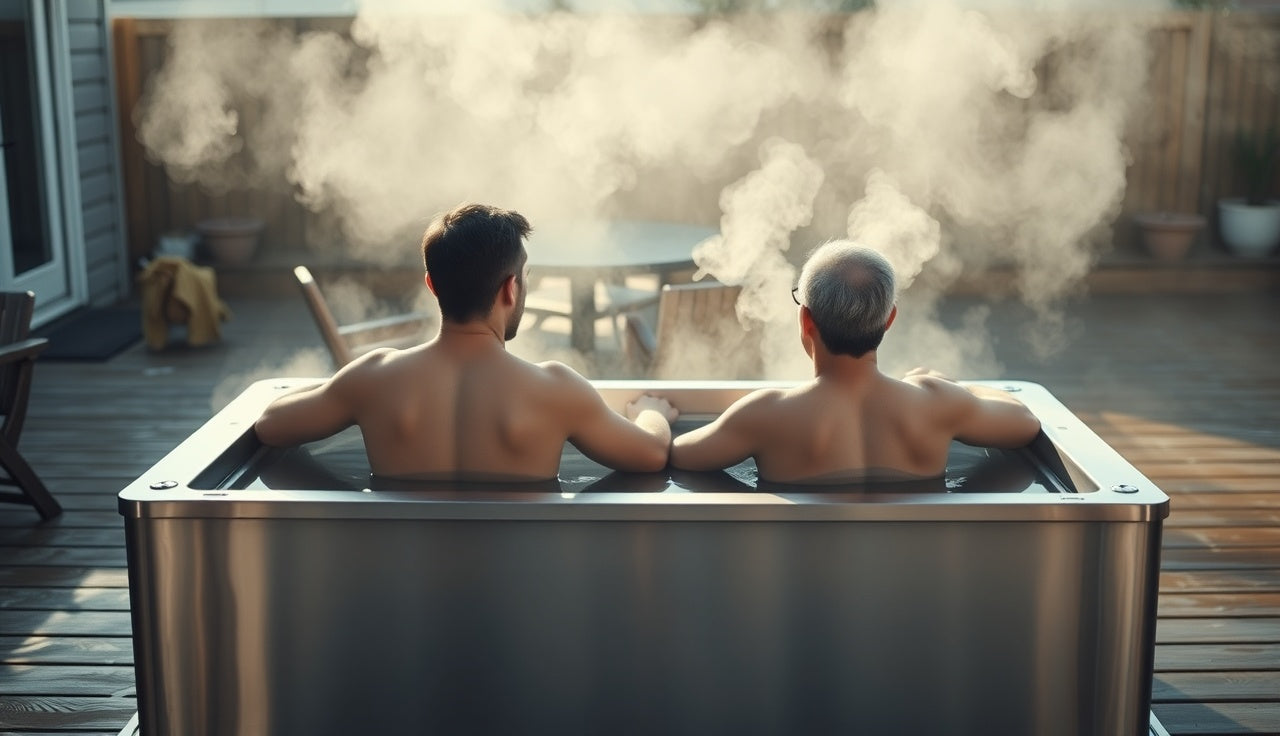
A cold plunge that fits two adults comfortably needs to be at least 72 inches (6 feet) long and 32 inches wide, with water depth of 24 to 28 inches. Most purpose-built two-person units land between 72x36 and 84x48 inches. Stock tanks and large soaking tubs work too, but they cost you in insulation and filtration.
What are the minimum dimensions for a two-person cold plunge?
Seventy-two inches long, 32 inches wide, 24 inches deep. That's the floor. It gets two average-sized adults into the water at the same time, seated facing each other or side by side, without anyone's knees ending up in someone else's face.
Those numbers come from standard ergonomic guidelines for two-person spa and bath design, where the rule of thumb is roughly 27 to 30 inches of shoulder width per seated adult. Two people at 27 inches each, plus a few inches of clearance on each side, puts you at 60 to 66 inches of interior width or length depending on how the seats face. Add wall thickness and the exterior footprint starts around 72 inches on the long side.
Depth matters as much as footprint. You need 24 inches of water to submerge a seated adult of average torso length up to the shoulders. Going to 28 inches gives you margin and lets taller people get their chest under without lying flat. Below 20 inches you're doing a leg soak, not immersion.
Taller than 6 feet, or broader through the shoulders? Bump the minimum to 78 inches long and 36 inches wide. Tight quarters feel tighter in cold water than in a warm bath, because people go still instead of shifting around.
What size cold plunge tubs are actually sold for two people?
The market has settled into a handful of common footprints. Here's what shows up across purpose-built plunge units, stock tanks, and large soaking tubs.
| Type | Typical interior size (L x W x D) | Two-person? | Approx. price range |
|---|---|---|---|
| Compact single plunge | 60" x 26" x 22" | No | $800, $3,000 |
| Mid-size plunge tub | 68" x 30" x 24" | Tight fit for two | $2,500, $6,000 |
| Two-person plunge tub | 72", 80" x 34", 40" x 26", 28" | Yes | $4,500, $12,000 |
| Round stock tank (8 ft) | ~90" diameter x 24" deep | Yes (bench config) | $400, $900 |
| Oval galvanized tank | 72" x 36" x 24" | Yes | $350, $700 |
| Large soaking tub converted | 72", 78" x 36" x 24" | Yes (no chiller) | $500, $2,000 |
| Commercial cold plunge | 84", 96" x 48" x 30" | Yes, comfortably | $8,000, $20,000+ |
Prices move around by region, brand, and whether a chiller and filtration come with it. A bare tub with no chiller sits at the low end. A fully integrated unit with a chiller that drops the water to 39°F plus UV or ozone filtration sits at the high end [2].
For most people who want a real two-person experience, the sweet spot is a purpose-built tub in the 72 to 80-inch range with an integrated chiller. Stock tanks work and cost a fraction of that, but you're hauling ice, balancing water chemistry by hand, and draining manually.
How much floor or deck space does a two-person cold plunge take up?
Plan for at least 10 feet of clear length and 5 feet of width on your deck or slab. The exterior footprint runs 6 to 18 inches larger than the interior on each side, so a tub with 70 inches of interior length usually measures 80 to 84 inches outside. Add 36 inches of clearance at one end for getting in and out, and that 10-foot number is where you land.
Outdoor installs on a wood deck have to account for point loads. A two-person cold plunge full of water weighs roughly 800 to 1,200 pounds depending on tub size and material, before anyone gets in. Two adults add another 300 to 450 pounds. Most residential decks are built to 40 pounds per square foot live load, which the International Residential Code sets as the standard for decks [3]. A 500-gallon plunge tub (about 42 square feet of footprint) at full load blows past that. You may need sistered joists or a concrete pad. Get a structural engineer to look at anything over 1,000 pounds going onto an existing wood deck.
Concrete pads are the safest and most common base for outdoor plunges. A 4-inch reinforced slab handles the load with room to spare. Indoor installs in a garage or basement need the same floor load check plus a floor drain within reach.
| Compact single plunge (too small for 2) | 60 |
| Mid-size plunge tub (tight for 2) | 68 |
| Two-person purpose-built tub (min) | 72 |
| Two-person purpose-built tub (typical) | 78 |
| 8-ft round stock tank (diameter) | 90 |
| Commercial cold plunge | 92 |
Source: Manufacturer spec sheets and product categories, 2024
Is a stock tank big enough for two people?
Yes, if you pick the right size. An 8-foot round galvanized stock tank has roughly 90 inches of interior diameter, which gives two adults plenty of room to sit across from each other on the bench or the tank floor [4]. The 6-foot round tank (about 72 inches interior) works for two smaller adults but gets crowded fast.
Oval stock tanks in the 6-foot by 3-foot range are tighter. Two people can share one, but expect knees against knees.
The real limit with stock tanks isn't size. It's holding temperature. You're filling with ice or running an external chiller, and a bigger tank holds more water, which means more ice per session or a stronger chiller to pull the temperature down into the 50 to 59°F range most cold exposure research uses [5]. An 8-foot round tank holds around 700 gallons. Getting 700 gallons from 65°F to 50°F takes roughly 120 to 150 pounds of ice per session. That cost and hassle add up fast.
Plenty of people running stock tanks for two eventually add an inline water chiller (usually 1 to 1.5 horsepower for tanks this size) to skip the ice haul. That's another $1,000 to $3,500 depending on the chiller and install.
Before you commit to a stock tank, map out the total cost including ongoing ice or chiller electricity. Our cold plunge section walks through the options.
What water temperature should a two-person cold plunge be set to?
Start at 55 to 60°F and go colder as you adapt. Most cold immersion research has used water between 50°F (10°C) and 59°F (15°C). A 2022 meta-analysis in PLOS ONE found most cold water immersion studies for recovery used the 10 to 15°C range with immersion times of 10 to 15 minutes [5]. The authors wrote that "cold water immersion at 10 to 15°C for 10 to 15 minutes appears to be most commonly used for recovery."
Below 50°F the physiological response gets strong enough that beginners should not linger. The American Red Cross recommends avoiding cold water immersion for people with heart conditions, and the standard advice is to never immerse alone when you're new to it [6].
Two-person setups have a built-in safety edge here: someone's with you. The rules still hold. Start warmer (55 to 60°F), keep sessions short (3 to 5 minutes for beginners), and get out if you feel dizzy or short of breath.
One practical note. A chiller that can hold a two-person tub at 50°F in summer heat needs more cooling capacity than one built for a single-person tub. Buy for the tub's actual water volume, not the number on the marketing label.
What should you look for in a two-person cold plunge besides size?
Filtration, insulation, entry design, and cover quality. Those four separate a good two-person setup from one you regret.
Filtration counts for more with two users because you're doubling the bacteria, sunscreen, and body oils going into the water. A single-person tub might get by on a basic cartridge filter. A two-person unit needs at least a cartridge filter plus UV sterilization or an ozone system to keep the water sanitary between changes. Some commercial units run all three [2].
Insulation decides how hard your chiller works and what your power bill reads. A well-insulated tub (closed-cell foam or equivalent, at least 2 to 3 inches on the sides and 3 to 4 inches on the bottom) loses much less temperature to the air overnight. A poorly insulated tub in a warm yard can have the chiller running almost nonstop. Check for the manufacturer's stated BTU loss or heat gain spec if they publish one.
Entry and exit design matters more here because you're both getting in and out, often at different times. Steps on at least one end plus a grab handle or rail make a real difference. A tub where both people have to vault the same wall at once is a mild annoyance in warm water and a genuine hazard in a cold plunge when hands and feet go numb.
Then there's the cover. A two-person tub has more surface area exposed to heat and debris. A rigid insulated cover or a folding hard cover cuts heat gain a lot. Soft covers work but lose their insulating value faster.
For a wider look at what separates good cold plunge benefits setups from overpriced ones, that guide goes deeper on the research.
Can you use an ice bath as a two-person cold plunge?
Yes, if the container is big enough. A traditional ice bath setup, meaning a large container filled with cold tap water and ice, fits two people as long as you have 72 inches of usable length, 32 inches of width, and 24 inches of depth. Same dimension rules as a purpose-built tub.
Bathtubs are the most common household option, and most standard bathtubs run 60 inches long by 30 inches wide. That's short for two adults. A freestanding soaking tub or a jetted tub in the 66 to 72-inch range works much better. A few hotel-style soaking tubs go to 78 inches and are genuinely comfortable for two average-sized adults.
The ice cost scales with size. A bigger container needs a lot more ice to hit the target. A 100-gallon bathtub might need 30 to 50 pounds of ice to drop from 65°F to 55°F. A 200-gallon soaking tub needs roughly double that. At $2 to $4 per 20-pound bag from a gas station or grocery store, one session for a 200-gallon tub costs $6 to $20 in ice alone. Do that three to five times a week and it hurts.
For people running contrast sessions in pairs, pairing a larger home sauna with a right-sized cold plunge is the practical move. The two setups feed each other, and that usage justifies the spend.
What does a two-person cold plunge cost, and is it worth it for two users?
A stock tank setup for two runs $400 to $1,500 all in, including the tank, a basic pump or chiller, and starter supplies. A purpose-built two-person plunge with a chiller and filtration runs $4,500 to $12,000 for consumer units, and up to $20,000 or more for commercial-grade stainless steel.
The worth-it question hinges on how often two people will actually use it together. If you and a training partner or a spouse are plunging three to five times a week, the per-session cost of a $6,000 unit drops fast against a gym or wellness center with a cold plunge. Most facilities with a dedicated plunge charge $20 to $50 per visit, or fold it into a $100 to $200 monthly membership.
Shared ownership tilts the math further. Two households splitting a $5,000 setup at one location is a different calculation than one person buying alone.
Running costs count too. A chiller for a two-person tub pulls roughly 800 to 1,500 watts when active, depending on the unit and ambient temperature. At the U.S. average electricity rate of about 16 cents per kilowatt-hour as of 2024 [7], that's $0.13 to $0.24 per hour of chiller runtime. In hot climates the chiller runs more hours to hold temperature. Budget $20 to $60 a month in electricity for a well-insulated outdoor unit in a moderate climate, more through a southern U.S. summer.
SweatDecks has a cold plunge section with two-person-capable units across several price points if you want to compare specs side by side.
How do you set up a two-person cold plunge outdoors?
Four things: structural support, drainage, electrical, and privacy. Get those right and the rest is easy.
Structural first. A concrete pad is the safest base, and a 4-inch slab reinforced with rebar handles any consumer cold plunge without a second thought. Putting the unit on an existing deck? Get a structural assessment before you fill it.
Drainage next. You need a way to empty and refill for water changes. Most purpose-built units have a drain port. Running a buried drain line to a dry well or a municipal storm drain keeps the area from turning into a swamp on change day. Some people just run a garden hose to a lawn area. Check local codes before connecting to storm drains, since some municipalities regulate what you can discharge [8].
Electrical is where you don't cut corners. Smaller chillers run on 120V standard household current; larger or commercial chillers need 240V. Have a licensed electrician install a dedicated circuit with GFCI protection within reach of the unit. The National Electrical Code Article 680 covers electrical requirements for outdoor water features and requires GFCI protection for all equipment near water [9]. Do not run this off an extension cord.
Privacy and weather round it out. A simple pergola or shade structure over an outdoor unit cuts direct sun on the water, which lowers chiller load and slows UV wear on the tub surface. A solid fence panel or plantings on the open sides gives two users the privacy to get in and out without an audience.
If you're running the plunge alongside an outdoor sauna, place the two units within 15 to 30 feet of each other so the hot-to-cold transition stays quick.
Are there specific two-person cold plunge models to look for?
Rather than name models that turn over with inventory, here's what to read for on the listing page.
The listing should state interior dimensions, not exterior. If a brand publishes only exterior numbers, ask for interior. You want at least 70 inches of usable interior length and 32 inches of interior width for two adults.
Chiller capacity should be stated in BTUs per hour or matched to a specific water volume. A chiller rated for "up to 200 gallons" on a 300-gallon tub will struggle. Match the chiller to the tub's actual water volume, not the marketing maximum.
Filtration type should be listed outright. "Included filtration" that turns out to be a single cartridge filter is not enough for two users sharing the water several times a week. Look for UV or ozone as a second stage.
Warranty coverage carries more weight with two-person units because the filtration, pump, and chiller all work harder. A one-year warranty on an $8,000 unit is thin. Look for at least two years on the mechanical components and five years on the tub shell.
User weight capacity is sometimes listed, sometimes not. Two adults at 200 pounds each, plus water pressing against the walls and floor, is common. If the spec sheet gives a weight limit, confirm it covers your actual users.
For how plunge sizing fits into a broader contrast setup with a sauna, the sauna benefits guide covers the research on alternating heat and cold that makes the two-unit pairing popular.
What are the safety considerations specific to two-person cold plunges?
Two people in a plunge is safer one way and trickier another.
Safer, because someone's present if one of you has a bad reaction. Cold water immersion sets off a fast cardiovascular response: heart rate and blood pressure spike the moment you enter, then usually settle within 30 to 90 seconds [6]. Most healthy adults handle this fine, but for someone with an undiagnosed cardiac condition it can turn dangerous. A partner in the water means someone can help or call for help.
Trickier, because peer pressure pushes both people to stay in longer than they should. "You're getting out already?" is a real force in a shared session. Set a timer before you get in and both agree to climb out when it goes off, no matter how the other person feels about it.
Hypothermia risk is real below 50°F for sessions past 10 to 15 minutes. The U.S. Centers for Disease Control and Prevention notes that water pulls heat from the body roughly 25 times faster than air at the same temperature, and that cold shock and incapacitation can hit quickly in water below 60°F [10]. Know the signs: uncontrollable shivering, slurred speech, loss of coordination.
Never plunge while intoxicated. Alcohol wrecks the body's temperature regulation and the judgment to get out when you should.
Children should not share a two-person plunge with adults without close supervision and much warmer target temperatures. A child's thermoregulatory system responds differently than an adult's, and the cold immersion research is almost entirely on adults.
Frequently asked questions
What is the minimum size cold plunge for two people?
The minimum practical interior size for two adults is 72 inches long, 32 inches wide, and 24 inches deep. That gives each person roughly 27 to 30 inches of shoulder width and enough depth to submerge to the chest while seated. Taller or wider users need at least 78 by 36 inches interior. Below these numbers two people can technically fit, but it's cramped enough that most find it unpleasant.
Can a single cold plunge tub fit two people?
Some tubs sold as single-person units are actually big enough for two if the interior hits the 72 by 32-inch threshold. Many marketed "single" units run 60 to 68 inches long, which is too short for two average adults seated facing each other. Always check interior dimensions on the spec sheet, not exterior. A tub listed as a single with a 74 by 35-inch interior is a two-person tub in practice.
How many gallons does a two-person cold plunge hold?
A typical two-person cold plunge in the 72 to 80-inch by 34 to 40-inch range holds about 150 to 300 gallons, depending on depth and whether the interior is rectangular or contoured. Some larger oval or round two-person units reach 400 to 500 gallons. Water volume drives chiller sizing: match the chiller to the actual gallons in the tub, not a conservative marketing estimate.
What is the best shape for a two-person cold plunge: round, oval, or rectangular?
Rectangular gives the most usable space for two people seated facing each other or side by side, and it fits against a wall or into a corner more efficiently. Round tanks feel spacious but eat more floor area per usable seat and don't pack into outdoor spaces as neatly. Oval sits in between. For two-person efficiency in a tight outdoor space, rectangular purpose-built tubs are the most practical.
How much does a two-person cold plunge cost compared to a single?
Single-person purpose-built plunges with chillers typically run $2,500 to $6,000. Two-person units with comparable filtration and insulation run $4,500 to $12,000 for consumer models, up to $20,000 for commercial-grade. The premium is roughly 50 to 100 percent over a single-person unit. Stock tank setups for two cost $400 to $1,500 all in, the lowest-cost entry point if you're willing to manage ice or an add-on chiller.
Can a stock tank be used as a two-person cold plunge?
Yes. An 8-foot round galvanized stock tank has around 90 inches of interior diameter and comfortably fits two adults on bench-style seating. The 6-foot round works for two smaller adults. The main limits are temperature maintenance (you need a lot of ice or an external chiller) and sanitation (no built-in filtration). Many users add an inline chiller plus a basic pump-and-filter system to handle both.
How do you keep a two-person cold plunge clean with two users?
Two users double the bacteria, oils, and organic matter in the water. At minimum you need a cartridge filter plus a second-stage sanitizer like UV or ozone. Test water chemistry weekly with a standard strip for pH (aim for 7.2 to 7.8) and sanitizer levels. Shower before you get in. Change the water fully every 30 to 90 days depending on use. Without a second-stage sanitizer, water quality drops fast with two regular users.
What electrical requirements does a two-person cold plunge have?
Most consumer chillers for two-person tubs run on 120V at 15 to 20 amps, or 240V for larger, more powerful units. The National Electrical Code Article 680 requires GFCI protection for all electrical equipment near water features. A dedicated circuit is strongly recommended so you're not tripping a shared one. Have a licensed electrician handle the install instead of using an extension cord or sharing an outlet with other high-draw appliances.
How long does it take to cool down a two-person cold plunge?
A consumer chiller on a 200 to 300-gallon two-person tub usually takes 12 to 24 hours to bring water from ambient (say 65 to 70°F) down to 50°F on the first fill. Once at temperature, a good chiller with an insulated tub holds it with short daily run cycles. In hot climates a larger or dual-chiller setup cuts the initial cooldown. Commercial units with more BTU capacity reach target temps in 6 to 10 hours on a fresh fill.
Is a two-person cold plunge worth it if only one person uses it most of the time?
Probably not, unless you have the space and budget to shrug off the premium. A two-person unit costs 50 to 100 percent more than a single and burns more electricity holding temperature on a bigger water volume. If two-person use is occasional rather than regular, a larger single-person unit (68 to 70 inches) that fits a second person in a pinch is the smarter buy. Buy for your actual usage pattern, not the aspirational one.
How much weight can a deck hold for a two-person cold plunge?
The International Residential Code sets 40 pounds per square foot as the standard live load for residential decks. A two-person cold plunge full of water with two adults in it can reach 1,200 to 1,600 pounds total across a 40 to 60-square-foot footprint, which exceeds standard deck ratings. A concrete pad is the safest base. On an existing wood deck, have a structural engineer assess it first and consider sistering the joists beneath the tub.
What temperature should a two-person cold plunge be set to for recovery?
Most cold water immersion research for recovery uses 50 to 59°F (10 to 15°C) with sessions of 10 to 15 minutes. A 2022 PLOS ONE meta-analysis noted that 10 to 15°C for 10 to 15 minutes is the most commonly studied range. For beginners, 55 to 60°F is a reasonable start. Below 50°F suits experienced users but isn't recommended for people new to cold exposure. Two users should agree on a temperature and stick to a timer.
Can you do contrast therapy with a two-person cold plunge and a sauna?
Yes, and it's one of the main reasons people buy a two-person plunge instead of a single. Alternating a sauna session (typically 10 to 20 minutes at 160 to 190°F) with a cold plunge (3 to 10 minutes at 50 to 59°F) is a common recovery protocol among athletes. Sizing both for two makes the routine social and consistent. Keep the units within 15 to 30 feet of each other so the hot-to-cold transition stays fast enough to matter.
What drainage setup do you need for a two-person cold plunge?
Most purpose-built units have a drain port that connects to a garden hose or a 1.5 to 2-inch drain line. You need somewhere for 150 to 500 gallons to go during a water change. Options: a lawn area (check local guidelines on discharge), a dry well, or a connection to a storm drain or sanitary sewer (requires local code compliance). A floor drain within 10 feet makes indoor installs much easier. Never discharge chemically treated water into a storm drain.
Sources
- CDC, Healthy Swimming: Residential Pool and Spa Water Quality: UV and ozone systems used as secondary sanitizers in pool and spa water; recommended pH range 7.2 to 7.8
- International Residential Code (IRC), Section R507, Exterior Decks: IRC sets 40 psf as the standard live load for residential decks
- Galvanized Stock Tank Dimensions, Tarter Farm & Ranch Equipment product specifications: 8-foot round galvanized stock tank interior diameter approximately 90 inches; standard depth approximately 24 inches
- Machado et al., 'Cold water immersion: can the shock of cold water actually help with exercise recovery?' PLOS ONE, 2022: Cold water immersion at 10 to 15°C for 10 to 15 minutes is the most commonly studied range for post-exercise recovery; authors stated 'cold water immersion at 10-15°C for 10-15 minutes appears to be most commonly used for recovery'
- American Red Cross, Water Safety: Cold Water Immersion: Recommends avoiding cold water immersion for individuals with cardiac conditions; cold shock and cardiovascular spike occur on entry to cold water
- U.S. Energy Information Administration, Electric Power Monthly, Average Retail Price of Electricity, 2024: U.S. average retail electricity rate approximately 16 cents per kilowatt-hour as of 2024
- U.S. Environmental Protection Agency, Clean Water Act Section 402, NPDES Permit Program: Some municipalities regulate what can be discharged to storm drain systems under Clean Water Act provisions
- NFPA 70 National Electrical Code (NEC), Article 680, Swimming Pools, Spas, and Hot Tubs: NEC Article 680 requires GFCI protection for all electrical equipment near water features including spas and outdoor tubs
- U.S. Centers for Disease Control and Prevention, Natural Disasters and Severe Weather: Cold Water Safety: Water conducts heat away from the body approximately 25 times faster than air; incapacitation can occur quickly in water below 60°F
- International Code Council, International Residential Code Section R301, Structural Load Requirements: IRC structural provisions covering deck and floor load capacity requirements for residential construction

Share:
Cold plunge tub resale value: what you can realistically expect
Cold plunge tub depth minimum for shoulder immersion