
Last updated 2026-07-11
TL;DR
You need at least 24 inches of usable water depth to submerge your shoulders in a cold plunge sitting upright. That covers the average adult (5'4" to 5'10"). Most seated tubs hit 26 to 30 inches, which gives real shoulder coverage with a buffer. Anything under 22 inches is a hip bath, not a plunge. Taller people and anyone chasing neck immersion want 28 to 32 inches.
What water depth do you actually need to cover your shoulders in a cold plunge?
Twenty-four inches of usable water depth for most adults sitting upright. That puts the waterline at roughly the top of the shoulder joint for someone of average build (5'4" to 5'10") on a flat tub floor, legs extended or bent in front of them.
Why 24 exactly? It's geometry. When you sit on the floor of a tub, your torso rises 18 to 20 inches before you hit the shoulder cap. Add a couple inches for the shoulder itself plus another inch or two of margin so you aren't perched at the exact waterline, and 24 is where the math lands. Drop below 22 and you get chest immersion at best, which cuts the skin surface in cold contact and blunts the physiological response.
Most manufacturers and home builders aim for 26 to 28 inches. That gives real shoulder coverage with buffer for taller users or people who slouch. If you're 6'2" or up, honest advice: target 28 to 30 so you're not arching your neck just to keep your shoulders wet.
Here's the thing people miss. Water depth at rest is not the depth printed on the outside of the tub. Interior floor thickness, any built-in seat ledge, and the displacement of your own body all eat into real working depth. Ask for interior usable depth, never exterior tub height.
How does body height change the depth you need?
Shoulder height when seated tracks with overall body height, but not linearly. The distance from floor to the top of the shoulder (the acromion) in a seated position runs roughly 19 to 26 inches across adult male and female anthropometric data collected by the U.S. Army and referenced by OSHA [1][2]. The table maps common height ranges to approximate seated shoulder height and the depth you actually need.
| Body Height | Approx. Seated Shoulder Height | Minimum Water Depth for Shoulder Coverage |
|---|---|---|
| Under 5'4" | 18 to 20 in | 22 in |
| 5'4" to 5'10" | 20 to 22 in | 24 to 26 in |
| 5'10" to 6'2" | 22 to 24 in | 26 to 28 in |
| Over 6'2" | 24 to 26 in | 28 to 30 in |
These are estimates, not certified ergonomic standards. Proportions vary. A long-torso person at 5'10" may need more depth than a long-legged person at 6'0". So measure yourself. Sit on the floor with legs straight, measure floor to the top of your shoulder, add 3 to 4 inches. That number is your minimum water depth.
One rule for shared tubs: design for the tallest person in the house. Shorter users lose nothing to extra depth. The tall user lives in frustration with a tub that only reaches their chest.
What is the standard depth of most cold plunge tubs on the market?
Most purpose-built cold plunge tubs land in the 24 to 30 inch interior water depth range. But the market is genuinely fragmented, and manufacturers report specs inconsistently [3].
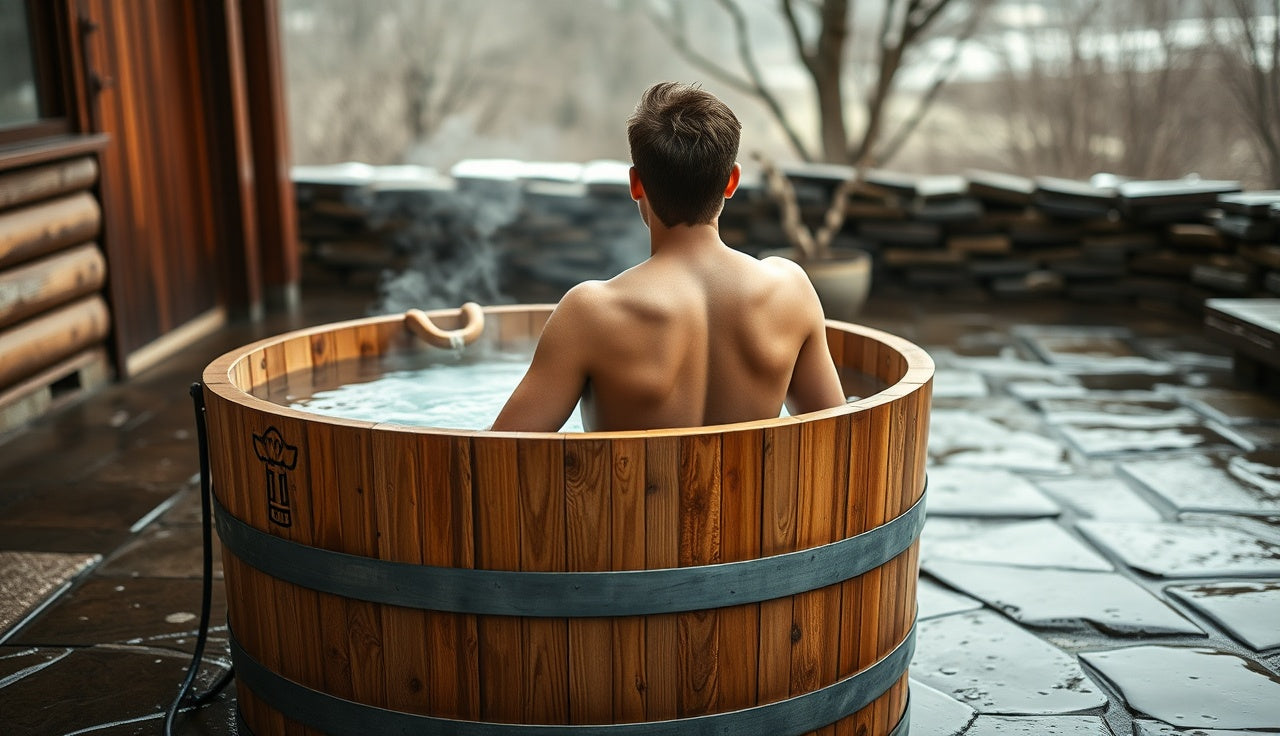
Barrel-style plunges, the wooden cylinder format, usually give 27 to 32 inches of usable depth when filled. The upright cylindrical shape wastes no headroom and fills deep relative to its footprint. These are the most reliable for shoulder immersion.
Rectangular fiberglass and acrylic models are all over the map. Entry-level units sold as "ice bath tubs" can be as shallow as 18 to 20 inches inside, which only covers up to mid-chest. Premium freestanding models usually spec 26 to 30 inches.
Inflatable plunge tubs, the popular budget pick, typically offer 24 to 28 inches of depth. But the inflatable sidewall eats 1 to 2 inches per side, so the interior is smaller than the box photo suggests.
Steel stock tanks, the agricultural trough conversion that caught on in cold exposure circles, come in standard depths. The 2-foot (24-inch) oval tank is borderline for shoulders on an average adult. The 2.5-foot (30-inch) tank works for most people [4].
Comparing options? The cold plunge collection page lists specs alongside filtration and chilling, both of which decide whether you'll still be using the tub in a year.
| Under 5'4" (22 in min) | 22 |
| 5'4" to 5'10" (24 to 26 in min) | 25 |
| 5'10" to 6'2" (26 to 28 in min) | 27 |
| Over 6'2" (28 to 30 in min) | 29 |
Source: ANSUR II anthropometric data via U.S. Army Natick Soldier Center; SweatDecks editorial estimates
Does immersion depth actually affect the physiological benefits of cold water therapy?
Yes, and more than most people expect. The cold-water effects people chase (norepinephrine release, reduced muscle soreness, and the cardiovascular reflex called cold shock) scale with the skin surface in contact with cold water. More immersion, more receptor activation.
One widely cited line of research from Finnish cold-exposure labs found that whole-body immersion to the neck produced norepinephrine increases roughly tripling resting baseline, with chest and shoulder immersion landing at intermediate levels [5]. Depth is a lever, not a rounding error.
For muscle recovery, the evidence points toward at least waist-deep immersion as a threshold for meaningful effects on delayed-onset muscle soreness (DOMS), with some data favoring shoulder-level immersion after upper-body training. The systematic review by Machado and colleagues in the Journal of Strength and Conditioning Research (2016) found immersion depth was one of several variables that moderated recovery outcomes, alongside water temperature and duration [6].
Nobody has clean data on the exact centimeter where the effect falls off. But the read across the literature is steady: cutting depth to save money or space trades away a real slice of the physiological effect, more than comfort.
More on the evidence base sits in the cold plunge benefits guide.
How deep does a cold plunge need to be for full neck and chin immersion?
If shoulders take 24 inches, neck immersion (water to the base of the skull) needs another 4 to 6 inches on top for the average adult. Call it 28 to 32 inches of water depth for full neck-level exposure.
Few consumer tubs reach 32 inches of usable depth in a standard upright sit. To get there you either buy a tub with unusually deep construction or you take a lower seating position, which some tubs allow through a reclined or near-supine design. Certain commercial plunge pools are built for horizontal submersion, which erases the depth constraint but demands a much bigger footprint.
Here's the compromise most people land on. Buy a tub with 28 to 30 inches of depth, then lean back or slide down so shoulders and the base of the neck go under. No heroic posture required, and it works in most barrel or rectangular plunges in that range.
For the cold shock response, full neck submersion does produce a stronger initial hit than shoulders alone, partly because the cooling reaches vagus nerve pathways in the neck. But the sustained benefit from a 5 to 10 minute session shows up at shoulder level too. Don't let perfect wreck a good ice bath setup.
How does a seated cold plunge compare to a walk-in or lying-down design?
This is the biggest dimension decision you'll make. Three basic configurations exist, and each has a different relationship between overall tub size and effective immersion depth.
Seated upright (most common): You sit on the tub floor, legs in front. Shoulder immersion takes 24 to 28 inches of depth, but the footprint stays small. A 28-inch diameter barrel handles it fine. Most space-efficient design going.
Reclined / semi-supine: You lean back against one end at an angle. That lowers your shoulder height relative to the floor, so you get coverage with slightly less depth (sometimes 20 to 22 inches), but the tub has to be longer. Good for people with limited hip mobility who find deep upright seating rough.
Lying flat (supine): You need a tub at least 6 feet long and only 14 to 16 inches deep, since the body is horizontal. Horizontal tubs burn far more water volume, and therefore far more chilling capacity, than upright designs. The immersion is excellent. The cost and space are not.
For most home setups, seated upright at 26 to 28 inches is the practical sweet spot. It handles the widest range of bodies, fits smaller spaces, and keeps water volume (and chilling costs) sane.
What interior dimensions should you look for when buying a cold plunge tub?
Depth is the number that decides everything, but it works with width and length. Check these four before you buy.
Interior usable depth first. Ask for the depth from the interior floor surface to the fill line or overflow drain. Some brands list exterior height, which can run 2 to 4 inches taller than actual water depth. You want the figure after subtracting floor panel thickness and any lid-seal overlap.
Interior width or diameter next. You need room to sit without your knees jammed into the sidewall. Minimum comfortable interior width for one person is about 22 to 24 inches. Barrel plunges at 28 to 32 inches inner diameter work well. Anything under 20 inches interior feels claustrophobic before the first minute is up.
Entry height third. On standalone plunges you often step up and over the rim. A tub standing 32 to 36 inches tall with a rim at the same height makes entry awkward without a step stool. Check whether a step is included, or budget for one.
Fill volume last. Volume decides how fast temperature drifts once you get in. A seated tub with 26 inches of depth and a 28-inch inner diameter holds roughly 80 to 100 gallons. That's enough thermal mass to hold temperature well with an active chiller, but it'll warm noticeably during a session without one.
SweatDecks lists interior depth specs in product descriptions across barrel and rectangular formats. Verify them against your own measurements before ordering.
Can you modify a DIY or stock tank cold plunge to get adequate depth?
Yes, and it's one of the most common workarounds in the home cold-exposure world.
The Rubbermaid 300-gallon oval stock tank is about 26 inches deep, with roughly 24 inches of usable water depth once you account for the rim lip and body displacement [4]. That covers shoulders for most adults in the 5'6" to 6'0" range. The 150-gallon model is only 24 inches deep and runs tight for taller users.
Working with a tub that's slightly too shallow? A few moves help, and one common one hurts. Adding a false floor insert (a grated platform) raises your seated position and paradoxically cuts depth. Wrong move for shoulders. Instead, make sure you're not stacking extra floor material, and fill to the maximum safe level.
Another angle: lower your body position. A sunken installation, where the tub recesses partway into a deck, doesn't change water depth, but it eases entry and nudges people to sit lower, which raises effective immersion.
For custom builds, structure is the real limit. An outdoor wooden plunge holding 30 to 32 inches of water exerts serious hydrostatic pressure on the walls (water pushes about 0.433 PSI per foot of depth, so around 1.1 PSI at the base of a 32-inch column). Framing and liner choice matter more as depth grows [7]. Well inside normal construction ability, but plan for it.
How does cold plunge depth affect water temperature and chilling requirements?
Deeper water means more volume, and that cuts both ways.
More volume holds temperature more stably once chilled (better thermal mass), but it takes longer and more energy to chill in the first place. A 100-gallon tub cooled to 50°F (10°C) by a 1/4-horsepower chiller might take 4 to 6 hours from ambient. A 150-gallon tub from the same starting point could take 8 to 10 hours on the same chiller. Larger volumes cool proportionally slower for a given chiller capacity [8].
This bites hardest for people who want daily plunges without a dedicated chiller. Rely on ice, and more volume means more ice per session. The community rule of thumb: roughly 1 pound of ice per gallon drops water temperature about 10°F starting from 65°F tap water, though it swings with ambient conditions [9]. An 80-gallon tub wants 80 pounds of ice for a 10°F drop. Expensive and annoying at scale.
So the implication is clean. Want true shoulder immersion (24 to 28 inch depth) without a chiller? A compact seated-upright format is far more manageable than a big horizontal tub. Buying a chiller? The volume gap between a 26-inch and a 30-inch deep tub is small enough that it shouldn't drive your decision. Let immersion depth pick the tub, then size the chiller to the volume.
Are there safety considerations with deeper cold plunge tubs?
A few, and they matter most for home setups.
Deep immersion to chest, shoulder, or neck level produces a stronger cold shock response than partial immersion. The gasp reflex and hyperventilation are real physiological reactions, more than discomfort, and they peak in the first 30 to 90 seconds [10]. The Royal National Lifeboat Institution's cold water safety guidance identifies cold shock as a primary cause of drowning in sudden cold water immersion, separate from hypothermia [10]. In a controlled home plunge with seated water, the risk sits far below open-water exposure. It isn't zero.
Mitigations that work: never plunge alone, especially your first several sessions. Enter slowly. Keep your face out. If you have cardiovascular disease, Raynaud's, or a history of arrhythmia, talk to a physician before starting. The American Heart Association notes that cold exposure triggers cardiovascular responses including transient blood pressure spikes [11].
On tub design: avoid smooth, steep interior walls with no grip point. A built-in grab handle or textured rim matters more in a 28-inch-deep tub than a shallow one, because you're climbing out of a deeper, colder position with tired muscles.
Children should not use full-depth plunge tubs without supervision, and never at neck or head level. Lower body mass means their core temperature drops faster.
What depth do cold plunge manufacturers actually recommend, and how reliable is that guidance?
Most manufacturers don't publish a "minimum depth for shoulder immersion" spec at all. They give overall tub dimensions and sometimes a lifestyle photo showing how a person fits inside, which tells you more than you'd think.
The honest picture: guidance here is variable and unstandardized. There's no ANSI or ISO cold plunge immersion depth standard the way there are standards for hot tubs and spas (which fall under ANSI/APSP-14 for portable residential electric spas, covering electrical and structural safety, not immersion ergonomics) [12].
What you can trust: a stated interior depth measurement, in consistent units across a spec sheet, is usually reliable. What you can't: marketing copy calling the experience "full-body immersion" with no depth figure, or photos that cast shorter-torso models to make the depth look adequate.
Before buying, ask the manufacturer or retailer for interior usable water depth at maximum fill. If they can't answer directly, that's an answer too.
For the wider view on evaluating and comparing options, the cold plunge buying guide walks through the specs worth checking.
Frequently asked questions
What is the minimum cold plunge depth for shoulder immersion?
The minimum is 24 inches of usable interior water depth for adults in the 5'4" to 5'10" range sitting on the tub floor. Taller users over 6 feet should target 27 to 30 inches. These figures cover seated torso height plus a few inches of buffer, so shoulders stay submerged without awkward arching of the neck.
Is 20 inches of water depth enough for a cold plunge?
Not for shoulder immersion. At 20 inches, most adults sit with water at mid-chest. That still delivers meaningful cold exposure to the core and torso, but it misses the upper back, shoulder cap, and neck. For a plunge that actually covers your shoulders, 24 inches is the practical floor.
How deep is the water in a typical barrel cold plunge tub?
Barrel cold plunges typically give 26 to 32 inches of usable water depth, one of the most reliable formats for shoulder immersion. The upright cylindrical shape produces deep water relative to its footprint. Standard consumer barrels run 26 to 30 inches inner diameter and 28 to 34 inches tall, with 2 to 4 inches of wall and base subtracting from the exterior height.
Do I need neck immersion to get the benefits of a cold plunge, or is shoulder depth enough?
Shoulder depth covers most documented benefits: reduced delayed-onset muscle soreness, norepinephrine elevation, cardiovascular response. Neck immersion produces a stronger initial cold shock reflex and may add marginally greater neurochemical response, but the evidence for a meaningful recovery difference between shoulder and neck depth is thin. Most people do fine at 24 to 28 inches.
How much water does a seated cold plunge tub hold at the right depth for shoulder immersion?
A seated barrel plunge at 28 inches inner diameter and 26 inches of water depth holds roughly 80 to 95 gallons after body displacement. Rectangular models vary more. Volume drives chiller sizing and ice needs: expect a chiller rated for at least 100 gallons, or around 80 to 100 pounds of ice per session without one.
Can a stock tank work as a cold plunge with enough depth for shoulders?
Yes. The Rubbermaid 300-gallon stock tank runs about 26 inches deep with 24 to 25 inches of usable water depth, which covers shoulders for most average-height adults. The 150-gallon model is shallower (around 24 inches total) and marginal for taller users. Stock tanks are a cost-effective DIY option but need separate chilling or ice to hit target temperatures.
What cold plunge depth should a 6-foot-tall person look for?
A 6-foot person typically has a seated shoulder height around 22 to 24 inches from the floor. To keep the shoulders submerged with margin, look for at least 27 to 28 inches of interior water depth. A 30-inch depth gives comfortable coverage and room for posture shifts during the session without losing immersion.
Does a reclined or lying-down cold plunge require less depth than a seated one?
Yes. Fully reclined (supine), shoulder coverage takes only 14 to 16 inches of depth because the body lies horizontal. But the tub has to be much longer (at least 6 feet) and holds far more water. For most home users, the space and cost of a full-length horizontal plunge make the seated upright format more practical, even though it needs more depth.
How does cold plunge depth affect safety?
Greater depth means more cold skin contact, which produces a stronger cold shock response (gasp reflex, hyperventilation) in the first 60 to 90 seconds. Manageable in a controlled home setting, but it's exactly why plunging with someone nearby matters. People with cardiovascular conditions should consult a physician before full shoulder-depth immersion. Entry and exit safety (grip points, non-slip surfaces) also matters more at greater depths.
What should I measure to know if a cold plunge will cover my shoulders?
Sit on a flat floor with your legs straight in front of you. Have someone measure from the floor to the top of your shoulder, the bony peak at the shoulder cap. Add 3 to 4 inches. That result is the minimum interior water depth you need for reliable shoulder immersion. Compare it against the manufacturer's stated interior usable depth at maximum fill.
Does water temperature change what depth I need for an effective cold plunge session?
Temperature and depth are independent, but they interact in total physiological stimulus. Colder water (50°F vs 60°F) drives greater vasoconstriction and neurochemical response per unit of skin area, so a shallower but colder plunge partly compensates for less depth. At a given temperature, though, more depth means more benefit. The standard target stays 50 to 59°F (10 to 15°C) at shoulder depth.
Are there any standards or regulations for cold plunge tub dimensions?
No immersion-depth standards exist for cold plunge tubs. Hot tub and spa standards like ANSI/APSP-14 cover electrical, structural, and suction safety for portable spas but set no ergonomic depth requirements. Cold plunge tubs also fall outside most local building permits unless installed with electrical, plumbing, or as permanent structures. Requirements vary by municipality, so check your local building department.
How do I compare cold plunge tub depth specs across brands?
Always request interior usable water depth at maximum fill, not exterior height. Ask whether the measurement starts at the interior floor surface or includes a raised seat platform. Request fill volume in gallons to cross-check: divide fill volume by 7.48 (gallons per cubic foot) and reconcile against the stated interior dimensions. Gaps between stated depth and fill volume usually reveal measurement discrepancies.
Can I raise the water level above the overflow drain to get more depth?
No, and don't try. Overflow drains prevent flooding and hold a safe water level for the tub's structural design and electrical components. Blocking or bypassing a drain creates a flood risk and can void the warranty on chillers or filtration. If the maximum fill depth doesn't meet your shoulder-immersion target, the tub is simply the wrong size for your body.
Sources
- U.S. Army Natick Soldier Center, Anthropometric Survey of U.S. Army Personnel (ANSUR II): Seated shoulder height (acromion height) ranges approximately 19 to 26 inches across the adult male and female military population, informing the depth table by height bracket
- OSHA, Computer Workstations eTool: Anthropometry reference data: Seated shoulder height measurements used as reference anthropometric data for depth calculations
- U.S. Consumer Product Safety Commission, Portable Spas and Hot Tubs safety information: Cold plunge tub depth specs are not standardized by any federal body; product dimensions vary by manufacturer and category
- Rubbermaid Commercial Products, Structural Foam Stock Tank specifications (300-gallon and 150-gallon): Rubbermaid 300-gallon stock tank has approximately 26-inch exterior depth; 150-gallon model is approximately 24 inches deep
- Makinen TM et al., 'Autonomic nervous function during whole-body cold exposure before and after cold acclimation,' Aviation Space and Environmental Medicine (2008): Cold water immersion to neck level produced norepinephrine increases approximately three times resting baseline; partial immersion produced intermediate effects
- Machado AF et al., 'Can Water Temperature and Immersion Time Influence the Effect of Cold Water Immersion on Muscle Soreness? A Systematic Review and Meta-Analysis,' Journal of Strength and Conditioning Research (2016): Immersion depth was identified as a moderating variable in cold water immersion recovery outcomes alongside temperature and duration
- USDA Forest Service, Forest Products Laboratory, Wood Handbook: Wood as an Engineering Material (FPL-GTR-190): Hydrostatic pressure principles for custom wooden plunge builds; water exerts approximately 0.433 PSI per foot of depth, relevant to structural design at 30-plus inch water depths
- U.S. Department of Energy, Energy Saver: water heating and thermal performance guidance: Thermal mass principles applied to chiller sizing: larger water volumes take proportionally longer to cool with a given chiller capacity
- Engineering ToolBox, Specific Heat of Water and Ice reference data: Ice-to-water temperature reduction: approximately 1 pound of ice per gallon for a 10°F temperature drop starting from 65°F ambient, used as rule-of-thumb reference
- Royal National Lifeboat Institution (RNLI), cold water safety guidance: Cold shock response (gasp reflex, hyperventilation) peaks in first 30 to 90 seconds of cold water immersion and is identified as a primary drowning risk in sudden cold water exposure
- American Heart Association, scientific statement on temperature extremes and cardiovascular disease: Cold immersion triggers cardiovascular responses including transient blood pressure elevation; people with cardiovascular conditions advised to consult a physician before cold immersion
- Pool & Hot Tub Alliance (PHTA), ANSI/APSP-14 Standard for Portable Electric Spas: ANSI/APSP-14 covers structural and electrical safety for portable residential spas but does not set ergonomic immersion depth requirements; no equivalent standard exists for cold plunge tubs

Share:
What size cold plunge fits two people?
Cold plunge tub length for a 6'4" person: what actually fits