
Last updated 2026-07-09
TL;DR
Thermal contrast therapy alternates heat exposure (sauna, steam, hot bath) with cold immersion (ice bath, cold plunge) in repeated cycles. Most protocols run 2-4 rounds of roughly 10-20 minutes hot followed by 2-5 minutes cold. Research shows circulation gains and reduced muscle soreness, though the best timing ratios stay debated. It works best as a recovery tool, not a substitute for sleep or training.
What is thermal contrast therapy?
Thermal contrast therapy is the deliberate alternation of hot and cold exposures, usually across two to four cycles, to drive responses that neither heat nor cold alone produces at the same intensity. You heat the body, cool it, then heat it again. The swing between states is the whole point.
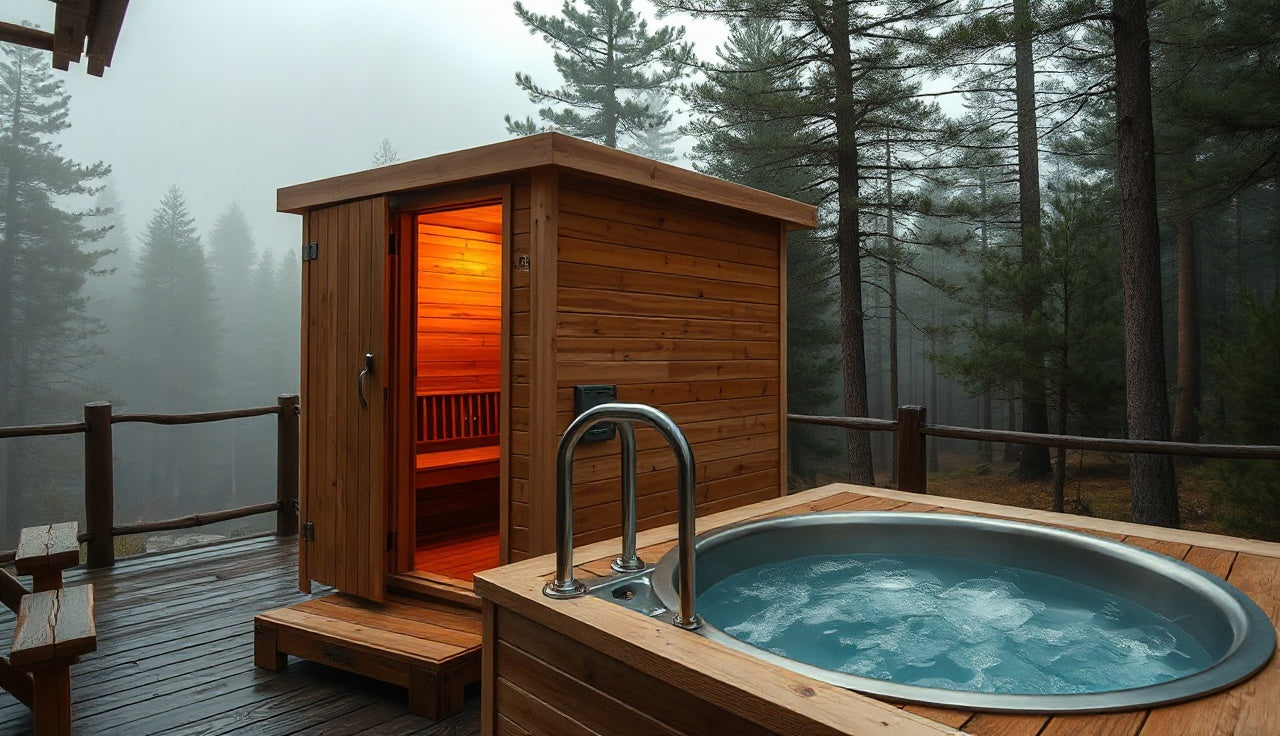
The practice goes back centuries. Finnish sauna culture has always paired the löyly with a roll in the snow or a plunge into a cold lake. Nordic spas built the same idea into a formal circuit. What's newer is the sports science interest in the mechanism, and the home wellness market's ability to deliver it affordably with home saunas and cold plunges sitting side by side in a backyard.
The core idea is vascular. Heat dilates blood vessels. Cold constricts them. Cycling between the two creates what researchers sometimes call a "vascular pump," a repeated squeeze-and-release of the circulatory system. The clinical question is whether that pump delivers recovery and health outcomes beyond passive rest. The honest answer: probably yes for some things, less clear for others.
What does the science say about contrast therapy benefits?
The research base is real but thin, and most studies use athletes rather than the general population. A 2013 meta-analysis in the Journal of Strength and Conditioning Research examined cold-water immersion and contrast water therapy across 17 studies and found contrast therapy reduced delayed-onset muscle soreness (DOMS) more than passive recovery at 24 and 48 hours post-exercise [1]. The effect sizes were modest, not dramatic.
A separate review in the British Journal of Sports Medicine looked at recovery modalities and noted cold-water immersion produced statistically significant reductions in DOMS and perceived fatigue, but the benefit was small enough that the authors cautioned against over-relying on cold if hypertrophy is the goal [2]. This matters. There is reasonable evidence that cold right after strength training may blunt some of the molecular signaling (specifically mTOR pathway activity) that drives muscle protein synthesis. So contrast therapy is probably better scheduled after sport or cardio than immediately after heavy lifting when building muscle is the priority.
On circulation, a study in the International Journal of Sports Medicine found contrast water therapy significantly increased limb blood flow compared to passive rest [3]. Heart rate variability, an indirect marker of autonomic recovery, has improved in some small trials, but study quality is inconsistent. The circulation and soreness data are the most credible. Claims around immune function, sleep, and metabolic effects are plausible but rest on weaker or indirect evidence.
One thing the research supports clearly is the subjective experience. People rate contrast therapy as feeling more restorative than rest alone, and perceived recovery has real value for training consistency even when objective biomarker changes stay small.
What is the best protocol ratio of hot to cold?
Nobody has settled this with a definitive trial. The protocols in the literature vary enough that calling one ratio "optimal" would be dishonest. That said, the most-studied ratios cluster around 3:1 or 4:1 hot-to-cold by time.
A frequently cited sports medicine protocol runs three to four cycles of three to four minutes hot followed by one minute cold [4]. Nordic spa circuits go longer on the heat side: ten to twenty minutes in a sauna or steam room, then two to five minutes in cold water, repeated two to four times. The longer-heat version is more traditional and easier for beginners. The shorter-cycle version may produce a sharper cardiovascular stimulus.
Here is what a reasonable starting protocol looks like:
| Phase | Duration | Temperature |
|---|---|---|
| Heat (sauna/steam) | 10-15 min | 176-194°F (80-90°C) |
| Cold (plunge/shower) | 2-3 min | 50-59°F (10-15°C) |
| Rest | 5 min | Ambient |
| Repeat | 2-3 more rounds | Same |
The rest phase is optional but useful for beginners. It lets your heart rate settle and makes the session more sustainable. Most people find two full cycles is plenty for the first few weeks. Experienced practitioners run three or four.
Temperature matters more than duration up to a point. A cold shower at 65°F does not produce the same vasoconstriction stimulus as immersion at 50°F. Water beats air every time because it pulls heat off the body roughly 25 times faster [5]. A cold plunge or ice bath is not a luxury upgrade. It is a functionally different stimulus.
| Contrast water therapy | 74% |
| Cold-water immersion alone | 66% |
| Warm-water immersion | 38% |
| Passive rest | 0% |
Source: Journal of Strength and Conditioning Research, Poppendieck et al. 2013
How does contrast therapy compare to sauna alone or cold plunge alone?
Each modality does something distinct. Sauna alone drives heat shock protein production, plasma volume expansion over repeated sessions, and cardiovascular adaptations that look a bit like aerobic training. The sauna benefits research, particularly Laukkanen et al.'s work from the University of Eastern Finland, found that frequent sauna use (four to seven times per week) was associated with reduced cardiovascular disease risk in a long-term Finnish cohort [6]. That research tracked standalone sauna use. It did not test contrast therapy.
Cold plunge or ice bath alone drives norepinephrine release (studies find increases of 200-300% from cold exposure), some reduction in inflammation markers, and the well-documented soreness relief. The Søberg et al. 2021 paper in Cell Reports Medicine showed deliberate cold exposure also increased brown adipose tissue activity, relevant to the metabolism discussion [7].
Contrast therapy adds the oscillation. The vascular pump effect is specific to cycling. If your main goal is cardiovascular adaptation over months, regular sauna alone has more research behind it. If your main goal is post-game recovery the next morning, contrast therapy probably beats either modality alone based on the DOMS data. If you enjoy the ritual and the feeling, contrast therapy wins on adherence, the most underrated variable in any wellness protocol.
| Goal | Best Evidence For |
|---|---|
| Long-term cardiovascular health | Sauna alone (frequent use) |
| Acute muscle soreness reduction | Contrast therapy or cold alone |
| Norepinephrine / mood | Cold alone |
| Relaxation, parasympathetic activation | Sauna alone |
| Perceived recovery (subjective) | Contrast therapy |
Is thermal contrast therapy safe, and who should avoid it?
For healthy adults, yes, contrast therapy is safe with common sense. The main risks are cardiovascular stress from the temperature swings, dehydration from heat, and the cold shock response.
The cold shock response is the involuntary gasp and hyperventilation that hits in the first thirty seconds of cold immersion. It is the leading cause of drowning in open cold water and can trigger cardiac arrhythmias in people with underlying heart conditions [5]. That is why entering cold water slowly, especially below 60°F, matters. If you can control your breathing before you are fully submerged, you have adapted enough to proceed.
Talk to a doctor first if you have diagnosed heart disease, arrhythmia, or uncontrolled hypertension, if you take medications that affect blood pressure or vasodilation, or if you are pregnant. The American College of Sports Medicine does not publish a specific contrast therapy protocol, but its general position on heat exposure recommends avoiding saunas during pregnancy because elevated core body temperature carries teratogenic risk [8].
Dehydration is the most common practical problem. A typical sauna session can produce 0.5 to 1.0 kg of sweat per hour depending on temperature and individual variation [9]. Drink water before and between cycles. Alcohol before or during a session is a bad idea. It blunts the cardiovascular response, adds dehydration risk, and wrecks your read on how you actually feel.
Age alone is not a contraindication. Older adults can do contrast therapy safely, but should start with more conservative temperatures and shorter cold exposures, and should never do it alone until they know their personal response.
Does contrast therapy help with muscle recovery after workouts?
This is the strongest use case in the literature. The 2013 meta-analysis found contrast water therapy produced significant reductions in DOMS at 24 and 48 hours post-exercise versus passive rest [1]. Several mechanisms are proposed: the vascular pump flushing metabolic byproducts from muscle tissue, reduced edema from cold-induced vasoconstriction, and reduced neural sensitivity to pain from the cold stimulus.
The timing caveat from the British Journal of Sports Medicine review bears repeating. If you just finished a hypertrophy-focused strength session and you want maximum muscle growth from it, jumping into cold water immediately afterward may reduce the anabolic signaling that drives that adaptation [2]. The research here is not fully settled, but the cautious read is to wait at least one to two hours after a heavy lift before cold immersion, or to save contrast therapy for after endurance and sport sessions.
For team sport athletes, endurance runners, cyclists, and anyone doing two-a-day sessions who needs to feel recovered for the next training block, contrast therapy is one of the better-supported tools available. It does not replace sleep, nutrition, or load management. As an add-on, it has meaningful evidence behind it.
What equipment do you actually need to do contrast therapy at home?
The minimum viable setup is a way to get hot and a way to get cold. In practice, that means some form of sauna or heated space and some form of cold immersion.
On the heat side, options include a traditional Finnish sauna, an infrared sauna, a steam room, or a very hot bath. Traditional saunas running 176-212°F give the most intense heat stimulus and the closest match to the research protocols. Infrared saunas operate lower, typically 120-150°F, and produce a different stimulus. They still raise core temperature, just less aggressively and with less ambient heat stress. A home sauna built for your backyard or garage is the most popular long-term solution.
On the cold side, a dedicated cold plunge is the most controllable option because it holds a set temperature. A filled bathtub with ice works but needs resetting every session and lacks precise temperature control. A cold shower is the lowest barrier to entry but, as noted above, produces a meaningfully weaker stimulus than immersion.
Want a starting point without major spend? A portable sauna paired with a cold shower is a legitimate introductory protocol. You will hit the ceiling of what that setup can do within a few months, but it is a real stimulus. The upgrade path is a full outdoor sauna and a cold plunge unit, which is what most serious practitioners end up running. SweatDecks carries both categories and has pairing options for homeowners designing a contrast therapy setup from scratch.
One space note. You need to move between hot and cold within about two minutes to preserve the thermal contrast. If your sauna and cold plunge sit far apart, you lose the stimulus on the transition. Co-locate them if you can.
How hot and how cold should the water actually be?
On the heat side, traditional sauna temperatures run 176-212°F (80-100°C) with relatively low humidity, or lower with steam rooms that compensate with high humidity (see sauna vs steam room for a full comparison). The variable that matters is core body temperature rise. You want your core to reach roughly 38.5-39°C (101-102°F), the threshold where most of the acute responses kick in. A 10-15 minute sauna session at proper temperature gets most people there.
On the cold side, the research generally uses water at 50-59°F (10-15°C) for immersion [1][4]. Below 50°F intensifies the cold shock response without clear added benefit for most people. Above 65°F, the vasoconstriction stimulus weakens considerably. The sweet spot most practitioners settle on is 50-55°F for the plunge.
If you are starting out and 50°F feels overwhelming, begin at 60°F and lower the temperature over weeks. Adaptation to cold is real. Most people who stick with it report the cold feeling manageable within two to four weeks of consistent sessions. The first thirty seconds stay the hardest part regardless of experience.
How does contrast therapy fit into a weekly training schedule?
There is no universal schedule, but some patterns work better than others. Most athletes who use contrast therapy run it two to four times per week, usually on high-volume training days or the days right after.
A common structure for an endurance athlete:
- Monday: hard training, evening contrast session
- Tuesday: easy training or rest
- Wednesday: hard training, evening contrast session
- Thursday: moderate training
- Friday: hard training, contrast session
- Saturday/Sunday: long session, optional sauna only (no cold)
The sauna-only days give the body heat adaptation benefits without the potential interference with muscle protein synthesis. The contrast days target acute recovery.
For general fitness rather than competitive sport, the schedule matters less than consistency. Two sessions per week of even one or two cycles each produces noticeable effects on how people feel and recover. Adherence beats perfection. A shorter protocol you actually do beats a flawless one you skip.
Does contrast therapy help with inflammation or injury recovery?
This is an area where the marketing gets ahead of the science. Cold does reduce acute inflammation, and that is well established. Applying cold to a fresh acute injury (sprains, contusions) in the first 24-48 hours can reduce swelling and pain. Most sports medicine guidelines support this for acute injury management [8].
Chronic inflammation is more complicated. Systemic markers like CRP and IL-6 have dropped in some cold exposure studies, but the magnitude and clinical relevance for people without diagnosed inflammatory conditions is unclear. Nobody has run a large randomized controlled trial on contrast therapy for inflammatory diseases.
For general recovery from training-induced microtrauma, the soreness data is the most direct evidence of an anti-inflammatory effect that matters to most users. The reduction in DOMS at 24-48 hours in the meta-analysis corresponds to feeling less stiff and sore, which has practical value even if it tells us little about long-term inflammation biology.
One honest caveat. If you have a chronic injury, say a tendon problem or a stress reaction, adding cold may mask pain signals in a way that lets you overtrain. Pain is information. Use contrast therapy for recovery, not to silence the signals your body is sending about tissue overload.
What does a beginner's first contrast therapy session actually look like?
Keep it simple. One or two cycles. Do not start with extreme temperatures on either end.
A reasonable first session: 1. Warm up for five minutes at ambient temperature. Do not start cold or come straight from outdoor cold. 2. Enter the sauna at a comfortable temperature, targeting 160-175°F if you are new. Stay eight to twelve minutes. Drink water before you go in. 3. Get out and move to cold within two minutes. Start with a cold shower if you do not have a plunge. Aim for thirty seconds to one minute at the coldest comfortable setting. 4. Rest for five minutes. Drink more water. See how you feel. 5. If you feel good, do one more cycle with the same parameters. 6. End on cold if you want alertness afterward. End on heat if you want relaxation.
Most people end on heat because it feels better going into an evening. The finishing temperature shapes the parasympathetic versus sympathetic outcome. A cold ending fires the sympathetic nervous system and tends to produce alertness. A heat ending shifts toward parasympathetic dominance and relaxation. Neither is wrong. They serve different contexts.
SweatDecks has a breakdown of specific equipment setups for home contrast therapy if you want to go deeper on the hardware once you have tried the protocol and know you want to invest in it.
Track how you feel the next morning. Most people notice something: less stiffness, better sleep, or a vague sense of having recovered faster. That feedback loop is what builds the habit.
Frequently asked questions
Should you end contrast therapy on hot or cold?
It depends on what you want afterward. Ending on cold fires the sympathetic nervous system, leaving you alert and energized, which suits morning sessions or a workday. Ending on heat drives parasympathetic activation, promoting relaxation and better sleep onset. Most evening users end on heat. Most morning users end on cold. Neither is physiologically harmful.
How long should a full contrast therapy session take?
A typical session with two to three cycles runs 45 to 75 minutes including transitions and rest periods. Each cycle is roughly 10-20 minutes of heat followed by 2-5 minutes of cold plus a 5-minute rest. Beginners often finish in 30-40 minutes with one or two cycles. You do not need to go longer to get benefit. Consistency across weeks matters more than session length.
Can contrast therapy help with anxiety or mental health?
Cold exposure reliably increases norepinephrine, with studies showing increases of 200-300% from short cold immersion. Norepinephrine affects mood and focus. Sauna use in observational data has been associated with reduced depression risk, though the causal direction is not certain. Most people report feeling calmer and clearer after contrast sessions. The evidence is promising but not conclusive enough to recommend it as a mental health treatment.
Is contrast therapy the same as contrast water therapy?
Essentially yes. Contrast water therapy (CWT) is the clinical research term and usually refers to alternating hot and cold water baths in a sports medicine setting. Thermal contrast therapy is the broader consumer term that includes saunas and steam rooms on the heat side. The underlying physiology is the same: cycling vasoconstriction and vasodilation. Research on CWT applies directly to sauna-and-plunge setups.
Does contrast therapy burn calories or help with weight loss?
Cold exposure does increase metabolic rate modestly as the body works to hold core temperature. Sauna sessions raise heart rate in ways that superficially resemble light cardio. Neither produces meaningful calorie expenditure compared to actual exercise. Research on brown adipose tissue activation from cold is real but has not translated into clinically significant weight loss in human trials. Weight loss is not a well-supported primary use case.
How cold does a cold plunge need to be for contrast therapy to work?
Research protocols generally use 50-59°F (10-15°C). Below that intensifies the cold shock response without clear added recovery benefit. Above 65°F, the vasoconstriction stimulus weakens significantly. For practical home use, targeting 50-55°F gives you the physiological response described in most studies while staying in a range you can manage with consistent practice.
Can you do contrast therapy every day?
Many people do, particularly the sauna portion. Daily full contrast sessions (multiple cycles of heat and cold) are not contraindicated for healthy adults, but there is no evidence daily use beats four to five times per week. Overuse fatigue from thermal stress is real if sessions run very long. Most experienced practitioners run full contrast two to four times per week and add sauna-only sessions on other days.
Is contrast therapy safe during pregnancy?
No. Sauna use during pregnancy is not recommended due to the risk of elevated core body temperature, associated with neural tube defects particularly in the first trimester. The American College of Sports Medicine and most obstetric guidelines advise against sauna exposure during pregnancy. Cold immersion adds cardiovascular stress. Pregnant women should consult their OB before any thermal therapy.
What is better for soreness: ice bath alone or contrast therapy?
The meta-analysis evidence favors both over passive rest, with contrast therapy showing slightly stronger effects on DOMS at 24 and 48 hours in some analyses. The practical difference is small. If you only have cold available, cold-water immersion alone produces meaningful soreness relief. If you have both, the contrast protocol is worth doing because the subjective recovery benefit is consistently higher across studies.
Does contrast therapy interfere with muscle growth?
Cold water immediately after strength training may blunt muscle protein synthesis signaling, particularly through the mTOR pathway. A British Journal of Sports Medicine review flagged this as a real concern for hypertrophy goals. The practical recommendation is to avoid cold immersion in the first one to two hours after a heavy strength session if maximizing muscle growth is the priority. Contrast therapy is better timed after endurance, sport, or cardio sessions.
How many cycles of hot and cold should you do per session?
Two to four cycles is the range in most research protocols. Beginners should start with one to two cycles and assess how they feel. Three cycles of 10-15 minutes hot and 2-3 minutes cold is a solid intermediate protocol. Four cycles is enough for even experienced practitioners. More than four rarely adds benefit and increases the risk of dehydration and cumulative fatigue from thermal stress.
Can you use a regular bathtub with ice instead of a cold plunge?
Yes, and many people start this way. Fill the tub with cold water and add ice to reach 50-55°F. The limits are setup time (10-15 minutes per session), the need to constantly replenish ice, and no temperature control between sessions. A dedicated cold plunge unit holds a set temperature and is ready instantly, which dramatically improves adherence. The ice bath is a real stimulus. The plunge is just more convenient.
What is the difference between contrast therapy and cryotherapy chambers?
Cryotherapy chambers use extremely cold air (minus 166 to minus 220°F) for two to three minutes rather than cold water immersion. Cold water immersion is far more effective at reducing skin and tissue temperature because water conducts heat roughly 25 times better than air. Most research finds cold water immersion superior to whole-body cryotherapy for soreness reduction. Cryo chambers cost more and are arguably less effective per session.
Sources
- British Journal of Sports Medicine, recovery modality review: Cold-water immersion may blunt mTOR pathway signaling and reduce hypertrophic adaptation when used immediately after strength training
- International Journal of Sports Medicine, Wilcock et al. 2006, contrast water therapy and blood flow: Contrast water therapy significantly increased limb blood flow compared to passive rest
- Journal of Athletic Training, Cochrane 2004, contrast water immersion review: Commonly studied contrast protocols use 3-4 minutes hot followed by 1 minute cold for 3-4 cycles
- National Center for Cold Water Safety, cold shock and immersion physiology: Water conducts heat away from the body approximately 25 times faster than air; cold shock response causes involuntary gasping and can trigger cardiac events
- JAMA Internal Medicine, Laukkanen et al. 2015, sauna use and cardiovascular outcomes in Finnish men: Frequent sauna use (4-7 times per week) was associated with significantly reduced cardiovascular disease risk in a long-term Finnish cohort
- Cell Reports Medicine, Søberg et al. 2021, cold exposure and metabolic effects: Deliberate cold exposure increased brown adipose tissue activity and norepinephrine release, with cold immersion showing increases of 200-300%
- American College of Sports Medicine, position stands and heat/cold guidelines: ACSM advises avoiding sauna during pregnancy due to risk of elevated core body temperature; supports cold for acute injury management
- National Center for Biotechnology Information (NIH), Sawka et al. exercise and fluid replacement literature: A typical sauna session can produce 0.5 to 1.0 kg of sweat per hour depending on ambient temperature and individual variation
- National Institutes of Health, National Library of Medicine, PubMed search: contrast water therapy: Research database supporting literature on contrast water therapy protocols, cold immersion, and recovery outcomes

Share:
Barrel sauna Pure 3 for 1-2 people: what you need to know
Small barrel sauna: what to know before you buy