
Last updated 2026-07-09
TL;DR
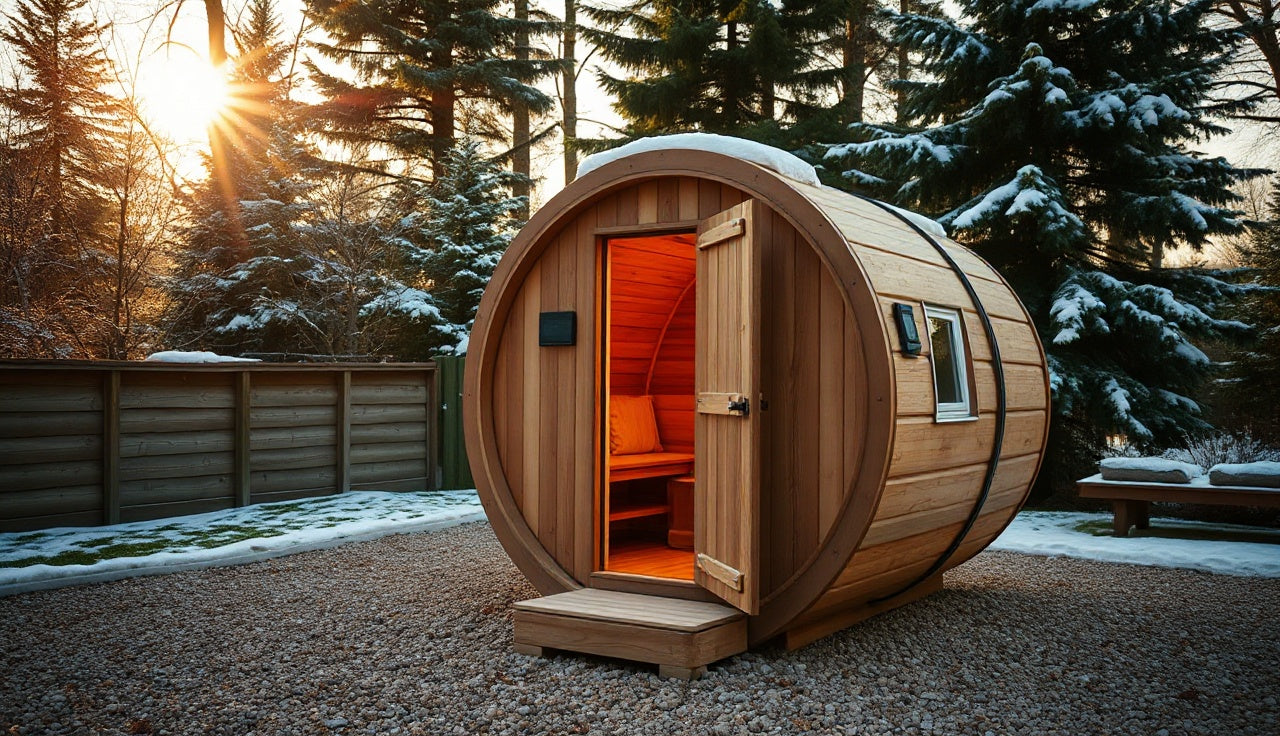
A small barrel sauna is a round, stave-built wood sauna for 1-2 people, usually 4-6 feet across and 6-7 feet long. Basic kits start near $2,000. They heat faster than box saunas, and in most towns they sit on gravel or pavers with no foundation permit. Two people can assemble one in a weekend.
What exactly is a small barrel sauna?
A barrel sauna is a cylinder built from curved wooden staves banded together with metal hoops, the same way a wine barrel is made. The round interior holds less air than a rectangular room of the same footprint, which is why a 4x7-foot barrel heats faster than a 4x7-foot shed-style box.
Small barrel saunas target 1-2 person use. Common sizes run from about 4 feet in diameter and 6 feet long up to 5 feet in diameter and 7 feet long. You'll see "2-person" labels on models that are tight for two adults but roomy for one person who wants to lie down and stretch out.
The shape does real work. The curved ceiling keeps hot air from pooling at a flat peak above your head and channels it back down the walls, which some sauna users say makes the heat feel more even. Whether your body notices that difference is honestly hard to measure. The physics of a smaller air volume heating faster, though, is solid.
Barrel saunas are almost always outdoor units, though a few small models suit a large patio or covered deck. If you're also weighing a traditional indoor box design, our home sauna guide runs the full comparison.
How much does a small barrel sauna cost?
Prices swing hard depending on wood species, heater type, and kit quality. Basic 1-2 person kits start around $1,800. A solid mid-range unit lands near $3,900. Here's an honest breakdown based on market pricing as of mid-2025.
| Category | Typical price range | What you get |
|---|---|---|
| Budget DIY kit | $1,800 - $2,800 | Canadian hemlock or spruce, basic electric heater, no floor |
| Mid-range kit | $2,800 - $5,000 | Western red cedar or Nordic spruce, better heater, floor kit |
| Premium kit | $5,000 - $9,000 | Clear cedar or thermowood, wood-burning stove option, porch add-on |
| Custom or cabin-grade | $9,000 - $20,000+ | Thick stave, lifetime hardware, professional assembly |
The heater is often sold separately from the shell. A decent electric sauna heater for a 1-2 person unit runs $300 to $900 on its own. Budget kits may throw in a 3kW or 4.5kW heater that works but takes longer to reach temperature than a properly sized unit [1].
Shipping is real money. A 4x6-foot barrel kit ships in one to three freight crates weighing 400 to 700 pounds. Expect $200 to $600 in freight depending on your location, and some sellers hide that number until checkout.
Installation labor, if you hire it out, runs $500 to $1,500 for a simple ground-level setup. Most handy homeowners finish a kit in one full day, or two half-days with a partner.
What wood species should a small barrel sauna use?
Wood choice drives heat retention, durability, smell, and how much the barrel moves as the seasons change. The main options:
Western red cedar is the standard for outdoor barrel saunas. It resists rot and insects on its own, has low density so it doesn't soak up heat and burn bare skin, and smells excellent when warm [8]. The catch is cost. Clear cedar stock pushes kit prices up fast.
Nordic spruce (sold as "European spruce" or "Finnish spruce") is what most Scandinavian saunas are built from. It's lighter in color, less aromatic than cedar, and does very well indoors or under cover. It costs less than cedar. In wet climates with no roof over it, it asks for more maintenance.
Thermowood is heat-treated spruce or pine. The process cooks sugars and moisture out of the wood cells, leaving it dimensionally stable, darker, and far more rot-resistant than untreated spruce. It costs more than plain spruce and less than top-grade cedar. For an outdoor barrel that lives in rain and snow, thermowood is a smart pick.
Hemlock shows up in budget kits. It performs acceptably but is softer and less rot-resistant than cedar. Fine under a covered patio, riskier left exposed year-round in a wet region.
Stave thickness matters too. Budget kits use 1.25-inch or 1.5-inch staves. Quality kits use 1.75-inch to 2-inch staves, which hold heat longer between cycles and feel more solid under your hand. Two kits, same price, one with thicker staves? Take the thicker staves.
| Budget DIY kit (hemlock/spruce) | $2,300 |
| Mid-range kit (cedar/Nordic spruce) | $3,900 |
| Premium kit (clear cedar/thermowood) | $7,000 |
| Custom cabin-grade | $14,500 |
Source: Retailer market survey, SweatDecks research, 2025
Electric heater vs. wood-burning stove: which is better for a small barrel sauna?
This comes down to where you're putting it and how much fuss you want. For most homeowners, electric wins.
Electric heaters are the practical choice. You plug in (or hardwire) the unit, set a temperature on a digital or analog control, and walk away. A 4.5kW electric heater in a 4x6-foot barrel reaches 170-185°F in roughly 30-45 minutes [1]. Running cost tracks your electricity rate. At the U.S. average of about 16 cents per kWh (2024 EIA data), a 4.5kW heater running one hour costs roughly 72 cents [2].
Wood-burning stoves give a different kind of heat. The radiant warmth off a real fire, the crackle, the smell of burning birch: these matter to people who take sauna ritual seriously. Heat-up runs longer, 45-75 minutes for most small barrels with a properly sized stove, and you're tending a fire the whole time.
Here's the regulatory catch. Many jurisdictions restrict open-flame outdoor appliances. Some HOAs ban them outright. Some towns require a burn permit or block wood fires during dry season. Check local rules before you commit to a wood stove.
Electric is the better bet for most barrel buyers. But if you have a rural property, love the ritual, and don't mind the wait, a wood-burning stove is genuinely better in ways that are hard to explain until you've sat in one.
Skip propane or gas heaters. They exist, but they need gas line work, carry ongoing certification requirements, and offer no real advantage over electric in a 1-2 person unit.
How fast does a small barrel sauna heat up?
A well-insulated 4x6-foot barrel with a properly sized 4.5kW electric heater reaches 160-175°F in 30-45 minutes in normal outdoor conditions. That speed is one of the main reasons people pick a barrel over a box. The round shape shrinks interior air volume relative to floor space, so the heater has less work to do.
In cold climates (below 20°F ambient), add 10-20 minutes. A 6x8-foot barrel with a 6kW heater takes closer to 45-60 minutes [1].
Compare that to a traditional 6x8-foot rectangular outdoor sauna room running the same heater. The corners and flat ceiling trap dead air and the wall volume is bigger, so heat-up usually runs 60-90 minutes.
Thicker stave wood holds heat longer between sessions, which matters if you do multiple rounds with a cool-down between them (the traditional Nordic protocol). A 2-inch cedar stave barrel stays warm to the touch 30-40 minutes after the heater shuts off. A 1.25-inch hemlock barrel cools noticeably faster.
If you're pairing sauna with a cold plunge, heat-up time shapes whether the habit sticks. The faster the sauna is ready, the easier it is to keep the routine when motivation runs low.
What size small barrel sauna do you actually need?
"Small" means different things depending on the seller, so match the number to how you'll actually use it. A 5-foot diameter by 7-foot long barrel is the sweet spot for most 1-2 person buyers. Here's the practical size guide.
A 4-foot diameter by 6-foot long barrel is the smallest functional unit from reputable makers. Usable width after the stave curve is roughly 48 inches bench-to-bench. One person sits comfortably or lies down with knees bent. Two people sit shoulder-to-shoulder. This is honestly a solo sauna.
A 5-foot diameter by 7-foot long barrel is the most popular "small" option sold. Interior width is closer to 57-60 inches. Two adults sit comfortably side by side. One person can lie flat. Buy this if you want flexibility.
A 6-foot diameter barrel at any length is really a medium sauna. Interior bench width approaches 70 inches, and many models seat 3-4 people. If you use it alone or with one partner, the extra heating cost isn't worth it.
Ceiling height matters too. The top of the arc inside a 4-foot diameter unit hits roughly 47-50 inches at the peak. Most people sit in a sauna, so that's fine for seating, but you'll duck entering and exiting. A 5-foot or 6-foot diameter barrel gives you a peak interior height around 56-68 inches, usable standing height for most adults.
If tight space is your main driver and you want something that stores or moves, look at the portable sauna category too, though those trade heat quality for portability.
Does a small barrel sauna need a foundation or permit?
Usually no permit for the structure itself, and no poured foundation. Most buyers don't ask this until after the kit ships. The answer depends on your municipality and how the sauna is classified.
Most small barrel saunas (under 200 square feet of floor area) count as accessory structures in the U.S. Many local building codes exempt small accessory structures from permit requirements entirely. The International Residential Code, which most U.S. jurisdictions adopt with local amendments, exempts one-story detached accessory structures used as tool or storage sheds with a floor area of 200 square feet or less from many provisions. Local amendments often set that threshold lower, at 100 or even 60 square feet [3].
A 4x6-foot barrel covers roughly 24 square feet. A 5x7-foot barrel is about 35 square feet. Both sit well under any local exemption threshold. Check with your local building department, not the sauna seller.
Electrical permits are a separate matter. If your electric heater needs a dedicated 240V circuit (anything above about 1.5kW), that circuit installation requires an electrical permit and inspection in most jurisdictions [9]. A licensed electrician pulling the permit is the right call. Budget $300-$700 for that work.
As for the foundation: barrel saunas sit on two pressure-treated or cedar runners (often called cradles) that come with the kit. Those cradles rest on compacted gravel, concrete pavers, a concrete pad, or a deck rated for the load. No poured concrete foundation, which saves real money and time.
One caveat. HOA rules can be stricter than local code. If you're in an HOA, read the CC&Rs before you order anything.
How do you maintain a small barrel sauna?
Barrel saunas ask for less than most people expect, but the little maintenance you do matters. The single most useful habit: after each session, leave the door open for 20-30 minutes to let moisture escape. That one move prevents the mold and mildew that shorten the life of neglected saunas. If your barrel has a vent, open it during the cooldown.
The exterior needs attention a few times a year. Untreated cedar weathers to a silver-gray patina that many people like. If you prefer the warm brown, apply an exterior wood oil or stain made for outdoor cedar (not a film-forming sealer, which traps moisture). Most manufacturers recommend an annual application in rainy climates, every two years in dry ones.
Never oil or stain the interior. Heat drives volatile compounds off finishes, and you don't want to breathe those. Scrub interior benches with a mild sauna cleaner or diluted hydrogen peroxide if they discolor. A light sand with 120-grit paper brings cedar and spruce back to pale wood when staining gets bad.
The metal bands (hoops) holding the staves together expand and contract with the seasons. Most kits include adjustment nuts. In dry summer months, the staves shrink and bands loosen. Tighten them hand-tight plus a quarter turn. In wet or cold months, staves swell and the bands snug up on their own. Gaps between staves during dry seasons are normal and close when humidity returns.
For the heater: wipe the sauna stones down annually and replace them every 3-5 years depending on use. Fragmented stones choke airflow and cut heating efficiency. The heater element itself usually lasts 10-15 years with normal use.
What are the health benefits of regular sauna use?
Evidence quality varies a lot by claimed benefit, so be skeptical of grand promises on sauna marketing. The strongest data is cardiovascular. A Finnish longitudinal study published in JAMA Internal Medicine in 2015 followed 2,315 middle-aged men over 20 years and found that frequent sauna use (4-7 times per week) was tied to a lower risk of fatal cardiovascular events compared to once-weekly use [4]. The study states: "the frequency of sauna bathing was inversely associated with the risk of sudden cardiac death, fatal coronary heart disease, and fatal cardiovascular disease." This is an association study, not a randomized trial. Causality is not proven.
Core body temperature rises 1-2°C during sauna use, and heart rate typically reaches 100-150 bpm, similar to moderate exercise [5]. Whether that "passive cardiovascular conditioning" produces the same adaptations as real exercise is genuinely uncertain.
For recovery and muscle soreness, heat raises local blood flow and may speed clearance of metabolic byproducts. Reviews of heat exposure and delayed-onset muscle soreness report reductions in some protocols, but the study sizes are small and the effects modest.
Heat stress also triggers heat shock proteins, which have roles in cellular repair. That's real biology. Translating it to specific clinical outcomes needs more evidence than currently exists.
Keep your expectations conservative. Sauna feels good, the cardiovascular data is compelling, and the risk for healthy adults is low. That's the honest summary. For more on what the research actually shows, see our sauna benefits guide.
Contraindications are real. People with uncontrolled hypertension, a recent heart attack, unstable angina, or who are pregnant should talk to a physician before using a sauna [5].
Small barrel sauna vs. other outdoor sauna types: how does it compare?
Buyers usually cross-shop barrels against cabin-style box saunas and prefab sauna pods. Here's an honest side-by-side.
| Feature | Small barrel sauna | Box/cabin sauna | Sauna pod/cube |
|---|---|---|---|
| Footprint | ~24-40 sq ft | 36-80+ sq ft | 30-60 sq ft |
| Heat-up time | 30-45 min | 60-90 min | 40-60 min |
| 2-person cost | $2,800-$6,000 | $3,500-$12,000 | $4,000-$10,000 |
| Foundation needed | Cradles on gravel | Often yes | Often yes |
| Aesthetic | Rustic/natural | Traditional | Modern |
| Expandability | None (fixed shape) | Can add room | None |
| DIY-friendly | Very high | Moderate | Low |
The barrel wins on heat-up speed, DIY assembly, and price-to-performance for 1-2 person use. The box cabin wins if you want to seat 4 or more people, or add a dressing room. The pod or cube wins if modern lines matter to you.
For a broader look at outdoor options, see outdoor sauna for a full breakdown of structure types.
Cross-shopping a barrel against a steam room? Those are different environments entirely. A steam room runs at 100-115°F with near-100% humidity. A sauna runs 150-195°F at 10-25% humidity. They produce different physiological responses. See sauna vs steam room if you're weighing both.
Can you use a small barrel sauna year-round in cold climates?
Yes, and cold climates are one place barrels beat rectangular boxes. The cylindrical shape and curved staves create fewer thermal bridges than flat walls. There are no 90-degree corners for cold air to slip through, and corners are where a lot of heat leaks out of box saunas. With thick staves (1.75 inch or greater), a small barrel performs well through sustained sub-zero Fahrenheit temperatures.
Three cold-weather things to plan for:
Heat-up time climbs. Add 15-25 minutes below 10°F. A larger heater (6kW instead of 4.5kW) helps if you're in Minnesota, Montana, or anywhere comparable.
Wood moves. Cedar and spruce expand and contract with temperature swings. In very cold, dry winters followed by wet springs, stave gaps can open temporarily. Proper band tensioning (see the maintenance section above) manages it.
Snow load is a non-issue. A barrel sheds snow on its own. You won't brush it off the roof the way you would a flat-lidded structure. The curved profile is a structural advantage.
Drain any water gear (a bucket or ladle left inside) to prevent freeze damage. The shell itself is solid wood and takes freezing temperatures without trouble.
In brutally cold regions, some owners build a simple lean-to or pergola over the barrel for extra weather protection. It's not required, but it stretches the life of the exterior finish.
SweatDecks carries outdoor barrel models picked for year-round performance, including units with thicker staves and reinforced hardware for cold climates.
Is a small barrel sauna worth the money?
At $3,000-$5,000 installed for a solid mid-range unit, a small barrel sauna earns its keep for anyone who'll use it consistently. Gym sauna access runs $30-$100 a month depending on membership. Five years of that lands between $1,800 and $6,000. Use a home sauna three or more times a week and the payback math works in two to four years.
The non-financial case is stronger than the money one. Convenience decides whether a habit sticks. A sauna 30 steps from your back door gets used. A gym sauna that means driving, parking, and a locker room gets skipped. The research linking sauna frequency to cardiovascular outcomes specifically favors high frequency, 4-7 times per week, over occasional use [4], and that's far easier to hit with a unit at home.
Where it's not worth it: a budget kit with a thin hemlock shell and a minimum-spec heater on a small covered patio you'll use now and then. The bench stays warm for 10 minutes after shutoff, the heater runs constantly to hold temp, and after two winters the wood looks rough. Spend at least $3,500 if you want something that lasts.
Also not worth it: the cheapest barrel kits sold on big e-commerce marketplaces by unverifiable overseas sellers. No warranty support, no replacement parts, inconsistent stave quality. For a long-term investment in your health and your property, buy from a company with a real phone number and documented warranty terms.
For a candid look at budget big-box options, see Costco sauna.
Frequently asked questions
How many people fit in a small barrel sauna?
A 4-foot diameter barrel seats 1-2 people. A 5-foot diameter barrel comfortably fits 2 adults side by side and lets 1 person lie flat. Manufacturers advertise optimistic occupancy numbers. A barrel labeled "2-person" is usually a snug two and a roomy one. If you regularly use it with a partner, size up to the 5-foot diameter before ordering.
What electrical requirements does a small barrel sauna have?
A 4.5kW electric heater needs a dedicated 240V, 20-30 amp circuit. A 6kW heater needs 240V at 30 amps. Both call for a licensed electrician to run the circuit and pull an electrical permit in most U.S. jurisdictions. Budget $300-$700 for the work. Some very small 1.5kW heaters plug into a standard 120V outlet, but they're underpowered for real sauna temperatures in most outdoor barrel sizes.
How long does a small barrel sauna last?
A quality cedar or thermowood barrel with proper maintenance lasts 15-25 years. Budget hemlock or spruce units in exposed wet climates may need major repairs or replacement in 8-12 years. The metal bands are the most likely hardware failure point; quality kits use stainless steel or galvanized bands that resist corrosion. Interior benches often need resanding or replacement after 10 years of heavy use.
Can a small barrel sauna stay outside in winter?
Yes. Barrel saunas are built for year-round outdoor use. The curved shape sheds snow on its own. Cedar, thermowood, and quality spruce handle freeze-thaw cycles well. In very cold climates (sustained below -10°F), a larger heater (6kW or more) is worth the upgrade. Tighten the bands seasonally, drain any standing water, and treat the exterior wood annually for best longevity.
How much does it cost to run a small barrel sauna per session?
At the U.S. average electricity rate of roughly 16 cents per kWh (2024 EIA data), a 4.5kW heater running one hour costs about 72 cents. A typical 30-minute heat-up plus one 30-minute session runs roughly $0.60 to $1.00 in electricity. Monthly cost for four sessions a week lands around $10-$20, well below any gym membership that includes sauna access.
Do you need a building permit for a small barrel sauna?
Usually no permit for the structure itself. A 4-6 foot barrel covers 24-40 square feet, well under most local exemption thresholds for accessory structures. The 240V electrical circuit almost always requires an electrical permit and inspection, though. Always check with your local building department before installation. HOA rules can add restrictions regardless of municipal code.
What is the best wood for a small outdoor barrel sauna?
Western red cedar is the top choice for durability, rot resistance, low thermal mass, and smell. Nordic or Finnish spruce is an excellent, cheaper alternative for covered or semi-sheltered spots. Thermowood (heat-treated spruce or pine) is the best value upgrade for wet-climate outdoor exposure. Avoid pine, fir, or hemlock as the primary structural wood for a barrel that lives outdoors year-round.
How do you assemble a barrel sauna kit?
Most kits ship with pre-cut, numbered staves, metal bands, hardware, and illustrated instructions. Two people assemble a standard 4x6 or 5x7 kit in 6-10 hours. The sequence: set cradle runners on level ground, lay the first stave as a base, stack staves around the jig, slide on the metal bands and tighten, install end panels, then fit the door and interior benches. No special tools beyond a socket wrench, rubber mallet, and level.
Is a barrel sauna better than a traditional box sauna?
Barrel saunas heat faster and are easier to self-install, which makes them better for most solo or 2-person outdoor buyers. Traditional box saunas give more headroom, seat more people, and are easier to expand or customize with a changing room. For 1-2 person outdoor use where ease and budget matter, the barrel wins. For families or buyers who want a permanent, room-like sauna, a box cabin earns the extra cost and construction effort.
Can you add a porch or changing room to a small barrel sauna?
Many barrel manufacturers offer a porch extension kit that adds 2-4 feet to the barrel length, creating a shaded outdoor bench at the entrance. Full enclosed changing rooms on barrels are rare because the round geometry makes attachment awkward. If a changing room matters to you, a traditional box cabin sauna takes that addition far more easily.
Should you pair a small barrel sauna with a cold plunge?
Contrast therapy, alternating heat and cold, is a common recovery and wellness practice. Moving from a 170°F sauna to a 50-55°F cold plunge and repeating 2-3 cycles has a physiological basis, though the specific outcome data is still thin. In practice, a barrel sauna and a compact cold plunge fit together in most backyards. See our cold plunge guide for sizing and cost on that side of the setup.
What temperature should a small barrel sauna reach?
A properly sized small barrel should reach 160-195°F (70-90°C) at bench level. Traditional Finnish protocols target 175-195°F. Many North American users prefer 160-175°F, especially with higher humidity from regular löyly (water on the stones). If your barrel isn't hitting 160°F after 45 minutes with the door closed, the heater may be undersized or heat is leaking through gaps in the stave joints.
How do you clean the interior of a barrel sauna?
Wipe the benches with a damp cloth after each session and leave the door open to ventilate. For a deeper clean, scrub with a mild sauna-specific cleaner or a 3% hydrogen peroxide solution diluted in water. Never use bleach, oil-based cleaners, or conventional wood stains inside the sauna. If the bench wood discolors from sweat over time, light sanding with 120-grit paper restores the surface without chemicals.
Are there safety rules to follow when using a sauna?
Keep early sessions to 10-15 minutes until you know how your body responds. Hydrate before and after. Don't use a sauna alone if you have a cardiovascular condition, are pregnant, or have been drinking alcohol. Major medical guidance advises those with uncontrolled hypertension, a recent heart attack, or unstable cardiac conditions to consult a physician before sauna use. Exit right away if you feel dizzy, nauseous, or short of breath [7].
Sources
- Finnleo / TyloHelo technical specifications, sauna heater sizing guide: A 4.5kW electric heater in a 1-2 person barrel sauna reaches 160-185°F in approximately 30-45 minutes under normal conditions; heater sizing guidelines for sauna volume
- U.S. Energy Information Administration, Electric Power Monthly, average retail electricity price: U.S. average retail electricity price approximately 16 cents per kWh as of 2024, used to calculate per-session operating cost
- International Code Council, International Residential Code (IRC) Section R105.2, Work Exempt from Permit: IRC exempts one-story detached accessory structures used as tool or storage sheds with floor area of 200 square feet or less from many permit provisions; local amendments often set lower thresholds
- Laukkanen et al., JAMA Internal Medicine, 2015 – Association Between Sauna Bathing and Fatal Cardiovascular and All-Cause Mortality Events: Finnish longitudinal study of 2,315 men over 20 years found frequent sauna use (4-7 times per week) associated with significantly reduced risk of fatal cardiovascular events; study states 'the frequency of sauna bathing was inversely associated with the risk of sudden cardiac death, fatal coronary heart disease, and fatal cardiovascular disease'
- Hannuksela & Ellahham, American Journal of Medicine, 2001 – Benefits and Risks of Sauna Bathing: Core body temperature rises 1-2°C during sauna use; heart rate reaches 100-150 bpm similar to moderate exercise; contraindications include uncontrolled hypertension, recent MI, unstable angina, and pregnancy
- U.S. Consumer Product Safety Commission, Sauna Safety: CPSC guidance on sauna safety including session length limits and contraindications for vulnerable populations
- U.S. Forest Service, Wood as an Engineering Material – Wood Handbook Chapter on Wood Species Properties: Properties of western red cedar including natural rot and insect resistance and low thermal mass compared to denser species; thermal and physical properties of softwood species
- National Fire Protection Association, NFPA 70 National Electrical Code Article 424 – Fixed Electric Space-Heating Equipment: NEC requirements for dedicated circuits for electric heating equipment including sauna heaters; 240V dedicated circuit requirements for heaters above certain wattage thresholds
- U.S. Energy Information Administration, Residential Energy Consumption Survey (RECS): Baseline U.S. residential electricity consumption and pricing data used to contextualize sauna operating cost estimates

Share:
Barrel sauna Pure 3 for 1-2 people: what you need to know
Thermal contrast therapy: how hot and cold work together