
Last updated 2026-07-09
TL;DR
The Pure 3 is a compact barrel sauna built for one or two people, usually about 6 feet long and 5 feet across. It hits 160-180°F in 30-45 minutes on a wood or electric stove, fits most backyards without a permit, and costs roughly $2,500-$4,500 depending on wood species and stove. For daily solo use, it's the right size.
What exactly is the Pure 3 barrel sauna?
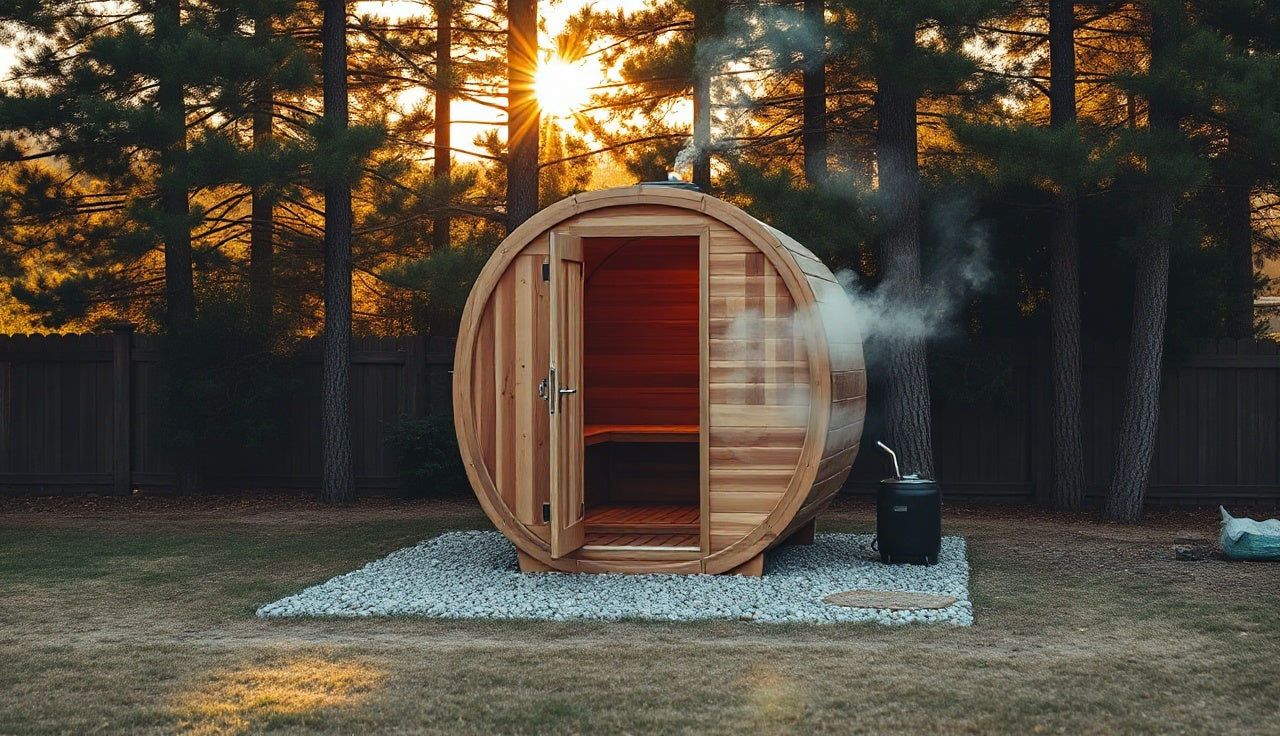
The Pure 3 is a small outdoor barrel sauna made for one person or a tight two. The name points to the product line and the rough interior length, which usually runs about 6 feet (183 cm) with a 4.5-to-5-foot (137-152 cm) outer diameter. That's smaller than the Pure 4 or Pure 5. Smaller is the whole idea.
Barrel saunas behave differently from box saunas. The curved walls push radiant heat back toward the center benches, and air moves in a natural convection loop, so the temperature at bench height stays more even than in a rectangular room where heat stacks up at the ceiling. For one or two people, that geometry pays off. You're not heating empty corners nobody sits in.
Several manufacturers sell a "Pure 3" under similar naming. Dundalk LeisureCraft is the best-known brand using this line structure [1]. Almost Heaven and Canadian Timber build barrel saunas in the same size class under different names. When you see "Pure 3" in a listing, confirm the exact outer diameter and interior bench length before you buy, because these numbers drift between brands.
Want the wider view? The shape, heat-up time, and wood choices set a barrel apart from an indoor infrared or prefab box unit. Our home sauna guide lays out how the styles compare.
What are the dimensions and how much space do you actually need?
A Pure 3 clears a footprint of about 10 feet by 8 feet with room to walk around it. Most units run 4.6-5 feet in outer diameter and 7-8 feet long once you count the roof overhang and any front porch. Interior bench space is about 5.5-6 feet, enough for two adults facing each other or one adult lying down.
Bench depth in a two-person barrel is usually 20-24 inches per side. Two benches at that depth inside a 5-foot drum leave almost no standing room. This is a sit-and-sweat unit, not a place to socialize. Fine for what it is. Don't expect to stretch out with a partner.
Clearance matters for yard placement. Manufacturer installation guides and fire code generally call for at least 18-24 inches on the sides and back, plus 36 inches at the door for safe entry [2]. Add 12-18 inches above the barrel if it sits under a pergola or low roof, since the vent stack has to discharge into open air.
That small footprint is a real advantage over larger outdoor sauna builds. A Pure 3 fits on a standard suburban deck or in a modest backyard without eating the whole space.
Foundation options include a gravel bed, concrete pads, or pressure-treated 4x4 runners. Here's the counterintuitive part: a rigid slab poured flush is worse than two parallel runners. The barrel shifts slightly as it heats and cools, and runners let it move without cracking. Most manufacturers say this outright in their installation documents.
How hot does it get and how long does it take to heat up?
A well-loaded wood stove in a Pure 3 reaches 160-190°F (71-88°C) in 30-45 minutes under normal conditions [3]. A 3-4.5 kW electric heater takes longer, usually 40-60 minutes to hit 160°F, partly because it cycles on and off instead of burning steady.
The cylinder shape helps. Less wall surface per unit of interior volume means less heat escaping, so you get to temperature faster and hold it with less fuel.
Outside temperature moves these numbers a lot. Below 20°F, add 15-20 minutes to heat-up and expect to burn 30-40% more wood to hold temperature. Quality Nordic spruce or red cedar staves at least 1.5 inches thick insulate far better than thin budget staves. Cold climate? Read the stave thickness on the spec sheet before anything else.
Once it's hot, a wood stove in a small barrel runs efficiently for 1.5-2 hours on a single load of hardwood. Softwoods burn faster and hotter but don't hold coals. Kiln-dried birch or oak gives you sustained heat without constant reloading.
What stove options come with the Pure 3?
The Pure 3 ships with a wood-burning sauna stove (kiuas) or an electric heater, and some brands let you choose either at checkout. For a 1-2 person barrel, a 3-4 kW electric heater is plenty, and a 7,000-10,000 BTU wood stove covers the wood side.
Wood stoves for a barrel this size carry an integrated rock tray. The rocks (usually diabase or olivine) soak up heat and release it slowly, which smooths temperature swings and lets you throw water for steam (löyly). That steam burst is the center of the Finnish tradition [4]. A wood stove in a small barrel heats fast and gives a wet, wraparound heat that most people prefer once they feel it.
Electric heaters win on convenience. Pre-set the temperature from the house, no wood to split, no ash to shovel, and a timer means the sauna's ready when you walk out. The tradeoff: drier heat and a weaker steam response. On a tight urban lot where smoke or open flame is a problem, electric is the smarter call.
A 4 kW heater running one hour costs about $0.64 at the U.S. average rate of $0.16/kWh [5]. A full session with heat-up runs $1.00-$1.50 in electricity. That's cheap enough to ignore.
Harvia, Huum, and Narvi stoves show up as upgrades on some models. These are Finnish brands with strong reputations. The stock stove on most North American barrels works but stays basic. If you're serious, a stove upgrade is often the best $200-$400 you'll spend on the whole unit.
How much does the Pure 3 barrel sauna cost?
Most buyers land between $3,000 and $5,500 all-in, assuming you handle the foundation yourself (most people do). Entry-level Pure 3 saunas in western red cedar or hemlock start around $2,500-$3,200. Nordic spruce and thermowood run $3,200-$4,500. Add $300-$600 for a porch extension, $200-$400 for a stove upgrade, and $300-$800 for shipping depending on your zone.
| Configuration | Estimated price range |
|---|---|
| Basic hemlock or pine, electric stove | $2,500-$3,000 |
| Western red cedar, wood stove | $3,000-$3,800 |
| Nordic spruce or thermowood, wood stove | $3,500-$4,500 |
| With porch extension, stove upgrade, delivery | $4,200-$5,500 |
These are honest retail ranges as of mid-2025. Prices shift by brand, dealer, and shipping distance. Warehouse clubs sell barrel saunas in this size class for less, but the tradeoff is usually thinner staves and a weaker stove. Our Costco sauna breakdown covers how those hold up on real longevity.
For context, a comparable indoor prefab home sauna kit runs $2,000-$5,000 before electrical work. The barrel often works out cheaper, because you skip the dedicated interior room, the framing, and the ventilation permits most jurisdictions require for an indoor build.
Do you need a permit to install a small barrel sauna?
The barrel itself almost certainly doesn't need a permit. The electrical connection probably does. The Pure 3's small footprint of roughly 30-40 sq ft falls under nearly every accessory-structure exemption on the books.
Most U.S. municipalities exempt accessory structures below a set square footage from building permits. Common thresholds are 120 sq ft or 200 sq ft, though they vary by city and county [6]. A Pure 3 sits well under that. Electrical work for an electric heater is the exception: it almost always needs a permit and a licensed electrician no matter how small the structure.
For wood-burning stoves, confirm local rules on open-combustion appliances and setbacks from property lines. Many HOAs also restrict outbuildings, so read your CC&Rs before you order.
One rule of thumb: if your area follows the International Residential Code, Section R105.2 lists exemptions for small accessory structures [7]. Your local building department can tell you whether they've adopted it and what threshold applies.
Budget two to four hours with a licensed electrician and a $100-$200 permit fee if you're going electric.
What wood is the Pure 3 barrel sauna made from and does it matter?
The wood is what you're buying, and it matters a lot. The common options are western red cedar, Nordic spruce, hemlock, and thermowood (heat-treated pine or spruce).
Western red cedar is aromatic, naturally rot-resistant, and dimensionally stable through wet-dry cycles [8]. It smells great. The catch: cedar is a premium softwood, and prices climbed hard after 2021 on lumber supply constraints. Budget models claiming cedar sometimes use lower grades with more knots, which check (crack) over time.
Nordic spruce is lighter in color, less aromatic, and slightly less rot-resistant than cedar. Scandinavian saunas use it widely because it's abundant, affordable, and holds heat well. A spruce barrel in a covered spot lasts 15-20 years with basic care.
Thermowood is kiln-treated near 400°F, which drives out the sugars and moisture that feed rot and insects [9]. The result is a darker, more stable wood that needs no staining or sealing. Good pick for wet climates. Some people love the darker tone; others want the raw cedar look.
Hemlock is the budget option. It works, but it's neither as rot-resistant as cedar nor as stable as thermowood. If two otherwise identical saunas differ only in hemlock versus cedar, the hemlock one should be clearly cheaper to earn the tradeoff.
For a sauna you plan to keep a decade or more, western red cedar or thermowood is worth the extra $400-$800.
How does a Pure 3 compare to a larger barrel sauna for 1-2 people?
A Pure 3 is slightly tight for two adults and just right for one, and the smaller size buys you real advantages. Faster heat-up. Lower fuel cost. Smaller footprint. For daily solo use, which is how most owners actually use a sauna after the novelty fades, 6 feet of bench is plenty.
Where the Pure 3 gives ground to a Pure 4 or Pure 5: you can't lie down with a second person in the room, and users above 6 feet find legroom tight if the barrel sits on the short end of the spec range. Hosting guests? A bigger barrel or a 4-person model is simply more practical.
| Spec | Pure 3 (1-2 person) | Pure 4 (2-3 person) | Pure 5 (4+ person) |
|---|---|---|---|
| Typical interior length | 5.5-6 ft | 6.5-7 ft | 7.5-8 ft |
| Outer diameter | 4.5-5 ft | 5 ft | 5-5.5 ft |
| Heat-up time (wood) | 30-45 min | 35-55 min | 45-65 min |
| Approx. base price | $2,500-$3,800 | $3,200-$4,800 | $4,200-$6,500 |
| Best for | Solo daily use, couples | Couples, small families | Groups, frequent hosting |
If you have the yard and the budget, a Pure 4 adds flexibility for a modest price jump. But the Pure 3 isn't a compromise unit. For its job, it's the correct size.
What are the real health benefits of regular sauna use at this size?
Size doesn't change the physiology. Temperature, time, and frequency do. Run a Pure 3 at 176°F for 15-20 minutes, four or five times a week, and you match the conditions behind the strongest sauna research on record.
The most cited human data comes from a Finnish cohort study in JAMA Internal Medicine (2015), which followed 2,315 middle-aged men. Those who used the sauna 4-7 times per week had a 40% lower risk of fatal cardiovascular events than once-weekly users [10]. The study measured traditional Finnish sauna at 176°F (80°C) for an average of 14 minutes per session. A Pure 3 hits those exact conditions.
The authors put it plainly: "the frequency of sauna bathing was inversely associated with the risk of fatal cardiovascular disease events" [10]. That's the strongest phrasing they used. It's an association, not proof of cause, and a sauna doesn't replace medical care.
Other research shows consistent signals for heat shock protein activation, which is relevant to muscle recovery [11], and for passive heating's effect on blood pressure and heart rate variability. The mental health and sleep data looks promising but thinner. Nobody has good long-term RCT data on home sauna use specifically; most studies draw on Finnish public sauna populations.
The practical point: consistency beats size. Four to five sessions a week at 15-20 minutes hits the pattern the best observational data supports, and you don't need a bigger sauna to get there. Our sauna benefits page digs into what the research actually says.
Pairing heat with cold? Our cold plunge guide walks through the contrast therapy protocol.
| 1x per week (baseline) | 0% |
| 2-3x per week | 22% |
| 4-7x per week | 40% |
Source: JAMA Internal Medicine, Laukkanen et al., 2015
How do you assemble and maintain a Pure 3 barrel sauna?
Most Pure 3 kits ship flat-packed on a pallet, and two adults with basic tools assemble one in 4-8 hours. The staves go up first with metal bands and tension rods, then the floor frame, benches, door, and stove. Dundalk LeisureCraft and similar brands post numbered instructions and assembly videos online.
You don't need a contractor for the barrel. The only steps that reward professional help are the electrical connection for an electric heater and the chimney flashing if you run a wood stove through the roof.
Maintenance is short:
- Rinse benches and floor with hot water after sessions. No soap.
- Leave the door cracked after use to dry the interior. This is the single most important habit.
- Inspect the metal tension bands once a year and retighten if the staves have dried. Common in the first year as the wood settles.
- Sand benches lightly with 120-grit paper if they feel rough or gray. No oil or sealant inside.
- Apply a UV-protective exterior wood oil or stain to the outside every 1-2 years, more often in wet climates.
Wood stove upkeep means clearing ash every 2-3 uses and inspecting the chimney flue annually for creosote. A chimney brush kit runs $30-$50 and takes 15 minutes.
With reasonable care, a cedar or thermowood barrel lasts 15-25 years. The stove usually outlives the barrel.
Is the Pure 3 worth buying, or should you consider alternatives?
For a solo user or a couple who wants a backyard sauna under $5,000, the Pure 3 is a genuinely good buy. The size is honest about its limits, the heat-up time is practical, and the outdoor barrel format skips any interior renovation.
Where it's the wrong fit: if you'll mostly use it with three or more people, the interior is too tight and you'll wish you'd gone to a Pure 4 or larger. If you rent and move often, a barrel is a pain to relocate. And if your HOA restricts outbuildings, you may hit aesthetic or permit objections even when the technical exemption is on your side.
Alternatives worth a look: Almost Heaven's 2-person barrels sit in the same price tier. If you want a smaller footprint and don't need outdoor placement, a portable sauna tent runs $300-$700 but delivers a much weaker experience. For budget buyers who still want a fixed unit, warehouse clubs are reasonable to check, though quality control varies.
SweatDecks carries barrel saunas and other home recovery gear if you want to compare models side by side. The site filters by size, stove type, and wood species, which makes narrowing the field quick.
The Pure 3 isn't the flashiest sauna out there. It's a small, efficient, well-proportioned unit for exactly the job it describes. For one or two people who want a daily sauna habit without a construction project, that's the whole point.
Frequently asked questions
How many people fit in the Pure 3 barrel sauna?
The Pure 3 comfortably seats one adult and fits two in a pinch. Two average-size people can sit on opposing benches, but there's no room to lie down and little space to move. For regular two-person use, a Pure 4 (one size up) gives meaningfully more comfort without a large jump in price or footprint.
How long does it take for the Pure 3 to heat up?
With a wood stove in mild outdoor temperatures, a Pure 3 reaches 160-180°F in about 30-45 minutes. A 3-4 kW electric heater takes roughly 40-60 minutes for the same temperature. Cold winter conditions add 15-20 minutes to either method. Thicker staves (1.5 inches or more) and a porch barrier at the door speed things up slightly.
What foundation does the Pure 3 barrel sauna need?
Two parallel pressure-treated 4x4 or 6x6 runners, level and spaced to match the barrel's width, are the standard foundation. A gravel bed beneath them improves drainage and prevents rot. Rigid concrete isn't ideal, because barrel saunas expand and contract with heat cycles. Most manufacturers include runner-placement specs in their installation guide.
Can I use a Pure 3 barrel sauna year-round in cold climates?
Yes, though heat-up time and fuel use climb in cold weather. Below 20°F, expect to add 15-20 minutes and burn noticeably more wood or electricity. Thicker stave construction (1.75 inches vs. 1.5 inches) makes a real difference in the cold. A door vestibule or porch extension helps by blocking the rush of cold air every time you enter.
Do I need an electrician to install a Pure 3 with an electric heater?
Almost certainly yes. A 3-4 kW sauna heater needs a dedicated 240V circuit, which isn't a DIY job in most jurisdictions. You'll need a licensed electrician to run the circuit from your panel, and most municipalities require a permit for new 240V circuits even when the structure itself doesn't. Budget $300-$600 for the electrical work plus a permit fee.
How long does a barrel sauna last outdoors?
A western red cedar or thermowood barrel maintained with annual exterior sealing and proper post-session drying lasts 15-25 years in most climates. The main failure modes are stave rot (from trapped moisture) and band corrosion. Leaving the door cracked after every session is the single most effective maintenance habit. Budget wood like untreated hemlock may show wear in 8-12 years.
Is a barrel sauna better than a box sauna for two people?
For outdoor use at the two-person scale, barrels heat up faster and cost less to run than comparably sized box saunas, because the curved geometry cuts dead air volume. Box saunas are easier to insulate for indoor installation and allow more design flexibility. For a backyard unit, the barrel wins on practicality. For an interior dedicated sauna room, a box gives you more options.
What's the difference between wood-burning and electric in a small barrel sauna?
Wood stoves heat faster, throw more authentic steam (löyly), and cost nothing per session beyond wood. They ask more of you: sourcing and splitting wood, starting fires, clearing ash. Electric stoves are set-and-forget with programmable timers, produce drier heat, and need no fuel storage. At $0.64-$1.50 per session in electricity, operating cost is trivial. Choose wood for the experience, electric for convenience.
Can I put a Pure 3 barrel sauna on a deck?
Possibly, but check your deck's load capacity first. An assembled Pure 3 with stove and rocks weighs roughly 600-900 lbs. With two occupants and water, total load can top 1,200 lbs. Most residential decks are rated for 40-60 lbs per square foot. Have a contractor assess the framing before placing a heavy barrel on it. Ground placement on runners is simpler and structurally lower-risk.
How much does it cost to run a Pure 3 electric sauna monthly?
At the U.S. average rate of about $0.16/kWh, a 4 kW heater running 1.5 hours (including heat-up) costs roughly $0.96 per session. Five sessions a week comes to about $4.80 per week, or $19-$21 per month. Actual cost varies by local rates and heater efficiency. It's genuinely cheap next to gym sauna memberships or spa visits.
Can I add a cold plunge to pair with my Pure 3 sauna?
Yes, and contrast therapy (alternating heat and cold) is one of the most common reasons people build a backyard recovery station. A freestanding cold plunge tub 5-10 feet from the sauna door lets you move between the two fast. The standard protocol is 10-20 minutes in the sauna, then 2-5 minutes in cold water, repeated 2-3 rounds. Our cold plunge guide covers what the research says.
What sauna rocks should I use in a Pure 3 wood stove?
Diabase (also called olivine-diabase) and peridotite are the standard picks. They take high heat over and over without cracking or releasing harmful minerals. Avoid granite and sedimentary rocks like sandstone, which fracture under thermal stress. Replace rocks every 1-2 years, or sooner if you spot cracking or catch a sulfur smell. Most stove makers sell compatible rock sets sized for their models.
Does a Pure 3 barrel sauna add value to my home?
Limited data exists specifically on barrel saunas. National Association of Realtors surveys find outdoor features generally raise buyer appeal, and in Scandinavian-influenced markets (Minnesota, the Pacific Northwest, parts of New England) a dedicated sauna is a real selling point. In other markets, buyers may read it as a maintenance burden. It's unlikely to hurt resale value and probably adds modest appeal in the right markets.
Sources
- Dundalk LeisureCraft – Pure 3 barrel sauna product specifications: Dundalk LeisureCraft manufactures the Pure 3 barrel sauna line with a nominal 6-foot interior bench length and 4.6-5 foot outer diameter
- National Fire Protection Association – NFPA 211 Chimneys, Fireplaces, Vents, and Solid Fuel-Burning Appliances: Clearance requirements around wood-burning appliances and structures, including recommended side and rear clearances for freestanding sauna stoves
- Finnish Sauna Society – Traditional sauna temperatures and practices: Traditional Finnish sauna temperature range of 160-195°F (70-90°C) and typical heat-up times for small sauna rooms
- Finnish Sauna Society – Löyly and steam in traditional sauna bathing: The practice of pouring water over heated rocks (löyly) is central to the traditional Finnish sauna experience
- U.S. Energy Information Administration – Average retail electricity price by state: U.S. average retail electricity rate of approximately $0.16 per kilowatt-hour as of 2024
- International Code Council – International Residential Code (IRC) Section R105.2 exempt work: IRC R105.2 exempts from permit requirement accessory structures under 200 square feet in many adopting jurisdictions
- International Code Council – International Residential Code (IRC) Section R105.2: Section R105.2 of the IRC provides the model code basis for local permit exemptions on small accessory structures
- U.S. Forest Service – Wood Handbook: Wood as an Engineering Material (Chapter 2: Characteristics and Availability of Commercially Important Woods): Western red cedar's natural rot resistance and dimensional stability through moisture cycling
- U.S. Forest Service Forest Products Laboratory – Technical Note on thermally modified wood: Thermowood treatment at approximately 400°F drives out sugars and moisture that cause rot and insect damage, increasing dimensional stability
- JAMA Internal Medicine – Laukkanen et al. (2015) 'Association Between Sauna Bathing and Fatal Cardiovascular and All-Cause Mortality Events': In a cohort of 2,315 Finnish men, 4-7 sauna sessions per week was associated with a 40% lower risk of fatal cardiovascular events vs. once weekly; 'the frequency of sauna bathing was inversely associated with the risk of fatal cardiovascular disease events'
- Journal of Applied Physiology – Kregel KC (2002) 'Heat shock proteins: modifying factors in physiological stress responses and acquired thermotolerance': Heat exposure activates heat shock proteins relevant to cellular protection and muscle recovery

Share:
Thermal contrast therapy: how hot and cold work together
Small barrel sauna: what to know before you buy