
Last updated 2026-07-09
TL;DR
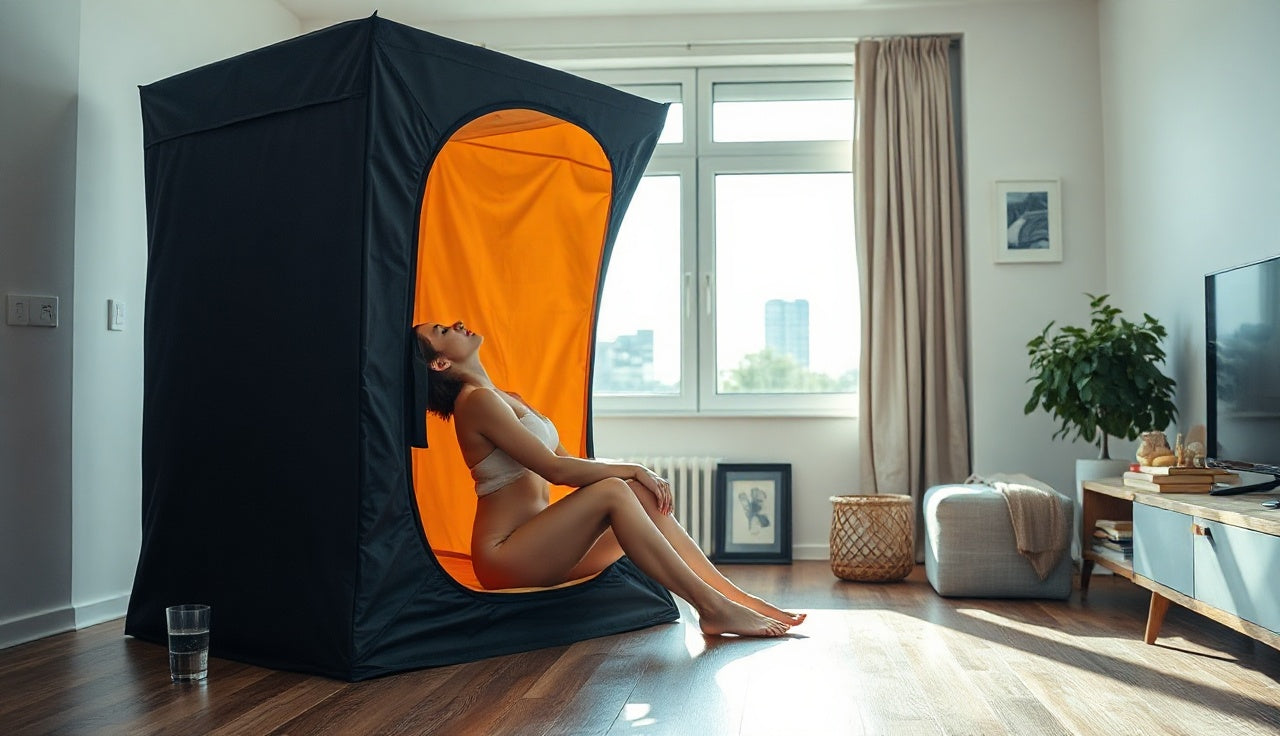
The Therasage Thera360 Plus is a tent-style personal infrared sauna. It emits near, mid, and far infrared from wall panels plus a heated floor pad. It runs about $799-$899, sets up in under 10 minutes, and fits one seated user with the head out the top. For renters or anyone who can't install a cabinet sauna, it's a real option, though it's a different animal from a wood-panel room.
What is the Therasage Thera360 Plus and how does it work?
The Thera360 Plus is a personal portable infrared sauna. You sit inside a fabric tent on a low stool, zip it closed around your torso, and let your head poke out the top. The tent traps radiant heat from panels in the walls and a heated pad under your feet. Your head stays in room air the whole time.
Therasage calls this "full-spectrum" because the heating elements produce near-infrared (roughly 700-1400 nm), mid-infrared (1400-3000 nm), and far-infrared (3000 nm to 1 mm) wavelengths [1]. Most entry-level portable saunas emit far-infrared only. The distinction matters because different wavelengths reach different tissue depths. Near-infrared penetrates shallowly and shows up in surface photobiomodulation research. Far-infrared heats deeper tissue and is the wavelength most studied for cardiovascular and heat stress effects [1].
The unit runs on standard 120V household current. Therasage rates it at about 1200-1400 watts, roughly a hair dryer. No electrician and no dedicated circuit for most homes. Don't run it on an extension cord or share the circuit with other heavy appliances [10].
The floor pad is what separates this model from generic tent saunas. Cheap tents heat only from the sides. The Thera360 Plus heats from below too, so your feet and ankles warm more evenly. Therasage also builds in a tourmaline and carbon fiber layer that the company says produces negative ions. The clinical evidence for ionized-air health effects inside a sauna is thin.
This is still a tent sauna. It is not a wood-panel cabinet. Skin-surface temperature inside tops out around 140-150°F, lower than a traditional Finnish sauna (typically 160-200°F) but in the same band most infrared sauna research uses [2]. That lower air temp is why breathing inside feels easier, and why your head stays out.
What are the actual specs on the Thera360 Plus?
Here are the published specifications. Some numbers come straight from Therasage's product documentation. Where third-party sources differ, I've flagged it.
| Spec | Thera360 Plus |
|---|---|
| Infrared type | Full-spectrum (near, mid, far) |
| Power draw | ~1200-1400W |
| Voltage | 120V / standard US outlet |
| Interior temp range | Up to ~140-150°F |
| Heat-up time | 10-15 minutes |
| Weight | ~22 lbs |
| Packed size | Roughly 24" x 14" x 12" bag |
| Recommended session | 20-45 minutes |
| Head position | Outside the tent |
| Price (retail) | $799-$899 USD |
The tent uses a multi-layer build. Oxford cloth on the outside, a reflective interior lining meant to bounce infrared back toward you instead of letting it bleed off. The stool comes with it.
One number worth flagging: Therasage lists EMF (electromagnetic field) output as "ultra-low" and points to third-party testing, publishing reports that show magnetic field levels under 1 milligauss at the user's body. I haven't independently verified those lab reports. The claim tracks with what manufacturers using carbon fiber heating elements (instead of nichrome wire coils) typically measure. If EMF exposure is a specific worry, ask Therasage directly for the test report PDFs before you buy.
The box includes a carry bag, the floor pad, a remote control, and the stool. Replacement parts, especially the floor pad, are available from Therasage directly.
What does the research say about infrared sauna health effects?
Here's where manufacturer marketing and the actual science part ways, so be careful.
The strongest evidence for infrared sauna benefits sits with cardiovascular outcomes. A long-running Finnish cohort study in JAMA Internal Medicine found men who used a sauna 4-7 times per week had a 40% lower risk of all-cause mortality than once-weekly users [2]. That study used traditional Finnish saunas, not infrared, so translating it to infrared is an extrapolation. The mechanism (passive heat stress raising core temperature and heart rate) likely carries over, but no large prospective trial has tested infrared sauna use against cardiovascular mortality directly.
A 2015 review in the Canadian Medical Association Journal concluded that "regular sauna bathing appears to be well tolerated... and may reduce risk of cardiovascular events" and called for more randomized trial data [3].
Near-infrared has its own growing body of photobiomodulation research. A review by Hamblin in Photomedicine and Laser Surgery found evidence that near-infrared light reduces inflammation and supports mitochondrial function in cellular models and small human trials [4]. Whether a tent sauna delivers near-infrared at the dose and distance that dedicated photobiomodulation devices use is an open question. The emitter in a tent sits several inches from your skin across a big surface area. Purpose-built red light panels work at defined distances and power densities. The two overlap. They aren't the same.
Heat stress raises core temperature, pushes heart rate up in a way that resembles moderate aerobic exercise, and triggers heat shock protein production [2]. Those effects are well documented and are the plausible engine behind most of the recovery and cardiovascular benefits people report. Our sauna benefits overview goes deeper on the evidence.
Honest summary: the passive heat stress from any infrared sauna, the Thera360 Plus included, probably produces real physiological effects that match the sauna literature. The add-on claims about full-spectrum wavelengths, tourmaline, and negative ions are much harder to verify in this format.
| 1x per week (baseline) | 0% |
| 2-3x per week | 24% |
| 4-7x per week | 40% |
Source: Laukkanen JA et al., JAMA Internal Medicine, 2015
How does the Thera360 Plus compare to other portable saunas?
Most portable tent saunas cost $100-$300 and use simple far-infrared carbon panels or nichrome wire heaters. The Thera360 Plus costs $799-$899. That's a real gap, so let's be direct about what the money buys.
| Feature | Budget tent saunas ($100-$300) | Thera360 Plus (~$800) | Home cabin sauna ($1,500-$6,000+) |
|---|---|---|---|
| Infrared type | Far only | Full-spectrum | Far or full-spectrum |
| Floor heating pad | Rarely | Yes | Sometimes |
| EMF mitigation | Rarely addressed | Claimed ultra-low | Varies by brand |
| Heat-up time | 10-20 min | 10-15 min | 20-45 min |
| Head position | Inside or outside | Outside | Inside |
| Portability | High | High | None |
| Permanent install | No | No | Yes |
| Price | $100-$300 | ~$800 | $1,500-$6,000+ |
The floor pad and full-spectrum emitters are the two things that genuinely set the Thera360 Plus apart from generic tents. Whether they justify the $500-$700 premium over the cheapest alternatives comes down to how hard you'll use it and how much you care about near-infrared exposure.
Against a home cabinet sauna, the Thera360 Plus costs less, stores in a bag, and needs zero installation. You give up the wood-paneled room, the ability to pour water on rocks, and the higher air temperature. If you have the space and budget for a real home sauna, a cabin unit delivers a fuller experience. If you're renting, traveling, or testing infrared before a bigger buy, the Thera360 Plus is one of the more credible portable sauna options out there.
One thing it does not compete with: traditional Finnish or wood-burning saunas that hit 180-200°F. If that intense dry heat is the goal, no infrared tent replicates it. Our sauna vs steam room piece breaks down how the types compare.
Is the Thera360 Plus actually full-spectrum, and does that matter?
"Full-spectrum" is an infrared sauna marketing term, and it helps to know what it means technically.
Infrared radiation runs from roughly 700 nm to 1 mm wavelength. Manufacturers split it into near (NIR, 700-1400 nm), mid (MIR, 1400-3000 nm), and far (FIR, 3000 nm to 1 mm). Most lower-cost infrared saunas use carbon fiber panels that emit primarily far-infrared, peaking around 9-14 micrometers [1]. The Thera360 Plus combines carbon fiber with other emitter materials to hit near, mid, and far bands.
Does it matter clinically? Honest answer: maybe, for some uses. The best-studied cardiovascular and metabolic effects run on passive heat stress, which far-infrared produces fine on its own. The near-infrared component matters more if you're after photobiomodulation effects on skin, wound healing, or mitochondrial function, since near-infrared penetrates shallowly and interacts with cytochrome c oxidase in cells [4].
If your goal is sweating, cardiovascular stress, and winding down, a quality far-infrared-only unit may serve you just as well. If you want near-infrared as part of a light therapy routine, the Thera360 Plus bundles it in, though it won't replace a dedicated red-light panel for targeted treatment.
Mid-infrared is the least studied of the three in human wellness. It penetrates a bit deeper than far-infrared into subcutaneous tissue, but the clinical literature on mid-infrared specifically in saunas is sparse.
How do you set up and use the Thera360 Plus?
Setup is fast. Most people get it out of the bag and ready to plug in within 5-8 minutes. The frame is a pop-up structure much like a camping chair. Attach the panels, lay out the floor pad, plug into a standard wall outlet.
The basic session protocol:
1. Plug in and turn on 10-15 minutes before you use it. Let it pre-heat. 2. Strip down to minimal clothing or none. The infrared needs to reach skin. 3. Sit on the stool, zip the tent around your torso, head out the top. 4. Start at 20-25 minutes if you're new to infrared. Build to 30-45 minutes as tolerated. 5. Hydrate. Drink 16-24 oz of water before, and keep water within reach during. 6. Cool down gradually after. Don't leap into a cold shower if you feel lightheaded.
A few practical notes from regular users: bring a small towel inside to catch sweat before it hits the floor pad. The included stool works but isn't plush. Some people add a folded towel on top. The remote lets you change temperature without unzipping.
After your session, wipe down the interior with a damp cloth and leave the tent open to air out. Zip it closed while damp and the fabric traps odor. Most owners run theirs 4-7 times per week, which matches the frequency range in the Laukkanen et al. cohort data [2].
Want to pair sauna with cold exposure? See our cold plunge and ice bath guides. Contrast therapy (heat then cold) has a separate but overlapping evidence base.
Who should buy the Thera360 Plus, and who should skip it?
Buy it if:
You rent and can't install a built-in unit. You travel a lot and want to bring a sauna along. You want to try infrared before dropping $2,000-$6,000 on a cabin. You have limited space. You specifically want full-spectrum exposure, near-infrared included.
Skip it if:
You want the traditional Finnish sauna experience. Tent saunas don't get near 180-200°F air temperature, and there are no rocks, no steam, no löyly. If that sensory and cultural part matters, a tent is no substitute. Our sauna overview covers those differences.
Also skip it if you want to share sessions with a partner or family member. The Thera360 Plus is single-occupancy. For two-person sessions, you need a two-person cabin sauna, which starts around $1,500-$2,500.
Skip it too if EMF is a dealbreaker and you haven't seen Therasage's actual third-party test reports. The company makes ultra-low EMF claims. Verify them yourself.
One more honest note: the tent format feels different from a wood-panel room. Some people find it claustrophobic at first. Others adapt fast. The head-out design helps, but you don't get the full-body hot-air immersion of a cabin.
SweatDecks carries the Thera360 Plus next to cabin saunas and cold plunges if you want to line up options before committing.
Are there safety concerns or contraindications with the Thera360 Plus?
The same contraindications for any sauna apply here. The FDA has not approved sauna devices to treat any specific medical condition, and the Thera360 Plus is sold as a wellness product, not a medical device [5].
General precautions for all saunas:
Pregnancy. Most medical guidelines advise against sauna use during pregnancy because of hyperthermia risk. The American College of Obstetricians and Gynecologists advises pregnant women to avoid raising core body temperature above 102.2°F (39°C) [6].
Cardiovascular conditions. Infrared sauna raises heart rate and blood pressure transiently. People with unstable cardiovascular conditions, recent myocardial infarction, or severe aortic stenosis should talk to a physician before using any sauna [3].
Medications. Some drugs impair thermoregulation (anticholinergics, certain antihypertensives, diuretics). If you take regular prescriptions, check with your prescriber.
Alcohol. Don't use the sauna while intoxicated. Cardiovascular and dehydration risks compound.
Children. Therasage does not market this for pediatric use, and children's thermoregulatory systems are less developed. Keep kids out.
The tent format carries one specific safety note: don't fall asleep inside. The tent zipped around your torso slows how fast you can exit if you need to. Set a timer.
For most healthy adults, 20-45 minutes at the temperatures this unit reaches (up to 140-150°F surface) is safe with good hydration. The Laukkanen cohort of regular Finnish sauna users found acute adverse events were rare in healthy populations [8].
How does the Thera360 Plus hold up over time, and what's the warranty?
Tent saunas have a durability ceiling that wood-panel cabins don't. The fabric, zippers, and wiring in any tent degrade faster than the cedar or hemlock in a built-in unit. That's just physics.
Therasage offers a limited warranty on the Thera360 Plus. Terms have shifted across model generations, so check directly with Therasage or the retailer at purchase for current duration and coverage. Historically, Therasage has offered 1-3 year warranties on portable units, with heating elements and electronics covered separately from the fabric enclosure.
The common wear points on tent saunas are the zipper (gets sticky from sweat residue if you skip the wipe-down), the floor pad connector, and the fabric at stress points where the frame presses the interior. All manageable with basic upkeep.
For longevity:
- Wipe the interior and zipper track with a damp cloth after every session.
- Air the tent out fully before packing.
- Don't fold the floor pad tightly against the heating elements. Roll it loosely.
- Store somewhere dry.
Replacement floor pads and heating panels come from Therasage directly, which matters more than it sounds: when a component fails outside warranty, you don't have to buy a whole new unit.
Realistic lifespan for a well-kept unit: 3-6 years of regular use. A well-kept cedar cabin sauna can go 15-20 years. That durability gap is part of the cost math.
How does the Thera360 Plus fit into a heat and cold contrast therapy protocol?
Contrast therapy, alternating heat and cold immersion, has caught on as a recovery routine among athletes. The usual pattern is heat for 15-20 minutes, cold for 1-3 minutes, repeated 2-3 times. Research on contrast therapy in athletic recovery suggests it may cut delayed onset muscle soreness better than passive rest, though effect sizes are modest and study quality varies [7].
The Thera360 Plus works as the heat side of a contrast protocol. Its 10-15 minute heat-up and 20-40 minute session pair well with a cold plunge or ice bath. You need both units, which adds to cost.
Building a home contrast setup, the sequence most people use is sauna first (open vasodilation, raise core temp), then cold plunge (drive vasoconstriction and the norepinephrine response). Some practitioners flip this for different goals, but sauna-first is more common in traditional Scandinavian practice and in most research protocols.
For cold plunge specifics, see our cold plunge benefits and ice bath guides. The Thera360 Plus goes well with compact cold plunge tubs for apartment or small-home setups where a full outdoor install isn't realistic.
One practical note: the unit takes about 10-15 minutes to heat up and 10-15 to cool down before packing. Running multiple contrast cycles, you keep it on between rounds rather than cycling it off and on.
What do actual owners say, and are there common complaints?
I won't invent testimonials or composite reviews. What I can do is describe the pattern of feedback that shows up consistently across verified retail review platforms and discussion forums for this category.
Common positives: real sweat output within 15-20 minutes, easy setup and storage, the head-out design cutting claustrophobia, and clear muscle relaxation after sessions. Owners who once used cheaper tent saunas often say the floor pad makes a real difference in full-body heat distribution.
Common complaints: the stool is uncomfortable for tall people (inseams over roughly 34 inches feel cramped), the tent holds odor if you don't air it out after use, and the remote on some units has had reliability trouble. Some find the enclosure awkward to get in and out of versus a cabin where you just open a door. A small share of buyers report their unit didn't reach advertised temperatures consistently, which Therasage customer service usually handles through replacement.
The price-to-experience gap is the friction point that shows up most in negative reviews. For $800, some buyers expected a more substantial feel and were caught off guard by the tent construction. Fair critique. This is a portable fabric sauna. If the format doesn't appeal to you on sight and touch, don't let the full-spectrum marketing talk you out of that instinct.
Therasage has been building portable saunas for roughly 15 years and has a support setup budget-brand tents don't. That matters for warranty claims and replacement parts.
Where can you buy the Thera360 Plus and what should you pay?
The Thera360 Plus retails between $799 and $899 USD through authorized dealers. Therasage sells direct, and specialty wellness retailers carry it too.
Be wary of heavily discounted units from marketplace sellers without authorized dealer status. Therasage's warranty is typically tied to authorized retailers, and a $200 "discount" from an unverified seller can void your warranty and leave you without support when a heating element fails.
At the time of writing, SweatDecks carries the Thera360 Plus as part of its portable sauna lineup, with direct access to manufacturer warranty support.
A few things to check on any purchase:
- Is the seller an authorized Therasage dealer?
- Does the listing include the floor pad, stool, carry bag, and remote?
- What warranty does this specific retailer offer?
The price has been fairly stable in the $799-$899 range. Sales occasionally bring it to $699-$749. Don't wait for a mythical 40%-off deal on this unit. That hasn't happened with any regularity through authorized channels.
Still unsure whether a portable unit fits your needs? Our portable sauna guide covers the full field of tent and foldable options, and our home sauna guide covers when to step up to a cabin.
Frequently asked questions
Is the Therasage Thera360 Plus worth the price compared to cheaper tent saunas?
It depends on what you value. The full-spectrum emitters and heated floor pad are real differentiators cheaper units don't offer. If you want near-infrared exposure and more even heat from below, the premium is defensible. If you just want to sweat, a $200-$300 far-infrared tent produces heat. The bigger gap is build quality, EMF mitigation claims, and warranty support.
Can you use the Thera360 Plus every day?
Yes, daily use is safe for most healthy adults. The Laukkanen cohort study found 4-7 sessions per week was associated with the largest cardiovascular benefit compared to 1-2 sessions. Stay hydrated, cap sessions at 45 minutes, and skip a session if you feel ill or lightheaded. People with cardiovascular conditions should consult a physician before starting a daily routine.
Does the Thera360 Plus heat your whole body including your head?
No. The head stays outside the tent. That's a deliberate design choice that keeps your airway in ambient room air rather than heated infrared air. Your torso, arms, and legs get infrared exposure. Some users like the lower claustrophobia; others miss the full-body heat immersion of a traditional sauna where the air itself is hot.
How hot does the Thera360 Plus actually get?
Surface temperatures inside the tent reach roughly 140-150°F. That's lower than a traditional Finnish sauna (160-200°F) but consistent with the temperature range used in most clinical infrared sauna research. The felt intensity runs high because infrared penetrates tissue rather than just warming the surrounding air.
Is the Thera360 Plus safe for people with high blood pressure?
Sauna use transiently raises heart rate and can shift blood pressure, so anyone with hypertension should consult their physician before using any sauna. Some small studies suggest regular sauna use may support healthy blood pressure over time, but that research isn't definitive. Don't use it as a substitute for prescribed hypertension management.
How long does it take the Thera360 Plus to heat up?
Therasage specifies 10-15 minutes to reach operating temperature. In practice, most users start around the 10-minute mark and find the tent at a comfortable infrared level by 15 minutes. It heats faster than a wood-panel cabin sauna, which typically takes 20-45 minutes.
Can you use the Thera360 Plus if you're pregnant?
No. The American College of Obstetricians and Gynecologists advises pregnant women to avoid raising core body temperature above 102.2°F. Sauna use, infrared included, can push core temperature above that threshold. Avoid all saunas during pregnancy unless your OB specifically clears you.
What is the difference between the original Thera360 and the Thera360 Plus?
The Plus added the heated floor pad as standard, expanded full-spectrum emitter coverage, and adjusted the tent construction for better heat retention. The original Thera360 lacked the floor pad, which cut foot and lower-leg heat exposure noticeably. Most dealers now stock the Plus rather than the base model.
Does the Thera360 Plus emit low EMF?
Therasage publishes third-party test reports claiming magnetic field output under 1 milligauss at the user's body. Carbon fiber heating elements generally measure lower EMF than nichrome wire coils. If EMF is a specific concern, request the actual test report from Therasage before buying and verify the testing lab's credentials on your own.
Can the Thera360 Plus help with weight loss?
Sweating in a sauna causes temporary water weight loss that comes back when you rehydrate. Any caloric burn from passive heat stress is modest, similar to light to moderate activity. There's no credible evidence that infrared sauna sessions produce meaningful fat loss. Use it for recovery, relaxation, and cardiovascular stress. Don't buy it expecting weight loss.
How do you clean the Thera360 Plus?
Wipe the interior fabric, floor pad surface, and zipper track with a damp cloth after each session. Use mild soap if needed but avoid soaking the fabric. Leave the tent fully open to air-dry before packing. The floor pad has a removable cover on some versions that hand-washes. Airing it out prevents odor buildup, the most common maintenance complaint.
Is the Thera360 Plus good for muscle recovery after workouts?
Heat exposure promotes blood flow, eases muscle tension, and may support recovery from exercise-induced muscle damage. A review in the European Journal of Applied Physiology found passive heat therapy can reduce delayed onset muscle soreness, though effect sizes varied by protocol. The Thera360 Plus delivers heat in a format consistent with those protocols. Pair it with adequate protein and sleep for best results.
What's the return policy on the Thera360 Plus?
Return policies vary by retailer. Therasage's direct return window and authorized dealer policies differ, so check specifically at point of purchase. Because these units involve hygiene considerations once used, many retailers limit returns on opened units. Buy from an authorized dealer that clearly states its return terms before you order.
Sources
- NIST Engineering Toolbox, Infrared Radiation: Near-infrared spans 700-1400 nm, mid-infrared 1400-3000 nm, and far-infrared extends from 3000 nm to 1 mm wavelength
- Laukkanen JA et al., JAMA Internal Medicine 2015, Sauna bathing and all-cause mortality: Men who used a sauna 4-7 times per week had a 40% lower risk of all-cause mortality compared to once-weekly users in a Finnish cohort study
- Canadian Medical Association Journal, Sauna as a valuable clinical tool for cardiovascular, autoimmune, toxicant-induced and other chronic health problems, 2015: "Regular sauna bathing appears to be well tolerated... and may reduce risk of cardiovascular events" but more randomized trial data is needed
- Hamblin MR, Photomedicine and Laser Surgery, Mechanisms and applications of the anti-inflammatory effects of photobiomodulation: Near-infrared light has evidence for reducing inflammation and supporting mitochondrial function in cellular models and small human trials
- U.S. Food and Drug Administration, Consumer Products vs Medical Devices: The FDA has not approved portable infrared sauna units for treatment of specific medical conditions; they are sold as wellness products
- American College of Obstetricians and Gynecologists, Committee Opinion on Exercise During Pregnancy: Pregnant women are advised to avoid raising core body temperature above 102.2°F (39°C)
- Bieuzen F et al., PLOS ONE, Contrast water therapy and exercise induced muscle damage, 2013: Contrast water therapy (alternating heat and cold) may reduce delayed onset muscle soreness more effectively than passive rest, though effect sizes are modest
- Laukkanen T et al., Age and Ageing, Sauna bathing frequency, cardiovascular function and longevity, 2018: Frequent sauna bathing is associated with reduced cardiovascular and all-cause mortality; acute adverse events rare in healthy populations
- European Journal of Applied Physiology, Passive heat therapy for recovery from exercise, 2019: Passive heat therapy can reduce delayed onset muscle soreness after exercise with effect sizes varying by protocol
- U.S. Consumer Product Safety Commission, Electrical Safety for Home Appliances: High-wattage appliances (1200W+) should not be run on extension cords or shared circuits with other high-draw devices

Share:
Portable hot air sauna: what it is, how it works, and whether it's worth buying
Blow up ice baths: what you actually need to know before buying