
Last updated 2026-07-09
TL;DR
Inflatable ice baths are portable, collapsible tubs you fill with cold water and ice at home. They cost $40 to $400, hold 50 to 100 gallons, and can drop to near-freezing with enough ice. Most people use one as a low-cost trial before buying a hard-shell plunge. Setup takes under 10 minutes and the tub folds flat for storage.
What is a blow up ice bath and how does it work?
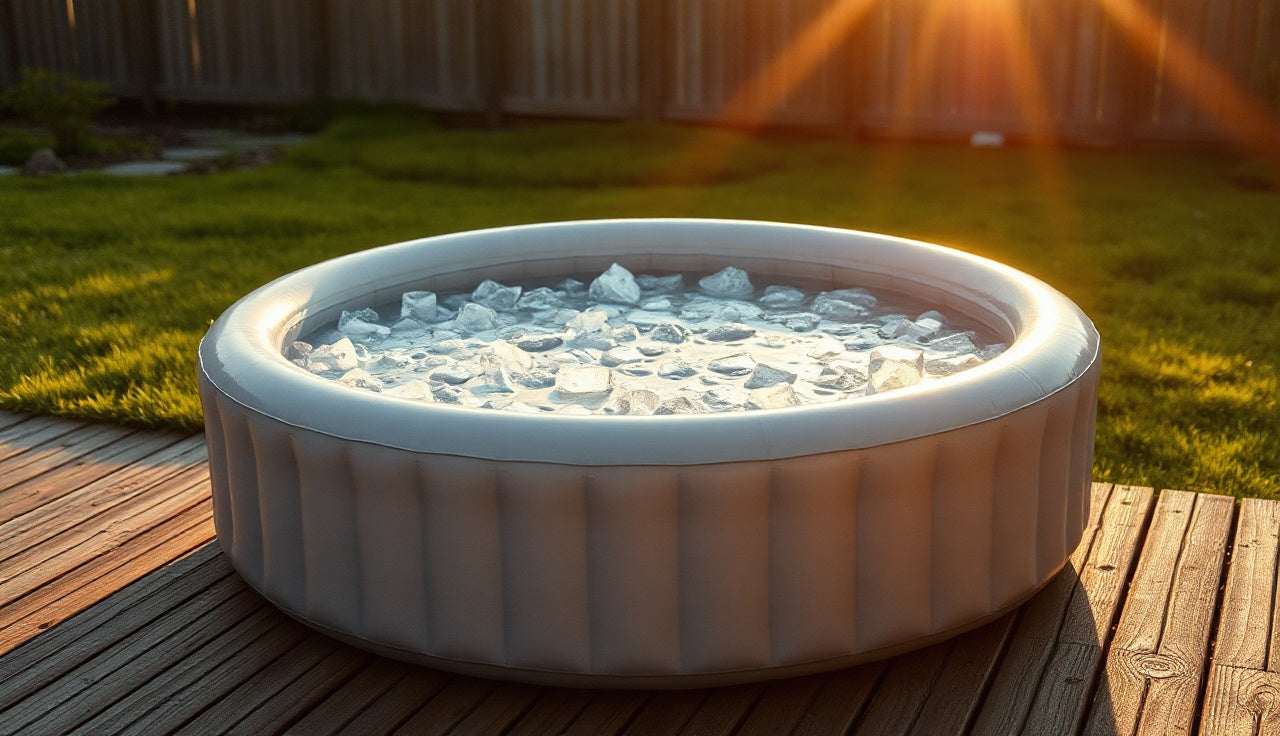
A blow up ice bath is an inflatable tub, usually round or oval, made from layered PVC or thermoplastic. You inflate it with a pump, fill it with cold water, add ice or hook up a chiller, and get in. That's the whole machine.
The walls are full of air, so they give you some insulation. A good inflatable holds temperature better than a cheap kiddie pool because that air layer slows heat moving between the cold water and the warmer air around it. No inflatable matches a double-wall insulated hard-shell for cold retention, though. Not close.
Most models hold 50 to 100 gallons. You sit or squat so the water covers your torso and legs, and you stay anywhere from 1 to 15 minutes depending on your protocol. The tub drains through a plug at the base, deflates in a few minutes, and folds into a bag you can shove in a closet.
If you're just starting with cold plunge therapy, this is the cheapest way in the door.
What are the real benefits of cold water immersion?
The mechanism researchers keep pointing to is the sympathetic nervous system response. Cold water triggers a norepinephrine surge. A 2022 systematic review in PLOS ONE found cold water immersion was linked to significant reductions in self-reported stress and negative mood compared to control conditions [1].
Sore-muscle relief is the claim athletes care about most. The evidence is real but modest. A Cochrane review on cold water immersion for muscle recovery found it reduced delayed-onset muscle soreness compared to passive rest, though the authors flagged small-to-moderate effect sizes and shaky study methods [2].
Sleep is another area with a genuine signal. Some people plunge in the evening and report faster sleep onset during the rewarming phase afterward. The data here is thinner than the marketing wants you to believe.
Where the evidence gets weak: fat loss, immune function, longevity. Small studies, narrow populations, nobody should be promising you anything. Read the actual papers before you buy into an influencer's claim.
One honest caveat. Almost all the peer-reviewed research used purpose-built tanks, cold pools, or lab tubs. Very little of it ran on inflatable tubs specifically. The physiology carries over, but keep that gap in mind. There's more on cold plunge benefits if you want the full breakdown.
How cold does a blow up ice bath actually get?
That depends almost entirely on how much ice you add and how warm your tap water starts. There's no magic to it. It's arithmetic.
Tap water usually starts between 55°F and 70°F depending on your region and the season. Most people aim for 50°F to 59°F (10°C to 15°C) for a meaningful response. Getting below 50°F takes a lot of ice or a dedicated chiller.
Here's a rough guide:
| Target Temp | Starting Tap Temp | Ice Needed (approx.) |
|---|---|---|
| 59°F (15°C) | 65°F | 10 to 15 lbs |
| 55°F (13°C) | 65°F | 25 to 35 lbs |
| 50°F (10°C) | 65°F | 50 to 60 lbs |
| 45°F (7°C) | 65°F | 80 to 100 lbs |
These numbers move a lot in summer, when tap water runs warmer. A 70°F start can take nearly double the ice to hit 50°F. Buying gas-station bags at $2 to $4 each, the cost stacks up fast.
If you want consistent temperatures without the hassle, a recirculating chiller kills the ice problem. Most chillers that fit inflatable tubs run $300 to $800 and connect through hose fittings. Plenty of people move the chiller onto a hard-shell tub later if they upgrade.
Winter is the cheat code. In cold climates, an outdoor inflatable holds 40°F to 45°F water with no ice at all.
| Target 59°F (15°C) | 12 |
| Target 55°F (13°C) | 30 |
| Target 50°F (10°C) | 55 |
| Target 45°F (7°C) | 90 |
Source: SweatDecks editorial analysis based on thermodynamic estimates; see body text
How do inflatable ice baths compare to hard-shell cold plunges?
The honest comparison comes down to four things: cost, durability, insulation, and how it feels to use.
Cost goes to inflatables, no contest. A quality inflatable runs $80 to $300. A basic hard-shell plunge starts around $600, and chiller-equipped units go $1,500 to $8,000 and up. If you're not sure the habit will stick, starting inflatable is the smart move.
Durability goes to hard-shell. PVC inflatables develop pinhole leaks, seam stress, and UV damage over time. Figure a practical lifespan of 1 to 3 years with regular use. A quality fiberglass or polyethylene hard-shell lasts 10 to 20 years.
Insulation isn't close. Foam-insulated or double-wall hard-shells hold temperature far better. An inflatable in summer sun gains several degrees an hour with no active cooling. A well-insulated hard-shell gains maybe 1 to 2 degrees an hour in the same spot.
Feel is subjective but real. A rigid tub with a flat seat feels stable. A soft-sided inflatable shifts under you. Tall or larger users sometimes find inflatables buckle or tilt in ways that get old fast.
The verdict: testing the habit or need something portable, inflatable makes complete sense. Committed to daily plunging for years, a proper ice bath or hard-shell pays itself back in ice savings and consistency.
What should you look for when buying an inflatable ice bath?
Material thickness matters more than most listings make obvious. Look for PVC described as 0.4mm or thicker, or reinforced tarpaulin-style PVC. Thin-walled tubs rated for kids' pools split at the seams within months of adult use.
The inflation system should be simple. Models with standard air valves work with any bike pump or electric pump you already own. Proprietary valves are a headache waiting to happen.
Drain placement is the thing buyers ignore until they're bailing 80 gallons with a bucket. You want a bottom drain plug near the tub edge so gravity does the work. Side drains that leave several inches of standing water are genuinely annoying.
Dimensions have to match your body. Most adults need a tub at least 28 inches wide and 26 inches deep to cover the torso and thighs while seated. Oval or rectangular shapes usually beat circles for tall people.
A lid or cover matters if you keep water cold between sessions or leave the tub filled outside. Insulated covers slow the temperature rise a lot. Even a basic tarp over the top helps.
Check for a filtered intake if you plan to run a chiller. Chillers with internal pumps hate debris and last longer with a simple foam pre-filter on the intake hose.
How long should you stay in a blow up ice bath?
The internet gives wildly different answers here, and the research is messier than any single protocol admits. Start conservative and build.
For beginners, 1 to 2 minutes at 55°F to 60°F is a reasonable start. You'll feel the cold shock response in the first 30 to 60 seconds. Breathing slowly through that first wave is the skill you're actually training.
Most published studies on muscle recovery and mood used 10 to 20 minutes at 50°F to 59°F [2]. A 2021 study in the Journal of Physiology reported that norepinephrine stayed elevated well after cold water immersion at 14°C (57°F) compared to a warm control [3].
The often-cited Andrew Huberman figure of 11 minutes per week total, split across 2 to 4 sessions, comes from studies with specific temperature and immersion conditions. It's a starting reference, not a universal law.
Hypothermia risk is real but needs longer exposure than most intentional protocols. The U.S. Coast Guard classifies water below 40°F as posing incapacitation risk within about 30 minutes for an average adult [4]. At 50°F to 59°F, the range most plungers target, the risk is low with sane time limits, but anyone with a cardiovascular condition should talk to a physician first [6].
Start short. Add time slowly. Get out if you lose sensation in your hands or feet.
Is a blow up ice bath safe to use?
For healthy adults, yes, with basic awareness. Cold water triggers an immediate cardiovascular jolt: heart rate spikes, blood pressure rises, breathing rate jumps in the first 30 to 90 seconds [10]. That's the cold shock response, and it's the whole reason slow, controlled breathing on entry matters so much.
The American Heart Association has flagged cold water immersion as a trigger for cardiac events in people with underlying heart conditions [5]. Any history of heart disease, arrhythmia, high blood pressure, or Raynaud's phenomenon, talk to a doctor before you start.
Pregnant women should skip cold immersion. People with peripheral neuropathy may not feel dangerous temperature drops in their extremities. Hypothyroid conditions can blunt how well the body handles cold.
Practical rules:
- Don't plunge alone your first few times. Have someone nearby.
- No alcohol before you get in.
- Know where the drain plug is before you fill.
- Get out if you feel chest pain, severe dizziness, or uncontrollable shaking.
- Keep warm clothes or a towel within reach.
The research does not reward longer past a certain point. More is not more [6]. Build up time and coldness in steps.
How do you keep a blow up ice bath cold without spending a fortune on ice?
Ice is the recurring cost nobody mentions at checkout. Plunge three times a week on store-bought ice and you're looking at $15 to $30 a week, or $780 to $1,560 a year. That's more than a lot of hard-shell tubs cost.
Your options:
A chiller unit is the most effective fix. Circulating units, whether general-purpose aquarium chillers or purpose-built plunge chillers, cool the water continuously. Models that fit inflatable tubs run $300 to $800, kill the ice cost entirely, and let you dial an exact temperature.
Tap water plus a shade cover works surprisingly well in cooler months. In many northern climates from October through April, cold tap water (45°F to 55°F) under an insulated cover holds a usable temperature with no ice and no chiller.
Batch ice from a chest freezer is the budget middle ground. A standalone chest freezer ($150 to $250) lets you freeze water in jugs or bags over several days. After the upfront buy, per-session ice cost drops to basically nothing.
Municipal or food-service ice delivery exists in some areas. A 300-pound block for $30 to $50, broken down, lasts some households several weeks.
For storage between sessions: an insulated cover plus shade or a cool garage slows heat gain a lot. A 2-inch foam circle cut to the tub's diameter and floated on the surface is a cheap DIY insulator that actually works.
Where should you set up an inflatable ice bath?
Outdoors on a flat, level surface is the practical answer for most people. A patio, a deck (check the load rating, 80 gallons of water weighs about 670 pounds), or a grass patch all work. Stay within reach of a garden hose for filling and keep a clear drain path for emptying [8].
Indoors is possible but the drainage gets real. You'd need a floor drain nearby or a submersible pump to move water into a utility sink. Bathroom floors usually work if the deflated tub fits through the door and you have a drain to route to.
Sun speeds ice melt hard. A north-facing spot, a covered area, or a garage with the door open beats full sun in summer by a wide margin.
Garages have become the popular pick: controlled shade, a concrete floor with drain access, privacy. Cold concrete gets uncomfortable, so put a rubber mat under the tub for comfort and traction.
If you're eyeing a permanent setup down the road, this is also where heat therapy comes in. Plenty of people pair a cold plunge with a home sauna or portable sauna for contrast sessions, moving between heat and cold in one sitting.
How do you clean and maintain a blow up ice bath?
Water sitting in a warm tub grows bacteria and algae fast. This is the part most buyers underestimate.
Draining after every use: rinse the interior with a hose, wipe it down with diluted white vinegar (1 part vinegar to 10 parts water), then let it air dry partway before you deflate and store it. That handles most microbial growth at zero chemical cost.
Keeping water in the tub between sessions means you need sanitation [9]. Options:
- Non-chlorine oxidizing treatments (the hot-tub kind) at low doses
- Ozone generators sized for small water volumes
- A UV-C recirculating filter
- Hydrogen peroxide at 3% (roughly 1 cup per 100 gallons as a starting point; test your water chemistry)
Standing water should be swapped out completely every 7 to 14 days in most conditions. Warmer air speeds up biofilm.
For the tub itself: store it fully dry and out of UV when it's not in use. PVC degrades under sun even deflated. A UV cover or indoor storage between sessions adds real life to the tub.
PVC patch kits are cheap and fix most pinhole leaks in minutes. Keep one on hand. Seam failures are harder to repair and usually mean the tub is done.
What do inflatable ice baths cost and are they worth the money?
The price range is genuinely wide, and the gap between the cheapest and mid-range options is real.
$40 to $80: Kiddie-pool-grade tubs that work in a pinch but leak at seams, skip the drain valve, and hold temperature poorly. Fine for a one-off trial. Not a real solution.
$80 to $150: Where usable options start. Reinforced PVC, a proper drain plug, dimensions that fit most adults. Several direct-import brands populate this range on Amazon.
$150 to $300: Better wall thickness, often an insulated lid, sometimes a filtration pouch or pre-filter. Some throw in a thermometer. More generous dimensions. Most regular users land here.
$300 to $500: Premium inflatables with double-wall construction, temperature displays, and ports for chiller hoses. These blur the line between inflatable and semi-permanent plunge.
At SweatDecks, the cold plunge lineup covers both inflatable and hard-shell categories so you can compare them without clicking through a dozen retailer tabs.
Worth it? If you'll actually use it, yes. Cold water immersion has real evidence behind it for recovery and mood [1][2]. The $80 to $150 range is a low-stakes way to find out whether the habit fits your life before you drop $2,000 to $5,000 on a hard-shell.
When should you upgrade from an inflatable to a hard-shell cold plunge?
Three signals usually show up.
First, you're buying ice constantly or fighting inconsistent temperatures every session. Once cold immersion becomes a real habit (four or more times a week), the ice cost and the temperature fiddling add up to a genuine problem. A chiller-equipped hard-shell solves both at once.
Second, the inflatable is falling apart. Seam leaks, soft spots, or a tub that won't stay inflated mean you've gotten the value out of it. That's the moment to weigh $200 toward another inflatable against a down payment on a hard-shell.
Third, your goals changed. If you started with casual recovery and now run daily structured cold protocols, exact temperature control matters more. Knowing the water is 50°F every morning without guessing is worth something.
For a lot of people, the inflatable does its job for 6 to 18 months, builds the habit, and makes the hard-shell purchase feel obvious instead of speculative. That's a good outcome. You didn't waste money on the inflatable. You used it to figure out what you actually want.
If you're there, reading up on permanent plunge setups and sauna benefits alongside contrast protocols is the logical next step.
Frequently asked questions
Can I use a blow up ice bath without any ice?
Yes, especially in cooler months or climates. If your tap water runs below 60°F and you use an insulated cover, you may not need ice at all. In summer, when tap water runs 65°F to 75°F, you'll need ice or a chiller to reach meaningful immersion temperatures (50°F to 59°F). Winter outdoor placement solves the problem for free in cold climates.
How many bags of ice do I need for an inflatable ice bath?
It depends on your tap and target temperatures. Rough rule: dropping a 70-gallon tub from 65°F to 55°F takes about 25 to 35 pounds of ice. Hitting 50°F from the same start needs 50 to 60 pounds. A standard 20-pound bag from a gas station runs $2 to $4, so reaching 50°F can cost $5 to $12 per session in ice alone.
How long do blow up ice baths last before they need to be replaced?
With regular use, most inflatables last 1 to 3 years. UV exposure, chemical contact, and seam stress are the main failure modes. Storing the tub dry and out of direct sun extends its life a lot. Keep a PVC patch kit around, since pinhole leaks are common and quick to fix. Seam separation usually signals the tub is at the end of its life.
What temperature should a blow up ice bath be for recovery?
Most published research on cold water immersion for muscle recovery used 50°F to 59°F (10°C to 15°C). That range produces a meaningful physiological response without extreme cold. Beginners often start at 55°F to 60°F and work lower over weeks. Water below 50°F sharply increases both the difficulty and the amount of ice needed to hold it.
Can you get sick from a dirty inflatable ice bath?
Yes. Standing water in an unclean tub can harbor bacteria, including Pseudomonas aeruginosa, which does well in cool water. Drain and clean the tub after every use if you can. If you keep water between sessions, run a low-level sanitizer (hydrogen peroxide, non-chlorine oxidizer, or UV treatment) and change the water completely every 7 to 14 days.
Are blow up ice baths safe for people with heart conditions?
Cold water immersion causes an immediate spike in heart rate and blood pressure from the cold shock response. The American Heart Association has identified cold water immersion as a trigger for cardiac events in people with underlying heart disease. Anyone with a history of heart disease, arrhythmia, uncontrolled hypertension, or other cardiovascular conditions should consult a cardiologist before starting.
How do I deflate and store an inflatable ice bath?
Drain all the water first, then open the air valve and fold the tub toward the valve to push the air out. Most inflatables deflate fully in 2 to 5 minutes. Let it air dry for 20 to 30 minutes before folding to keep mold out of the creases. Store it flat or lightly rolled in the included bag, away from sun and sharp objects. A cool, dry indoor space is ideal.
What's the difference between a blow up ice bath and a cold plunge tub?
The terms overlap, but generally: a cold plunge tub is a hard-shell, often insulated unit for permanent or semi-permanent installation, sometimes with a built-in chiller. A blow up ice bath is inflatable PVC, temporary, and runs on ice or an external chiller. Hard-shell plunges cost more ($600 to $8,000 and up) but hold temperature better, last longer, and make temperature control easier.
Can inflatable ice baths be used on a deck or balcony?
Yes, but check your structural load rating first. A full 70-gallon tub weighs roughly 585 to 670 pounds (water plus tub plus person). Many residential decks are rated for 40 to 60 pounds per square foot. A filled tub on a small footprint can exceed that. Verify your deck's capacity with the builder's specs or a contractor before you fill it.
Do blow up ice baths work with a chiller?
Most inflatable tubs pair with an external chiller if they have an accessible water inlet and outlet. You need a tub with fittings or a way to route hoses in and out without cutting the material. Some premium inflatables come with pre-installed hose ports. Chillers compatible with inflatables typically cost $300 to $800 and hold exact temperatures with no ice.
How long does it take to fill and set up a blow up ice bath?
Inflation takes 2 to 5 minutes with a standard electric pump. Filling a 70-gallon tub via garden hose at typical residential pressure (3 to 5 gallons per minute) takes 15 to 25 minutes. Adding ice and reaching target temperature adds time depending on ice quantity. Total from deflated tub to cold-water-ready: 25 to 40 minutes on a typical session.
Is contrast therapy (hot and cold) possible with a blow up ice bath?
Yes, and it's one of the more popular home recovery setups. The protocol alternates a heat source (sauna, hot tub, steam room) with cold immersion, usually 10 to 20 minutes hot then 1 to 5 minutes cold, repeated 2 to 4 rounds. An inflatable placed near an outdoor sauna or a shower makes this doable without a big investment. See our home sauna guide for pairing details.
What size inflatable ice bath do I need?
For full torso and leg immersion while seated, most adults need a tub at least 28 inches wide and 26 inches deep. People over 6 feet tall often find oval or rectangular designs (roughly 55 by 35 inches) more comfortable than a standard circle. Check the listed interior dimensions, not the outer diameter, which includes the inflated wall thickness.
Sources
- PLOS ONE, Yankouskaya et al., 2022 — Cold water immersion and stress/mood outcomes: Cold water immersion was associated with significant reductions in self-reported stress and negative mood states compared to control conditions.
- Cochrane Database of Systematic Reviews, Machado et al., 2016 — Cold water immersion for muscle soreness: Cold water immersion reduced delayed-onset muscle soreness compared to passive rest, with small to moderate effect sizes.
- Journal of Physiology, Søberg et al., 2021 — Cold exposure and norepinephrine: Norepinephrine levels remained elevated after cold water immersion at 14°C compared to warm water control conditions.
- U.S. Coast Guard — Cold Water Survival: Water below 40°F causes incapacitation risk within roughly 30 minutes for an average adult.
- American Heart Association — Cold water and cardiac risk: Cold water immersion has been identified as a trigger for cardiac events in people with underlying heart conditions.
- National Institutes of Health, MedlinePlus — Hypothermia: Prolonged cold water exposure can result in hypothermia, with risk increasing as water temperature decreases.
- International Journal of Environmental Research and Public Health, Esperland et al., 2022 — Health effects of voluntary cold exposure: Voluntary cold water exposure studies demonstrate effects on mood, metabolism, and autonomic nervous system response, though most trials are small.
- U.S. Consumer Product Safety Commission — Inflatable pool safety: Inflatable recreational water containers carry structural and safety considerations including load limits and drowning prevention guidance.
- Centers for Disease Control and Prevention — Healthy Swimming, water quality: Standing water in personal recreational water containers can harbor bacteria including Pseudomonas aeruginosa without proper sanitation.
- PLOS ONE, Tipton et al., 2017 — Cold shock response physiology: Cold shock response involves rapid heart rate increase, blood pressure spike, and involuntary gasping in the first 30 to 90 seconds of cold water immersion.

Share:
Therasage Thera360 Plus portable infrared sauna: full review
Cheap ice bath: every real option, ranked by cost and results