
Last updated 2026-07-09
TL;DR
A working cold plunge starts at $20 (a bag of ice and a plastic tub) and tops out around $400 for a used chest freezer. The research target is water at 50 to 59°F (10 to 15°C) for 11 to 15 minutes a week, split across sessions. A $5,000 commercial unit hits the same temperature a $300 build does.
What counts as a 'cheap' ice bath and what does cold exposure actually require?
Know what your body needs before you spend a dollar. The most-cited human study on cold water immersion, published in PLOS ONE in 2022 by Søberg et al., found that 11 minutes per week, split across two to four sessions, produced measurable increases in brown adipose tissue activity and norepinephrine release [1]. Water in that protocol sat around 50 to 59°F (10 to 15°C).
That's the target. Nothing in it requires a fancy tub or a chiller. You need cold water at a set temperature for a set time. A $20 plastic stock tank hits that as well as a $6,000 chiller unit does, as long as you'll add ice by hand or you live somewhere with cold tap water.
'Cheap' here means anything well below the $3,000 to $8,000 range of purpose-built plunges. That splits into three tiers: disposable or improvised setups under $50, reusable mid-range options from $50 to $500, and budget dedicated vessels from $500 to $1,500 that still undercut the flagship price by 70 to 80%. This article covers all three.
What are the cheapest ice bath options available right now?
Here are the main options, honest about the cost and where each one falls short.
Bathtub with ice Cost: $5, $25 per session (ice only). Your tub is free. A gas-station bag of ice runs $2, $4 and weighs about 10 lbs. A full tub at 55°F usually takes 20 to 40 lbs depending on your tap water, so figure $8, $16 per soak, more in summer. Fine for occasional use. The cost stacks up fast with daily sessions, and reusing the water drains your pipes at an annoying rate.
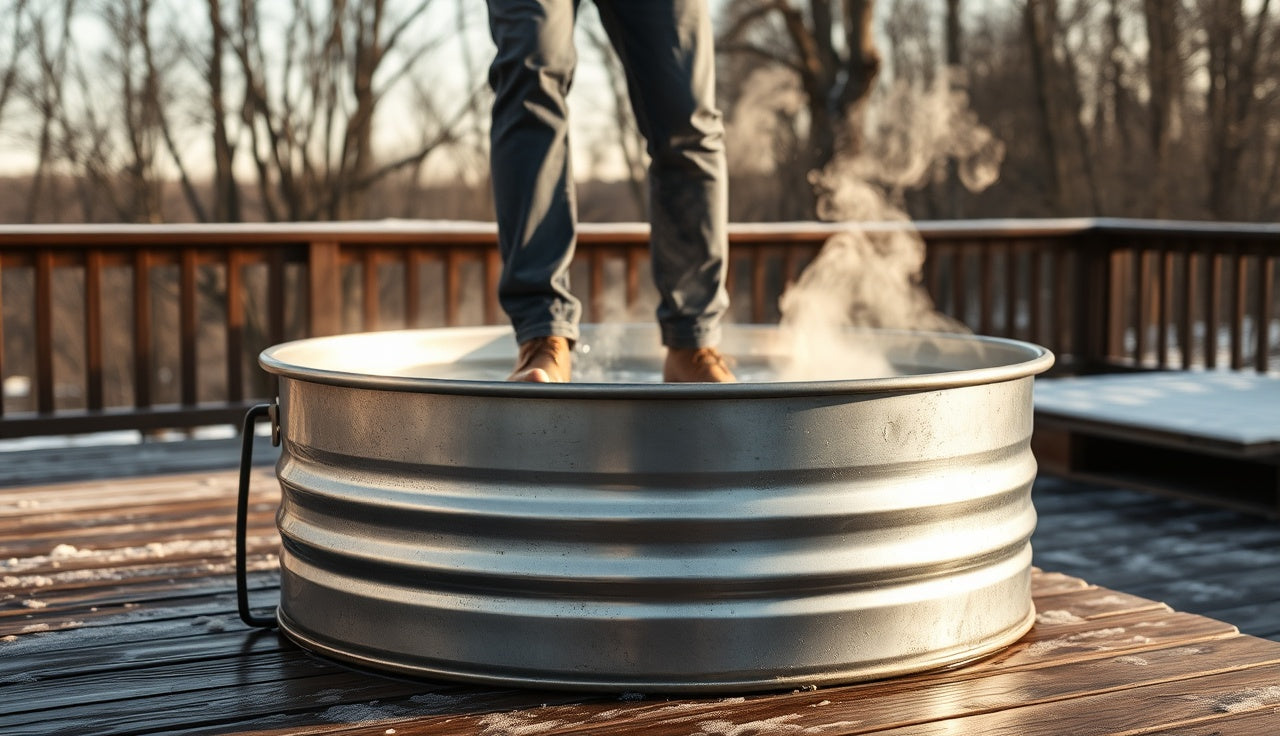
Rubber or plastic stock tank Cost: $40, $120 new. Farm supply stores sell galvanized steel or polyethylene tanks in 50- to 150-gallon sizes. The 100-gallon polyethylene tank at Tractor Supply runs about $80, $100. It holds water across multiple sessions, it lasts, and it's the best value for most people. You still need ice, or you can add a pump and a small chiller later.
Inflatable or portable ice bath tubs Cost: $30, $150. These collapsible tubs are usually PVC or thick nylon. They fold flat, which matters in an apartment. Quality swings hard. The cheap models under $50 sometimes leak at the seam within months. Pay $80, $150 and you get something reliable. They don't last like a stock tank, but portability is real.
Chest freezer cold plunge (DIY) Cost: $150, $500. A used chest freezer off Facebook Marketplace or Craigslist runs $80, $200 for a 15-cubic-foot model. Add a pre-filter and a submersible pump ($30, $80) and you have a plunge that holds temperature with no ice at all. This is the move for daily plunging. The freezer cycles on and off to hold your target temp, you stop buying ice, and the total often lands under $400. The catch: you need a dedicated 120V outlet, ideally on a GFCI circuit, and you have to treat the water against bacteria.
Cold shower Cost: $0 beyond your water bill. Honest answer: a cold shower is not cold water immersion. It hits less body surface, the temperature is harder to control, and the research on showers is thin next to the immersion data. Better than nothing if immersion isn't an option. But if you can swing $80 for a stock tank, spend it there.
The cost comparison chart is below.
How do you build a DIY chest freezer cold plunge for under $400?
The chest freezer is where most serious daily plungers on a budget end up. Here's the actual process.
Find a used chest freezer in the 10- to 20-cubic-foot range. Fifteen cubic feet fits most adults with legs curled. Confirm the compressor runs (listen for it to kick on) and the lid seal is intact. Budget $80, $200.
Clean the interior with a diluted bleach solution. The CDC recommends 1 tablespoon of unscented household bleach per gallon of water for surface disinfection [2]. Rinse well. Let it air out for a full day.
Fill it with water. Do not run the freezer on its normal thermostat or you'll freeze the water into a block. Two options: plug in an external temperature controller (an Inkbird or Ranco unit runs $25, $40) that sits between the outlet and the freezer and cuts power at your target temp, or unplug the freezer once the water hits temp and watch a waterproof thermometer.
Water treatment matters. Still water at 50 to 60°F grows bacteria over days. A little pool shock (calcium hypochlorite) or a floating bromine tablet keeps it clean between sessions. Test strips for pH and sanitizer cost about $10 for 50. Aim for free chlorine at 1 to 3 ppm and pH between 7.2 and 7.8 [3].
Add a submersible fountain pump ($15, $30) to circulate the water. Moving water feels colder at the same temperature because it strips the thin warm layer against your skin, so you hit the same effect at a slightly higher temp, or get there faster.
GFCI protection is non-negotiable. The National Electrical Code requires GFCI protection for outlets near water [4]. If your garage or outdoor outlet isn't already protected, a plug-in GFCI adapter costs under $15.
Total build for the average setup: $150, $400. After that you mostly pay for electricity, roughly $10, $25 a month for a freezer cycling intermittently, depending on your utility rate and how warm the room gets [9].
| Bathtub + ice (per session) | $15 |
| Inflatable tub + ice | $100 |
| Stock tank + ice | $100 |
| Chest freezer DIY | $300 |
| Stock tank + small chiller | $600 |
| Budget dedicated plunge unit | $1,150 |
Source: SweatDecks editorial research, 2025; electricity cost basis EIA (Citation 9)
How cold does your ice bath actually need to be?
There's no single magic number, but the research gives a tight range: 50 to 59°F (10 to 15°C). The Søberg et al. 2022 PLOS ONE study used roughly 10 to 15°C [1]. A 2021 review in the International Journal of Environmental Research and Public Health found most recovery protocols used 10 to 15°C for 10 to 20 minutes [5].
Colder isn't clearly better. Below 10°C (50°F) the risk of cold shock and hyperventilation climbs sharply. The gasp reflex can pull water into your lungs, and the cold shock response (rapid breathing, elevated heart rate) peaks in the first 30 seconds of immersion [6]. Above 15°C (59°F) it starts to feel like a cool bath, and the physiological response fades.
Call 50 to 59°F the sweet spot. Buy a waterproof digital thermometer ($10, $15) before you fix on a target. Tap water across the continental US runs roughly 45 to 75°F depending on season and region [10], so you'll need barely any ice in winter and a lot in summer.
A chest freezer with an external controller lets you dial in a target and hold it hands-off. That session-to-session consistency is the one real edge the freezer has over ice-bag methods, where the temperature drifts up as the ice melts.
Is a stock tank or a chest freezer the better budget cold plunge?
This is the question most people actually face, so here's the direct comparison.
| Method | Upfront cost | Ongoing cost | Temperature control | Durability | Best for |
|---|---|---|---|---|---|
| Bathtub + ice | $0 | $8, $25/session | Poor (drifts) | N/A | Occasional use only |
| Inflatable tub + ice | $30, $150 | $8, $25/session | Poor | 1 to 3 years | Apartment/portability |
| Stock tank + ice | $80, $120 | $8, $25/session | Poor | 10+ years | Budget, low frequency |
| Stock tank + small chiller | $300, $800 | $15, $30/month elec | Good | 5 to 10 years | Regular use, no DIY |
| Chest freezer (DIY) | $150, $400 | $10, $25/month elec | Excellent | 5 to 10 years | Daily plungers |
| Budget dedicated plunge | $800, $1,500 | $20, $40/month elec | Excellent | 5 to 10 years | Plug-and-play buyers |
Plunge two or three times a week with a stock tank and ice and you'll spend about $50, $75 a month on ice alone. A chest freezer setup pays for itself inside four to eight months. If you're committed to a regular practice, the freezer is almost always the smarter financial call.
Want to test the idea before spending anything? Buy two bags of ice and get in your bathtub. Seriously. It costs $10 and tells you whether you'll do this regularly before you drop $200 on gear.
For background on what cold immersion is and how dedicated units differ, see our ice bath guide. If you're thinking about pairing heat and cold, the cold plunge overview compares purpose-built units.
How much does ice cost, and is it worth buying a bag or making your own?
Bagged ice from a store runs $2, $5 for 10 lbs. A 20-lb bag from a vending machine typically runs $3, $5. Cooling a 60-gallon tub from 65°F tap water to 55°F takes roughly 25 to 40 lbs, so figure $7, $15 per session in a stock tank.
Home ice is far cheaper per pound, about $0.15, $0.30/lb against $0.25, $0.50/lb for bagged, but most fridges make it slowly. A countertop ice maker produces 20 to 30 lbs a day and costs $80, $150 new. For high-frequency stock tank use, a countertop maker can cut your ongoing ice cost by 40 to 60% versus buying bags.
Most people who stick with ice settle into one of two rhythms: buy bags in bulk (some grocery stores discount 10-packs), or run a small ice maker overnight. Neither beats a chest freezer that holds temperature on its own, but both work.
One thing worth knowing: fill a chest freezer and let the compressor cool it, and you need no ice at all after the first fill. That difference in ongoing cost is real and adds up fast.
What are the health benefits of cold water immersion, and what does the research actually say?
The honest answer: the evidence is promising and the field is still young. Here's what the best research shows.
Norepinephrine and dopamine: the Søberg et al. 2022 study found cold water immersion raised norepinephrine by up to 300% and dopamine by 250% [1]. Real, measured neurochemical changes. Whether that turns into lasting mood improvement for everyone is less settled.
Muscle recovery: a 2012 Cochrane review found cold water immersion reduced muscle soreness and perceived fatigue versus passive rest after exercise. The authors were blunt that "the optimal mode and duration of treatment are not clear," and effect sizes varied [7]. The 2021 meta-analysis matched that, finding immersion effective for delayed-onset muscle soreness (DOMS), best at 10 to 15°C for 10 to 20 minutes [5].
Metabolic effects: brown adipose tissue (BAT) activation from cold is real, and the Søberg study measured more BAT activity after repeated immersion. What's unclear is how much that shifts body composition over months in the general population. Most of the data is short-term.
Blood pressure and heart risk: cold immersion causes an immediate spike in blood pressure and heart rate, which is why people with uncontrolled hypertension or arrhythmias are told to check with a physician first [6]. The long-term cardiovascular data in healthy adults is thin.
Muscle adaptation concern: cold immersion right after strength training may blunt muscle protein synthesis. A 2015 study in the Journal of Physiology found post-exercise cold immersion reduced long-term gains in muscle mass and strength compared to active recovery [8]. If building muscle is the goal, timing matters. Many people now plunge on rest days or wait a few hours after lifting.
The bottom line: cold water immersion has real, studied effects on recovery and neurochemistry. It's no cure-all, but for recovery and the mood and alertness effects the evidence is solid enough to take seriously. For more on what the research supports, see our cold plunge benefits read.
Check with a physician first if you have cardiovascular disease, Raynaud's phenomenon, or any condition affected by cold.
How do you keep a cheap ice bath clean between uses?
This is the part most DIY guides skip. Still water at 50 to 60°F is cold enough to slow bacteria but not stop them. With no sanitation, a freezer or tank full of water can grow algae and bacteria within days.
Treat it like a small hot tub. Pool or spa shock (calcium hypochlorite) raises chlorine to kill bacteria. After that, a floating tablet dispenser with spa bromine or chlorine tablets holds a residual level between sessions. Test strips read the levels in under a minute. Target free chlorine at 1 to 3 ppm and pH at 7.2 to 7.8, the same ranges used for pools and spas [3].
For a chest freezer, change the water every two to four weeks even with good treatment. More often with multiple users. When you drain it, wipe the interior with diluted bleach solution and rinse before refilling.
If you'd rather skip chlorine, hydrogen peroxide at 35 to 50 ppm is used as a sanitizer in some spa setups, though its performance in cold water is less documented than chlorine's.
One practical tip: shower before you get in. Body oils, lotions, and skin debris burn through sanitizer fast and foul the water in a way that's hard to fix short of a full drain and refill.
Can you use a cold plunge in winter without spending anything on cooling?
Live somewhere with real winters and your outdoor setup becomes a near-free cold plunge for months. A stock tank outdoors where nights drop below 40°F cools on its own. Cover it with a foam-board lid to hold temperature overnight and keep debris out.
In the Midwest, Northeast, or mountain West, air temperatures routinely push outdoor water into the 40 to 55°F range for four to six months a year. That's free cooling. Plenty of people run a stock tank outside all winter and switch to a chest freezer or ice bags only when it warms up.
The main risk outdoors in freezing weather: leave the water uncovered and unmonitored below 28°F for long, and it can freeze solid and crack a plastic tank. A 50-watt stock tank de-icer ($20, $30 at feed stores) keeps the surface open while the bulk of the water stays cold. It draws almost no power.
Wind chill hits you harder than it hits the water. Warming up after matters. Keep dry clothes within reach and a warm indoor space or portable sauna to step into. Contrast therapy (heat then cold, or cold then heat) is a legitimate protocol and, anecdotally, more comfortable in cold climates when you have both. Our sauna benefits article covers what the heat side adds.
What accessories do you actually need vs. what's a waste of money?
The upsell around cold plunging is enormous. Here's an honest take on what earns its cost.
Worth buying:
- Waterproof digital thermometer ($10, $15): you have to know your actual water temp. Non-negotiable.
- GFCI outlet or adapter ($12, $20): non-negotiable for any electric setup near water.
- Test strips for pH and sanitizer ($10): cheap, and the only way to know your water is safe.
- Submersible pump ($15, $30): makes cold water feel colder by breaking the warm skin layer. Real effect.
- Insulating lid or cover ($20, $60, or DIY foam board under $10): keeps debris out, holds temp, cuts energy use in a freezer setup.
- External temperature controller for a chest freezer ($25, $40): required for that method. The freezer's own thermostat isn't built for liquid water.
Probably not worth it at the cheap end:
- Ozone generators marketed for cold plunges: they work, but they cost $100, $300, and test strips plus chlorine tablets do the job for $20 a year.
- Fancy insulated plunge tubs under $300: the insulation rarely performs as claimed at this price, and a stock tank plus a foam lid does the same for less.
- Apps and connected temperature monitors: fine if you love data, but a $12 thermometer gives you the same number.
SweatDecks carries cold plunge gear, including purpose-built units, if you reach the point where you want to step up from DIY. For most people starting out, the cheap setup is the right setup. Upgrade once you know you'll use it.
What are the safety risks of a cheap ice bath and how do you avoid them?
The risks are real but manageable with basic precautions.
Cold shock response: the first 30 seconds trigger involuntary gasping, rapid breathing, and a spike in heart rate and blood pressure [6]. It passes. Don't panic. Control your breathing before you get in. Never jump into water below 50°F without acclimating. Start at 60°F and work down over weeks.
Hypothermia: for sessions under 15 minutes at 50 to 60°F, hypothermia in a healthy adult isn't a serious risk. The risk climbs sharply below 50°F, past 20 minutes, or for a smaller or older person with less insulating mass. Set a timer. Get out when it goes off.
Electrical hazard: any electrical device (pump, controller, heater, phone) near water is a hazard. GFCI protection is the single most important safety step for a DIY setup. NEC Article 680 (pools and spas) and Article 210 both cover GFCI requirements for water-adjacent circuits [4]. If the electrical side makes you nervous, pay an electrician for the outlet. It's a one-time cost.
Fainting: standing up fast out of cold water can trigger vasovagal syncope, especially after longer sessions. Exit slowly. Sit on the edge for 30 seconds before you stand.
Who should skip it or get clearance first: people with cardiovascular disease, Raynaud's phenomenon, peripheral artery disease, uncontrolled hypertension, or recent cardiac events. Pregnant women should consult their OB. Skip it with open wounds or active skin infections.
How does a cheap ice bath compare to expensive cold plunge units?
The honest comparison: a chest freezer build and a $5,000 commercial plunge both get water to 55°F. Same temperature. Same physiological response.
What you give up at the cheap end: filtration and circulation (fixed with a $20 pump and test strips), looks (a chest freezer is not pretty), convenience (you manage the water chemistry yourself), and warranty (a Marketplace freezer has none).
What you don't give up: the cold. The temperature. The actual thing that produces the documented effects.
Purpose-built units hold temperature more precisely, filter automatically, and look good on a patio. That matters to some people and not at all to others. If you're mainly after the physiological effects and you're handy enough to run a simple DIY setup, a $300 chest freezer build is functionally equal to a $5,000 unit.
Decide later that you want something that handles filtration and temperature on its own, and that's when a purpose-built cold plunge starts to make economic sense. Starting cheap isn't starting wrong. Most people who eventually buy a nice unit started with a stock tank or a freezer. The cheap setup is how you prove to yourself you'll actually do this.
Frequently asked questions
What is the cheapest way to take an ice bath at home?
Fill your bathtub with cold tap water and add 20 to 40 lbs of bagged ice (about $10, $16). That gets most tubs to 55°F, inside the research-backed 50 to 59°F range. It's the cheapest entry point and needs no equipment. Cost per session adds up fast if you plunge regularly, but it's a legitimate way to test cold immersion before investing in any setup.
How much does a DIY chest freezer cold plunge cost to build?
A used chest freezer from Facebook Marketplace or Craigslist runs $80, $200. Add an external temperature controller ($25, $40), a submersible pump ($15, $30), test strips ($10), and a sanitizer like pool shock ($10, $15). Total build lands at $150, $400. Monthly electricity after that runs roughly $10, $25 depending on your utility rate. It usually pays for itself within four to six months versus buying ice bags.
What temperature should a cold bath be for health benefits?
The most-cited research, including the Søberg et al. 2022 PLOS ONE study, used water at roughly 10 to 15°C (50 to 59°F). That range produces measurable increases in norepinephrine and brown adipose tissue activity. Colder isn't clearly better for most people and raises cold shock risk. Warmer than 60°F produces a more modest response. A waterproof digital thermometer lets you dial it in precisely.
How long should you stay in a cheap ice bath?
The Søberg et al. 2022 protocol found benefits from 11 total minutes per week, split across two to four sessions. Single sessions of 5 to 10 minutes at 50 to 59°F are typical. Don't exceed 20 minutes, especially below 55°F. Set a timer before you get in. Exit slowly and sit on the edge before standing to avoid dizziness.
Is a stock tank or a chest freezer better for a cold plunge?
For one to two sessions a week, a stock tank plus ice bags works well and costs $80, $120 upfront. For daily plunging, a chest freezer setup is cheaper over time because you drop the recurring ice cost, and it holds temperature precisely between sessions. Stock tanks last longer and are easier to maintain. Both work; the choice comes down to frequency and how much DIY you want.
Can a cold shower replace an ice bath?
Cold showers are not physiologically equal to cold water immersion. Immersion covers more body surface, the temperature is more controllable and consistent, and nearly all the research on cold exposure for norepinephrine, brown fat, and recovery uses immersion, not showers. A cold shower beats nothing for someone without a tub or tank, but if you can manage an $80 stock tank, that's a more effective tool.
How do you keep a DIY ice bath clean and safe?
Treat the water like a small pool or hot tub. After filling, add pool shock to raise chlorine to 1 to 3 ppm. Use a floating tablet dispenser with spa chlorine or bromine to hold that level. Test with strips (pH should be 7.2 to 7.8) every few days. Change the water fully every two to four weeks. Shower before getting in. For a chest freezer, wipe the interior with diluted bleach on each full water change.
Is it safe to use a chest freezer as a cold plunge?
Yes, with precautions. Plug the freezer into a GFCI-protected outlet, which the National Electrical Code requires for water-adjacent circuits. Use an external temperature controller so the water doesn't freeze solid. Keep pumps and controllers away from the water surface or use ones rated for contact. Treat the water with a sanitizer. Don't use the freezer's original thermostat, which is calibrated for air, not liquid water.
Should you do an ice bath before or after a workout?
For recovery and soreness, cold water immersion is best studied immediately post-exercise, where research shows reduced delayed-onset muscle soreness. But a 2015 Journal of Physiology study found cold immersion right after strength training may reduce long-term muscle and strength gains. Many people now plunge on rest days or wait three to four hours after lifting. Timing matters more for strength athletes than for endurance or general recovery.
What are the risks of a cheap ice bath and who should avoid them?
Cold shock (involuntary gasping, heart rate spike) is the main risk in the first 30 seconds. Manage it by controlling your breathing before entering and acclimating gradually. Hypothermia is unlikely in healthy adults at 50 to 60°F for under 15 minutes. People with cardiovascular disease, uncontrolled hypertension, Raynaud's phenomenon, or who are pregnant should consult a physician first. Never immerse below 50°F without experience. Always use a GFCI outlet for any electrical setup.
How many bags of ice do you need for an ice bath?
To bring a standard bathtub (about 60 gallons) from 65°F tap water to 55°F, you typically need 25 to 40 lbs of ice, or three to four standard 10-lb bags. A smaller stock tank (50 gallons) needs slightly less. In warmer months or climates, you may need 50 lbs or more. Each 10-lb bag costs $2, $5, so budget $10, $20 per session for a bathtub or stock tank setup.
Do inflatable ice bath tubs actually work?
As vessels, yes. Inflatable or collapsible plunge tubs in the $80, $150 range hold water fine and are the best option for apartments or anyone who needs portable storage. The limitations are durability (seams can fail after one to two years of regular use) and insulation (most don't hold temperature as long as a rigid tank). Avoid the cheapest models under $50 if you plan to use one more than occasionally.
Can you use a plastic trash can or rubbish bin as an ice bath?
A large food-grade plastic bin (32 to 44 gallons) works for people who fit their lower body inside, though most adults can't fully immerse in one. It's a legitimate option for leg recovery after running. Make sure it's food-grade plastic, not a standard trash can, which may leach chemicals. Cost is typically $20, $50. Stability is a concern: the shape is top-heavy when full, so secure it against tipping before use.
How often should you take an ice bath for maximum benefit?
The Søberg et al. 2022 PLOS ONE study found meaningful effects from 11 minutes per week, split across two to four sessions. Most people plunge two to four times a week. Daily plunging is common among dedicated users and appears safe for healthy adults, though there's no strong evidence that daily frequency adds proportional benefit over two to four times a week. If you strength train, avoid plunging right after lifting.
Sources
- PLOS ONE, Søberg et al. 2022 – Cold exposure, brown adipose tissue, and metabolic signaling: 11 minutes of cold water immersion per week at 10–15°C increased brown adipose tissue activity and raised norepinephrine by up to 300% and dopamine by 250%
- CDC – Cleaning and Disinfection Guidance: 1 tablespoon of unscented household bleach per gallon of water is recommended concentration for surface disinfection
- CDC – Healthy Swimming: Pool and Hot Tub Chemistry: Recommended free chlorine level for pools and spas is 1–3 ppm with pH of 7.2–7.8
- NFPA – National Electrical Code (NEC) Articles 210 and 680: GFCI protection is required by the NEC for electrical outlets and circuits near water, including spa and pool applications
- International Journal of Environmental Research and Public Health, 2021 – Cold water immersion for recovery meta-analysis: Cold water immersion at 10–15°C for 10–20 minutes was effective for reducing delayed-onset muscle soreness (DOMS)
- Tipton MJ et al. – Cold water immersion: kill or cure? Experimental Physiology, 2017: Cold shock response (involuntary gasping, rapid breathing, heart rate spike) is strongest in the first 30 seconds of immersion and poses cardiac risk in those with underlying conditions
- Cochrane Database of Systematic Reviews, Bleakley et al. 2012 – Cold water immersion for preventing and treating muscle soreness after exercise: Cold water immersion reduced muscle soreness and perceived fatigue compared to passive rest; optimal mode and duration of treatment are not clear
- Journal of Physiology, Roberts et al. 2015 – Post-exercise cold water immersion attenuates acute anabolic signalling: Cold water immersion after strength training reduced long-term gains in muscle mass and strength compared to active recovery
- US Energy Information Administration – Electricity data and residential prices: Average US residential electricity rate used to estimate $10–$25/month operating cost for a chest freezer cold plunge
- NOAA – National climate and temperature data: Tap water temperature in the continental US ranges from approximately 45–75°F depending on season and region

Share:
Blow up ice baths: what you actually need to know before buying
How long should you sit in an ice bath? A practical guide