
Last updated 2026-07-09
TL;DR
A portable hot air sauna is a collapsible fabric or pop-up tent that uses an electric or steam heater to warm the air around your body to roughly 120 to 140°F. Setup takes 5 to 15 minutes. They cost $80 to $500 depending on size and heater quality. Research on sweat and cardiovascular response is real but modest; don't expect the same depth of heat as a traditional Finnish sauna.
What exactly is a portable hot air sauna?
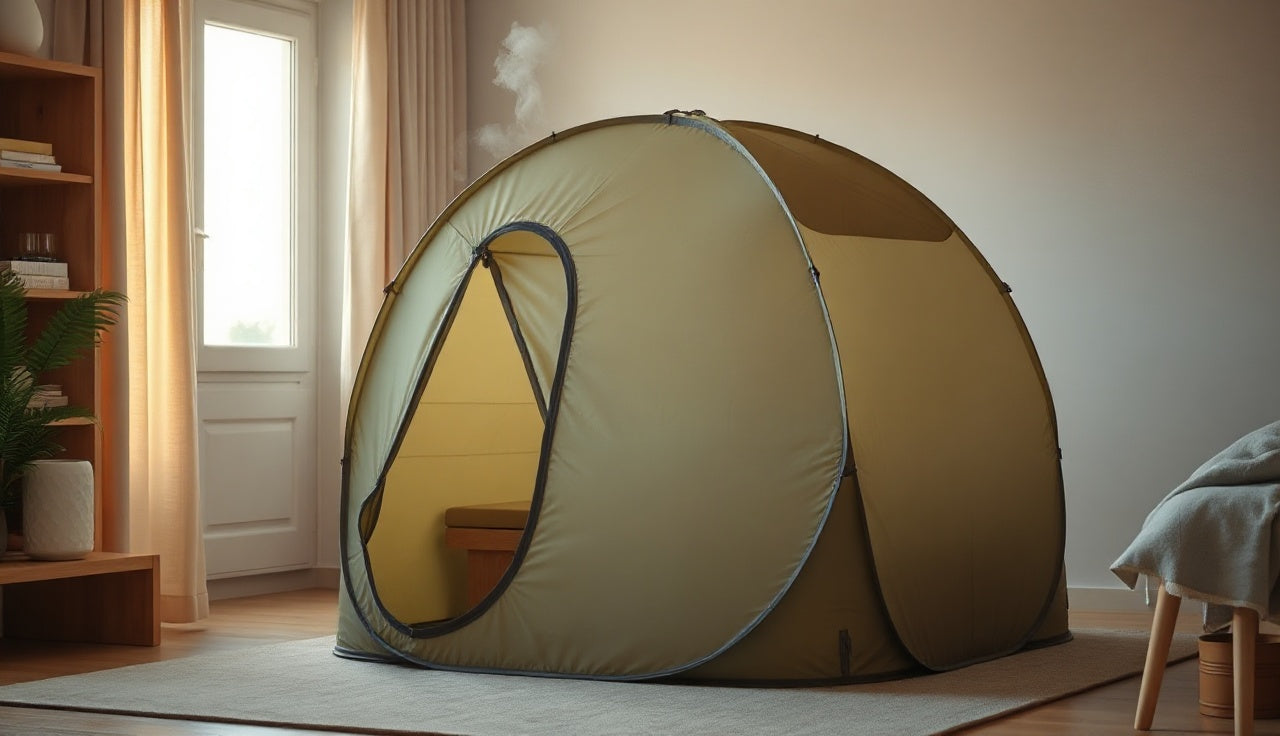
A portable hot air sauna is a collapsible enclosure, usually made from a layered polyester or nylon fabric, designed to trap heated air around your body. Most models have a hole at the top for your head so you breathe room-temperature air, not superheated steam. A small electric heater, a steam generator, or both sits inside or connects via a hose.
The key distinction is air heat versus steam. Some manufacturers use the two terms interchangeably, but a true hot air sauna primarily heats the surrounding air rather than saturating it with water vapor. That puts it closer in concept to a traditional Finnish sauna than a steam room, though it runs at much lower temperatures and much smaller volumes. A traditional Finnish sauna operates between 160°F and 212°F [1]; most portable hot air units top out around 120 to 140°F simply because the insulating fabric can't safely contain higher temperatures.
These aren't the same thing as an infrared sauna blanket or pod, which uses radiant infrared panels to heat your skin and tissue directly. A portable hot air sauna heats the air first, and that warm air transfers heat to you by convection. The distinction matters if you're trying to match a specific research protocol. Most of the strongest heat therapy studies used Finnish-style saunas at 174°F; portable hot air units operate well below that [2].
The appeal is obvious: you can fold the whole thing into a bag, set it up in an apartment, a hotel room, or a backyard, use it for 20 to 30 minutes, and break it down again. For people without the space or budget for a permanent home sauna, that's a genuine value proposition.
How does a portable hot air sauna work?
The heater is the engine. Most entry-level portable hot air saunas come with a steam box: a small plastic or metal unit you fill with water. It heats water and produces steam that flows into the fabric tent, raising both air temperature and humidity. Better units include a dry-heat electric rod or coil element that warms the air without adding much moisture, which is a truer hot air experience.
The fabric tent itself is usually two or three layers of polyester with a reflective inner lining, sometimes mylar or aluminized film. That lining reflects radiant heat back toward your body and slows heat loss through the walls. A zipper runs the length of one side so you can get in and out. A collar of fabric or foam around the neck opening tries to minimize heat escape, though none of them seal perfectly.
Setup takes 5 to 15 minutes for most models. You unfold the tent, connect the heater hose or plug in the heating element, close the zipper, and let it pre-heat for 5 to 10 minutes before you sit down. Most have a fold-out or collapsible stool inside.
Temperature control varies a lot by model. Cheap units have a simple on/off switch; mid-range ones have a dial or digital controller that lets you set a target temperature and a timer. A real timer matters because you shouldn't be sitting in one of these while falling asleep. Sessions of 15 to 30 minutes at moderate heat are what most users report as comfortable. Running it longer doesn't mean more benefit. It mostly means more discomfort and more risk of overheating.
Learn more about the broader category in our portable sauna guide, which covers infrared and steam options alongside the hot air style.
What temperatures do portable hot air saunas reach?
In real-world conditions, most portable hot air saunas reach 110 to 140°F (43 to 60°C) inside the tent. The air temperature at head height, where your face is exposed, is almost always well below that because the neck opening leaks heat continuously.
| Model type | Typical air temp inside | Heater wattage | Price range |
|---|---|---|---|
| Basic steam-box unit | 110 to 120°F | 600 to 800W | $80, $150 |
| Mid-range steam + dry heat | 120 to 130°F | 1000 to 1200W | $150, $300 |
| Premium hot air unit | 130 to 140°F | 1500 to 1800W | $300, $500 |
| Traditional Finnish sauna | 160 to 212°F | varies | $3,000+ |
For comparison, the cardiovascular and heat-shock-protein responses that researchers have studied most extensively were produced at 174°F in a traditional Finnish sauna [2]. Portable hot air units operate at a meaningful deficit. You will sweat. Your heart rate will rise. But the stimulus is genuinely different in magnitude.
Humidity also differs. A Finnish sauna operates at 10 to 20% relative humidity; a steam-based portable unit can run much higher, sometimes 40 to 60%. Higher humidity reduces evaporative cooling from your skin, which means you feel hotter and sweat more visibly at a given air temperature. Whether that's physiologically better or just more uncomfortable is debated.
| Portable hot air (budget) | 115 |
| Portable hot air (mid-range) | 125 |
| Portable hot air (premium) | 137 |
| Portable infrared blanket | 130 |
| Steam room | 115 |
| Traditional Finnish sauna | 185 |
Source: Finnish Sauna Society; Laukkanen et al. JAMA Internal Medicine 2015; manufacturer specs
What does the research actually say about hot air sauna health benefits?
The honest answer is that most of the strong evidence comes from traditional Finnish sauna studies, not portable units specifically. So be careful about extrapolating.
The most-cited long-term data comes from the Kuopio Ischemic Heart Disease Risk Factor study published in JAMA Internal Medicine, which tracked 2,315 Finnish men over 20 years and found that men who used a sauna four to seven times per week had a 50% lower risk of fatal cardiovascular events compared to once-a-week users [2]. The saunas in that study were traditional wood-heated Finnish rooms at roughly 174°F. Portable hot air units were not involved.
Shorter-term physiology studies tell us more about what heat stress itself does. Core body temperature can rise 1 to 2°C during a 20-minute session at moderate sauna temperatures, which triggers cardiovascular responses including increased heart rate and cardiac output, similar in some ways to moderate aerobic exercise [3]. Heat also prompts expression of heat shock proteins, which support cellular repair and protein quality control [11]. A 2021 review in Temperature (Taylor and Francis) concluded that repeated heat exposure can improve vascular function and reduce arterial stiffness in sedentary adults, though the authors noted the evidence base is still developing [4].
For portable hot air saunas specifically: nobody has run a controlled trial comparing them to traditional saunas on hard outcomes. The closest honest statement is that if a portable unit raises your core temperature by 1 to 2°C for 15 to 20 minutes, the acute physiological response is probably in the same direction as a traditional sauna session, just smaller in magnitude. That's useful, not nothing, but it's not the same as the Finnish data.
See our full breakdown of what studies actually support in the sauna benefits article.
Is a portable hot air sauna safe? What are the real risks?
For most healthy adults, a 15 to 30 minute session at 120 to 140°F carries low risk if you stay hydrated and listen to your body. That said, several real hazards deserve attention.
Dehydration is the most common issue. You can lose 0.5 to 1.0 liters of sweat in a 20-minute session [3]. If you go in already dehydrated, you exit more dehydrated. Drink water before and after. Avoid alcohol before a session.
Overheating and hyperthermia are possible if you fall asleep or ignore warning signs. Dizziness, nausea, or a sudden feeling of cold despite the heat are signs to get out immediately. The neck-hole design helps because your face stays in cooler air, but it doesn't eliminate the risk.
Electrical safety matters more than people realize. These units involve electricity in close proximity to water and sweat. Look for units with UL, ETL, or CE certification. The heating element should sit in a dry area of the enclosure, not pooling water. Never plug a damaged cord into an outlet, and never leave the unit running unattended.
The CDC and Consumer Product Safety Commission track sauna-related injuries, and most involve high temperatures, extended sessions, and alcohol or drug use [5]. The CPSC advises against use for pregnant women, people with cardiovascular disease or uncontrolled hypertension, and anyone who has consumed alcohol [5].
Children and elderly adults are more vulnerable to heat stress. CDC guidance recommends consulting a physician before regular sauna use if you have any chronic condition [10]. That's not legalese. Thermoregulatory capacity declines with age, and some medications impair sweating.
For fire safety, keep the unit away from curtains, bedding, and anything flammable. The outer surface of the tent gets warm but usually not dangerously hot; the heater itself is a different story.
How does a portable hot air sauna compare to infrared, steam, and traditional saunas?
These four categories get lumped together constantly, and they really shouldn't be.
| Type | Primary heat mechanism | Typical temp | Humidity | Portability | Entry cost |
|---|---|---|---|---|---|
| Portable hot air | Convection (heated air) | 110 to 140°F | 20 to 60% | High | $80, $500 |
| Portable infrared blanket/pod | Radiant infrared | 100 to 150°F skin temp | Low | High | $200, $700 |
| Traditional Finnish sauna | Convection + radiant | 160 to 212°F | 10 to 20% | None | $3,000, $10,000+ |
| Steam room | Condensing steam | 110 to 120°F | 95 to 100% | None | $1,500, $8,000 |
A traditional sauna is hotter, more thoroughly studied, and produces a deeper, more consistent heat stimulus. If you have the space and budget, it wins outright. An infrared blanket heats tissue differently: the infrared wavelengths penetrate a few millimeters into skin and muscle rather than heating the surrounding air. Some people prefer the feeling; the physiological differences are real but modest at practical temperatures [6].
A steam room operates at near-100% relative humidity, which sharply reduces evaporative cooling and makes lower air temperatures feel extremely intense. The sauna vs steam room comparison is genuinely close for respiratory benefits; for cardiovascular heat stress, the sauna wins on pure temperature.
The portable hot air sauna sits in an honest middle ground: more air-heated than an infrared blanket, less hot and less studied than a real Finnish sauna. For someone who lives in a 700-square-foot apartment and wants regular heat exposure without a permanent installation, it's a reasonable tool.
What should you look for when buying a portable hot air sauna?
The heater is the single most important component. A steam box under 800W will struggle to reach useful temperatures in a cold room. Look for at least 1000W if you plan year-round use in a temperate climate. Electric rod heaters that produce dry heat are more durable than steam boxes because there's less water to evaporate, less mineral buildup, and fewer failure points.
Fabric quality matters for both heat retention and durability. Thicker multi-layer fabric with a reflective inner layer holds temperature better and survives repeated folding longer. Single-layer nylon tents heat faster but lose heat faster and tend to degrade after 100 or so sessions.
Look for these specific features:
- Adjustable temperature control with a visible readout, more than a dial
- Auto-shutoff timer (30 to 60 minute maximum is ideal)
- A detachable, washable seat or included folding stool
- ETL, UL, or CE electrical certification on the heater
- Neck collar that fits your frame (measure before ordering if possible)
- A carrying bag that fits in a closet
Size matters practically. One-person tents are roughly 35 x 35 x 45 inches folded out; some two-person models exist but are harder to heat evenly. For solo use, single-person units are more efficient.
Price reality: under $100 usually means a fragile steam box, thin fabric, and no auto-shutoff. Between $150 and $300 is the sweet spot for a unit that will last 1 to 3 years with regular use. Above $300, you're paying for better build quality, a longer warranty, and a more capable heater, but you're also approaching the price point where a permanent outdoor sauna or a small infrared cabin starts to make financial sense.
How do you set up and use a portable hot air sauna correctly?
Setup takes 5 to 15 minutes the first few times, less once you know the unit. Most tents have a collapsible aluminum or fiberglass frame that unfolds like a camping chair. Spread it on a flat, non-carpeted floor if possible; the heater can drip condensation.
Fill the steam box with distilled water if your tap water is hard; mineral buildup clogs the steam generator over time. Connect the steam hose to the tent's inlet port, usually a velcro flap at the bottom. Plug in and let it pre-heat for 5 to 10 minutes before sitting inside.
For a session:
1. Pre-heat the tent to target temperature (120 to 130°F is a reasonable starting point for beginners). 2. Drink 500 to 750ml of water before you get in. 3. Sit on the stool, close the zipper, and settle the neck collar. 4. Set a timer for 15 minutes if your unit doesn't have auto-shutoff. 5. Exit if you feel dizzy, nauseous, or unusually cold despite the heat. 6. After the session, towel off, rest for 5 to 10 minutes, and drink water.
Adding a contrast protocol by following with a cold shower or even a bucket of cold water works well for some people. You can read more about the logic behind that approach in our cold plunge and ice bath guides. The research on alternating heat and cold is genuinely interesting, though most of it uses traditional sauna temperatures, not portable-unit temperatures [4].
Cleaning: wipe the interior with a damp cloth after each session. Most fabric tents can't be machine washed; check the manufacturer's guidance. The steam box should be emptied and dried after each use to prevent mold.
Can a portable hot air sauna help with weight loss or muscle recovery?
Weight loss: the short answer is no, not in any meaningful way. Water weight you lose by sweating comes back when you drink. A 20-minute session at 120°F burns perhaps 100 to 200 calories through increased heart rate and metabolic work, but the evidence that this produces real fat loss over time is weak [3]. Some vendors make aggressive claims about calorie burn. Treat them skeptically.
Muscle recovery is a more interesting question. Heat after exercise may reduce delayed-onset muscle soreness (DOMS) by increasing blood flow to fatigued tissue and by modulating inflammatory signaling. A 2015 study in the Journal of Science and Medicine in Sport found that post-exercise heat application reduced perceived muscle soreness at 24 and 48 hours [7]. The mechanism is real; the magnitude in a portable hot air unit is uncertain because the temperatures are lower than the study interventions.
Heat shock protein upregulation is a genuine cellular response to heat stress. HSPs are intracellular chaperone proteins that help refold damaged proteins and protect against later stress [11]. Studies in Temperature and related journals confirm that repeated heat exposure increases HSP70 expression in humans [4]. Whether portable-unit temperatures are high enough to produce a meaningful HSP response is an open question; the threshold appears to be a core temperature rise of at least 1°C, which is achievable at 130°F if you stay in for 20 minutes or more.
Relaxation and sleep quality are probably the most reliably experienced benefits. Passive body heating raises core temperature, and the subsequent cooling as you exit triggers sleep-promoting mechanisms. A 2019 meta-analysis in Sleep Medicine Reviews found that body heating in the 1 to 2 hours before bed reduced sleep onset latency and improved subjective sleep quality [8]. A portable sauna fits that protocol reasonably well.
SweatDecks carries a selection of portable sauna options if you want to compare specs side by side before committing.
How long do portable hot air saunas last and what do they cost to run?
Build quality varies widely, but here's a realistic durability picture: a budget steam-box unit used two to three times a week will likely need heater replacement or full replacement within 6 to 18 months. Mid-range units with better fabric and a sturdier heater run 2 to 4 years under regular use. A few premium brands offer 3-year warranties, which is a useful signal of manufacturer confidence.
The steam box is almost always the first failure point. The internal heating element corrodes, or the steam tube degrades. Replacement steam boxes cost $20 to $50 and are often sold separately, which extends the life of an otherwise functional tent.
Running costs are low. A 1200W heater running for 30 minutes costs roughly $0.07 at a national average electricity rate of $0.12 per kWh [9]. A daily 30-minute session for a year runs about $25 in electricity. That's negligible compared to a gym membership or a commercial spa visit.
Water use is minimal, a few hundred milliliters per session for a steam unit.
Storage: most portable hot air saunas fold to a bag measuring roughly 24 x 18 x 6 inches, which fits on a closet shelf. The heater stores separately.
Are there downsides to a portable hot air sauna I should know about before buying?
Yes, several real ones.
Temperature ceiling. You're limited to 120 to 140°F in practice. If you want the deeper heat stress that Finnish sauna research documents, you need a real sauna. This isn't a knock on the product; it's physics and materials. Acknowledge the limitation before you buy.
The neck-opening compromise. Your head stays out, which helps avoid overheating but means your neck and shoulders sit cooler than the rest of you. Some people find this uncomfortable. The seal is never perfect, so hot air escapes and heat-up times stretch out.
Sweating in an enclosed fabric bag is exactly as visually unappealing as it sounds. The interior gets moist, and if you don't wipe it down and dry it thoroughly, mold can grow in the fabric folds within weeks. This is a genuine maintenance commitment, not optional.
Noise. Steam boxes are not quiet. Most produce a steady bubbling-hissing sound that some people find relaxing, others find irritating. If you're in a thin-walled apartment, your neighbors will know when you're using it.
Single-person limitation. These are solo tools. If you want a shared recovery ritual with a partner, you need two units or a proper installation.
The tent-in-a-room look is not for everyone. These don't read as premium wellness equipment; they look like a reflective camping tent set up in your living room. If you care about your space's appearance, factor that in.
For people who want to share the experience, compare budget options, or think about long-term value, it's worth reading about the Costco sauna options, which sometimes include entry-level permanent units in the same price range as premium portable models.
Frequently asked questions
What temperature does a portable hot air sauna reach?
Most portable hot air saunas reach 110 to 140°F (43 to 60°C) inside the tent during normal operation. Budget steam-box units tend to top out at 110 to 120°F; better-built units with 1500W heaters can hit 130 to 140°F. That's meaningfully below the 160 to 212°F of a traditional Finnish sauna, so the heat stimulus is real but less intense than the conditions used in most major sauna health research.
How long should I stay in a portable hot air sauna?
Start with 10 to 15 minutes and see how your body responds. Most experienced users do 20 to 30 minute sessions. Get out immediately if you feel dizzy, nauseous, or unusually cold. Don't exceed 30 to 45 minutes without a break. Always drink water before and after. The Consumer Product Safety Commission specifically advises against extended sessions without monitoring.
Can you lose weight using a portable hot air sauna?
Any weight you lose during a session is water weight that returns when you rehydrate. The calorie burn from a 20 to 30 minute session at 120 to 130°F is roughly 100 to 200 calories from elevated heart rate and metabolic work, which is real but modest. There is no good evidence that portable hot air sauna use produces meaningful fat loss beyond what rehydration replaces.
Is a portable hot air sauna worth it compared to a traditional sauna?
Depends on your situation. If you have space and budget for a permanent installation, a traditional or infrared cabin sauna is better: hotter, more comfortable, more thoroughly researched. If you live in a small apartment, travel often, or want to try heat therapy before committing $3,000 or more, a portable hot air sauna at $150 to $300 is a reasonable low-risk starting point. It's not a substitute; it's an approximation.
Are portable hot air saunas safe for people with heart conditions?
The Consumer Product Safety Commission and CDC both advise people with cardiovascular disease to consult a physician before using saunas. Heat raises heart rate and blood pressure transiently. Most healthy adults handle this fine, but for anyone with hypertension, arrhythmia, or prior cardiac events, professional medical clearance before starting regular heat therapy is a real recommendation, more than legal boilerplate.
What is the difference between a portable hot air sauna and an infrared sauna blanket?
A portable hot air sauna heats the air around your body by convection, similar in principle to a Finnish sauna. An infrared blanket uses radiant panels to heat your skin and tissue directly at the wavelength level. The physiological mechanisms overlap but aren't identical. Infrared blankets tend to feel more enveloping and don't require a separate stool; hot air saunas let your head stay outside the heated zone, which some people prefer.
Can I use a portable hot air sauna every day?
Healthy adults can generally use one daily without harm if sessions are 20 to 30 minutes, they stay hydrated, and they exit when uncomfortable. The Finnish men studied in the JAMA Internal Medicine paper who had the best cardiovascular outcomes used saunas four to seven times per week. Daily use with a portable unit is reasonable for most people, though the heat stimulus is lower than what was studied.
How much electricity does a portable hot air sauna use?
A typical 1200W portable hot air sauna running for 30 minutes uses 0.6 kWh. At the U.S. average retail electricity rate of about $0.12 per kWh, that's roughly $0.07 per session. A daily session for a full year costs about $25 in electricity total, which is genuinely inexpensive compared to commercial spa access or gym fees.
Can a portable hot air sauna help with muscle soreness?
Post-exercise heat application has modest evidence behind it. A 2015 study in the Journal of Science and Medicine in Sport found heat application after exercise reduced perceived DOMS at 24 and 48 hours. A portable hot air unit can deliver that heat stimulus, though the temperatures are lower than the studied interventions. The effect is real but probably smaller in magnitude than a proper Finnish sauna session.
How do I clean and maintain a portable hot air sauna?
Wipe the interior fabric with a damp cloth after each session and leave the tent open for 15 to 20 minutes to dry before folding. Empty and dry the steam box after every use to prevent mineral buildup and mold. Most fabrics can't be machine washed. If you use tap water in the steam box, descale every 4 to 8 weeks with a diluted citric acid solution. Neglecting this is the main reason these units fail early.
What's the best way to use a portable hot air sauna for sleep?
Use it 60 to 90 minutes before bedtime. Passive body heating followed by natural cooling triggers sleep-onset mechanisms: a 2019 meta-analysis in Sleep Medicine Reviews found that heating the body in the 1 to 2 hours before bed reduced sleep onset latency and improved subjective sleep quality. Keep the session to 20 to 25 minutes at 120 to 130°F, cool down naturally or with a warm-to-cool shower, then go to bed.
Do portable hot air saunas work in cold climates or winter?
They do, but performance drops in a cold room. A 1200W heater that reaches 135°F in a 70°F room will struggle to top 115°F in an unheated garage at 40°F. Use your portable sauna indoors in winter, in a room that's at least 60°F. Some users add a small space heater nearby to warm the ambient air before starting, which helps the unit reach target temperature faster.
Can two people use a portable hot air sauna at once?
Most portable hot air saunas are built for one person, with an interior of roughly 35 x 35 inches. Two-person tent models exist but are harder to heat evenly and need a much more powerful heater. In practice, two separate single-person units are more comfortable and more reliably heated than cramming two people into an oversized tent with a single steam box.
Should I try contrast therapy with a portable hot air sauna?
You can. Alternating heat with cold, like finishing a sauna session with a cold shower or a cold plunge, is a popular recovery protocol. The research on contrast therapy is mostly from studies using traditional sauna temperatures and full cold immersion, so results don't extrapolate perfectly to a portable unit. That said, the protocol is low-risk for healthy adults and many people find it genuinely invigorating. Our cold plunge benefits guide covers the cold side of that equation.
Sources
- Finnish Sauna Society, sauna temperature guidelines: Traditional Finnish saunas operate between 160°F and 212°F (70–100°C).
- JAMA Internal Medicine, Laukkanen et al. 2015, Sauna bathing and fatal cardiovascular and all-cause mortality events: Men who used a sauna 4–7 times per week had a 50% lower risk of fatal cardiovascular events vs once-weekly users; sauna temperature was approximately 174°F.
- Mayo Clinic Proceedings, Laukkanen et al. 2018, Cardiovascular and Other Health Benefits of Sauna Bathing: A 20-minute sauna session can raise heart rate to 100–150 bpm and cause sweat loss of 0.5–1.0 liters; metabolic rate increases similarly to moderate exercise.
- Temperature (Taylor and Francis), Laukkanen et al. 2021, review of heat therapy and vascular function: Repeated heat exposure can improve vascular function and reduce arterial stiffness; heat shock protein upregulation requires a core temperature rise of at least 1°C.
- U.S. Consumer Product Safety Commission, Sauna Safety: CPSC advises against sauna use for pregnant women, people with cardiovascular disease or hypertension, and those who have consumed alcohol; most injuries involve high temperatures and extended sessions.
- Photobiomodulation, Photomedicine, and Laser Surgery journal, Hamblin 2017, Mechanisms and applications of the anti-inflammatory effects of photobiomodulation: Infrared wavelengths penetrate a few millimeters into skin and tissue, producing a different primary heat mechanism compared to convective air heating.
- Journal of Science and Medicine in Sport, Pointon et al. 2015, Heat application for recovery from exercise-induced muscle damage: Post-exercise heat application reduced perceived delayed-onset muscle soreness at 24 and 48 hours after exercise.
- Sleep Medicine Reviews, Haghayegh et al. 2019, Before-bedtime passive body heating and sleep: Body heating in the 1 to 2 hours before bed reduced sleep onset latency and improved subjective sleep quality.
- U.S. Energy Information Administration, Average retail electricity price: U.S. average retail electricity price is approximately $0.12 per kWh (national residential average; exact figure varies by state and year).
- Centers for Disease Control and Prevention, Extreme Heat and Your Health: CDC guidance recommends consulting a physician before sauna use if you have any chronic condition; elderly adults and children are more vulnerable to heat stress.
- National Institutes of Health, National Library of Medicine, Heat shock proteins and cellular stress response: Heat shock proteins (including HSP70) are upregulated in response to heat stress and function as intracellular chaperone proteins supporting protein quality control.

Share:
BlueCube cold plunge tubs: honest review and buyer's guide
Therasage Thera360 Plus portable infrared sauna: full review