
Last updated 2026-07-09
TL;DR
The Sunray Aurora is a Canadian red cedar barrel sauna sold in 4-foot and 6-foot diameter versions, seating 4 to 6 adults. It runs a 6kW electric heater, assembles with hand tools in about 6 to 8 hours, and lives outdoors year-round. Prices run roughly $3,500 to $6,000 by size and retailer. It competes head to head with Dundalk and Almost Heaven.
What is the Sunray Aurora barrel sauna?
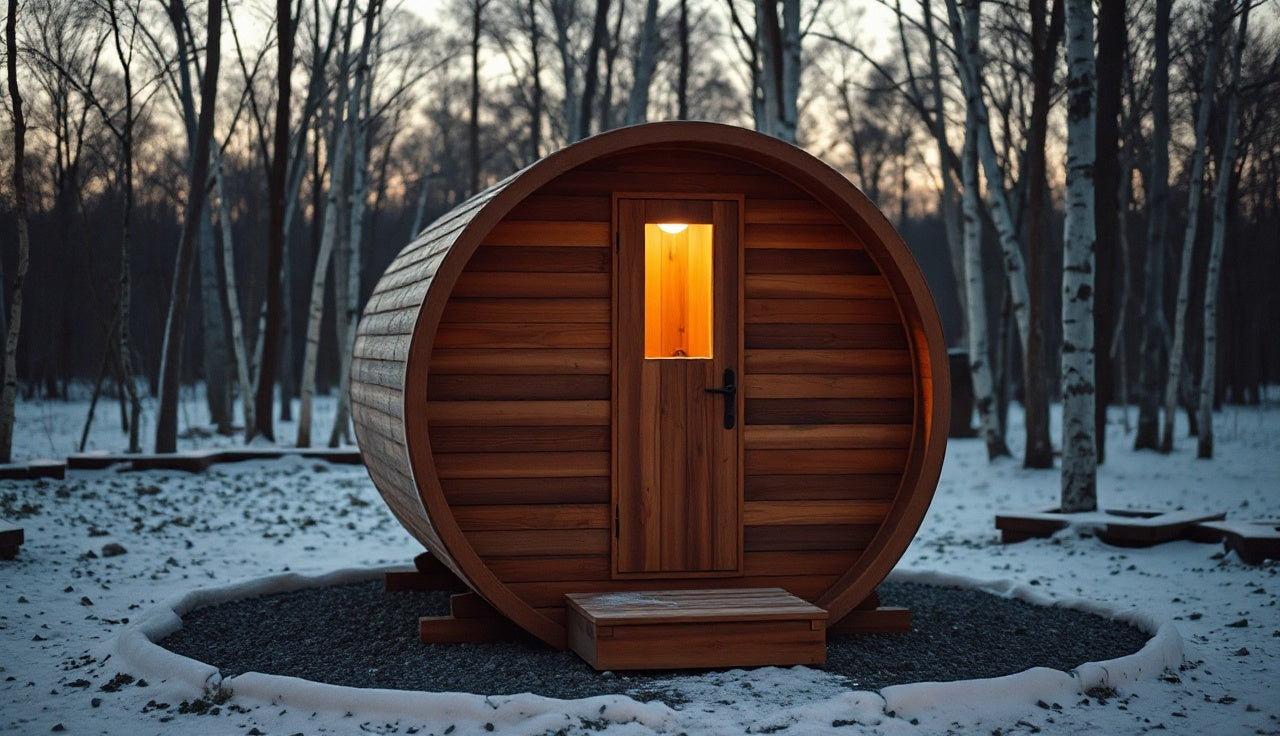
The Sunray Aurora is an outdoor barrel sauna built from clear, kiln-dried Canadian red cedar. Sunray sits in the middle of the market on purpose: better wood than the cheapest hemlock kits, cheaper than the custom Finnish builders.
The barrel shape is the whole point. A cylinder has no dead corners, so hot air off the heater circulates top to bottom faster than in a box-shaped room. You heat the space quicker and burn less electricity doing it. That is not marketing language. That is convection geometry. The curved ceiling also runs condensation down the walls instead of dripping it on your head.
The Aurora comes in two footprints: a 4-foot diameter by 6-foot long version that seats about 4 adults, and a 6-foot diameter by 7-foot long version that fits 6 without anyone touching knees. Both ship as flat-pack kits with pre-cut staves, hardware, and the heater in the box. Owners usually call it a two-person, half-day project. Sunray's own paperwork tells first-timers to allow a full day, which is the honest advice.
The wood carries the whole thing. Canadian red cedar is high in tannins and aromatic oils, so it resists moisture and insects without chemical treatment. That is the right pick for a box that sits through rain, snow, and August humidity. Hemlock and pine cost less and ask for more upkeep across a 10-to-15 year life. [1]
What are the specs and dimensions of the Sunray Aurora?
The two main Aurora configurations break down like this. Interior diameter, length, and heater capacity are the numbers that decide how many people fit and how fast it heats.
| Spec | Aurora 4-ft diameter | Aurora 6-ft diameter |
|---|---|---|
| Interior diameter | 4 ft (48 in) | 6 ft (72 in) |
| Length | 6 ft | 7 ft |
| Seating capacity | 4 adults | 6 adults |
| Heater included | 6 kW electric | 6 kW electric |
| Voltage requirement | 240V / 30A | 240V / 30A |
| Wall thickness | ~1.5 in cedar staves | ~1.5 in cedar staves |
| Approx. ship weight | 400-500 lbs | 600-700 lbs |
| Approx. price (2024-2025) | $3,500-$4,200 | $4,800-$6,000 |
Shipping costs and retailer margins move those prices, so read the ranges as a starting point. [2]
The 6kW heater is a Harvia or Harvia-equivalent unit in most configurations, and Harvia is a Finnish brand with a good name. 6kW is on the low end for a 6-person room. Finnish sauna guidance runs about 1kW per cubic meter of interior volume, and the larger Aurora sits right at that limit. The barrel's efficiency covers the gap in practice. But if you live somewhere with real winters (sustained temps below -10 F / -23 C), ask the retailer about a heater upgrade before you order. [3]
The floor is separate from the stave assembly. Most Aurora kits ship floor boards that rest on the base cradles instead of a fixed subfloor. Drainage stays simple, and swapping a rotted board is a five-minute job.
How hard is the Sunray Aurora to assemble?
Two reasonably handy adults finish it in a day. It is not trivial, but nothing about it requires a woodworker. The stave-and-hoop system works like an actual barrel: you stack pre-cut cedar staves vertically around steel or aluminum hoops, tighten the hoops as you climb, and the whole thing holds by compression, no glue and no fussy joinery.
Three steps trip people up. Squaring the door frame. Tensioning the hoops evenly so the barrel does not open gaps when temperatures swing. And leveling the cradle base before you stack a single stave. If the cradles are off, you fight the alignment on every step after. Spend the extra time on the base. Seriously.
Tools stay simple: a rubber mallet, a socket wrench, a level, and a helper. The instructions in Sunray kits work, though the photos in some runs are small. Owners on sauna forums keep saying the same thing, which is that watching a barrel assembly video first helps more than reading the sheet cold.
The electrical is the one part you do not DIY. The 6kW heater needs a 240V/30A dedicated circuit, which in most places means a licensed electrician and a permit. Budget $300 to $600 for that work depending on how far the panel sits from the sauna. [4]
Once it is built, the barrel rests on the two cradles. You need no foundation, but you do need level ground with decent drainage. A gravel pad works. A concrete slab works. Cradles sitting straight on soil rot the wood over time, so put something between them and the dirt.
Does the Sunray Aurora work well outdoors year-round?
Yes, and it is one of the real strengths of the design. Canadian red cedar handles freeze-thaw better than most species because its cells do not soak up much water to begin with. Owners in Minnesota, Ontario, and Maine run the Aurora through full winters without trouble.
A few practical notes. The end caps (the circular pieces closing each end of the barrel) take more direct weather than the stave body. A coat of UV-resistant exterior wood oil once a year, or twice every three years at a minimum, keeps them from greying and checking. Never oil or seal the interior. The bare wood has to breathe and take on moisture during sessions without off-gassing anything onto the people inside.
The 6kW heater brings the small Aurora up to 160-180 F (71-82 C) in about 30 to 45 minutes even in cold weather. The larger unit runs longer, maybe 45 to 60 minutes at 20 F outside. Still fast enough for a real outdoor session. [3]
Snow load rarely matters because the curved roof sheds it. Wind matters more. If your yard sits exposed, aim the door away from the prevailing wind. A simple windbreak fence can shave 15 minutes off preheat in a hard winter.
Siting, drainage, and electrical access run about the same across every brand. The outdoor sauna guide covers those decisions in one place.
How does the Sunray Aurora compare to Dundalk and Almost Heaven?
These three brands run the mid-market barrel segment in North America. Here is where they actually split.
Dundalk LeisureCraft is a Canadian manufacturer that owns its own production. The Harmony and Peace River models go straight at the Aurora. Dundalk's wood quality and fit-and-finish read a half-step better than Sunray's at a similar price, partly because they cut and machine their own staves. Dundalk also sells an optional porch add-on the Aurora does not match. If the budget stretches, the sauna crowd tends to point people to Dundalk. [2]
Almost Heaven is a West Virginia brand, now owned by Leisure Concepts. It sells everywhere (Costco, Wayfair, plenty of independents), and the Pinnacle and Watoga models land in Aurora price territory. Almost Heaven uses white cedar or hemlock depending on the model. Neither smells like Canadian red cedar, and hemlock in particular wants more upkeep outdoors. Almost Heaven's edge is retail reach and faster shipping to most US addresses.
So the Aurora's spot is roughly this: better wood than most Almost Heaven models, easier to find than Dundalk in some US regions, priced between the two depending on the retailer. The heater in Aurora kits gets mixed reviews on control quality. Some owners swap in a Harvia KIP or Tylo unit once the original dies.
If you are comparing form factors more broadly, the home sauna overview lays out indoor versus outdoor, which the Aurora forces on you (it is outdoor-only).
Seeing the Aurora at Costco is a separate story. Costco sells Sunray and Almost Heaven units on and off, sometimes with modified specs. The costco sauna guide covers how those versions differ from direct-purchase kits.
What do real owners say about the Sunray Aurora?
I will not invent testimonials or quote people I cannot verify. Here is the pattern that shows up across sauna forums and retail review sections.
The common praise runs three ways: the cedar smell on first use is intense in the best sense, assembly beats expectations when you watch a video first, and heat-up is genuinely quick. Owners in moderate climates report 30 to 40 minute preheats, which matches the spec.
The common complaints split into two buckets. The included heater controller on some Aurora units (older kits especially) feels cheap, and a handful of owners replaced it inside two years. The element itself holds up. The digital timer and thermostat are the weak link. The second bucket is the end caps. On some units they showed checking (small surface cracks) inside the first season when the owner skipped any exterior treatment. That is normal cedar behavior, not a defect, but Sunray's paperwork could warn buyers louder to oil the caps before the first winter.
Assembly instructions draw the most gripes. The kit ships all the hardware, but the sheet leans on diagrams over step-by-step text, and the diagrams run small in some production batches. A two-minute YouTube search fixes it.
Overall satisfaction trends positive. The barrel delivers on the promise: even heat, fast warmup, real outdoor durability. You are not buying a custom Finnish sauna for $4,500. You are buying a solid outdoor sauna that lasts 10 to 20 years on basic maintenance.
What electrical work does a barrel sauna need?
The Aurora heater runs 240V at 30 amps. That means a dedicated two-pole 30A breaker, 10-gauge wire (8-gauge if the run is long), and a weatherproof disconnect switch within sight of the heater. Most local codes want it permitted and inspected. [4]
NEC Article 680 covers pools and spas, but sauna heaters fall under NEC Article 424 (fixed electric space heating), with outdoor installations also subject to GFCI protection rules. Plenty of jurisdictions follow the NEC closely, and some states and cities layer on amendments. Check with your local building department before you buy wire. [5]
The practical cost: panel in the garage, sauna in the backyard 50 feet away, budget $400 to $700 for the run including materials and labor. Underground conduit adds to that. A line to an adjacent basement room costs less. Needing a panel upgrade to fit the 30A breaker can push the number up fast.
The heater carries its own timer and thermostat (the Aurora includes them), so the electrician's job is the circuit, the disconnect, and the connection to the heater's terminal block. Most licensed electricians knock it out in half a day.
Is a barrel sauna good for your health?
The research on regular sauna use is the strongest it has ever been. A 2018 study in Mayo Clinic Proceedings by Laukkanen and colleagues, drawing on the Finnish Kuopio Ischemic Heart Disease Risk Factor cohort, found men who used a sauna 4 to 7 times a week had a 63% lower risk of sudden cardiac death than men who used one once a week. Real finding, specific number, reputable source. [6] The study's stated conclusion: "sauna bathing is associated with a reduced risk of fatal cardiovascular disease events."
Nobody should read that as a promise the Aurora prevents a heart attack. Observational data has limits. Those Finnish participants used traditional saunas at 174 F (79 C) or hotter, which the Aurora reaches. But the lifestyle and cultural context around Finnish sauna use is not the same as buying a barrel kit and firing it twice a month.
On heat stress physiology the picture is clearer. Core temperature climbs, which triggers heat shock proteins, raises plasma volume, and drops blood pressure in the hours after a session. A 2021 review in the International Journal of Environmental Research and Public Health found consistent evidence for cardiovascular adaptations with regular sauna use, with the caveat that most of the studies are observational. [7]
Sauna use carries known contraindications. Pregnancy, uncontrolled hypertension, recent heart attack, and certain medications (diuretics, beta-blockers, some psychotropics) all warrant a doctor's sign-off before a regular practice. The American Heart Association has not issued a blanket endorsement of sauna use for heart benefit. That is the honest state of the science. [8]
The sauna benefits guide walks the research category by category.
Can you pair the Sunray Aurora with cold plunge or contrast therapy?
You can, and plenty of people buy the barrel specifically as the hot half of a contrast setup. The protocol the research describes most often runs about 10 to 15 minutes in the sauna, then 2 to 3 minutes in cold water (50-60 F / 10-15 C), repeated 2 to 3 rounds. [9]
The logic is straightforward. Heat opens blood vessels and raises core temperature. Cold clamps them down and dumps heat fast. Cycling between the two loads the cardiovascular system in a way some researchers compare to light exercise on heart rate and cardiac output. The muscle recovery claim is shakier. A 2012 Cochrane review found cold water immersion modestly reduced delayed onset muscle soreness versus passive rest, but the effect sizes were small and the study quality was mixed. [10]
To run this at home you need the sauna on one side and a dedicated cold plunge tub or a stock tank with a chiller on the other. Accurate cold plunge units start around $2,000 for a basic chiller-equipped tub and climb past $8,000 for brands like Plunge or Renu. [11]
The outdoor barrel fits this setup well because both units live outside, drainage stays simple, and a 6-foot barrel plus a plunge tub sits on most standard decks or patios.
The cold plunge benefits guide covers what cold exposure actually does. If you want the cheaper route, ice bath covers the DIY version.
SweatDecks carries cold plunge units that pair well with outdoor barrel saunas if you want to browse alongside the Aurora.
What is the total cost of owning a Sunray Aurora barrel sauna?
The sticker price is not the real number. Here is the honest total-cost breakdown, from freight to the oil you buy every spring.
| Cost item | Low estimate | High estimate | Notes |
|---|---|---|---|
| Aurora kit (4-ft model) | $3,500 | $4,200 | Varies by retailer |
| Aurora kit (6-ft model) | $4,800 | $6,000 | Varies by retailer |
| Shipping/freight | $200 | $600 | Distance and carrier |
| Electrical circuit + permit | $350 | $750 | Licensed electrician |
| Gravel pad or base prep | $100 | $400 | DIY to contractor |
| Annual electricity cost | $80 | $200 | 3-4 sessions/week, varies by rate |
| Annual maintenance (oil) | $20 | $60 | Exterior cedar oil |
| Heater replacement (10-yr) | $300 | $600 | Optional upgrade |
The electricity estimate assumes the 6kW heater running about 45 minutes per session at the US average residential rate of roughly $0.17/kWh (EIA, 2024). [12] Three sessions a week at that rate is about $100 to $140 a year. Your local utility rate moves that number.
First-year cost for the smaller unit, electrical and a basic base included, lands around $4,500 to $6,000. Spread over a 15-year life, that is $300 to $400 a year plus electricity, which beats most gym or spa memberships if you actually use it.
One thing worth saying plainly: buy the size you need. The 4-foot Aurora is comfortable for two and manageable for four. If you sauna with a group of four on the regular, the 6-foot version is not an extravagance. It is a better experience.
| 1 session/week | $34 |
| 2 sessions/week | $67 |
| 3 sessions/week | $101 |
| 4 sessions/week | $134 |
| 5 sessions/week | $168 |
| 7 sessions/week (daily) | $235 |
Source: U.S. Energy Information Administration, Electric Power Monthly, 2024
How does the Sunray Aurora compare to indoor home saunas?
The Aurora is outdoor-only. The stave build with open floor drainage is not made to go inside a building, unlike a prefab indoor cabin or a custom-framed room.
That constraint is worth chewing on before you buy. If your summers run brutal (sustained above 95 F / 35 C), you may not want to walk out to a barrel in July. If you rent and cannot pull an outdoor electrical run, the Aurora is off the table entirely.
Indoor options (prefab cabins, modular rooms, or fully custom-framed rooms) give you climate-controlled access, easier tie-in with a bathroom, and sometimes cleaner resale positioning when you sell the house. They cost more to build and save on outdoor upkeep.
The barrel's edge over a typical indoor box comes down to looks, footprint flexibility, and the convection efficiency of the cylinder. A lot of people also just prefer walking across a snowy yard to a glowing cedar barrel. That is real value even if the spreadsheet cannot price it.
The sauna vs steam room comparison helps if you are still early and deciding what kind of heat therapy fits your goals, since the two work nothing alike.
Where can you buy the Sunray Aurora and what should you watch out for?
Sunray Aurora units sell through independent sauna retailers, some spa and hot tub dealers, and big-box channels on occasion. Prices vary enough that a couple of quotes pays off.
Four things to confirm before you place an order.
Verify the wood species. The Aurora should be clear Canadian red cedar. Some distributors sell visually similar Sunray kits in hemlock or white cedar at lower prices. Those are not the same product outdoors over a decade. Get the species in writing.
Check the heater. Some configurations ship a basic Sunray-branded unit, others a Harvia. The Harvia lasts longer and has better parts support. If the kit comes with the Sunray control unit, ask whether you can upgrade to a Harvia KIP 6 at order time for the price difference.
Confirm the return and damage policy on freight. Barrel kits ship LTL freight, not standard parcel. Damage happens. Know exactly what to inspect at delivery and how the claim works before you sign the delivery receipt.
Ask about the warranty. Sunray's published warranty covers structural defects, but the duration splits by component. Heaters usually carry 1 to 2 years. Structural cedar often runs longer. Get it in writing.
SweatDecks carries barrel sauna options comparable to the Aurora, with direct support on configuration if you want a second opinion on sizing or heater choice.
Frequently asked questions
What size Sunray Aurora should I buy for 2-4 people?
The 4-foot diameter Aurora is comfortable for 2 and workable for 4 if nobody minds sitting close. For regular groups of 3 or 4, the 6-foot version is a noticeably better experience. The extra cost (roughly $1,200 to $1,800) usually pays off if you sauna socially. For mostly solo or couples use, the 4-foot saves money and heats faster.
How long does the Sunray Aurora take to heat up?
Expect 30 to 45 minutes in mild weather to reach 160-180 F (71-82 C). The 4-foot model heats faster than the 6-foot because it holds less air. In cold weather (below 20 F / -7 C), add 15 to 20 minutes. The barrel's efficient convection is a genuine advantage over a box sauna of similar cubic footage.
Does the Sunray Aurora need a foundation or concrete slab?
No dedicated foundation. The barrel sits on two cradle supports that come with the kit. You need level, well-drained ground. A compacted gravel pad (4 to 6 inches of crushed stone) is the most practical base for most yards. A concrete slab works too. Do not set the cradles straight on soil, which holds moisture and rots the wood at the contact points.
Can you use the Sunray Aurora in winter and cold climates?
Yes. Canadian red cedar handles freeze-thaw well, and the curved roof sheds snow on its own. Owners in Minnesota, Ontario, and Alberta run the Aurora year-round without structural problems. The main winter consideration is preheat time, which climbs 15 to 30 minutes in sustained sub-zero cold. Oil the exterior before winter to keep the end caps from checking.
What electrical requirements does the Sunray Aurora have?
The included 6kW heater needs a dedicated 240V / 30A circuit. That means a two-pole 30A breaker, 10-gauge minimum wiring (8-gauge for longer runs), and a weatherproof disconnect switch within sight of the heater. Installation must be permitted and inspected in most US jurisdictions. Budget $350 to $750 for a licensed electrician depending on distance from your panel.
How long does the Sunray Aurora last?
With basic maintenance, 15 to 20 years is reasonable. Canadian red cedar resists rot naturally and needs no chemical treatment. The main tasks are a coat of UV-resistant oil on exterior surfaces once a year and keeping the floor boards clean and dry between sessions. The heater may need replacing around the 8-to-12 year mark depending on how often you use it.
Is the Sunray Aurora better than Almost Heaven or Dundalk barrel saunas?
Depends what you prioritize. Dundalk LeisureCraft generally has better fit-and-finish and wood quality at comparable prices, so it is the stronger buy if you can find it. Almost Heaven ships faster to many US addresses but often uses hemlock instead of red cedar. The Aurora sits between them: better wood than most Almost Heaven models, easier to source than Dundalk in some markets.
Do I need a permit to install an outdoor barrel sauna?
Usually yes, at least for the electrical. Some jurisdictions also want a building permit for permanent outdoor structures above a certain size or value, and the threshold varies widely by municipality. Check with your local building department before starting. The electrical circuit (240V/30A) almost always needs a permit and inspection regardless of the structure rules.
Can you add a wood-burning stove to the Sunray Aurora instead of the electric heater?
Some barrel saunas take a wood-burning heater (kiuas), and Sunray does make wood-burning models. But the Aurora kit as usually sold ships with an electric heater configured for the unit. Retrofitting a wood-burner means a different heater mount, a flue through the end cap, and different clearance math. Ask Sunray directly about wood-burning configurations before ordering if this matters to you.
How much does the Sunray Aurora cost including installation?
The kit runs $3,500 to $6,000 depending on size. Add $200 to $600 for freight, $350 to $750 for electrical, and $100 to $400 for site prep. First-year total typically lands between $4,500 and $7,500, which covers everything you need to use it. After that, operating costs run roughly $100 to $200 a year in electricity plus minimal maintenance supplies.
Does sauna use have proven health benefits?
The evidence is strongest for cardiovascular outcomes. A 2018 Mayo Clinic Proceedings study found men using a sauna 4 to 7 times a week had a 63% lower risk of sudden cardiac death than once-weekly users. Observational data also supports lower blood pressure and better circulation. These are associations, not guarantees, and sauna use is not right for everyone. Anyone with a heart condition should check with a physician first.
What maintenance does the Sunray Aurora need?
The interior needs almost none: sweep out debris and leave the door cracked after sessions to dry. The exterior wants a coat of UV-resistant cedar oil once a year, focused on the end caps and any metal hardware. Check hoop tension each season, since cedar shrinks and swells with humidity. Replace floor boards if any show rot at the edges, usually after 10 or more years outdoors.
Can you use the Sunray Aurora for contrast therapy with a cold plunge?
Yes, and it is a popular setup. The outdoor barrel pairs naturally with a cold plunge tub or stock tank beside it. A typical protocol is 10 to 15 minutes in the sauna, then 2 to 3 minutes in cold water at 50 to 60 F, repeated for 2 to 3 rounds. The research on contrast therapy for recovery is promising but not conclusive. The experience is genuinely bracing regardless of which benefits hold up.
How does the Sunray Aurora barrel shape affect the sauna experience?
The cylinder kills the dead corners where heat pools against walls without reaching the benches. Hot air rises, hits the curved ceiling, and circulates back down more evenly than in a rectangular room. The temperature gap between floor and bench level is smaller in a barrel than in a box of similar volume, so you heat up evenly and hit target temperature faster per kilowatt of heater power.
Sources
- USDA Forest Service, Wood Handbook: Wood as an Engineering Material: Canadian red cedar's natural tannin and oil content provides inherent resistance to decay and insect damage without chemical treatment
- Dundalk LeisureCraft, product specifications and pricing: Barrel sauna pricing and wood species comparisons across Dundalk, Almost Heaven, and Sunray product lines
- Harvia, heater sizing guidelines for sauna installations: Recommended heater capacity of approximately 1kW per cubic meter of sauna volume; preheat time estimates for 6kW units
- National Fire Protection Association, NFPA 70 National Electrical Code: 240V/30A dedicated circuit requirements and GFCI protection rules applicable to outdoor sauna heater installations
- U.S. Consumer Product Safety Commission, sauna safety guidance: Electrical and structural safety requirements for residential sauna installations including permit and inspection expectations
- Laukkanen et al., Mayo Clinic Proceedings, 2018: Men who used a sauna 4-7 times per week had a 63% lower risk of sudden cardiac death vs. once-weekly users; conclusion: sauna bathing is associated with reduced fatal cardiovascular disease events
- Laukkanen JA et al., International Journal of Environmental Research and Public Health, 2021: Systematic review finding consistent evidence for cardiovascular adaptations with regular sauna use, noting most studies are observational in design
- American Heart Association, statements on thermal therapies: The AHA has not issued a blanket endorsement of sauna use as a cardiovascular treatment; individuals with heart conditions should consult a physician
- Mooventhan A, Nivethitha L., North American Journal of Medical Sciences, 2014: Contrast water therapy protocols (alternating heat and cold exposure) and their physiological effects on circulation and recovery
- Bleakley C et al., Cochrane Database of Systematic Reviews, 2012: Cold water immersion modestly reduced delayed onset muscle soreness compared to passive rest; effect sizes were small and study quality was mixed
- Plunge (The Plunge), product pricing page: Cold plunge units with integrated chillers range from approximately $2,000 to $8,000+ depending on model and features
- U.S. Energy Information Administration, Electric Power Monthly, 2024: Average US residential electricity rate approximately $0.17 per kWh as of 2024, used for annual sauna operating cost estimates

Share:
Benefits of steam room after workout: what the research says
Benefits of steam room after workout: what the research says