
Last updated 2026-07-09
TL;DR
A steam room after exercise can lower perceived muscle soreness, push more blood to recovering muscle, soothe irritated airways, and drop you into rest-and-digest mode. Most studies run 10-20 minute sessions at 40-45°C with 100% humidity. The benefits are real but modest. Steam is a recovery tool, not a substitute for sleep, food, or actual rest.
What does a steam room actually do to your body after exercise?
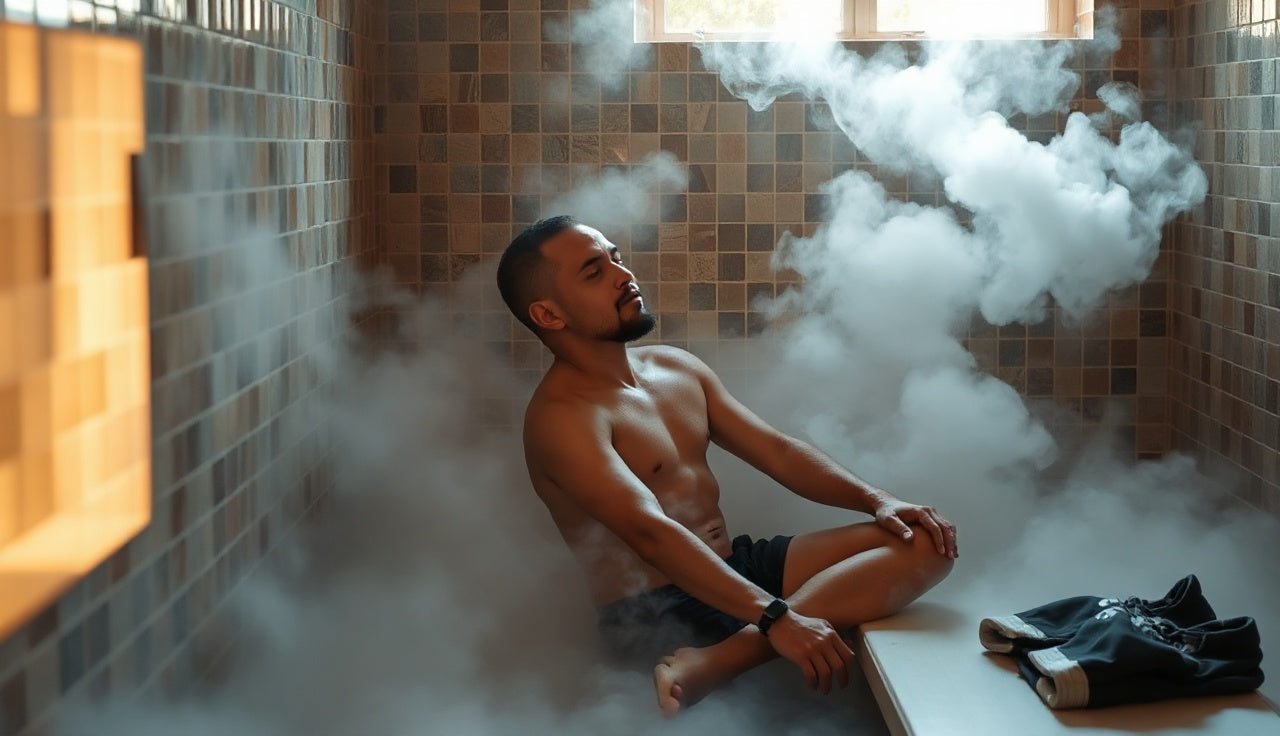
A steam room sits at roughly 40-45°C (104-113°F) with 100% relative humidity [1]. That combination is the whole story. The heat load is lower than a Finnish sauna (which runs 80-100°C), but saturated air won't let your sweat evaporate, so skin temperature climbs fast and core temperature follows within a few minutes.
Your body is already working when you walk in. Heart rate is up, peripheral vessels are open, and your muscles are sitting in metabolic waste like lactate and hydrogen ions. Steam piles a second thermal load on top. Heart rate climbs higher, vasodilation widens, and blood gets pushed away from your core toward the skin. Passive heat can raise blood flow to skeletal muscle substantially [2].
That extra circulation is the engine behind most of the recovery claims people make. More blood to tired tissue means faster washout of byproducts and faster delivery of the oxygen and glucose early repair needs.
The steam room isn't magic, though. It speeds up a process your cool-down does anyway. It just makes that process faster and more obvious.
Does steam room help with muscle soreness and recovery?
Moist heat probably reduces soreness, probably in the moderate range, and the research is suggestive rather than airtight. Delayed-onset muscle soreness (DOMS) peaks 24-72 hours after hard or unfamiliar exercise [3]. The real question is whether heat in that window changes how you feel.
Passive heat therapy has decent backing. A review of heat therapy for muscle recovery in the Journal of Science and Medicine in Sport concluded that "continuous low-level heat wrap therapy is more effective than ibuprofen or acetaminophen for treating delayed-onset muscle soreness" [4]. That work covered topical wraps rather than room-based steam, but the mechanism is the same: heat opens vessels and makes tissue more pliable.
Here's the honest caveat. Almost no randomized controlled trials have tested an actual steam room, on exercised humans, with DOMS as the primary outcome. Most of the evidence borrows from general heat therapy research and extrapolates to steam.
So treat the soreness benefit as likely and moderate, not proven and dramatic.
For how steam stacks up against dry sauna recovery, see our sauna vs steam room breakdown.
How does steam room affect circulation and cardiovascular response post-workout?
Passive heat looks a lot like mild cardio on the inside. Heart rate typically rises 30-50% above resting levels during a steam or sauna session, and cardiac output climbs to match [5]. After a hard workout, that keeps your cardiovascular system in an extended moderate gear instead of dropping it straight to zero.
Some coaches call this passive active recovery. The claim is that keeping blood moving through muscle for 10-20 minutes clears lactate faster than sitting still. The research is mixed. A study in the European Journal of Applied Physiology found that passive heating after exercise cleared lactate faster than passive sitting, but not as fast as light active recovery like walking [6].
So if you can spare five minutes to walk before steam, do it.
Blood pressure deserves a note. Vasodilation drops peripheral resistance, so systolic pressure usually falls during steam. For most healthy adults that's fine. If you have uncontrolled hypertension, a recent cardiac event, or a low baseline blood pressure, the post-workout steam combination needs medical clearance first.
| Light active recovery (walking) | 2.1 |
| Passive heat (steam/sauna) | 1.6 |
| Passive rest (seated) | 1.0 |
| Cold plunge | 0.8 |
Source: European Journal of Applied Physiology, cited in Laukkanen et al. 2018 (Citation 6)
What are the respiratory benefits of steam after exercise?
Warm, humid air soothes airways, which is the oldest reason people sit in steam. Exercise in cold or dry conditions can leave your airways irritated and mildly inflamed, and inhaling steam temporarily warms and humidifies them.
That can reduce bronchial irritation and ease breathing for people with exercise-induced bronchoconstriction. The American Lung Association notes that humidity levels affect how easily you breathe and can help loosen mucus [7]. If you train in cold weather and get post-workout chest tightness or a nagging cough, a short steam session offers real symptomatic relief.
One firm qualifier. Steam is not a treatment for asthma or any clinical respiratory condition. If your symptoms are significant, see a pulmonologist before you build steam into your routine. What you get here is comfort and mild soothing, not therapy.
Does steam room help with flexibility and joint mobility after training?
Heat makes tissue more extensible, and that's settled in the physical therapy literature. Warm tendons and joint capsules have lower elastic resistance, so stretching in or right after steam reaches a greater range of motion than cold stretching [8].
If you already stretch after training, try moving that work to right after steam. Your tissue is warm from exercise, and the steam keeps it warm. The effect fades within about 20-30 minutes of leaving the heat, so the timing window is short and worth respecting.
Heat also bumps synovial fluid circulation, which can temporarily improve joint lubrication. Athletes with chronic stiffness in hips, shoulders, or knees often say steam loosens things up before they stretch. Whether that helps joints over the long haul is unproven. As short-term prep for mobility work, it's a low-risk practice that costs you nothing.
How does a steam room affect stress hormones and mental recovery?
The parasympathetic nervous system (rest-and-digest) competes with the sympathetic system (fight-or-flight) that runs the show during hard training. Recovery means getting out of that sympathetic overdrive, and heat helps.
A 2018 paper in Complementary Therapies in Medicine reported that regular sauna and steam bathing was associated with lower cortisol and better subjective well-being in participants [9]. Part of that is direct thermal relaxation of muscle tone. Part is psychological: the steam room forces you to sit still and do nothing for 15 minutes, which is harder than it sounds for athletes.
Serotonin and endorphin release during heat has been floated as another factor, though that research is thinner. What's well-supported is simpler: relaxation scores go up after steam, and perceived stress goes down.
The mental side of recovery gets ignored. It shouldn't.
Is steam room or cold plunge better after a workout?
If you train for long-term strength or size, steam is the safer default. If you need to bounce back for a competition in 24-48 hours, cold plunge wins. That's the whole answer, and the reason is inflammation.
Cold exposure after exercise blunts the inflammatory response. That sounds great until you remember post-exercise inflammation is part of the adaptation signal. Regular ice baths right after resistance training can actually cut your strength and hypertrophy gains [10]. Cold fits situations where recovery speed beats adaptation, like a packed competition schedule.
Heat preserves that inflammatory signal and adds vasodilation that speeds clearance without switching off adaptation. For strength athletes and anyone chasing long-term progress, steam after lifting is the less disruptive move.
Contrast therapy (alternating heat and cold) is a third path with its own evidence. See our cold plunge benefits article for the cold side, and our ice bath guide for protocols.
| Recovery method | Best for | Avoid if | Adaptation impact |
|---|---|---|---|
| Steam room | Soreness, relaxation, mobility | Hypotension, heat intolerance | Minimal to none |
| Cold plunge | Speed recovery between competition days | Trying to maximize hypertrophy | Reduces strength adaptation signal |
| Contrast therapy | General recovery, high training volume | Cardiovascular instability | Moderate blunting |
| Active recovery (walking) | Lactate clearance | Very high fatigue | None |
How long should you stay in a steam room after a workout?
10 to 20 minutes covers most research protocols and practical advice [1]. Longer doesn't buy proportionally more benefit, and the risks (dehydration, dizziness, heat exhaustion) climb past 20 minutes, especially when you're already warm and a little dehydrated from training.
Here's a protocol that works. Cool down with 3-5 minutes of light walking, drink at least 250-500ml of water, then step in for 10-15 minutes. Exit, cool off for 5 minutes in ambient air or a cool shower, then drink again. If you're going for a second round, wait 5-10 minutes.
Intensity should set your duration. After a low-intensity session, 15-20 minutes feels fine for most people. After a maximal effort, cap it at 10 because your core is already hot and your heart is more taxed.
Dizziness, nausea, or chest discomfort mean you exit immediately. No exceptions.
What are the risks of using a steam room right after exercise?
Dehydration is the most common problem. You sweat in the steam room even though you can't see it, because sweat can't evaporate in 100% humidity. You're already down fluid from the workout. Stack steam on top without drinking first and you can slide into real dehydration, which slows recovery instead of helping it. Drink before, drink after.
Hypotension (low blood pressure from vasodilation) is a legitimate risk right after intense exercise, when cardiac output is falling and vessels are still wide open. Standing up fast can cause lightheadedness or a faint. Sit or lie down for the first minute, then stand slowly.
Heat exhaustion shows up when high intensity, warm ambient conditions, poor hydration, and a long session all line up. Watch for heavy sweating, pale skin, fatigue, dizziness, and nausea. If they hit, get out, get cool, and drink.
Pregnant women, people with cardiovascular disease, and anyone on medications that affect blood pressure or thermoregulation should get medical clearance before post-exercise steam, or skip it. The American College of Obstetricians and Gynecologists advises avoiding hyperthermia in pregnancy, which includes hot tubs, saunas, and steam rooms [11].
Does steam room help with weight loss after exercise?
You'll lose weight after a steam session. Almost all of it is water, and it comes back the moment you rehydrate. A 15-minute steam can drop 0.5-1.0 kg of fluid in sweat. There's no evidence that steam meaningfully raises fat oxidation or metabolic rate beyond the modest calories your body burns holding core temperature during the session.
That caloric cost runs about 25-50 kcal above baseline for 15 minutes, depending on body size and how hard you push it [1]. In most training contexts, that's a rounding error.
Sweat suits worn during exercise are a different and more contested topic. See the sweat suits sauna article for that.
If weight management is the goal, the steam room isn't where the work gets done. What it can do is keep you consistent by cutting soreness, so you show up fresher and train harder next session. That indirect effect is real. The direct calorie math is not impressive.
How often should you use a steam room for recovery?
There's no established optimal frequency. Most studies showing benefit used sessions 2-4 times per week. Daily use is normal in Finnish bathing culture with no documented harm in healthy adults, but daily post-workout steam stacks thermal stress on top of training stress, and that combination calls for caution during high-volume blocks.
A practical starting point: use the steam room after your two or three hardest workouts each week. Skip it on light days. Give your body at least one day a week with no added thermal load, especially deep in a training block.
If you're building a home recovery setup, our sauna benefits guide covers the dry sauna evidence, which overlaps heavily with steam room research. Our steam room product breakdown compares home steam generators and prefab units, and the home sauna guide helps if you haven't chosen between steam and dry heat.
Consistency beats frequency. Two sessions a week held for months does more than five a week for three weeks followed by nothing.
Should you shower before or after the steam room post-workout?
Rinse off before you go in. A light pre-steam shower clears sweat, sunscreen, and skin oils that would otherwise bake on your skin in a hot, humid room. That's basic hygiene, and it makes the space better for everyone in it.
Afterward, a cool or lukewarm shower brings your core temperature down and helps close pores. Skip the ice-cold blast if you're sensitive to fast temperature swings. For most people, a brief cool rinse feels great and speeds the return to baseline.
Some athletes chase the steam room with a cold plunge as a deliberate contrast protocol. That's more aggressive than a cool shower, with a different effect: rapid vasoconstriction right after vasodilation. If that interests you, the cold plunge page has equipment details, and the sauna vs steam room article covers how each pairs with cold.
Frequently asked questions
Is it safe to use a steam room immediately after a hard workout?
For most healthy adults, yes, with conditions: cool down for 3-5 minutes, drink water before entering, and keep the session to 10-15 minutes. Right after maximal effort your cardiovascular system is already stressed, so steam adds to that load. If you feel dizzy or nauseated, get out. People with heart conditions, pregnancy, or uncontrolled hypertension should get medical clearance first.
How long should you stay in a steam room after working out?
10-20 minutes is the range most research and practical guidance support. After intense exercise, aim for the lower end (10-15 minutes) because your core is already hot. Past 20 minutes, dehydration and heat exhaustion risk rise without a matching gain in benefit. For multiple rounds, rest 5-10 minutes between them and rehydrate each time.
Does steam room reduce muscle soreness (DOMS)?
Moist heat therapy has cut delayed-onset muscle soreness in controlled studies. The mechanism is heat-induced vasodilation improving blood flow to recovering tissue. Most evidence comes from heat wraps and local heat rather than steam room trials specifically, so the effect size is plausibly similar but not precisely measured for room-based steam.
Can you lose weight by sitting in a steam room after exercise?
You'll see the scale drop, but that's water weight from sweating, not fat. A 15-minute steam burns roughly 25-50 extra calories above baseline. Rehydrating brings your weight right back. Steam supports fat loss indirectly by improving recovery so you train more consistently. It is not a meaningful direct fat-loss tool.
Is a steam room better than a sauna after a workout?
It comes down to preference more than clear physiological superiority. Steam rooms run cooler (40-45°C) at 100% humidity; saunas run hotter (80-100°C) with low humidity. Both produce vasodilation and recovery benefits. Steam is gentler on the airways and suits people who find dry sauna uncomfortable. Sauna tends to feel more intense at equal times. Both work.
Should you do a cold plunge or steam room after a workout?
Cold plunge blunts the inflammatory adaptation signal, useful for competition recovery but counterproductive for long-term strength or muscle gains. Steam preserves that signal while still improving circulation and soreness. If you train for performance improvement, steam is the safer default. If you need to recover fast for a competition in 24-48 hours, cold plunge is better.
How much water should you drink before and after a steam room session?
Drink at least 250-500ml before entering, especially after a workout when you're already down fluid. Afterward, replace what you lost, which can run 0.5-1 kg per 15-minute session. An electrolyte drink is worth considering if the workout itself was long or intense, since you lose sodium and potassium in sweat too.
Can steam room use after exercise improve flexibility?
Yes, as a short-term effect. Heat increases tissue extensibility by lowering the elastic stiffness of tendons and joint capsules, so stretching in or right after steam reaches greater range of motion than cold stretching. The window is short: tissue cools within 20-30 minutes of leaving the heat. Do your mobility work straight after the steam room to use it.
What should you eat or drink before using a steam room post-workout?
Water first, always. A light carbohydrate and protein snack before steam is fine and won't cause trouble during a 15-minute session. Skip heavy meals right before, since digestion plus heat stress can cause nausea. If you usually have a post-workout shake, drinking it after the steam room instead of before is a reasonable adjustment.
Can steam room use help with breathing problems after exercise?
Warm, humid air can ease airway irritation and loosen mucus, which may help athletes with post-exercise coughing or mild bronchial tightness, especially after cold-weather training. Steam is not a treatment for exercise-induced asthma or any clinical respiratory condition. If you have diagnosed respiratory issues, talk to a pulmonologist before adding steam to recovery.
Is it okay to use a steam room every day after workouts?
Daily use in healthy adults is common in bathing cultures with no documented harm. That said, daily post-workout steam stacks thermal stress on training stress, which calls for caution during high-volume blocks. A practical starting point is 2-4 sessions per week, timed after your hardest training days. Consistency over months matters more than frequency in any one week.
Do steam rooms help with sleep quality after exercise?
Passive heat before sleep has been linked to better sleep onset and quality in multiple studies, partly because the core-temperature drop after leaving heat mimics the natural thermal decline that signals sleep. A late-afternoon or early-evening steam after training may support better sleep that night, which is itself the most powerful recovery tool you have [12].
What is the difference between steam room and steam shower for post-workout recovery?
A steam room is a dedicated space with a generator that fills the whole room to 100% humidity at 40-45°C. A steam shower adds steam to a shower enclosure and hits similar humidity and temperature in a smaller footprint. The physiology is essentially the same. Steam showers are more common at home and work fine for recovery if the enclosure seals well enough to hold heat and humidity.
Sources
- Harvard Health Publishing, Harvard Medical School – 'Sauna Health Benefits': Steam rooms and saunas are typically used in 10-20 minute sessions; steam rooms operate at approximately 40-45°C with 100% humidity
- PubMed / Journal of Applied Physiology – Wilkins et al., passive heat and skeletal muscle blood flow: Passive heat exposure substantially increases blood flow to skeletal muscle tissue via peripheral vasodilation
- National Institutes of Health / National Library of Medicine – 'Delayed Onset Muscle Soreness' (StatPearls): DOMS typically peaks 24-72 hours after unaccustomed or intense exercise
- Journal of Science and Medicine in Sport – Petrofsky et al., 'Moist Heat or Dry Heat for Delayed Onset Muscle Soreness': Continuous low-level heat wrap therapy is more effective than ibuprofen or acetaminophen for treating delayed-onset muscle soreness
- Mayo Clinic Proceedings – Laukkanen et al., 'Cardiovascular and Other Health Benefits of Sauna Bathing', 2018: Sauna and steam bathing raise heart rate 30-50% above resting levels and increase cardiac output, mimicking mild aerobic exercise
- European Journal of Applied Physiology – passive heating and lactate clearance post-exercise: Passive heating after exercise accelerated lactate clearance compared to passive sitting, though less efficiently than light active recovery
- American Lung Association – humidity and lung health guidance: Warm, humid air can help loosen mucus and reduce airway irritation following exercise-induced irritation
- Physical Therapy journal (APTA) – Draper et al., 'The carry-over effects of diathermy and stretching in developing joint flexibility': Heat increases tissue extensibility by reducing elastic stiffness of tendons and joint capsules, improving range of motion during and shortly after heat exposure
- Complementary Therapies in Medicine – Hussain & Cohen, 'Clinical effects of regular dry sauna bathing', 2018: Regular sauna/steam bathing was associated with lower cortisol levels and improved subjective well-being
- Journal of Physiology – Roberts et al., 'Post-exercise cold water immersion attenuates acute anabolic signalling and long-term adaptations in muscle', 2015: Cold water immersion after resistance training blunts the anabolic signaling cascade and reduces long-term strength and hypertrophy gains
- American College of Obstetricians and Gynecologists (ACOG) – Committee Opinion on Exercise in Pregnancy: ACOG recommends avoiding hyperthermia during pregnancy, which includes hot tubs, saunas, and steam rooms
- Sleep Medicine Reviews – Haghayegh et al., 'Before-bedtime passive body heating by warm shower or bath improves sleep quality', 2019: Passive heat exposure before sleep is associated with improved sleep onset and quality due to the post-heat drop in core body temperature

Share:
Sunray Aurora barrel sauna: full review and buyer's guide
Sunray Aurora barrel sauna: full review and buyer's guide