
Last updated 2026-07-09
TL;DR
Stainless steel cold plunge tubs are the most durable option you can buy. They resist corrosion, stay cleaner than acrylic or wood, and run $1,500 to $8,000 depending on size and whether you add a chiller. They cost more upfront and weigh a lot more, but the maintenance math usually favors them if you plunge often.
What is a stainless steel cold plunge tub?
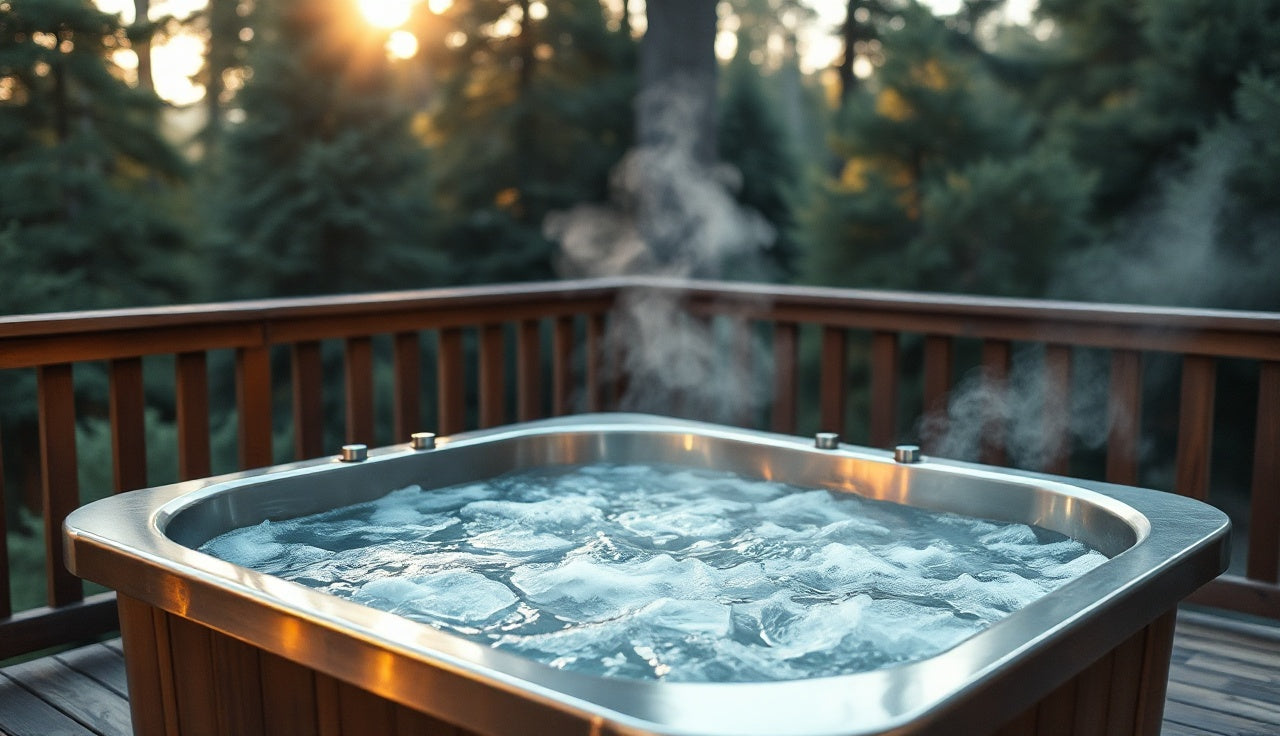
A stainless steel cold plunge tub is a submersion vessel built from food-grade or marine-grade steel, usually 304 or 316, made to hold water between roughly 39°F and 60°F while you sit or crouch in it. That's the entire product. The concept has no frills.
The difference between stainless and a plastic tub or a stock tank shows up over time, in the material behavior. Steel doesn't absorb bacteria the way porous acrylic can [1]. It doesn't leach chemicals when the water turns acidic from chlorine swings. It holds up outdoors without cracking, warping, or yellowing under UV the way polymer shells do. A good 316-grade unit lasts 15 to 20 years with basic care.
Most stainless plunges come one of two ways. There's the standalone shell (a large steel tub you fill and maintain by hand) and the fully integrated system with a built-in chiller, pump, filtration, and sometimes a UV or ozone sanitation stage. The price gap between those two is dramatic. Which one makes sense for you depends almost entirely on how often you plan to get in.
Stainless is also heavy. A 100-gallon shell alone runs 150 to 250 lbs empty, before you add a drop of water. Plan your floor or ground prep before the unit shows up.
What grades of stainless steel should you look for?
Grade matters more than most buyers realize. Two show up in cold plunge tubs, 304 and 316, and they are not the same steel.
304 stainless is the common one. It runs roughly 18% chromium and 8% nickel, which makes it highly rust-resistant in most environments [2]. It handles chlorinated tap water fine, shrugs off most sanitizers, and sits inside the majority of mid-range plunges. If your tub lives indoors or under cover, and you're not near a coast, 304 does the job.
316 stainless adds molybdenum (around 2 to 3%) to the mix. That addition sharply improves resistance to chlorides, salt, and the pitting corrosion that shows up in marine air or when you run ozone or saltwater sanitation [2]. Coastal property, full salt-air exposure, or a saltwater system? 316 earns its premium. Expect to pay $300 to $600 more for a 316 shell over the 304 version from the same brand.
Avoid anything marketed vaguely as "commercial grade" or "food grade" without the actual ASTM alloy number on the spec sheet. Thin-gauge steel (under 1.2mm, which is 16 gauge) can crack at the welds over time, especially on a tub that gets moved around. Ask for the gauge before you pay.
Some imported units use cheap carbon steel under a coating painted to mimic stainless. The coating scratches, the steel below rusts, and polishing does nothing. Quick test: a magnet grabs carbon steel hard and grabs true austenitic stainless weakly or not at all. It's not perfect, but it catches the worst fakes.
How much does a stainless steel cold plunge tub cost?
Stainless cold plunge tubs run $500 for a bare 304 shell with no chiller, up to $8,000 or more for a fully integrated 316 system with a chiller that hits 39°F, UV filtration, and a circulation pump. The serious midrange lives between $1,800 and $4,500.
Here's how the tiers break down:
| Type | Typical price range | What you get |
|---|---|---|
| Shell only (304, no chiller) | $500 to $1,500 | Steel tub, drain, fill manually with ice or cold water |
| Shell + basic chiller bundle | $1,800 to $3,500 | Tub plus 1/3 to 1 HP chiller, simple filtration |
| Integrated system (304, mid-spec) | $2,500 to $4,500 | Tub, chiller, pump, filter, basic sanitation |
| Integrated system (316, high-spec) | $4,500 to $8,000+ | Full 316 shell, powerful chiller, UV or ozone, app control |
Installation costs extra if you're running electrical for the chiller (a standard chiller needs a dedicated 110V or 220V circuit depending on its rating [3]), pouring a concrete pad, or hiring a plumber for the drain. Budget $200 to $800 for those, depending on your setup.
Ice is a real ongoing cost with a shell-only tub. A 100-gallon tub needs roughly 40 to 80 lbs of ice to fall from room temperature to 50°F, depending on the heat around it. At $3 to $5 per 20-lb bag from a convenience store, that's $6 to $20 in ice per session. A chiller pays itself off fast if you plunge daily.
Compared to other materials: a cedar or cypress plunge costs $1,000 to $3,000 but demands far more upkeep and dies sooner. An acrylic or fiberglass shell runs $800 to $2,500 but scratches easily and grows biofilm in the micro-abrasions. Stainless costs more upfront and less across a 5- to 10-year window.
| Inflatable / portable | $425 |
| Stock tank (galvanized) | $375 |
| Wood (cedar/cypress) | $2,000 |
| Acrylic / fiberglass | $2,150 |
| Stainless shell only | $1,000 |
| Stainless + basic chiller | $2,650 |
| Stainless integrated (304) | $3,500 |
| Stainless integrated (316) | $6,250 |
Source: SweatDecks market survey, 2024
What temperature should a cold plunge tub be?
Most cold plunge practitioners set 50°F to 59°F (10°C to 15°C) for the bulk of their sessions [4]. That range produces real physiological responses without the risks of very cold immersion in untrained bodies. Some experienced people push into the low-to-mid 40s°F, mostly for short exposures.
Colder water drives a bigger norepinephrine spike. A study in the International Journal of Circumpolar Health tied cold water immersion at or below 15°C (59°F) to measurable increases in norepinephrine, one of the mechanisms researchers think drives the mood and alertness effects of cold [5]. Nobody has pinned down the optimal temperature for a given outcome, though. The research is observational and shifts with protocol, duration, and how cold-tolerant a person is.
Here's the practical picture. Most good stainless chillers reach 39°F to 40°F at the low end, but they take 30 to 90 minutes to pull down from tap temperature (55°F to 65°F across most U.S. regions), depending on the air around them and the chiller's horsepower. A 1 HP chiller cools a 100-gallon tub to 50°F in roughly 60 to 90 minutes in a temperate climate. A 1/3 HP unit takes much longer and may never reach below 50°F in a warm climate.
In winter, cold-climate owners often find their plunge sits closer to 40°F than they set it, because the outside air pre-chills the water before the chiller kicks on. The cold-seekers love that. For anyone who wants the milder end, a digital thermostat controller holds the water steady.
Our guide to cold plunge benefits goes further into what the research actually says about temperature thresholds and specific protocols.
How do you maintain and sanitize a stainless steel cold plunge?
This is where stainless earns its price. The non-porous surface gives bacteria nowhere to hide, unlike scratched acrylic or textured fiberglass. But non-porous doesn't mean self-cleaning.
A shared or high-use plunge needs a real sanitation routine. For home use with one or two people, the minimum that works looks like this:
- Keep the water between 50°F and 60°F (cold water itself is hostile to most microbial growth)
- Hold free chlorine at 1 to 3 ppm [6], or bromine at 3 to 5 ppm if you prefer it
- Test the chemistry 2 to 3 times per week with a reliable strip or drop kit
- Drain, rinse, and refill every 2 to 4 weeks depending on how much you use it
- Wipe the interior monthly with a soft cloth and diluted white vinegar or a stainless-safe cleaner
A built-in UV or ozone system cuts the chemical demand hard. UV kills bacteria and viruses on contact as water moves through the lamp housing, so you can run lower chlorine (often 0.5 to 1 ppm) and stay safe [7]. Ozone works the same way and also breaks down some organic matter. Neither removes the need for a chemical residual entirely, but both drop how much you need.
Keep pH between 7.2 and 7.8, the same range pools and hot tubs use [6]. Low pH speeds up surface oxidation on even stainless steel over years, and it makes chlorine work worse. High pH weakens the sanitizer and leaves scale on the steel.
One thing stainless does poorly: it shows hard water deposits worse than a dark acrylic shell. If your tap water carries high calcium (above 200 ppm), white scale forms at the waterline. A weekly vinegar wipe clears it. A whole-house or point-of-use softener stops it before it starts.
Never use steel wool, abrasive pads, or high-concentration bleach directly on the steel. Those wreck the passive oxide layer that makes stainless corrosion-resistant to begin with. Soft cloths, pH-neutral or mildly acidic cleaners, and good rinses are the whole game.
What are the health benefits backed by research?
The honest answer: the research on cold water immersion is real but messy. Most studies are small, the protocols scatter all over the place, and very few are randomized controlled trials with big samples. A few findings hold up well enough to take seriously.
The most replicated effect is on muscle soreness and recovery. A Cochrane systematic review of 17 small trials found that cold water immersion (usually 10 to 15°C, 50 to 59°F, for 10 to 20 minutes) reduced delayed onset muscle soreness compared to passive rest in the 24 to 96 hours after exercise [8]. The effect was moderate, not dramatic, and showed up most consistently in team-sport athletes doing repeated training bouts.
On mood and alertness, a frequently cited 2008 paper in Medical Hypotheses proposed a mechanism: cold exposure activates afferent nerves that project to the brain and raise norepinephrine and beta-endorphins [9]. Norepinephrine ties to alertness and mood regulation. The catch is that this was a hypothesis paper with small preliminary data, not a large clinical trial. The effect is plausible and gets reported anecdotally all the time, but it isn't settled medicine.
Cardiovascular adaptation from regular cold has some support. A study in the European Journal of Applied Physiology found changes in heart rate variability after repeated cold water immersion sessions, which people use as a proxy for autonomic nervous system adaptation [10]. What that actually means clinically for healthy adults is genuinely unclear.
The Centers for Disease Control does not list cold water immersion therapy as a treatment for any specific condition [11]. That's the regulatory reality. Anyone with a heart condition, Raynaud's disease, cold urticaria, or a pregnancy should talk to a physician first, because the cardiovascular stress of sudden cold immersion is real and documented.
For a wider look at the literature, our ice bath and cold plunge benefits guides go deeper.
What size stainless cold plunge tub do you actually need?
Most adult bodies need 65 to 80 gallons to submerge to shoulder height in a seated or semi-reclined position inside a standard-footprint tub. The common commercial sizes are 100 gallons (roughly 60" x 30" x 24" deep) and 120 to 150 gallons (longer or deeper, better for tall users or lying flat).
If you're 6'2" or taller and want your shoulders under, look for a minimum 27" depth. Most standard stainless shells run 22" to 24" deep, which handles seated immersion fine but leaves tall shoulders in the air.
Two people plunging at once means 180 gallons or more. That's a real use case for partners or training buddies, but filled weight gets serious: 180 gallons of water weighs roughly 1,500 lbs before you count the shell. Make sure your floor or deck can take it. Residential wood-framed decks usually handle 40 to 50 lbs per square foot, and a 180-gallon unit can concentrate 800 to 1,000 lbs in a 12 to 15 square foot footprint, which can blow past that limit. A structural engineer or contractor can tell you whether your specific setup is safe.
For indoor installs, measure your doorways before you order. A 60" x 30" shell won't clear a standard 32" door without pulling the legs or finding another way in.
How does stainless compare to acrylic, wood, and stock tank options?
Every material has a legitimate use case. Stainless isn't automatically right for everyone.
| Material | Lifespan | Maintenance | Cold retention | Weight | Typical price |
|---|---|---|---|---|---|
| Stainless steel (304/316) | 15-20+ years | Low-medium | Excellent with insulation | Very heavy | $1,500-$8,000 |
| Acrylic / fiberglass | 8-15 years | Medium | Good | Medium | $800-$3,500 |
| Wood (cedar/cypress) | 5-15 years | High | Fair | Medium | $1,000-$3,000 |
| Stock tank (galvanized) | 5-10 years | Medium | Fair | Light-medium | $150-$600 |
| Inflatable / portable | 2-5 years | Low | Poor | Very light | $50-$800 |
Galvanized stock tanks are the popular DIY route. They're cheap and they work, but the zinc coating can leach into acidic or chlorinated water, which is why they're not rated for potable water or swimming. For occasional soaks in plain water, the risk is probably low. For daily use with chemical sanitation, a proper stainless or acrylic unit is the better call.
Wood plunge tubs look incredible and feel genuinely different to sit in. The trouble is that wood swells and shrinks with temperature, the joints can weep, and algae loves a porous wood surface. A well-kept cedar plunge lasts a decade, but "well-kept" means regular drying, oiling, and watching the chemistry closely. If the look is the whole point and you'll do the upkeep, wood makes sense. If you want set-it-and-forget-it, stainless wins.
Acrylic is a fair middle ground. It's lighter, easier to install, and comes in more shapes. The downside is scratching, and scratches open micro-crevices where biofilm settles in. Stainless, short of a physical gouge, doesn't have that problem.
To browse across these categories, the cold plunge and ice bath pages at SweatDecks cover specific products in each material class.
Can you use a stainless steel cold plunge outdoors year-round?
Yes, and this is one of the material's strongest selling points. Properly finished 304 or 316 stainless handles temperature swings, rain, snow, and sun far better than most alternatives.
A few things to plan for.
In freezing climates, if you skip the plunge through winter, the water will freeze. Water expands roughly 9% in volume when it freezes [12], and that can damage shell welds, pump lines, or the chiller if you've left water inside. Standard practice is to fully drain the system before the first hard freeze, or run the chiller through winter (the compressor throws off enough heat to keep the water liquid down to most ambient temperatures).
Direct UV won't hurt the steel, but it can degrade the foam insulation panels that wrap the outside of some shell designs. A UV-resistant cover or a shade structure helps those last.
A concrete or composite deck pad beats gravel or bare soil for outdoor placement, because it keeps the base dry and prevents galvanic issues from constant contact with wet earth minerals. A pressure-treated wood platform works too, though some wood preservatives corrode metals over long contact. Put rubber isolation pads between the tub feet and the wood.
Salt air is the one outdoor context where stainless genuinely struggles over time, if you bought a 304 unit. Chloride ions in salt air drive exactly the pitting corrosion that 316's molybdenum resists. Within a mile or two of the ocean, 316 is worth the extra money.
What should you look for in a chiller for a stainless cold plunge?
The chiller often matters more than the shell. A great steel tub paired with an undersized or flaky chiller will frustrate you every time you want to get in.
Specs to weigh:
Cooling capacity, in BTUs or horsepower. A 1/3 HP unit manages roughly 80 to 100 gallons in mild air. A 1 HP unit handles 100 to 150 gallons and reaches lower temperatures faster. In hot summers (ambient above 85°F), even a 1 HP chiller works harder and can underperform at the lowest settings. Some makers rate their chillers at 68°F ambient, so ask for performance specs at 85°F to 95°F ambient if you live somewhere warm.
Electrical. Most residential chillers run on 110V/15A standard circuits. Higher-capacity units (above 1 HP) usually need a dedicated 240V/20A circuit. Have an electrician confirm your panel has room before you order a high-spec system [3].
Flow rate. The pump needs to move the full tub volume through filtration at least once every 4 to 6 hours. For a 100-gallon tub, that's a pump pushing at least 17 to 25 gallons per hour. Most bundled systems are spec'd fine; just check that the flow rate is listed.
Noise. Compressor chillers aren't silent. Most run 50 to 60 decibels, about the level of a conversation or a quiet dishwasher [13]. If the tub sits under a bedroom window or on a shared apartment deck, that matters. Some makers say "whisper quiet" without a dB number, so ask.
Digital temperature control. Non-negotiable for reliable cold therapy. You want a controller that holds within 1°F to 2°F of setpoint with a clear display. Smart home integration is a nice bonus if you like to pre-cool before a session.
Is cold plunging actually safe? What are the real risks?
Cold water immersion carries real physiological risks, and understanding them isn't about scaring you off. It's about using cold exposure intelligently.
The main acute risk is the cold shock response: a sudden gasp reflex, a fast jump in heart rate and blood pressure, and possible hyperventilation in the first 30 to 60 seconds of immersion [14]. In healthy people it's uncomfortable and passes. In people with cardiovascular disease, hypertension, or arrhythmias, that spike can be dangerous. The American Heart Association advises anyone with heart disease to consult a physician before starting any cold water immersion practice [11].
Hypothermia only becomes a risk at long durations or very low temperatures. A 5- to 15-minute session at 50°F to 59°F in a healthy adult produces cold stress, not hypothermia. Hypothermia starts when core body temperature drops below 95°F (35°C) [14], which takes far longer exposures than any normal plunge protocol.
Cold urticaria (hives from cold exposure) hits a small slice of the population. Those people mount significant histamine responses to cold skin contact, ranging from mild discomfort to (rarely) anaphylaxis. If you've ever broken out in hives from a cold shower or a cold swim, a doctor can diagnose it.
Practical safety rules that hold regardless of your health status:
- Never plunge alone when you're new to cold immersion
- Enter slowly and breathe through the initial cold shock instead of gasping
- Set a timer rather than trusting your sense of elapsed time
- Have a warm layer ready for after
- Don't push through chest pain, trouble breathing, or numbness in your extremities
For most healthy adults on reasonable protocols, the risk profile is low. The load-bearing phrase there is "healthy adults."
How long should a cold plunge session actually be?
Eleven minutes per week of total cold immersion is the figure the research cites most, from a 2022 review in Neuroscience and Biobehavioral Reviews that pulled data across multiple cold exposure studies [5]. That's not 11 minutes per session. It's 11 minutes spread across 2 to 4 sessions in a week, which works out to roughly 3 to 4 minutes each time.
In practice, most experienced practitioners do 2 to 10 minutes per session. Beginners often find 60 to 90 seconds at 55°F is plenty. That's a completely valid starting point. There's no strong evidence that longer sessions produce proportionally bigger benefits once you've hit the cold shock response and the norepinephrine spike. More isn't automatically better.
What the evidence does suggest: consistency over time beats the length of any single session. Regular cold exposure (several times a week over months) appears to produce more durable adaptation than the occasional long soak [10].
One timing note for athletic recovery. Research suggests cold immersion right after exercise (within an hour) works best for cutting muscle soreness from high-intensity training [8]. If muscle building is the goal, though, some researchers worry that immediate post-exercise cold might blunt the anabolic signaling that drives growth. A 2015 study in the Journal of Physiology found cold water immersion after resistance training reduced gains in muscle mass and strength across a 12-week block [4]. The effect size was modest, and the sports-science debate is still open. If you train mainly for strength or size, plunging 4 to 6 hours after a session (rather than right after) is a reasonable hedge on current evidence.
Where can you buy a stainless steel cold plunge tub?
The market has grown fast the past few years. You can find stainless cold plunge tubs through dedicated cold plunge retailers, direct-to-consumer brands, a handful of Amazon sellers, and a growing set of specialty wellness stores that carry curated selections across price tiers.
Buying straight from a brand's site or a specialty retailer usually gets you better warranty support, accurate spec documents, and someone who can answer real questions about electrical needs, dimensions, and compatible accessories. Amazon listings for cold plunge gear swing wildly in quality and often skip the technical specs you need to make a good call.
Verify these before buying from any source:
- The actual steel grade (304 or 316, more than "stainless steel")
- The gauge (thickness) of the shell material
- The warranty terms, specifically whether the chiller compressor is covered separately (compressors often carry 1-year warranties even when the shell warranty runs 3 to 5 years)
- Return or restocking policy on a product that weighs 200+ lbs
- Whether the price includes shipping and any state sales tax
SweatDecks carries a curated selection of stainless cold plunge tubs at several price points, with full spec sheets for each model. The cold plunge collection page is a reasonable place to start comparing what's on the market.
If you're also weighing contrast therapy (alternating cold and heat), the sauna and home sauna pages pair naturally with cold plunge research, since people often buy them together or use them in sequence.
Frequently asked questions
How long does a stainless steel cold plunge tub last?
A properly maintained 304 stainless shell typically lasts 15 to 20 years. 316 stainless lasts at least as long and holds up much better in coastal air or with saltwater or ozone sanitation. The chiller compressor is the likelier failure point; most are rated for 5 to 10 years of regular use and are usually the first thing that needs replacing in an integrated system.
What temperature should I set my cold plunge tub?
Most research on cold water immersion uses 10°C to 15°C (50°F to 59°F). That range produces measurable physiological responses in healthy adults. Beginners should start at the warmer end (55°F to 59°F) and work cooler over several weeks. Some experienced people go down to 40°F to 45°F, but there's no clear evidence that below 50°F produces meaningfully better outcomes for most goals.
Can a stainless steel cold plunge be used outdoors year-round?
Yes, stainless handles outdoor exposure well. The main worry in freezing climates is leaving water in the shell during extended non-use; frozen water expands and can stress welds or damage plumbing. Either drain the system before hard freezes or keep the chiller running through winter, which throws off enough compressor heat to stop freezing in most conditions.
How much does it cost to run a cold plunge chiller daily?
A typical residential cold plunge chiller (1/3 to 1 HP) draws roughly 500 to 1,200 watts while actively cooling. Once the water hits setpoint, the compressor cycles on and off to hold temperature, usually running 30% to 50% of the time. At the U.S. average electricity rate of about $0.17 per kWh (2024 EIA data), daily operating cost lands around $0.50 to $2.50 depending on climate, insulation, and chiller efficiency.
Do I need a permit to install a stainless cold plunge at home?
Usually no permit for the tub itself, but you may need an electrical permit if you're adding a new dedicated circuit for the chiller. In some places, adding a permanent outdoor water feature triggers a plumbing permit. Rules vary a lot by city and county, so check with your local building department before running new wiring or hard-plumbing a drain.
How often should I change the water in a cold plunge tub?
For a single user with a working sanitation system (correct chlorine, steady pH of 7.2 to 7.8), most cold plunge makers recommend a full water change every 2 to 4 weeks. High use (several users daily) or bad chemistry can push that to weekly. With ozone or UV cutting chemical demand, some users stretch to 4 to 6 weeks, though monthly is a safer default.
Is a cold plunge safe for people with heart conditions?
Cold water immersion causes an immediate spike in heart rate and blood pressure during the cold shock response in the first 30 to 60 seconds. For people with cardiovascular disease, hypertension, or arrhythmias, that's a real risk. The American Heart Association advises anyone with heart disease to consult a physician before starting cold immersion. Don't skip that step.
What's the difference between 304 and 316 stainless steel for a cold plunge?
304 stainless runs 18% chromium and 8% nickel, which makes it corrosion-resistant in most environments. 316 adds roughly 2 to 3% molybdenum, which sharply improves resistance to chloride-driven pitting, salt air, and saltwater sanitation. For most inland installs, 304 is fine. For coastal properties or saltwater sanitation, 316 is worth the extra $300 to $600 usually charged for the upgrade.
Can I use a cold plunge tub right after a workout?
Yes, and for reducing delayed onset muscle soreness, immersion within about an hour of exercise has the most research support. The caveat: if building muscle mass is your main goal, some evidence suggests cold immersion right after resistance training may blunt anabolic signaling. Waiting 4 to 6 hours after a strength session before plunging is a reasonable hedge if hypertrophy matters to you.
How do I clean and maintain a stainless cold plunge tub?
Test and balance the chemistry (chlorine 1 to 3 ppm, pH 7.2 to 7.8) two to three times a week. Wipe the interior with a soft cloth and diluted white vinegar monthly to clear scale or discoloration. Drain and refill every 2 to 4 weeks. Skip steel wool, abrasive pads, and high-concentration bleach directly on the steel, since those damage the passive oxide layer that keeps stainless corrosion-resistant.
How heavy is a filled stainless cold plunge tub?
A 100-gallon stainless cold plunge weighs roughly 150 to 250 lbs empty (depending on shell thickness and accessories) and about 980 to 1,080 lbs filled. A 120-gallon unit filled tops 1,200 lbs. For indoor installs, confirm your floor joists can carry the concentrated load before placing the tub. Residential floors are typically rated for 40 to 50 lbs per square foot, and a concentrated plunge load can exceed that.
What are the differences between a cold plunge, an ice bath, and a cold plunge tub?
Functionally they're the same thing: cold water immersion. "Ice bath" usually means a temporary setup using ice in a basic tub or even a bathtub. "Cold plunge" and "cold plunge tub" mean dedicated vessels, often with chillers, built for regular use. A stainless cold plunge tub is a purpose-built, permanent version with better temperature control, filtration, and durability than a portable ice bath.
Can you use a stainless cold plunge indoors?
Yes, stainless cold plunges work well indoors. Plan for water weight on your floor (potentially 1,000+ lbs filled), a drainage path, and ventilation for chiller heat. The chiller exhausts warm air and needs at least a few feet of clearance around its vent. A floor drain or utility sink nearby makes water changes much easier. Some units connect to a standard garden hose for filling and draining.
Sources
- CDC, Healthy Swimming / Healthy Water: Infection Risks: Non-porous surfaces resist bacterial biofilm formation better than porous materials like acrylic or wood
- ASTM International, Standard Specification for Stainless Steel Bars and Shapes (ASTM A276): 304 stainless contains 18% chromium and 8% nickel; 316 adds 2-3% molybdenum for improved chloride corrosion resistance
- U.S. Consumer Product Safety Commission, Electrical Safety Information: Dedicated circuits are required for high-draw appliances; residential chiller electrical requirements vary by unit rating
- Roberts LA et al., Journal of Physiology 2015: Post-exercise cold water immersion attenuates acute anabolic signalling and long-term adaptations in muscle: Cold water immersion after resistance training attenuated gains in muscle mass and strength over a 12-week training block; 10-15°C water used in standard protocols
- Søberg S et al., Neuroscience and Biobehavioral Reviews 2022: Winter swimming: Association between frequency and duration, and activation of norepinephrine: Eleven minutes per week total cold water immersion across 2-4 sessions was associated with significant norepinephrine increases in reviewed studies
- CDC, Model Aquatic Health Code, Disinfection and pH Requirements: Free chlorine should be maintained at 1-3 ppm; pH should be held between 7.2 and 7.8 for effective sanitation
- EPA, Ultraviolet Disinfection Guidance Manual for the Final Long Term 2 Enhanced Surface Water Treatment Rule: UV disinfection kills bacteria and viruses on contact, allowing reduced chemical residual requirements in water systems
- Bleakley C et al., Cochrane Database of Systematic Reviews 2012: Cold-water immersion (cryotherapy) for preventing and treating muscle soreness after exercise: Cold water immersion at 10-15°C for 10-20 minutes reduced delayed onset muscle soreness versus passive rest across 17 small trials
- Shevchuk NA, Medical Hypotheses 2008: Adapted cold shower as a potential treatment for depression: Cold exposure proposed to activate afferent nerves projecting to the brain, increasing norepinephrine and beta-endorphins
- Al Haddad H et al., European Journal of Applied Physiology 2010: Effect of cold or thermoneutral water immersion on post-exercise heart rate recovery and heart rate variability indices: Cold water immersion sessions produced changes in heart rate variability compared to thermoneutral immersion following exercise
- American Heart Association, Cold Weather and Cardiovascular Disease: Cold exposure causes acute cardiovascular stress; AHA advises people with heart disease to consult a physician before cold immersion
- USGS Water Science School, Water Properties: Water expands approximately 9% in volume when it freezes, which can stress vessel welds and plumbing
- CDC/NIOSH, Noise and Hearing Loss Prevention: Everyday reference: normal conversation registers approximately 60 decibels; used here as a comparative reference for chiller noise levels
- Tipton MJ et al., Journal of Physiology 2017: Cold water immersion: kill or cure?: Cold shock response includes gasp reflex, heart rate and blood pressure increase, and hyperventilation in the first 30-60 seconds of cold water immersion; hypothermia begins below 35°C core body temperature

Share:
Barrel sauna roof: every option, cost, and fix explained
Disadvantages of contrast therapy: what the research actually shows