
Last updated 2026-07-09
TL;DR
A barrel sauna's curved roof is usually unfinished cedar, but adding shingles, EPDM rubber membrane, or metal flashing pushes its life from 5-7 years to 15-25 years. Expect to spend $80-$800 depending on material and barrel diameter. The most common mistake is skipping a breathable underlayment and trapping moisture against the wood staves.
What makes a barrel sauna roof different from a standard roof?
A barrel sauna has a continuously curved surface. No flat ridge line. No peaked gable. No single flat plane to nail shingles onto. The curve runs the full length of the barrel, so every roofing material you apply has to follow that arc or it cracks, gaps, and leaks within a season or two.
Standard residential roofing assumes a flat or gently sloped deck beneath every layer. Cedar shingles, asphalt, even metal panels are all built to lay flat. On a barrel, the staves themselves are the structural skin, and the curve radius on most 6-foot-diameter barrels is tight enough that rigid materials need to be cut into narrow strips or swapped for something that bends on its own.
That geometry changes how water sheds. Rain hits the apex and runs down both sides at once. If the barrel sits level, water exits cleanly at the bottom edge of the staves. Tip the barrel even a few degrees toward one end and water pools at the low end, sits against end-grain wood, and rots the staves from the inside out. Roof material choice and site leveling are the same problem. Solve them together.
The curve also limits your underlayment. Felt paper (15 lb or 30 lb) will conform if you cut it into strips and overlap generously, but a single uncut sheet buckles and tears. Self-adhering peel-and-stick membranes made for curved surfaces work better, and they are worth the extra cost on a permanent outdoor installation.
What roofing materials actually work on a barrel sauna?
There are four realistic options for most homeowners. Each has a different price, skill requirement, and expected lifespan.
Bare cedar staves (no added roofing) Most kit barrels ship this way. The tongue-and-groove cedar staves span the full length of the barrel, and if the wood is tight and well-sealed, they keep water out for 3-7 years in mild climates. In wet Pacific Northwest or Midwest freeze-thaw conditions, bare cedar often starts cupping and cracking at the joints in year 2-3 [1]. Annual applications of a UV-stabilizing exterior wood oil slow this down, but bare cedar alone is not a long-term outdoor roof.
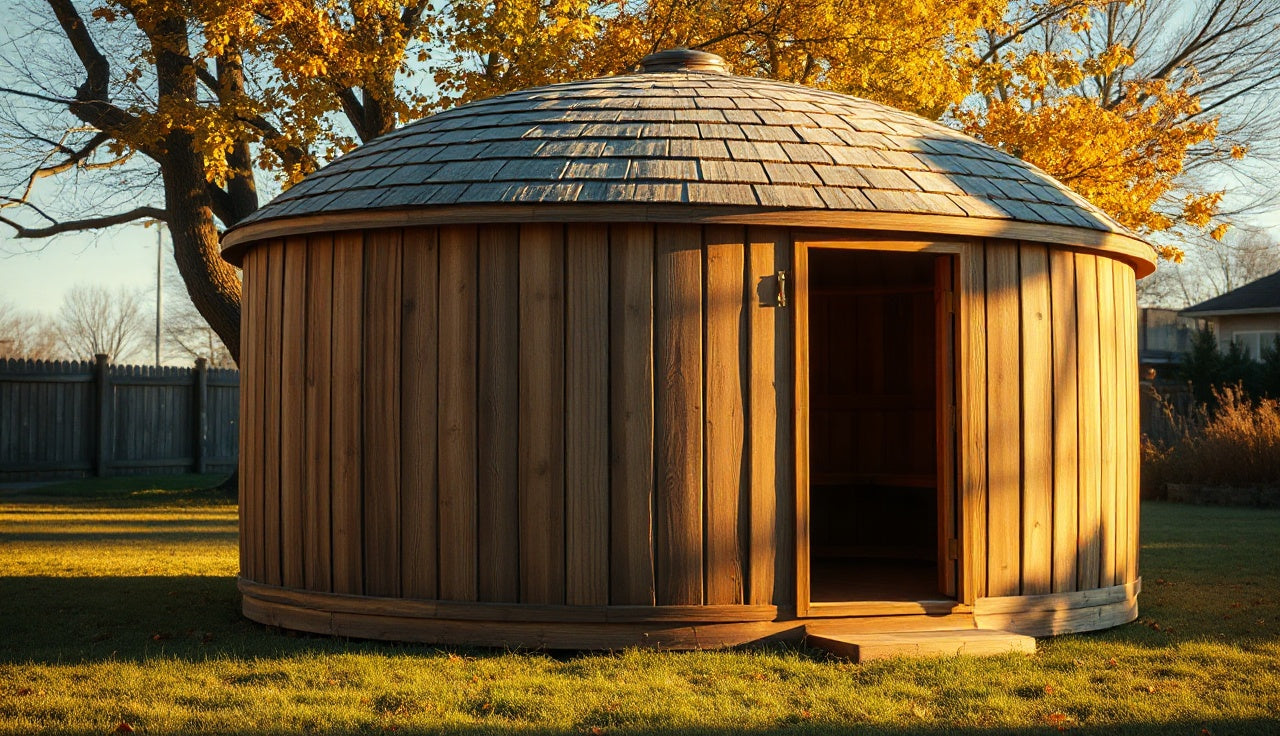
Cedar shingles or shakes The most popular upgrade. Narrow cedar shingles (3-4 inches wide) follow the barrel's curve well enough when nailed in overlapping rows from the bottom edge up. Each row covers the nail heads of the row below, same as a conventional roof. A full re-roof with cedar shingles on a standard 6-foot-diameter, 8-foot-long barrel takes roughly 2-3 bundles and runs $150-$350 in materials [2]. Labor adds $200-$400 if you hire someone. Lifespan is 15-20 years with annual inspection.
EPDM rubber membrane EPDM (ethylene propylene diene monomer) is a single-ply roofing rubber used on flat commercial roofs and, more and more, on curved structures. It stretches and conforms without cracking. A 10x10 foot roll of 45-mil EPDM costs roughly $80-$120 and covers most barrel tops with room to spare [3]. You glue it with EPDM contact cement, trim the edges, and seal the perimeter. It is the most waterproof of the four and the easiest for a solo installer because you work with one continuous piece. The tradeoff is looks: black rubber does not read as a traditional sauna. In snowy climates the dark surface absorbs solar heat and sheds snow faster, which helps.
Standing-seam or corrugated metal Metal over a barrel is more common in Scandinavia and commercial installs than in American backyards, but it works well done right. Thin-gauge (28-30 gauge) corrugated steel or aluminum bends enough to follow the curve on longer barrels. Pre-painted Galvalume steel runs $1.50-$3.00 per square foot in materials [4], so a modest barrel roof might cost $120-$250 in metal alone. Seams need to run parallel to the barrel's length (not across it) so water flows over the joints instead of into them. Screws need neoprene washers, driven into the stave wood at the right torque. Overtighten and you crush the washer into a leak path. Undertighten and the screw backs out in freeze-thaw cycles.
| Material | Material Cost (6x8 ft barrel) | DIY Difficulty | Expected Lifespan |
|---|---|---|---|
| Bare cedar (maintained) | $0-$40 (sealant only) | Easy | 3-7 years |
| Cedar shingles | $150-$350 | Moderate | 15-20 years |
| EPDM membrane | $80-$150 | Easy-Moderate | 20-25 years |
| Corrugated metal | $120-$300 | Moderate-Hard | 20-30 years |
How much does it cost to roof or re-roof a barrel sauna?
Materials alone run from about $80 for a basic EPDM sheet up to $800 or more for cedar shingles with a quality peel-and-stick underlayment and professional installation. Here is where the money actually goes.
DIY cedar shingle job on a standard 6-foot-diameter barrel: figure $150-$250 for three bundles of #1 or #2 grade western red cedar shingles, $30-$50 for a self-adhering curved underlayment or carefully cut felt strips, $20 for galvanized or stainless roofing nails (never zinc-coated, they streak and corrode faster on cedar), and another $20-$40 for a tube of exterior wood sealant to finish the edges. Call it $220-$360 in materials.
EPDM: a 10x10 roll of 45-mil membrane runs $80-$120 [3], bonding adhesive is $25-$40 per gallon (you need maybe half a gallon), lap sealant is $15, and a seam roller is $10. You are out about $130-$200 and a Saturday afternoon.
Metal: materials land at $120-$300 depending on gauge and panel width, plus $25-$40 in screws and $15 for a tube of sealant at the endcap seams.
Professional installation, if you can find a roofer willing to work on a barrel (many won't bother for a small job), typically adds $200-$500 in labor for a half-day on a small structure. Some sauna companies offer installation for $300-$600 total. Get three quotes before you take the first offer.
One cost people miss: the endcap seals. Where the roof surface meets the circular end panels, water finds a way in if the joint is caulk-only with no flashing. A tube of exterior polyurethane caulk and a half-hour of attention to those seams prevents $500-$1,000 in rot repair later.
| Bare cedar (maintained) | 6 |
| Cedar shingles with underlayment | 17 |
| EPDM rubber membrane | 22 |
| Standing-seam metal | 35 |
Source: Cedar Shake and Shingle Bureau, EPDM Roofing Association, Metal Construction Association (citations 5, 3, 4)
How do you install cedar shingles on a curved barrel sauna roof?
The process is not complicated, but the curve adds a few steps you won't find in a standard roofing tutorial.
First, dry-fit one shingle at the widest point of the curve (the apex) and one at the edge. A 4-inch-wide shingle sits flat at the apex. At the edge where the curve is tightest (the bottom quarter of the barrel), a rigid shingle bridges over the surface instead of hugging it, leaving a small air gap. On most 6-foot-diameter barrels that gap is small enough to close under the next row. On tighter curves (some 4-foot-diameter barrels), use narrower 3-inch shingles or score the back face lightly with a utility knife to allow a slight bend.
Start at the bottom edge and work up toward the apex. Nail the starter course with the shingle tips hanging about half an inch past the stave edge so water drips clear. Use two nails per shingle, about 3/4 inch from each side and 1 inch above where the next course's exposure line will land. Every nail should be a 1.5-inch galvanized or stainless ring-shank.
Exposure on cedar shingles for a steep-pitch application (barrel tops qualify as steep) is typically 7.5 inches for 18-inch shingles or 5 inches for 16-inch shingles [5]. The barrel's curve means the effective pitch changes from about 12:12 at the side edges to nearly vertical at the very bottom, so shorten your exposure slightly for the bottom two courses.
At the apex, cap shingles need a ridge-cap shape. Cut a shingle in half lengthwise, flip the two pieces face-to-face, bend them slightly, and nail them straddling the apex line. Seal the nail heads with exterior caulk.
The whole job on an 8-foot barrel takes 4-6 hours for one person.
How do you install an EPDM membrane on a barrel sauna?
EPDM is the fastest route to a truly waterproof barrel roof, and it forgives mistakes better than shingles.
Clean the stave surface thoroughly. Dirt, mill glaze, old sealant, or sawdust will keep the adhesive from bonding. A light sand with 80-grit paper followed by a wipe-down with a clean rag is usually enough.
Cut the EPDM sheet so it overhangs the barrel by 3-4 inches on each long side and 4-6 inches on the ends. Lay it dry over the barrel and let it relax into the curve for 30 minutes. EPDM has a memory from being rolled, and letting it settle first means fewer wrinkles under the adhesive.
Fold half the sheet back on itself lengthwise. Brush EPDM bonding adhesive onto both the exposed stave surface and the underside of the folded membrane. Wait the flash time on the adhesive can (usually 15-25 minutes, until tacky but not wet), then fold the membrane back down and press firmly from the center outward. A seam roller pushes out air pockets. Repeat for the other half.
Long edges: fold the overhang under the stave edge and secure with EPDM termination bar (a thin metal strip with pre-punched holes) screwed every 8-10 inches into the bottom edge of the staves. Cover the bar with lap sealant.
Endcaps: cut the EPDM so it wraps around to the inside of the circular end panel by about an inch. Glue it to the end panel, then run a bead of EPDM lap sealant along the seam. This end-cap detail is where most DIY EPDM jobs leak, so slow down here.
Total materials budget: $130-$200. Time: 3-4 hours.
What causes barrel sauna roof leaks and how do you fix them?
The most common leak source is not the roofing material. It is the joint between the roof surface and the barrel's circular end panels. Water hits the curved roof, runs to the end, and pools right at that joint. If the seal there is caulk-only with no flashing, the caulk cracks within one or two freeze-thaw cycles and water walks right in.
The fix: chip out the old caulk, apply a bead of self-leveling polyurethane exterior caulk, and press a strip of aluminum or galvanized metal flashing over it before the caulk sets. The flashing laps over the end panel by at least an inch. Cover the top edge of the flashing with another caulk bead. Under an hour of work, and it stops most end-leak problems for years.
The second most common problem is cupped or cracked staves under the roof surface. If you have cedar shingles on top but the staves below were never sealed, moisture cycles through the wood from the inside of the sauna (hot steam) and the outside (rain and snow). That cycling cups the staves, which lifts shingle edges. Water gets under the lifted shingles and the whole thing gets worse.
Fix: pull the affected shingles, let the staves dry completely (ideally a week of sun), apply two coats of exterior wood stabilizer, and re-shingle with a self-adhering underlayment between the stave and the new shingle.
On EPDM, the usual failure is edge termination lifting. The membrane peels up at the bottom edge where it was glued or wrapped around a stave. Re-adhere with fresh EPDM contact cement and reinstall a proper termination bar with screws. EPDM almost never fails in the middle of a sheet unless it was installed over a sharp protrusion that eventually punctures it.
Should you add a canopy or overhang to a barrel sauna roof?
A canopy or extended overhang is one of the most useful upgrades you can make to an outdoor barrel sauna. Most kits ship with a roof that ends flush with the end panels or overhangs only 2-4 inches. That is not enough to keep rain off the door, the bench area just inside, or the wood endcaps.
Adding a simple 18-24 inch lean-to canopy over the door end is straightforward. Two angled 2x4 or 2x6 brackets lag-bolted to the stave wood at the door end, a pair of purlins spanning between them, and metal roofing or corrugated polycarbonate panels screwed down. The whole extension goes up in an afternoon for $80-$200 in lumber and panels.
Polycarbonate earns its place here because it lets light in. An opaque metal canopy over the door makes the entryway dim. Clear or bronze-tinted twin-wall polycarbonate panels ($1.50-$3.00 per sq ft at most home improvement stores) solve that while keeping rain off the door.
Heavy snow climate? Size the canopy structure for snow load. A basic residential snow load for many northern US states is 25-40 pounds per square foot [6]. A 2-foot-deep canopy over a 6-foot-wide barrel end faces about 12 square feet of snow surface, so design for 300-480 pounds on the frame. 2x6 brackets at 24-inch spacing handle that easily when they are properly bolted.
If your barrel sits under a tree, a canopy also keeps leaves and debris off the top, which saves real maintenance. Wet leaves sitting on cedar staves trap moisture and speed up rot.
How do you weatherproof and seal a barrel sauna roof for winter?
Fall maintenance before the first hard freeze is the single most cost-effective thing you can do to extend barrel sauna roof life.
Step one: inspect every caulk joint at the endcaps and along any seam where roofing meets wood. Press on the caulk. If it flexes and feels spongy, it is still good. If it cracks or pulls away from the wood, replace it before winter. Use a polyurethane exterior caulk rated for below-freezing application, not silicone (silicone does not bond well to bare wood).
Step two: if you have bare cedar staves or cedar shingles, apply a penetrating exterior wood sealant. Products with paraffin-based water repellents hold up better in freeze-thaw cycles than film-forming sealants, which crack when the wood expands and contracts [7]. Brush it on during a dry day above 50°F. One quart covers roughly 100-150 square feet on rough cedar.
Step three: check that the barrel is still level or draining correctly. Winter frost heave can tilt a barrel that was dead level last spring. If the low end is trapping water, shim the frame back to level.
Step four: if you get more than 60-80 inches of snow a year, consider covering the barrel top with a tarp or fitted vinyl cover after the last use of the season. Some manufacturers sell fitted covers for $50-$150. This is optional in most climates if your roofing is sound, but it is cheap insurance in places like Minnesota, Vermont, or the Upper Peninsula.
On EPDM roofs, winter prep is simpler: inspect the termination bar edges and re-apply lap sealant anywhere the membrane has lifted. EPDM handles extreme cold well and stays flexible down to minus 40°F [3].
How long does a barrel sauna roof last?
Lifespan comes down to what material you used and how well you maintain it.
Bare, unsealed cedar staves in a wet climate start showing cracks and joint gaps in 2-4 years. The same staves with annual sealant might last 6-8 years before you see meaningful water infiltration. Cedar shingles installed with proper underlayment and maintained every 2-3 years with a wood preservative run 15-20 years before they need significant replacement. The Cedar Shake and Shingle Bureau rates #1-grade western red cedar shingles at a 30-year life expectancy on conventional steep-slope roofs [5], but a barrel's curved exposure is harder on shingles than a flat deck, so expect somewhat less.
EPDM membranes installed correctly last 20-30 years. The EPDM Roofing Association commonly cites a 20-25 year service life in outdoor applications [3]. The adhesive bond at the edges usually weakens before the membrane itself fails, so edge inspections every 2-3 years matter.
Metal roofing (steel or aluminum) in a standing-seam or corrugated setup runs 30-50 years with minimal maintenance. Screws with neoprene washers are the weak point and should be inspected every 5 years.
The biggest variable is interior moisture. A barrel sauna that is properly vented, with a vent at floor level and another near the ceiling that you open after each session, dries out between uses. One that stays sealed traps humid air against the inside face of the staves and rots from within, no matter how good the exterior roofing is. If you are thinking about your first barrel sauna, read through what makes an outdoor sauna work long-term before you buy.
What should you look for when buying a barrel sauna kit to avoid roof problems?
Not all barrel sauna kits treat the roof the same way. Check these five things before you buy.
Stave thickness. The roof staves take more weathering stress than the wall staves because they face the sky. Look for at least 1.5 inches of actual thickness. Some budget kits use 38mm (about 1.5 inch) staves, which is fine. Anything under 30mm (1.2 inch) for the roof is thin for a permanent outdoor installation.
Wood species. Western red cedar is the standard and the best choice for outdoor roofing because its natural extractives resist decay [1]. Some kits use Nordic spruce, pine, or thermally modified wood. Spruce and pine are fine for the interior but need more aggressive sealing on the roof. Thermally modified wood (often sold as Thermowood) has genuinely improved rot resistance from the heat treatment and works well outdoors, though it costs more than standard cedar.
Joint design. Tongue-and-groove staves shed water better than simple butt joints. Ask the manufacturer whether the roof staves are T&G or butt-joined. T&G is the right answer.
Included hardware. The bands (steel hoops that hold the barrel together) should be galvanized or stainless. If the bands rust, they stain the staves and lose tension over time. Some kits use painted mild steel, which is adequate but needs inspection every few years.
If you are shopping for a full barrel sauna, the home sauna guide covers what to compare across kit brands, and SweatDecks carries a selection of barrel models with specs listed for stave thickness and wood species.
Warranty language. A manufacturer that warrants the structure against defects for 1-2 years is more confident in their materials than one offering 90 days. Ask specifically whether the warranty covers wood checking (surface cracking) on the roof staves. Most don't, because checking is a natural characteristic of wood, but the answer tells you how the company talks about its own product.
Do building codes or permits apply to a barrel sauna roof?
This varies by jurisdiction, and the honest answer is: sometimes yes, often no, and you need to check with your local building department before you install.
Most barrel saunas are classified as accessory structures. In many US municipalities, accessory structures under a certain square footage (commonly 120-200 square feet) are exempt from a full building permit, but the threshold varies widely [8]. A 6x8-foot barrel sauna is typically 48 square feet of footprint, which falls under most thresholds. Electrical work is the exception: a heater needs a dedicated circuit, and that almost always requires an electrical permit and inspection regardless of structure size.
The roof itself is generally not subject to separate review if the structure is permit-exempt. Roof design gets scrutinized when the sauna is attached to or sits within a certain setback of a primary structure, or when it is a larger barrel (some commercial-scale barrels are 10-12 feet in diameter and 20 feet long, which crosses into serious structure territory).
Snow load compliance is a real issue in northern states. The International Residential Code Section R301 specifies ground snow loads by geographic area [6], and some states (Minnesota, Vermont, New Hampshire) publish their own tables with higher requirements. If you live in a high-snow-load area and your barrel is on a permitted site, the structure and its roof need to carry that load. Kits from reputable manufacturers usually specify the snow load their banding system is designed for. Read that spec.
HOA rules are a separate layer with nothing to do with building codes. Some HOAs restrict outbuilding appearance, height, or roofing material. Check before you buy materials.
For anyone weighing a barrel sauna against a traditional box sauna, the sauna vs steam room article covers the structural and installation differences that change permit requirements.
What are the best practices for long-term barrel sauna roof maintenance?
A maintenance schedule is worth more than any premium roofing material. The two best materials fail faster than bare cedar if you ignore them.
Every spring: walk the roof carefully, because the curve is slippery when wet. Look for lifted shingle edges, EPDM membrane peeling at the edges, and any area where the wood looks dark or spongy. Dark staining on the wood beneath shingles signals moisture infiltration. Probe soft spots with a screwdriver tip. If the tip sinks more than a quarter inch without real resistance, the wood is rotting and needs attention before it spreads.
Every 1-2 years on cedar: apply a penetrating exterior wood sealant to exposed cedar surfaces, including any bare stave wood at the bottom edge and on the endcap panels. Skip deck paint and solid stains on the roof. They form a film that traps moisture underneath and peel off badly on curved surfaces.
Every 2-3 years on EPDM: inspect the termination bar along the edges. Re-apply EPDM lap sealant anywhere the membrane edge has lifted. This is a 30-minute job and about $15 in sealant.
Every 5 years on metal: check screw tightness (use a nut driver, not an impact driver, to avoid overdriving) and look for rust staining around screws. Replace any screw where the neoprene washer has compressed flat or cracked.
After any major storm: check the endcap seals and clear debris jammed under shingle edges. A single small branch wedged under a shingle can lift it enough to let weeks of rain in before you notice.
Saunas that get used regularly tend to be better maintained than ones that sit idle for months. If you are debating whether a barrel sauna is worth the upkeep, reading about sauna benefits might settle whether regular use is realistic for you. For the full recovery setup, many barrel owners pair their sauna with a cold plunge for contrast therapy, which keeps them using both structures often enough to stay on top of maintenance.
Frequently asked questions
Can I shingle a barrel sauna roof myself with no roofing experience?
Yes, with some patience. Cedar shingles on a barrel are more forgiving than a house roof because there is no valley flashing or complex geometry. The skills you need are measuring consistent exposure, driving nails without splitting shingles (predrill if splitting happens), and sealing the apex and endcap joints properly. Budget a full day the first time, not a half day.
How do I stop my barrel sauna roof from leaking at the ends?
The endcap joint is the number-one leak source on barrel saunas. Remove any old caulk, apply a bead of exterior polyurethane caulk, then press a strip of aluminum drip-edge flashing into the wet caulk so it laps over the endcap by at least an inch. Follow with a second caulk bead over the top flashing edge. This two-layer approach lasts far longer than caulk alone.
What is the best roofing material for a barrel sauna in a rainy climate?
EPDM rubber membrane is the most waterproof option and handles constant moisture better than cedar shingles. It conforms to the curve, has no seams for water to penetrate when installed as a single piece, and lasts 20-25 years. Cedar shingles are a close second if installed with a self-adhering underlayment, but they need more annual maintenance in wet climates to prevent mold and cupping.
How much does it cost to replace a barrel sauna roof?
Material costs run $80-$350 for most standard 6x8-foot barrels: about $80-$150 for EPDM, $150-$350 for cedar shingles with underlayment, or $120-$300 for corrugated metal. Hire a handyman or roofer and expect $200-$500 in labor. Total replacement cost for most homeowners doing it themselves is $100-$400 depending on material.
Do I need a permit to put a barrel sauna in my backyard?
Most barrel saunas fall under the accessory structure exemption (under 120-200 sq ft footprint in many jurisdictions), so no structural permit is needed. The electrical heater circuit almost always requires an electrical permit regardless of structure size. Snow load rules may also apply in northern states. Check with your local building department before installation.
How long does a cedar barrel sauna last outdoors?
With proper roofing and annual sealant maintenance, a quality western red cedar barrel sauna can last 20-30 years outdoors. The roof is the most vulnerable part: bare unsealed cedar staves may show water damage in 3-5 years, but properly shingled or EPDM-covered roofs protected by good endcap flashing run 15-25 years between major maintenance cycles.
Can I use asphalt shingles on a barrel sauna roof?
Technically yes, but they are not ideal. Standard 3-tab or architectural asphalt shingles are stiff and do not follow the curve of most barrels, leaving gaps at the sides. They also add real weight, which can stress the banding on lighter kits. Cedar or EPDM suit the curved geometry better. If you do use asphalt, cut the shingles into narrow strips (3-4 inches wide) so they conform.
What wood treatment or sealant should I use on a barrel sauna roof?
Use a penetrating exterior wood sealant with a water repellent, not a film-forming finish or deck stain. Products with paraffin-based water repellents (rather than acrylics) perform better in freeze-thaw cycles because they do not form a surface film that cracks when the wood moves. Apply annually or every other year on exposed cedar. Avoid silicone sprays, which wash off fast outdoors.
How do I add an overhang or awning to my barrel sauna?
The simplest approach is two angled 2x6 brackets lag-bolted into the stave wood at the door end of the barrel, with a pair of horizontal purlins between them and corrugated metal or polycarbonate panels on top. Size the brackets for your local snow load (25-40 lb/sq ft in many northern states). An 18-24 inch overhang keeps rain off the door and entry for $80-$200 in materials.
Does a barrel sauna roof need a vapor barrier?
Not in the traditional residential sense. A sauna interior already runs at high humidity by design, and a vapor barrier on the roof exterior would trap that moisture inside the stave wood instead of letting it dry. What you want is a breathable underlayment (a water-resistive barrier, not a full vapor barrier) beneath cedar shingles, which lets the wood dry while keeping liquid water out [10].
What happens if I do not maintain my barrel sauna roof?
Unsealed cedar stave joints absorb water and swell, then dry and shrink, over and over, until the joints open enough to let water in. That moisture reaches the interior staves and the bench framing and causes rot that can compromise the barrel's structural integrity within 3-5 years in wet climates. Re-roofing early is always cheaper than replacing rotted staves or the whole barrel.
Are there prefabricated roof covers made specifically for barrel saunas?
Some manufacturers and specialty vendors sell fitted vinyl or polyester tarp covers sized for standard barrel diameters (4, 5, 6, and 7 feet are most common). These are seasonal storage covers, not permanent roofing substitutes. Prices run $50-$150 depending on size. They protect the barrel during off-season months or long stretches of non-use in heavy-snow climates.
Can I put a green or living roof on a barrel sauna?
It is possible but not practical for most homeowners. A green roof needs a root barrier, drainage layer, growing medium, and plants, plus a structure that can carry 15-25 lb/sq ft of saturated weight. Most barrel banding systems are not rated for that load. Some custom barrel saunas with heavy timber framing have carried green roofs, but a standard kit barrel is not the right platform.
Sources
- USDA Forest Service, Forest Products Laboratory - Wood Handbook: Western red cedar's natural extractives give it superior decay resistance compared to spruce and pine, making it preferable for outdoor roofing applications.
- National Roofing Contractors Association (NRCA) - Roofing Manual: Cedar shingle material costs and installation guidance for steep-slope residential roofing applications.
- EPDM Roofing Association - EPDM Product Guide: EPDM 45-mil membranes remain flexible to minus 40°F and carry a 20-25 year expected service life in outdoor roofing applications.
- Metal Construction Association - Metal Roofing Systems Design Manual: Standing-seam and corrugated steel panel pricing ($1.50-$3.00 per sq ft) and 30-50 year lifespan for Galvalume steel roofing.
- Cedar Shake and Shingle Bureau - Grading and Installation Standards: #1-grade western red cedar shingles rated at 30-year life expectancy on conventional steep-slope roofs; recommended exposure of 7.5 inches for 18-inch shingles on steep slopes.
- International Code Council - International Residential Code, Section R301: IRC Section R301 specifies ground snow loads by geographic area for structural design of residential and accessory structures.
- USDA Forest Products Laboratory - Finishing of Wood (General Principles): Penetrating paraffin-based water repellents outperform film-forming sealants on rough exterior wood in freeze-thaw cycles because they do not crack when wood expands and contracts.
- U.S. Department of Housing and Urban Development: Many US municipalities exempt accessory structures under 120-200 square feet from full building permit requirements, though thresholds vary by jurisdiction.
- American Society of Civil Engineers - ASCE 7 Minimum Design Loads: Residential snow load design requirements of 25-40 pounds per square foot are standard across many northern US states under ASCE 7 provisions.
- Building Science Corporation - Understanding Vapor Barriers and Water-Resistive Barriers: Breathable water-resistive barriers allow wood to dry while blocking liquid water infiltration, making them preferable to vapor barriers in applications with high interior humidity like saunas.

Share:
Barrel sauna cover: do you actually need one and what to buy
Barrel sauna cover: do you actually need one and what to buy