
Last updated 2026-07-09
TL;DR
The SaunaLife Ergo Series is a Canadian red cedar barrel sauna built for outdoor use, sold in four lengths (4, 5, 6, and 7 feet) with an electric or wood-burning heater. Prices run roughly $2,800 to $6,500 depending on size and heater. Assembly takes about half a day for two people. It's a solid mid-range choice for serious home sauna buyers.
What is the SaunaLife Ergo Series barrel sauna?
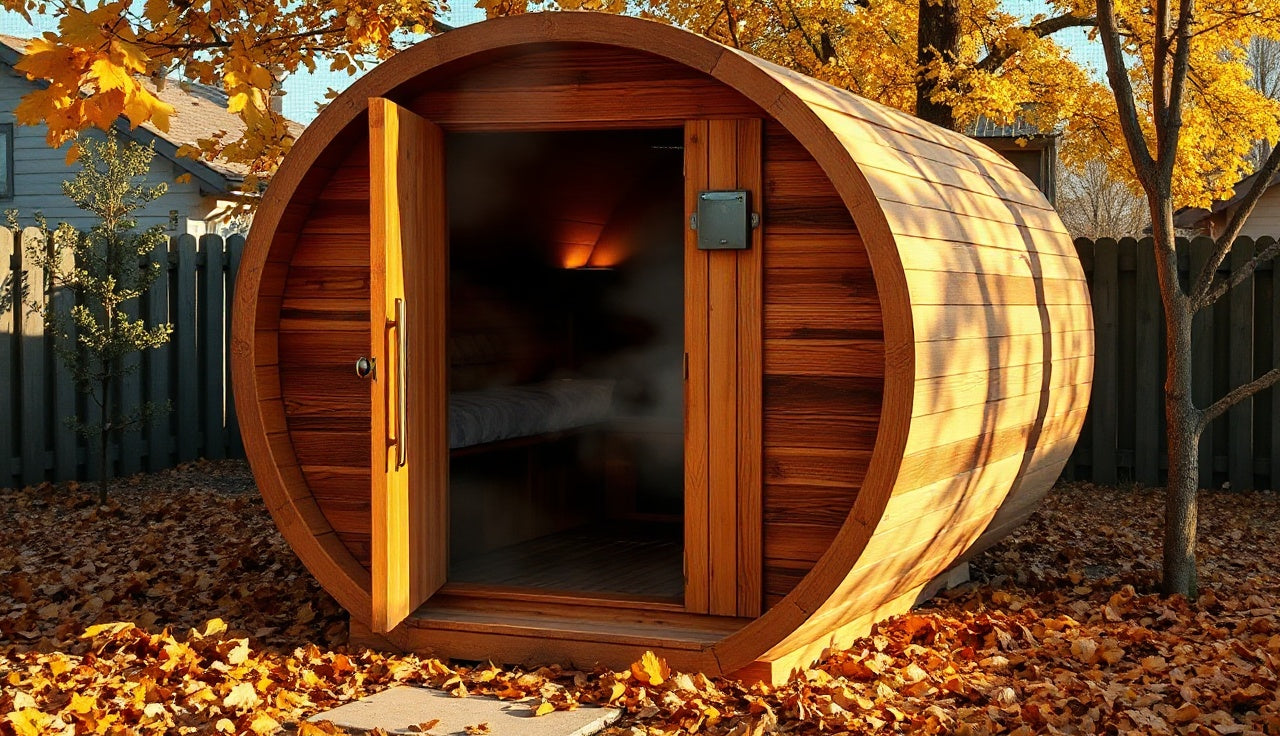
The SaunaLife Ergo Series is an outdoor barrel sauna made from clear-grade Canadian red cedar, built to sit in a backyard without a permit in most U.S. jurisdictions. SaunaLife is a brand under EOS Group, one of the larger sauna importers in North America. The Ergo line is their entry-to-mid-range barrel product.
"Ergo" refers to ergonomic shaping. The interior benches are contoured, not flat boards. Your lower back rests against a curve instead of sitting bolt upright on a plank. That one detail separates it from cheaper barrel saunas where the benches are just straight lumber.
The barrel arrives pre-staved. The staves (the boards that form the round shell) come pre-drilled and pre-banded with galvanized steel rings. You're assembling a kit, not cutting wood. SaunaLife ships the Ergo flat-packed on a pallet and includes hardware, a floor rack, and the heater depending on which package you order.
This is a home sauna built to live outdoors year-round. Red cedar handles freeze-thaw cycles well, and the barrel shape sheds rain and snow on its own.
What sizes does the Ergo Series come in?
SaunaLife sells the Ergo Series in four interior lengths: E7 (4 feet), E8 (5 feet), E9 (6 feet), and E11 (7 feet). Outer diameter is about 71 inches across every model. Capacity runs from 2 people in the E7 up to 4 to 5 in the E11.
Here's how the lineup stacks up:
| Model | Interior Length | Capacity | Heater Options | Approx. Price (2025) |
|---|---|---|---|---|
| E7 | 4 ft | 2 persons | Electric or wood | ~$2,800 to $3,200 |
| E8 | 5 ft | 2 to 3 persons | Electric or wood | ~$3,500 to $4,000 |
| E9 | 6 ft | 3 to 4 persons | Electric or wood | ~$4,500 to $5,200 |
| E11 | 7 ft | 4 to 5 persons | Electric or wood | ~$5,800 to $6,500 |
Prices vary by retailer and heater package. Wood-burning packages usually cost $100 to $300 less than electric because there's no electrical component in the kit, though you'll spend on firewood over time. Electric packages include a SaunaLife-branded heater, a 6 kW or 8 kW unit depending on the model.
For most solo or couple buyers, the E8 is the sweet spot. It's big enough to lie down in and small enough that a 6 kW heater hits 170°F in under 45 minutes. Buying for a household of four or planning to host guests? Go E9 or E11 and don't second-guess the upgrade.
What wood is the Ergo Series made from, and does it matter?
The Ergo Series uses Canadian western red cedar (Thuja plicata) for the staves, benches, and trim. This is one of two woods you'll see most in quality barrel saunas, the other being Nordic spruce. Both work. Neither wins in every situation.
Cedar carries a natural oil content that resists moisture and insects without any chemical treatment [1]. It also moves less than spruce across temperature swings, which matters for a barrel sitting outside through Michigan winters and Texas summers. The smell reads pleasant to most people, though a small share find it irritating.
Pay attention to the galvanized steel bands that hold the staves together. On cheaper barrel saunas the bands run thin and rust fast. SaunaLife uses hot-dip galvanized bands, which hold up better in wet climates.
The floor rack sits above the curved bottom to give you a flat place to stand. It's cedar slats. Simple, and easy to replace in five years if it wears out. Replacement racks are widely stocked for standard barrel dimensions.
One thing to know: red cedar is soft. Drag wet towels across the benches or drop heavy gear on them and you'll see surface dents over time. That's the species, not a manufacturing defect. Western red cedar sits in the highest natural durability class for outdoor exposure among Pacific Coast softwoods [10], but durability and hardness aren't the same thing.
How does the Ergo Series heater work, and which option should you choose?
SaunaLife gives you two heater paths for the Ergo: an electric heater (usually the SaunaLife SENSE 6 or SENSE 8) or a wood-burning stove.
The electric heater runs on 240V and needs a dedicated circuit. The E7 and E8 ship with a 6 kW unit. The E9 and E11 use an 8 kW unit, because the larger interior volume needs more power to reach temperature. A licensed electrician has to run the circuit to wherever the sauna sits, which typically adds $300 to $800 depending on distance from your panel and local labor rates. Improper 240V installation is a recognized fire and electrical hazard [9].
The wood-burning option uses a separate firebox-and-chimney kit. SaunaLife's wood stove for the Ergo is a steel unit that vents through the end wall or roof. Wood heats differently: the temperature swings more, the air feels drier when the fire is hot, and the whole session has more texture. You're tending a fire, which some people love and some find tedious.
Go electric for convenience. Set a timer, walk out to a sauna that's ready, sweat in 30 to 45 minutes. Go wood for the experience. Honest warning: if you live where wood fires get restricted seasonally (much of California), check your local air quality management district rules before ordering the wood package [2].
Temperature matters for the health side too. Sauna research generally looks at sessions at 80 to 100°C (176 to 212°F), and the Ergo's electric units reach that range without trouble [3].
Pairing your sessions with a cold plunge afterward? Electric wins on timing, since you can set the heat to finish exactly when you want it.
How hard is Ergo Series assembly, and what does it actually take?
SaunaLife calls the Ergo a DIY assembly, and that holds up with a couple of caveats.
The kit arrives on a pallet. Delivery is usually curbside freight, meaning the truck drops the pallet at your curb and moving it is your job. A barrel sauna pallet is heavy (most Ergo models ship at 500 to 800 lbs depending on size), so line up a hand truck, some friends, or a rented mover.
Assembly runs 4 to 8 hours for two people. The steps: level your foundation, assemble the two pre-cut end walls, stand the staves up around the rings, attach the floor rack, install the door and windows, mount the heater. SaunaLife includes a manual, and most buyers say the instructions are clear enough to follow without calling support.
You need a level foundation. SaunaLife sells an optional cradle base (a pair of curved wooden runners the barrel sits in), which is the most common choice because it needs no concrete and no permit in most places. Pour a concrete pad instead and you add cost plus a likely permit, depending on your municipality.
Tools you actually need: a rubber mallet, a drill, a level, and basic hand tools. Nothing exotic.
The electrical hookup for the electric heater is a separate step after the structure is up. Don't touch that part unless you're a licensed electrician. A 240V connection done wrong is a fire risk and voids your warranty.
By comparison, a traditional indoor sauna kit takes similar time but needs finished wall space and dedicated ventilation. The Ergo barrel drops into a backyard with far less infrastructure.
Does the Ergo Series need a permit?
Probably not, but check. That's the honest answer.
Most U.S. municipalities exempt detached outdoor structures below a square footage threshold (commonly 100 to 200 sq ft) from building permits [4]. A barrel sauna with a footprint under that threshold usually qualifies. Local rules vary enormously though. Some jurisdictions call out sauna structures specifically. Others treat any electrical work as permit-required no matter the structure.
The safe path: call your local building department before assembly, give them the dimensions, and ask whether the structure and the electrical work each need a permit. That call takes 10 minutes. Most counties also run permit lookup tools on their websites.
For the electric heater circuit, most jurisdictions require an electrical permit even when the structure itself doesn't need one. That permit usually gets pulled by the licensed electrician doing the work, so ask them to handle it.
HOA rules are a separate question. If you live in an HOA community, read your CC&Rs before ordering. Some HOAs ban outbuildings outright or set aesthetic requirements on anything visible from the street.
How does the Ergo Series compare to other barrel saunas at this price?
The barrel sauna market runs from sub-$2,000 imported kits of unknown wood origin up to $15,000-plus for custom Finnish builds. The Ergo Series lands in the $2,800 to $6,500 range, which puts it head to head with a handful of established brands.
| Brand / Model | Wood | Heater Included | Price Range | Notable Difference |
|---|---|---|---|---|
| SaunaLife Ergo Series | Canadian red cedar | Yes (electric or wood) | $2,800 to $6,500 | Ergonomic contoured benches |
| Dundalk Leisurecraft Canadian Timber | Canadian red cedar | Buyer's choice | $3,500 to $7,000 | Wider heater compatibility |
| Almost Heaven Pinnacle | Appalachian white oak | Harvia included | $3,200 to $5,500 | Different wood, good U.S. support |
| HUUM / Custom Nordic | Nordic spruce | HUUM electric | $5,000 to $9,000 | Premium Finnish heater, higher build |
| Costco-sold barrel kits | Fir or unspecified | Often excluded | $1,800 to $2,800 | Price competitive, quality variable |
The contoured bench is SaunaLife's real differentiator. Flat-bench barrels are fine for short sessions, but at 30 to 40 minutes you start feeling the straight-board edge. The Ergo benches fix that.
Dundalk is a real competitor at similar prices with an excellent reputation for cedar quality. Almost Heaven offers good value and solid U.S.-based support. Comparing the Ergo to a Costco sauna? Understand that the Costco options rotate seasonally and their wood sourcing is barely documented.
For a buyer who wants a reasonably priced, ready-to-assemble outdoor barrel and doesn't want to build from scratch, the Ergo is a fair pick. It isn't the cheapest and it isn't the best. It's a well-made, honest product in a crowded category.
What are the real health benefits of using a barrel sauna regularly?
This section is worth getting right, because the marketing in this space runs sloppy.
Here's what the research actually shows. Regular sauna use is associated with lower cardiovascular mortality and better cardiovascular function. The most-cited work is the Kuopio Ischemic Heart Disease (KIHD) study, a long-running Finnish cohort that followed over 2,300 middle-aged men. The 2015 paper in JAMA Internal Medicine found that men who used a sauna 4 to 7 times per week had a 40% lower risk of all-cause mortality compared to once-a-week users [3]. Striking, yes. But it's observational, not causal, and the population was Finnish men, not everyone.
A 2018 review in Mayo Clinic Proceedings summed up the evidence and noted that sauna bathing "has been shown to have several health benefits," including effects on cardiovascular function, while the authors stayed careful about claiming causation [5].
For athletes chasing recovery, heat exposure raises core temperature and triggers adaptations including increased plasma volume and improved thermoregulation [6]. Those effects are real. Whether they translate to measurably better sports performance is less clear from the current evidence.
Mental health effects are newer ground. Some studies show reduced symptoms of depression and anxiety after regular sauna use, possibly through endorphin release and lower stress hormones. Nobody has great data on the mechanism yet.
Want the fuller picture? The sauna benefits literature is more interesting than most marketing copy admits.
Safe use: the American College of Sports Medicine and most sauna researchers recommend sessions of 15 to 20 minutes at around 80 to 100°C, followed by a cool-down [7]. Stay hydrated. Skip the sauna if you're pregnant, have uncontrolled hypertension, or have been drinking alcohol.
| Once per week (baseline) | 0% |
| 2–3 times per week | 24% |
| 4–7 times per week | 40% |
Source: Laukkanen et al., JAMA Internal Medicine, 2015
How does the Ergo Series hold up over time, and what maintenance does it need?
Red cedar left untreated outdoors turns gray. That's cosmetic, not structural. Want to keep the warm honey color? Apply a UV-resistant exterior wood oil or penetrating sealer once a year. Simple product, simple job, maybe 30 minutes.
Inspect the steel banding rings annually. Tighten any that loosened from wood movement. Surface rust on the bands is usually oxidation on the zinc coating, not structural rust. A wire brush and some cold galvanizing compound handles it.
The door seal (the rubber or foam gasket around the frame) takes the most wear, cycling through wet-hot conditions over and over. Plan to replace it every 3 to 5 years. Replacement seals for standard barrel doors run $20 to $50 and are easy to find.
For the electric heater, clean the rocks once a year. Pull them, rinse, dry, and swap out any that cracked. The SaunaLife SENSE heaters are Harvia-adjacent in design (Harvia is a Finnish company and a major OEM supplier to the North American market), so replacement parts are generally around.
The interior needs no sealant or finish. Cedar interiors always stay raw so they can breathe. Finishing the inside is a mistake: it off-gasses at sauna temperatures.
For an outdoor sauna in a wet climate like the Pacific Northwest, keep the cradle base off direct soil contact. Elevate it slightly if you can. Standing water under the barrel speeds up cradle deterioration, even in cedar.
Is the SaunaLife Ergo Series worth the money?
For a buyer who wants a real outdoor sauna without hiring a contractor to build one from scratch, yes. The Ergo delivers a legitimate sauna: hot enough, big enough, made from wood that lasts 15 to 20 years with basic upkeep.
Where it earns the premium over the cheapest kits: contoured benches, documented wood sourcing, and a heater package that's actually included. You're not sourcing your own heater and gambling on matching it to the volume.
Where it doesn't justify extra spend: SaunaLife's customer service draws mixed reviews online, and parts availability can be spotty. Finnish brands like Harvia or Helo have deeper parts ecosystems.
Here's the honest comparison. A custom cedar barrel from a local carpenter might run $8,000 to $15,000. A cheap imported kit might run $2,000 but could hand you significant troubleshooting. The Ergo sits between them and does it credibly.
Mapping out the full contrast therapy setup? A sauna paired with a cold plunge or ice bath is a meaningful recovery protocol. The Ergo is a reasonable starting point for the heat half.
SweatDecks carries the Ergo lineup alongside a curated set of cold plunge options, so if you want to buy both under one roof and compare configurations, that's on the table.
Bottom line: at $3,500 to $5,000 for the middle sizes, the Ergo E8 or E9 is fair value for a homeowner who'll actually use it. Buy it if you're committed to regular sessions. Don't buy it as an optimistic aspiration.
What do owners actually say about the Ergo Series?
There's no formal aggregate review database specific to the Ergo Series, so this reflects the pattern of public reviews on retailer sites and sauna enthusiast forums as of mid-2026. Two caveats: review samples skew toward people with strong opinions, and SaunaLife's volume isn't large enough for statistically reliable averages.
Consistent positives: the assembly instructions are clear, the contoured benches are genuinely comfortable, the cedar looks and smells good on arrival, and the unit heats faster than buyers expect for its size.
Consistent negatives: shipping packaging sometimes fails to prevent damage (a few buyers report cracked staves on arrival), customer service can lag during peak season (fall and early winter), and door hardware on some units needed adjustment out of the box.
The shipping damage issue is worth taking seriously. Inspect your pallet before the freight driver leaves. See obvious packaging damage? Note it on the delivery receipt and photograph everything. That documentation is what carries a warranty claim.
SaunaLife's warranty typically runs one year on parts and structure, but verify current terms with the retailer at purchase, since those terms change.
Want to try the format before buying? Some larger fitness clubs and athletic recovery centers have installed barrel saunas you can sit in. A commercial unit isn't identical, but it gives you a feel for the shape and heat.
Frequently asked questions
What is the SaunaLife Ergo Series price range in 2025?
The Ergo Series runs from roughly $2,800 for the smallest E7 to $6,500 for the largest E11. Those prices include the heater package (electric or wood-burning, your choice). Add $300 to $800 for electrician costs if you choose electric, plus freight delivery charges. Prices shift by retailer, so compare at least two sources before buying.
How long does it take to assemble the SaunaLife Ergo barrel sauna?
Most buyers report 4 to 8 hours for two people. The kit is pre-drilled and pre-banded, so no cutting wood. The main steps: level the foundation, assemble the end walls, stand up the staves, install the door and floor rack, mount the heater. Electrical hookup for an electric heater is a separate step needing a licensed electrician.
Does the SaunaLife Ergo Series require a building permit?
Usually no, but it depends on your municipality. Most U.S. jurisdictions exempt detached outdoor structures under 100 to 200 square feet from building permits. The electrical circuit for an electric heater typically needs an electrical permit regardless of the structure's status. Call your local building department before assembly to confirm your specific rules.
What is the best size Ergo Series to buy for two people?
The E8 (5-foot interior) is the best fit for two people. It's long enough to lie down in, and a 6 kW heater brings it to temperature in about 45 minutes. The E7 fits two but feels tight if both want to stretch out. Consider the E9 if you expect occasional guests or want room to lie flat comfortably.
Should I get the electric or wood-burning heater for the Ergo Series?
Electric is more convenient: set a timer, show up when it's hot. Wood-burning gives a different experience with more heat texture and no electrical installation cost, but you're managing a fire and buying wood. Check local air quality regulations before ordering the wood option if you live in California or another area with burn restrictions.
How hot does the SaunaLife Ergo Series get?
The Ergo Series reaches 170 to 190°F (77 to 88°C) under normal conditions with the included electric heater. The wood-burning option can push slightly higher depending on how the fire is managed. Most sauna health research looks at temperatures between 80 and 100°C (176 to 212°F), and the electric units reach that range comfortably.
What maintenance does the SaunaLife Ergo barrel sauna need?
Annual tasks: apply UV-resistant wood oil to the exterior to preserve color, inspect and tighten the steel banding rings, clean the heater rocks. Every 3 to 5 years: replace the door seal gasket. The interior needs no finish ever. Keep the cradle base off standing water in wet climates. Total annual maintenance time is under two hours.
How long will a SaunaLife Ergo Series barrel sauna last?
Canadian red cedar outdoor saunas typically last 15 to 20 years with basic maintenance. The main failure points are the door seal (easy replacement), the cradle base (degrades faster in wet climates without drainage), and heater elements (replaceable). The cedar stave shell itself rarely fails if the banding stays tight and water drains properly.
Can the Ergo Series be installed on a deck or concrete pad?
Yes. The most common setup uses SaunaLife's optional cradle base (curved wooden runners) on a level surface: gravel, pavers, a deck, or concrete. A concrete pad works well but may require a permit depending on your municipality. Installing on a wood deck? Verify the deck's load rating, since a full Ergo E9 with occupants can exceed 1,200 lbs.
How does the SaunaLife Ergo Series compare to Dundalk Leisurecraft barrel saunas?
Both use Canadian red cedar and ship pre-drilled kits. The Ergo's main advantage is the contoured ergonomic benches. Dundalk is slightly more flexible on heater compatibility (pair any heater you want). Prices are comparable. Dundalk has a longer market history and somewhat more consistent customer service reviews, based on sauna enthusiast forums.
What foundation does the SaunaLife Ergo Series need?
The Ergo Series needs a level, stable surface. SaunaLife's cradle base (sold separately) is the simplest option and needs no concrete. You can also use a concrete pad, compacted gravel, or pavers. The surface must be genuinely level across the full length of the barrel, or the staves won't seat properly and the door won't close cleanly.
Is sauna use actually good for your health?
The observational evidence is encouraging. A 2015 study in JAMA Internal Medicine following 2,300+ Finnish men found 4 to 7 weekly sauna sessions were associated with 40% lower all-cause mortality versus once-weekly use. A 2018 Mayo Clinic Proceedings review confirmed cardiovascular benefits. These are associations in specific populations, not guaranteed outcomes. Use saunas safely: 15 to 20 minutes per session, stay hydrated, avoid alcohol beforehand.
Can you use the SaunaLife Ergo Series in cold winter climates?
Yes. Red cedar handles freeze-thaw cycles well, and the barrel shape sheds snow and ice. In very cold climates (sustained below -20°F), it takes longer to heat up and burns more electricity or wood. The steel bands may need tightening after the first winter as the wood contracts. Some cold-climate owners add a weather-resistant cover for shoulder seasons when the sauna isn't in use.
What electrical requirements does the Ergo Series electric heater need?
The electric heater (6 kW for E7/E8, 8 kW for E9/E11) needs a 240V dedicated circuit with a 30-amp or 40-amp breaker depending on heater size. A licensed electrician must install that circuit. Most jurisdictions require an electrical permit for this work. Budget $300 to $800 for the electrical installation depending on panel distance and local labor rates.
Sources
- USDA Forest Service, Wood Handbook: Wood as an Engineering Material (General Technical Report FPL-GTR-190): Western red cedar has natural oil content that contributes to decay and insect resistance without chemical treatment.
- California Air Resources Board, Residential Wood Burning: California air quality management districts restrict residential wood burning on Spare the Air days and in certain zones year-round.
- Laukkanen JA et al., JAMA Internal Medicine, 2015 — 'Association Between Sauna Bathing and Fatal Cardiovascular and All-Cause Mortality Events': Men using a sauna 4 to 7 times per week had a 40% lower risk of all-cause mortality compared to once-a-week users in the KIHD cohort study.
- International Code Council, 2021 International Residential Code Section R105.2 (Work Exempt from Permit): The model residential code exempts certain detached accessory structures under defined square footage thresholds from permit requirements; local adoption and amendments vary.
- Laukkanen T et al., Mayo Clinic Proceedings, 2018 — 'Cardiovascular and Other Health Benefits of Sauna Bathing: A Review of the Evidence': The review states sauna bathing 'has been shown to have several health benefits' including effects on cardiovascular function, while noting most evidence is observational.
- Périard JD et al., Experimental Physiology, 2015 — 'Cardiovascular adaptations supporting human exercise-heat acclimation': Heat exposure increases plasma volume and improves thermoregulation as physiological adaptations to repeated heat stress.
- American College of Sports Medicine, Position Stand on Exercise and Fluid Replacement: ACSM guidelines recommend avoiding sauna use with alcohol and maintaining adequate hydration; safe session duration is generally 15 to 20 minutes.
- Finnish Sauna Society, Sauna Safety Guidelines: Standard sauna temperatures recommended by the Finnish Sauna Society range from 80 to 100°C (176 to 212°F) for traditional sauna use.
- U.S. Consumer Product Safety Commission, Electric Sauna Heater Safety: Electric sauna heaters must be installed on dedicated 240V circuits; improper installation is a recognized fire and electrical hazard.
- USDA Forest Service, Wood Decay and Durability of Pacific Coast Species: Western red cedar is classified in the highest natural durability class for outdoor exposure among Pacific Coast softwoods.

Share:
Outdoor barrel sauna: everything you need to know before buying
2 person cold plunge tub: everything you need to know before buying