
Last updated 2026-07-09
TL;DR
An outdoor barrel sauna is a cylindrical cedar or spruce structure that heats faster than a box sauna because the curved walls hold less dead air. Expect to pay $2,000 to $10,000 depending on size and heater. Assembly takes a weekend with two people. With annual band-tightening and a dry-out habit, a good one lasts 20 to 30 years.
What exactly is an outdoor barrel sauna?
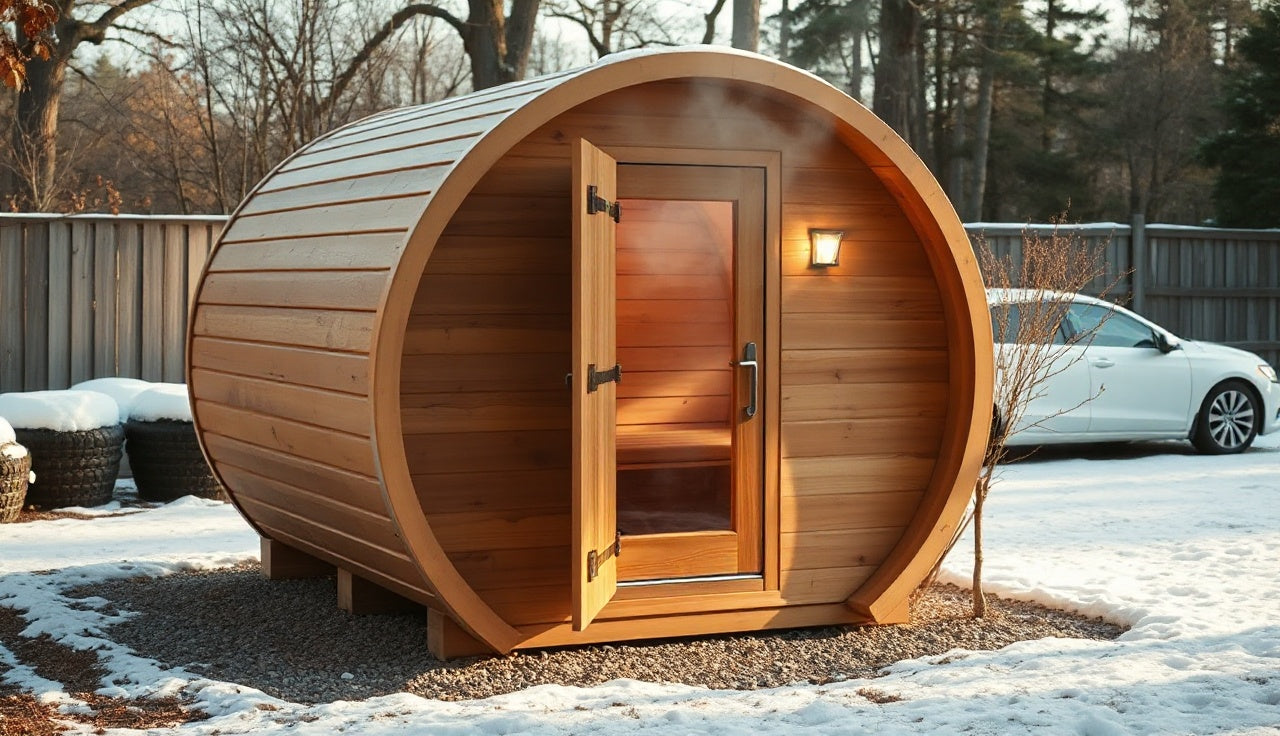
A barrel sauna is a cylindrical sauna built from stave-cut lumber (usually western red cedar, Nordic spruce, or white cedar) banded together with galvanized or stainless steel rings, the same construction as a wine cask. The cylinder rests on a pair of cradle supports so it never touches the ground, and the door is cut into one flat end.
The shape is the whole point. A box sauna has four right-angle corners where cool air pools and the heater grinds to warm dead zones. A cylinder has no corners. Hot air rises off the heater, circles the curved wall, and drops back to the floor in a continuous loop, so the temperature evens out sooner and the heater runs less to hit your target. Most barrel saunas reach 160-180°F (71-82°C) in 30 to 45 minutes. A comparable box sauna takes 45 to 60. [1]
They also look good in a yard. The round profile, the wood grain, and the curl of steam on a cold morning make barrel saunas the most photographed home sauna style by a wide margin. That has nothing to do with performance, but it matters when the thing lives on your patio for the next two decades.
Still deciding between sauna types? Our guide to outdoor saunas walks through barrel, cabin, pod, and prefab box.
How does a barrel sauna heat up compared to other saunas?
Faster, and the reason is geometry. A barrel holds less interior air per square foot of wall than a rectangular room of the same capacity, and less air means less time and less energy to heat it. Guidance from the Finnish Sauna Society notes that curved barrel walls reduce dead air volume against a comparable rectangular room. [1] For a typical 6-foot-diameter, two-to-four person barrel, that trims heat-up time noticeably against a boxy 4x6 with the same bench length.
The curved ceiling helps too. In a box sauna, a flat ceiling stacks the heat: broiling at head height, cooler at your feet. The curve deflects rising heat back down along the walls before it can pile up at the top. You still get the classic Finnish gradient, hotter up top and cooler down low, but it's gentler, which makes the lower bench usable for anyone who finds 190°F punishing.
Wood-fired versus electric changes the experience more than the barrel shape does. A wood-fired barrel gives softer, moister heat and takes 45 to 75 minutes because you're tending a fire. An electric barrel with a Harvia or Helo unit is ready in 30 to 40 minutes and holds temperature on its own. [2] Either way, the barrel beats a comparable box on heat-up time.
For how the main types stack up, the sauna vs steam room breakdown is worth reading.
What does an outdoor barrel sauna cost in 2025?
The range is wide because "barrel sauna" covers everything from a budget flatpack to a hand-built Scandinavian import with a custom heater.
| Category | Typical price range | What you get |
|---|---|---|
| Entry-level kits | $1,800 - $3,500 | Spruce or low-grade cedar, 4 kW electric heater, basic hardware |
| Mid-range | $3,500 - $6,500 | Western red cedar, 6-9 kW heater, better door seal, stainless bands |
| Premium | $6,500 - $10,000+ | Old-growth or Nordic cedar, premium heater (Harvia, Helo, or Tylo), custom length options |
| Wood-fired add-on | +$800 - $2,500 | IKI or Narvi wood stove, chimney kit |
Shipping adds $300 to $1,200 depending on your location and whether the kit rides a freight pallet or a parcel carrier. Most manufacturers quote FOB (freight on board at their warehouse), so get the delivered price before you compare. [3]
Electrical is the most overlooked cost. A 240V/40-60A dedicated circuit run from your panel to an outdoor spot costs $500 to $1,500 depending on distance and local labor rates. Go wood-fired and you skip that, but you take on the chimney and fire-clearance work instead.
Here's the benchmark I'd use: budget $5,000 to $7,000 all-in (kit, heater, delivery, electrical) for a quality two-to-four person barrel that lasts 20 years. Spend under $2,000 and you're usually buying thin staves, weak hardware, and a heater you'll replace in five years.
| Entry-level kit (installed) | $3,500 |
| Mid-range kit (installed) | $6,000 |
| Premium kit (installed) | $9,500 |
| Wood-fired add-on cost | $1,500 |
Source: HPBA market data and manufacturer pricing, 2024-2025
What sizes do outdoor barrel saunas come in?
Two numbers matter: diameter and length. Diameter sets the ceiling height and how the inside feels. Length sets how many people fit.
Standard diameters are 4 feet, 5 feet, and 6 feet. A 4-foot barrel is cramped, with maybe 38 inches of headroom above the upper bench, and most adults can't sit upright comfortably. The 5-foot diameter is the practical floor for adults, giving roughly 48-50 inches of headroom. The 6-foot diameter is the comfortable pick, especially if you want to lie down or share it with family.
Lengths run from 6 feet (a solo or two-person sauna) to 8 feet (the most popular size, sleeping two adults or seating four) up to 12 feet and beyond for commercial or big-family use. The 8-foot by 6-foot-diameter barrel is the single most common configuration in the North American market. [3]
One thing buyers miss: the listed length is the exterior length. Subtract 12 to 18 inches for the end walls to get the real bench length. An 8-foot barrel gives roughly 6 to 6.5 feet of usable bench, enough for two adults lying head to foot.
Tight on space? A portable sauna is worth a look before you commit to a permanent structure.
What wood is best for an outdoor barrel sauna?
Western red cedar is the gold standard and the honest answer most of the time. Its low density (about 23 lb/ft³) means it doesn't soak up much heat before radiating warmth back to you. Natural oils fight rot and insects without chemical treatment. And it smells extraordinary. [4]
Nordic spruce (Picea abies) is what most Finnish-made saunas use. It's denser than cedar, which some traditionalists prefer because it holds heat a touch longer and throws a different steam character when you ladle water on the rocks. It's more prone to moisture damage if the sauna gets neglected, so it wants more attentive drying and sealing.
Thermo-treated wood (sold as "thermory" or "thermo-aspen") is regular lumber kiln-heated to 180-215°C to bake out sugars and moisture. That makes it dimensionally stable and highly rot-resistant, a strong choice outdoors because it barely warps through weather cycles. The trade-off: none of the cedar aroma.
White cedar and basswood are the budget options. They work, but white cedar rots faster than western red, and basswood (common in cheap North American kits) doesn't hold up to outdoor moisture over the years. If a kit won't name the species, ask before you buy.
Stave thickness counts too. Exterior staves should run at least 1.5 inches; 1.75 to 2 inches is better for cold climates. Thin staves lose heat faster and are more likely to check (surface-crack) through freeze-thaw cycling.
Do you need a permit for an outdoor barrel sauna?
Usually yes for a permanent structure, and almost always for the electrical. The exact rules depend on your municipality, but the framework is consistent across most of the United States.
Most jurisdictions treat an outdoor sauna as an accessory structure, like a large shed or gazebo. The building-permit trigger is typically floor area over 120-200 square feet (the threshold varies by city and state), and many barrel saunas come in under 100 square feet, so they may skip the structural permit. [5]
Electrical permits are another matter. Any 240V install needs one regardless of the sauna's footprint. Your electrician pulls it. Skip it and you've created a real liability problem if there's ever a fire or an insurance claim.
Zoning setbacks apply. Most residential zones require accessory structures to sit a set distance from property lines, usually 3 to 10 feet. Some HOAs ban permanent outdoor structures outright. Check the zoning code and the HOA rules before you order anything.
The International Residential Code, adopted in some form by most jurisdictions, addresses saunas and points to NFPA 70 (National Electrical Code) for heater wiring. [5][6] NFPA 70 governs the dedicated circuit and GFCI protection for a 240V heater. A wood-fired barrel also has to meet clearance rules for solid-fuel appliances, usually 18-36 inches from combustibles depending on the stove maker's specs.
Call your local building department before you buy. Most have an online lookup or will answer basic questions by phone. Getting caught with an unpermitted structure means fines, and possibly tearing it down.
How do you install an outdoor barrel sauna?
Good news: most kits are built for two people with basic tools over one to two days. No carpentry skills required.
Foundation first. The sauna can't sit on bare ground, because it will rot and it won't stay level. Your options, roughly cheapest to most permanent: a gravel pad with pressure-treated cradles ($50-$200), concrete pavers or stepping stones ($100-$300), or a poured slab or deck ($500-$3,000 depending on size). The cradles that ship with the kit sit on any of these. Get them level to within about 1/4 inch or the door won't seal.
Stave assembly goes faster than people expect. Lay the first ring of staves in the bottom cradle, add the floor frame, keep adding staves and tightening the steel bands as you climb, mount the benches, hang the door, wire the heater. Most kits number the staves and include a step-by-step manual. The tricky part is tightening the bands evenly so the cylinder stays round.
Heater clearances are not negotiable. Electric heaters need specific gaps from wood surfaces, typically 4-6 inches on the sides and top. The heater manufacturer and the IRC set these numbers. [5] Don't freelance here. It's a fire risk.
Leave 2 to 4 inches of air gap between the sauna and any fence or wall for ventilation and moisture escape. Push it flush against a fence and you trap moisture, which rots both surfaces.
How do you maintain an outdoor barrel sauna to make it last?
A barrel sauna lasts 20-30 years if you handle the basics. The ones that die early almost always die from water: cracked end panels or loosened stave bands letting weather in.
Tighten the bands every spring. Freeze-thaw cycling swells and shrinks the wood, which loosens the bands over a winter or two. Tightening them takes 10 minutes with a wrench and keeps the staves from gapping and leaking. Long-lived barrel owners point to this one task more than any other.
Leave the exterior bare or treat it with a penetrating oil made for outdoor wood (teak oil, linseed oil, or a product like Penofin). Film-forming sealers and exterior paint trap moisture inside the wood and rot it from within. The interior stays unsealed so the wood can breathe. Never paint or varnish the interior benches or walls. [4]
The end panels are the weak point. They're flat-cut wood, weather on one side and heat on the other. Coat the outside face with an exterior wood preservative once a year and check for checking and cracks. Replace any cracked panel section before water finds its way in.
After every session, prop the door open for 15 to 20 minutes so interior moisture escapes. A wet interior that never fully dries is how mold and rot start on the benches and floor boards.
Covers split opinion. A UV-resistant cover protects the finish but traps moisture if you throw it on before the sauna is bone-dry. Plenty of owners in wet climates skip the cover, let the cedar weather to silver-grey, and rely on the wood's own rot resistance.
What are the real health benefits of using a barrel sauna?
Sauna research got serious over the past decade, mostly out of Finland where the sauna is a cultural institution. The most cited work is a prospective cohort of 2,315 Finnish men in JAMA Internal Medicine (2015), which found men who used a sauna 4-7 times a week had a 40% lower risk of all-cause mortality than men who went once a week. [7] Strong association, but it doesn't prove the sauna caused it. Heavy sauna users tend to be health-conscious to begin with.
The cardiovascular response is well documented. A 2018 review in Mayo Clinic Proceedings concluded that "regular sauna bathing is associated with a reduced risk of cardiovascular diseases" and compared the acute response to moderate-intensity exercise. [8] Core temperature rises 1-2°C in a 15-20 minute session, heart rate climbs to 100-150 bpm, and stroke volume goes up, roughly like a light aerobic workout.
Muscle recovery is where a lot of athletes reach for it. Heat drives blood flow to muscle, which speeds clearance of metabolic waste like lactate. A 2021 review in Sports Medicine found evidence for reduced delayed-onset muscle soreness with post-exercise heat therapy, while flagging variable study quality and a need for more controlled trials. [9] Nobody has clean data here. The mechanism is plausible, the trial evidence is promising but not settled.
Want the cold half? Pair sessions with a plunge afterward. The cold plunge benefits article covers the recovery evidence in detail.
None of this is medical advice, and none of it makes a barrel sauna a medical device.
How does a barrel sauna compare to a traditional cabin sauna?
First-time buyers usually land between a barrel and a cabin (box-shaped) sauna. Here's the honest head-to-head:
| Feature | Barrel sauna | Cabin/box sauna |
|---|---|---|
| Heat-up time | 30-45 min | 45-60 min |
| Interior headroom | Lower (curved ceiling) | Full height |
| Footprint for same capacity | Smaller | Larger |
| Aesthetic | Distinctive, natural | Traditional or modern |
| Typical price range | $2,000-$10,000 | $3,500-$15,000+ |
| Assembly difficulty | Easy (kit-based) | Moderate to hard |
| Insulation options | Limited (stave walls) | Full insulation possible |
| Cold-climate performance | Good with thick staves | Better (insulated walls) |
The barrel loses one matchup: insulation. Stave walls, even at 1.75 inches, don't insulate like a framed box wall packed with R-8 to R-15 of mineral wool. In brutal cold (sustained below 0°F), an insulated cabin is more efficient and easier to bring to temperature. A barrel just runs the heater longer.
For most climates and most users, the barrel wins on simplicity, speed, and price per square foot. It isn't perfect. It is the most practical first outdoor sauna.
Our full home sauna guide covers every option, indoor builds included.
Can you use a barrel sauna year-round in cold climates?
Yes, and plenty of owners say winter is the best season for it. Step out of the heat into snow, roll in a drift, or drop into a cold plunge in freezing air, and you've got the classic Scandinavian contrast experience. The sauna itself handles cold weather fine.
The practical issues are real but manageable. Heat-up time stretches when it's cold, so add 10-20 minutes below 20°F. Thicker staves (1.75-2 inches) cut that penalty. Some owners in hard-freeze regions add an insulated mat or weatherstrip the door to kill drafts.
Wood movement is the bigger worry. Cycle through enough freeze-thaw and the staves swell and shrink, which is exactly why spring band-tightening matters. Cedar rides this out better than spruce thanks to lower density and more natural oil, but every wood moves. Keep the bands snug and the end panels sealed and you'll stay ahead of trouble.
One thing to avoid: don't let ladle water freeze inside the sauna. If you're leaving it unheated for weeks during a hard freeze, empty the water bucket and crack the door to stop condensation from building up inside.
Run the sauna next to a cold plunge or ice bath outdoors in winter and contrast therapy gets genuinely intense.
What should you look for when buying an outdoor barrel sauna?
After sorting through the market honestly, here's what separates a good buy from a headache.
Heater quality beats wood quality. The heater is the mechanical heart of the sauna, and cheap ones fail. Look for brands with real commercial history: Harvia (Finnish, founded 1950), Helo (Finnish), or Tylo (Swedish). Skip the unbranded units bundled with budget kits. A quality 6-8 kW electric heater runs $400-$800 and should last 15+ years with basic care. [2]
Stave thickness: 1.5 inches minimum for mild climates, 1.75 inches for anything with hard winters.
Band material: stainless steel over galvanized when you can get it. Galvanized bands rust, fast in humid or coastal air.
Door construction: a double-pane tempered glass door looks great and cuts heat loss. A solid wood door is traditional and fine, but inspect the seal. A gappy door seal is the single most common heat-loss problem in barrel saunas.
Ventilation: the sauna needs an adjustable vent (or two) to control airflow while you're in it. This is how you regulate temperature and fresh air, and it's not optional. Any reputable kit includes it. If a listing doesn't mention vents, ask.
At SweatDecks, the barrel saunas come from manufacturers that clear the stave-thickness and heater thresholds above. Worth checking before you finalize a comparison.
Read the warranty. The wood structure should carry 2-5 years minimum, and the heater at least 2 years on parts. Budget kits with 90-day warranties tell you exactly what the maker thinks of their own product.
Frequently asked questions
How long does it take to heat up an outdoor barrel sauna?
Most barrel saunas reach 160-180°F in 30 to 45 minutes with an electric heater, or 45 to 75 minutes with a wood-fired stove. Add 10-20 minutes in very cold weather. The curved interior holds less dead air than a box sauna, which is why heat-up times run faster for the same bench capacity.
How much does an outdoor barrel sauna cost to run per month?
A typical 6-8 kW electric barrel used three times a week for 1-hour sessions burns roughly 18-24 kWh per week. At the U.S. average residential rate of about $0.16/kWh (EIA, 2024), that's $11-$16 per month in electricity. A wood-fired sauna costs almost nothing if you have your own firewood, or $20-$50 per month if you buy it.
Can one person assemble a barrel sauna alone?
Technically yes, but it's miserable solo. Stave assembly means holding sections in position while you tighten bands, which really needs two sets of hands. Most manufacturers recommend two people. Plan for a full weekend with two adults and basic tools (wrench set, level, rubber mallet). The steps are straightforward; the physical coordination is the hard part.
What foundation do I need for an outdoor barrel sauna?
The sauna rests on two cradle supports, so it doesn't need a full slab, but it does need a level, stable surface. Concrete pavers, a gravel pad, a wooden deck, or a poured slab all work. Get the cradles level to within 1/4 inch. Don't set the cradles directly on soil; ground contact rots the cradle wood.
Do barrel saunas need to be sealed or stained on the outside?
You can let the exterior weather naturally (cedar turns silver-grey) or treat it with a penetrating oil like teak oil or linseed oil once a year. Avoid film-forming sealers and exterior paint; they trap moisture inside the wood. Never seal or paint the interior. Bare, breathable wood is essential for both performance and safety.
How many people fit in a typical barrel sauna?
The most popular size, a 6-foot-diameter by 8-foot-long barrel, comfortably seats two adults on the upper bench or four using both benches. A 6x6 foot barrel is a solo or couple's sauna. Longer barrels (10-12 feet) can seat six to eight but need a larger heater (8-12 kW) to hold temperature.
Is western red cedar or spruce better for an outdoor barrel sauna?
Western red cedar is better for most buyers: naturally rot-resistant, dimensionally stable, great smell, and it handles outdoor moisture cycling well. Nordic spruce is denser and preferred by traditionalists for heat retention and steam character, but it needs more attentive maintenance outdoors. In dry or mild climates either works. In wet or humid air, cedar's rot resistance wins.
Do I need a permit to install an outdoor barrel sauna?
Usually yes, at least for the 240V electrical circuit. A structural building permit may or may not be required depending on your municipality's threshold for accessory structures, typically 120-200 sq ft. A wood-fired sauna also has to meet solid-fuel appliance clearance rules. Always check with your local building department and HOA before purchasing.
How long will an outdoor barrel sauna last?
A quality western red cedar barrel with 1.75-inch staves, stainless steel bands, and basic annual care (tighten bands, oil the end panels, dry the interior after use) should last 20 to 30 years. Budget kits with thin spruce staves and galvanized hardware typically last 8-12 years before structural problems show up.
Can I add a cold plunge next to my barrel sauna for contrast therapy?
Yes, and it's one of the most popular outdoor wellness setups right now. The swing from sauna heat (160-180°F) to cold plunge immersion (50-60°F) drives a strong cardiovascular and recovery response. You need a level pad or deck beside the sauna with water access and drainage for the plunge. Our cold plunge guide covers the setup in detail.
What temperature should an outdoor barrel sauna run at?
Traditional Finnish sauna temperatures run 158-212°F (70-100°C), with 176-194°F (80-90°C) most common for experienced users. New users should start around 150-160°F and work up. Humidity comes from throwing water on the rocks; the resulting steam (löyly) makes the heat feel more intense without moving the thermometer.
Is a wood-fired or electric barrel sauna better?
Electric is more convenient: push a button, 30-40 minutes later it's ready, and temperature holds on its own. Wood-fired is a richer experience (softer heat, the ritual of the fire, no electrical install) but takes longer and demands more attention. For a home sauna you use several times a week, electric is the practical pick. For a seasonal cabin or off-grid use, wood-fired makes sense.
What heater size do I need for an outdoor barrel sauna?
The standard rule is 1 kW per 50 cubic feet of interior space. A 6-foot-diameter, 8-foot-long barrel holds roughly 180 cubic feet, so a 4-6 kW heater is the minimum and a 6-8 kW heater gives comfortable headroom. Size up for cold climates or larger barrels. Undersizing the heater is the most common mistake in barrel sauna purchases.
Can a barrel sauna sit on a composite deck or wood deck?
Yes, with care. The cradles concentrate a lot of weight (structure plus occupants) on a few contact points. Make sure the joists under those points can carry the load, typically 600-1,200 lbs for a standard 8-foot barrel. Ensure ventilation beneath the sauna too; trapped moisture on a wood deck rots both surfaces.
Sources
- Finnish Sauna Society, sauna design guidance: Curved barrel sauna walls reduce interior dead air volume vs. comparable rectangular saunas, shortening heat-up time
- Harvia Group, product and heater specifications: Quality electric sauna heaters from established manufacturers (Harvia, Helo, Tylo) have documented 15+ year service life with maintenance
- HPBA (Hearth, Patio & Barbecue Association), outdoor living product market data: 8-foot by 6-foot-diameter barrel sauna is the most popular North American configuration; shipping costs and FOB pricing practices
- USDA Forest Service, Forest Products Laboratory, Wood Handbook Chapter 2: Characteristics of Commercial Wood Species: Western red cedar density (~23 lb/ft³), natural oil content, and rot resistance compared to spruce and other sauna wood species
- International Code Council, International Residential Code (IRC) and accessory structure provisions: IRC covers saunas; accessory structure permit thresholds and heater clearance requirements for electric sauna heaters
- NFPA 70, National Electrical Code, covering fixed electric space heating equipment: NEC governs 240V sauna heater wiring requirements including dedicated circuit, GFCI protection, and installation standards
- Laukkanen et al., JAMA Internal Medicine 2015 — Association Between Sauna Bathing and Fatal Cardiovascular and All-Cause Mortality Events: Men using sauna 4-7 times/week had 40% lower all-cause mortality risk vs. once-weekly users in a 2,315-person cohort study
- Laukkanen et al., Mayo Clinic Proceedings 2018 — Cardiovascular and Other Health Benefits of Sauna Bathing: Regular sauna bathing associated with reduced cardiovascular disease events; acute hemodynamic response comparable to moderate-intensity exercise
- Sports Medicine 2021 — review of heat therapy effects on delayed onset muscle soreness: Post-exercise heat therapy associated with reduced DOMS in review; study quality variable, more controlled trials needed
- U.S. Energy Information Administration, Electric Power Monthly — average retail electricity prices by state, 2024: U.S. average residential electricity rate approximately $0.16/kWh as of 2024 data

Share:
How to buy a barrel sauna: what actually matters
SaunaLife Ergo Series barrel sauna: full buyer's guide