
Last updated 2026-07-09
TL;DR
Barrel saunas cost roughly $1,500 to $8,000 for a complete outdoor unit, depending on diameter, wood species, heater type, and whether you buy a kit or a pre-built. The curved shape sheds water naturally and heats faster than boxy designs. Most homeowners land on a 6-foot diameter, 6-7 foot long unit. Cedar is the safest wood choice. Electric heaters are the easiest starting point.
What is a barrel sauna and why does the shape matter?
A barrel sauna is exactly what it sounds like: a cylindrical sauna built from curved staves of wood, assembled around two or more circular cradle frames. The geometry is the whole point. Because the walls curve inward toward the top, hot air rises and immediately curves back down instead of pooling at the peak. That means the temperature gradient from floor to bench is smaller than in a traditional rectangular room, and you heat the usable space faster using less energy.
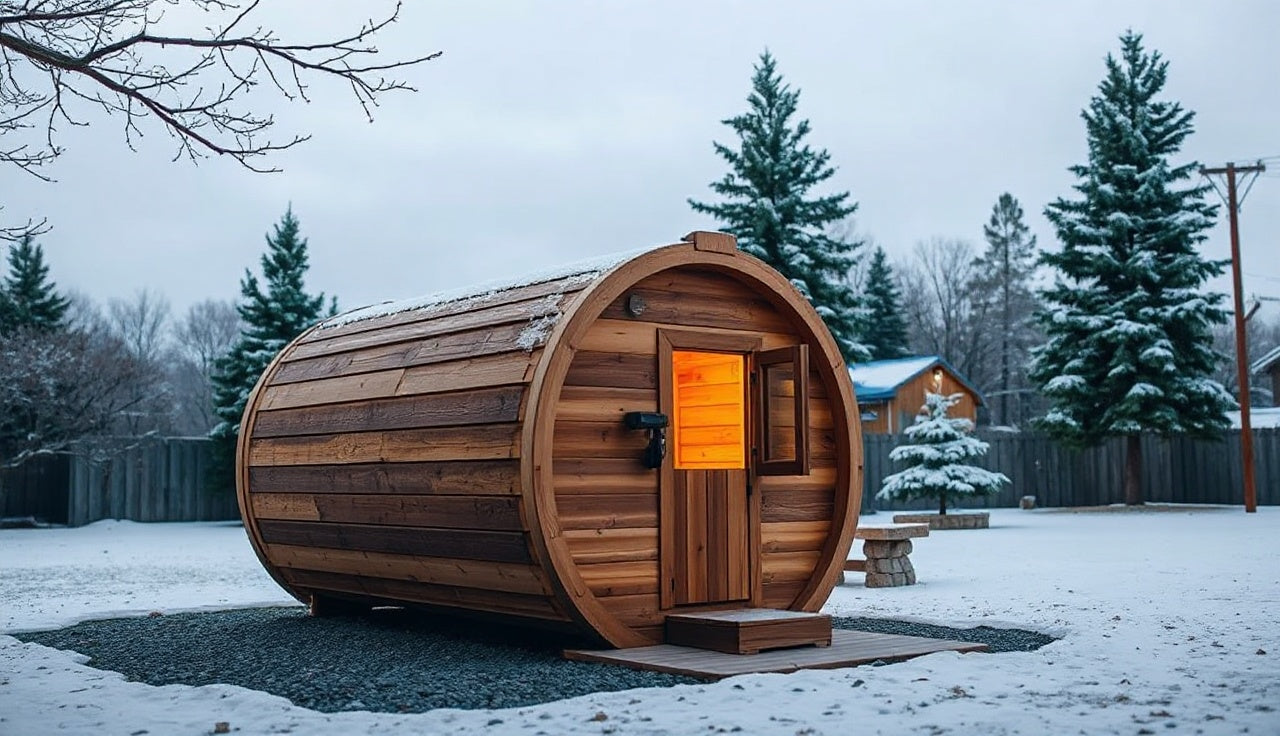
The curved roof also sheds rain and snow without gutters or special roofing. No flat surfaces means no standing water. That matters a lot if you live somewhere with real winter.
The tradeoff is interior headroom. The center of the barrel is the tallest point, so tall users sometimes feel cramped near the sides. A 6-foot diameter unit gives about 5 feet 8 inches of peak ceiling height. A 7-foot diameter gets you closer to 6 feet 6 inches, which is comfortable for most people.
For a full comparison between barrel saunas and other outdoor sauna styles, the outdoor sauna guide has a detailed side-by-side.
How much does a barrel sauna cost?
The honest range is wide. A basic two-person barrel sauna kit in hemlock or spruce starts around $1,500 to $2,500. Mid-range cedar kits with a decent electric heater land between $3,000 and $5,000. Premium units in clear western red cedar, with a wood-burning stove, proper bench hardware, and pre-assembled panels, run $5,000 to $8,000 or more. Custom sauna builders charge $10,000 and up for turnkey installation.
Three things drive the price more than anything else. Wood species (clear cedar costs roughly 2x hemlock). Diameter (every additional foot adds real material). And whether you need a licensed electrician to wire a 240V circuit, which runs $300 to $800 on its own, depending on your panel location. [1]
Shipping is easy to underestimate. A typical 6-foot diameter by 7-foot barrel sauna kit weighs 600 to 900 pounds. Freight shipping adds $150 to $500 depending on distance and delivery type. Some suppliers quote free shipping but build it into the base price.
A useful rule of thumb: budget 20 to 30 percent above the kit price for electrical, a gravel or concrete pad, assembly time (or a contractor), and accessories like a thermometer, hygrometer, and ladle set.
| Setup Type | Typical Total Cost |
|---|---|
| DIY kit, hemlock/spruce, electric heater | $2,000, $3,500 |
| DIY kit, cedar, electric heater | $3,500, $6,000 |
| DIY kit, cedar, wood-burning stove | $4,000, $7,000 |
| Pre-assembled or contractor-installed | $6,000, $12,000+ |
| Custom cabin-style build | $12,000, $25,000+ |
What size barrel sauna should you buy?
Diameter and length are the two dimensions to nail. Most residential buyers choose between a 4-foot, 5-foot, 6-foot, or 7-foot diameter, and lengths from 5 feet to 9 feet.
A 4-foot diameter unit fits one person, barely. It is better described as a solo barrel or a steam pod. Real relaxation is tight. Skip this unless your yard is extremely constrained.
Five feet of diameter seats two people comfortably in opposing bench layouts. Good for couples or solo use with room to stretch out.
Six feet is the most popular residential size. It seats two on the back bench and one or two more on a lower bench. Total capacity is typically 4 adults, though 2 to 3 is far more comfortable for a real sauna session. The 6-foot by 7-foot configuration is the industry sweet spot.
Seven feet of diameter opens up the interior significantly. You can fit a full L-shaped bench, a changing room partition, or a longer resting bench. Weight and shipping costs jump noticeably.
For length, shorter units (5 to 6 feet) are enough for sitting sessions. If you want to lie down on the bench, you need at least 7 feet, ideally 8. That single detail is worth thinking about before you order.
Also measure your yard access. The largest section of a barrel sauna kit typically comes in panels up to 8 to 9 feet long. Make sure you can get them through your gate or around your house.
| DIY kit, hemlock/spruce, electric | $2,750 |
| DIY kit, cedar, electric | $4,750 |
| DIY kit, cedar, wood-burning | $5,500 |
| Pre-assembled or contractor-installed | $9,000 |
| Custom cabin-style build | $18,500 |
Source: U.S. EIA Residential Energy Data and industry supplier pricing, 2024
Which wood species is best for a barrel sauna?
Cedar, hemlock, and spruce are the three most common options. Thermally modified wood is a newer category worth knowing.
Western red cedar is the gold standard. It resists moisture and mold naturally, contains natural oils that slow decay, and stays relatively cool to the touch even at sauna temperatures. It smells good. It costs more. Clear grades (no knots) cost significantly more than knotty grades. For an outdoor barrel sauna that will sit through rain, snow, and freeze-thaw cycles year-round, the moisture resistance of cedar pays for itself over a 10 to 15 year span.
Hemlock is denser, slightly harder, and has no natural oils. It is cheaper and works fine in covered or semi-covered locations. Outdoors with no protection, it needs more regular maintenance (oiling, staining) to hold up. Some sauna users actually prefer it because it has less off-gassing than cedar when new.
Spruce is the budget option. It works. It requires the most maintenance outdoors. Knots can leak resin when hot, which is uncomfortable if they are near the bench.
Thermally modified wood (often labeled ThermoWood or SaunaWood) is regular softwood that has been heat-treated to remove sugars and moisture, making it more stable and decay-resistant without chemicals. It is darker in color, holds up outdoors well, and is increasingly available in barrel sauna kits. It costs more than untreated hemlock but less than premium cedar. [2]
One practical note: for outdoor barrels, look for kiln-dried staves with a moisture content below 12 percent. Staves that arrive with high moisture content will shrink as they dry out, opening gaps in the barrel. Reputable suppliers list moisture content in their specs. If they do not, ask.
Electric heater or wood-burning stove: which is better for a barrel sauna?
Both work. The right choice depends on your local rules, your proximity to electricity, and what kind of experience you want.
Electric heaters are the easier path for most people. You mount the unit, wire it to a 240V/20A or 240V/30A circuit (most residential sauna heaters pull 4 to 9 kW), set the temperature on a digital or analog controller, and walk away. Preheat takes 30 to 45 minutes for a typical 6-foot barrel. You can set it from inside the house. No ash, no wood storage, no smoke. [3]
The downside is that electric heat tends to be drier and some people find it less immersive than a wood fire. Running cost is real: a 6 kW heater running 45 minutes to preheat plus a 60-minute session uses roughly 5 to 8 kWh total including the warmup. At the national average residential rate of around $0.16/kWh in 2024, that is roughly $0.80 to $1.30 per session. [4]
Wood-burning stoves offer the traditional experience: crackling fire, wood smoke outside, dry radiant heat inside. The Löyly (steam burst from water on hot rocks) feels different with a real wood fire. Preheat time is longer, roughly 45 to 75 minutes depending on wood quality and outside temperature. The ritual of splitting and stacking wood is either a feature or a bug depending on who you ask.
The regulatory issue matters in some areas. Many municipalities restrict open burning or wood-burning appliances in residential zones. Some HOAs prohibit them entirely. Check your local ordinances before buying a wood stove. [5] In dense suburban areas, the smoke alone causes neighbor complaints.
For most first-time buyers in suburban settings, electric is the right default. For rural properties or buyers who specifically want the traditional experience, wood-burning is a legitimate choice if local rules allow it.
For context on how sauna benefits are affected by heater type, the research does not draw strong distinctions. Temperature and humidity matter more than fuel source.
Kit vs. pre-built vs. custom: which should you buy?
These three paths have very different cost, effort, and timeline profiles.
A kit is a flat-pack product. The staves arrive pre-cut and numbered. The roof panels, bench boards, door frame, and hardware ship together. A competent DIYer can assemble a standard 6-foot kit in one to two weekends with a helper. Kits are the most affordable option and give you full control over placement and customization. The limitation is that kit quality varies enormously between suppliers. The stave thickness, joint precision, hardware quality, and assembly instructions range from excellent to genuinely frustrating.
Pre-built means the barrel arrives partially or fully assembled, typically on a pallet. Some units arrive as two half-shells that bolt together. Assembly is faster, typically a few hours. Shipping costs are higher because you are shipping volume, not flat-pack. The quality floor tends to be higher because structural slop shows immediately in a pre-assembled unit.
Custom means you hire a sauna builder or general contractor to build a barrel sauna (or a more bespoke outdoor sauna structure) from scratch on your property. This is the highest-cost, highest-quality path. Lead times of 4 to 12 weeks are normal. Worth it if you want something that integrates into a deck or landscaping, or if you want a size or feature not available off the shelf.
For most buyers, a high-quality kit is the right call. The money saved relative to pre-built is real and the assembly is genuinely achievable. The trap is buying the cheapest kit available: thin staves (less than 1.5 inches) will gap and warp faster, cheap hardware rusts, and bad assembly instructions turn a fun project into a headache.
If you are comparing barrel saunas to more compact indoor alternatives, the home sauna guide covers the full indoor option landscape.
What permits and codes apply to a barrel sauna?
This question has no universal answer, but there are consistent patterns worth knowing.
Most jurisdictions treat a barrel sauna as an accessory structure. If the unit is over a certain size (commonly 120 or 200 square feet of floor area, though this varies by municipality), a building permit is typically required. A standard 6-foot diameter barrel sauna has roughly 28 square feet of floor area, which puts it well under most thresholds. Many jurisdictions exempt small accessory structures entirely from permit requirements. But that does not mean no rules apply.
Electrical work almost always requires a permit and a licensed electrician in jurisdictions that follow the National Electrical Code, regardless of the structure size. The NEC covers fixed electrical equipment, which a wired sauna heater is. [6] Running a new 240V circuit from your panel without a permit can create problems when you sell your home, since unpermitted electrical work shows up in inspections.
Setback requirements are the other common issue. Most residential zones require accessory structures to sit a certain distance from property lines, fences, and the primary dwelling. Setbacks of 5 to 10 feet are common, though this varies widely. Check your local zoning code or call your building department before placing your barrel.
If you live in an HOA, the approval process can be more involved than municipal permitting. Some HOAs require design review for any new outdoor structure.
The practical checklist before buying: call your local building department and ask whether a small outdoor sauna (give the square footage) requires a permit, confirm setback requirements, verify with a licensed electrician what your electrical panel situation requires, and check your HOA rules if applicable.
How long do barrel saunas last, and what maintenance do they need?
A well-built cedar barrel sauna, maintained properly, lasts 15 to 25 years outdoors. Hemlock or spruce builds without a covered roof land closer to 10 to 15 years before significant wood degradation. These are not guarantees; they are typical ranges based on what builders report. Nobody has peer-reviewed data on barrel sauna lifespan specifically.
The enemies are moisture and UV. Water that sits in cracks, joints, or end grain is what causes rot. UV exposure grays and degrades the surface wood over time. Both are manageable.
Maintenance tasks:
- Exterior sealing: Apply a penetrating wood sealer or UV-blocking oil to the exterior every 1 to 2 years, more often in harsh climates. Products marketed as sauna-safe exterior sealers work well. Avoid film-forming sealers or paints that trap moisture.
- Interior: Leave the interior unsealed. The wood needs to breathe and shed moisture after each session. Clean the benches with a mild soap and water solution periodically. Sand any rough spots that develop.
- Cradle contact points: Check the cradle frame and the stave contact points for standing moisture every spring. These are the most common rot initiation sites. Some builders recommend a sacrificial wood strip or a rubber gasket at the cradle contact.
- Roof: The top of the barrel takes the most UV and rain. Extra attention to the top staves during your sealing routine pays off.
- Heater stones: If you have an electric heater with rocks, replace the stones every 3 to 5 years. Stones crack and fragment over time, which reduces thermal mass and can create uneven steam.
- Door and hinges: Hinges in a high-humidity environment corrode. Stainless steel hardware is worth specifying from the start; if you have zinc or plain steel, replace it with stainless when it shows rust.
Where should you place a barrel sauna in your yard?
Level ground is the foundation requirement. The barrel sits on cradle supports, and if the ground shifts or settles unevenly, the staves will rack and gaps will open. A compacted gravel pad (4 to 6 inches of crushed stone, well-tamped) is the most forgiving base: it drains, it does not heave as badly as concrete in freeze-thaw climates, and it is cheap to install. Concrete pads work too and are the right call if you have a wood-burning stove with a chimney that needs a solid footing.
Orientation matters more than most buyers realize. Point the door away from prevailing wind so the door does not fight you on cold nights. In northern climates, placing the barrel near a windbreak (fence, wall, tree line) on the north and west sides meaningfully reduces heat loss in winter.
Access to your electrical panel affects cost. Every additional foot of conduit run between the panel and the heater adds a small cost; a 100-foot run costs meaningfully more to wire than a 20-foot run.
Proximity to a cold water source is worth thinking about if you plan to do contrast therapy. Many barrel sauna owners eventually add a cold plunge or cold plunge tub nearby. The distance between the two matters more than you think at 11pm in January when you are trying to talk yourself into the cold water.
Finally: privacy. Sauna sessions are more enjoyable when you are not on display to the street or neighbors. A fence panel, a planted screen, or a thoughtful placement relative to your house and yard does a lot for the experience.
What should you look for when comparing barrel sauna brands?
The barrel sauna market spans North American custom builders to overseas kit importers, and quality varies more than the marketing photos suggest. Here is what actually separates good from mediocre:
Stave thickness: 1.75 inches is the minimum worth buying. 2 inches is better. Thin staves (1.25 to 1.5 inches) are cheaper but retain heat poorly, warp more easily, and feel flimsy.
Joint type: Tongue-and-groove stave joints are more weather-resistant than flat butt joints. Better kits use T&G; budget kits often use simpler joints that open more over time.
Heater quality: The heater is the component most likely to fail first. Look for heaters from established manufacturers with actual replacement parts available. HUUM, Harvia, Finnleo, and Tylo are Finnish and Estonian brands with long track records and widely available parts. [7] Avoid no-name heaters with no warranty documentation.
Warranty terms: A legitimate structural warranty on the wood is 1 to 5 years from serious suppliers. Heater warranties from name brands are typically 2 to 3 years on parts. No warranty, or a warranty with no real contact information behind it, is a red flag.
Customer service and support: Forum communities (Reddit's r/Sauna community, Sauna Talk podcast archives) have honest discussions about specific brands and suppliers. Reading those before buying is worth the hour.
SweatDecks carries a curated selection of barrel saunas that have been vetted for stave thickness, joinery quality, and heater brand. It is a reasonable starting point if you do not want to sort through the full market yourself.
Also check whether the supplier offers replacement parts: staves crack and doors warp. If replacement staves are unavailable, you are stuck with a patched repair or a full-unit problem.
For comparison with other sauna types before committing, the sauna guide covers the full category.
Is a barrel sauna worth it compared to other home sauna options?
Compared to a prefab indoor sauna room of similar capacity, a barrel sauna typically costs more upfront but requires no indoor space and no ventilation modifications to your home. That is a real advantage for homeowners who do not want to dedicate a bathroom or basement room.
Compared to a portable sauna, a barrel sauna is in a completely different category. Portables are cheap ($100 to $500) and work for solo use, but the experience is not comparable. A barrel sauna is a real room you sit in with friends. If you are choosing between the two, think about how you will actually use it: solo quick sessions favor portables, while social or ritual use favors a real barrel.
The health research on sauna use does not specifically study barrel saunas, but the underlying evidence on heat exposure is reasonably solid. A 2018 study published in Mayo Clinic Proceedings found that regular sauna use (4 to 7 sessions per week) was associated with reduced cardiovascular event risk in a Finnish cohort study of over 2,000 men followed for 20 years, though the study was observational and cannot prove causation. [8] The mechanism hypothesized involves heat stress responses similar to moderate aerobic exercise. Any sauna that gets you to 170 to 195 degrees Fahrenheit and lets you stay for 15 to 20 minutes accomplishes what the research population was doing.
The honest assessment: a barrel sauna is a significant outdoor home improvement. It adds a meaningful amenity to your property and, if you use it consistently, delivers real recovery and relaxation value. It is not a medical device. It is not a guaranteed resale value boost (though real estate agents in Nordic-influenced markets like Minnesota or the Pacific Northwest often cite saunas as desirable features). If you buy a quality unit, take care of it, and actually use it, you will not regret it. If you buy the cheapest kit available because the price is attractive, you likely will.
What accessories do you actually need when buying a barrel sauna?
The sauna itself is just the start. Here is what you actually need versus what is nice to have.
Required:
- Thermometer and hygrometer: You need to know the temperature and relative humidity inside. Basic analog units cost $15 to $30 and are reliable in sauna conditions. Digital units work but fail faster in sustained heat.
- Ladle and water bucket: For pouring water on the heater stones. An 8 to 16 oz ladle and a 3 to 5 gallon bucket. The wood species matters less than the handle length; short ladles burn your arm.
- Towels and bench covers: Sauna etiquette and hygiene. Sitting directly on bare wood is fine, but a towel protects the wood from sweat oils and extends the time between cleanings.
- Sand timer: Helpful for session timing. Most people use a phone, but a 15-minute sand timer is a nice analog touch and does not require you to bring your phone into the sauna.
Useful but not required:
- Backrest: A cedar backrest that hooks over the upper bench. Meaningfully more comfortable for longer sessions.
- Essential oils: A few drops of eucalyptus or birch oil in the water bucket goes a long way. Use sauna-specific diluted oils, not pure essential oils directly on the stones.
- Outdoor light and speaker: A waterproof outdoor speaker and a low-voltage light inside or outside the barrel improve the experience substantially.
- Changing room vestibule: Some barrel sauna kits include or offer an optional vestibule room at the door end. In winter climates, this is genuinely useful as a place to undress without standing in the cold.
For contrast therapy enthusiasts who plan to pair the sauna with cold water immersion, the ice bath guide covers what you need on the cold side, and cold plunge benefits explains what the research says about alternating heat and cold.
Frequently asked questions
How long does it take to assemble a barrel sauna kit?
A standard 6-foot diameter barrel sauna kit takes two people one to two weekends to assemble, assuming the ground is already prepared and the electrical circuit is in place. Some pre-panelized kits go up in a single day. Larger units or those requiring a new concrete pad and electrical rough-in can take two to three weekends total. Clear assembly instructions from the supplier make a substantial difference in how that timeline goes.
Do I need a concrete pad for a barrel sauna?
No, though a stable, level base is required. A compacted gravel pad, 4 to 6 inches deep, is the most popular and often preferred base because it drains naturally and resists frost heave better than a solid concrete slab in cold climates. Concrete works well too. Grass or soft soil alone is not sufficient; the cradle supports will sink unevenly over time, opening gaps in the staves.
Can a barrel sauna stay outside in winter?
Yes. A well-sealed cedar barrel sauna handles winter conditions fine, including heavy snow loads and temperatures well below freezing. The curved roof sheds snow without special treatment. The main precaution is draining any water from the heater and leaving the door slightly ajar when not in use for extended periods, to allow airflow and prevent moisture buildup inside. A barrel sauna in winter is often the best experience you will have in it.
What electrical requirements does a barrel sauna have?
Most residential barrel sauna heaters require a dedicated 240V circuit, typically 20A for heaters up to 4.5 kW and 30A for heaters from 6 to 9 kW. The circuit needs a disconnect switch within sight of the heater, per the National Electrical Code. This work requires a licensed electrician in most jurisdictions, and a permit. Budget $300 to $800 for the electrical rough-in depending on panel proximity and local labor rates.
How many people fit in a barrel sauna?
A 6-foot diameter barrel sauna comfortably seats 3 to 4 adults, though the marketed capacity is often listed as 4 to 6. In practice, 2 to 3 people is the comfortable sweet spot for most sessions. A 7-foot diameter unit adds meaningful room for an extra bench or more relaxed seating. The length of the unit determines whether you can lie down; you need at least 7 feet of interior length for that.
Is a wood-burning sauna stove better than electric?
Neither is objectively better. Wood-burning stoves give a traditional experience, dry radiant heat, and no electricity costs, but require wood supply, more maintenance, longer preheat times, and compliance with local burning regulations. Electric heaters are more convenient, precise, and permitted anywhere with adequate electrical service. The research on sauna health outcomes does not distinguish between heat sources. Choose based on your situation, not on what sounds more authentic.
How much does it cost to run a barrel sauna per month?
An electric barrel sauna heater pulling 6 kW, used 4 times per week for 90-minute total sessions including preheat, uses roughly 18 to 24 kWh per week. At the 2024 U.S. average residential rate of about $0.16/kWh, that comes to approximately $11 to $15 per month. Heavy users doing daily sessions could see $25 to $40 per month. Wood-burning stoves shift the cost to firewood, typically $150 to $300 per cord in most U.S. regions.
Does a barrel sauna add value to my home?
There is no peer-reviewed data on barrel saunas and home resale values specifically. Anecdotally, real estate agents in markets where outdoor living is valued (Minnesota, Pacific Northwest, New England) report saunas as a desirable feature. A well-built, well-maintained cedar barrel sauna is a permanent outdoor amenity that appeals to a specific buyer. A cheap, deteriorating one can be a liability. The primary value is in using it, not in resale.
How do I choose between a 6-foot and 7-foot diameter barrel sauna?
The 6-foot diameter is the right choice for most homeowners: enough room for 2 to 4 people, manageable shipping weight, and a reasonable footprint. Go to 7 feet if you want a true L-shaped bench layout, a separate changing area, or you routinely host more than 3 people. The 7-foot unit costs 20 to 35 percent more to buy and ships at significantly higher freight cost. Most buyers who go 7 feet are glad they did; most buyers who go 6 feet are not wishing they had gone larger.
What is the difference between a barrel sauna kit and a fully assembled barrel sauna?
A kit ships as pre-cut, numbered components that you assemble on-site, typically over one to two weekends. Assembly requires basic tools and a helper but no special skills. Fully assembled units ship as pre-built sections that bolt together in a few hours. Kits cost less and ship more affordably because the volume is flat-packed. Assembled units cost more but reduce setup time and skill requirements. Quality can be high in both categories; the difference is in effort, not inherent in the format.
What sauna temperature and humidity should a barrel sauna reach?
A traditional Finnish sauna runs 170 to 195 degrees Fahrenheit (77 to 90 degrees Celsius) at bench level with relative humidity between 10 and 20 percent at rest, spiking to 40 to 60 percent briefly after pouring water on the stones. A well-insulated barrel sauna with a properly sized heater reaches these temperatures within 30 to 45 minutes. If yours takes over an hour, the heater is undersized or there are significant air gaps in the stave joints.
Can I use a barrel sauna for contrast therapy with a cold plunge?
Yes, and many owners specifically buy a barrel sauna with contrast therapy in mind. The standard protocol involves cycling between the hot sauna (10 to 20 minutes) and cold water immersion (1 to 3 minutes), with a rest period between. Place the cold plunge within a few steps of the sauna door for practical use in cold months. The research on alternating heat and cold is promising but still limited; the closest studies suggest benefits for recovery and perceived fatigue, though large randomized trials are lacking.
How do I maintain and clean the inside of a barrel sauna?
Sweep or vacuum the floor after each use. Wipe down benches with a damp cloth or mild soap solution monthly. Sand any rough spots or splinters that develop on bench surfaces with 120-grit sandpaper. Never seal or paint the interior wood. Leave the door slightly open after each session to allow the interior to dry. If mold or mildew appears (usually from inadequate ventilation), clean with a diluted solution of white vinegar and water, then improve airflow.
Sources
- U.S. Energy Information Administration, Residential Energy Consumption Survey: Baseline for residential electrical installation cost context and electricity rate data
- USDA Forest Products Laboratory, Wood Handbook (General Technical Report FPL-GTR-190): Wood species properties including moisture content, decay resistance, and thermal behavior of western red cedar vs. hemlock and spruce
- U.S. Energy Information Administration, Electric Power Monthly, Table 5.6 (Average Retail Price of Electricity to Ultimate Customers): 2024 average U.S. residential electricity rate of approximately $0.16 per kWh
- U.S. Environmental Protection Agency, Burn Wise Program: Wood-burning appliance regulations and municipal restrictions on residential open burning
- NFPA 70, National Electrical Code (2023 edition), Article 424: NEC requirements for fixed electric space heating equipment, including dedicated circuits and disconnect requirements
- Harvia Plc, Annual Report and Product Specifications: Heater warranty terms (2-3 years parts) and product specifications for Finnish sauna heater brands
- Mayo Clinic Proceedings, 2018: Sauna Bathing and Incident Cardiovascular Disease (Laukkanen et al.): Regular sauna use (4-7 sessions/week) associated with reduced cardiovascular event risk in Finnish cohort of 2,000+ men over 20 years; observational study, not causation
- U.S. Consumer Product Safety Commission, Home Improvement and Electrical Safety: Safety requirements for permanently installed electrical equipment in residential accessory structures
- American National Standards Institute / ThermoWood Association, Thermally Modified Wood Standards: Thermal modification process, resulting wood properties (reduced moisture absorption, improved decay resistance), and typical applications including sauna construction
- International Residential Code (IRC), Section R105 – Permits (International Code Council): Typical permit exemption thresholds for accessory structures (commonly 120-200 sq ft) and setback requirements under model residential code

Share:
Barrel sauna reviews: what buyers actually experience
Barrel sauna in Michigan: what to know before you buy