
Last updated 2026-07-09
TL;DR
Barrel saunas in Michigan run $3,000 to $12,000 installed, depending on size and wood species. The state's Finnish roots make it one of the best places in the country for backyard sauna culture. Residential barrel saunas under 200 sq ft usually skip the building permit, but the 240V electrical hookup always needs one. Cedar and thermally modified Nordic spruce survive Michigan freeze-thaw cycles best.
Why Michigan is one of the best states for a barrel sauna
Michigan has more saunas per capita than almost any other state, and that is not a sales pitch. The Upper Peninsula alone has roughly one sauna for every three households, a density that traces straight back to Finnish and Scandinavian immigration during the copper and iron mining booms of the late 1800s [1]. Finns brought the tradition. It never left.
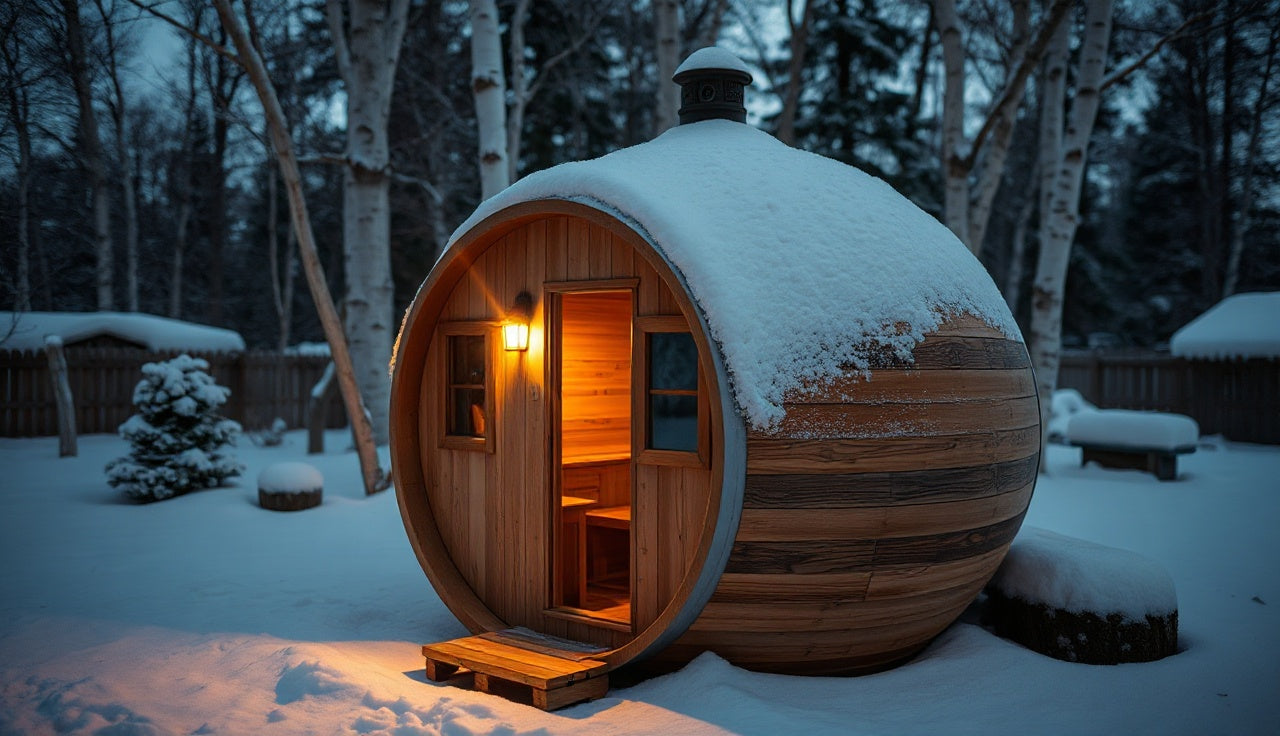
The climate makes the practical case. Winters in the UP drop below 0°F on a regular basis, and even lower Michigan sits below 20°F for long stretches. A barrel sauna half-buried in a snowdrift, throwing off 180°F of dry heat, is not a gimmick. It is a sensible answer to five months of cold and grey.
The barrel shape earns its keep beyond looks. The curved interior sets up natural convection: hot air rises through the peak, circles, and slides back down the rounded walls instead of stalling flat against a ceiling. Heat spreads more evenly than in a box sauna, and the round cross-section holds less air, so the stove hits temperature faster. If you want to climb in for 20 minutes after shoveling the driveway, that fast heat is the whole point.
Want more on how outdoor saunas hold up year-round in cold climates? That guide covers insulation and weather protection in depth.
How much does a barrel sauna cost in Michigan?
A complete, installed barrel sauna in Michigan runs $3,000 to $12,000. The range is wide because the variables are real, not padding.
| Configuration | Typical Price Range |
|---|---|
| DIY kit, 2-person, no heater | $2,800 to $4,500 |
| 4-person kit with wood-burning stove | $4,500 to $7,000 |
| 6-person kit with electric heater, delivered | $6,500 to $10,000 |
| Fully custom, contractor-installed | $9,000 to $18,000+ |
A kit covers the barrel staves, end walls, benches, door, and sometimes the heater. It does not cover delivery, foundation prep, electrical work, or permits. Add a licensed electrician for a 240V circuit (required for any electric heater) and you are usually looking at $800 to $2,000 in extra labor, depending on how far the panel sits from the sauna [2].
Wood species is the single biggest driver of kit price. Western red cedar is the common choice and costs a premium for its natural oils and dimensional stability through freeze-thaw cycles. Thermally modified Nordic spruce (sold as ThermoWood) costs a bit less and performs about the same in cold-wet conditions. Pine is the budget pick, but it resins and warps harder in Michigan humidity. Spend $5,000 on a sauna and the cedar or thermally modified wood is where that money should go.
Delivery is a real line item here. Many makers ship from the Pacific Northwest or Canadian mills, and freight to the UP can add $300 to $700 over shipping to metro Detroit. Confirm freight terms before you buy, not after.
For how home saunas price out across formats, that overview breaks down indoor versus outdoor side by side.
Do you need a permit for a barrel sauna in Michigan?
It depends on your township or city, but a few rules hold almost everywhere. Michigan building permits run at the local level under the Michigan Building Code, which adopts the International Building Code with state amendments [3]. Residential outbuildings under 200 square feet usually skip the building permit. Any new electrical circuit does not.
Most small barrel saunas clear the building-permit threshold easily. A 4-person or 6-person barrel has a footprint of 35 to 80 square feet, well under 200. Many jurisdictions still want a zoning permit or site plan review, even for a small structure. A large 8-foot-diameter, 12-foot barrel could push past the square-footage line, so check the math on the big ones.
The electrical circuit is the non-negotiable part. Michigan follows the National Electrical Code, and a 240V sauna circuit is a permitted install no matter how small the sauna is [4]. Skip this and you create insurance liability. A non-permitted 240V hookup can void your homeowner's policy if something goes wrong.
Plumbing permits only apply if you add a shower or drain to the structure. Most barrel saunas have no plumbing, so most owners never touch this.
Setbacks vary by municipality. Unincorporated UP areas often set accessory-structure setbacks at 5 to 10 feet from property lines. Suburban communities around Grand Rapids or Metro Detroit can require 15 feet or more. Call your local building department before you pour anything. The call takes ten minutes and beats moving a 900-pound barrel later.
If you belong to an HOA, its rules can be stricter than municipal code. Check both.
| DIY kit, 2-person, no heater | $3,650 |
| 4-person kit with wood stove | $5,750 |
| 6-person kit with electric heater | $8,250 |
| Fully custom, contractor-installed | $13,500 |
Source: Almost Heaven Saunas manufacturer pricing and industry estimates, 2024
What is the best wood for a barrel sauna in Michigan's climate?
Cedar and thermally modified spruce top the list, because Michigan's climate is brutal on wood. Some UP locations average 200 inches of snow a year [5], and freeze-thaw cycling runs relentless from November through March. You need wood that shrugs off moisture, dimensional stress, and UV without falling apart in a decade.
Western red cedar is the standard pick, and for good reason. Its natural thujaplicin oils fight mold and insects, and its low density keeps it from scorching skin even when the walls are screaming hot. It smells good too, which counts for something. Expect a premium of roughly 20 to 40 percent over pine.
Thermally modified spruce (ThermoWood) is a strong number two. The process heats the wood to around 392°F in a low-oxygen chamber, breaking down the hemicellulose that fungi feed on and making the wood more dimensionally stable [6]. You get a darker, denser board that holds up in wet-cold cycling, costs less than cedar, and shows up more often now from North American suppliers.
White cedar, native to Michigan, works for a locally sourced build. It is softer and lower in oil than western red cedar but still does fine outdoors. If you are building from scratch and want a local material, it is a legitimate choice.
Keep pressure-treated lumber out of the barrel entirely. The preservatives off-gas when heated, and you do not want that in your lungs.
For the exterior that faces Michigan weather, all of these do better with a penetrating oil finish applied once a year. Sikkens and similar oil-based products hold the wood's moisture content and slow the grey UV fade.
What size barrel sauna should you get?
A 6-foot diameter by 8-foot length is the practical sweet spot for most Michigan households. Barrel saunas come mainly in 5-foot and 6-foot diameters (7 feet on premium models). Length runs from about 6 feet for a solo or two-person unit up to 12 to 14 feet for a six-to-eight-person build.
That 6-by-8 fits two people on opposing benches, heats in 30 to 45 minutes with a decent electric or wood-burning stove, and ships as a kit two adults can wrestle into place. Its interior floor space runs roughly 28 square feet, well under every permit threshold I know of.
Regular family use or entertaining pushes you toward a 6x10 or 6x12. Those cost more and take a little longer to heat, but you are not folding four adults into a tube.
The changing room is the piece people forget. A real Finnish sauna session includes somewhere to undress, cool off, and dry without crossing a snowy yard in a towel. Some longer barrels include an anteroom, a short vestibule at one end with a bench and hooks. In a Michigan January, that space is worth paying for.
Wood-burning stove vs electric heater: which is better for Michigan?
Both are legitimate, and the right answer depends on how you want to live with the thing. A wood-burning sauna stove (kiuas in Finnish) gives you the traditional experience: crackling fire, the smell of burning birch or maple, and heat that many practitioners swear feels softer than electric. It also works when the power drops, which matters in rural Michigan after an ice storm. In the UP, wood-burning saunas are the norm.
The downsides are practical. You need a steady wood supply, a proper chimney with clearance from the barrel, and the discipline to start the fire 45 to 90 minutes before you climb in. Wood-burning also lands in a grey zone with municipal ordinances that restrict outdoor burning, so read your local fire code first.
An electric heater is easier to control, heats faster (20 to 40 minutes for a well-insulated barrel), and pairs with a timer or smart switch so the sauna is ready when you are. The tradeoffs are the running cost and the 240V circuit. A 6kW heater run for one hour uses about 6 kWh. At Michigan's average residential rate of roughly 17 to 18 cents per kWh [7], that is about $1 a session. Not a real concern for most budgets.
My honest take: if you have cheap wood and want the authentic Finnish experience, go wood-burning. If convenience wins, go electric. Either way, do not undersize the heater. A 6-foot diameter, 8-foot barrel holds roughly 225 cubic feet of air, and a good manufacturer will spec the kW rating to the exact barrel dimensions.
Where to buy a barrel sauna in Michigan
You have three real paths: buy a kit online and build it yourself, hire a local contractor to build one from lumber, or go through a specialty retailer who handles delivery and setup.
Kit makers who ship to Michigan include Almost Heaven, Dundalk LeisureCraft (Canada), Kirami, and several Pacific Northwest producers. Quality and price vary. Almost Heaven kits start around $3,000 to $4,000 for the smaller units and run through a wide dealer network [8]. Dundalk ships to Michigan regularly and their cedar is generally strong. For both, read the assembly instructions before you order and be honest about your own carpentry. These kits suit a capable DIYer, not a first-timer.
Local sauna builders exist in Michigan, concentrated in the UP and the Finnish-American communities around Houghton, Hancock, and Calumet. The Finnish American Heritage Center in Hancock helps connect people with local builders and enthusiasts [1]. A contractor build costs more but gets matched exactly to your property and climate.
Specialty online retailers like SweatDecks curate a selection and help match heater size to barrel volume, a step people skip that matters a lot for performance. Buying through a curated retailer means someone already vetted the build quality.
Big box stores stock barrel kits now and then, and the Costco sauna question comes up often, but the selection is seasonal and the post-purchase support is thin. Fine if the specs match your needs and you are comfortable assembling with little hand-holding.
How do you prepare a site for a barrel sauna in Michigan?
A barrel sauna does not need a poured concrete slab, which surprises most people. Most manufacturers call for a gravel pad or concrete deck blocks. A 4-inch layer of compacted gravel on a level spot handles drainage and gives a stable base.
Frost heave is the Michigan wrinkle. The frost line runs 42 inches through most of lower Michigan and deeper in the UP [9]. Pour a concrete slab and it needs footings below that line or it will shift and crack. Gravel pads and deck blocks actually do well in freeze-thaw because they are not rigid and have no footings, so they move with the ground instead of fighting it.
Want something permanent? Helical piers or post-and-beam footings below the frost line are the right call. That adds cost but buys you a level platform that holds for decades.
Site choice matters too. Point the door away from the prevailing winter wind (usually out of the northwest in Michigan). Set the barrel close enough to your electrical panel to keep the wire run cheap, but far enough from the house to clear setbacks. Leave 3 to 4 feet of clearance around the whole barrel for airflow and maintenance. If you are running a chimney for a wood stove, account for stack-height clearance from any nearby roofline.
Can you use a barrel sauna year-round in Michigan, including in January?
Yes, and January is exactly when you want it. A well-built barrel sauna with a quality heater handles a Michigan winter without complaint. The wood construction suits cold ambient air: the barrel heats from the inside out, and the cold exterior actually stabilizes the interior temperature by acting as a heat sink. Finnish sauna culture grew up in a climate not far off from the UP.
A few winter notes. Clear snow off the roof after a heavy dump. Most barrels are rated for real snow load (often 60 to 90 pounds per square foot per the manufacturer spec), but a sustained heavy wet load above that is worth managing. Keep the path to the door clear. And if you leave the sauna cold for a long winter stretch, crack the door so airflow keeps moisture from getting trapped and freezing inside.
The contrast experience in a Michigan winter is genuinely excellent. Plenty of practitioners roll in the snow between rounds, the old Finnish move, or pair the sauna with a cold plunge. Research on cold-water immersion after sauna points to benefits for cardiovascular recovery and mood, though the evidence is still building [10]. For more on that side, the cold plunge benefits guide lays out what the current studies actually show.
What are the health benefits of regular sauna use?
The strongest evidence on sauna and health comes from Finnish population studies, which makes sense given who got studied. A 2018 review in Mayo Clinic Proceedings pulled together multiple studies and found that frequent sauna use (4 to 7 times per week) was linked to a 40 percent lower risk of all-cause mortality versus once-weekly use, though the authors flagged the observational nature of the data [11].
As that review put it: "the available evidence suggests that sauna bathing has several potential health benefits," and the authors called for randomized controlled trials to pin down cause. That is honest framing. Association is not proof.
Here is what we can say with reasonable confidence. Regular sessions raise core body temperature, push heart rate into a range comparable to moderate exercise, and drive real sweating. Short-term blood pressure effects show up across multiple studies. Heat shock protein production rises with repeated heat exposure, which ties into muscle recovery [12].
The sauna benefits guide walks through the specific studies, including the limits researchers have flagged. Read it before you make a health decision off sauna marketing copy.
The conservative advice stands: sauna is not medical treatment. If you have a cardiovascular condition, talk to a physician before starting a regular routine. Pregnant women should avoid high-temperature sauna. Drink water before and after every session.
How do barrel saunas compare to other sauna types for a Michigan backyard?
The main alternatives are traditional box saunas, infrared cabins, and prefab modular units. Each has a real use case.
| Type | Heat Style | Heat-Up Time | Best For |
|---|---|---|---|
| Barrel sauna | Convection, 170-195°F | 25-45 min | Outdoor, traditional experience |
| Box/cabin sauna | Convection, 160-195°F | 30-60 min | Larger groups, indoor or outdoor |
| Infrared cabin | Radiant, 120-150°F | 10-15 min | Indoor use, lower temp preference |
| Portable sauna | Convection or steam | 15-30 min | Renters, tight budgets |
For an outdoor Michigan setup, the barrel sits in a good spot. It heats faster than a box sauna of the same volume because there is less air to warm. It ships as a kit more easily than a modular cabin. And it looks right in a snow-covered backyard in a way a plastic infrared box never will.
Infrared saunas are the wrong tool for outdoor Michigan. Their electronics and wood-and-glass construction are not built for freeze-thaw or humidity cycling. They belong indoors.
A portable sauna is worth a mention for renters or anyone who cannot make a permanent install. It does not match a barrel on performance, but it works and costs a fraction of the price.
Still weighing formats? The sauna vs steam room comparison covers how the two experiences differ physiologically.
What maintenance does a barrel sauna need in Michigan?
Low-maintenance, not zero-maintenance, and Michigan raises the bar a little. Once a year, check the barrel bands (the metal hoops holding the staves together) for rust or slack and tighten as needed. Oil any exposed exterior wood with a penetrating exterior oil. Check the door seal and hinges. If you run a wood stove, inspect and clean the flue before burn season.
After every session, leave the door open for 15 to 20 minutes so moisture can escape. This one habit does more to extend interior wood life than anything else. A barrel that stays damp grows mildew on the benches and lower staves.
Interior wood gets no oil, no paint, no sealer. The heat and humidity cycle is how it seasons. A light sanding of the benches with 150 grit now and then, plus a wipe with a damp cloth, is the whole interior routine.
Cracked staves usually come from rapid moisture swings. Regular use keeps the wood conditioned, so a sauna that runs year-round cracks less than one that hibernates all summer and gets fired up cold every October.
For electric heaters, check the element and rocks every year or two. Sauna rocks break down under repeated thermal cycling and should be swapped every 3 to 5 years depending on how hard you use it.
Frequently asked questions
Do I need a permit to install a barrel sauna in Michigan?
Building permits for small outbuildings (under 200 sq ft) are often not required in Michigan, but local rules vary by township or city. Electrical permits are always required for any 240V sauna heater circuit under the Michigan Electrical Code. Check with your local building department before you start. HOA rules may add restrictions beyond municipal code.
How much does it cost to run a barrel sauna in Michigan each month?
An electric sauna heater running at 6kW for one hour uses about 6 kWh. At Michigan's average residential rate of roughly 17 to 18 cents per kWh, that is about $1 per session. If you use the sauna 20 times per month, expect $20 to $25 in added electricity costs. Wood-burning stoves cost whatever firewood costs locally, typically $150 to $250 per cord in Michigan.
Can a barrel sauna survive a Michigan winter outside?
Yes. Cedar and thermally modified wood barrel saunas handle Michigan winters well. The barrel design sheds snow naturally, and most units are rated for significant snow load. Use the sauna regularly through winter to keep the wood conditioned, clear heavy snow off the roof, and leave the door slightly cracked when the sauna sits unused for long stretches to prevent trapped moisture.
How long does it take to assemble a barrel sauna kit?
Most 2-person to 4-person barrel sauna kits take two adults 6 to 10 hours to assemble on a prepared level surface. Larger 6-person kits can take 12 to 16 hours. You need basic carpentry tools: a drill, level, rubber mallet, and the hardware in the kit. Instructions vary by manufacturer; Dundalk and Almost Heaven both have decent assembly guides.
What foundation does a barrel sauna need in Michigan?
A compacted gravel pad 4 inches deep is the most common and practical choice. It handles drainage and allows for some frost movement. Concrete slabs require footings below Michigan's 42-inch frost line in most of the lower peninsula, or they will shift. Concrete deck blocks and gravel work well for most residential barrel sauna installations.
Is cedar or thermally modified spruce better for Michigan?
Both hold up well in Michigan's freeze-thaw climate. Western red cedar has natural oils that resist mold and insects and is the traditional choice. Thermally modified spruce (ThermoWood) is more dimensionally stable and slightly cheaper. If budget allows, cedar is the classic pick. If you want to save 15 to 25 percent without losing much performance, thermally modified spruce is a solid option.
Where is sauna culture strongest in Michigan?
The Upper Peninsula, especially the Keweenaw Peninsula communities of Houghton, Hancock, and Calumet, has the deepest sauna culture in the state. Finnish immigrants built saunas before houses in some towns. The Finnish American Heritage Center in Hancock is an active resource for sauna history and community events. The UP is estimated to have roughly one sauna for every three households.
How does a barrel sauna compare to an infrared sauna for outdoor use in Michigan?
For outdoor Michigan installation, a barrel sauna wins easily. Infrared saunas are built for indoor use. Their electronics and glass construction do not handle freeze-thaw cycling, humidity, or snow well. Barrel saunas with traditional convection heat (wood or electric) are purpose-built for outdoor exposure and run safely in sub-zero ambient temperatures.
What size barrel sauna fits two people comfortably?
A 5-foot diameter by 6-foot or 7-foot-long barrel works for two but runs tight. A 6-foot diameter by 8-foot-long barrel gives two adults comfortable bench space plus room for a small heater. For three or four people on a regular basis, move to the 6x10 or 6x12. Interior bench depth of at least 18 to 20 inches matters if you want to lie down.
Can I pair a barrel sauna with a cold plunge in Michigan?
Yes, and it is a natural pairing. Many Michigan sauna owners roll in snow between rounds, but a dedicated cold plunge tub gives you more controlled temperature and year-round use. Research on contrast therapy (alternating heat and cold immersion) points to possible benefits for cardiovascular function and recovery, though large randomized trials are still limited. The cold plunge benefits guide covers the current evidence.
Do barrel saunas increase home value in Michigan?
No published appraisal data covers Michigan or barrel saunas specifically, so treat any exact percentage claim with skepticism. Anecdotally, outdoor saunas read positively in Michigan listings, especially in the UP. A permanent, well-built sauna on a proper foundation is more likely to add value than a kit sauna sitting on gravel. Consult a local appraiser if this matters to your decision.
How hot does a barrel sauna get, and how long should sessions last?
Traditional Finnish sauna temperatures run 170 to 195°F (77 to 90°C) at bench level. Most people start with 10 to 15 minute rounds, step out to cool down, and repeat 2 to 3 times. Beginners should start shorter and cooler. Stay hydrated before and after. People with cardiovascular conditions should get medical clearance before regular high-temperature sauna use.
What is the best barrel sauna brand available in Michigan?
Almost Heaven and Dundalk LeisureCraft are two of the most widely available brands shipping to Michigan, with consistent quality at mid-range prices. Kirami is a Finnish brand with premium construction. For locally built custom saunas, finding a UP craftsman through the Finnish American Heritage Center network is worth the effort. No single brand is objectively best; match the brand to your budget and support needs.
What are Michigan's setback requirements for a backyard sauna?
Setback requirements are set locally, not statewide. Rural UP townships often require 5 to 10 feet from property lines for accessory structures. Suburban Michigan communities can require 15 feet or more. Always call your local building or zoning department before installing. Getting this wrong can mean moving a 900-pound barrel, which is a bad afternoon.
Sources
- U.S. Bureau of Labor Statistics, Occupational Outlook Handbook: Electricians: Electrician labor rates used to estimate 240V circuit installation costs of $800 to $2,000
- Michigan Department of Licensing and Regulatory Affairs, Bureau of Construction Codes: Michigan adopts the International Building Code with state amendments and administers permits at the local level
- National Fire Protection Association, NFPA 70 (National Electrical Code): Any new 240V electrical circuit installation requires a permit under the National Electrical Code, which Michigan adopts
- NOAA National Centers for Environmental Information, Michigan Climate Summary: Some Upper Peninsula locations average over 200 inches of annual snowfall, creating significant freeze-thaw stress on outdoor structures
- USDA Forest Service, Forest Products Laboratory: Thermal Modification of Wood: Thermal modification at around 392°F in low-oxygen environments breaks down hemicellulose, improving wood resistance to fungi and dimensional stability
- U.S. Energy Information Administration, Electric Power Monthly: Michigan Average Retail Price: Michigan average residential electricity rate is approximately 17 to 18 cents per kWh
- Almost Heaven Saunas, manufacturer product listings: Almost Heaven barrel sauna kits start around $3,000 to $4,000 for smaller units and are available through a wide dealer network
- Michigan Department of Transportation, Frost Depth Maps: Michigan's frost line is 42 inches in most of the lower peninsula and deeper in the Upper Peninsula, relevant to foundation design
- PubMed Central, National Library of Medicine: Cold water immersion and recovery: Research on cold-water immersion after sauna suggests potential benefits to cardiovascular recovery and mood, though the evidence base is still developing
- Mayo Clinic Proceedings, 2018: Cardiovascular and Other Health Benefits of Sauna Bathing: Frequent sauna use 4 to 7 times per week was associated with 40 percent lower risk of all-cause mortality vs once-weekly use; authors noted observational data and stated 'the available evidence suggests that sauna bathing has several potential health benefits'
- Journal of Science and Medicine in Sport: Heat shock proteins and exercise recovery: Heat shock protein production increases with repeated heat exposure, relevant to muscle recovery mechanisms

Share:
How to buy a barrel sauna: what actually matters
Barrel sauna reviews: what buyers actually experience