
Last updated 2026-07-09
TL;DR
Barrel saunas run $1,500 to $8,000+ depending on size, wood species, and whether a heater is included. Buyers report faster warm-up than box cabins (30 to 45 minutes to 160-185°F) and even heat, but the quality gap between budget and mid-range units is wide. Assembly takes 4 to 8 hours for two people. Cedar and Nordic spruce beat hemlock outdoors.
What is a barrel sauna and how does it actually heat?
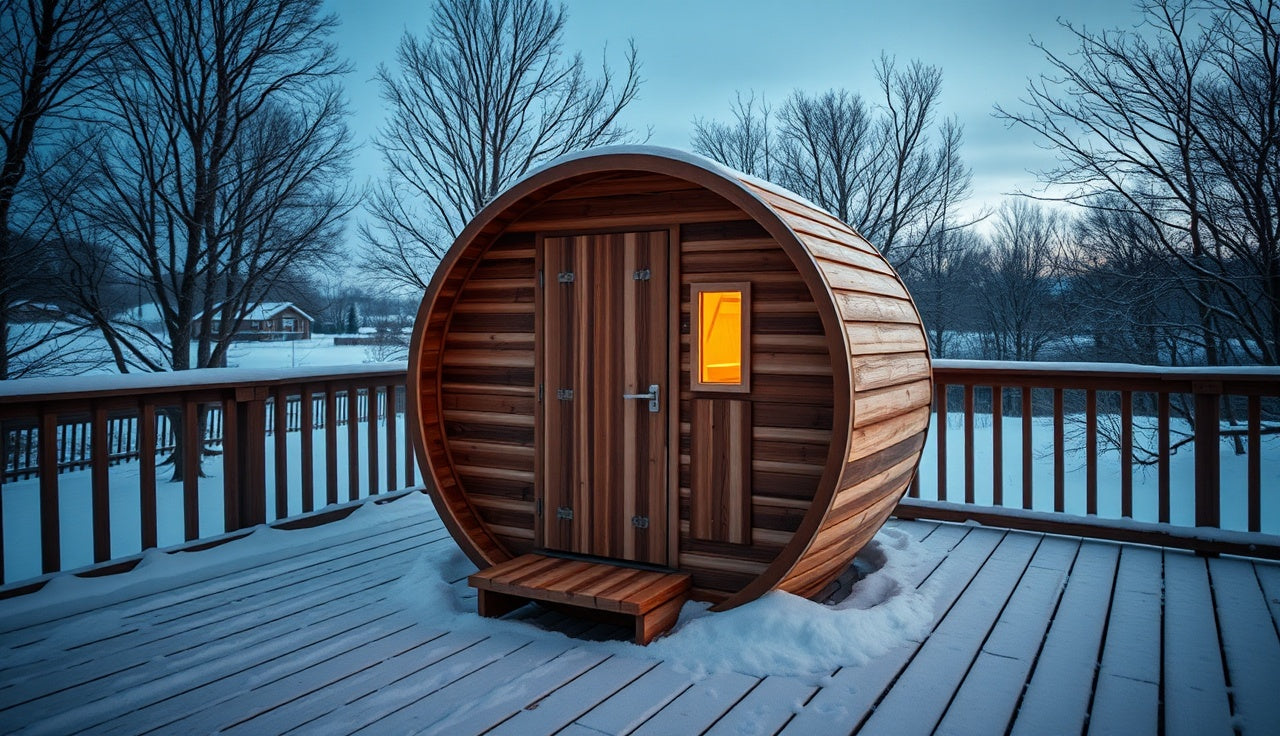
A barrel sauna is a cylindrical wood room built from stave-and-hoop construction, the same joinery used in wine barrels. The curved shape does real work. Heat rises to the apex of the cylinder and rolls back down along the walls, so the hot zone at bench height stays more even than in a box-shaped room. You get fewer cold floor drafts and a faster climb to temperature.
Most barrel saunas seat 2 to 6 people depending on diameter (common interior diameters are 4, 5, and 6 feet) and length (6 to 8 feet for a two-person unit, 8 to 10 feet for four-plus). The heater sits at one end, either a wood-burning stove or an electric unit. Electric heaters in the 6 to 9 kW range are what most backyard buyers install, because running a dedicated 240V circuit is simpler than dealing with chimney clearance and local burn ordinances.
The cylinder does one more useful thing. It cuts dead air volume. A 6-foot-diameter, 8-foot-long barrel holds roughly 155 cubic feet of interior air. A comparably seated rectangular cabin holds 200 to 240 cubic feet. Less air to heat means you hit 160 to 185°F in 30 to 45 minutes instead of 60 to 90 minutes, and that gap shows up again and again in buyer accounts.
Before you commit, it helps to read about the broader category first: how barrel saunas fit against traditional home sauna designs and other outdoor sauna formats.
What do barrel sauna reviews say about heat performance and comfort?
Heat is where barrel saunas earn their reputation, and where the category splits into acceptable and excellent. Buyers who spent $2,500 or more on cedar or Nordic spruce units report even bench-to-ceiling temperature, quick steam response when water hits the rocks, and no meaningful cold spots after 20 minutes of warm-up. Buyers who went under $2,000, especially on hemlock or pine with thin staves, report uneven heating, condensation on the interior walls, and heaters that cannot hold temperature in winter.
Wood species matters more than most buyers expect going in. Western red cedar resists moisture and insects naturally, has low density that speeds heat absorption, and carries the scent most people associate with sauna. Nordic spruce (common in Finnish-made units) is denser, holds its shape over years of thermal cycling, and is the standard in Scandinavia where outdoor saunas take genuinely harsh winters [1]. Hemlock is cheaper and fine indoors, but it swells and cracks faster outdoors under freeze-thaw.
One finding shows up in nearly every buyer account: bench width matters as much as the heater. Benches 18 inches or wider let you lie down, which changes the whole session. Narrow 12- to 14-inch benches, common in budget kits, get tiring after 20 minutes.
See sauna benefits for what the research says about regular heat exposure. Those comfort variables decide whether you actually use the thing.
How much do barrel saunas cost, and what does each price tier get you?
"Barrel sauna" can mean a $1,500 direct-import kit or a $7,000+ assembled unit from a Finnish maker. Here is what each tier actually includes:
| Price range | What you typically get |
|---|---|
| $1,500 to $2,500 | Hemlock or pine staves, basic 4.5 to 6 kW electric heater, 2-person capacity, thin walls (1.5 in), no floor |
| $2,500 to $4,000 | Cedar or spruce staves, 6 to 9 kW heater, 2-4 person, thicker walls (1.75 to 2 in), floor included, basic hardware |
| $4,000 to $6,000 | Premium cedar or Finnish spruce, 6-9 kW quality heater (Harvia, Tylö, or equivalent), 4-person, tempered glass door, porch add-on option |
| $6,000+ | Custom sizes, premium Finnish or Canadian manufacture, stainless hardware throughout, heater included, 5+ year warranty, sometimes white-glove delivery |
These ranges reflect a mid-2025 market survey of kits shipped to the continental U.S. Canadian cedar units often add $200 to $600 in freight depending on distance. If you hire out installation, electricians typically charge $300 to $800 to run a dedicated 240V, 40-amp circuit, which most 6 to 9 kW heaters require [2].
The most common low-end regret is simple: buying a 2-person unit and wishing for 4-person capacity. You cannot expand a barrel. Upgrading later means buying an entirely new one. If there is any chance you will use it with family or guests, buy one size up from your minimum.
For how these prices stack against other home heat therapy options, the Costco sauna breakdown covers a popular entry-level alternative.
| Budget (hemlock/pine, 2-person) | $2,000 |
| Mid-range (cedar/spruce, 2-4 person) | $3,200 |
| Premium (cedar/spruce + glass door, 4-person) | $5,000 |
| High-end (Finnish/Canadian, 4-6 person) | $7,500 |
Source: Market survey of U.S. barrel sauna retailers, 2025
How hard is barrel sauna assembly, and what can go wrong?
Most kits ship pre-cut and numbered, and makers advertise 4 to 8 hours for two people. That estimate is honest if you are comfortable with basic tools (rubber mallet, level, drill, socket set) and have a flat, prepared surface ready. It stretches to 10 to 12 hours for first-timers, people working alone, or kits with instructions translated poorly from Korean or Chinese.
The assembly problems buyers report most:
1. Staves not fitting tight because of shipping damage or warping. Premium makers pre-dry wood to 8 to 12% moisture content. Budget brands sometimes ship wetter wood that swells unevenly after a few seasons. 2. Hardware that strips easily, especially the stainless banding screws on low-cost units. 3. Missing or mislabeled parts, more common with direct-import brands that have no domestic support line. 4. Electrical: buyers who did not pre-plan the 240V circuit location end up with a cord that barely reaches, or have to move the whole unit after assembly.
The foundation matters a lot. Barrel saunas sit on two curved cradle rails and must be level to within about a quarter-inch or the door will not seal. A gravel pad, concrete blocks, or a pressure-treated lumber frame all work. A deck works if it is rated for the weight, which runs 600 to 1,200 pounds fully assembled depending on size [3].
Not handy? Hiring a local contractor to do the assembly for $300 to $700 is reasonable, and it heads off the frustrating outcome where the unit leaks or the door gaps because leveling was off.
Which barrel sauna brands have the strongest reviews?
No single third-party ratings database covers barrel saunas the way Consumer Reports covers appliances. What exists is aggregated buyer feedback across retailer sites and enthusiast forums (the r/sauna community on Reddit is unusually rigorous). The brands that keep showing up in positive discussions:
Harvia (Finland): Known mostly for heaters, but it also makes barrel units. Harvia heaters ship inside many premium kit brands and have a strong service history. The company has built sauna equipment since 1950 [4].
Dundalk LeisureCraft (Canada): The Canadian Timber series is probably the most-reviewed Canadian-made cedar barrel line in North America. Buyers call out tight stave fit, real cedar scent, and solid hardware.
Aleko: A value brand with mixed reviews. Acceptable in the $2,000 to $2,500 range, but not durable outdoors past the 3-year mark without annual treatment.
Almost Heaven (West Virginia) and SaunaLife are the mid-market names most commonly bought through U.S. retailers. Almost Heaven gets strong marks for customer service and warranty response. SaunaLife (U.S.-distributed, Finnish-designed) sits at the higher mid-range and earns good reviews on build quality.
Approach these carefully: any barrel sauna sold without a named heater manufacturer, without an explicit wood species, and without a returnable warranty. Several Amazon and Walmart direct-import brands in the $1,200 to $1,800 range draw steady complaints about stave warping after one winter and heaters that fail inside 18 months.
SweatDecks carries a selection of barrel saunas where wood species and heater brand are verified before listing. That matters when you cannot inspect the unit before you buy.
What wood is best for an outdoor barrel sauna, and does it really matter?
Yes, it matters. Wood is the single most underrated variable in barrel sauna buying.
Western red cedar is the standard for outdoor use in North America. It contains natural oils (thujaplicins) that resist fungal decay without chemical treatment, and its low density (about 23 lb/ft³) lets it absorb and release heat quickly without burning skin on contact. If sustainable sourcing matters to you, check for Forest Stewardship Council (FSC) certification, which covers responsibly harvested cedar [5].
Nordic white spruce (Picea abies) is what most Finnish-made saunas use. It is denser than cedar, holds dimensional stability through repeated heat cycling, and handles cold well. It lacks cedar's natural decay resistance, so outdoor spruce barrels need more consistent maintenance (annual wood treatment) in wet climates.
Thermally modified wood (thermowood) is worth understanding. It is spruce or pine heat-treated at 185 to 215°C in an oxygen-free environment, which permanently alters the cell structure. That cuts moisture absorption by 40 to 50% versus untreated wood and improves dimensional stability [6]. Thermowood barrels cost more but hold up better in humid coastal or rainy climates and ask for less maintenance.
Hemlock is fine indoors. Outdoors it starts checking (surface cracks) within two to three seasons if untreated, and it has none of cedar's resistance to insects or moisture.
Pine is the lowest-quality common choice for an outdoor barrel. Budget brands use it because it is cheap. It has no protective oils, drinks moisture, and can grow mold on the interior if the sauna is not ventilated and dried between uses.
How do barrel saunas compare to traditional box saunas for home use?
This comes up constantly and deserves a straight answer instead of a both-are-great dodge. Barrel saunas win on outdoor looks, faster heat-up, and easier assembly with no foundation slab required. Box saunas win on usable bench capacity for a given footprint, customizability, and interior headroom.
| Factor | Barrel sauna | Box/cabin sauna |
|---|---|---|
| Heat-up time | 30-45 min typical | 45-90 min typical |
| Bench space (4-person) | Limited by curved floor | More usable flat floor |
| Outdoor appearance | Better, more compact | Requires more planning |
| Assembly | Kit, 4-8 hours | Heavier kit or pre-built |
| Interior height | 5.5 to 6.5 ft at apex | 6.5 to 7 ft flat ceiling |
| Maintenance | Annual wood treatment | Same |
| Price (4-person) | $3,000 to $6,000 | $3,500 to $7,000+ |
If you want daily use with several guests, a box sauna with a full bench layout often makes more practical sense. If you have a small yard, a garden corner, or a strong preference for the rounded look, a barrel is genuinely the better call.
Still deciding on the broad category? The sauna vs steam room comparison is worth reading.
One honest caveat: the heat-up advantage shrinks in very cold weather. Below 0°F, the extra thermal mass of a well-insulated rectangular cabin can outperform a thinner-walled barrel. Budget barrels with 1.5-inch staves are the most exposed to this in northern climates.
What are the real safety and electrical requirements for a barrel sauna?
Electrical is where buyers cut corners most, and where cutting corners has real consequences.
Most 6 to 9 kW electric heaters need a dedicated 240V, 40-amp circuit with a GFCI breaker. The National Electrical Code (NEC) Article 424 covers fixed electric space heating equipment, and many jurisdictions apply similar rules to sauna heaters. The NEC is adopted by most states, though local amendments exist [7]. GFCI protection on outdoor circuits near water is not optional in most code interpretations, and the CPSC backs GFCI protection on all wet or outdoor circuits [12]. Treat it as non-negotiable.
For placement, the International Residential Code (IRC) Section R302 addresses fire separation from property lines, but specific setbacks are handled locally. Most jurisdictions treat a detached outdoor sauna as an accessory structure, so setback rules (often 5 to 10 feet from property lines and 6 feet from the main dwelling) apply. Check with your building department before you site the unit [8].
Heater guards are required by most heater makers and by common sense. The rocks and heater surface pass 200°F. The Finnish safety standard SFS-EN 60335-2-53 covers sauna heaters and requires a protective guard if any part of the heater is reachable from the bench [4].
Ventilation: a barrel sauna needs a fresh air intake (a vent near the floor, opposite the heater) and an exhaust vent near the ceiling. Without fresh air, carbon dioxide builds up during long sessions. Most makers pre-install these vents. Confirm yours does before buying.
For wood-burning barrels, chimney clearance to combustibles follows the appliance maker's specs and local fire code, typically 2 inches to combustibles for double-wall stovepipe. Burn bans and HOA rules also apply.
How long do barrel saunas last, and what maintenance do they need?
A well-built cedar or spruce barrel, maintained properly, should last 15 to 25 years outdoors. Budget hemlock or pine units in exposed climates realistically last 5 to 10 years before stave cracking, banding corrosion, or floor rot become serious.
The maintenance rhythm is simple.
Annually: Apply an exterior wood treatment to the outer staves. A penetrating oil (teak oil, linseed oil, or a dedicated sauna exterior product) keeps the wood from checking and graying. Budget about an hour and $30 to $60 in product.
Seasonally, or after heavy rain: Check the metal banding for rust. Stainless banding on quality units holds for years. Galvanized banding on budget units starts rusting at contact points within two to three seasons. Tighten any loose bands.
After each use: Leave the door slightly open to let the interior dry. Moisture trapped inside between uses speeds mold growth on the bench surfaces. Never put exterior sealants or varnishes on the interior. They release fumes when heated and are not safe [9].
Every 2 to 3 years: Sand the bench surfaces lightly with 120-grit paper to remove gray oxidation and surface splinters. Do not apply any finish to the interior bench.
Heater maintenance: follow the maker's schedule for checking the element, replacing sauna stones (every 3 to 5 years for frequently used units), and inspecting the thermostat and control unit.
One practical note for snow country: clear heavy snow off the top of the barrel. The curved shape sheds light snow, but heavy accumulation piles on hundreds of pounds the cradles were never designed to carry.
Can you use a barrel sauna with cold plunge contrast therapy?
You can, and plenty of buyers set up a barrel specifically for it. Heat exposure followed by cold immersion is a contrast therapy protocol with a growing research base. A 2021 study in the journal Temperature found alternating heat and cold produced greater cardiovascular response and subjective recovery scores than either alone, though the authors flagged that the evidence base is still maturing [10].
For a home setup, the usual layout is a barrel sauna on a patio or deck with a cold plunge tub, chest freezer conversion, or purpose-built cold plunge unit within 10 to 20 feet. Proximity matters. The cold hits best in the 10 to 30 minutes after you exit the heat, and walking a long, cold distance while sweating is miserable in most climates.
The protocol referenced most in research: 10 to 20 minutes in the sauna at 160 to 185°F, then 1 to 5 minutes in cold water (50 to 59°F is the range used in most studies), repeated 2 to 3 rounds with rest between. Nobody has nailed down the optimal durations. The closest systematic review, Versey et al. (2013) in Sports Medicine, found water immersion below 15°C effective for recovery but noted big protocol variation across studies [11].
Building a contrast station at home? The ice bath guide covers the cold side, including target temperature ranges and which containers work for a backyard install.
SweatDecks pairs barrel saunas with cold plunge options for buyers setting up full contrast stations at home.
What should you check before buying a barrel sauna online?
Buying online means you cannot touch the wood or test the heater, so you are leaning entirely on the seller's info and on reviews that reflect real long-term use. Here is what actually matters to verify:
Wood species: Must be stated by name. "Natural wood" or "premium wood" means nothing. Ask for cedar, spruce, or thermally modified wood explicitly.
Stave thickness: 1.75 inches minimum for outdoor use, 2 inches is better in cold climates. Thinner staves are cheaper and lose heat faster.
Heater brand: Named manufacturer (Harvia, Tylö, HUUM, Narvi, Sawo) or a generic unit? Named brands have replacement parts, warranty support, and safety certifications (CE, ETL, or UL listing). Generic heaters sometimes ship without UL or ETL listing, which matters for insurance and safety.
Warranty terms: What is covered, and for how long? Structural warranty on the wood frame should be at least 2 to 3 years. Heater warranty should be at least 1 year on parts.
Delivery: Is the freight quote in the listing, or does it appear after checkout? Barrel saunas ship freight (LTL), not UPS. Freight surprises of $300 to $500 are common on listings advertising a low base price.
Return policy: Most sellers do not accept returns on assembled or installed units. Know this before you buy.
Permits: Ask the seller whether their unit triggers a building permit in your area. Most outdoor accessory structures under 200 square feet do not, but add a covered porch and you may cross a threshold that requires one [8].
To compare the barrel format against other outdoor sauna formats before you finalize, the full format breakdown helps.
Frequently asked questions
Are barrel saunas worth the money compared to a regular sauna kit?
For outdoor use, yes, if you value the look, faster heat-up, and simpler assembly. Barrel saunas typically reach temperature 15 to 30 minutes faster than comparably sized box saunas because of lower air volume. Where they lose is bench capacity and headroom. At the same price, a good barrel and a good cabin deliver similar heat quality, so the deciding factors are your space and how many people you will regularly have inside.
How long does it take to assemble a barrel sauna?
Plan for 4 to 8 hours with two people for a standard 6 to 8 foot unit. Buyers working alone or fighting poorly translated instructions commonly report 10 to 12 hours. You need a level, prepared surface before you start. The slowest steps are leveling the cradle rails precisely and running the electrical connection, which requires a licensed electrician in most jurisdictions for the 240V circuit.
What size barrel sauna do I need for two people?
A 4-foot interior diameter, 6-foot length barrel comfortably fits two people sitting. If you want to lie down on the bench (most regular users eventually do), step up to an 8-foot length. For occasional use with three to four people, a 5-foot diameter, 8-foot length is the minimum that does not feel cramped. The regret buyers mention most: buying smaller to save money and wishing they had sized up.
Can a barrel sauna stay outside year-round?
Yes. Cedar and Nordic spruce barrel saunas are built for year-round outdoor use. The curved shape sheds rain and moderate snow. In heavy snowfall areas, clear accumulation off the top. In freezing climates, drain any water from the floor drain and leave the door slightly ajar when not in use to prevent moisture buildup. Annual exterior wood treatment keeps the staves from checking and graying in sun and rain.
Do barrel saunas need a building permit?
Most jurisdictions classify a detached outdoor barrel sauna as an accessory structure, and structures under 200 square feet often need no permit, but local rules vary a lot. Adding a covered porch, connecting to utilities, or exceeding your local accessory-structure size limit typically triggers a permit. Check with your building department before siting and installing. The International Residential Code Section R302 covers accessory structures, but local amendments govern in practice.
What is the best wood for a barrel sauna?
Western red cedar is the best choice for outdoor barrel saunas in North America: natural decay resistance, low density, fast heat absorption, and a pleasant scent. Nordic white spruce is the traditional Finnish choice, dense and dimensionally stable but needing more exterior maintenance in wet climates. Thermally modified wood (thermowood) is the best pick for high-humidity or coastal environments. Avoid pine or hemlock outdoors; both break down faster without cedar's natural oils.
How do I maintain a barrel sauna?
Apply an exterior penetrating wood oil once a year. Leave the door cracked after each use to dry the interior. Check metal banding for rust seasonally and tighten loose bands. Sand bench surfaces every two to three years to remove oxidation. Never use sealants or varnishes on the interior; they release fumes when heated. Replace sauna rocks every three to five years with regular use. An annual heater inspection is good practice.
What heater should I get for a barrel sauna?
Size the heater to the interior volume: roughly 1 kW per 45 cubic feet is a common rule of thumb, though maker specs vary. For a typical 4-person barrel, a 6 to 9 kW electric heater works well. For brands, Harvia, HUUM, and Tylö are the most reviewed and have documented warranty support. Avoid generic, unbranded heaters without UL or ETL listing. Wood-burning stoves are an option but require chimney clearance compliance and a local burn ordinance review.
Can you use a barrel sauna in cold weather?
Yes. Quality cedar or spruce barrels with 1.75- to 2-inch staves hold heat reasonably well down to 0°F, though heat-up time increases and you burn more electricity to maintain temperature. Thin-walled budget barrels (1.5-inch staves) struggle a lot below 20°F. In extreme cold, some buyers drape a reflective radiant barrier blanket over the exterior during heating. It is not elegant, but it measurably cuts heat loss.
Is a barrel sauna good for contrast therapy with cold plunge?
It is well-suited for it. Fast heat-up means you can cycle between hot and cold without long waits. A typical contrast protocol runs 10 to 20 minutes in the sauna, then 1 to 5 minutes in water below 59°F, repeated two to three times. Research on contrast therapy shows cardiovascular and recovery benefits, though optimal durations are still being studied. Placing a cold plunge within 20 feet of your barrel makes cycling practical.
What are common complaints about barrel saunas?
The most frequent ones: staves that warp or crack after one to two seasons on budget units (thin wood, wrong moisture content at manufacturing), heaters that underperform in cold climates, limited bench space versus box saunas, curved floors making seating less flexible, and assembly documentation that is poorly translated or incomplete. Electrical planning is a common afterthought too. Buyers who did not pre-run a 240V circuit often have to move the unit or extend cords unsafely.
How do barrel saunas compare to portable saunas?
They target different use cases. Barrel saunas are permanent outdoor structures that deliver a real traditional experience at 160 to 185°F. Portable saunas are fabric enclosures that reach lower temperatures (120 to 140°F typically) and mostly produce sweat rather than true heat immersion. For genuine sauna benefits, a barrel is not comparable to a portable tent. Portable units work for travel or very small spaces. See the portable sauna guide for a full breakdown.
What is the average lifespan of a barrel sauna?
A cedar or Nordic spruce barrel with annual maintenance typically lasts 15 to 25 years outdoors. Budget hemlock or pine units in wet or cold climates realistically last 5 to 10 years before structural deterioration. The heater usually outlasts the wood structure with routine care; elements and control units can be replaced independently. Stainless hardware is the other long-term differentiator; galvanized banding begins rusting within a few seasons on lower-cost units.
Do barrel saunas hold their resale value?
Better than most backyard additions, especially cedar units from recognized brands in good condition. The resale market for outdoor saunas is active, and a well-maintained 4 to 6 person cedar barrel typically resells at 40 to 60% of original retail within its first five years. Disassembly and transport is labor-intensive, which limits the buyer pool but also means serious buyers pay fairly. Budget brands with unknown wood species are much harder to resell.
Sources
- University of Eastern Finland, Faculty of Health Sciences, publications on Finnish sauna culture and construction: Nordic spruce (Picea abies) is the primary structural wood used in traditional Finnish outdoor saunas, chosen for dimensional stability through repeated thermal cycling in cold climates
- U.S. Bureau of Labor Statistics, Occupational Employment and Wages for Electricians: Electrician labor costs in the U.S. support the $300 to $800 range for running a dedicated 240V circuit for a sauna heater installation
- American Wood Council, Residential Deck Construction Guide: Structural load ratings for residential decks and accessory structure foundations must account for dead loads including assembled sauna weights of 600 to 1,200 pounds
- Harvia Group, company history and product safety documentation: Harvia has manufactured sauna heating equipment since 1950 and requires heater guards when any heater surface is accessible from the bench per their installation documentation
- Forest Stewardship Council, FSC Certification Overview: FSC certification covers sustainably harvested Western red cedar and other sauna construction woods; buyers can verify certification status through the FSC database
- USDA Forest Service, Forest Products Laboratory, Thermal Modification of Wood: Thermal modification of wood at 185 to 215°C in oxygen-free conditions reduces equilibrium moisture content by 40 to 50% compared to untreated wood and improves dimensional stability
- National Fire Protection Association, National Electrical Code (NEC) Article 424: NEC Article 424 governs fixed electric space heating equipment including sauna heaters; most heaters above 5 kW require a dedicated 240V circuit with GFCI protection
- International Code Council, International Residential Code Section R302: IRC Section R302 addresses accessory structures and fire separation; most jurisdictions treat outdoor saunas as detached accessory structures subject to local setback rules, typically 5 to 10 feet from property lines
- Finnish Sauna Society, sauna construction and maintenance guidelines: Interior sauna surfaces should not be treated with varnishes or sealants as these release volatile organic compounds when heated, which is a safety hazard in enclosed sauna spaces
- Temperature (Taylor and Francis), 2021, contrast therapy cardiovascular response study: A 2021 study published in Temperature found alternating heat and cold exposure produced greater cardiovascular response and subjective recovery scores than either modality alone, with authors noting the evidence base is still maturing
- Sports Medicine, Versey et al. 2013, water immersion recovery systematic review: Versey et al. (2013) in Sports Medicine found cold water immersion below 15°C was effective for post-exercise recovery but noted significant variation in protocol durations across reviewed studies
- U.S. Consumer Product Safety Commission, outdoor structure electrical safety guidance: CPSC guidance on outdoor electrical installations supports the requirement for GFCI protection on all circuits in wet or outdoor locations including sauna installations

Share:
How to buy a barrel sauna: what actually matters
Barrel sauna in Michigan: what to know before you buy