
Last updated 2026-07-09
TL;DR
A two-person cold plunge tub is any vessel sized roughly 60 to 80 inches long and 28 to 36 inches wide that lets two adults cold-soak at the same time. Prices run from about $1,500 for a DIY chest-freezer build to $30,000 for an insulated, chiller-equipped outdoor unit. Chiller quality, insulation, filtration, and interior finish are what separate a cheap tub from a good one.
What counts as a 2-person cold plunge tub?
There's no industry-standard definition, so manufacturers put "2-person" on anything wide enough to hold two seated adults shoulder-to-shoulder. In practice you need interior dimensions of at least 60 inches long and 28 inches wide to give two average-sized adults a soak that isn't miserable. Depth matters too. Twenty-four inches of water is the minimum to cover the shoulders while seated. Anything shallower forces one person to prop their legs up at an angle, which defeats the point.
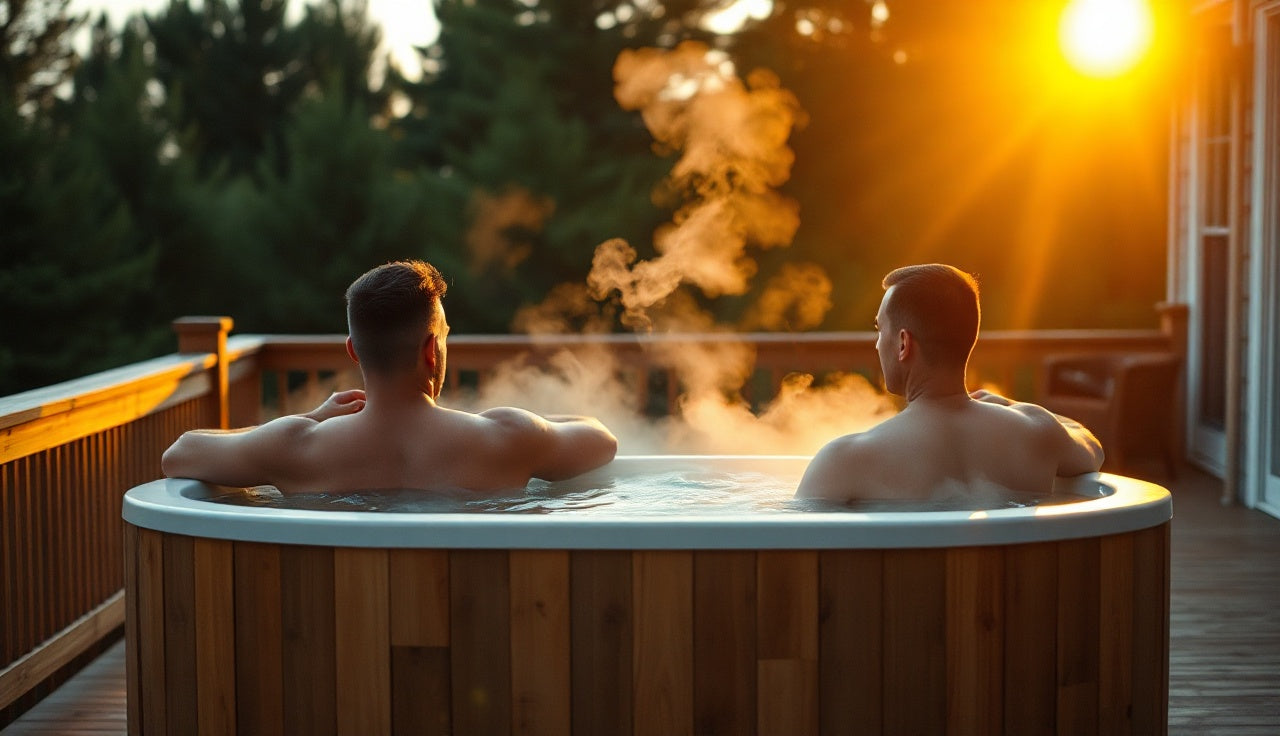
The form factor varies a lot. Some two-person units look like elongated stock tanks. Others look like small hot tubs running cold. A few are purpose-built fiberglass shells with bench seating. Each shape carries tradeoffs in installation, insulation, and price.
How much does a 2-person cold plunge tub cost?
Two-person cold plunge tubs cost anywhere from about $400 for a DIY chest-freezer build to $35,000 for a bespoke unit. The chiller is where most of the money goes, and whether you have one is the single biggest line on the price sheet.
| Category | Typical price range | What you get |
|---|---|---|
| DIY chest freezer conversion | $400 to $1,500 | Freezer + pump + basic filter, no insulated shell |
| Entry-level manufactured tub | $1,500 to $4,000 | Rotomolded or acrylic shell, no active chiller |
| Mid-range with chiller | $4,000 to $10,000 | Dedicated chiller (1/3 to 1 HP), insulated shell, filtration |
| Premium outdoor unit | $10,000 to $20,000 | Commercial chiller, UV/ozone sanitation, cedar or stainless shell |
| High-end bespoke | $20,000 to $35,000+ | Custom fabrication, full spa-grade filtration, smart controls |
A refrigeration unit that can drop 200-plus gallons to 39°F and hold it there costs $2,000 to $6,000 on its own, before housing or filtration [1]. Entry-level units without a chiller lean on ice, which adds $10 to $25 per session depending on local ice prices and how often you refill.
Run the ice math before you buy an ice-only model. At $15 a session with two people plunging daily, that's $5,475 a year. A $6,000 chiller unit pays for itself in ice savings in about 13 months at that pace. Ice isn't always the deciding factor, but the numbers surprise people.
Installation adds to the total. A plumber running drain and water lines charges $75 to $150 per hour [2], and wiring a 240V chiller circuit runs $200 to $600 depending on how far the panel is. Budget 10 to 15% of the unit price for installation on any hardwired model.
What temperature should a 2-person cold plunge be set to?
Most regular plungers land between 50 and 59°F for daily use. Research from the University of Portsmouth found that water around 57°F was enough to produce the cardiovascular and alertness responses people chase with cold immersion [3]. Drop into the 39 to 45°F range and you cut your tolerable time way down while raising the risk of cold shock and hyperventilation, especially for beginners.
Tolerance varies a lot person to person. Someone who's been plunging for two years and a first-timer are not in the same physiological neighborhood. The American Red Cross recommends avoiding cold water immersion below 50°F for untrained people because of the cold shock response [4].
Agree on a starting temperature before you buy. If one person wants 39°F and the other wants 55°F, you'll fight about the thermostat every day. Most couples and training partners settle around 50 to 55°F.
A quality chiller with a digital thermostat holds temperature within 1 to 2°F, and that matters more than people expect. Passive methods (ice, pre-chilled water) drift 10 to 15°F over a 20-minute soak, so minute one feels nothing like minute fifteen.
| DIY chest freezer conversion | $1,000 |
| Entry-level manufactured (no chiller) | $2,750 |
| Mid-range with chiller | $7,000 |
| Premium outdoor unit | $15,000 |
| High-end bespoke | $27,500 |
Source: SweatDecks market survey cross-referenced with U.S. DOE and BLS labor data, 2024
How do you keep a 2-person cold plunge clean?
Two people put roughly twice the bioload into a tub as one. Sweat, skin cells, oils, and microbes build up faster, and a neglected cold plunge can grow Pseudomonas aeruginosa and other pathogens within days [5]. The CDC's guidance for pools and hot tubs recommends pH of 7.2 to 7.8 and free chlorine at 1 to 3 ppm, and that's a fair baseline for a residential cold plunge too [5].
Your filtration stack does the heavy lifting. A solid two-person setup includes:
- A particle filter (10 to 50 micron) to catch debris
- An active sanitizer: bromine, chlorine, or a salt-chlorine generator
- UV or ozone as a secondary kill step (cuts chemical load a lot)
- A circulation pump running at least 2 to 4 hours per day
Bromine usually beats chlorine in cold water because it stays active across a wider pH range and off-gasses less at low temperatures. UV systems add $300 to $800 to the price but drop how much bromine or chlorine you need to hold safe levels.
You still have to drain and scrub the shell every 4 to 8 weeks no matter how good the filtration is. With two users, plan on the shorter end. It's not glamorous. It's the reality of shared cold water.
Indoor vs. outdoor: which is better for a 2-person cold plunge?
Both work. The right call depends on your space, your climate, and how you plan to use it.
Outdoor units handle the footprint better. A two-person tub runs 60 to 80 inches long and 30 to 40 inches wide, which eats a real chunk of indoor floor. Outdoors you get easier drainage, better ventilation (condensation off a chilled tub is real), and the option to pair it with an outdoor sauna for contrast therapy. In a cold climate, most chillers work down to about 40 to 50°F ambient, though some premium models handle 20°F ambient with insulated cabinetry. Check the chiller's ambient operating range before you buy for a cold-climate outdoor install.
Indoor units keep you plunging year-round without going out in the weather, which matters for building the habit. Drainage gets trickier: you need a floor drain, a pump-out line to a utility sink, or a long garden hose routed somewhere sensible. Most residential floors handle the static load of a 200-gallon tub (roughly 1,700 lbs plus the tub weight), but check with a structural engineer if you're going upstairs or over a wood-framed foundation.
For contrast therapy, where you move between hot and cold repeatedly, a short walk between your cold plunge and your sauna makes the whole protocol feel better. A paired outdoor setup within 20 feet is what most people end up wanting.
What size tub do two people actually need?
Interior dimensions are the only number that matters. The exterior footprint decides where the tub fits; the interior decides whether two people are comfortable once they're in it.
For two adults seated upright or at a slight recline:
- Minimum length: 60 inches (5 feet)
- Comfortable length: 68 to 72 inches (elbow room for both, and taller users can straighten their legs somewhat)
- Minimum width: 28 inches
- Comfortable width: 32 to 36 inches
- Minimum water depth: 24 inches
- Comfortable depth: 28 to 32 inches (shoulder immersion for most adults)
Seating layout matters too. Some tubs put both users on one bench side by side. Others use an opposed layout with two shorter benches facing each other. Opposed usually gives both people better shoulder immersion at once but needs more length. Side-by-side works in a shorter tub but needs more width.
Don't trust "2-person" on the marketing copy. Ask the manufacturer or retailer for the interior dimensions, then sit two people in something the same size before you commit. Tape an outline on your floor if that helps.
What's the difference between a 2-person cold plunge and a regular ice bath?
An ice bath is a one-time fill, a short soak, and a drain. You fill a tub, bathtub, or stock tank with cold water, dump ice in to hit temperature, soak, then drain. It works. Athletes have used it for decades and the physiology is the same as any cold water immersion.
A purpose-built cold plunge tub differs in three ways. It holds temperature continuously with a mechanical chiller, so you're not rebuilding conditions every session. It runs integrated filtration, so the water stays sanitary for repeated two-person use without draining between soaks. And the shell and seating are shaped for comfortable extended immersion, which an ice-filled bathtub is not.
The cold plunge benefits you're after (less muscle soreness, a norepinephrine spike, better mood) come from both formats. A 2022 meta-analysis in the British Journal of Sports Medicine found that cold water immersion reduced post-exercise muscle soreness compared to passive recovery, with water between 50 and 59°F and immersion times of 10 to 15 minutes showing the strongest effects [6]. That result doesn't need a $15,000 tub. It needs cold water.
Where a purpose-built tub earns its price is frequency. If you're both plunging daily or close to it, a ready-to-use, temperature-stable tub kills the friction that ends most ice bath habits.
What chiller do you need for a 2-person cold plunge?
A two-person tub holds 150 to 250 gallons, and cooling 200 gallons from 70°F to 50°F in under 4 hours takes roughly 8,000 to 12,000 BTU of cooling capacity. That's the number that actually matters, not horsepower. Manufacturers love to list HP, but BTU capacity against your water volume is what tells you whether a chiller can do the job.
Most 1 HP chillers rated for cold plunge use deliver 8,000 to 11,000 BTU, which handles this volume in moderate ambient temperatures. In a hot climate or an uncooled garage, you need headroom: a 1.5 HP or larger unit.
Chiller ambient operating range is the other spec to verify. Most residential units work between 50°F and 100°F ambient. For an outdoor install in a northern climate, look for a unit rated for low-ambient operation, or plan to move the chiller indoors or insulate it over winter.
Electrical: most 1 HP chillers need a dedicated 20-amp, 240V circuit. That's a licensed electrician job in most places, and permits may apply. Budget for it.
Noise is worth checking. Compressor-based chillers run 50 to 65 decibels during operation [7], about the level of a conversation or a quiet air conditioner. If the tub sits near a bedroom window or a neighbor's fence, that's a real consideration.
Is cold plunging with two people safe?
Cold water immersion carries real risks that don't vanish at home, but having a second person in the tub is an argument for two-person use, not against it. Someone is present if something goes wrong. The cold shock response, that involuntary gasp and hyperventilation in the first 30 to 90 seconds, can cause water inhalation and cardiac arrhythmia in susceptible people [8]. A companion doesn't remove that risk. They just make sure you're not facing it alone.
The American Heart Association notes that sudden cold water immersion can trigger cardiac events in people with underlying cardiovascular conditions [9]. If either user has a history of heart disease, arrhythmia, or hypertension, get medical clearance before regular cold plunge use.
Practical rules for two-person use:
- Enter slowly. Don't jump in.
- Cap first sessions at 2 to 3 minutes and build from there
- Never put your head under
- Get out at the first sign of numbness, uncontrollable shivering, or confusion
- Keep a towel and a warm layer within reach
- Children should not use cold plunge tubs
The National Drowning Prevention Alliance recommends supervision protocols for all immersion activities [10]. For home use that means never plunging alone, especially at low temperatures. Two-person use lines up with that on its own.
What are the best materials for a 2-person cold plunge tub?
The shell material sets durability, maintenance, insulation, and how the tub looks ten years from now. Here's how the common options stack up.
Fiberglass gelcoat is the most common material in mid-range and premium units. Smooth, non-porous, easy to clean, and it holds up to the temperature cycling of a cold plunge. It's repairable if chipped. Weight is moderate, usually 150 to 300 lbs for a two-person shell before water.
Rotomolded polyethylene is cheaper to make and common in entry-level units. Durable and UV-resistant, but the surface is slightly porous at the microscopic level, which can harbor bacteria if you slack on cleaning. Fine for a solid entry-level buy. Just clean it more often.
Stainless steel (304 or 316 grade) shows up in commercial and high-end residential units. Extremely durable, fully non-porous, and it looks sharp. The catch: it conducts cold, so the outside of the tub gets noticeably cold to the touch, and condensation can be a problem in humid spaces. It's also the heaviest option.
Cedar or teak exteriors (usually over a fiberglass or stainless liner) look great and insulate naturally. Wood needs seasonal sealing and can crack in hard freeze-thaw cycles if left unprotected. Want the wood look with less upkeep? Some makers offer composite wood-look cladding over fiberglass.
Insulation between the shell and exterior is where budget units cut corners. Closed-cell spray foam or rigid foam board between the walls cuts chiller runtime and operating cost hard. Ask about insulation R-value before buying any chiller-equipped unit. A well-insulated tub might run its chiller 2 to 4 hours a day versus 8 to 10 for a poorly insulated one.
SweatDecks carries two-person cold plunge tubs across most of these material categories, which makes it easier to compare shell construction side by side instead of decoding marketing language across a dozen brand sites.
How does a 2-person cold plunge compare to contrast therapy setups?
Contrast therapy, alternating heat and cold, is probably the main reason couples and training partners want a two-person cold plunge in the first place. The protocol usually runs 10 to 20 minutes in a sauna, then 2 to 5 minutes in the cold plunge, repeated 2 to 4 times. Size both units for two people and the whole thing becomes shared instead of one person waiting while the other soaks.
A home sauna paired with a two-person cold plunge is the setup most people in this space actually want. An outdoor sauna is the most common pairing, because plumbing and drainage for the cold tub are far easier to manage outdoors and both units fit naturally on a backyard deck.
The sauna benefits side is well documented on its own. A JAMA Internal Medicine cohort study of Finnish men found that 4 to 7 sauna sessions per week were associated with lower risk of fatal cardiovascular disease over 20 years of follow-up [11]. The cold side adds its own response: a norepinephrine spike measured at 200 to 300% above baseline in some studies [12], plus a short-lived anti-inflammatory effect. Nobody has proven the contrast protocol beats heat or cold alone, but the reports of better mood and recovery are consistent enough across serious practitioners to take seriously.
Building a contrast setup? Plan the layout before you buy either unit. Keep the sauna door within 30 feet of the cold plunge, closer if you can. A wet, slippery surface between the two is a hazard, so use textured composite decking or rubber mats.
What should you look for when buying a 2-person cold plunge tub?
Buy on these factors, in roughly this order.
Chiller quality and warranty. The chiller is the part most likely to fail and the most expensive to replace. Look for at least a 2-year warranty on the compressor and a current commercial-grade refrigerant (R-410A or R-32). Avoid units running a no-name chiller with no direct service support.
Filtration completeness. A two-person tub should have at minimum a particle filter, an active sanitizer, and a UV or ozone stage. If a tub this size ships with only a basic pump and filter, budget for an upgrade before you buy.
Insulation. Ask for the shell's R-value or insulation thickness. Anything under 2 inches of foam will cost you in chiller electricity over the years.
Interior dimensions (see the sizing section above). Don't accept marketing claims without numbers.
Drain configuration. A gravity drain with a 2-inch or larger port is the easiest to live with. Pump-out systems are fine but add one more part to maintain.
Cover quality. A well-fitted insulated cover keeps the water cold between sessions without running the chiller nonstop, and it keeps out debris and kids. A thin plastic lid is not a real cover. Look for at least 2 inches of foam core.
Serviceability. Can you reach the chiller, pump, and filter housing without taking the tub apart? This sounds boring until you're replacing a pump at 7am on a Wednesday.
If you're scanning the cold plunge market broadly before narrowing to two-person units, this helps: single-person units dominate under $5,000, and most genuinely good two-person options start around $5,000 to $8,000 once you include a real chiller and filtration.
Frequently asked questions
How long does it take a chiller to cool a 2-person cold plunge tub?
Most 1 HP chillers take 4 to 8 hours to cool 200 gallons of tap water (around 65 to 70°F) down to 50°F, depending on ambient temperature and insulation. If the tub is well-insulated, a daily top-up run of 1 to 2 hours holds temperature between sessions. The first fill from warm tap water always takes the longest.
Can you use a stock tank as a 2-person cold plunge?
Yes. A 300-gallon galvanized stock tank (roughly 8 feet by 2 feet) fits two adults side by side, though it's narrow. You'd add a chiller or ice, a submersible pump, and a basic filter. Total with a chiller runs $2,500 to $5,000. The galvanized metal needs occasional inspection for rust at the seams, and the flat bottom gets uncomfortable on longer soaks without a foam mat.
What's the monthly electricity cost of running a 2-person cold plunge with a chiller?
A 1 HP chiller running 4 to 6 hours a day at the U.S. average residential rate of about $0.16 per kWh (EIA, 2024) costs roughly $25 to $45 a month [13]. A poorly insulated tub running 8 to 10 hours daily could hit $60 to $90 a month. Insulation and a quality cover are the two biggest variables in operating cost.
Do you need a permit to install a 2-person cold plunge tub outdoors?
It depends on your municipality. A cold plunge is often classified as a residential pool or spa under local building code if it holds more than a set volume (often 150 gallons) or exceeds a certain depth. Many jurisdictions require a permit and may require a barrier or fence around any water feature deeper than 18 to 24 inches. Check with your local building department before installing.
How often do you need to change the water in a 2-person cold plunge?
With a full filtration and sanitation system (particle filter, sanitizer, UV or ozone), two-person tubs usually need a full drain and refill every 4 to 8 weeks under daily use. Without UV or ozone, change it more often, every 2 to 4 weeks, to keep bacterial counts safe. Test pH and sanitizer levels 2 to 3 times a week with strips.
What temperature is too cold for a cold plunge?
The American Red Cross warns against cold water immersion below 50°F for untrained people because of cold shock risk. Most research on benefits uses 50 to 59°F with sessions of 10 to 15 minutes. Below 40°F, safe immersion time drops sharply, and it should only be attempted by experienced, healthy users who are not plunging alone.
Can a 2-person cold plunge be used indoors?
Yes, with planning. You need a floor drain or a reliable pump-out system, ventilation to handle condensation off the cold shell, and confirmation your floor can carry the weight (a 200-gallon tub weighs around 1,700 lbs plus the tub itself). The chiller also needs airflow around it to run efficiently. A bathroom or utility room with a floor drain is the most practical indoor spot.
Is a 2-person cold plunge tub worth it compared to two single-person units?
For couples or partners who plunge together consistently, one two-person unit is almost always the better call. One chiller, one filtration system, one cover, one maintenance routine. Two single units cost more in total, take more space, and double the upkeep. The exception is when both users want very different temperatures, because then sharing one thermostat becomes a daily frustration.
How deep should a 2-person cold plunge tub be?
Minimum 24 inches of water for real shoulder immersion when seated. Most people find 28 to 32 inches more comfortable, since it covers the shoulders without making you slide down. Tubs sold as cold plunges with only 18 to 20 inches of water are essentially leg baths. They have their uses, but they're not what most buyers expect.
What's the best way to pair a 2-person cold plunge with a sauna?
Put the cold plunge within 30 feet of the sauna exit, on non-slip decking or matting. A typical contrast protocol is 15 to 20 minutes in the sauna, then 2 to 5 minutes in the cold plunge, repeated 2 to 3 rounds. Having both ready at once (sauna at temperature, plunge pre-chilled) removes friction and makes it something you actually repeat. An outdoor sauna and outdoor cold plunge sharing a deck is the most popular home setup.
Do 2-person cold plunge tubs come with built-in seating?
Most purpose-built units include molded bench or ledge seating in the shell. Stock tanks and chest freezer conversions don't, so users add foam mats or wooden slats to the bottom for comfort. When you evaluate seating, check bench height against water depth: the bench should put your shoulders at or just below the waterline without making you slouch.
Can children use a 2-person cold plunge tub?
No. Children have a much higher ratio of body surface area to mass than adults, so they lose core temperature far faster in cold water. The cold shock response is also more severe in kids. Most manufacturers explicitly exclude children from their use guidelines. Cold water immersion for therapeutic reasons in children should only happen under direct medical supervision.
How do you winterize a 2-person outdoor cold plunge tub?
If you're in a freeze-prone climate and pausing use, drain the tub fully, blow out the pump and filter lines with compressed air, and store or insulate the chiller per the manufacturer's cold-weather instructions. Many chillers have minimum ambient operating temperatures of 40 to 50°F. For year-round use, choose a chiller rated for low-ambient operation and keep an insulated cover on between sessions to cut thermal load.
Sources
- U.S. Department of Energy, ENERGY STAR Certified Residential Water Heaters and Cooling Equipment: Residential refrigeration and chiller units in the 1 HP range suitable for cold plunge applications are priced in the $2,000–$6,000 range depending on BTU capacity and brand.
- U.S. Bureau of Labor Statistics, Occupational Employment and Wage Statistics: Plumbers: Licensed plumbers in the United States typically charge $75–$150 per hour for residential service work.
- Tipton MJ et al., University of Portsmouth, European Journal of Applied Physiology, 2017: Cold water at approximately 57°F (14°C) was sufficient to produce cardiovascular and alertness responses associated with cold immersion in healthy adults.
- American Red Cross, Water Safety Program: The American Red Cross recommends avoiding cold water immersion below 50°F for untrained individuals due to cold shock response risk.
- CDC, Healthy Swimming: Residential Hot Tubs and Pools: The CDC recommends pH levels of 7.2–7.8 and free chlorine at 1–3 ppm for residential aquatic features, and notes that Pseudomonas aeruginosa can accumulate rapidly in improperly maintained water.
- Moore E et al., British Journal of Sports Medicine, 2022 meta-analysis on cold water immersion and muscle recovery: Cold water immersion significantly reduced muscle soreness after exercise compared to passive recovery; water temperatures of 50–59°F and immersion times of 10–15 minutes showed the strongest effect sizes.
- U.S. Environmental Protection Agency, Noise and Its Effects: Compressor-based refrigeration units typically produce 50–65 decibels during operation, comparable in volume to a normal conversation.
- Tipton MJ, Cold Water Immersion: Kill or Cure?, Experimental Physiology, 2008: Cold shock response in the first 30–90 seconds of cold water immersion can cause involuntary gasping, hyperventilation, water inhalation, and cardiac arrhythmia in susceptible individuals.
- American Heart Association, Cardiac Risks of Cold Water Exposure: Sudden cold water immersion can trigger cardiac events in individuals with underlying cardiovascular conditions.
- National Drowning Prevention Alliance, Aquatic Supervision Guidelines: The NDPA recommends supervision protocols for all cold water recreational immersion activities.
- Laukkanen JA et al., JAMA Internal Medicine, 2015, Sauna bathing and cardiovascular health: Regular sauna bathing (4–7 sessions per week) was associated with significantly reduced risk of fatal cardiovascular disease in a cohort of Finnish men over 20 years of follow-up.
- Siems WG et al., Cold-induced norepinephrine release, Archives of Biochemistry and Biophysics, 1994: Cold water immersion produced norepinephrine increases of 200–300% above baseline in human subjects.
- U.S. Energy Information Administration, Electric Power Monthly, 2024: The U.S. average residential electricity rate was approximately $0.16 per kWh in 2024.

Share:
Sisu barrel sauna: what it is, what it costs, and is it worth it
Sisu barrel sauna: what it is, what it costs, and is it worth it