
Last updated 2026-07-09
TL;DR
Sisu is a Finnish-heritage barrel sauna brand selling outdoor wood-barrel saunas in 6- to 8-foot diameter sizes, priced roughly $3,000 to $9,000+ depending on configuration. They use Nordic spruce or white cedar, pair with electric or wood-burning heaters, and install in a few hours without a foundation. Worth considering if you want a genuine Finnish sauna feel in a backyard format.
What is a Sisu barrel sauna?
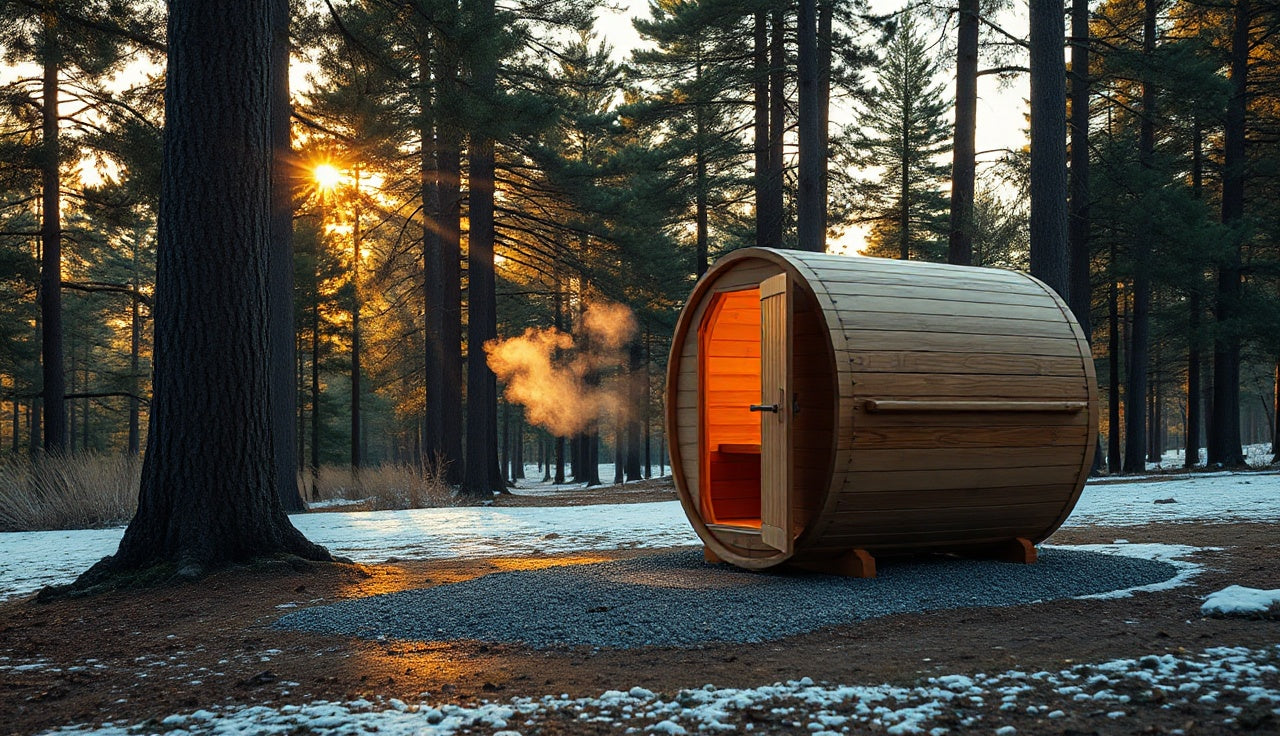
Sisu (the Finnish word for grit or inner resilience) is a brand that makes outdoor barrel saunas built in the Finnish tradition. The concept is simple. A cylindrical cedar or spruce shell, curved staves bound together like a wine barrel, sits on a pair of cradle-style legs so it doesn't need a concrete pad. You pick your heater, roll it into the backyard, and you're saunaing within a weekend.
The barrel shape isn't just for looks. Because the interior is round rather than rectangular, hot air pools at the top where you sit and cooler air stays low near your feet. That gradient makes a barrel sauna heat up fast and feel more intense at head level than a flat-ceilinged box of the same cubic footage. Most barrel saunas reach 160 to 185°F in 30 to 45 minutes with a properly sized heater [1].
Sisu positions itself as a mid-to-premium option. It sits above entry-level big-box barrel saunas (which often use lower-grade softwood and thinner staves) and below fully custom Finnish sauna builders that charge $15,000 and up. That middle ground is a crowded market, so the brand has to compete on wood quality, joinery, and the accessories package it includes.
If you're still deciding whether a barrel design is the right format for your yard at all, the broader outdoor sauna guide covers the full range of outdoor sauna structures.
What sizes and configurations does Sisu offer?
Sisu sells barrel saunas in two main diameter classes: roughly 6 feet and 7 to 8 feet. Length runs from about 6 feet to 9 feet depending on the model. A 6-foot-diameter by 7-foot-long unit seats 4 to 6 people comfortably. An 8-foot by 9-foot seats 8 or more if everyone's willing to cozy up.
Here's an honest benchmark of configuration options across barrel sauna brands at Sisu's tier:
| Feature | Entry-level barrel ($1,500, $2,800) | Sisu tier ($3,000, $9,000+) | Custom Finnish builder ($12,000+) |
|---|---|---|---|
| Stave thickness | 1.25 to 1.5 in | 1.5 to 1.75 in | 1.75 to 2 in+ |
| Wood species | Hemlock, low-grade spruce | Nordic spruce or white cedar | Select Nordic pine or thermowood |
| Heater included | Usually no | Optional add-on | Usually no |
| Lead time | 2 to 6 weeks | 4 to 10 weeks | 8 to 20 weeks |
| Assembly required | Yes | Yes, 2 to 4 hours | Varies |
| Floor drain | Rare | Optional | Common |
Wood species matters more than most people realize. White cedar (Thuja occidentalis) is naturally rot-resistant and dimensionally stable in outdoor conditions, which is why it's standard in quality outdoor barrel saunas [2]. Nordic spruce is denser and smells more authentically Scandinavian but wants better staining or sealing in wet climates. Sisu typically offers both and lets you pick based on your region's weather.
Some Sisu models include a changing room extension, a small vestibule on one end separated by an interior door. That vestibule adds about 2 feet to the total length and gives you a dry spot to hang towels and leave your shoes. In a cold climate it also acts as an airlock, cutting heat loss every time the door opens. It's a real feature, not a gimmick.
How much does a Sisu barrel sauna cost?
Sisu's pricing has moved enough over the past few years that any single number published more than a few months ago may be stale. Based on current market positioning, expect:
- 6-foot diameter, basic configuration (no heater, no changing room): $3,000, $4,500
- 7 to 8-foot diameter with changing room: $5,000, $7,500
- Fully equipped with premium heater, floor drain kit, and cedar interior benches: $7,500, $9,000+
Shipping runs $300, $800 depending on distance and whether you're in a major metro or a rural address. Sisu ships freight, not UPS, so you'll need someone available to offload it. If the driver has to drop it on the ground and you then have to move it, you want two people and a furniture dolly.
The heater is a meaningful line item. A quality electric sauna heater for a space this size (typically 6 to 9 kW) runs $400, $1,200 on its own [3]. A wood-burning sauna stove (called a kiuas in Finnish) runs $500, $1,500 for a solid unit. Sisu bundles heaters as optional add-ons, so the listed unit price without a heater can look attractively low until you price the rest of it out.
For context on where this lands against other popular outdoor sauna purchases, the Costco sauna guide covers the budget end of the market. It's a useful reference point if you're trying to decide how much you really want to spend.
What wood does Sisu use and why does it matter for outdoor saunas?
Wood choice in a barrel sauna isn't cosmetic. It sets how long the structure lasts outdoors, how much it expands and contracts with humidity swings, and how comfortable the benches feel against bare skin.
Sisu uses Nordic spruce (Picea abies) or white cedar (Thuja occidentalis), sometimes with thermowood-treated options on higher-end models. Thermowood is regular wood heat-treated at 185 to 215°C to drive out moisture and make it more dimensionally stable and rot-resistant. The European thermowood industry standard is EN 14257, which governs the process parameters [4]. Thermowood costs more but warps and cracks less in climates with big seasonal humidity changes.
White cedar's natural oils (thujopsene and related compounds) make it resistant to moisture, decay, and insects without any chemical treatment, which is why it's the default for outdoor barrel saunas in the northeastern United States and Canada [2]. It's also lower in density than spruce, so it doesn't hold as much heat in the wood itself. That means it stays touchable even when the air temperature is 180°F. If you've ever burned your back on a wooden bench, the culprit is usually a denser species like hemlock or Douglas fir.
Spruce has a tighter grain and a more neutral aroma, which some people prefer because it doesn't compete with the birch-whisk smell or the heater's steam. It's harder wearing for bench surfaces too. In a dry Western climate, spruce holds up beautifully. In the humid Southeast, cedar or thermowood is the safer pick.
For the benches specifically, Sisu uses the same species as the shell in most configurations, which keeps the thermal properties consistent. The better option if you're customizing is an abachi (Aningeria) bench surface, an African softwood that's extremely low in thermal mass and popular in Finnish saunas for that reason. Not all Sisu configurations include it, but it's worth asking about.
Electric heater or wood-burning stove: which should you choose for a Sisu barrel sauna?
This is the decision most buyers get wrong. They default to wood-burning because it feels more authentic, without thinking through how often they'll actually use the sauna.
Wood-burning heaters produce an arguably more intense, enveloping heat with a softer steam quality when you ladle water. Loyly (the Finnish word for the steam and sensory experience created when water hits the rocks) is generally considered better from a wood stove. The Finnish Sauna Society's guidance on authentic sauna practice consistently treats the wood-fired stove as the standard [5]. If you use the sauna once or twice a week on planned occasions, a wood stove is a great choice.
Electric heaters win on convenience. You push a button from an app or a timer, the sauna is ready in 30 to 45 minutes, and there's no ash to deal with. If you're the kind of person who decides at 9 PM that you want a sauna that night, electric is the realistic option. How much people actually use their at-home saunas comes down to friction. A sauna you use three times a week is healthier than one you use three times a month because the wood stove felt like too much work.
For a Sisu barrel in the 6 to 7 foot diameter range, a 6 kW electric heater is usually the minimum. A 9 kW unit is more comfortable if you're heating to 180°F+ or live somewhere cold. The NEC (National Electrical Code) requires a dedicated circuit for any heater over 2,000 watts, and most sauna heaters need a 240V/60A circuit [6]. Budget $300, $800 for an electrician to run that circuit if you don't already have one.
Wood stoves need a proper chimney through the barrel roof, which Sisu accommodates with a pre-cut chimney port on most models. Check local building codes before you commit. Some municipalities and HOAs prohibit open-combustion appliances in residential outdoor structures. More on permits below.
Does a Sisu barrel sauna need a permit or foundation?
The foundation question is usually easier than people expect. Because the barrel sits on cradle legs rather than a deck or concrete pad, most jurisdictions don't classify it as a permanent structure. You do still need a flat, stable surface. Gravel, compacted decomposed granite, or an existing patio slab all work. Leave enough clearance under the cradles for air circulation (at least 4 to 6 inches off wet grass) and the wood lasts longer.
The permit question is more variable. Requirements depend entirely on your local jurisdiction. The general rule in most U.S. municipalities is that an accessory structure under a certain square footage (commonly 120 square feet, though it ranges from 100 to 200 square feet depending on the locale) and not attached to a permanent foundation doesn't require a building permit [7]. A typical 6x7 foot Sisu barrel has a floor footprint of about 42 square feet, which usually falls under that threshold.
The electrical connection almost always requires a permit regardless of the structure's size. An unpermitted 240V sauna circuit is both a code violation and a real safety risk. Any licensed electrician should pull the permit as part of the job. If they say you don't need one, find a different electrician.
In an HOA, check the CC&Rs before you order. Some HOAs prohibit outbuildings visible from the street or above a certain height. A barrel sauna at 6 feet in diameter sitting on 18-inch legs clears about 7.5 feet at the apex, which can trip fencing-height rules.
For comparison, home sauna installations inside the house almost always require a permit because of the electrical and sometimes HVAC modifications.
How long does it take to assemble a Sisu barrel sauna?
Most buyers assemble a Sisu barrel sauna in 2 to 4 hours with two people. The staves arrive pre-assembled into curved panels that you band together, set on the cradles, and seal. The door and window hardware is the fiddliest part. Sisu includes an instruction manual and most models have a YouTube walkthrough.
The tools you actually need: a rubber mallet, a cordless drill, a level, and someone to hold panels steady while you run the banding rings. No special woodworking skills required. If you've assembled flat-pack furniture and felt fine about it, this is manageable.
Heater installation is separate from the barrel assembly. Electric heater mounting takes 30 to 60 minutes once the circuit is ready. Plumbing the wood stove and chimney takes another 1 to 2 hours. Plan the electrician visit and the assembly on different days to avoid a logjam.
One thing people underestimate: placement. Once a barrel sauna is fully assembled and loaded with wood, it's very heavy (a 6x7 unit runs 600 to 900 lbs). Decide exactly where it's going before you start, not after. Leave at least 3 feet clearance on all sides for maintenance access and ventilation, and keep it away from overhanging branches. Wood stove sparks are a real fire risk under a tree canopy.
What are the actual health benefits of using a barrel sauna regularly?
The research on sauna use is more solid than the wellness industry makes it sound, and more specific than the marketing claims suggest. Most of the strong evidence comes from Finnish population studies, particularly a long-running cohort published in JAMA Internal Medicine in 2015 that followed 2,315 middle-aged Finnish men over 20 years. That study found men who used a sauna 4 to 7 times per week had a 40% lower risk of all-cause mortality compared to those who used it once per week [8]. The association held independent of other cardiovascular risk factors.
The mechanism most studied is cardiovascular. Sauna exposure pushes heart rate to 100 to 150 bpm (similar to moderate aerobic exercise), increases cardiac output, and drives vasodilation in peripheral blood vessels [9]. Core body temperature rises to roughly 38 to 39°C during a typical session. These acute responses appear to produce adaptations similar to exercise training with repeated exposure, particularly for blood pressure regulation.
For recovery specifically, the evidence is decent but mixed. A 2013 systematic review in Sports Medicine found contrast water therapy reduced delayed-onset muscle soreness in some studies, but effect sizes were modest and study quality varied [10]. If you're using the sauna mainly for recovery rather than cardiovascular benefit, pairing it with cold water immersion (contrast therapy) has better evidence behind it.
On that note: a cold plunge next to a barrel sauna is the classic Finnish approach, and the contrast between the two is what makes the experience genuinely addictive. More on that below.
Keep the health claims honest. Sauna use is associated with these outcomes in observational data, but it's not a medical treatment. Anyone with cardiovascular disease, pregnancy, or low blood pressure should talk to their doctor before starting regular sauna use. The Finnish Sauna Society publishes safety guidance that remains the most authoritative reference for safe session protocols [5].
For a fuller look at the evidence, the sauna benefits article covers the research in more depth.
| 1x per week (baseline) | 0% |
| 2–3x per week | 24% |
| 4–7x per week | 40% |
Source: Laukkanen et al., JAMA Internal Medicine, 2015
How does a Sisu barrel sauna compare to other outdoor barrel sauna brands?
The barrel sauna market has gotten crowded fast. Here's an honest read on where Sisu sits:
| Brand | Price range | Wood | Heater included | Ships from | Notable |
|---|---|---|---|---|---|
| Sisu | $3,000, $9,000+ | Nordic spruce or white cedar | Optional | Varies (often North America) | Finnish branding, mid-premium build |
| Dundalk Leisurecraft | $3,200, $8,500 | White cedar | Optional | Canada | Long-established, strong warranty |
| Almost Heaven | $2,500, $6,500 | Hemlock or spruce | No | USA (WV) | Wide availability, good entry price |
| Scandia | $4,000, $10,000+ | Spruce or thermowood | Optional | Varies | High build quality, fewer dealers |
| HUUM (kit) | $5,000, $12,000 | Nordic spruce | Yes (HUUM heater) | Estonia | Premium heater integration |
Dundalk Leisurecraft is probably Sisu's closest direct competitor. They've made cedar barrel saunas in Canada for decades and have a genuine track record for outdoor durability. Prices overlap heavily. If you can find both available in your market, compare stave thickness, bench configuration, and warranty terms side by side before deciding.
Almost Heaven is a popular option at box-store pricing levels. The hemlock they typically use is fine but not as naturally rot-resistant as cedar, and the joinery on their entry-level units is noticeably less tight. For a garage or covered space it's workable. For a fully exposed outdoor install in a wet climate, I'd spend more.
Sisu differentiates partly on brand story (the Finnish word, the Nordic design ethos) and partly on the accessories ecosystem. Whether that's worth a premium over Dundalk or Almost Heaven depends on how much the brand narrative matters to you. The physical experience of a well-built barrel sauna from any of these companies is more similar than the marketing would suggest.
Can you use a Sisu barrel sauna year-round in cold climates?
Yes, and honestly winter is when it shines. A well-insulated barrel sauna with a properly sized heater handles outdoor temperatures down to -20°F with no issues. The barrel shape and the thick staves (1.5 to 1.75 inches) give you reasonable thermal mass, and because you're heating a relatively small volume of air, a 9 kW heater beats the cold quickly.
The practical consideration in cold climates is the wood itself. Cedar and thermowood handle freeze-thaw cycles well. Untreated spruce in a wet climate can check (develop surface cracks) over time as water infiltrates and freezes in the grain. Applying a sauna-safe exterior sealant or oil (products like Rubio Monocoat or a traditional linseed oil blend) once or twice a year dramatically extends the lifespan. Don't use paint or film-forming finishes on the exterior. They trap moisture and peel.
In snow country, roof load matters. A barrel doesn't have a flat roof, so snow sheds naturally. But if you're in an area that gets heavy wet snow, the ice buildup on the windward side of the barrel can be significant. Some buyers add a simple shelter or pergola roof over the sauna to keep precipitation off. That also extends the wood's life.
The interior needs no special winterization as long as the heater runs regularly. If you're leaving it dormant for months, open the door periodically to let it breathe and prevent mold. Wood-burning stove owners should clean the firebox and flue before the season's first use.
For the contrast therapy experience in winter, having a cold plunge or even just a cold shower hookup nearby completes the circuit. Stepping from 180°F into 40°F water and then back is genuinely one of the better things a backyard can offer.
How does contrast therapy with a barrel sauna and cold plunge actually work?
Contrast therapy is alternating between heat and cold exposure, typically in cycles of 10 to 15 minutes of sauna followed by 2 to 5 minutes of cold immersion, repeated 2 to 4 times. The Finnish tradition runs sauna, then roll in the snow or jump in a lake, then rest. The Western version usually substitutes a cold plunge tub.
Physiologically, the heat phase causes vasodilation and increases blood flow to the periphery. The cold phase causes vasoconstriction. Repeated cycling creates what researchers call a vascular training effect, though the evidence is still building and most human studies are small [10]. The anecdotal experience is compelling. Most people feel deeply relaxed and alert at the same time in the 30 to 60 minutes after a good contrast session.
For a Sisu barrel setup, you want the cold plunge within about 20 feet of the sauna door if possible. Closer is better. You lose body heat fast when you're wet and walking, which defeats some of the point. Many buyers put a freestanding cold plunge tub on a gravel pad directly beside the barrel.
The cold temperature target for meaningful cold water immersion is typically 50 to 59°F (10 to 15°C), based on the protocols used in most clinical studies [11]. You don't need ice-cold water. The vasoconstriction response is substantial at 55°F. A dedicated cold plunge tub with a chiller holds temperature automatically. A chest freezer conversion or a stock tank with ice works but demands more management.
For a full breakdown of the cold side of this equation, including tub sizing and chiller specs, the ice bath guide and the cold plunge benefits article cover the research in detail. SweatDecks carries several cold plunge options sized specifically to pair with outdoor barrel sauna setups, if you're building the full station at once.
What maintenance does a Sisu barrel sauna actually need?
Less than most people expect, but not zero. Here's a realistic picture by timeframe.
After each use: let the sauna cool with the door ajar for 30 to 60 minutes to dry the interior. Wipe the bench surfaces if moisture is pooling. Leave the vent open.
Monthly: check the banding tension. The steel bands that hold the barrel staves together can loosen slightly as the wood settles, especially in the first year. Sisu includes tension hardware. Hand-tighten any loose bands. Inspect the door seal for cracks.
Annually (or semi-annually in wet climates): apply an exterior wood oil or sealant. Sand the bench surfaces lightly if they're getting rough and apply a food-safe oil (raw linseed or tung oil are traditional; avoid anything with solvents in the interior). Clean the heater element if electric, or the firebox and flue if wood-burning. Check the chimney cap for bird nests in spring.
Every few years: the steel banding eventually needs replacement as it corrodes, particularly in coastal or high-humidity environments. Stainless steel banding (an upgrade Sisu offers on some models) stretches that interval considerably.
The benches take the most maintenance because they're constantly hit with sweat and humidity. Light sanding and re-oiling once or twice a year keeps them from getting rough or gray. If a stave cracks (it happens occasionally in very dry climates due to shrinkage), a waterproof wood glue and a clamp usually fixes it. Major splits may need a replacement stave from the manufacturer.
Budget about 3 to 5 hours per year for maintenance, plus materials. It's not onerous if you stay on top of it, but a neglected outdoor barrel sauna can deteriorate noticeably within 2 to 3 years.
Is a Sisu barrel sauna worth the money compared to other options?
Depends on what you're comparing it to.
Versus a cheap barrel sauna from a generic importer or big-box store at $1,500, $2,500: yes, probably worth the extra $1,000, $2,000. The wood quality, joinery, and hardware on entry-level units are noticeably worse, and a barrel sauna that warps, cracks, or loses band tension in three years isn't a deal.
Versus Dundalk Leisurecraft at similar pricing: it's close. Dundalk has a longer track record and strong warranty support. If Sisu isn't meaningfully cheaper or better specified in the configuration you want, Dundalk is a legitimate alternative.
Versus a prefab indoor home sauna kit at similar pricing: different product, different experience. Indoor prefab units (typically a corner sauna or a modular room) install more easily and don't need weatherproofing, but you lose the outdoor experience, which is genuinely part of what makes barrel saunas compelling. If you live somewhere with brutal winters and no covered outdoor space, an indoor unit is the practical choice.
Versus a custom Finnish sauna at $15,000+: a Sisu barrel is the right call for most homeowners. Custom builds make sense if you're building into an existing structure, want a specific room configuration, or simply want the best money can buy. For a standalone outdoor structure where the goal is frequent sauna use, a well-made barrel at $5,000, $7,000 all-in delivers 90% of the experience.
My honest take: the barrel format is genuinely great, and Sisu's pricing puts a quality unit within reach of most homeowners who've decided they're serious about this. The risk is buying on photos and brand story without verifying the specific wood spec, stave thickness, and warranty terms for the exact model you're ordering. Get those in writing before you pay.
If you're still in the research phase on whether a sauna at all makes sense for your situation, the sauna and outdoor sauna guides are good starting points. For anyone ready to look at hardware, SweatDecks curates barrel sauna options alongside cold plunge setups if you want to build a contrast therapy station rather than just a sauna.
Frequently asked questions
How long does a Sisu barrel sauna last outdoors?
A well-maintained cedar or thermowood barrel sauna should last 15 to 25 years outdoors. The main variables are climate exposure, wood species, and whether you apply exterior sealant annually. Stainless steel banding extends hardware life significantly compared to standard steel. Neglected barrels in wet climates can show serious degradation in 5 to 7 years, so maintenance isn't optional.
What size Sisu barrel sauna do I need for 4 people?
A 6-foot diameter barrel in the 7-foot length range seats 4 adults comfortably with upper and lower bench levels. If you want everyone on the upper bench (hotter, closer to the peak), you need the 7 to 8 foot diameter models. The smaller units work for 2 to 3 people on the upper bench, which is where you want to be for serious heat.
Can a Sisu barrel sauna sit directly on grass or dirt?
You can, but you shouldn't long-term. Direct contact with soil or wet grass promotes rot at the cradle contact points and creates an unstable base. Put the cradles on concrete pavers, gravel, or a compacted gravel pad at minimum. The barrel itself doesn't need a full concrete foundation, but the four contact points need something solid and moisture-resistant underneath them.
What's the difference between a barrel sauna and a traditional Finnish sauna?
Traditional Finnish saunas are rectangular rooms, typically inside a building or a dedicated sauna cottage, with a large heater (kiuas) and a high ceiling. Barrel saunas are outdoor, cylindrical, and smaller. The heat experience is similar if both are built well, but the barrel heats faster due to lower volume. Traditional Finnish saunas often have a separate dressing room and washing area that barrels can't match in size.
Does a barrel sauna need to be grounded or have an electrical permit?
Any sauna with an electric heater over 2,000 watts requires a dedicated 240V circuit, and that circuit requires a permit in virtually every U.S. jurisdiction. The heater itself must also be bonded and grounded per NEC requirements. This is not an area to skip: unpermitted sauna wiring creates fire and electrocution risks and can void homeowner's insurance coverage.
How hot does a Sisu barrel sauna get?
A properly sized heater brings a Sisu barrel to 160 to 195°F (71 to 90°C) at bench level, depending on heater wattage, outside temperature, and insulation quality. At the peak of the barrel, temperatures can be 10 to 15°F higher than at sitting height. Traditional Finnish sauna temperatures run 80 to 100°C; most North American users prefer the 70 to 85°C range.
Can I install a Sisu barrel sauna myself without a contractor?
The structural assembly (putting the barrel together and setting it on the cradles) is a genuine DIY project for two adults with basic tools and 2 to 4 hours. The electrical connection for an electric heater is not a DIY project unless you're a licensed electrician. Wood stove installation with a chimney is intermediate: the barrel penetration is straightforward, but proper chimney clearance and flashing require some knowledge and a permit in most areas.
Is Nordic spruce or white cedar better for a barrel sauna?
Cedar wins for outdoor durability and bench comfort, especially in humid or high-rainfall climates. It's lighter in density, stays cooler to the touch at high temperatures, and doesn't need chemical treatment to resist rot. Spruce is denser, harder-wearing on bench surfaces, and has a more neutral aroma. In dry Western climates, spruce performs well. In the Pacific Northwest or Southeast, cedar or thermowood is the practical choice.
Do I need a changing room vestibule on a barrel sauna?
Not required, but genuinely useful in cold climates. A vestibule keeps your outdoor gear dry, gives you a spot to warm up before entering the main barrel, and reduces heat loss when the door opens. In warm climates, it's a luxury. If you're in a region where temperatures drop below 20°F regularly, the vestibule adds comfort and modestly improves heat retention during the session.
How does a barrel sauna compare to a steam room?
A barrel sauna uses dry heat with low humidity (typically 10 to 20% relative humidity) unless you add steam by ladling water on the rocks. A steam room operates at 100% humidity near 110 to 120°F. The experiences are physiologically similar in some ways (elevated heart rate, sweating) but feel entirely different. Most people find dry sauna heat more tolerable at higher temperatures. For a full breakdown, see the sauna vs steam room comparison.
What heater wattage do I need for a Sisu barrel sauna?
The standard rule is 1 kW per 50 cubic feet of sauna volume, but barrel saunas heat faster than boxes due to the curved ceiling. A 6x7 foot barrel (roughly 200 cubic feet interior) does fine with a 6 kW heater in moderate climates and a 9 kW heater in cold climates or if you want fast heat-up times. Undersizing the heater is the most common mistake; it results in long heat-up times and a sauna that never reaches proper temperature.
What's the ROI on a barrel sauna for home resale value?
Honest answer: nobody has clean data on barrel saunas specifically. General outdoor amenity data suggests quality outdoor structures add 70 to 80 cents per dollar spent in home resale value in markets where buyers value them (the Upper Midwest, Pacific Northwest, and mountain regions tend to respond better than the South or hot-climate markets). A barrel sauna is more of a lifestyle purchase than an investment vehicle.
Can you use a Sisu barrel sauna if you have heart disease or high blood pressure?
Consult your doctor before starting sauna use if you have any cardiovascular condition. The JAMA Internal Medicine 2015 Finnish cohort study found protective associations in healthy men, but people with active cardiovascular disease, uncontrolled hypertension, or recent cardiac events were not part of that study population. The physiological stress of heat exposure (heart rate rising to 100 to 150 bpm) requires clearance from your physician, not a wellness blog.
Sources
- Finnish Sauna Society, sauna temperature and heating guidelines: Barrel saunas typically reach 160–185°F in 30–45 minutes with a properly sized heater; traditional Finnish sauna temperatures run 80–100°C
- USDA Forest Service Forest Products Laboratory, Wood Handbook: Wood as an Engineering Material, chapter on wood species durability: White cedar (Thuja occidentalis) is naturally rot-resistant and dimensionally stable due to natural oils, making it suitable for outdoor exposure without chemical treatment
- U.S. Department of Energy, home electric heating and appliance load guidance: Electric heating appliances in the 6–9 kW range draw substantial load and require dedicated 240V circuits; quality residential sauna heaters price in the $400–$1,200 range
- European Committee for Standardization, EN 14257: Adhesives, wood, determination of tensile strength under elevated temperature conditions: European standards govern process parameters for thermowood heat treatment at 185–215°C
- Finnish Sauna Society, sauna bathing guidelines and safety: The Finnish Sauna Society consistently treats the wood-fired stove as the standard for authentic sauna practice and provides authoritative safety session protocols
- NFPA, National Electrical Code (NEC) Article 680 and Article 422, dedicated circuit requirements for fixed appliances: The NEC requires a dedicated circuit for any heater over 2,000 watts; most sauna heaters require a 240V/60A circuit
- International Code Council (ICC), International Residential Code accessory structure provisions: Most U.S. municipalities exempt accessory structures under approximately 120 square feet from building permit requirements, though thresholds vary by jurisdiction
- Laukkanen et al., JAMA Internal Medicine, 2015, 'Association Between Sauna Bathing and Fatal Cardiovascular and All-Cause Mortality Events': Men who used a sauna 4–7 times per week had a 40% lower risk of all-cause mortality compared to those who used it once per week, in a 20-year Finnish cohort study of 2,315 men
- Laukkanen et al., Mayo Clinic Proceedings, 2018, 'Cardiovascular and Other Health Benefits of Sauna Bathing': Sauna exposure causes heart rate to rise to 100–150 bpm, increases cardiac output, and causes vasodilation; core body temperature rises to approximately 38–39°C during a typical session
- Versey et al., Sports Medicine, 2013, 'Water Immersion Recovery for Athletes: Effect on Exercise Performance and Practical Recommendations': Systematic review found contrast water therapy reduced delayed-onset muscle soreness in some studies but effect sizes were modest and study quality varied
- Bleakley et al., British Journal of Sports Medicine, 2012, 'Cold-water immersion (cryotherapy) for preventing and treating muscle soreness after exercise': Protocols in clinical cold water immersion studies typically target 50–59°F (10–15°C) water temperature for meaningful physiological response

Share:
2 person cold plunge tub: everything you need to know before buying
2 person cold plunge tub: everything you need to know before buying