
Last updated 2026-07-11
TL;DR
A privacy fence around an outdoor sauna gives you seclusion, wind protection, and a finished backyard look. The best options include cedar board-on-board fencing, slatted screens with airflow gaps, masonry half-walls, pergola-style frames with climbing plants, and prefab panel systems. Budget runs roughly $15 to $50 per linear foot installed, depending on material. Permits are often required once a fence exceeds 6 feet.
Why does an outdoor sauna need a privacy fence in the first place?
An outdoor sauna without any screening is a loud visual statement in most neighborhoods. You step outside in a towel, the neighbors are right there. That alone is reason enough for most people, but the fence does more than hide you.
Wind is the bigger functional problem. A well-placed fence or screen wall cuts convective heat loss from the sauna exterior, which matters more for barrel and cube saunas whose walls are thinner than a stick-built structure. In cold climates, blocking prevailing wind reduces the time the sauna shell spends below ambient temperature and can meaningfully shorten preheat times, though nobody has published a controlled study on exactly how much.
Aesthetically, a fence turns a sauna dropped in a yard into a composed outdoor room. That framing changes how the space feels to use. It also, practically, adds resale appeal: a fenced sauna nook reads as a spa area rather than a garden shed.
Finally, there is the liability side. Many homeowners insurance policies and HOA rules treat unclosed hot structures near the property line differently than enclosed ones. A fence can help define the boundary and, depending on your jurisdiction, may reduce your exposure if a neighbor's child wanders in. Check your policy and your municipality's fence ordinance before you build anything. [1]
For a full overview of outdoor sauna types and what to look for before buying, see outdoor sauna.
What permits do you need for a fence around an outdoor sauna?
Permit requirements for residential fences vary by municipality, but the most common threshold is 6 feet in height. [1] Fences at or below that height are often exempt from a building permit in many U.S. cities; anything taller typically requires one. Some jurisdictions also restrict fence height in front yards to 3 or 4 feet regardless of material.
If the sauna itself required a permit (most jurisdictions require one for permanent structures above a certain square footage, often 120 sq ft or more), the fence around it may be reviewed as part of that same project scope. [2]
HOA rules layer on top of municipal codes and are often stricter. Common HOA restrictions include: approved materials (no chain-link in residential zones, for example), color palettes, maximum heights below 6 feet, and setback requirements from property lines. Read your CC&Rs before you order lumber.
The safe path: pull up your city's fence ordinance online, confirm the setback requirement from property lines (commonly 0 to 2 feet for fences, versus 5 to 10 feet for structures), and call the building department if the sauna and fence are attached or share footings. A $50 permit beats a $2,000 variance hearing.
One more thing: if the fence encloses a hot tub or sauna, some jurisdictions treat it as a barrier for a water feature and apply pool barrier codes, which in many states require self-closing, self-latching gates at least 48 inches tall. [3] Worth checking even if your sauna is not a water feature.
What are the best privacy fence materials for a sauna enclosure?
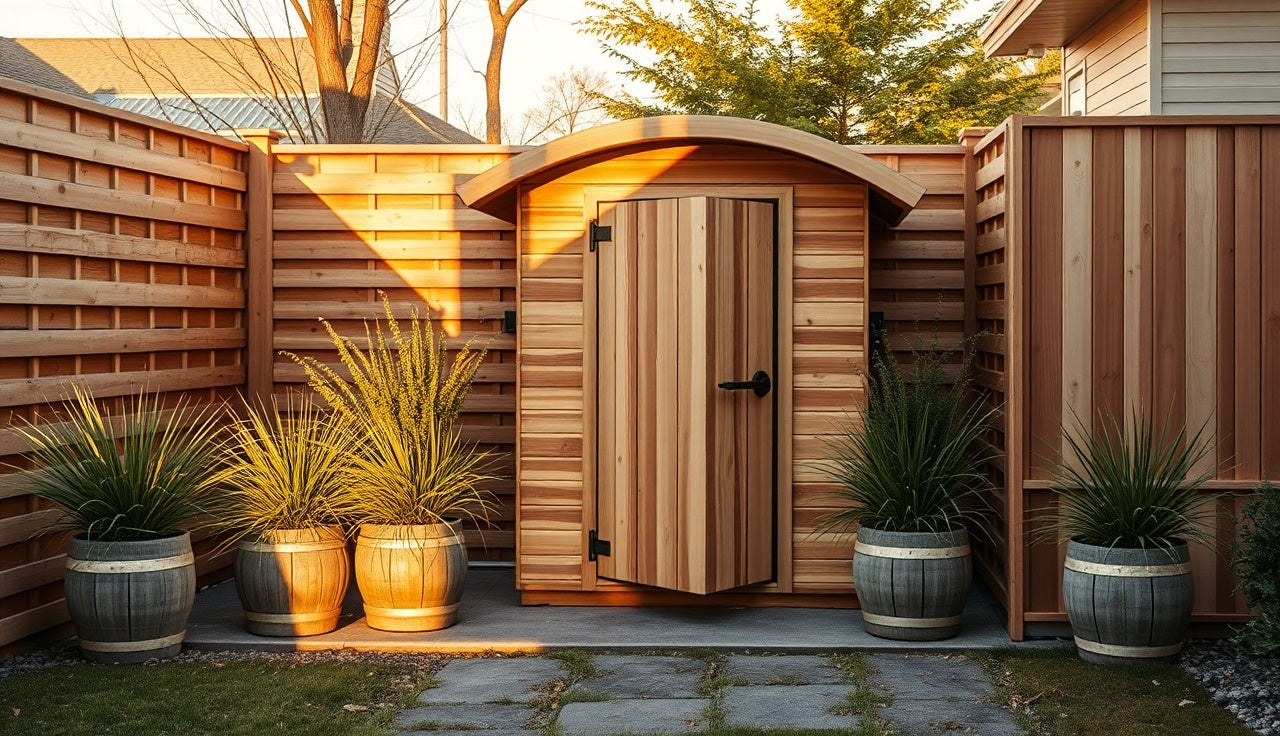
Cedar is the default choice for a reason. It resists rot naturally, it does not require pressure treatment chemicals near a skin-contact environment, and the reddish tone weathers to a silver-gray that looks good with most sauna finishes. Board-on-board cedar fencing, where boards alternate on each side of the rail so there are no gaps, gives you full privacy at any angle. Expect to pay roughly $18 to $30 per linear foot installed. [4]
Redwood is better than cedar on longevity (heartwood redwood can last 20+ years with minimal maintenance) but harder to source outside the western U.S. and more expensive, often $25 to $45 per linear foot installed.
Pressure-treated pine is the budget option at $15 to $22 per linear foot installed, but avoid placing it directly against a sauna exterior where someone might lean or where splash water could carry preservative residue onto skin. ACQ-treated lumber is safer than older CCA-treated wood, but cedar is still the cleaner choice for a wellness space.
Composite (wood-plastic composite) fencing runs $20 to $40 per linear foot installed and is nearly maintenance-free. The aesthetic is more suburban than rustic, which may or may not suit your sauna's look.
Steel and aluminum panel systems, often used in modern landscape design, cost $30 to $60 per linear foot installed and pair well with cube-style contemporary saunas. They do not rot, but they do get hot in direct sun and can feel industrial.
Masonry: poured concrete, CMU block, or natural stone. The most expensive option ($40 to $100+ per linear foot depending on finish and material) but also the most permanent and the best wind blocker. A half-wall of stone capped with a wood rail is one of the nicest-looking solutions if your budget allows.
| Material | Installed cost (per lin. ft.) | Lifespan (years) | Maintenance |
|---|---|---|---|
| Cedar board-on-board | $18 - $30 | 15-20 | Stain every 2-4 yr |
| Redwood | $25 - $45 | 20+ | Stain every 3-5 yr |
| Pressure-treated pine | $15 - $22 | 10-15 | Stain every 1-2 yr |
| Composite | $20 - $40 | 25+ | Wash annually |
| Steel/aluminum panel | $30 - $60 | 30+ | Minimal |
| Masonry half-wall | $40 - $100+ | 50+ | Seal every 5-10 yr |
| Pressure-treated pine (low) | $15 |
| Pressure-treated pine (high) | $22 |
| Cedar board-on-board (low) | $18 |
| Cedar board-on-board (high) | $30 |
| Composite (low) | $20 |
| Composite (high) | $40 |
| Steel / aluminum panel (low) | $30 |
| Steel / aluminum panel (high) | $60 |
| Masonry half-wall (low) | $40 |
| Masonry half-wall (high) | $100 |
Source: Angi / HomeAdvisor, Fence Installation Cost Guide 2024
How do you design a fence that gives privacy without blocking airflow to the sauna?
This is the real design problem. A solid board fence close to the sauna exterior can trap moisture under the eaves, slow the release of steam after sessions, and in extreme cases contribute to wood rot on the sauna cladding. You want privacy without wrapping the structure in a vapor-trapping cocoon.
The simplest solution is a slatted or louvered fence. Horizontal cedar slats spaced 1 to 1.5 inches apart block sightlines at normal standing height (because the boards overlap visually at any angle) while still allowing air to move. This is the most popular design for sauna enclosures in Scandinavian-influenced residential landscapes.
Another approach is to set the fence back from the sauna by at least 3 to 4 feet on all sides. That buffer zone gives you a walkway and allows air to circulate freely. The fence does not have to touch the sauna to hide it.
Pergola-style structures, which are open overhead but screened on the sides, solve both the airflow and the rain-on-a-hot-sauna problem. A pergola frame with vertical slat panels on three sides and an open top gives you visual privacy from most angles while letting heat convect upward naturally.
If you go with a fully solid fence, include a gap at the base (2 to 4 inches off the ground) and leave at least one section where you can open a gate or panel. That allows cross-ventilation on warm days and makes it much easier to get a sauna in or out if you ever need to move it.
For portable sauna owners who want a temporary screen solution, a freestanding lattice panel with climbing plants or a tensioned fabric screen can work without any permit in most jurisdictions. See our guide on portable sauna options if that applies to your situation.
What are 12 specific privacy fence ideas that actually work with a sauna?
Here are designs that real homeowners and landscape architects use. Each has an honest trade-off.
1. Cedar board-on-board, natural finish. The workhorse. Alternating boards eliminate gaps. Seal with a penetrating oil finish (Penofin or similar) every two to three years. Best for traditional barrel saunas.
2. Horizontal cedar slat screen with 1-inch gaps. Modern look, excellent airflow. Works best when the fence is set 3+ feet from the sauna. Privacy is angle-dependent, so account for any elevated neighbor sightlines.
3. Shou sugi ban (charred wood) fence panels. Charring cedar or pine creates a highly rot-resistant surface and a dark finish that photographs well and hides soot and weathering. Cost is higher because the charring process adds labor.
4. Composite board fence in dark tones. If you do not want to restain every few years, composite in cedar or dark gray tones is low-drama and durable. Looks best with a cube or modern sauna.
5. Steel corten panels. Weathering steel develops a rust patina that stabilizes after the first season. Bold, industrial look. Expensive, but essentially maintenance-free after the patina sets.
6. Bamboo roll fence over a wood frame. Budget-friendly temporary or semi-permanent option. Bamboo rolls attached to a 2x4 frame can cost under $5 per linear foot in materials. Not as durable as wood (expect 5 to 8 years) but very fast to install.
7. Gabion wall. Wire cages filled with river stone or recycled concrete. Heavy, permanent, excellent noise reduction. The texture pairs well with natural wood saunas. Labor-intensive to build but the materials are relatively inexpensive.
8. Masonry half-wall with wood top rail. A 3- to 4-foot concrete block or stone wall with a cedar or ipe cap rail on top. The wall handles wind and sightlines from seated positions; the slat fence or trellis above handles standing sightlines. This layered approach solves multiple problems at once.
9. Pergola with louvered side panels. Build a pergola frame that clears the sauna roof by 18 inches, then install motorized or fixed louvered panels on the sides that get the most sun or foot traffic. Overhead is open. This is my favorite design for people who also want shade.
10. Living fence (arborvitae or bamboo hedge). Emerald Green arborvitae planted 3 feet apart will form a dense 8-to-10-foot privacy screen in 5 to 7 years. Almost no maintenance, looks natural, and is the only option that actually improves with age. The downside is the wait time and the fact that trees need water and occasional trimming.
11. Tensioned fabric sail screen on posts. Architectural shade sails can block sightlines from above and from specific angles. Not a full perimeter fence, but useful if your primary exposure is a neighbor's second-floor window or deck. Very affordable and removable.
12. Corrugated metal panels on a steel frame. Galvanized or painted corrugated metal has become popular in contemporary outdoor rooms. It is durable, inexpensive per square foot relative to stone, and pairs well with cedar sauna exteriors if you use a warm-toned finish on the wood.
If you are planning a more built-out sauna area and considering adding a cold plunge alongside it, the fence design should account for that space from the start. Running cold water lines and drain lines before the fence footings go in is much cheaper than cutting through later. See cold plunge for what to think about on the plunge side.
How much does it cost to fence in an outdoor sauna area?
The cost depends on the perimeter you are enclosing, the material, and whether you DIY or hire a contractor.
A typical outdoor sauna area might be 12 x 12 feet with a small deck, so you are fencing roughly 40 to 50 linear feet (leaving room for a gate on one side). At those dimensions:
- Budget build (pressure-treated pine, DIY): $600 to $1,100 in materials.
- Mid-range (cedar board-on-board, contractor-installed): $900 to $1,500 in materials plus $600 to $900 in labor, so roughly $1,500 to $2,400 total.
- Premium (horizontal cedar slats or composite, contractor-installed): $2,000 to $3,500 total.
- High-end (corten steel panels, masonry, or custom pergola structure): $5,000 to $15,000+ depending on complexity.
Gates add cost: a basic wood gate with hardware is $150 to $400 installed; a custom metal gate can be $500 to $2,000.
Permit fees, if required, range from $50 to $300 in most municipalities for a residential fence permit. [1]
If you are DIYing, the biggest cost variable is post footings. Setting wood posts in concrete takes time and concrete costs money, but it is the right way to do it in frost-prone climates. In USDA Plant Hardiness Zone 5 and colder, posts need to go below the frost line, which can be 36 to 48 inches deep. [5] That affects both labor time and the amount of concrete you need.
Honest expectation: most homeowners spend $2,000 to $5,000 all-in for a well-done cedar or composite fence around a standard outdoor sauna area, including a gate and any basic lighting. That is real money, but it is a one-time cost for a structure that should outlast the sauna itself if built properly.
How should you orient the fence to maximize privacy and sun?
Sun orientation matters more for a sauna enclosure than for a typical yard fence, because you want the sun to help preheat the exterior and dry out the space between sessions, but you also do not want the interior of the enclosure to become an oven in summer.
The standard recommendation for northern hemisphere installations is to orient the sauna entry toward the south or southeast, so the door faces the sun for morning use. The fence on the north and west sides then acts as a windbreak against prevailing cold winds (which in the continental U.S. tend to come from the northwest). [6]
If privacy from the street or a neighbor is the primary concern, identify which direction those sightlines come from first, then make sure that face of the fence is solid or tightly slatted. Other sides can be more open.
Shadowing the plunge pool (if you have one) is worth thinking about separately. A cold plunge in full afternoon sun in a dark tub can gain several degrees per hour, which undermines your cooling protocol. A partial pergola or shade sail on the west side of the enclosure solves this without fully blocking the space.
For people pairing sauna and cold contrast sessions, the spatial flow from hot to cold matters. Do not place the sauna and plunge so that you have to open a gate or navigate steps between them while dripping. The fence design should treat the path between them as a primary circulation route, not an afterthought.
What fence height gives you enough privacy for a sauna area?
The answer depends on your terrain, your neighbors' terrain, and what you are trying to block.
For a flat yard with neighbors at the same grade, a 6-foot fence gives complete privacy for someone using the sauna and immediate deck area. Standing at 5'10" plus the 6-inch gap from grade to your eye line, the fence clears your sightline by a comfortable margin, and a neighbor at the same height on the other side cannot see over it.
If your neighbor has an elevated deck, a second story, or is on higher ground, 6 feet is not enough. You would need either 8-foot fence panels (which often require a permit) or a creative solution like an overhead pergola or sail screen that blocks the downward angle without requiring a taller solid fence.
If you are below grade (your yard is lower than the neighbor's), you face the same problem in reverse. A retaining wall combined with a standard 6-foot fence can solve it, but that is a more complex and expensive project.
For most standard residential situations, a 6-foot cedar fence hits the sweet spot: tall enough for real privacy, below the typical permit threshold in many jurisdictions, and proportional to a standard barrel or cube sauna (which runs 7 to 9 feet tall at the peak). Going to 8 feet can feel oppressive if the enclosure is tight; the extra foot matters more when you have a large deck area inside the fence.
How do you make a fenced sauna area look good, more than private?
A fence that is purely functional tends to look like a utility enclosure. A few design decisions make the difference.
Material consistency is the easiest win. If your sauna is cedar, use cedar for the fence. If your sauna has a dark stain, match the fence tone. When the materials rhyme, the space reads as intentional.
Lighting transforms the enclosure after dark, which is when most sauna sessions actually happen. Recessed post-cap lights, simple clip-on string lights along the top rail, or a low-voltage path light along the interior fence line all work. The goal is enough light to move safely without killing the mood. LED strip lights inside the sauna roof overhang aimed at the fence can create a warm glow that makes the whole area feel designed.
Plants soften hard edges. A few containers of tall ornamental grasses, a Japanese maple near the gate, or a simple planter box mounted to the interior fence face with trailing plants fill the space without requiring a garden. These also help with the sound environment, which matters if you value quiet during sessions.
The gate is the face of the enclosure. Spend more on the gate than feels necessary. A wide, well-hung gate with a proper latch and smooth operation is used every single session. A sticky, sagging gate is an annoyance you will resent forever.
Finally, consider what is overhead. An open enclosure with a fence but no overhead structure can feel exposed to upstairs neighbors and uncomfortable in rain. A simple pergola with a polycarbonate roof panel over the waiting/cooling area (not over the sauna itself) makes the space usable year-round. SweatDecks has outdoor sauna configurations designed for this kind of built-out installation if you are looking for a unit that fits cleanly into an enclosed yard space.
For more on what health benefits justify the investment in this kind of setup, see sauna benefits.
Can you use a living fence (hedge or bamboo) instead of a wood fence?
Yes, and in some ways a living fence is the best long-term option. It requires patience, though.
Emerald Green arborvitae (Thuja occidentalis 'Smaragd') is the most popular choice for dense privacy hedging in the U.S. It grows 6 to 9 inches per year [7], reaches 10 to 15 feet at maturity, and stays narrow (2 to 4 feet wide), which makes it practical close to a fence line. Space them 3 feet apart center-to-center for a solid screen. At current nursery prices, expect to pay $25 to $60 per plant for a 4-to-5-foot start, so a 40-foot run costs $350 to $800 in plants plus mulch and irrigation setup.
The problem: you will not have real privacy for 4 to 6 years. For a sauna you want to use starting this season, a living fence alone does not work. The solution is to combine a temporary bamboo roll screen or basic wood fence now with arborvitae planted just outside it. As the hedge fills in, you can remove the temporary screen.
Running bamboo is cheap and fast, but it is invasive outside its native range and many municipalities have restrictions or neighbor liability issues if it spreads onto adjacent properties. [8] Clumping bamboo (Fargesia species) is non-invasive but slower. If you go with running bamboo as a living screen, install a physical rhizome barrier at least 24 inches deep around the planting area.
A living fence does nothing for wind protection in the first few years. In a cold climate where wind blocking has functional value for preheat times, this matters. Plan accordingly.
What mistakes do people make when fencing in a sauna?
The most common mistake is building the fence before thinking about utility access. Once the fence is up, getting a propane tank in for a wood-burning stove, running an electrical circuit for an electric heater, or routing a water line for a cold plunge becomes dramatically harder. Run all utilities before you close the space.
The second mistake is making the enclosure too tight. A 12 x 12-foot sauna footprint with a fence 18 inches from the exterior walls on all sides sounds like enough room, but it feels claustrophobic, makes maintenance difficult, and does not give you space to air out after a session. Add at least 4 feet on the door side and 2 to 3 feet on the others.
Under-speccing the gate is almost universal. People spend $3,000 on cedar fencing and put a $60 gate from a big-box store on it. The gate is the piece that gets touched every single session. Buy a solid gate with stainless or hot-dip galvanized hardware, and make it wide enough to get a wheelbarrow through, because you will eventually need to bring something in or out of the enclosure.
Ignoring drainage is another one. A sauna area generates a lot of water: steam, sweat, and if you have a cold plunge, overflow and drain-back. If the enclosure has no slope to grade or drain, that water sits, accelerates rot on wood posts, and creates mosquito habitat. Grade the interior toward a single drain point or at least a gravel dry well.
Finally, people skip the post depth. In frost-prone climates, wood posts not set below the frost line heave and shift within two winters. The fence looks fine in October and leans noticeably by April. Dig to the local frost depth and set posts in concrete. This is not optional in USDA hardiness zones 5 and colder. [5]
How do you maintain a wood fence around a sauna over time?
A cedar fence near a sauna is in a challenging microenvironment. Steam, thermal cycling, and the moisture released during and after sessions accelerate weathering compared to a fence in a dry corner of the yard.
The maintenance protocol is simple: clean, inspect, and refinish on a schedule.
Cleaning: wash the interior fence face annually with a wood cleaner or diluted oxygen bleach solution to remove mildew and tannin staining. A pump garden sprayer and a soft-bristle brush are enough. Rinse thoroughly.
Inspection: check every post at grade level for soft spots (probe with a screwdriver or awl). Soft wood at the post base means rot has started. Catching it early lets you sister a new post alongside the old one rather than rebuilding a section.
Refinishing: a penetrating oil-based stain on cedar every two to three years on the interior face, and every three to four years on the exterior (which sees less moisture). Film-forming stains look good initially but peel as the wood moves; penetrating products are better for fence applications.
Hardware: stainless screws or hot-dip galvanized screws and hardware. Anything zinc-electroplated rusts within two seasons in a moist sauna environment and stains the wood orange.
If you have a shou sugi ban or charred finish, it is nearly self-maintaining. Re-char any areas that get scratched or show raw wood, and apply a light coat of tung oil annually if you want to preserve the deep black tone.
For the sauna itself, the maintenance calculus is similar. See our home sauna guide for what upkeep looks like on different sauna types over a 10-year ownership horizon.
Frequently asked questions
Do I need a permit to build a fence around my outdoor sauna?
In most U.S. municipalities, fences 6 feet tall or under do not require a building permit, but rules vary widely. Some cities require permits for any fence, and HOAs often have their own approval process. If the fence is structurally attached to the sauna or shares footings with it, the permit requirements for the sauna itself may apply. Always check your local fence ordinance and your HOA's CC&Rs before starting.
What is the best wood for a sauna privacy fence?
Cedar is the best balance of durability, rot resistance, aesthetics, and cost for most homeowners. It does not require chemical treatment, weathers gracefully, and is available at most lumber yards. Redwood is more durable but harder to source and more expensive. Pressure-treated pine works but should not be used in contact zones near a sauna where preservative residue could be an issue.
How close can a fence be to the sauna exterior walls?
Leave at least 2 to 3 feet on the sides and rear for air circulation and maintenance access. On the door side, leave at least 4 feet so you have room to step out comfortably and air out after sessions. A fence pressed against the sauna walls traps moisture, accelerates rot on both structures, and makes future sauna access or removal very difficult.
How tall should a fence around a sauna be for real privacy?
6 feet handles privacy for most flat-yard situations. If neighbors have elevated decks or your yard sits lower than theirs, 8 feet or a pergola overhead structure may be needed. Many jurisdictions allow 6-foot fences without a permit but require one for 8-foot fences, so confirm local rules first. For elevated neighbor sightlines, a shade sail or pergola overhead is often easier than a taller fence.
Can I use bamboo fencing around an outdoor sauna?
Bamboo roll fencing is a fast, affordable option but has a shorter lifespan than cedar, typically 5 to 8 years. It works well as a temporary screen while a permanent fence or hedge is being built or established. Running bamboo planted as a living fence is effective long-term but requires a rhizome barrier to prevent it from spreading to neighboring properties, and some municipalities restrict it.
How much does it cost to build a privacy fence around an outdoor sauna?
Most homeowners spend $1,500 to $5,000 all-in for a cedar or composite fence enclosing a standard sauna area of 40 to 50 linear feet, including a gate and basic hardware. Budget builds with pressure-treated pine can come in under $1,000 in materials for a DIY project. Premium materials like corten steel or masonry can push costs to $10,000 or more for the same perimeter.
Can I build a fence around a sauna myself, or should I hire a contractor?
A standard wood fence is a reasonable DIY project for someone comfortable with post-setting, measuring, and basic carpentry. The hardest part is digging and setting posts to the correct depth, especially below frost line in cold climates. A 40-foot cedar fence can be DIY'd over a long weekend with a post-hole digger and two people. Custom metalwork, masonry, or anything requiring a permit review is better handled by a licensed contractor.
Does a fence help the sauna heat up faster?
Indirectly, yes. A fence on the windward side of the sauna reduces convective heat loss from the sauna exterior, which can help the shell maintain temperature more efficiently during preheat in cold or windy weather. The effect is modest and depends on your climate and sauna wall thickness. Nobody has published precise data on the time savings, but it is a real secondary benefit rather than marketing noise.
What is the best fence design if I also have a cold plunge next to my sauna?
Design the fence to enclose both units as a single spa zone with clear circulation between them. Keep the path from sauna door to plunge entry under 8 feet if possible, make it level, and make sure the gate to exit is not in that path. Shade the plunge from afternoon sun to slow temperature gain. Include a drain or sloped grade in the enclosure floor, because a cold plunge generates significant overflow and splash water.
Are there any HOA-friendly fence materials for a sauna enclosure?
HOAs most commonly approve cedar or composite wood-look fencing in earth tones. Avoid chain-link, corrugated metal, or unconventional finishes like shou sugi ban in communities with strict aesthetic guidelines. Get written pre-approval from your HOA architectural committee before purchasing materials. Bring sample photos, a site plan showing dimensions and setbacks, and the exact material spec. Written approval protects you if board members change later.
How do I keep the fence from rotting near the sauna?
Use cedar or composite for rot resistance. Apply a penetrating oil-based stain to wood every 2 to 3 years on the interior face, which sees the most moisture. Use stainless or hot-dip galvanized hardware throughout. Keep the interior graded to drain water away from post bases. Inspect post bases annually with a screwdriver or awl for soft spots. Catching early rot in one post costs $100 to repair; ignoring it means replacing a whole fence section.
Can I use a pergola instead of a fence for sauna privacy?
A pergola frame with louvered or slatted side panels on the exposed sides is one of the best designs for a sauna enclosure. It provides sightline privacy at normal angles, allows heat and steam to convect upward naturally, and can include a partial polycarbonate roof over a cooling area without trapping moisture against the sauna. It typically costs more than a flat fence but functions better as a year-round outdoor room.
What plants work well inside or around a sauna privacy fence?
Inside the enclosure, keep plantings simple: containerized ornamental grasses, a Japanese maple, or a single architectural plant like a yucca or phormium. These tolerate reflected heat and dry spells better than fussy perennials. On the exterior fence face, Emerald Green arborvitae planted 3 feet apart creates a dense living screen over 5 to 7 years. Avoid climbing vines directly on the fence if rot is a concern, as they hold moisture against the wood.
Sources
- U.S. Department of Housing and Urban Development, Fence Permit Overview: Many municipalities require building permits for fences exceeding 6 feet in height; requirements vary by local ordinance.
- International Code Council, 2021 International Residential Code Section R105 (Permits): Residential structures above certain square footage thresholds typically require a building permit; accessory structures under 200 sq ft may be exempt depending on jurisdiction.
- U.S. Consumer Product Safety Commission, Pool and Spa Safety (CPSC Pub. 362): Many state pool barrier codes require self-closing, self-latching gates at least 48 inches tall around enclosed hot water or heated enclosures.
- HomeAdvisor / Angi, Fence Installation Cost Guide 2024: Cedar board-on-board fencing costs approximately $18 to $30 per linear foot installed; pressure-treated pine runs $15 to $22 per linear foot installed.
- USDA Agricultural Research Service, Frost Depth and Plant Hardiness Zone Data: In USDA Plant Hardiness Zone 5 and colder, frost depth can reach 36 to 48 inches, requiring fence posts to be set below that depth to prevent frost heave.
- National Oceanic and Atmospheric Administration (NOAA), U.S. Wind Climatology: Prevailing winter winds in the continental United States generally come from the northwest, informing windbreak placement on the north and west sides of structures.
- University of Florida IFAS Extension, Thuja occidentalis 'Smaragd' (Emerald Green Arborvitae) Plant Profile: Emerald Green arborvitae grows approximately 6 to 9 inches per year and reaches 10 to 15 feet at maturity, making it a common choice for privacy screening.
- USDA Forest Service, Invasive Plant Species: Phyllostachys (Running Bamboo): Running bamboo species (Phyllostachys) can spread aggressively beyond planting areas; rhizome barriers at least 24 inches deep are recommended to contain spread.
- National Fenestration Rating Council / ENERGY STAR, Residential Outdoor Structure Guidance: Windbreak structures on the north and west sides of a building can reduce heating energy demand; the principle applies to outdoor structures including saunas.
- American Institute of Architects, Residential Design and Site Planning Principles: Enclosure and screening of outdoor wellness spaces improves perceived comfort and usability; material consistency between structures improves aesthetic cohesion.

Share:
Outdoor sauna wind block placement: where to put it and why
Sauna landscaping drainage: how to slope the ground away properly