
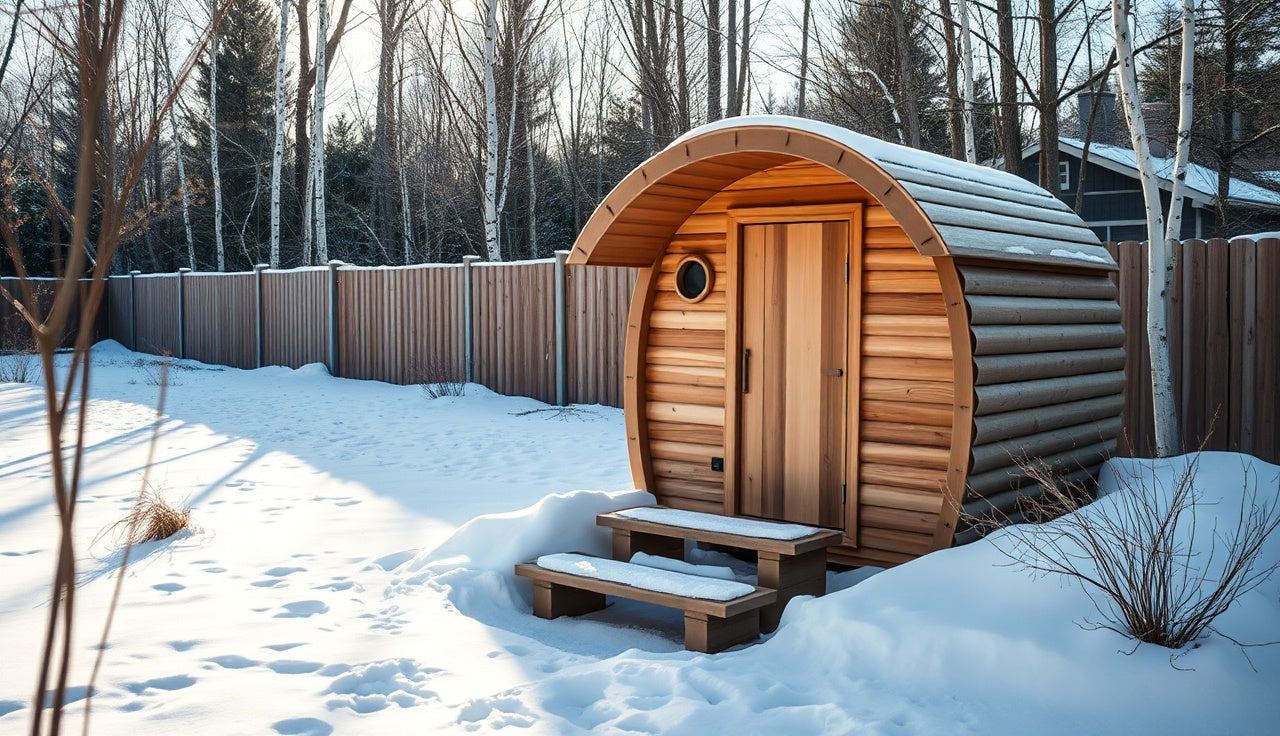
Last updated 2026-07-11
TL;DR
Put your wind block on the prevailing wind side, 3 to 6 feet out from the wall, angled 15 to 30 degrees off parallel so it redirects air instead of trapping it. Solid fencing, dense hedgerows, and earthen berms all work. The point is cutting convective heat loss off the cabin and shielding the door from drafts that steal interior heat every time it opens.
Why does wind matter so much for an outdoor sauna?
Wind strips heat off any structure through forced convection. On a calm day, a well-insulated cabin sheds heat to the outdoor air at a slow, manageable rate. Add a 15 mph wind and that rate jumps. The building science term is wind-driven infiltration: pressure differences across walls and door seals push cold air in and force warm air out faster than the heater can keep up.
A sauna feels this more than a garden shed would. You're holding 160 to 195°F inside while it's 30°F outside. Every degree the exterior surface drops widens the thermal gradient across the wall, and a wider gradient means more heat conducted outward. Wind keeps that exterior cold and never lets a warm boundary layer settle on the wood.
The entry door is the weakest single point. Open it, and a column of cold air rolls in. If the door faces into prevailing wind, that air arrives under pressure, more than gravity. A wind block set between the door and the wind can cut that pressure difference by 50 to 80% depending on geometry. [1]
There's a second effect people miss. The heater has to cycle harder to keep up. On a wood-burning unit that means more fuel and more creosote from short, hot burns. On an electric heater it shortens element life. Neither is dramatic on any single day. Over a full sauna season it adds up.
How do you find the prevailing wind direction on your property?
You can't place a wind block well without knowing where the wind actually comes from at your exact spot. Regional prevailing wind and the wind on your specific lot often differ, because buildings, tree lines, hills, and even big paved surfaces bend the airflow.
Start with the nearest National Weather Service station. NOAA's Local Climatological Data tables list prevailing wind direction by month for hundreds of stations. [2] Across much of the continental US the prevailing surface wind runs from the southwest or west, but coastal areas, mountain valleys, and Great Plains sites diverge hard from that.
That's your starting point. Now do your own field check. Tie a ribbon to a stake at the exact sauna location and watch it over several days, morning and afternoon. Take photos. Notice whether the dominant direction shifts with the season. In many northern climates winter winds come harder from the northwest than the summer southwest, and winter is exactly when heat protection matters most.
Google Earth's historical imagery helps you spot where snow drifts form. Drifts pile up on the leeward, downwind side of obstacles. A consistent drift behind your garage or fence tells you which direction the wind arrives from.
One tool worth your time: a wind rose chart, available through the NOAA wind rose tool or Weather Underground, shows direction and frequency in a single picture. [2] A wind that blows 20% of the time at 20 mph does far more thermal work than one blowing 60% of the time at 5 mph.
Where exactly should a wind block be placed relative to the sauna?
Set the block 3 to 6 feet from the sauna wall on the windward side. That gap is deliberate. Too close and you carve a narrow channel that speeds wind up through the Venturi effect. Too far and the redirected air recovers before it ever reaches your structure.
Height matters as much as distance. To protect a structure, standard windbreak guidance says the barrier should be at least as tall as what it shields, and taller helps, up to about 1.5 times the height for close placement. [9] A typical barrel or pod sauna stands 7 to 9 feet tall. A 6-foot privacy fence covers the lower wall and door but leaves the upper wall and roof exposed. An 8-foot fence or a mature hedge of similar height does the whole job.
Angle is the part almost everyone ignores. A solid wall set exactly perpendicular to the wind deflects air up and sideways cleanly. Angle the block 15 to 25 degrees so the far end swings away from the sauna, and you push air away rather than over, which usually protects the door better. Agricultural windbreak design runs on the same logic. [3]
For the door: face it away from prevailing wind if you can. When you can't, a short return panel, a 3-foot wing off the end of the main block toward the door, kills the pressure zone right at the entry. Worth doing even on a cramped lot.
Table: Wind block placement by sauna position and lot constraint
| Scenario | Recommended block distance | Recommended height | Notes |
|---|---|---|---|
| Open yard, sauna centered | 4 to 6 ft from windward wall | 1.0 to 1.5x sauna height | Angled 15 to 25° preferred |
| Sauna near existing fence | Use existing fence + 2-ft extension | Match or exceed sauna height | Check fence orientation vs. prevailing wind |
| Sauna in corner of property | Corner walls act as two-sided block | Match or exceed sauna height | Still add wing near door if door faces wind |
| Sauna on elevated deck | Account for higher deck-level exposure | 1.5x sauna height minimum | Decks see faster wind than grade level |
| Tight urban lot | Neighbor's structure or dense hedge | Match or exceed sauna height | Verify neighbor's wall doesn't channel wind |
| Earthen berm (solid) | 75% |
| Solid wood fence | 68% |
| Dense evergreen hedgerow (mature) | 65% |
| Semi-porous lattice fence (50% open) | 52% |
| Sparse hedgerow (newly planted) | 20% |
Source: USDA National Agroforestry Center, Windbreaks for Rural Living
What are the best materials for an outdoor sauna wind block?
The best material gives you a solid, continuous barrier at the right height with little maintenance. Each option carries a real tradeoff.
Wood privacy fencing (cedar, redwood, pressure-treated) is the common pick. It's cheap enough, looks right next to a wooden sauna, and you can build it to the exact height you need. The weakness is gaps at posts and between boards. True board-on-board construction with overlapping planks blocks wind better than spaced pickets. A 6-foot cedar privacy fence runs roughly $25 to 45 per linear foot installed, depending on region. [4]
Masonry walls (concrete block or brick) bring mass and permanence. They soak up daytime heat and release it slowly, which warms the microclimate near the entry a little. The cost is the catch, plus a footing below frost line in cold climates. Expect $60 to 100 per linear foot for a professionally built block wall.
Dense evergreen hedges (arborvitae, spruce, juniper) are the most natural-looking option, and they beat a fence of the same height at distances past 10 feet because they break airflow into small turbulence instead of throwing it up in one mass. The catch is time. A newly planted arborvitae row needs 3 to 5 years to reach protective density. [3] Building the sauna now? Plant the hedge and run a temporary fence while it fills in.
Earthen berms are underused. A 4-foot berm on the windward side, sloped gently on the upwind face and steeper on the sauna side, drops wind velocity hard. Research on agricultural windbreaks shows a solid berm can cut wind speed up to 75% right downwind and shelter a distance of roughly 10 times its height. [3] Berms look permanent and settled. The cost is soil volume and drainage engineering.
Composite or vinyl fencing panels work fine aerodynamically. They're nearly maintenance-free but read as out of place next to traditional sauna wood for a lot of homeowners. If your outdoor sauna has modern architectural lines, composite can suit the space.
Can an existing structure like a house wall or garage act as the wind block?
Yes, and it's often the cheapest, most practical solution you have. Place the sauna within 6 to 15 feet of a house wall, garage, or solid fence that already faces the prevailing wind, and you've got your wind block for free.
The thing to check is that the existing structure makes a genuine pressure-reduction zone and not a channel. Wind hitting a building corner accelerates around it. Park your sauna just past that corner and it can see higher wind speeds than open ground. [10] Move it back along the wall, or add a short return panel to close the corner gap.
Moisture matters too. Tucking a sauna tight against a house wall concentrates the steam from each door opening in one spot. Keep at least 3 feet of clearance for airflow, and plan how water drains away from both structures. The International Residential Code addresses setbacks for accessory structures, though the exact numbers vary by jurisdiction. Check local zoning, since many municipalities set their own minimums that decide how close you can actually build. [5]
A garage wall is often the ideal backstop. It's usually taller than a sauna, it faces a direction you can check against your wind data, and it needs no new construction. I'd take this over building new fencing anytime the geometry cooperates.
Does a wind block affect sauna heating time or energy use?
It does, and the effect is bigger for electric heaters than most people expect. A USDA Forest Service study on windbreak energy savings found properly placed windbreaks cut residential heating energy use by 10 to 25% in cold climates. [3] A sauna isn't a house, but the physics carry over: less wind means a warmer exterior surface, a smaller thermal gradient, and a heater that holds temperature without constant cycling.
Take a typical 6kW electric sauna heater. If you use it three times a week across five winter months, rough math on a 15% energy reduction at $0.13/kWh (the US residential average in 2024) lands somewhere around $20 to 50 saved per season, depending on cabin volume and how cold your winters run. [6] That's not an ROI argument for building a fence. If you're already building one for privacy, though, the thermal bonus is real.
The preheat difference is what you notice right away. A well-blocked sauna on a cold, windy day reaches temperature 10 to 20 minutes faster than the same unit sitting exposed, simply because the heater isn't fighting wind-driven loss during warm-up. Come home after work in the January dark and that gap changes how often you actually use the thing.
How does wind block placement interact with sauna ventilation?
This is the question people skip and then regret. A sauna needs controlled ventilation: fresh air in low near the heater, stale air out high on the far wall or through the door. Both the intake and the exhaust have to work without wind pressure fighting them.
If your block builds a pressurized pocket on one side and a low-pressure zone on the other, it can reverse the airflow your vents were designed for. This happens most when the block sits too close and too solid, sealing off a near-enclosed space. The fix is easy: hold the block at least 3 feet from the wall, and keep vent openings out of the block's direct pressure face.
Wood-burning saunas add a wrinkle. Chimney draw depends on pressure differential, and a block too close to the chimney can stir up turbulence that fouls the draft and pushes smoke back inside. NFPA 211 covers chimney clearances and wind-related draft problems. [7] Rule of thumb: keep the chimney clear of any wind block by at least 3 feet horizontally, or fit a chimney cap built for cross-wind stability.
Electric heaters skip the chimney worry, but they still need the ventilation loop to move. Test it by feel after you set any block. Hold a stick of incense near the intake vent and watch the smoke. If it's getting pushed back out instead of drawn in, your block geometry needs work.
What about aesthetics: how do you make a wind block look intentional?
A wind block doesn't have to look like a wind block. The best outdoor sauna installations treat the whole space as one designed environment, and the block becomes part of it on purpose.
A pergola with a solid roof and two closed sides works as a wind block and a covered spot where you cool off between rounds without standing in rain or snow. It's common in Finnish-style saunas, where the exterior bench area (the cooling space) matters as much as the room inside.
A planted berm with ornamental grasses on the upwind face and a flagstone path between it and the sauna reads as landscaping, not infrastructure. If you're already grading the yard, steering a berm to the windward side adds almost nothing to the job.
A stacked-stone or mortared-block low wall at 3 feet, topped with a cedar lattice panel to bring the effective height to 7 or 8 feet, gives you wind protection, privacy, and a climbing surface for summer vines. Cedar lattice is cheap and durable, and the partial porosity actually helps at distances past 6 feet, where a fully solid barrier throws more turbulence than a semi-porous one does. [3]
Shopping for a new unit? SweatDecks carries outdoor sauna models with different door orientations, so you can match the layout to your site's wind geometry before you buy instead of retrofitting later.
Are there any code or permit requirements for sauna wind blocks?
It depends on what you build. The wind block itself, as a freestanding fence or wall, almost always falls under local zoning and sometimes needs a building permit.
Most US municipalities allow fences up to 6 feet tall in rear yards without a permit. Above 6 feet usually needs one, and some cities cap rear-yard fences at 8 feet regardless. Front yards run lower, often 3 to 4 feet. [5] Check your city or county zoning code before you build anything over 6 feet, especially in a front or side yard.
A masonry wall with a footing almost certainly needs a building permit and a frost-depth footing inspection. A simple wood fence on surface-mounted post bases often doesn't. The line moves by jurisdiction.
HOA rules can be stricter than local code. Some ban structures visible from the street above a set height, or require design approval for any outbuilding.
Earthen berms usually don't need a permit for minor grading on your own property. But if the berm sends water toward a neighbor's land or a public right of way, you can create liability. Check with the local building department before moving significant soil.
The sauna carries its own permit rules, separate from the wind block. Most jurisdictions treat an outdoor sauna as an accessory structure that needs a permit if it sits on a permanent foundation. [5]
What are the most common wind block placement mistakes?
The most common mistake is setting the block flush with the wall or less than 2 feet off it. That triggers the Venturi effect: the gap turns into a channel and the wind speeds up, hitting the wall harder than open-air placement would. Keep a minimum 3-foot gap. Four to five feet is better.
Second most common: a block shorter than the sauna. A 6-foot fence against a 9-foot barrel shields the lower wall and door but leaves the top third open. Wind deflects downward off structures and still drives heat loss from the upper surface. Match the height or beat it.
Third: blocking one side when your site has a second wind exposure. Plenty of lots get prevailing wind from the southwest but also cold northwesterly blasts in winter. A single-sided block handles one and ignores the other. You don't need a full enclosure. An L-shape covering both dominant directions beats a lone straight panel by a wide margin.
Fourth: ignoring door orientation. You can build a perfect block on the north wall, but if the door faces north with no return panel, every opening lets in pressured cold air. Orient the door away from prevailing wind, or add the return wing.
Fifth: treating placement as a one-time call. Trees grow, new structures go up, landscaping changes. Revisit the question after any big change to your surroundings. A neighbor's new garage from last spring might now shelter you, or it might be funneling wind where none used to hit.
Does a wind block also help with cold plunge placement outdoors?
Yes, and much of the logic carries over. An outdoor cold plunge or ice bath benefits from wind protection for a different reason than a sauna: you want less evaporative and convective cooling off the water surface between uses, which keeps the chiller from working overtime to hold target temperature (usually 45 to 59°F).
The bigger reason is the person. Standing next to a cold plunge in wind, dripping wet, is miserable and genuinely risky in real cold. The same block that shields your sauna door can protect a plunge set nearby. That's the core design idea behind contrast setups, where you want the sauna and cold plunge within 30 to 60 seconds of each other, both inside a sheltered microclimate.
Running a sauna-to-cold contrast protocol (typically 10 to 20 minutes hot, 2 to 3 minutes cold, repeated)? Make the wind block serve the whole space, not one unit. Position it to open a sheltered lane between both. The NEJM published a 2023 review on the cardiovascular and other health effects of sauna bathing, including heat-cold contrast, and the comfort of the transition is a big part of what keeps a protocol repeatable. [8]
For a full contrast setup, design the block for the entire pad, not the sauna wall alone.
Frequently asked questions
How far should a wind block be from my outdoor sauna?
3 to 6 feet is the practical range for most sites. Closer than 3 feet risks the Venturi effect, where the gap speeds wind up instead of blocking it. Past 6 to 8 feet, effectiveness fades, especially for shielding the door from pressure drafts. For a large earthen berm or dense hedge, 6 to 10 feet is fine, because those materials absorb and break up airflow rather than deflecting it in one mass.
What direction should my outdoor sauna door face to minimize cold drafts?
Away from prevailing wind, ideally south or southeast across most of the continental US. South-facing entries also catch low winter sun, which warms the entry area. If your site forces a north or northwest-facing door, add a return wing to the end of your wind block, extending 3 feet toward the door to cut the pressure zone right at the entry.
Can I use my house wall as a wind block for my sauna?
Yes, often the best option when the geometry works. Set the sauna 6 to 15 feet from the house wall on the windward side, with the wall between the sauna and the prevailing wind. Watch for wind speeding up at corners. Check local zoning setbacks, which commonly require at least 5 to 10 feet between an accessory structure and the main dwelling, depending on your municipality.
How tall does a wind block need to be to protect an outdoor sauna?
At minimum, match the sauna's height. Most barrel or cabin saunas run 7 to 9 feet tall. A 6-foot privacy fence gives partial protection but misses the upper wall and roof, which still lose heat to wind. For full coverage, build to at least sauna height. A block 1.0 to 1.5 times the sauna's height, at a 4 to 6 foot standoff, covers the structure thoroughly.
Will a wind block make my sauna heat up faster?
In cold, windy conditions, yes. Wind drives convective heat loss off the exterior and widens the thermal gradient across the wall, forcing the heater to work harder and longer during warm-up. A well-placed block can cut preheat time by 10 to 20 minutes in exposed northern climates. The effect shows up most on days with wind above 15 mph and temperatures below 20°F.
Do I need a permit to build a wind block fence for my sauna?
Usually not for a standard 6-foot wood fence in a rear yard, the most common permit threshold in US municipalities. Anything taller generally needs one, and masonry walls with footings almost always do. Check your city zoning code and any HOA rules before starting. Earthen berms usually skip permits for minor grading, but diverting drainage toward neighbors can create liability.
What plants make the best natural wind block for an outdoor sauna?
Dense evergreens: arborvitae (Thuja Green Giant grows 3 to 5 feet per year), Norway spruce, and Eastern red cedar are the common picks. A well-established hedgerow beats a solid fence at distances over 10 feet, because it breaks up turbulence instead of throwing air over the top. The tradeoff is time: allow 3 to 5 years for real protection, and run a temporary fence while the hedge fills in.
Can wind blocks help reduce sauna electricity costs?
Yes, though the savings are modest. USDA research on windbreaks shows 10 to 25% heating energy savings for residential buildings in cold climates. Applied to a typical 6kW electric sauna heater used three times a week through winter, that works out to roughly $20 to 50 per season at average US electricity rates. The bigger practical payoff is faster preheat and less heater cycling, which extends equipment life.
Should my wind block fully enclose the sauna area?
No. Full enclosure traps steam moisture, chokes the natural airflow a wood heater's chimney needs, and can pile up snow drifts in cold climates. The goal is a partial barrier: block the dominant wind direction while leaving two or three sides open for circulation, drainage, and access. An L-shape covering your two worst wind directions is usually the best compromise.
How does wind affect a wood-burning sauna differently from an electric one?
Beyond the shared heat-loss problem, a wood-burning sauna faces chimney draft trouble. Wind turbulence near a chimney can cause pressure reversals that push smoke back into the room. Keep any solid wind block at least 3 feet horizontally from the chimney, and use a wind-stabilizing cap. Electric saunas skip this, but they still depend on a working ventilation loop that wind pressure can disrupt if a block seals off a pocket.
Does a wind block affect how my outdoor sauna looks?
Only if you let it. The best installations treat the block as part of the overall design: a planted berm with a flagstone path reads as landscaping; a pergola with two solid sides doubles as a covered cooling area; a low stone wall topped with cedar lattice gives both wind protection and privacy. The worst installations are afterthought panel fences that look exactly like afterthought panel fences.
How do I protect my outdoor sauna from wind without blocking the view?
Use a semi-transparent barrier on the view side and a solid one on the dominant wind side. Tempered glass or polycarbonate panels on a framed post system block wind nearly as well as solid wood while keeping sightlines. Or run a low masonry wall at 3 feet with a cedar lattice top section, which gives about 70% wind reduction and a partially open view. Semi-porous barriers also throw less turbulence than solid walls past 6 feet.
Can I place my outdoor sauna in a corner of my yard and use the two fences as wind blocks?
Yes, one of the best natural setups available. Two existing property-line fences meeting at a corner give you L-shaped protection on two sides for free. Make sure the corner deflects wind away from the sauna door rather than funneling it there. Confirm the fences are at least as tall as your sauna, and add a wing or return panel near the entry if the door faces one of the open sides.
Sources
- US Department of Energy, Energy Saver: Air Sealing Your Home: Wind-driven infiltration creates pressure differences across walls and door seals that force cold air in and warm air out; structures in wind shadow can see 50 to 80% reduction in pressure differentials
- NOAA National Centers for Environmental Information, Local Climatological Data: LCD tables and Wind Rose tools provide monthly prevailing wind direction and frequency data for hundreds of US weather stations
- USDA National Agroforestry Center, Windbreaks for Rural Living: Properly placed windbreaks can reduce wind speed by up to 75% immediately downwind, provide protection for a distance of roughly 10 times their height, and reduce residential heating energy use by 10 to 25% in cold climates; semi-porous barriers cause less turbulence than fully solid walls at distances beyond 6 feet
- HomeAdvisor (Angi), Fence Installation Cost Guide: Cedar privacy fence installation costs approximately $25 to 45 per linear foot depending on region and height
- International Residential Code (IRC) 2021, Sections R105 and R302 on accessory structures and setbacks: Most US municipalities treat outdoor saunas as accessory structures subject to setback and permit requirements; fence height limits typically allow up to 6 feet in rear yards without a permit
- US Energy Information Administration, Electric Power Monthly, Average Retail Price of Electricity 2024: US average residential electricity price in 2024 was approximately $0.13 per kWh
- National Fire Protection Association, NFPA 211: Standard for Chimneys, Fireplaces, Vents, and Solid Fuel-Burning Appliances: NFPA 211 covers chimney clearances and wind-related draft problems, including turbulence interference with chimney draw from nearby structures
- New England Journal of Medicine, Cardiovascular and Other Health Effects of Sauna Bathing, 2023: NEJM published findings on cardiovascular effects of Finnish sauna bathing involving heat-cold contrast protocols
- University of Minnesota Extension, Windbreaks for Energy Conservation: Windbreak design guidance recommends placing barriers at 1.0 to 1.5 times structure height at a standoff of 3 to 6 feet for maximum protection; angling the barrier 15 to 25 degrees redirects airflow rather than deflecting it upward
- Building Science Corporation, Understanding Air Barriers: Wind velocity increases around building corners, creating zones of higher wind exposure immediately downwind of corners that can exceed open-field exposure

Share:
How to anchor a sauna on a skid foundation (step-by-step)
Sauna surrounded by privacy fence ideas: 12 real designs