
Last updated 2026-07-09
TL;DR
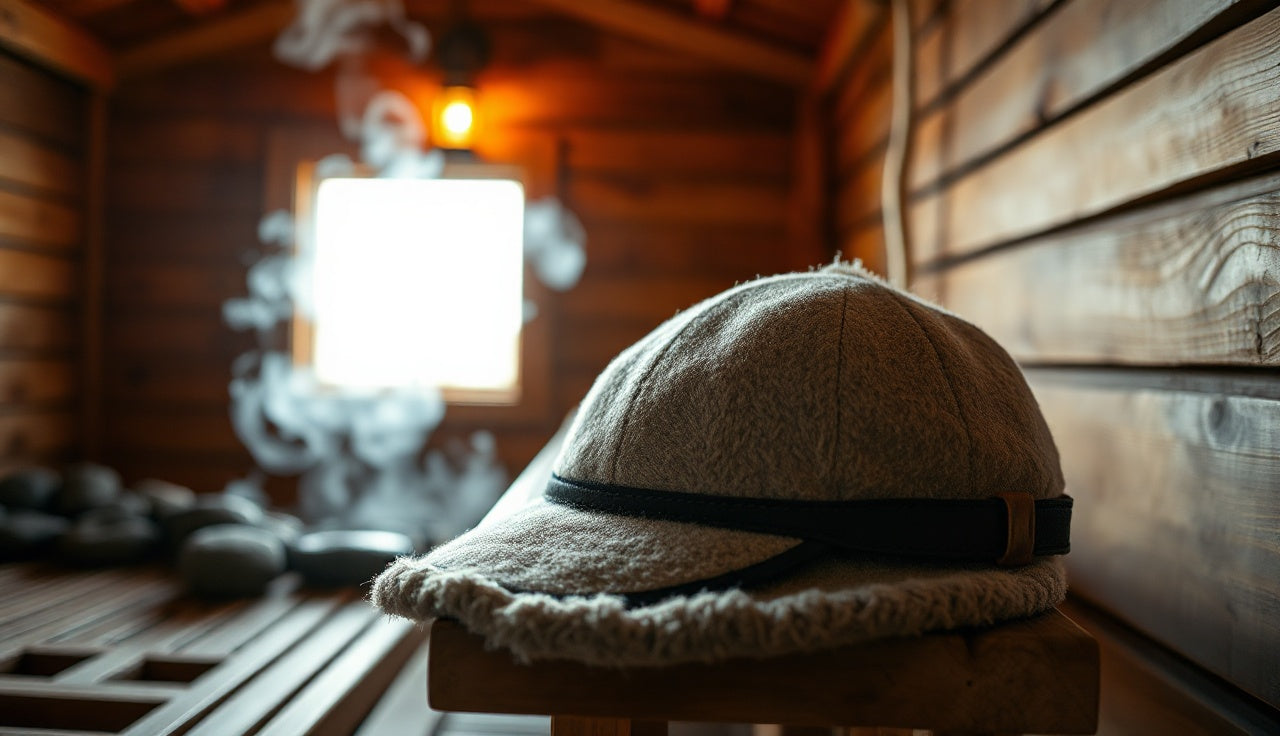
A sauna cap is a thick, insulating hat you wear inside a sauna to shield your scalp and hair from intense heat. It lets most people stay in 10-20 minutes longer by slowing overheating at the head. Wool felt and linen are the best materials. Caps cost $15-$60, last years with hand-washing, and matter most in Finnish-style saunas running above 170°F.
What does a sauna cap actually do?
A sauna cap does one specific thing: it slows the rate at which heat reaches your scalp and hair. That matters because the head has a dense network of blood vessels sitting close to the surface, and when scalp temperature climbs fast, core body temperature follows fast. Slow that process down and you stay in the heat longer before you hit your limit.
The physics is simple. The cap holds a small insulating pocket of air between your scalp and the sauna air. Wool felt, the traditional material, has a thermal conductivity around 0.04 W/m·K, low enough to buffer real radiant and convective heat from a 180°F room [1]. Linen works the same way, though it breathes a little more. Both fibers soak up some moisture without feeling drenched, which helps the moment you pour water on the rocks and the humidity jumps.
Secondary benefits show up in your hair. Repeated dry heat at sauna temperatures pulls moisture out of the hair shaft and damages the cuticle over time. A cap cuts that direct exposure. Go to the sauna several times a week and this matters far more than it does for the once-a-month visitor.
There's a modest blood pressure angle too, though the evidence is indirect. Finnish sauna culture has used caps for generations specifically to soften the head-rush feeling near the end of a long session. Nobody has run a controlled trial on caps and blood pressure. The underlying principle, slowing vasodilation at the scalp, is physiologically plausible and no more than that.
What are sauna caps made of, and which material is best?
Material decides almost everything about how a cap performs. Here's the honest breakdown.
Wool felt is the traditional choice and what most Finnish and Russian banya regulars reach for. Wool's crimped fibers trap air, it survives repeated wetting and drying without rotting, and it doesn't melt or off-gas at sauna temperatures. Thick, dense felt (3-5 mm) beats thin craft felt every time. The catch: good wool felt caps run $30-$60 and need hand-washing.
Linen is the other respectable option. It's lighter, breathes more, and is easier to care for than wool. If you run hot and full wool feels suffocating, go linen. It doesn't insulate quite as well in dry saunas above 200°F, but in a steam room or a lower-temperature home sauna running 150-170°F it holds up well.
Cotton terry caps live at the budget end. They soak up sweat and steam nicely but compress fast under heat and lose the air gap that does the work. They also turn heavy when wet. Fine for the occasional visit, wrong for regular sessions.
Synthetic materials (polyester, acrylic) are a hard pass. Most off-gas at elevated temperatures, some soften or melt where they touch a very hot bench, and none breathe. Stick to natural fibers.
| Material | Insulation | Breathability | Durability | Price range |
|---|---|---|---|---|
| Wool felt (thick) | Excellent | Moderate | Excellent | $30-$60 |
| Linen | Good | High | Good | $20-$45 |
| Cotton terry | Moderate | High | Moderate | $15-$30 |
| Synthetic | Poor | Low | Moderate | $10-$20 |
Buying one cap for regular use in a traditional Finnish-style sauna? Thick wool felt is the answer. Just testing the idea for the first time? A linen cap is a sensible, cheaper experiment.
How hot does a sauna get, and why does that make head protection matter?
Traditional Finnish saunas run 80-100°C (176-212°F) at bench level [2]. That's the air your scalp sits in, unprotected, through a typical 10-20 minute round. The head isn't just another body part here. The hypothalamus, which runs your temperature control, sits a few centimeters behind your forehead and reacts fast to changes in blood temperature.
A 2018 Mayo Clinic Proceedings review of sauna cardiovascular research reports core body temperature rising roughly 1°C per 10 minutes in a Finnish sauna at 80°C [3]. The scalp, sitting above the main body mass and often in the hottest zone of the room since heat rises, can warm even faster. On the top bench, air at head height often runs 10-20°F hotter than at bench level.
A portable sauna or lower-end unit might sit cooler, around 140-160°F, and the cap matters less there. But in a well-built outdoor sauna at full temperature, scalp protection genuinely changes how long a session feels bearable.
For people with high blood pressure, heart conditions, or no sauna experience, the American Heart Association's guidance is to keep sessions short and exit at any sign of dizziness [4]. A cap doesn't replace that caution. It's an accessory for people already comfortable in the heat who want to stretch their sessions.
| Thick wool felt (4-5mm) | 9 |
| Wool felt (3mm) | 7 |
| Linen | 6 |
| Cotton terry | 4 |
| Synthetic fleece | 2 |
Source: Engineering Toolbox thermal conductivity data [1]; traditional sauna practice documentation
Does a sauna cap actually let you stay in longer?
Experienced sauna users report 10-20 extra minutes of comfortable time with a cap on. No published randomized trial tests this exact claim, so treat it for what it is: consistent self-report from a practice that's been around for centuries in Finnish and Russian banya culture.
The physiological argument holds up. Slow how fast your scalp heats and you delay the signals telling your hypothalamus to crank sweating to maximum, then the lightheadedness that says it's time to leave. That's not invented. That's basic thermoregulation [5].
Here's what nobody should tell you: that a cap makes a session "safe" in any medical sense. Staying in a 180°F room longer carries its own cardiovascular load no matter what's on your head. The cap buys you comfort and hair protection. Whether to extend depends entirely on how you actually feel.
Run one test. Do your normal session without a cap and note when you want out. Do the same temperature with a cap. Most people feel the difference by the second or third try.
What size and fit should a sauna cap have?
Fit matters more than most buyers expect. Too tight and the cap compresses its own insulating layer, killing the effect. Too loose and it slides down over your eyes when you lean back, which is both annoying and pointless.
Most adult sauna caps are sized by head circumference: small/medium (54-57 cm, roughly 21.5-22.5 inches) and large/XL (58-62 cm, roughly 22.8-24.4 inches). Buying online? Measure your head just above the ears and eyebrows. Many traditional felt caps use a broad brim or structured crown that sits slightly off the scalp instead of hugging it, which is what keeps the air gap alive.
The cap should sit about an inch above your ears and cover the top and back of the head. Long hair goes up in a bun or loose twist underneath. Thick hair piled up actually helps the cap sit higher and cover more.
Avoid caps with metal hardware (snaps, buttons, grommets) anywhere near your scalp. Metal conducts heat straight through and can cause contact burns. All-natural-fiber construction with no metal is the standard for sauna-specific caps, and it's worth confirming before you buy any generic hat labeled as one.
How do you care for a sauna cap?
Caps get wet every session. Sweat, steam off the kiuas (the sauna stove), and humidity all sink into the material. Care keeps them from turning sour or losing their shape.
Wool felt caps: hand-wash in cool water with a little wool-safe detergent every few uses, or the moment they smell. Never machine-wash wool felt on a hot cycle. It shrinks and felts tighter, warping the shape for good. Rinse well, press out the water without wringing, and air-dry upside-down on a rounded surface to hold the dome. Drying flat works but can leave a crease.
Linen caps take slightly warmer water and forgive more, but the same rule applies: gentle wash, air dry.
After each session, don't stuff the cap into a sealed bag or locker. Hang it where air moves so it dries between uses. A cap left damp grows bacteria and mildew faster than almost any textile you own, because it lives in repeated heat and humidity.
With reasonable care, a quality wool felt cap lasts three to five years of regular use. The thicker the original felt, the longer it keeps its shape.
Are sauna caps good for your hair?
Heat damage to hair is well documented in dermatology literature: repeated exposure to temperatures above 150°F damages the hair cuticle (the outer protective layer of the shaft) and weakens the cortex over time [6]. A sauna at 180°F sits well past that line.
A cap cuts the direct contact between hot sauna air and your hair. It doesn't stop all moisture loss. The hair under the cap still sits in a warm, somewhat humid microclimate. The real difference is direct 180°F air versus a buffered pocket that might stay closer to 120-130°F inside the cap.
Color-treated hair sees the clearest benefit. High heat speeds color fade by opening the cuticle and letting pigment escape. A cap that buffers scalp temperature keeps that cuticle more closed during the session.
Work a little oil or a deep conditioning treatment into your hair before you put the cap on and you get a bonus: the gentle heat inside helps the treatment sink in. Banya tradition has done this for a long time with things like honey and natural oils. It's not a clinical recommendation. It's an old practice that people keep using because it works for them.
For the wider picture on sauna use, including temperature ranges and session structure, read the sauna benefits guide.
Can you use a sauna cap in a steam room or infrared sauna?
Yes, with some adjustments.
In a steam room, humidity sits near 100% and air temperature runs lower, usually 110-120°F. The cap still protects hair from sustained wet heat, but its insulating job matters less because the air is cooler. Linen beats thick wool felt here, since heavy felt gets saturated and heavy in full steam.
Infrared saunas are a different case. They run cooler, often 120-150°F, and heat your body through radiant infrared energy rather than by heating the air [7]. A cap in an infrared unit still shields hair, but the scalp-insulation benefit is small because the surrounding air stays mild. Use infrared exclusively and don't care about hair protection? You can skip the cap without much loss.
For traditional Finnish saunas, Russian banyas, or any wet sauna with water on the kiuas rocks, the cap earns its place most clearly. That's the room it was built for.
One note on contrast therapy: heading into a cold plunge after your sauna round means taking the cap off first. The cap is a sauna-side tool only. The cold side needs no headgear.
How much does a sauna cap cost, and is it worth buying?
Almost every cap on the market falls between $15 and $60. Here's how that breaks down.
$15-$25: cotton terry and thin linen. Fine for the occasional session or testing the idea. Don't expect more than one season of regular use.
$25-$45: mid-range wool felt and quality linen. This is where most people land and where the value is best. A cap in this range from a Finnish or Estonian maker is usually thick enough to perform and built to last.
$45-$60: thick hand-crafted wool felt, sometimes with embroidery or a shaped brim. The performance gain over a good mid-range cap is marginal. You're paying for craft and looks.
Worth it? Use a traditional sauna more than once a week and yes, easily. Hair protection alone covers the cost over the two- or three-year life of a decent cap. Use an infrared unit now and then and you can skip it, unless hair protection matters to you.
SweatDecks carries sauna accessories including caps for traditional sauna use, worth a look if you want to see what's in stock alongside your setup.
One genuine waste of money: novelty caps shaped like animals or made from synthetic fleece and marketed as sauna caps but built for nothing hotter than a photo. They're cute. They don't perform, and some off-gas at sauna temperatures.
What are the differences between a sauna cap and a regular beanie or towel on your head?
People ask this, and it's fair. The short answer: a wet towel over your head works in a pinch but isn't the same thing.
A wet towel drops a lot of moisture straight onto your scalp. In a dry Finnish sauna that feels cooling at first, but the water evaporates fast, and as it goes it pulls even more heat toward your head. The insulating gap never existed.
A regular beanie isn't built for the heat. Synthetic beanies off-gas, as noted above. A wool beanie might behave a little like a cap, but it's usually thin and form-fitting, which erases the air gap that makes a real sauna cap work. It also presses sweat against the scalp in a way a dome-shaped cap doesn't.
That dome shape is the whole point. Air is the insulator. The slight gap between the cap's inner surface and your scalp does the real work. A snug hat collapses it. A shaped cap protects it.
Some banya-goers use leafy birch branches (a venik) and a small towel over the head as part of the ritual, but that's a different protocol with a different purpose. For plain scalp protection, a purpose-built cap is the right tool.
What should you look for when buying a sauna cap online?
A few things separate a quality cap from a cheap knockoff when you can't hold it first.
Check the felt thickness. Anything listed as 3mm or thicker is likely fine. A listing that never mentions thickness is usually hiding a thin production piece.
Look for clear material disclosure. A legitimate product from a Finnish, Estonian, Lithuanian, or Russian maker usually names the wool or linen source. Vague listings that say "natural material" without specifics are often synthetic or low-grade blended felt.
Check the inner seam. A cap worn on bare, sweating skin should have flat or folded seams, not raised overlocking stitches that dig in. Many good caps have no inner seam at the crown at all.
Read the return policy on fit. Head circumference varies enough that a size exchange is common on a first purchase.
Ignore claims like "scientifically tested" or "clinically proven" on cap listings. No clinical trials exist on sauna caps. Honest sellers describe material and construction. They don't oversell medical benefits.
Building out a home sauna and weighing accessories alongside the cap? The home sauna guide covers what a setup actually needs.
Frequently asked questions
Do sauna caps actually work, or are they just a gimmick?
They work for what they claim: slowing heat transfer to the scalp in high-temperature saunas. No published clinical trial tests caps directly, but the physics of insulation is sound, and Finnish and Russian banya culture has used them for centuries. Hair protection from repeated heat exposure is also a documented benefit, based on what we know about heat and cuticle damage. Not a gimmick. A functional accessory.
Can I wear a sauna cap if I'm bald?
Yes, and many bald sauna users find caps more useful, not less. With no hair to buffer, the scalp sits directly in hot air. A cap supplies the insulation hair would otherwise partly provide. Fit can behave differently on a smooth scalp since the cap slips more easily, so look for one with a slightly snug band at the base.
How often should I wash my sauna cap?
Every three to five uses is a reasonable baseline, or the moment it smells. Caps absorb sweat and steam every session. A cap left damp between uses without air-drying grows bacteria and mildew quickly. Hand-wash wool felt in cool water with wool-safe detergent and air-dry in a well-ventilated spot. Never machine-wash on hot. It shrinks the felt badly.
What temperature is a sauna cap most useful at?
Traditional Finnish saunas running 170-212°F are where a cap makes the clearest difference. Below about 150°F it still helps with hair protection, but the scalp-temperature benefit shrinks. In infrared saunas (120-150°F) or steam rooms (110-120°F) it still protects hair while its insulating role fades. If your sauna regularly runs above 170°F, a cap is worth having.
Can I use a sauna cap in an infrared sauna?
Yes, though the benefit is mostly hair protection rather than scalp insulation. Infrared saunas run 120-150°F, cooler than traditional Finnish saunas. The radiant heating means the air itself stays fairly mild even as your body absorbs heat. A lightweight linen cap beats thick wool felt in that environment. If dry-heat hair protection isn't a concern, skipping the cap in infrared is fine.
What's the difference between a sauna cap and a regular wool hat?
The dome shape and thickness. A proper sauna cap sits slightly off the scalp, holding an insulating air gap. A regular wool hat is form-fitting and collapses that gap. Sauna caps also use thicker felt (3-5mm) built for repeated wet-dry cycles, and they skip metal hardware that conducts heat. A standard beanie technically works a little but performs noticeably worse.
Do sauna caps help with heat exhaustion or is that a safety claim?
A cap slows how fast your scalp heats, which delays the rise in core temperature that drives late-session discomfort. That's comfort management, not medical prevention of heat exhaustion. If you feel dizzy, lightheaded, or nauseous in a sauna, exit immediately no matter what's on your head. A cap doesn't replace knowing your own limits.
How long does a wool felt sauna cap last?
With proper care, three to five years for a quality thick-felt cap used several times a week. The main failure modes are loss of shape from bad washing (hot water shrinks wool felt) and thinning of the felt from compression over time. Hand-washing in cool water and air-drying upside-down on a rounded surface extends life a lot. Cheap thin caps usually last one or two seasons before losing structure.
Can kids wear sauna caps?
Kids' caps exist, sized for smaller heads. But children have less efficient thermoregulation than adults and should spend less time in saunas at lower temperatures regardless of accessories. The American Academy of Pediatrics has not published specific sauna temperature limits for children, so the conservative approach is short sessions (5-10 minutes), cooler temperatures, and close supervision. A cap helps but doesn't make extended sessions safe for young children.
Should I wet my sauna cap before putting it on?
In traditional Finnish and Russian banya practice, lightly dampening the cap before a session is common. It adds a small evaporative cooling effect at the scalp initially, and a damp cap holds its shape better on the head. Don't soak it. A light misting or a quick dip in cool water and a squeeze is enough. A soaking-wet heavy cap feels uncomfortable and adds real weight.
Are there sauna caps designed specifically for women or men?
Most caps are unisex and sized by head circumference, not gender. Some brands sell styles with wider brims or decorative touches marketed toward women, and some traditional Russian banya caps use a structured 'chef hat' shape that fits hair piled upward. What matters is circumference fit and material, not gender labeling. Measure before buying online.
Can I use a sauna cap for contrast therapy sessions?
The cap is for the sauna side only. Take it off before a cold plunge or ice bath. No headgear helps with cold immersion, and a soaked wool cap going into a cold plunge would be uncomfortable and slow to dry. Keep it on a hook near your sauna exit, do your cold exposure, then put it back on for the next heat round if you're running multiple cycles.
Do sauna caps smell bad over time?
They can if you neglect care. Wool felt left damp in a closed locker between sessions develops an odor within a few uses. Air-drying after every session and hand-washing every three to five uses prevents this in most cases. If a cap already smells, soaking it in cool water and white vinegar for 30 minutes before washing often helps. Natural wool carries a slight lanolin scent when wet, which is different from bacterial odor.
Sources
- Engineering Toolbox: Thermal Conductivity of Common Materials: Wool felt has a thermal conductivity of approximately 0.04 W/m·K, making it an effective insulating material.
- Finnish Institute for Health and Welfare (THL): Finnish Sauna Culture: Traditional Finnish saunas operate at 80-100°C (176-212°F) at bench level.
- Mayo Clinic Proceedings: Cardiovascular and Other Health Benefits of Sauna Bathing (Laukkanen et al., 2018): Core body temperature rises approximately 1°C per 10 minutes during Finnish sauna bathing at 80°C.
- American Heart Association: Sauna Safety Guidance: The AHA advises people with cardiovascular conditions to limit sauna session duration and exit immediately upon dizziness.
- National Institute of Environmental Health Sciences (NIEHS): Heat Stress and Thermoregulation: The hypothalamus regulates core body temperature in response to blood temperature changes including those driven by peripheral scalp vasodilation.
- Journal of the American Academy of Dermatology: Hair Shaft Damage from Heat (Gummer, 2002): Repeated exposure to temperatures above 150°F causes damage to the hair cuticle and weakens the cortex over time.
- National Center for Complementary and Integrative Health (NCCIH): Sauna Use for Health: Infrared saunas typically operate at lower air temperatures (120-150°F) than traditional Finnish saunas, heating the body through radiant energy rather than hot air.
- Laukkanen JA et al., JAMA Internal Medicine 2015: Sauna Bathing and Fatal Cardiovascular Events: Regular sauna use is associated with reduced cardiovascular risk; sessions studied were typically 15-20 minutes at temperatures of 78-100°C.
- UNESCO Intangible Cultural Heritage: Finnish Sauna Culture: Finnish sauna culture, including traditional accessories and rituals, was inscribed on the UNESCO Representative List of Intangible Cultural Heritage in 2020.
- International Journal of Environmental Research and Public Health: Sauna Use and Heat Stress Response (Hussain & Cohen, 2018): The study notes that sauna bathing induces measurable thermoregulatory responses including elevated heart rate and core temperature, consistent with moderate cardiovascular exercise.
Share:
Sauna advantages: what the science actually shows
Personal sauna: every type, cost, and setup question answered