
Last updated 2026-07-09
TL;DR
A personal sauna for home ranges from a $200 portable tent to a $10,000-plus permanent wood cabin. The right choice depends on space, budget, and how often you'll actually use it. Dry barrel saunas and indoor electric units hit the best balance of heat quality, durability, and cost. Most homeowners land between $3,000 and $6,000 all-in.
What exactly is a personal sauna, and what types can you put in your home?
A personal sauna is any sauna built for one to four people, sized and priced for a private home instead of a gym or spa. That covers a lot of ground. You can spend $200 on an infrared blanket, $1,500 on a portable pop-up tent, $4,000 on a pre-cut barrel kit you assemble in a weekend, or $12,000 on a custom cedar room built into your basement.
The main categories break down like this:
Traditional dry saunas use an electric or wood-fired heater to warm the air in an insulated wood room, typically to 150 to 195°F (65 to 90°C) [1]. You pour water on hot rocks to create bursts of steam and raise humidity briefly. This is the Finnish model, the one with the longest use history and the most research behind it.
Infrared saunas use infrared panels (near, mid, or far infrared) to heat your body directly rather than heating the air first. Operating temperatures are lower, usually 120 to 150°F (49 to 65°C), and the units tend to be compact, easy to assemble, and cheaper to run. The trade-off is that the heat feels different, and the research base is smaller than for traditional saunas [2].
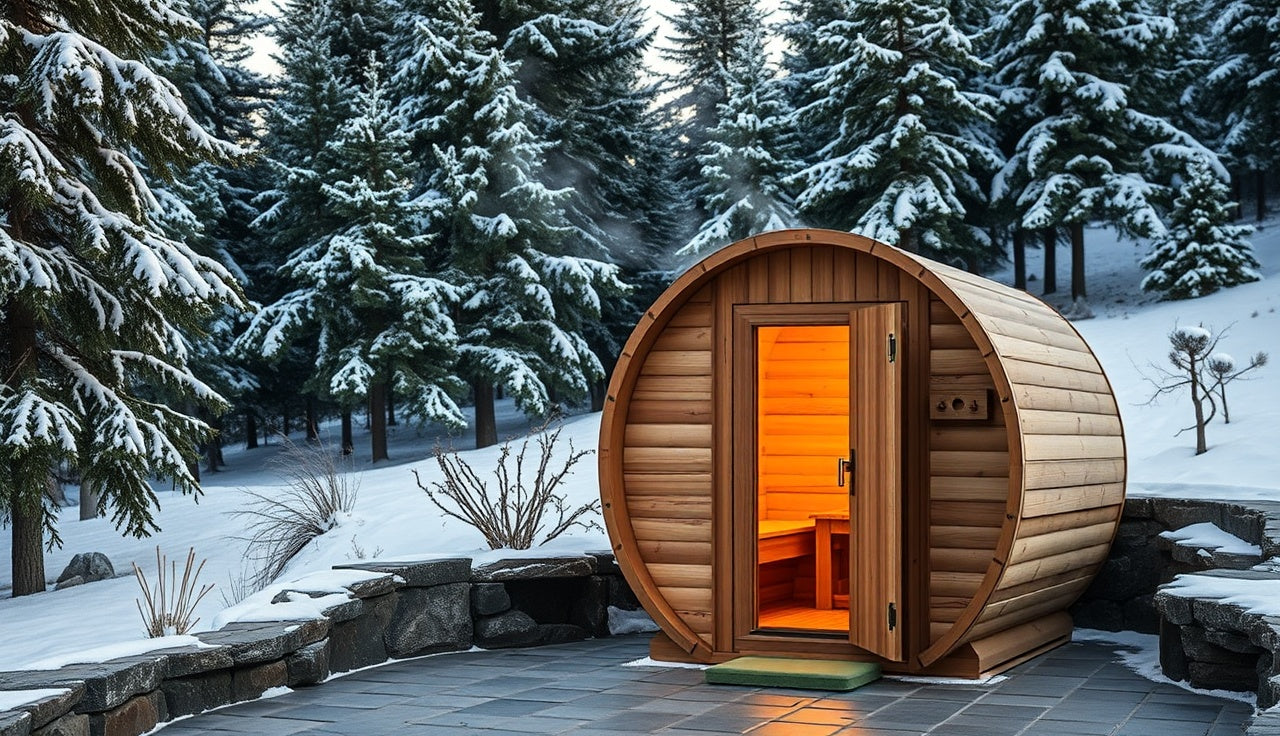
Barrel saunas are a shape, not a heat type. The rounded design is structurally efficient, sheds rain and snow well, and heats up fast. Most barrel saunas run a traditional dry heater. They're popular as outdoor units and ship as DIY kits.
Portable saunas and sauna tents are the entry-level option. A fabric shell, a small steam generator, and a folding chair. They work, but the heat quality is inconsistent and they wear out faster than solid-wall units. Read more about what to expect in our portable sauna guide.
Steam rooms are a separate category. They use a steam generator to fill a tiled space with wet heat at 100 to 115°F (38 to 46°C) and near 100% humidity. If you want steam, that's a different product than a sauna. See sauna vs steam room for a full comparison.
For most homeowners the real decision is between an indoor infrared unit and an outdoor traditional or barrel sauna. Both work well. The choice comes down to whether you have outdoor space and how much you want to spend on electricity.
How much does a personal sauna cost, including installation?
Cost depends on type, size, and whether you hire an electrician or do it yourself. Here's an honest breakdown:
| Type | Unit cost (1-4 person) | Typical install add-on | All-in range |
|---|---|---|---|
| Sauna blanket / tent | $200, $800 | $0 | $200, $800 |
| Indoor infrared cabinet | $1,200, $4,500 | $0, $400 (dedicated outlet) | $1,200, $4,900 |
| Outdoor barrel sauna kit | $2,500, $6,000 | $500, $2,000 (electrical + pad) | $3,000, $8,000 |
| Pre-built indoor traditional | $3,000, $7,000 | $400, $1,200 (electrical) | $3,400, $8,200 |
| Custom built-in room | $6,000, $20,000+ | Included in contractor quote | $6,000, $20,000+ |
Electrical is the hidden cost most buyers miss. A 4-person traditional sauna with a 6 kW heater needs a dedicated 240V/30A circuit. If your panel sits far from the install location, expect to pay an electrician $500 to $1,500 depending on your region [3]. Infrared units drawing under 15 amps can sometimes run on a standard 120V outlet, which erases that cost entirely.
Operating costs are modest. A 2 kW infrared unit running 45 minutes per session at the national average residential electricity rate of $0.17 per kWh (as of 2024) [4] costs about $0.26 per session. A 6 kW traditional heater for the same duration costs about $0.77. Neither is a meaningful household expense.
Wood-burning sauna stoves remove the electrical cost entirely but require a proper flue, clearance from combustibles, and in some areas a building permit. Going that route, budget $300 to $800 for a quality wood sauna stove plus chimney materials.
For a broader look at what drives pricing on home sauna setups, our home sauna page has more detail on what the ranges actually buy you.
Do you need a permit to build a personal sauna at home?
Permit requirements vary by municipality. There is no single federal rule. The general pattern is:
A freestanding outdoor sauna on a concrete pad or deck often requires a building permit if it's considered a permanent structure. Definitions of "permanent" vary, but most jurisdictions apply that label once you've attached anything to a foundation or added electrical wiring [5].
An indoor sauna inside existing square footage typically requires only an electrical permit for the new circuit, not a full building permit. But if you're framing new walls, adding ventilation penetrations, or altering the structure, a building permit is usually required.
Portable or semi-portable units (infrared cabinets that plug into a standard outlet, sauna tents) almost never require a permit.
The safest move is a five-minute call to your local building department before you buy anything. Tell them the size of the structure, whether it's attached or freestanding, and how it will be powered. They'll tell you exactly what you need. Skipping permits can create issues when you sell the house.
HOA rules are a separate layer. Some HOAs restrict outdoor structures by size, material, or placement. Check your CC&Rs before ordering a barrel kit.
For outdoor-specific placement and permit considerations, the outdoor sauna guide covers common scenarios.
| Sauna blanket / tent | $500 |
| Infrared cabinet (indoor) | $3,000 |
| Outdoor barrel sauna kit | $5,500 |
| Pre-built indoor traditional | $5,800 |
| Custom built-in room | $13,000 |
Source: SweatDecks market research, 2024, aligned with EIA and contractor cost data
What size personal sauna do you actually need?
Most people overbuy on size and underbuy on heater output. Here's the honest math.
A 1-person infrared cabin is typically 3 to 4 feet wide by 3 to 4 feet deep by 6 feet tall. That's tight but functional for solo use, and it fits in a spare bathroom or bedroom corner. If two people will ever use it together, step up to a 2-person unit.
For traditional dry saunas, the industry rule of thumb is about 45 to 50 cubic feet of room per person on the bench. A 4-foot by 6-foot floor with 7-foot ceilings is roughly right for two to three people. Go larger and you'll need a bigger heater to hold temperature, which adds to both purchase and operating cost.
The more important sizing variable is bench space, not floor area. A well-designed 2-person sauna with a full-length bench where you can lie down flat beats a 4-person cabinet where everyone sits upright.
Ceiling height matters too. Finnish protocol has you sitting on upper benches where temperatures run 15 to 30°F hotter than at bench level. A 7-foot ceiling gives you a real temperature gradient. Drop it to 6 feet and you lose that dynamic.
For heater sizing in a traditional sauna, the common guideline from heater manufacturers is 1 kW per 45 cubic feet of space, though well-insulated rooms can get by with slightly less. A standard 6 by 6 by 7 foot room is 252 cubic feet, which points to roughly a 6 kW heater. Undersizing the heater is the most common mistake in DIY builds. It means long preheat times and a room that can't hold temperature.
What are the actual health benefits of regular sauna use?
The research here is more solid than most wellness claims, and more nuanced than the marketing suggests. The strongest evidence comes from Finnish cohort studies that followed large populations over many years.
A 2018 study published in Mayo Clinic Proceedings, following 1,688 middle-aged Finnish men over 20 years, found that frequent sauna use (4 to 7 times per week) was associated with reduced cardiovascular mortality compared to once-weekly use [6]. The association held after adjusting for other lifestyle factors. The authors noted: "Sauna bathing is a safe activity for most healthy adults." That's a quoted conclusion from the paper, not a paraphrase.
A 2018 systematic review in the International Journal of Environmental Research and Public Health found consistent evidence that regular sauna use improves arterial compliance and reduces blood pressure in hypertensive patients, though the authors called for larger randomized trials before firm clinical recommendations [7].
Muscle recovery is where the evidence gets thin. Heat raises blood flow and may reduce delayed-onset muscle soreness, but the randomized controlled trial data is limited. Nobody has good population-scale data here; the closest studies use small samples and show modest effects.
Mental health signals look promising. Recreational heat exposure has been linked to lower depression symptoms in adults, though causality is hard to pin down from observational data.
Sleep is the benefit consistent users report most often. There's a plausible mechanism: core body temperature drops after a sauna, which mimics the pre-sleep temperature decline your body normally triggers. But clinical trial evidence for sauna specifically improving sleep quality is sparse.
The conservative summary. Regular sauna use is associated with cardiovascular benefits in healthy adults who use it consistently (multiple times per week), and there's credible evidence for blood pressure effects. For everything else, the signals are interesting but the evidence isn't conclusive. Check the sauna benefits article for a deeper look at the research.
Safety note: people with cardiovascular conditions, pregnant women, and anyone taking medications that affect thermoregulation should talk to a physician before using any sauna regularly. The Finnish Medical Society guidance is explicit on this [1].
Traditional sauna vs infrared sauna: which one is better for home use?
This question doesn't have a single right answer, but it has a clear structure.
Traditional dry saunas run hotter (150 to 195°F vs 120 to 150°F for infrared) and produce a different sensation. The high heat and low humidity, spiked with steam from pouring water on rocks, creates the experience most sauna researchers actually studied. If you care about matching the protocols in the cardiovascular literature, traditional is the match.
Infrared saunas are more practical for many home setups. They heat up in 10 to 15 minutes compared to 30 to 45 minutes for a traditional unit. They don't need 240V wiring in most cases. They're quieter and have no hot rocks to manage. The lower operating temperature also makes them easier for people who find 180°F hard to tolerate.
The marketing claim you'll see everywhere is that infrared penetrates deeper into tissue and produces more detoxification than traditional heat. The evidence for superior detox from infrared specifically (vs traditional heat) is weak. Sweat is sweat. The sauna industry's detox claims, across all types, run far ahead of the science.
For resale value, traditional and barrel saunas photograph better and read as a home amenity to buyers. An infrared cabinet in a spare bedroom looks more like appliance furniture.
If you have outdoor space, a traditional barrel or cabin sauna is hard to beat. If you're working with an apartment or small indoor footprint, an infrared unit makes more sense. Visit our sauna guide for a full type-by-type breakdown.
Can a personal sauna be installed indoors, and what does it take?
Yes, and it's more common than most people expect. Here are the real requirements.
Floor: Most infrared and pre-built traditional cabinets sit directly on any flat floor. They're self-contained. Basement concrete, bathroom tile, or hardwood all work. You don't typically need to reinforce a floor for a 4-person cabinet; the weight is usually under 500 lbs loaded.
Electrical: This is the main installation requirement. An infrared unit running at 120V plugs into a standard outlet. A 240V traditional sauna heater needs its own dedicated circuit, a GFCI breaker, and a disconnect within sight of the unit. This is the work that requires a licensed electrician in most states [3].
Ventilation: Saunas need air intake at floor level and exhaust near the ceiling to pull fresh air in and hot, humid air out. Many pre-built units have built-in vents. In a basement or interior room with no exterior wall, you may need to route exhaust to an adjacent space or up through the ceiling. Ignore ventilation and you invite mold, plus CO risk if you're burning wood.
Clearances: Electric and infrared heaters need clearance from combustible materials per the manufacturer's instructions and NFPA 70 (National Electrical Code) requirements [5]. Don't place the unit flush against a standard drywall wall without checking the manufacturer's minimum clearance spec.
Moisture: Even a dry sauna produces significant humidity. Use a moisture-resistant material between the sauna exterior and any adjacent wall if you're building into a tight space. Cedar and spruce resist moisture naturally; standard construction lumber does not.
Most infrared cabinet installs take two people about three to four hours. Pre-built traditional cabin kits with 240V power take a full weekend including the electrical rough-in.
How do you combine a personal sauna with cold plunge or contrast therapy?
Contrast therapy, alternating between heat and cold, is one of the most talked-about recovery protocols right now, and a home setup can replicate it fully.
The general protocol used in most research is: 10 to 20 minutes in the sauna, then 1 to 3 minutes in cold water (50 to 60°F / 10 to 15°C), repeat two to three cycles, ending either way depending on your goal. Ending cold is common for reducing inflammation and muscle soreness after training. Ending hot is more common for relaxation [9].
For a home setup, you need the sauna and something cold. Options in order of cost and effectiveness:
1. A cold shower (free, less immersive, still works for temperature contrast) 2. A chest freezer conversion or stock tank with ice (roughly $300 to $800) 3. A dedicated cold plunge tub with a chiller, which runs $2,000 to $8,000 depending on the model
If you go the dedicated cold plunge route, placement relative to the sauna matters. You want to move between them in under 60 seconds. The thermal contrast effect doesn't hinge on a specific temperature protocol validated in large RCTs, so don't overthink exact temperatures. The principle: hot enough to meaningfully raise core temp, cold enough to meaningfully drop skin temp and trigger vasoconstriction.
Our cold plunge and cold plunge benefits pages go into this in more detail, and if you're weighing a dedicated cold plunge tub against an ice bath setup, there's a practical cost and maintenance comparison there too.
SweatDecks carries both sauna and cold plunge options if you want to see what a paired setup looks like at different price points.
What materials and wood types make a personal sauna last longer?
Wood choice matters more in a sauna than in almost any other home product, because you're exposing the material to repeated temperature swings, humidity spikes, and direct body contact in a hot environment.
The four woods you'll see most often:
Western red cedar is the most popular in North American saunas. It resists warping and cracking through heat cycles, has low thermal conductivity (it stays comfortable to touch even at high temperatures), and its natural oils inhibit mold and rot. It smells good and ages well. Most quality pre-built units and kits use cedar.
Nordic spruce is the traditional Finnish choice. It's lighter in color, harder than cedar, and takes longer to warm up. It's slightly less rot-resistant than cedar but widely available in European-sourced kits. Less common in US retail.
Hemlock is cheaper than cedar and shows up in many entry-level infrared cabinets. It's fine for dry infrared use but less durable than cedar in a hot-wet traditional environment.
Thermally modified wood (also sold as "thermo aspen" or "thermowood") is wood that's been heat-treated to reduce its moisture content and improve dimensional stability. It's more common in higher-end builds. It costs more than cedar but stays extremely stable.
For hardware, use stainless steel or aluminum screws and hinges. Zinc-plated fasteners rust fast in a humid sauna and stain the wood.
Heater quality is the other durability factor most buyers overlook. Finnish brands like Harvia and Helo have a track record going back decades and use controls genuinely rated for the thermal environment. Cheap heaters from unbranded manufacturers fail at the control boards first, usually within three to five years.
For the structure itself, a well-built cedar sauna with a quality heater should last 20 years or more with basic maintenance: cleaning the benches periodically, checking the heater elements annually, and keeping the room dry between sessions.
Does a personal sauna add value to your home?
It can, but the answer depends heavily on type, location, and buyer market.
A well-built permanent outdoor barrel sauna or an integrated indoor sauna room in a finished basement usually reads as a positive amenity to real estate agents in markets where wellness features matter. Anecdotally (and this is anecdotal, since no large national study isolates sauna ROI), agents in northern states and premium markets report that a quality sauna can add more than its install cost to perceived value.
An infrared cabinet sitting in a corner of a spare bedroom is a different story. It's furniture, not a fixed improvement. Most buyers won't pay more for it.
The general real estate principle: permanently installed improvements that require skilled trades to install and can't easily be removed tend to add value. Plug-and-play appliances don't.
On taxes, a sauna installed for medical reasons and prescribed by a physician may qualify as a medical expense deduction under IRS Publication 502, but the bar is high and it must be primarily for disease treatment, not general wellness [10]. Don't assume it qualifies. Talk to a tax professional with the specifics.
For resale, document your electrical permits and installation specs. Buyers and their inspectors will ask.
What's the best personal sauna for a small space or apartment?
Small space constraints push you toward one of two categories: a freestanding infrared cabinet or a portable sauna tent.
For a 1-person infrared cabinet, the smallest units run roughly 36 by 36 by 75 inches. That's about the footprint of a large mini-fridge. You need a standard 120V outlet and a door or window nearby for ventilation. Most come flat-packed and assemble with basic tools. You can take them apart and move them if you relocate.
For apartments, check your lease. Some leases restrict high-wattage appliances or changes to electrical circuits. An infrared unit drawing 1,500 to 1,800 watts (about the same as a space heater) usually flies under the radar. A 240V traditional sauna requires a hardwired circuit and is not apartment-appropriate.
Portable sauna tents deserve a mention. They're genuinely workable for occasional use, take up almost no storage space, and cost under $300. The heat quality isn't great compared to a solid-wall unit, and the steam-based heat of most tents is different from a true dry sauna. But if you have no permanent space, a tent beats nothing. Check the portable sauna guide for specific models and realistic expectations.
Sauna blankets are the most space-efficient option there is. You lie inside an insulating bag with infrared elements. They're genuinely effective at raising core temperature and cost $200 to $500. The experience isn't the same as sitting in a sauna room, but for people in truly constrained spaces they're a legitimate option.
How do you maintain and clean a personal sauna?
A home sauna is low maintenance compared to most home features, but it does need consistent care to stay safe and last.
After each session: Open the door and leave the heater or panels off so the room dries completely. Wipe down benches with a clean towel. Most sweat sits on the surface; it doesn't penetrate well-built cedar. Sitting on a towel during sessions cuts the cleaning load a lot.
Weekly (for regular users): Scrub benches with a stiff brush and warm water. No soap on the wood, since it soaks in and hurts the wood's ability to breathe. Some manufacturers recommend a diluted hydrogen peroxide solution (around 3%) for deeper cleaning without residue.
Monthly: Check the heater elements or infrared panels for dust. Dust on infrared panels cuts efficiency; a dry cloth wipe usually handles it. For traditional heaters, check that the sauna stones are intact and not crumbling (crumbling stones can release dust and interfere with airflow; replace any that have deteriorated).
Annually: Inspect the electrical connections and heater controls. Check that the door seal is intact and the hinges are secure. Look for moisture intrusion at the floor-wall junction if the unit is indoors.
What not to do: Don't use bleach on wood benches; it damages the fibers and creates a chemical smell when the sauna heats up. Don't seal the wood interior with polyurethane or varnish; it off-gasses at sauna temperatures and makes the wood slippery. Tung oil or a purpose-made sauna wood oil, applied sparingly to the exterior only, is fine.
Frequently asked questions
How long does it take to heat up a personal sauna?
An infrared personal sauna reaches operating temperature in 10 to 15 minutes. A traditional dry sauna with a properly sized electric heater takes 30 to 45 minutes to reach 170 to 190°F. Wood-burning stoves take 45 to 60 minutes. Heater undersizing is the most common reason a sauna takes too long, so match heater output (roughly 1 kW per 45 cubic feet) to your room.
How many times per week should you use a personal sauna?
The most-studied frequency in cardiovascular research is 4 to 7 sessions per week, which is what Finnish cohort data associates with the strongest health outcomes. Even 2 to 3 sessions weekly showed benefits compared to once a week in the 2018 Mayo Clinic Proceedings study. Daily use is safe for healthy adults. Sessions of 15 to 20 minutes are the typical benchmark; longer isn't necessarily better.
Can you use a personal sauna every day?
Yes, for most healthy adults daily sauna use is safe. Finnish sauna culture historically included daily bathing. The main cautions are staying hydrated (drink water before and after each session), avoiding alcohol before use, and listening to how you feel. People with cardiovascular conditions, low blood pressure, or on medications that affect thermoregulation should consult a physician before using a sauna daily.
What's the difference between a 1-person and 2-person personal sauna?
Mainly floor footprint and bench length. A 1-person unit is roughly 36 by 36 inches; a 2-person unit is typically 47 to 60 inches wide. The 2-person size also lets one person lie down flat, which many regular users prefer for the heat distribution. Cost difference is usually $300 to $800. If budget allows, the 2-person size is worth it even for solo use.
Does an indoor personal sauna require ventilation?
Yes. Saunas need an air intake vent near the floor and an exhaust vent near the ceiling to pull fresh air in and prevent excess humidity buildup. Most pre-built cabinets have this built in. When installing in an interior room, you may need to route exhaust to an adjacent space. Poor ventilation leads to mold, stale air, and in wood-burning setups, carbon monoxide risk.
Is a personal infrared sauna safe for older adults?
Generally yes, with some caveats. Infrared saunas run at lower temperatures (120 to 150°F) than traditional saunas, which many older adults tolerate better. The main risks are dehydration and orthostatic hypotension (dizziness on standing). Older adults should stay under 15 to 20 minutes per session, hydrate before and after, and rise slowly. Anyone with heart disease or on blood pressure medications should get physician clearance first.
What's a realistic all-in budget for a quality personal sauna at home?
For a 2-person infrared cabinet with decent build quality, budget $2,500 to $4,500 including any electrical work. For a 2-person outdoor barrel sauna with a quality traditional heater, budget $4,500 to $7,000 all-in with concrete pad and electrical. Entry-level options under $1,500 exist but tend to underperform on heat retention and durability. The sweet spot for most homeowners is $3,000 to $5,500.
Can a personal sauna help with muscle recovery after workouts?
The evidence is promising but not definitive. Heat increases blood flow to muscles, and some small studies suggest it reduces delayed-onset muscle soreness. For recovery, many athletes combine heat and cold in contrast therapy protocols. Nobody has large-scale RCT data proving a specific sauna routine accelerates recovery better than rest alone. Still, the association with reduced soreness is consistent enough in smaller studies to make it a reasonable part of a recovery routine.
What's the minimum ceiling height for a personal sauna?
Six feet is the functional minimum, but 7 feet is significantly better. In a traditional sauna, the temperature gradient between the floor and upper bench is 15 to 30°F. More ceiling height means a hotter upper bench without requiring higher thermostat settings. Pre-built indoor infrared units are typically 6 to 6.5 feet tall and fit under standard 8-foot ceilings with room to spare.
Are there personal saunas that don't require any electrical work?
Yes. Portable sauna tents typically run on standard 120V outlets or sometimes even 20-amp circuits. Sauna blankets plug into a standard outlet. Some outdoor barrel saunas use wood-burning stoves and require no electricity at all, just a proper flue and clearances. If you want zero electrical involvement, a wood-fired barrel sauna or a sauna blanket are the practical options.
How does a personal sauna affect blood pressure?
During sauna use, blood pressure initially drops due to vasodilation. A 2018 systematic review in the International Journal of Environmental Research and Public Health found consistent evidence that regular sauna use improves arterial compliance and reduces resting blood pressure in hypertensive patients. However, the same review called for larger randomized trials before firm clinical recommendations. People with uncontrolled hypertension should consult a physician before using a sauna regularly.
What's the best wood for a personal home sauna?
Western red cedar is the top choice for most North American buyers. It resists warping, has low thermal conductivity (stays comfortable to touch at heat), and its natural oils resist mold and rot. Nordic spruce is the traditional Finnish alternative. Hemlock works fine for dry infrared use but is less durable in a hot-wet traditional environment. Avoid pressure-treated lumber; it off-gasses chemicals at sauna temperatures.
Can you put a personal sauna on a wood deck?
Yes, but with conditions. The deck must be structurally rated for the weight (a 4-person barrel sauna can weigh 800 to 1,200 lbs loaded). Make sure water drainage from the sauna door won't rot the deck surface. Some municipalities require a permit for permanent structures on decks. Most manufacturers recommend a leveled, solid base, either concrete pavers or a continuous platform rather than gapped deck boards.
Sources
- Finnish Medical Society Duodecim, Sauna guidelines: Traditional dry saunas heat the air to 150 to 195°F (65 to 90°C); Finnish Medical Society guidance on sauna safety for healthy adults
- NCCIH, National Institutes of Health, Whole-Body Hyperthermia: Infrared saunas operate at lower temperatures (approximately 120 to 150°F) than traditional saunas and have a smaller research base
- National Electrical Code (NFPA 70), Article 424: 240V sauna heaters require a dedicated circuit, GFCI breaker, and disconnect within sight of the unit per NEC requirements
- U.S. Energy Information Administration, Average Retail Electricity Prices: U.S. average residential electricity rate was approximately $0.17 per kWh as of 2024
- U.S. Consumer Product Safety Commission, Home Safety Guidance: Permanent outdoor structures with electrical wiring typically require a building permit; CPSC clearance requirements for electric heaters
- Laukkanen et al., Mayo Clinic Proceedings, 2018: Frequent sauna use (4 to 7 times per week) was associated with reduced cardiovascular mortality in a 20-year Finnish cohort study of 1,688 men; authors stated 'Sauna bathing is a safe activity for most healthy adults'
- Hussain and Cohen, International Journal of Environmental Research and Public Health, 2018: Systematic review found consistent evidence that regular sauna use improves arterial compliance and reduces blood pressure in hypertensive patients, with authors calling for larger randomized trials
- Versey et al., Sports Medicine, 2013, Hydrotherapy and Contrast Water Therapy for Recovery: Contrast therapy protocol: 10 to 20 minutes heat followed by 1 to 3 minutes in cold water at 10 to 15°C, repeated two to three cycles; ending cold used for inflammation reduction, ending hot for relaxation
- IRS Publication 502, Medical and Dental Expenses: A sauna installed for medical reasons and prescribed by a physician may qualify as a medical expense deduction, but only if primarily for disease treatment

Share:
Full spectrum infrared sauna: what it is and whether it's worth it
Full spectrum infrared sauna: what it is and whether it's worth it