
Last updated 2026-07-09
TL;DR
A full spectrum infrared sauna emits near, mid, and far infrared wavelengths in one cabin, running at 120-150°F instead of the 170-200°F of a traditional sauna. Regular use is linked to lower blood pressure, better cardiovascular markers, and faster muscle recovery. Whether it beats a single-wavelength far-infrared sauna is a question the evidence hasn't settled.
What is a full spectrum infrared sauna?
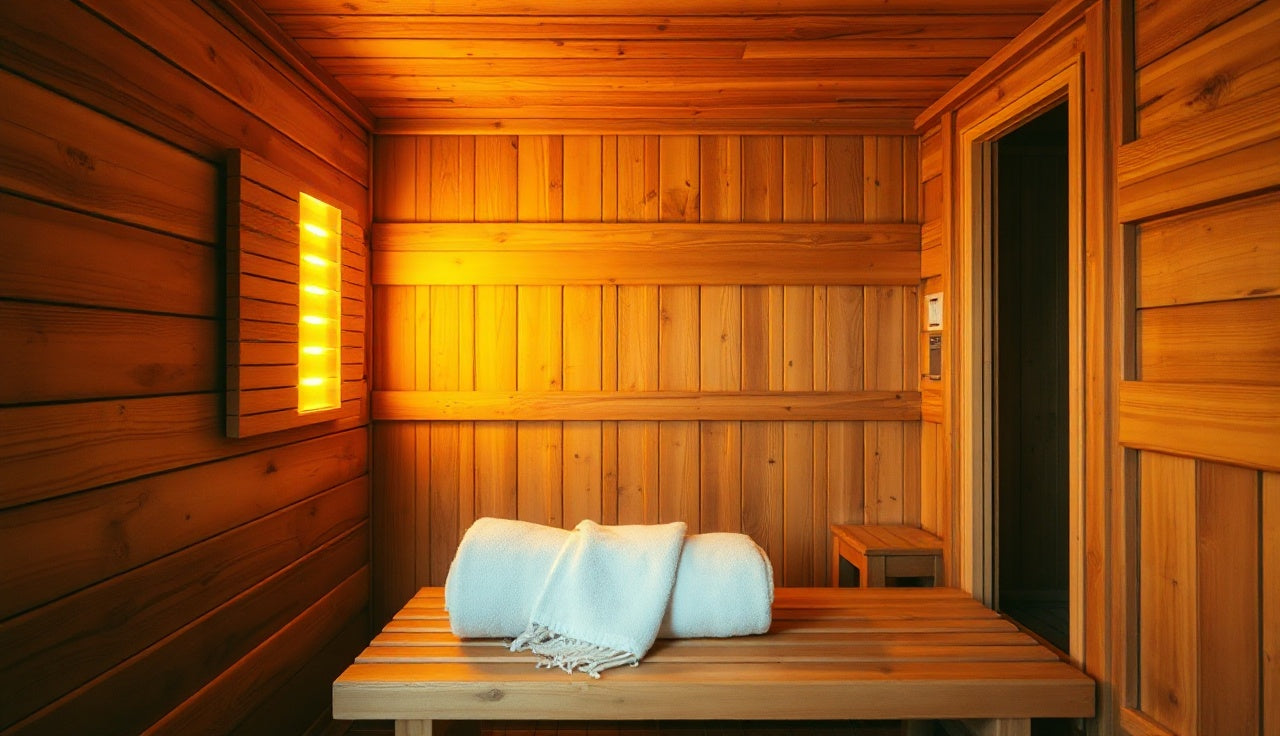
A full spectrum infrared sauna is a wood-paneled cabin with heaters that produce three bands of infrared light: near infrared (NIR, roughly 0.75-1.4 µm), mid infrared (MIR, 1.4-3 µm), and far infrared (FIR, 3-1000 µm). Each band reaches a different tissue depth and does a different job. Far infrared is the workhorse. It raises your core temperature. Mid infrared reaches muscle and joint tissue. Near infrared sits closest to visible red light and is the wavelength most studied in photobiomodulation research.
Most infrared saunas on the market are far-infrared only. They're cheaper to build, and far infrared has the longest human research record, going back to Japanese clinical trials from the 1980s and 1990s. Full spectrum units cost more because they need multiple heater types, usually pairing ceramic or carbon far-infrared panels with LED or tungsten near-infrared sources.
The operating temperature is a lot lower than a traditional Finnish sauna. Full spectrum units run between 120°F and 150°F (49-66°C). A wood-burning or electric Finnish sauna runs 170-200°F (77-93°C) [1]. That lower heat feels easier for most people, and many users sit longer, which may matter for the dose-response link between heat exposure and health outcomes.
Comparing to other heat options? The sauna vs steam room piece walks through how humidity changes everything about the experience.
What does the research actually say about full spectrum infrared sauna benefits?
Most of the human clinical evidence comes from far-infrared sauna studies, not full spectrum studies specifically. The full spectrum category is a marketing distinction more than a research category right now. That said, the far-infrared data is real and worth taking seriously.
A 2018 review in Mayo Clinic Proceedings examined multiple Finnish cohort studies and randomized trials and concluded that "sauna bathing has several health benefits," noting associations with reduced cardiovascular disease risk, lower all-cause mortality, and improved blood pressure [2]. The Kuopio Ischemic Heart Disease study, which followed over 2,300 Finnish men, found that men who used a sauna 4-7 times per week had a 40% lower risk of all-cause mortality compared to once-a-week users [2]. Those were traditional saunas, not infrared, so the translation has limits.
For infrared specifically, a 2009 randomized controlled trial in the Journal of Cardiac Failure found that far-infrared sauna use improved cardiac function and quality of life in patients with chronic heart failure [3]. Blood pressure benefits show up in small trials too. A 2012 study in Complementary Therapies in Clinical Practice found a single far-infrared session lowered both systolic and diastolic blood pressure in adults with hypertension [4].
Near infrared's contribution is mostly studied in photobiomodulation (low-level laser or LED therapy), not sauna. The photobiomodulation literature supports some wound-healing and anti-inflammatory effects through cytochrome c oxidase stimulation. Whether a brief near-infrared exposure during a sauna session delivers a therapeutic dose is genuinely unclear. Nobody has good data on that yet.
For a wider look at what the evidence supports, the sauna benefits guide goes deeper into the cardiovascular and recovery literature.
Near vs mid vs far infrared: what does each wavelength actually do?
| Wavelength band | Range | Approximate tissue depth | Primary studied effects |
|---|---|---|---|
| Near infrared (NIR) | 0.75-1.4 µm | Skin surface and subcutaneous tissue, ~5 mm | Photobiomodulation, collagen synthesis, wound healing [5] |
| Mid infrared (MIR) | 1.4-3 µm | Muscle and joint tissue, ~1-2 cm | Pain relief, circulation, joint mobility [6] |
| Far infrared (FIR) | 3-1000 µm | Deep tissue, ~4 cm | Core body temperature rise, cardiovascular response, sweating [2] |
Far infrared does the heavy lifting in any infrared sauna session. When FIR raises your core temperature, your heart rate climbs, blood vessels dilate, and you sweat. That cardiovascular and thermoregulatory response is what most of the health research is measuring.
Mid infrared gets marketed for pain relief and joint mobility. There's some evidence here. A 2009 trial in Clinical Rheumatology found infrared sauna sessions (combining MIR and FIR) improved pain and stiffness scores in rheumatoid arthritis patients compared to controls, with effects lasting up to four weeks post-treatment [6]. The sample sizes in that line of research are small, so treat the finding as encouraging, not settled.
Near infrared is the most speculative part of the full spectrum pitch. The photobiomodulation research base is real, but it usually uses targeted devices delivering specific doses to specific tissues, not ambient NIR in a hot room. The research hasn't confirmed whether a sauna-based NIR exposure replicates those effects.
| 1x per week (reference) | 0% |
| 2-3x per week | 24% |
| 4-7x per week | 40% |
Source: Mayo Clinic Proceedings, Laukkanen et al. 2018
How does a full spectrum infrared sauna compare to a traditional sauna?
The core difference is mechanism. A traditional sauna heats the air around you, and that hot air heats your skin by convection. An infrared sauna radiates energy that your tissues absorb directly. You sweat at a much lower ambient temperature, which many people find easier to tolerate for longer sessions.
Which one is better depends on what you want. The traditional sauna has a much larger evidence base, mostly because Finnish culture has used them for centuries and Scandinavian researchers have studied their users for decades. The infrared sauna is newer and the research, while promising, is thinner. If longevity and cardiovascular health drive your decision, the traditional sauna data is more convincing right now.
For muscle recovery after training, the comparison is close. Both raise core temperature and push blood flow to muscle tissue. A 2021 study in the Journal of Science and Medicine in Sport found post-exercise far-infrared sauna use reduced perceived muscle soreness and improved self-reported recovery scores compared to passive rest [7]. Traditional post-exercise heat studies show similar patterns.
Cost and installation split them too. A traditional sauna needs ventilation, a drain in many cases, and either a wood stove with a flue or a high-amperage electric heater (typically 240V, 20-60A depending on size) [8]. A full spectrum infrared sauna often runs on a standard 120V 20A circuit for smaller two-person units, though larger four-person cabins usually need 240V. That electrical gap is real money at install time. See the home sauna guide for a full breakdown of what installation actually costs.
If portability matters more than performance, the portable sauna category has fabric infrared options under $500, though they give up even heating and durability.
What are the real benefits of regular full spectrum infrared sauna use?
Separating honest benefits from marketing takes some effort in this category. Here's what the evidence actually supports.
Cardiovascular benefits are the most consistent finding. Regular sauna use (most studies define this as 3-7 sessions per week, 15-30 minutes each) is associated with lower resting blood pressure, better endothelial function, and reduced cardiovascular mortality risk [2]. Most of that data comes from traditional sauna research, but the far-infrared trials point the same direction.
Blood pressure reduction is one of the better-documented acute effects. A single infrared session has been shown to drop systolic blood pressure by roughly 5-10 mmHg in people with mild hypertension [4]. That's a real effect. It's not a substitute for medication or lifestyle change.
Pain and stiffness: the rheumatoid arthritis data above is genuine. The mechanism is thought to be increased local circulation plus a direct anti-inflammatory effect from heat. The MIR band may contribute here specifically, which is where the full spectrum argument earns some logic.
Mental health and stress: sauna use is associated with lower cortisol and better mood, though the research often doesn't separate infrared from traditional. A 2023 review in Psychophysiology noted that brief passive heat exposure reduces anxiety scores and improves subjective well-being, likely through both the parasympathetic shift during recovery and transient hyperthermia-induced opioid release [9].
Skin: near infrared has shown collagen synthesis effects in controlled photobiomodulation studies [5]. Whether a sauna session delivers enough NIR dose to replicate those findings is the honest gap. The sweating itself also cleans pores, a low-tech benefit that needs no special wavelengths at all.
What the evidence does not support: "detoxing" heavy metals through sweat. Sweat is mostly water and electrolytes. The liver and kidneys handle the actual detox work. Some metals do appear in sweat in measurable quantities, but the claim that sauna sweating is a meaningful detoxification pathway is not established science.
What should you look for when buying a full spectrum infrared sauna?
The sauna market has a lot of noise. Here's what actually matters.
Heater quality and configuration matter more than most specs you'll see advertised. Carbon panel heaters produce broad, even far-infrared coverage at a lower surface temperature (around 200-250°F), which cuts the risk of skin burns. Ceramic rod heaters run hotter at the surface and heat up faster. Full spectrum units usually add LED arrays or low-wattage tungsten emitters for near-infrared. Ask the manufacturer exactly what wavelength range each emitter covers and whether they have third-party spectral measurements.
Wood type: western red cedar is the most common choice, for good reason. It resists warping in humid conditions, doesn't off-gas much when heated, and has low thermal conductivity so the walls don't burn you when you touch them. Hemlock is a cheaper alternative that performs reasonably well. Avoid anything with MDF, particle board, or glues you can't verify as formaldehyde-free. At sauna temperatures, off-gassing from low-grade materials is a real concern.
EMF levels: infrared heaters produce low-frequency electromagnetic fields. Some manufacturers publish independent EMF test results. Look for units measuring below 3 milligauss at the typical sitting distance, which sits within the precautionary range recommended by building biology standards [10]. This is probably more of an anxiety-reduction feature than a documented health risk, but ask for the data anyway.
Size and electrical requirements: a two-person unit typically runs 1400-1800 watts and works on a 120V 20A dedicated circuit. A four-person unit may need 240V and a dedicated 30-40A circuit. Budget $200-$800 for an electrician to run a new circuit.
Warranty: look for at least 5 years on the heaters and 3 years on the cabin structure. Some reputable makers offer lifetime warranties on the wood. Heaters are the part most likely to fail.
SweatDecks carries a curated selection of full spectrum models if you want to see quality specs side by side, but the framework above holds no matter where you buy.
How much does a full spectrum infrared sauna cost?
Price ranges are wide, and the link between price and quality is real but imperfect. Here's a rough breakdown by segment.
| Tier | Typical price range | What you generally get |
|---|---|---|
| Budget | $800-$2,000 | 1-2 person, hemlock wood, basic far-infrared, few or no NIR emitters |
| Mid-range | $2,000-$5,000 | 2-3 person, cedar or hemlock, carbon panels plus NIR LEDs, Bluetooth audio |
| Premium | $5,000-$10,000 | 2-4 person, cedar, full spectrum heater arrays, low-EMF verified, chromotherapy lighting |
| Luxury / Medical grade | $10,000+ | Custom sizing, hospital-grade construction, independent spectral testing, extended warranty |
These are retail ranges based on prevailing market pricing as of mid-2025. Shipping is often free. Installation is always extra.
The accessories people underestimate: an outdoor or basement pad or deck if you're placing it outside (see outdoor sauna for site prep), a nearby dedicated circuit, and a proper towel setup. Budget an extra $300-$600 for accessories if you're starting from scratch.
One honest take: a mid-range $3,000-$4,000 full spectrum unit from a reputable brand will outlast the budget options in heater longevity and wood quality. The jump from mid-range to luxury is mostly aesthetics and brand. Unless you have specific medical needs or you're building a high-end wellness space, the luxury tier is hard to justify on performance alone.
How often and how long should you use a full spectrum infrared sauna?
The research doesn't hand you a single ideal protocol, but the population data points to a frequency signal. The Kuopio cohort that showed reduced cardiovascular mortality used saunas 4-7 times per week [2]. Most clinical trials studying infrared use sessions of 15-30 minutes, 3-5 days per week.
A practical starting point: begin with 10-15 minute sessions at around 120°F if you're new to heat, then work up to 20-30 minutes at 130-150°F over a few weeks. This isn't a rule from a governing body. It's a reasonable dose escalation based on how the research sessions were structured.
Hydration is simple but genuinely important. You can lose 0.5-1.5 liters of sweat in a 30-minute infrared session depending on temperature and physiology [11]. Drink 16-24 oz of water before, and have water or an electrolyte drink ready after. Alcohol before sauna use is a bad idea. Several sauna-related deaths have involved alcohol, and the combination wrecks both thermoregulation and judgment.
Contrast therapy (alternating heat with cold) is popular and has some recovery evidence behind it. The cold plunge and cold plunge benefits pages explain the cold side in detail. The general protocol in contrast research is 3-4 heat rounds of 10-15 minutes each, separated by 1-3 minute cold exposures, ending on cold for recovery or on heat for relaxation.
Is a full spectrum infrared sauna safe, and who should avoid it?
For most healthy adults, infrared sauna use has a good safety record. The lower operating temperature cuts the risk of heat exhaustion for people new to heat. That said, there are real contraindications.
Cardiovascular conditions: people with unstable angina, recent myocardial infarction (within 3-6 months), severe aortic stenosis, or uncontrolled hypertension should not use saunas without physician clearance. The American Heart Association hasn't issued specific guidance on infrared sauna use, but cardiologists typically advise caution for these conditions given the hemodynamic demands of heat exposure.
Pregnancy: sauna use during pregnancy is generally not recommended. Elevated core body temperature above 102.2°F (39°C) in the first trimester is associated with increased risk of neural tube defects [12]. The core temperature rise from infrared sauna use can cross that threshold, especially in longer sessions. The conservative advice is to avoid it entirely during pregnancy.
Medications: some drugs impair sweating or temperature regulation, including diuretics, beta-blockers, and certain psychiatric medications. If you're on any of these, ask your prescribing physician before starting regular sauna use.
Implanted devices: pacemakers and some implantable cardioverter-defibrillators (ICDs) may react to elevated temperature or electromagnetic fields. Check with your cardiologist. Cochlear implants and some joint replacements have material-specific heat tolerance limits.
Acute illness: don't use a sauna when you have a fever. You're already raising your core temperature. Adding outside heat when your thermostat is already off is not smart.
For healthy adults with no contraindications, the risk profile is genuinely favorable. This is one of the lower-risk passive interventions you can add to a routine.
Full spectrum infrared sauna vs far-infrared sauna: is the full spectrum upgrade worth paying for?
This is the question the sauna industry dodges, so let's answer it plainly.
Far infrared drives essentially all of the documented whole-body thermal effects: the core temperature rise, the cardiovascular response, the sweating. That's where the research lives. A good far-infrared sauna delivers those benefits.
The full spectrum premium adds mid and near infrared on top. The MIR case for pain and joint relief is modest but plausible. The NIR case for photobiomodulation effects in a sauna context is unproven as of 2025. The NIR LEDs or tungsten emitters in many full spectrum saunas produce relatively low NIR doses compared to dedicated photobiomodulation devices, and whether they hit a therapeutic dose during a session is genuinely unknown.
So here's the call. If you're choosing between a high-quality far-infrared sauna and a cheap full spectrum unit, take the better-built far-infrared sauna every time. If you're choosing between comparably built units from the same maker and the full spectrum version costs $500-$1,000 more, the upgrade is a reasonable bet for the MIR benefits and a speculative one for the NIR benefits.
The honest answer is that you're probably not buying the full spectrum unit for science reasons. You're buying it because you want the best option available, and that's a valid reason as long as you're clear-eyed about what's proven. To compare heat therapy formats across the board, the sauna hub is a good starting point.
Can you pair a full spectrum infrared sauna with cold therapy for better recovery?
Yes, and this is one of the stronger use cases for owning a home sauna. Contrast therapy (alternating heat and cold) has been studied in sports recovery for decades. A 2012 Cochrane review in the British Journal of Sports Medicine found that cold water immersion reduced delayed-onset muscle soreness (DOMS) more effectively than passive rest [13]. Swapping infrared sauna heat for hot water immersion in a contrast protocol is a reasonable approach, though direct head-to-head comparisons are sparse.
The ice bath experience is quite different from a cold plunge. Most cold plunges target 50-59°F (10-15°C), the range used in most DOMS research. Going colder doesn't appear to add recovery benefit based on current data, and it may blunt some of the training adaptation signal if done right after a workout.
A practical contrast protocol for recovery: 15-20 minutes in the infrared sauna at 130-140°F, then 2-3 minutes in a cold plunge at 50-59°F, repeated 2-3 rounds. End on cold if your goal is recovery and reducing inflammation. End on heat if relaxation and sleep quality come first.
SweatDecks covers both sides of this pairing if you want to build a home contrast space. The cold plunge benefits page has a full breakdown of what the cold exposure research actually shows.
What are the best full spectrum infrared sauna brands to consider?
A few names come up consistently in serious buyer communities. This isn't an exhaustive ranking and pricing shifts, but here's an honest picture of the landscape as of mid-2025.
Jacuzzi Infrared (formerly Clearlight) gets cited for low-EMF verified heaters and solid cedar construction. Their Sanctuary series is true full spectrum. Prices run $4,000-$9,000+ depending on size.
Healthmate is one of the longer-standing infrared sauna companies in the U.S. market. They use a mix of ceramic and carbon heaters. Pricing tracks Clearlight's mid-range.
Sunlighten is the most aggressive marketer in the full spectrum space. Their mPulse series lets users select wavelength programs. The company publishes third-party spectral data, which is a transparency positive worth noting. Prices range from $4,000 to over $10,000.
Sauna Space focuses on near-infrared using tungsten panel heaters and positions its products around photobiomodulation benefits. It's a different design philosophy (open, non-enclosed) and more expensive for what you get structurally, but it has a dedicated following.
Budget brands on Amazon and through big-box retailers land at the $1,000-$2,000 point. Some are fine for the price. The consistent complaints with budget units are uneven heating, premature heater failure, and wood quality problems. If you're going budget, read return and warranty policies carefully before you buy.
When evaluating any brand, ask for independent EMF measurements (more than the company's claims), wood species verification, heater element type and warranty, and any third-party spectral testing that confirms the wavelength ranges they advertise.
Frequently asked questions
What is the difference between full spectrum and far infrared sauna?
A far-infrared sauna emits only the FIR band (3-1000 µm), which drives whole-body heating and sweating. A full spectrum sauna adds mid infrared (1.4-3 µm) and near infrared (0.75-1.4 µm) emitters. The far-infrared component does most of the documented therapeutic work. Mid infrared may add joint and pain benefits. Near infrared's added benefit in a sauna context hasn't been clearly established by research.
How long should a full spectrum infrared sauna session be?
Most clinical protocols run 20-30 minutes per session. If you're new, start at 10-15 minutes at around 120°F and work up over several weeks. Drink 16-24 oz of water beforehand and have fluids ready after. You can lose 0.5-1.5 liters of sweat in a 30-minute session, so hydration matters. Going past 45 minutes without a break isn't well-studied and probably isn't necessary for most benefits.
What temperature should a full spectrum infrared sauna run at?
Most full spectrum infrared saunas operate comfortably between 120°F and 150°F (49-66°C), well below the 170-200°F of a traditional Finnish sauna. The lower temperature works because infrared heats your body directly rather than heating the air. Many users find 130-140°F a good balance between intensity and tolerability for a 20-25 minute session.
Is a full spectrum infrared sauna safe to use every day?
For healthy adults with no contraindications, daily use appears safe based on the research and the long-term Finnish population studies. The Kuopio cohort showed the greatest health benefits in men using saunas 4-7 times per week. Stay hydrated, avoid alcohol before sessions, and skip it if you have a fever, are pregnant, or have unstable cardiovascular conditions. Check with your doctor if you're on medications that affect sweating or temperature regulation.
Does a full spectrum infrared sauna help with weight loss?
An infrared sauna session burns some calories through elevated heart rate and thermoregulatory work, with estimates from 100-300 calories per 30-minute session depending on physiology. But most of the immediate weight loss after a session is water weight from sweating, which returns when you rehydrate. Sauna use is not a substitute for diet and exercise for real fat loss. The cardiovascular conditioning effects are real but modest next to actual aerobic exercise.
What wood is best for a full spectrum infrared sauna?
Western red cedar is the standard recommendation. It resists warping under heat and humidity cycles, has low thermal conductivity so walls stay touchable, and naturally resists mold. It also smells good when heated. Hemlock is a decent budget alternative. Avoid particle board, MDF, or any wood product held together with urea-formaldehyde glues, which can off-gas at sauna temperatures. Basswood and aspen are good choices for people sensitive to cedar's natural compounds.
What is near infrared in a sauna and does it really work?
Near infrared (NIR, 0.75-1.4 µm) is the shortest wavelength in a full spectrum sauna. It's the same wavelength studied in photobiomodulation research, where it stimulates cellular energy production via cytochrome c oxidase. Targeted photobiomodulation devices have decent evidence for wound healing and anti-inflammatory effects. Whether a sauna's ambient NIR output delivers a therapeutic dose during a session is an open question. The NIR component is the most speculative part of the value proposition.
Can I use a full spectrum infrared sauna if I have a pacemaker?
Not without explicit clearance from your cardiologist. Both the elevated temperature and the electromagnetic fields from infrared heaters could potentially interfere with pacemaker or ICD function. Most electrophysiologists advise caution or avoidance. This is a hard conversation to skip: book a 10-minute call with your cardiologist before your first session, not after.
How do full spectrum infrared saunas affect blood pressure?
A single far-infrared sauna session has been shown to lower systolic blood pressure by roughly 5-10 mmHg acutely in people with mild hypertension, based on a 2012 trial in Complementary Therapies in Clinical Practice. Regular use in larger population studies is associated with lower resting blood pressure over time. These are real effects, but sauna use isn't a treatment for hypertension and shouldn't replace medication or lifestyle changes your physician recommends.
Is a full spectrum infrared sauna good for muscle recovery?
The evidence is reasonably positive. A 2021 study in the Journal of Science and Medicine in Sport found post-exercise far-infrared sauna use reduced perceived muscle soreness compared to passive rest. The mechanism is increased blood flow to muscle tissue during heat exposure, which likely speeds clearance of metabolic waste. Pairing infrared heat with cold exposure in a contrast protocol may add recovery benefit based on the broader contrast therapy literature.
How much electricity does a full spectrum infrared sauna use?
A two-person full spectrum unit typically draws 1,400-1,800 watts on a dedicated 120V 20A circuit. A 30-minute session costs roughly $0.10-$0.25 in electricity at average U.S. rates ($0.13-0.17/kWh). Larger four-person units draw 2,400-4,000 watts on a 240V circuit and cost proportionally more. Pre-heating takes 20-30 minutes, so factor that into total energy use per session.
What certifications should I look for when buying a full spectrum infrared sauna?
Look for ETL or UL listing, which confirms the unit meets North American electrical safety standards. Third-party EMF testing is a plus. Some units carry CE marking for European markets. California Air Resources Board (CARB) Phase 2 compliance for wood composite materials is worth confirming if the unit uses any engineered wood. Independent spectral measurements of the heater wavelength output are the hardest to find but the most meaningful for a full spectrum purchase specifically.
Can a full spectrum infrared sauna help with stress and sleep?
Probably yes. Sauna use is associated with lower cortisol and better self-reported relaxation and sleep quality in several studies. A 2023 review in Psychophysiology found brief passive heat exposure reduces anxiety scores and improves subjective well-being, attributed to a parasympathetic shift during recovery and transient heat-induced opioid release. Evening sauna use followed by cooling may help sleep onset by triggering the drop in core body temperature that signals sleep readiness.
What's the difference between a full spectrum infrared sauna and a red light therapy panel?
A red light therapy panel is a targeted photobiomodulation device delivering specific near-infrared and red light wavelengths (typically 630-850 nm) at calibrated doses to specific body areas. A full spectrum sauna's NIR component is ambient, lower intensity, and paired with whole-body heating. They're related technologies but different tools. A dedicated red light panel delivers a more controlled NIR dose; a full spectrum sauna adds the whole-body thermal effects a red light panel doesn't provide.
Sources
- Mayo Clinic Proceedings, Laukkanen et al. 2018, Cardiovascular and Other Health Benefits of Sauna Bathing: Traditional Finnish sauna operating temperatures are 170-200°F (77-93°C); infrared saunas run at 120-150°F (49-66°C)
- Mayo Clinic Proceedings, Laukkanen et al. 2018, Cardiovascular and Other Health Benefits of Sauna Bathing: Men using saunas 4-7 times per week had 40% lower all-cause mortality vs once-weekly users; sauna bathing associated with reduced cardiovascular disease risk and improved blood pressure
- Journal of Cardiac Failure, Kihara et al. 2009, Repeated Sauna Treatment Improves Vascular Endothelial and Cardiac Function in Patients with Chronic Heart Failure: Far-infrared sauna use improved cardiac function and quality of life in chronic heart failure patients in a randomized controlled trial
- Complementary Therapies in Clinical Practice (Elsevier), 2012, far-infrared sauna and blood pressure: A single far-infrared sauna session reduced systolic and diastolic blood pressure in adults with hypertension
- Seminars in Cutaneous Medicine and Surgery / National Library of Medicine (PMC), Avci et al. 2013, Low-level laser (light) therapy (LLLT) in skin: stimulating, healing, restoring: Near infrared photobiomodulation stimulates collagen synthesis and wound healing at the skin and subcutaneous tissue level
- Clinical Rheumatology (Springer), Oosterveld et al. 2009, Infrared sauna in patients with rheumatoid arthritis and ankylosing spondylitis: Infrared sauna combining mid and far infrared improved pain and stiffness in rheumatoid arthritis patients with effects lasting up to four weeks post-treatment
- Journal of Science and Medicine in Sport (Elsevier), 2021, post-exercise far-infrared sauna and muscle recovery: Post-exercise far-infrared sauna use reduced perceived muscle soreness and improved recovery scores compared to passive rest
- National Fire Protection Association, National Electrical Code (NFPA 70), Article 424, Fixed Electric Space-Heating Equipment: Electric sauna heaters typically require 240V 20-60A dedicated circuits depending on unit size; electrical installation requirements governed by NEC Article 424
- Psychophysiology (Wiley), 2023, therapeutic use of heat and cold in psychiatry: Brief passive heat exposure reduces anxiety scores and improves subjective well-being through parasympathetic shift and transient hyperthermia-induced opioid release
- Building Biology Institute, Standard of Building Biology Testing Methods SBM-2015: Building biology guidelines recommend AC magnetic field levels below 1-3 milligauss as a precautionary threshold for sleeping and living areas
- National Institutes of Health, National Library of Medicine (MedlinePlus), fluid loss and dehydration guidance: Sweat losses of 0.5-1.5 liters per 30-minute heat session require deliberate rehydration to prevent dehydration
- Centers for Disease Control and Prevention, Neural Tube Defects Data and Statistics: Core body temperature above 102.2°F (39°C) in the first trimester is associated with increased risk of neural tube defects; sauna use during pregnancy is generally not recommended
- British Journal of Sports Medicine / Cochrane, Bleakley et al. 2012, Cold-water immersion (cryotherapy) for preventing and treating muscle soreness after exercise: Cold water immersion reduced delayed-onset muscle soreness more effectively than passive rest in meta-analysis

Share:
Personal sauna: every type, cost, and setup question answered
Personal sauna: every type, cost, and setup question answered