
Last updated 2026-07-11
TL;DR
A plain cotton or linen towel is the safest, cheapest, and most heat-safe bench cover for any sauna. Dedicated sauna cushions add comfort but must be rated for high heat and checked for off-gassing. Most sauna-goers are fine with a quality towel. A cushion is a worthwhile upgrade only if you sit long sessions on a bench that genuinely hurts.
Why does what you put on your sauna bench actually matter?
The bench is where you spend the whole session. It touches bare skin, soaks up sweat, and sits in air that routinely hits 160 to 200°F in a traditional Finnish sauna [1]. What goes between you and that wood matters for three reasons: hygiene, comfort, and the long-term health of the wood.
Sweat is salty and slightly acidic. Left to soak into raw wood session after session, it darkens the grain, breeds bacteria, and eventually makes the bench smell even when the room is cold. A cover, towel or cushion, catches most of that sweat before it reaches the wood. That alone is reason enough to use something.
Comfort is the second factor. Softwood benches like spruce or pine can have rough spots, knots, or edges that dig into your thighs during a long sit. Hardwoods like abachi or aspen feel smoother but still go firm after twenty minutes. A cover softens the sit.
The third factor is the one people skip: the cover itself has to handle the heat without releasing anything you don't want to breathe. That rules out a lot of the materials people casually grab off a shelf.
What are all the sauna bench cover options available?
The realistic choices fall into four groups.
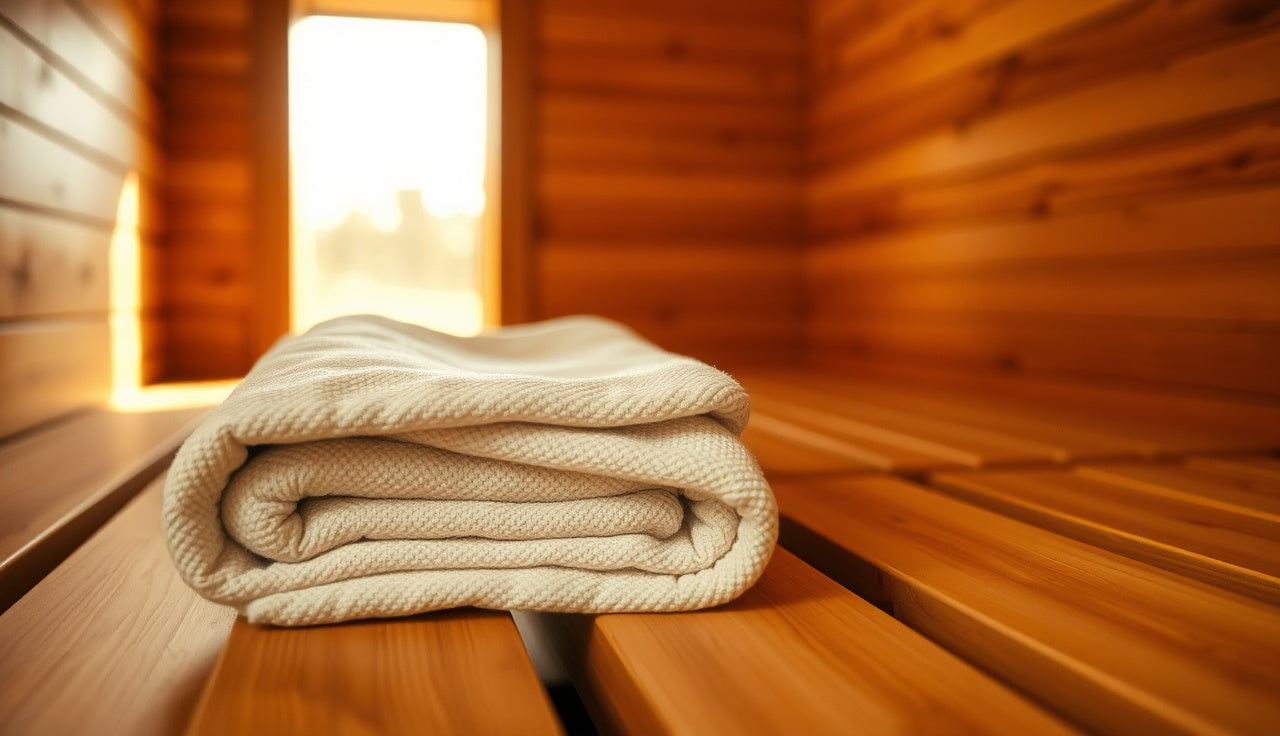
Plain towels (cotton, linen, or a cotton-linen blend) are what most sauna traditionalists use. You sit on one, drape another over your lap or the backrest, then toss them in the wash. No special purchase beyond your linen closet.
Dedicated sauna cushions are pads filled with foam or natural fiber, wrapped in a cover rated for sauna heat. They come as flat seat pads or with a small backrest section. A decent one costs $20 to $60 per pad, and specialty cedar-backed versions run higher [2].
Sauna headrests are a smaller cushion category: little rolls or pads for the back of your head when you lie down. They fix one narrow problem and aren't a full bench cover.
Wooden slat covers get sold as bench covers, but they're really extra bench sections. They add a second layer of wood and do nothing for sweat absorption.
For most home sauna owners, the real decision is towel versus cushion. The rest are accessories, not alternatives.
| Cover type | Typical cost | Machine washable | Heat-safe | Sweat absorption |
|---|---|---|---|---|
| Plain cotton towel | $5, $20 | Yes | Yes (up to 250°F) | Excellent |
| Linen towel | $15, $40 | Yes | Yes | Very good |
| Sauna cushion (foam) | $20, $60 | Cover only | Check label | Moderate |
| Sauna cushion (natural fill) | $30, $80 | Cover only | Yes if rated | Good |
| Wooden slat cover | $40, $150 | N/A | Yes | None |
Towel vs sauna cushion: which one actually performs better?
Honest answer: the towel wins on nearly every practical measure except raw comfort during a long sit.
A 100% cotton terry or waffle-weave towel soaks up sweat on contact, goes in your normal laundry, tolerates any sauna temperature you'll realistically set, and costs almost nothing. Cotton ignites around 400°F and releases no meaningful off-gas in a room that tops out at 200°F [3]. The hygiene case is simple: you can wash a towel after every single session without a second thought.
Cushions need more scrutiny. Both the fill and the cover fabric have to be heat-rated. Polyurethane foam, the guts of most budget cushions, can release volatile organic compounds at elevated temperatures [4]. A sauna at 185°F warms foam well past its comfortable range even if nothing visibly melts. So buy only cushions marketed for sauna use with a stated temperature rating, or go with natural fill like buckwheat or kapok inside a linen cover.
Here's where cushions actually win. If you sit 20 to 30 minute sessions on a hard bench and find it physically uncomfortable, a properly rated cushion cuts that fatigue in a way you can feel. That's real. It's a comfort upgrade, not a hygiene or safety one.
Outfitting a home sauna for the first time? Start with good towels. Add a cushion later, once you know whether your bench actually bothers you.
| Cotton/linen towel: Hygiene (washability) | 5 |
| Cotton/linen towel: Heat safety | 5 |
| Cotton/linen towel: Comfort | 3 |
| Cotton/linen towel: Cost-efficiency | 5 |
| Natural-fill sauna cushion: Hygiene | 3 |
| Natural-fill sauna cushion: Heat safety | 4 |
| Natural-fill sauna cushion: Comfort | 5 |
| Natural-fill sauna cushion: Cost-efficiency | 3 |
| Foam cushion (unrated): Hygiene | 2 |
| Foam cushion (unrated): Heat safety | 2 |
| Foam cushion (unrated): Comfort | 4 |
| Foam cushion (unrated): Cost-efficiency | 4 |
Source: Finnish Sauna Society and EPA indoor air quality guidance (citations 1, 4, 6)
Are sauna cushions safe, or do they off-gas at high heat?
Most product listings dodge this question, so here's the direct version. Polyurethane foam off-gassing is documented in indoor air quality research. Studies find foam products release higher concentrations of volatile organic compounds at elevated temperatures than at room temperature [4]. A sauna at 160 to 200°F is a high-temperature environment. Putting a foam-filled cushion in one and breathing the enclosed air for 15 to 20 minutes is a legitimate concern, not paranoia.
The Consumer Product Safety Commission tracks VOC exposure in enclosed spaces. There's no sauna-specific standard, but the general guidance is to minimize foam exposure in poorly ventilated hot environments [5].
Natural-fill cushions with linen or cotton covers are the safer bet. Buckwheat hull, cotton batting, and wool felt don't off-gas the same way at sauna heat. Some makers use thermally modified wood frames with linen covers to sidestep the issue entirely.
Already own a foam cushion and unsure whether it's rated for heat? Run a short session, step out, air the room fully, and see if you catch a chemical smell. If you do, retire the cushion. Marginal extra comfort isn't worth breathing VOCs in a sealed hot box.
For a sense of what good sauna air is supposed to be, the Finnish Sauna Society, running since 1937, treats clean, humidity-controlled air as central to the whole experience [6].
What kind of towel is best for a sauna?
Not all towels behave the same in the heat. Three things decide it: material, weight, and size.
Material: 100% cotton terry is the classic. It absorbs fast, survives repeated hot-wash cycles, and sheds no microplastics. Linen holds slightly less volume but dries faster between sessions and feels lighter when wet. A cotton-linen blend splits the difference nicely. Skip anything with real polyester content. Polyester barely absorbs and, like foam, raises heat-stability and off-gassing questions in a sealed hot room.
Weight: A medium-weight towel in the 400 to 550 GSM (grams per square meter) range is the practical pick. Heavy Turkish towels at 600+ GSM absorb more but dry slow and feel bulky under you. Light waffle-weave towels at 300 to 400 GSM dry fast and feel less unwieldy.
Size: A standard bath towel (27 by 52 inches) covers a single seat and backrest without dangling into nothing. Want to lie down along the full bench? A beach towel or dedicated sauna towel around 35 by 60 inches works better.
Some supply companies sell sauna towels with corner pockets that grip the bench edge. Handy, sure. But functionally they're any good cotton towel with one added feature.
Wash sauna towels after every use in hot water. Sweat plus heat plus bacteria is exactly the recipe for that sour smell if you leave a damp towel sitting in a pile.
How do you keep a sauna bench clean regardless of which cover you use?
The cover does most of the hygiene work, but the bench still needs its own attention.
For wood benches, let the surface dry fully after each session with the door cracked, then wipe it down once a week with diluted hydrogen peroxide or a mild sauna-specific cleaner. Skip chlorine bleach: it's harsh on wood and leaves residue. Skip oil-based cleaners too, since they can go rancid in the heat.
Sanding is the long-term step nobody mentions enough. Over months of use, bench wood soaks up sweat and darkens. A light pass with 120 to 180 grit sandpaper every year or two brings the surface back to fresh wood. It's the most thorough clean a wooden bench ever gets.
Running a portable sauna with fabric walls changes the math a bit. Fabric interiors hold odor more readily than wood, so seat towels matter even more, and airing the unit out after each session is non-negotiable.
The Finnish habit of a fresh cover per person in a shared sauna isn't just manners. It genuinely lowers the bacterial load on bench surfaces [6]. Same logic at home: your sauna, your towel, every session.
Can you use a regular bath towel in a sauna, or do you need a special one?
You can absolutely use a regular bath towel. The idea that a sauna needs a special towel is mostly marketing.
The one caveat is material. As covered above, 100% cotton or linen is fine. A towel with a heavy synthetic blend is worth swapping for a natural-fiber one, not because it'll catch fire (it won't at sauna temperatures) but because synthetic fibers barely absorb sweat and turn clammy in the heat.
Got standard cotton bath towels in the linen closet? Those work as bench covers today, at zero added cost. That's the honest answer.
Where a sauna-specific towel earns its price: an anti-microbial treatment, or higher-GSM linen that dries faster between morning and evening sessions. People who use the sauna twice a day get real value from a towel that won't still be damp and going musty by the second session.
What about sauna bench mats made from wood, silicone, or other materials?
Wood slat mats, sometimes called bench covers or sauna mats, sit on top of the existing bench and add another wood surface. They're common in some Scandinavian traditions. They can extend the life of a softer bench by giving the wear surface a replaceable layer. The catch is they do nothing for sweat, so you still need a towel on top. They're a bench-protection tool, not a comfort or hygiene fix.
Silicone mats show up for sauna use now and then. Silicone is heat-stable to around 450°F, so it won't degrade. But it doesn't absorb anything. Sitting on silicone means your sweat pools rather than soaks in, which is uncomfortable and barely more hygienic than bare wood.
Cork gets less attention than it deserves. It's naturally antimicrobial, absorbs a little moisture, and handles sauna heat fine. It sits firmer than a cushion but softer than bare wood. If you want a semi-permanent cover you never have to launder, cork tiles cut to bench size are a legitimate middle path.
For most people, none of these beat a good towel for simplicity. But if you're building a custom outdoor sauna and want something more finished-looking than a folded towel, cork or hardwood slats are worth considering as a design choice, knowing you still add a towel on top.
How much do sauna bench covers cost, and what should you budget?
The range is wide, and pricier doesn't mean better here.
A good 100% cotton bath towel costs $10 to $25 at any department store or linen supplier. For a two-bench sauna you want four to six towels cycling through the wash, so a full setup runs $40 to $150 total, with essentially no ongoing cost past laundry.
Dedicated sauna cushions start around $20 for a basic imported foam pad, climb to $60 to $80 for a quality linen-covered natural-fill option, and reach $150 or more for cushions with carved wood frames or specialty materials [2]. Outfit a two-person bench with two seat cushions and two small back cushions and you're looking at $100 to $250 for a quality set.
Cedar or teak slat covers run $40 to $150 per section, and a full bench might need two or three sections.
SweatDecks carries sauna accessories including towels and bench covers sized for both traditional and barrel saunas. Check the sizing guide before ordering, since bench dimensions vary a lot between manufacturers.
Honest budget call: spend your money on the sauna and the experience inside it. Good towels cover most people. A cushion upgrade later costs $30 to $60 and is easy to do once you know whether your bench actually bothers you.
Does the type of sauna affect which bench cover you should choose?
Yes, and the difference is real.
A traditional Finnish sauna running 170 to 195°F at 10 to 20% relative humidity creates the highest material stress [1]. Heat stability of your cover is the top concern here. Towels and natural-fill cushions handle it. Foam cushions are most at risk.
An infrared sauna runs much cooler, typically 120 to 150°F, using radiant heat instead of convective heat [7]. The lower temperature makes foam cushions less of an off-gassing worry. Infrared benches also tend to be thinner and sometimes less smooth than traditional benches, so cushions get more use in these cabins. If that's your setup, a quality foam-fill cushion with a rated cover is more reasonable.
A steam room runs cooler still but near 100% humidity [8]. Now the concern flips to mold and mildew. A cotton or linen towel washed after every session is the whole game. Cushions are a problem in steam because the fill stays wet for hours, ideal mold conditions. Avoid cushions in steam rooms unless the fill is rated for wet environments and dries fully between sessions.
Comparing sauna types for a first purchase? Our guide to sauna vs steam room covers the differences in more depth.
One fact worth carrying into that decision: most of the cardiovascular and relaxation research on sauna benefits used traditional Finnish saunas in the 170 to 190°F range.
What do sauna experts and traditional practices actually recommend for bench covers?
The Finnish Sauna Society, founded in 1937, is about as authoritative as sources on sauna practice get. Its traditional guidance centers on clean linen or cotton towels as the standard bench cover [6]. Sitting on a personal towel in any public or shared sauna is deeply ingrained in Finnish culture, and it's rooted in real hygiene logic, not ceremony.
The International Sauna Association likewise recommends bench hygiene built around absorbent, washable covers rather than permanent fixtures [9].
The published research on sauna health effects, including the widely cited cohort work from the University of Eastern Finland, doesn't address bench covers directly. But those studies describe sauna sessions in traditional Finnish settings where towels are the norm [10]. Nothing suggests the type of bench cover changes the physiological effects of sauna use.
What the tradition gets right is the emphasis on simplicity: fresh towel, hot bench, clean air, regular use. That's the protocol. The accessories market around saunas is large and mostly unnecessary for getting the actual benefit. A plain cotton towel is what generations of the most serious sauna cultures on earth have used, and it's still the correct default.
Frequently asked questions
Should I use a towel or a sauna cushion on my bench?
For most people, a plain cotton or linen towel is the better choice. It washes after every session, handles any sauna temperature safely, and costs almost nothing. A cushion makes sense if your bench is particularly hard and you sit long sessions that get genuinely uncomfortable. If you go the cushion route, buy one explicitly rated for sauna use with a natural fill, not a foam pad from a general home goods store.
Is it okay to use a regular bath towel in a sauna?
Yes. A standard 100% cotton bath towel works perfectly as a bench cover. The only towels worth avoiding are those with heavy polyester content, since synthetic fibers barely absorb. If your towels are cotton, grab them from the linen closet and you're set. You don't need a sauna-branded towel; the material and weight matter far more than the label.
Can foam cushions off-gas in a sauna?
This is a real concern. Polyurethane foam releases higher concentrations of volatile organic compounds at elevated temperatures than at room temperature. A sauna at 160 to 200°F is warm enough to raise that risk. Stick to cushions with a clearly stated high-heat rating and natural fills like buckwheat or cotton batting. If you smell anything chemical after placing a cushion in your sauna, remove it.
How often should I wash my sauna bench towels?
After every session. Sauna towels absorb heavy sweat in a hot, enclosed space, exactly the combination that breeds bacteria and sour odors if damp towels sit around. Wash them in hot water and dry them fully before the next use. If you sauna daily, rotating four to six towels keeps this painless.
What is the best material for a sauna bench cover?
100% cotton or linen. Both absorb sweat well, tolerate high heat without degrading or off-gassing, and wash cleanly in a standard machine. Linen dries faster and feels lighter when wet. Cotton terry holds more volume. Cork is a reasonable non-fabric option for a semi-permanent cover. Avoid synthetics like polyester and vinyl in a high-heat sauna.
Are sauna cushions worth the money?
For most people, no. The core sauna experience doesn't need one, and good towels handle hygiene better. A quality cushion earns its keep if your bench is genuinely uncomfortable during 20-plus minute sessions, or if a health condition makes hard surfaces painful. Budget $30 to $60 for a properly rated natural-fill cushion if you go that way. Don't buy a cheap foam pad and hope it holds up at high heat.
Can I use a silicone mat as a sauna bench cover?
Silicone is heat-stable and won't degrade in a sauna, so it's safe on materials alone. The problem is it absorbs no sweat at all. You'd sit in a pool of your own perspiration, which is uncomfortable and not especially hygienic. If you want to protect the bench surface, a silicone mat could sit under a towel, but it's not a standalone cover.
Do infrared saunas need different bench covers than traditional saunas?
Not dramatically, but the lower operating temperature of an infrared sauna (typically 120 to 150°F versus 170 to 195°F for traditional Finnish saunas) makes foam cushions somewhat less risky for off-gassing. Towels still win on hygiene. Cushions turn up more often in infrared saunas because the benches tend to be thinner and less comfortable for long sessions.
How do I clean a sauna cushion?
Most sauna cushions have a removable, machine-washable cover; the fill itself is usually spot-cleaned and air-dried only. Check the maker's care instructions before you buy, since this varies. Wash the cover regularly, and let the fill section dry completely between sessions to prevent mold. If the fill stays damp for long stretches, mold can grow inside where you can't see it.
What size towel works best as a sauna bench cover?
A standard bath towel (27 by 52 inches) covers a single seat and part of the backrest comfortably. If you want to lie down, a beach towel or dedicated sauna towel around 35 by 60 inches works better. For a shared bench, bring one towel per person. The rule of thumb: cover any surface your skin touches.
Should I use a bench cover in a steam room?
Yes, and a washable towel matters even more in a steam room than a dry sauna. Near-100% humidity keeps surfaces wet longer, better conditions for bacteria and mold. Avoid cushions in steam rooms because the fill stays saturated and can grow mold inside. A fresh cotton or linen towel every session is the simplest, most effective approach in high humidity.
Can I put a towel on the sauna bench backrest too?
Yes, and it's smart. The backrest touches your bare back and shoulders, so it collects sweat like the seat does. Drape a small hand towel or fold part of your larger towel up against the backrest for a washable layer there. Some accessories include a combined seat-and-backrest cover in one piece, which makes this easier.
Do sauna bench covers affect how hot the bench gets?
Marginally. A thick cushion insulates the bench surface a little, which softens the initial sit-down but also keeps the wood under it cooler than an uncovered surface. A thin cotton towel has almost no insulating effect, and the bench reaches its normal temperature. Neither changes the room's air temperature or your session's physiological outcome in any meaningful way.
What should I buy from a sauna accessories store for bench coverage?
Start with four to six 100% cotton or linen towels in a medium weight (400 to 550 GSM). That's genuinely all most people need. If you want to try a cushion after a few months of regular use, look for a stated temperature rating above 200°F, a removable washable cover, and a natural fill. Avoid anything where the maker won't specify the heat rating or fill material.
Sources
- Finnish Sauna Society, Sauna Temperature and Humidity Guidelines: Traditional Finnish sauna temperatures typically range from 170 to 195°F (80 to 90°C) with 10 to 20% relative humidity
- Amazon.com product category, Sauna Cushions and Accessories: Dedicated sauna cushions range from approximately $20 for basic foam pads to $60-$80 for linen-covered natural-fill options
- NFPA, Fire Protection Research Foundation, Ignition Properties of Textiles: Cotton ignites at approximately 400°F (205°C), well above normal sauna operating temperatures
- EPA, Indoor Air Quality: Volatile Organic Compounds: VOC emissions from foam and synthetic materials increase at elevated temperatures compared to room temperature conditions
- U.S. Consumer Product Safety Commission, Indoor Air Quality and VOC Exposure: CPSC guidance recommends minimizing foam product exposure in poorly ventilated hot environments due to VOC release
- Finnish Sauna Society, Sauna Etiquette and Hygiene Traditions: Finnish Sauna Society traditions center on clean linen or cotton towels as the standard personal bench cover in shared and private saunas
- NIH National Library of Medicine, Infrared Sauna in Cardiovascular and Other Conditions: Infrared saunas operate at lower temperatures of approximately 120 to 150°F (49 to 65°C) compared to traditional Finnish saunas
- CDC, Healthy Swimming and Wet Environment Hygiene: Near-100% humidity environments like steam rooms create conditions that accelerate bacterial and mold growth on surfaces
- International Sauna Association: The International Sauna Association recommends bench hygiene protocols built around absorbent, washable covers rather than permanent fixtures
- University of Eastern Finland, JAMA Internal Medicine, Sauna Bathing and Cardiovascular Mortality (Laukkanen et al. 2015): Long-term cohort studies on sauna health effects were conducted in traditional Finnish sauna settings with towel bench covers as the norm

Share:
Sauna towel etiquette and hygiene best practices
How to sanitize a sauna after use (the right way)