
Last updated 2026-07-11
TL;DR
Sit and lie on a clean towel in a sauna, never bare skin on the bench. Wash sauna towels after every session in hot water (60°C/140°F or above) to kill bacteria and fungi. Keep a dedicated sauna towel separate from your bath towel. Retire worn towels every 6 to 12 months of regular use.
Why does sauna towel etiquette matter at all?
Sauna benches are warm, humid, and porous. That is a near-perfect home for bacteria, fungi, and sweat residue. Sit bare skin on a wooden bench and you push sweat, dead skin, and whatever lives on you straight into the grain that the next person presses against.
This is not hypothetical. A 2016 study in the International Journal of Environmental Research and Public Health sampled sauna benches in public facilities and found Staphylococcus aureus, E. coli, and various fungi on the surfaces, worst in places where towel use was spotty [1]. The counts were not high enough to call saunas biohazards. They were real, and a towel would have stopped most of it.
Home saunas change the math a little. If you are the only person who ever uses your home sauna, you have more room to relax. Even solo users win with a towel layer though: sweat-soaked wood is a pain to clean, and repeated skin-on-wood contact darkens and stains a bench faster than anything else.
The rest of etiquette is plain respect for shared space. Public saunas in Finland, Germany, and Japan post towel rules at the door. Plenty of US gyms do too, though nobody enforces them the same way. Know the expectations before you sit down and you skip the awkward moment.
What should you actually sit on in a sauna?
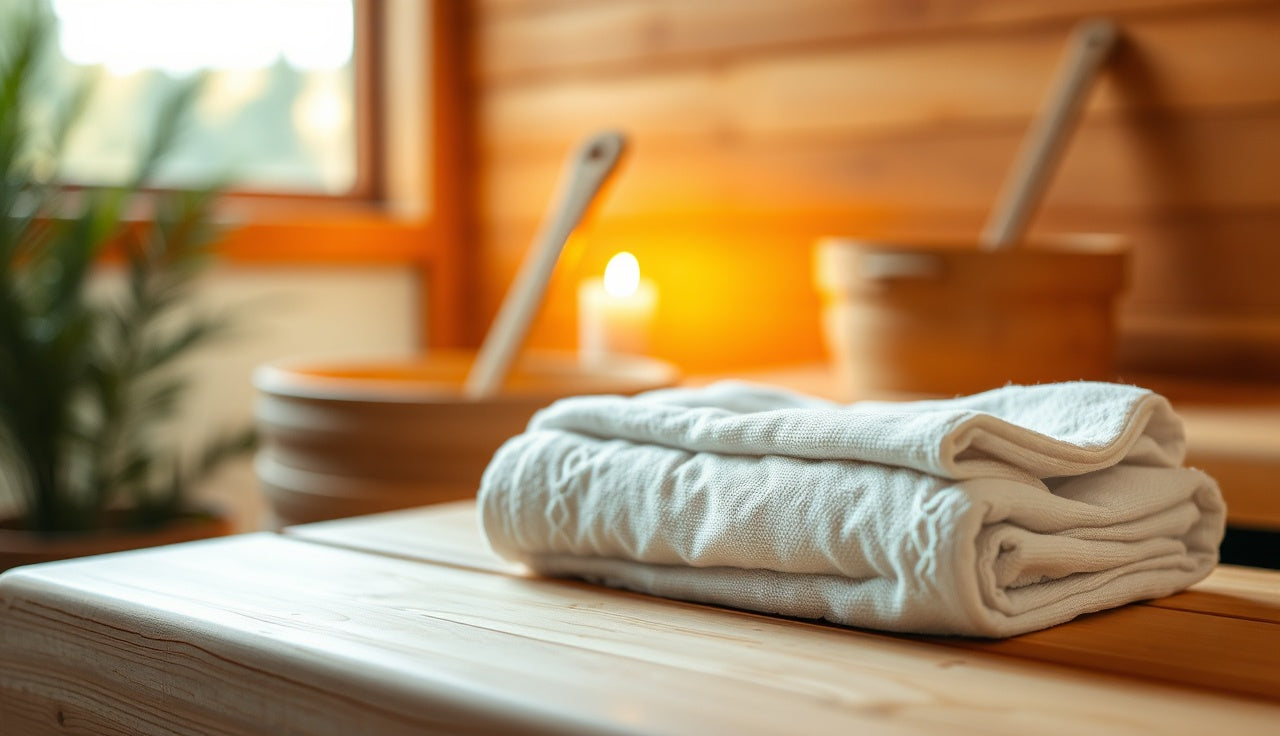
Sit on a towel big enough to cover the bench from behind your knees to the top of your back when seated, or your full body length when lying down. That is the standard across Finnish sauna culture and most facility guidelines [2]. In numbers, that means at least 50 by 100 cm (roughly 20 by 40 inches), though plenty of people reach for a full bath towel (70 by 140 cm) so there is nothing to think about.
Some folks use a dedicated sit pad or bench mat instead. Those work as long as they wash. Fixed foam mats that cannot go through a machine collect bacteria over time, so read the care label before you buy.
What you should not sit on: a thin gym hand towel with your thighs hanging off the edge, your clothes (synthetic fabric traps heat against your skin and off-gasses at high temperatures), or nothing at all in a shared space.
For a portable sauna, the rule holds even though the surfaces are fabric, not wood. Fabric liners soak up sweat and are harder to clean than a towel you can yank out and toss in the wash.
One trick experienced sauna-goers swear by: bring two towels. One covers the bench. The other wipes sweat off your face and body during the session. Split the jobs and neither towel turns into a dripping mess halfway through.
How hot should you wash sauna towels to actually kill bacteria and fungi?
This is where the number matters. The CDC and WHO both point to 60°C (140°F) as the point where most common pathogens, including Staphylococcus aureus and most dermatophyte fungi (the athlete's foot culprits), get reliably knocked out in a normal wash cycle [3][4]. Most household machines hit this on a "sanitize" or "hot" setting.
The CDC's healthcare laundry guidance states that satisfactory reduction of microbial contamination can be achieved with "water temperatures of at least 160°F (71°C) for a minimum of 25 minutes" in institutional settings [3]. For personal items at home, 60°C with a good detergent does the job.
A few things to get right:
- Wash sauna towels separately, or at least in small loads. Crammed machines do not agitate well and leave soap residue behind.
- Use a full dose of detergent. Sauna towels carry heavy sweat loads and need it.
- Tumble dry hot or line dry in direct sun. UV exposure has a documented antimicrobial effect on fabric [5].
- Never leave wet sauna towels balled up in a bag for hours. Bacteria multiply fast in warm, damp cloth. Rinse and hang, or go straight to the machine.
The part that catches people off guard: fabric softener coats the fibers and kills absorbency over time. Skip it on sauna towels, or use it once in a blue moon.
| Min. wash temp to kill S. aureus (°C) | 60 |
| Institutional wash temp recommended by CDC (°C) | 71 |
| Wash after every N uses (answer: 1) | 1 |
| Towel replacement cycle for daily users (months) | 6 |
Source: CDC Infection Control Guidelines (n=3); Finnish Sauna Society (n=2); Microbiology journal 2019 (n=6)
How often should you wash sauna towels?
Every single time. No exceptions.
People ask this hoping to hear "every two or three uses." The honest answer is that a sauna towel after one session is as dirty as any piece of workout clothing. You would not re-wear a sweaty gym shirt. Same logic here.
A 2019 review in the journal Microbiology, published by the Microbiology Society, found that reusing towels even twice raised bacterial transfer compared to fresh ones, especially for S. aureus [6]. The warm, slightly damp inside of a folded used towel is close to ideal for bacteria.
Daily sauna owners end up doing a lot of laundry because of this. The fix most people settle on is owning four to six dedicated sauna towels, so there is always a clean one while the rest cycle through the wash.
Are there rules about towels in public saunas and gyms?
Yes, and they shift by facility and country, but the core is the same everywhere: cover the bench and cover yourself.
In Finland, the home of the sauna tradition, nudity is normal, yet sitting on bare wood without a towel reads as both unhygienic and rude [2]. Finnish sauna societies and the International Sauna Association both call a personal towel or bench cover required practice.
US gyms and health clubs have leaned into posted towel rules, partly over liability worries about skin-on-bench contact. The wording usually runs: use a clean towel on any surface you touch, saunas and steam rooms alike.
For steam rooms the humidity climbs higher than a dry sauna, which can speed microbial growth on surfaces. The same towel rules apply, if anything more firmly.
Cannot find posted rules at a facility? The safe default never changes: towel on the bench, towel to wipe your face, and share neither with other bathers. That covers you in basically any room you walk into.
What kind of towel works best in a sauna?
Material matters more than people expect. Here is a straight comparison:
| Material | Heat tolerance | Absorbency | Wash durability | Notes |
|---|---|---|---|---|
| Turkish cotton (long-staple) | High | Very high | Excellent | Softens with washes, the ideal pick |
| Regular cotton terry | High | High | Good | Standard choice, works well |
| Bamboo blend | High | High | Good | Softer feel, slightly less durable |
| Microfiber | Moderate | Moderate (different mechanism) | Good | Can feel clammy in high heat |
| Linen | High | Moderate | Very good | Dries fast, traditional in Finland |
| Synthetic (polyester) | Low to moderate | Low | Good | Skip it for sauna |
Linen is the old Finnish choice for a reason. It dries fast between sessions, shrugs off high heat, and never gets as heavy-wet as thick terry. Want to go traditional? A linen bench towel is a real upgrade.
Microfiber is fine for cold-plunge or gym duty but feels oddly synthetic in hot air, and some people dislike it against sweaty skin at 80 to 100°C.
Avoid anything loaded with elastane or polyester. Synthetics can release trace chemicals at sauna heat, though the evidence on whether that matters for health is thin and mostly comes from tests run far hotter than any home sauna gets.
How do you sanitize sauna benches themselves?
Towels handle the barrier. The bench still needs regular cleaning, especially in shared or commercial rooms.
Wood benches, which is what most traditional saunas use, get a simple treatment: scrub with a brush and hot water. Skip harsh chemical cleaners on raw wood. Most sauna wood is unfinished (kiln-dried aspen, cedar, or alder), and strong detergents damage the surface and leave residue that off-gasses in the heat [7]. A mild soap diluted heavily in hot water is fine for the occasional deeper clean.
Rinse well after scrubbing, then run the sauna hot to dry the wood all the way through. This step matters. Damp wood that never fully dries grows mold.
Commercial facilities have more options. The Environmental Protection Agency registers disinfectants suited to high-temperature environments, and operators should follow the manufacturer's dilution instructions and ventilate well before the next session [8].
At home, most solo or family users find a damp-cloth wipe plus a hot heat cycle every few sessions does the trick, paired with steady towel use. A deeper scrub every month or two keeps the wood clean and the odor down.
Black spots forming on the wood? That is likely mold or mildew. Treat it fast with a 3% hydrogen peroxide solution, let it dry completely, and add ventilation going forward.
Is it okay to use a robe or wrap instead of a separate bench towel?
A robe is fine before and after your session. It is a poor stand-in for a bench towel.
Here is why. A robe covers your body but never makes a flat, steady barrier between your seated skin and the bench. Shift your position and the coverage shifts with you. The parts bunched under you also do not dry between sessions the way a flat-laid towel does.
Want modesty inside the sauna? Wrap a towel around your body and lay a separate towel on the bench. Now the bench stays covered no matter how you sit or move.
Some people wear sweat suits in saunas thinking the clothing does a towel's job. It does not. Synthetic sauna suits trap humidity against your skin and add nothing to bench hygiene.
When should you replace sauna towels?
Towels wear out. The fibers break down under repeated high-heat washing, and once a towel sheds lint like crazy, feels rough, or holds an odor that will not wash out, it is done.
Regular users (three or more sessions a week) should plan to replace dedicated sauna towels every 6 to 12 months. Sauna daily and wash after each session and you are running 150 to 365 high-heat cycles a year. That is a lot of mechanical and thermal stress on cloth.
A towel that keeps a mildew smell after a hot wash has biofilm buried in the fibers. Biofilm is a matrix of bacteria wrapped in a protective polysaccharide layer, and it does not reliably die in standard home laundry [6]. Retire that towel.
The cost here is small. Decent cotton towels run $8 to $25 each, so a rotation of five or six dedicated sauna towels costs $50 to $150 total, renewed once or twice a year for heavy users. That is a rounding error next to what most people spend on a home sauna or outdoor sauna build.
SweatDecks carries towels and bench accessories sized for sauna use if you want a starting point.
What about towel etiquette during contrast therapy (sauna plus cold plunge)?
Contrast therapy, alternating sauna heat with cold water immersion, makes towel hygiene a little trickier because you keep moving between two environments. (See cold plunge benefits for the research on why people do this.)
The setup that works: keep at least two towels in play during a contrast session. One stays in the sauna as your bench towel. A second, or a full bath towel, dries you between the cold plunge and the next sauna round. Do not dunk your sweaty bench towel in the cold plunge water, and do not turn your cold-plunge drying towel into your bench layer.
Separating them keeps your ice bath or cold plunge cleaner too. Sweat-soaked fabric dragged through cold water dumps organic material into it, which drops water quality faster and loads up your filter.
After the session, both towels go straight to the laundry. No exceptions.
Do sauna towel rules differ for infrared saunas vs traditional saunas?
The hygiene logic does not change with sauna type. You sweat, that sweat lands somewhere, and that somewhere should be a towel instead of the bench.
One small difference: infrared saunas run at lower air temperatures (50 to 65°C versus 80 to 100°C for traditional Finnish saunas), so the ambient environment is less hostile to microbes surviving on surfaces. (See sauna vs steam room for more on temperature differences.) In practice, bench surfaces in infrared cabins can pick up contamination a bit faster without towel use than in hotter traditional rooms.
Also worth flagging: infrared cabins often use hemlock or basswood panels that are softer and more porous than the cedar or aspen in traditional units. Those softer woods soak up sweat residue faster, which makes steady towel use matter even more for keeping the wood clean and odor-free over time.
What are the hygiene rules in Finnish sauna culture specifically?
Finnish sauna culture deserves its own explanation because it is the source of most of the world's sauna norms. UNESCO added Finnish sauna culture to its Representative List of the Intangible Cultural Heritage of Humanity in 2020 [9].
In Finland the sauna is a place of physical and social cleanliness at once. The expectation covers a few things: shower before entering, sit on a personal towel or a wooden bench cover called a pefletti, use the ladle and birch whisk (vihta) with care, and leave the sauna cleaner than you found it.
The Finnish Sauna Society, the authoritative voice on the tradition, says bathers should always use a personal towel or bench cover and shower before entering [2]. Nudity is expected in most Finnish saunas (mixed-gender settings have their own norms), and it coexists with strict hygiene through that towel use.
One Finnish detail that surprises visitors: talking loudly or bringing your phone into a sauna is rude. The hygiene rules are firm, and so is the atmosphere. The sauna is for quiet, heat, and rest. It is not a locker room.
Frequently asked questions
Do you have to use a towel in a sauna?
In public saunas and gyms, effectively always. Most facilities require it and post the rule. In a private home sauna it is your call, but a towel protects the wood from sweat absorption and staining and makes cleaning far easier. Even for solo home users, a bench towel is a good habit worth keeping.
Can you reuse a sauna towel the next day?
No. A towel used in a sauna session is as dirty as workout clothing. Bacteria multiply in warm, damp fabric within hours, and reusing a towel even once raises the bacterial load it carries. Wash sauna towels in hot water (60°C or above) after every session. Keep five or six in rotation so a clean one is always ready.
What temperature kills bacteria on sauna towels in the wash?
The CDC references 60°C (140°F) as effective for most common pathogens in home laundry, and at least 71°C (160°F) for 25 minutes in institutional settings. Most washing-machine "sanitize" cycles reach 60°C. Use a full detergent dose and dry on high heat or in direct sunlight for the best result.
Should sauna towels be washed separately from regular laundry?
Ideally, yes. Sauna towels carry heavy sweat loads and need a full cycle with real agitation, which a crammed machine cannot deliver. They also shed lint during the first few washes, which sticks to other clothes. Washing in small dedicated loads is the cleanest way to handle them.
What size towel do you need for a sauna?
For sitting, you need coverage from behind your knees to the top of your back, roughly 50 by 100 cm minimum. Most people prefer a full bath towel at 70 by 140 cm so there is no guesswork. To lie down, you need the full length. A hand towel does not work as a bench cover.
Is microfiber okay for sauna towels?
Microfiber works for cold plunge and gym use but is not the best sauna choice. It can feel clammy and synthetic against skin in hot air, and it absorbs differently than cotton. Traditional cotton terry, Turkish cotton, or linen all perform better in sauna heat and hold up better under high-temperature washing.
Can you bring one towel and use it for both the bench and drying off?
You can, but it is not ideal. A bench towel gets saturated with sweat over a 20 to 30 minute session, so drying yourself with it afterward is unpleasant and less effective. Two towels, one for the bench and one for drying, is a small investment that makes the whole experience better.
How do you get rid of the mildew smell in sauna towels?
Mildew smell usually means biofilm has set into the fibers. Wash on the hottest setting your machine has, with a full detergent dose plus half a cup of white vinegar in the drum. If the smell survives two or three hot washes, the biofilm is embedded and the towel should go. Prevention is easier: hang towels right after use and never leave them balled up wet.
Do sauna etiquette rules apply in a steam room too?
Yes. Steam rooms run at near 100% humidity with temperatures around 40 to 50°C, and wet surfaces collect microorganisms quickly. The same rules apply: shower before entering, sit on a personal towel, wipe the bench before you leave. Many steam-room surfaces are tile rather than wood and are easier to disinfect, but the towel barrier stays standard practice.
Is it rude to not use a towel in a public sauna?
Yes. In most sauna cultures, skipping a towel is unhygienic and inconsiderate. In Finnish tradition, sitting bare skin on a shared bench without a towel is a clear breach of etiquette. In US gyms, most facilities post rules requiring towel use. Even where nothing is posted, a towel is the expected norm, and going without will draw disapproving looks.
How often should you clean sauna benches in a home sauna?
A light wipe with hot water after heavy-use sessions, and a deeper scrub with diluted mild soap every month or two. Do not use harsh chemical cleaners on unfinished sauna wood. After cleaning, run the sauna hot to dry the wood completely. See dark spots forming? Treat them promptly with diluted 3% hydrogen peroxide and improve ventilation.
How many sauna towels should you own for regular use?
For three or more sessions a week, own at least five or six dedicated sauna towels. That keeps a clean one ready while others are in the wash or drying. At $10 to $25 per towel, a full rotation costs $50 to $150. Plan to replace the set every 6 to 12 months if you use and wash them often.
Can you use a beach towel as a sauna towel?
Yes, beach towels work fine as bench covers. They are usually large enough to cover the bench fully and made from cotton terry that handles hot washing well. The one downside is bulk: beach towels are thick and slow to dry between washes. A thinner Turkish cotton or linen towel of similar size is a more practical everyday pick.
What is a pefletti and do you need one?
A pefletti is a small wooden-slatted bench cover used in Finnish saunas, usually aspen or pine, that sits on the bench and lifts the bather slightly off the wood. You do not need one, but it allows good airflow underneath and rinses clean easily. It works alongside a towel layer rather than replacing it.
Sources
- International Journal of Environmental Research and Public Health, 2016 (microbial contamination of public sauna benches): S. aureus, E. coli, and fungi detected on sauna bench surfaces in public facilities, particularly where towel use was inconsistent
- Finnish Sauna Society (Suomen Saunaseura), sauna etiquette guidelines: Bathers should always use a personal towel or bench cover and shower before entering; sitting bare on shared wood is considered unhygienic
- CDC, Guidelines for Environmental Infection Control in Health-Care Facilities, Laundry section: Satisfactory microbial reduction achievable at water temperatures of at least 160°F (71°C) for a minimum of 25 minutes; 60°C with effective detergent is adequate for personal items
- WHO, Water, Sanitation and Health program guidance: 60°C (140°F) as the temperature at which most common pathogens including Staphylococcus aureus are reliably inactivated in a standard wash cycle
- USDA Agricultural Research Service, UV disinfection of surfaces and fabrics: UV exposure from direct sunlight has a documented antimicrobial effect on fabric surfaces
- Microbiology (Microbiology Society journal), 2019 review on towel reuse and bacterial transfer: Reusing towels even twice increased bacterial transfer compared to fresh towels, and biofilm in fibers does not reliably die in standard home laundry
- University of Minnesota Extension, wood care and finishing guidance: Harsh chemical cleaners on raw unfinished wood can damage the surface and leave residue that off-gasses when the wood is heated
- US EPA, Pesticide Registration (registered disinfectants and sanitizers): EPA registers disinfectants appropriate for high-temperature commercial environments; facilities must follow manufacturer dilution instructions
- UNESCO Intangible Cultural Heritage, Finnish sauna culture listing 2020: UNESCO added Finnish sauna culture to its Representative List of the Intangible Cultural Heritage of Humanity in 2020

Share:
Should you shower after a cold plunge? What actually helps
Sauna bench cover options: towel vs cushion explained