
Last updated 2026-07-11
TL;DR
Wipe benches and walls with a 1:1 white vinegar solution or 3% hydrogen peroxide after every session, while the wood is still warm. Air it out with the door open for at least 30 minutes. Deep clean monthly with a soft brush and an enzyme cleaner. Never use bleach on raw wood. This routine stops bacteria, mold, and odor before they take hold.
Why does a sauna need sanitizing after every use?
One 20-minute session pushes core body temperature toward 39°C and pulls roughly 0.5 to 1 liter of sweat out of you, depending on heat level and your own physiology [1]. That sweat lands on benches, backrests, and the floor. It carries salt, skin cells, oils, and whatever bacteria were living on your skin at the time.
Leave that organic material sitting there and mold gets exactly what it wants: warmth, moisture, and food. Staphylococcus aureus survives on dry surfaces for hours to days and shrugs off temperatures well above what most home saunas run [2]. A sauna that gets used and then sealed up stays humid long after the heater clicks off. That is the worst possible window for microbial growth.
This is arithmetic, not paranoia. Skip cleaning for a week and you layer sweat residue on top of sweat residue. The wood darkens and softens in those spots, odor sets in, and eventually black mold shows up in the grain. That is a far bigger job than three minutes of wiping after each session.
What supplies do you actually need to clean a sauna?
Keep it simple. Here is what works and what quietly ruins your wood.
What works:
- White vinegar diluted 1:1 with water. Mildly acidic, effective against many common bacteria and mold spores, cheap, and safe on untreated wood in moderation.
- 3% hydrogen peroxide (the standard drugstore bottle). Kills a broad spectrum of pathogens and breaks down into water and oxygen, so it leaves no harmful residue on wood [3].
- A purpose-made sauna cleaner, usually enzyme-based. Worth it for monthly deep cleans when you want more penetrating power than vinegar gives you.
- Soft-bristle scrub brush for bench joints and corners.
- Microfiber cloths or clean cotton towels. Skip anything abrasive.
- A bucket for rinsing.
What doesn't work (and causes damage):
- Bleach. Chlorine bleach is too harsh for raw softwood. It breaks down the lignin in the grain, discolors it, leaves a chemical smell that heats up badly, and can release chlorine gas in an enclosed hot space. Don't use it.
- Soap-based cleaners. Soap leaves residue that sinks into wood pores. When the sauna heats up, that residue off-gasses into a soapy or chemical smell. It also makes the wood slippery.
- Pressure washers. Too much water, full stop. Saturated wood takes days to dry, and wet wood in a warm room is a mold magnet.
For a home sauna setup, a spray bottle of diluted hydrogen peroxide and a stack of clean microfiber cloths cover every routine job you'll have.
How do you sanitize a sauna right after a session?
Wipe down within 15 to 20 minutes of finishing. The wood is still warm, which helps the cleaning solution work faster, and the sweat residue hasn't had time to dry and bond with the wood fibers. That single habit does most of the heavy lifting.
Step-by-step post-session routine:
1. Remove towels, wooden headrests, and accessories. Take them out to wash or hang to dry separately. 2. Spray diluted hydrogen peroxide or vinegar solution lightly across benches, backrests, and floor. Damp, not soaked. 3. Wipe everything with a clean microfiber cloth, working top to bottom so drips get caught. 4. Give extra attention to bench joints and corners where sweat pools. A small brush helps. 5. Leave the door open. Let it air out for at least 30 minutes before closing it up. Open the vent fully if you have one. 6. Launder or replace the cloth you wiped with. Tossing a sweat-soaked rag back into the sauna defeats the whole point.
The wiping takes about 5 minutes. People skip the 30-minute airing step, and that step matters more than the wiping does.
| Post-session bench wipe-down | 1 |
| Full surface wipe (all walls + floor) | 7 |
| Deep enzyme scrub | 30 |
| Sand and inspect bench surfaces | 90 |
| Replace sauna rocks | 365 |
Source: CDC MAHC Guidelines and Finnish Sauna Society recommendations
How often should you do a deep clean versus a daily wipe-down?
Run sauna maintenance in two layers: the per-session wipe-down above, and a monthly deep clean that gets into the grain. The wipe-down keeps things sanitary day to day. The deep clean pulls out what the daily routine leaves behind.
For the monthly deep clean:
1. Start cold. You want the wood dry and the pores relatively closed before any solution goes on. 2. Mix a sauna-safe enzyme cleaner or a stronger vinegar solution (2 parts vinegar, 1 part water) in a bucket. 3. Scrub the bench surfaces, backrests, floor boards, and walls with a soft-bristle brush dipped in the solution. Work with the grain. 4. Let it sit for 5 to 10 minutes. 5. Rinse with clean warm water and a wrung-out cloth. Damp, not soaked. 6. Leave the door and vents wide open. Put a fan outside the door blowing in if you can. Give it 2 to 4 hours to dry fully before the next session. 7. Inspect the heating element area, the rocks (in a traditional sauna), and the drain if you have one. Swap out any rocks that show heavy cracking or mineral buildup.
Use a public or shared sauna daily, or share your home unit among several people, and you move the deep clean to every two weeks. High-traffic saunas pick up organic matter faster than a monthly schedule can keep up with.
Does the type of sauna change how you clean it?
Yes, meaningfully. The chemistry stays the same, but the construction and heat source change how much moisture the space can safely take and what materials you're working with. A wood-and-rock Finnish room and an infrared cabin call for different habits.
| Sauna type | Key cleaning consideration | Products to avoid |
|---|---|---|
| Traditional Finnish (wood/rock) | Rocks absorb liquids; rinse them with plain water only | Any cleaner on or near rocks |
| Infrared (electric panels) | Panels must stay dry; wipe wood only, never spray near panels | Excess moisture near IR panels |
| Steam room | Tile/glass surfaces; use a tile-safe mold inhibitor | Anything that leaves film on glass |
| Barrel/outdoor sauna | More weather exposure; check exterior drainage and seal wood annually | Bleach (damages exterior sealant) |
| Portable sauna | Fabric interior; machine-wash or wipe fabric walls per manufacturer spec | Vinegar on some synthetic fabrics |
A traditional Finnish-style unit is kiln-dried softwood (usually spruce, pine, or hemlock). That wood is porous and reacts to moisture fast. In an infrared sauna, the panels are the thing to protect: never spray directly at them, and keep liquids well away [4].
Steam rooms are a separate animal. They're built for moisture, usually with tile or acrylic surfaces, and they want a proper mold-inhibiting tile cleaner weekly rather than a wood-specific solution. The sauna vs steam room guide covers maintenance alongside the other comparisons.
Outdoor saunas and barrel saunas carry an extra layer: re-apply exterior wood sealant once or twice a year depending on your climate, and make sure water drains away from the base instead of pooling underneath.
Does high sauna heat kill bacteria on its own?
Partly, and the gap between "partly" and "enough" is where people get burned. Dry sauna temperatures run between 70°C and 100°C (158°F to 212°F) at bench level [5]. Many common pathogens, including most strains of Staphylococcus and E. coli, die above 70°C with sustained exposure. So why isn't the heat the whole answer?
The wood surface never reaches air temperature. Ambient air might sit at 80°C to 95°C, but the bench surface can run 20 to 30°C cooler, especially on the lower bench. Bacteria tucked under a layer of dried sweat and skin oil get even less direct heat than that.
Mold spores are stubborn. Some species survive up to 70°C, lie dormant through a session, and germinate once the sauna cools and humidity climbs.
And heat does nothing about the residue. Even if it killed every pathogen, you'd still have salt, oils, and dead skin baked onto the bench. That layer is unsanitary on its own and feeds the next batch of bacteria.
CDC guidance on environmental infection control notes that surface disinfection requires both contact time and the right concentration of a disinfectant, not heat alone [2]. Treat the heat as a partial assist, never the whole job.
How do you get rid of sauna odor?
Bad sauna smell is almost always one of three things: sweat residue soaked into the wood, mold starting up in joints or under benches, or off-gassing from a cleaning product that never got rinsed out. Track down which one you have before you try to fix it.
For sweat odor, the monthly enzyme deep clean is the fix that sticks. Enzyme cleaners break down the protein compounds in sweat instead of masking them, which is why they beat vinegar on established odor [6].
For mold odor, find the source first. Check under bench boards, in floor-level corners, and behind wall panels. See black or green discoloration? Apply 3% hydrogen peroxide directly, let it sit 10 minutes, then scrub and rinse. Heavy mold may mean pulling and replacing the affected boards.
For cleaner off-gassing, run the sauna empty at full temperature for 30 to 45 minutes with the vent open. That burns off residue. Then wipe with a plain damp cloth and air it out again.
Baking soda in a small open container, left inside while the sauna is cool and unused, absorbs ambient odor between sessions. Swap it monthly.
What should you put on the bench before each session to reduce cleanup?
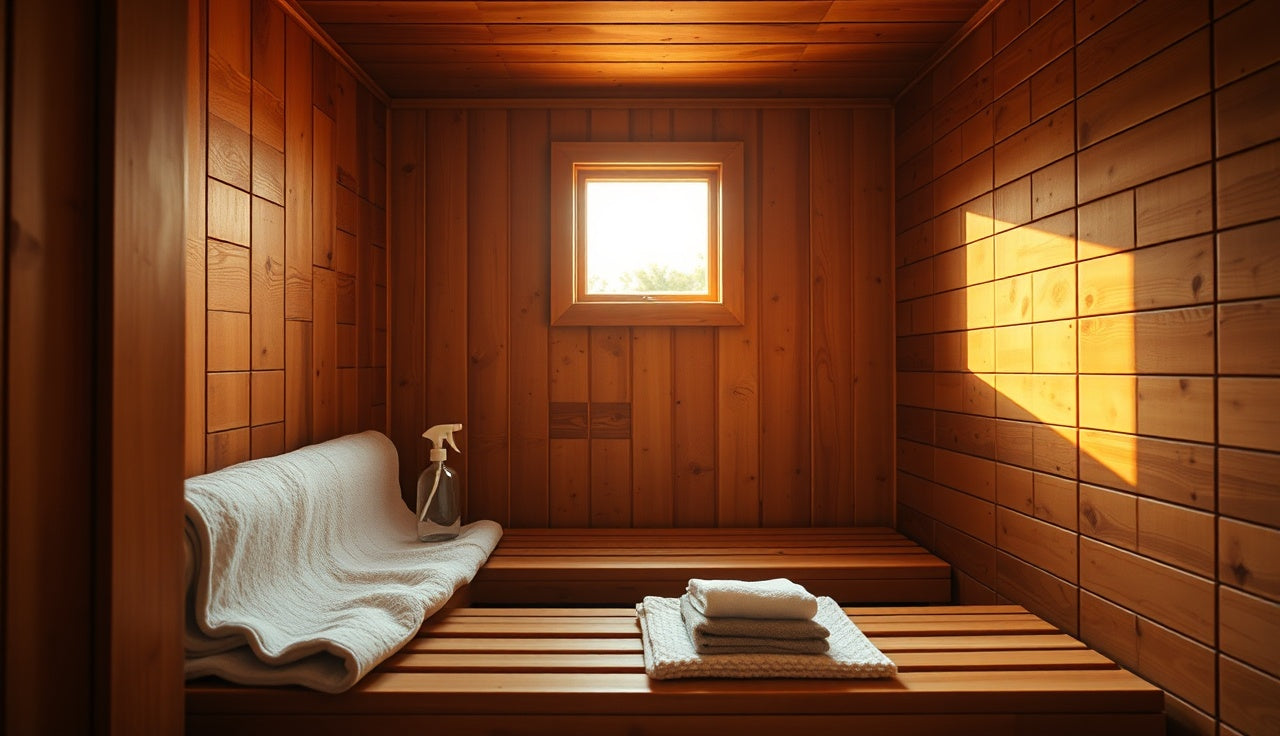
Put a clean towel down before every session, every time, no exceptions. That single habit catches most of the sweat before it ever reaches the wood, and it cuts your cleaning time more than any product does.
A few specifics matter:
- Use a dedicated sauna towel, not your post-shower drying towel. The cleaner the towel going in, the less you transfer to the bench.
- Cotton and linen absorb well. Microfiber works but holds heat more than cotton, which some people find uncomfortable at bench temperatures.
- Bench covers or sauna mats made from eucalyptus or linen are common in Scandinavian setups. They wash easily and protect the wood better than a folded towel because they cover the full bench and the spot where your feet rest.
- Always sit on a towel, never directly on the wood. This is standard hygiene in shared facilities [5].
Using a portable sauna changes the math a little: the fabric interior means you follow the manufacturer's guidance, since most portable units have removable liners you can spot-clean or wipe with a damp cloth and mild solution.
Are there any products that are unsafe to use in a sauna?
A handful of products cause real damage or safety problems, and they're worth naming outright.
Bleach (sodium hypochlorite): Covered above, but it earns a repeat. In an enclosed, high-heat space, bleach residue heats up and can release chlorine gas. This is not theoretical. The CPSC has documented chlorine exposure in pool and spa environments from improper chemical use in enclosed spaces [7]. Don't use it.
Essential oils applied directly to wood: Running oils through a diffuser is fine. Rubbing tea tree, eucalyptus, or similar oils straight onto bench wood as a "natural cleaner" is not. The oils go rancid in the grain, build up sticky, and burn off with an ugly smell at high heat.
Quaternary ammonium disinfectants (quats): Common in commercial disinfecting wipes and sprays. Fine on non-porous surfaces, but they leave a residue on wood that never breaks down cleanly and can off-gas at sauna temperatures. Hydrogen peroxide or vinegar is safer for porous wood.
Anything oil-based: Oil-based wood treatments belong on the exterior of your sauna structure, never the interior benches. Interior surfaces stay untreated softwood. Oil on a bench heats up, transfers to skin, and turns the surface dangerously slippery.
SweatDecks keeps a cleaning guide for customers who want product picks matched to their sauna type, which saves some trial and error on all of this.
How do you maintain sauna wood to prevent long-term damage?
Cleaning removes what's already there. Maintenance stops the wood from breaking down in the first place. The two jobs are different, and skipping the second one is how a good sauna dies young.
Softwood interior boards (spruce, hemlock, western red cedar, aspen) are porous and expand and contract through moisture cycles. Here is what keeps them sound for the long haul:
Let the sauna dry fully between uses. This is the whole ballgame. After the post-session airing, leave the door cracked if the unit isn't in a high-traffic spot. A sauna kept sealed and warm-humid between uses is a sauna that grows mold.
Sand lightly when the surface goes rough or dark. Use 120 to 150 grit sandpaper, always with the grain. It strips the stained top layer and exposes fresh wood. Do this on benches once the surface starts feeling tacky or looking dark.
Check the floor boards often. Floor boards take the most abuse because they're the hottest surface and the most moisture-exposed. Replace any that are soft, cracked through, or holding black mold that won't clean out.
Heaters and rocks: In a traditional sauna, inspect the rocks twice a year. Rocks that crack or flake need replacing. A cracked rock can shatter under thermal stress and damage the heater. The Finnish Sauna Society recommends rounded igneous rocks such as peridotite or olivine, replaced every 1 to 2 years for regular home use [8].
If you're weighing the full picture of sauna benefits and long-term use, this maintenance is what makes a home unit last 10 to 20 years instead of dying in five.
What's the cleaning routine for a shared or commercial sauna?
Shared saunas in gyms, spas, and multi-unit buildings need a tighter schedule than a home unit with one or two regular users. More bodies means more sweat, faster, and the cleaning cadence has to match.
The CDC's Model Aquatic Health Code (MAHC) sets guidelines for aquatic and spa facilities that many health departments use to regulate commercial wet leisure environments. Saunas aren't pools, but the surface disinfection principles carry over: the MAHC directs that high-contact wet-environment surfaces be cleaned and disinfected at minimum between each group of users and deep-cleaned daily [9].
A practical minimum schedule for a shared sauna:
- Between each use (or every 2 hours of heavy use): Wipe all bench surfaces with hydrogen peroxide or an approved disinfectant. Replace towel liners if provided.
- End of each operating day: Full wipe-down top to bottom, clean the floor, check and empty drainage, leave the door open overnight.
- Weekly: Full brush scrub with enzyme cleaner, inspect all bench joints and floor boards for early mold or damage.
- Monthly: Sand and assess benches, inspect heater and rocks, check ventilation.
Health departments in most states inspect commercial spa and sauna facilities under their public health codes. Requirements vary by state, and most require operators to keep a cleaning log. Check your state's department of health for the specific code language that applies to your facility [10].
How long should you wait before using a sauna again after cleaning?
After a quick post-session wipe-down with diluted hydrogen peroxide or vinegar, wait 30 to 60 minutes with the door open before using it again. That's enough time for the light moisture to evaporate and any mild solution smell to clear.
After a monthly deep clean with more solution and scrubbing, wait at least 2 to 4 hours, or until the wood is dry to the touch with no lingering cleaning smell. If you used an enzyme cleaner, give it the full 4 hours.
Sanded the benches as part of maintenance? Wait until the fine dust is fully wiped out and the sauna has been pre-heated and aired once before a real session. Running the sauna empty for 30 minutes after sanding burns off the dust and wood micro-particles that could irritate your lungs.
One practical tip: schedule deep cleans for mornings when you have the day free, not right before you want to use it. The rush to get back in leads people to cut the drying step short, and short drying is exactly where moisture problems start.
Frequently asked questions
Can I use bleach to clean my sauna?
No. Bleach is too harsh for untreated softwood and can release chlorine gas in an enclosed, high-heat space. It also discolors and weakens wood fibers over time. Use diluted hydrogen peroxide (3%) or a 1:1 white vinegar and water solution instead. Both handle bacteria and mold without damaging the wood or creating safety hazards.
How do I clean sauna rocks?
Rinse them with plain water only. Never apply any cleaning solution, since the rocks are porous and will absorb chemicals that then off-gas straight over the heating element. Inspect them every 6 months and replace any that are cracked or flaking. Rounded igneous rocks like peridotite hold up best under repeated thermal cycling and should be fully replaced every 1 to 2 years for regular home use.
Is it safe to use essential oils to clean a sauna?
Diffusing essential oils in a sauna is common and generally safe. Applying them directly to the wood as a cleaning agent is not. Oils on wood go rancid, build up sticky, and burn off with an unpleasant smell when the sauna heats up. For disinfection, stick with hydrogen peroxide or diluted vinegar. Add a few drops of eucalyptus to your ladle water separately if you want the aroma.
How do I remove black mold from sauna wood?
Apply 3% hydrogen peroxide directly to the spot, let it sit 10 minutes, then scrub with a soft brush and wipe clean. For mold that has soaked deep into the grain, sanding down to fresh wood is often the only reliable fix. If the board is structurally compromised or mold keeps returning in the same spot, replace it. Never use bleach on sauna wood.
Should I wipe down my sauna before or after heating it up?
After, while the wood is still warm. Wiping within 15 to 20 minutes of finishing means the solution works more effectively on warm wood and sweat hasn't dried and bonded yet. For a monthly deep clean, start cold, since you need dry wood before applying more solution. Pre-heat the sauna empty afterward to help it dry fully before the next use.
How do I get rid of the musty smell in my sauna?
Musty almost always means mold has started, usually in bench joints, under floor boards, or in corners. Find the source, apply hydrogen peroxide, scrub it out, and air the sauna with the door open for several hours. For general odor, an enzyme cleaner breaks down the protein compounds in sweat better than vinegar alone. Running the sauna empty at full heat for 30 to 45 minutes with the vent open also clears residue smell.
Do I need to clean an infrared sauna differently than a traditional sauna?
Yes. In an infrared sauna the panels must stay completely dry. Never spray liquid toward them and keep cleaning solutions away from the panel area. Wipe the wood benches and walls with a lightly dampened cloth using the same hydrogen peroxide or vinegar solution, but go easy on moisture. Otherwise the routine matches: wipe after each session, deep clean monthly, air out fully before closing up.
What's the best way to clean sauna benches that have turned dark from sweat?
Darkening is sweat and oil built up in the grain. Start with a deep clean using an enzyme cleaner and a soft scrub brush. If the discoloration is embedded, light sanding with 120 to 150 grit sandpaper along the grain exposes fresh wood underneath. After sanding, wipe out all dust, pre-heat the sauna empty once, then resume your regular post-session routine to keep the buildup from coming back.
How do I clean a portable sauna?
Portable saunas have fabric or synthetic interiors rather than raw wood, so the approach differs. Most manufacturers specify wiping with a damp cloth and a mild, non-soap cleaner after each session. Many have removable liners you can hand-wash or spot-clean. Check the care instructions before using any acidic solution like vinegar, since some synthetic fabrics react badly to it. Always air the unit out fully before collapsing and storing it.
How often should a shared or gym sauna be cleaned?
At minimum, wipe all bench surfaces with a disinfectant between user groups or every 2 hours of heavy use, and do a full surface clean at the end of each operating day. Run a deep enzyme scrub weekly, and inspect bench integrity, rocks, ventilation, and floor boards monthly. Many states require commercial spa facilities to keep a cleaning log; check your state health department's code.
Is it safe to use a sauna every day if it's cleaned properly?
On hygiene, yes, daily use is fine with a proper post-session wipe-down each time and full airing out. The wood handles it as long as it dries between sessions. On health, frequent sauna use has been linked to cardiovascular benefits in observational research, with the strongest signal for 4 to 7 sessions per week in the Kuopio Ischemic Heart Disease study [11]. Talk to a doctor if you have cardiovascular or other health conditions.
How do I clean the floor of my sauna?
Sauna floors take the most moisture and foot traffic. Sweep or vacuum out debris first, then spray your diluted hydrogen peroxide or vinegar solution and scrub with a soft brush. For duckboard or removable floor slats, take them out, clean both sides, and let them dry fully outside the sauna before returning them. Check underneath for mold or standing moisture each time. If you have a drain, flush it with warm water monthly.
Can I use vinegar to sanitize my sauna?
Yes. A 1:1 solution of white vinegar and water is mildly acidic, effective against many common bacteria and mold spores, and safe for untreated softwood in moderation. Don't use it full-strength, and don't soak the wood. The vinegar smell can be strong at first but clears fast as the sauna airs out. Hydrogen peroxide is an equally good option with less odor.
What should I do if someone with a skin infection used my sauna?
Do an immediate, thorough wipe-down with 3% hydrogen peroxide on every surface that person may have touched: benches, backrests, door handle, and floor. Let the solution sit 5 to 10 minutes before wiping. Wash any shared towels on a hot cycle. Air the sauna out for at least an hour. Staphylococcus aureus can survive on dry surfaces for hours to days, so prompt cleaning after known exposure matters more than the routine wipe.
Sources
- Harvard Health Publishing, Harvard Medical School - Sauna health effects overview: A sauna session can trigger production of roughly 0.5 to 1 liter of sweat depending on temperature and individual physiology
- CDC - Environmental Infection Control in Health-Care Settings: Staphylococcus aureus survives on dry surfaces for hours to days; surface disinfection requires contact time and appropriate disinfectant concentration, not heat alone
- CDC - Disinfection and Sterilization Guidelines (Rutala & Weber): 3% hydrogen peroxide is an effective broad-spectrum disinfectant that breaks down into water and oxygen, leaving no harmful residue
- U.S. Consumer Product Safety Commission - Sauna and spa product safety: Infrared panel components must be kept dry; excess moisture near electrical heating elements creates safety hazards
- Finnish Sauna Society - Sauna usage guidelines: Dry sauna temperatures typically run 70°C to 100°C at bench level; standard practice is to sit on a clean towel
- EPA - Safer Choice: Understanding enzymatic cleaners: Enzyme-based cleaners break down protein compounds in biological matter such as sweat, making them more effective than acid-based cleaners for established organic residue
- U.S. Consumer Product Safety Commission - Pool and spa chemical safety: CPSC has documented cases of chlorine gas exposure in enclosed pool and spa environments from improper use of bleach-based chemicals
- Finnish Sauna Society - Sauna stove and rock maintenance: The Finnish Sauna Society recommends rounded igneous rocks such as peridotite or olivine and replacement every 1 to 2 years for regular home use
- CDC - Model Aquatic Health Code (MAHC) 2016, Annex recommendations: MAHC guidance specifies that surfaces in high-contact wet leisure environments should be cleaned and disinfected between each group of users and deep-cleaned daily
- CDC - Healthy Swimming: State and Local Regulations: Health departments in most states inspect commercial spa and sauna facilities under their public health codes, with requirements varying by state
- JAMA Internal Medicine - Sauna bathing frequency and cardiovascular outcomes (Laukkanen et al., 2015): The Kuopio Ischemic Heart Disease Risk Factor Study found associations between frequent sauna use (4-7 sessions per week) and reduced cardiovascular mortality

Share:
Sauna bench cover options: towel vs cushion explained
Homemade sauna wood cleaner: recipes that actually work