
Last updated 2026-07-11
TL;DR
Modern pressure treated lumber (post-2004 CA/CB formulations) is far less toxic than the old arsenic-based CCA wood, but it still off-gasses copper and azole compounds when heated. Keep it out of any sauna surface you touch or breathe near. For a ground-contact base or substructure that stays cool and sealed off, it's a sound structural choice.
What is pressure treated wood and why does it matter for saunas?
Pressure treated wood is lumber forced full of chemical preservatives under high pressure so it resists rot, fungi, and insects. The chemicals go deep into the fibers, more than the surface. That's exactly what you want for a fence post buried in wet soil for 20 years. Inside a sauna it's a different animal.
The problem is heat. Traditional Finnish sessions run 150 to 195°F (65 to 90°C), and the wood inside soaks up that heat and radiates it back for the whole session [1]. Heat speeds the off-gassing of any volatile compounds in the wood, preservatives included. Now put that in a small, enclosed, humid box where you're sitting for 20 to 30 minutes and breathing deeply. The exposure question stops being theoretical.
Skin contact is the second issue. Benches and walls get touched constantly, and residual surface chemicals can transfer to sweaty skin.
Steam is the third. Pour water on hot rocks and you get a burst of vapor that interacts with wood surfaces and carries trace compounds into the air more readily than dry heat does.
None of this bans pressure treated wood from every part of a sauna build. It means location decides everything: where the wood sits in the structure, whether occupants touch it, and how hot that spot actually gets.
Has the chemistry of pressure treated wood changed over time?
Yes, and the change is big. Before 2004, most residential treated lumber in the United States used chromated copper arsenate, or CCA. The name says it all: arsenic, chromium, copper. The EPA and the wood treatment industry agreed in 2003 to phase CCA out of most residential uses, and by January 1, 2004, consumer lumber had made the switch [2].
EPA guidance states that CCA-treated wood "should not be used in applications where the treated wood would come into contact with food or animal feed," and children's play equipment made from CCA wood was a specific driver of the phase-out. Arsenic was the reason.
Modern residential treated wood almost always uses one of these systems instead:
| Preservative | Abbreviation | Active components | Common uses |
|---|---|---|---|
| Alkaline Copper Quaternary | ACQ | Copper + quaternary ammonium | Decking, fencing, ground contact |
| Copper Azole | CA or CB | Copper + tebuconazole or propiconazole | Decking, structural |
| Micronized Copper Azole | MCA | Fine copper particles + azole | Decking, framing |
| Sodium Borate | SBX | Boron compounds | Above-ground, interior dry use |
ACQ and CA/CB lumber sits on the shelf at every major home improvement retailer right now. These are meaningfully less toxic than CCA, but copper compounds and azole fungicides are still biocides. They're built to kill organisms. The sauna question is whether enough of them volatilize at sauna temperatures to matter for people. Honest answer: the specific data on sauna-temperature off-gassing from ACQ and CA lumber is thin. The closest analog is occupational exposure from sawing and sanding treated wood, which the EPA flags as a concern even for modern formulations [2].
Buying reclaimed or working with older stock? Check for a tag or end-mark. CCA-treated wood from before 2004 goes nowhere near a sauna.
Is pressure treated wood toxic when heated in a sauna?
The honest answer needs nuance, because the research is not clean.
For CCA wood, it's clear. Heating arsenic-treated wood increases arsenic volatilization and surface migration. A study in Environmental Science and Technology found measurable arsenic transfer from CCA-treated wood surfaces to skin, and the transfer rate rose with moisture and pressure, both present in a sauna [3].
For modern ACQ and CA/CB, the picture is calmer but not settled. Copper doesn't volatilize the way arsenic does. Its boiling point is 2,562°C, so at a 90°C sauna you are not aerosolizing copper metal. The concern shifts to the organic co-biocides (the azoles and quaternary ammonium compounds) and to surface dust and particles that can go airborne when the wood is hot and the air is moving.
The International Agency for Research on Cancer classifies several azole fungicides as compounds of concern in animal studies, and regulatory limits for tebuconazole and propiconazole are written for food use, not heated-wood-surface inhalation [4].
The EPA's reregistration work on copper-based wood preservatives acknowledges that treated wood in high-temperature applications can carry a different risk profile than ambient use, but it stops short of setting exposure limits for sauna contexts [2].
Bottom line: one board of modern treated lumber on a bench won't acutely poison you in a single session. Chronic exposure in an enclosed heated box is a different math problem, and the precautionary call is easy here because good untreated wood is cheap and available.
| UC1 (interior dry) — not rated for sauna interior heat/humidity | 1 |
| UC2 (interior damp) — not appropriate for interior sauna surfaces | 2 |
| UC3B (exterior above-ground) — exterior sauna cladding only, not interior | 3 |
| UC4A (ground contact, general) — acceptable for exterior sauna base skids | 4 |
| UC4B (ground contact, critical) — recommended for sauna foundation in wet climates | 5 |
Source: American Wood Protection Association (AWPA), Use Category System
Where in a sauna can you use pressure treated wood safely?
Split the sauna into three zones by temperature and exposure, then decide.
Zone 1: Interior surfaces (benches, walls, ceiling). This is where you sit, lean, breathe, and sweat. No pressure treated wood here. Not even modern ACQ or CA. The temperature is high, skin contact is constant, and the air is the air you inhale. Hard line.
Zone 2: Interior structural framing that stays enclosed. The 2x4 or 2x6 studs behind your interior paneling, the floor joists inside the structure. These run cooler than the interior air space, especially with good insulation. Some builders reach for treated framing here when moisture intrusion worries them, like a sauna sitting straight on a concrete pad with no vapor barrier. The counterargument: any gap in the paneling opens a path for off-gassing compounds to reach the interior. Better to use naturally rot-resistant or kiln-dried untreated framing and handle moisture with drainage and vapor barriers.
Zone 3: Exterior base and substructure. This is the real home for pressure treated wood in a sauna. The skids or foundation beams on the ground, the deck framing under an outdoor unit, the rim joists at grade. These never see interior sauna temperatures, never touch your skin, and sit outside the thermal envelope entirely. Ground-contact rated (UC4B or UC4C) pressure treated lumber here is standard practice and structurally sound [5]. It's what the wood was built for.
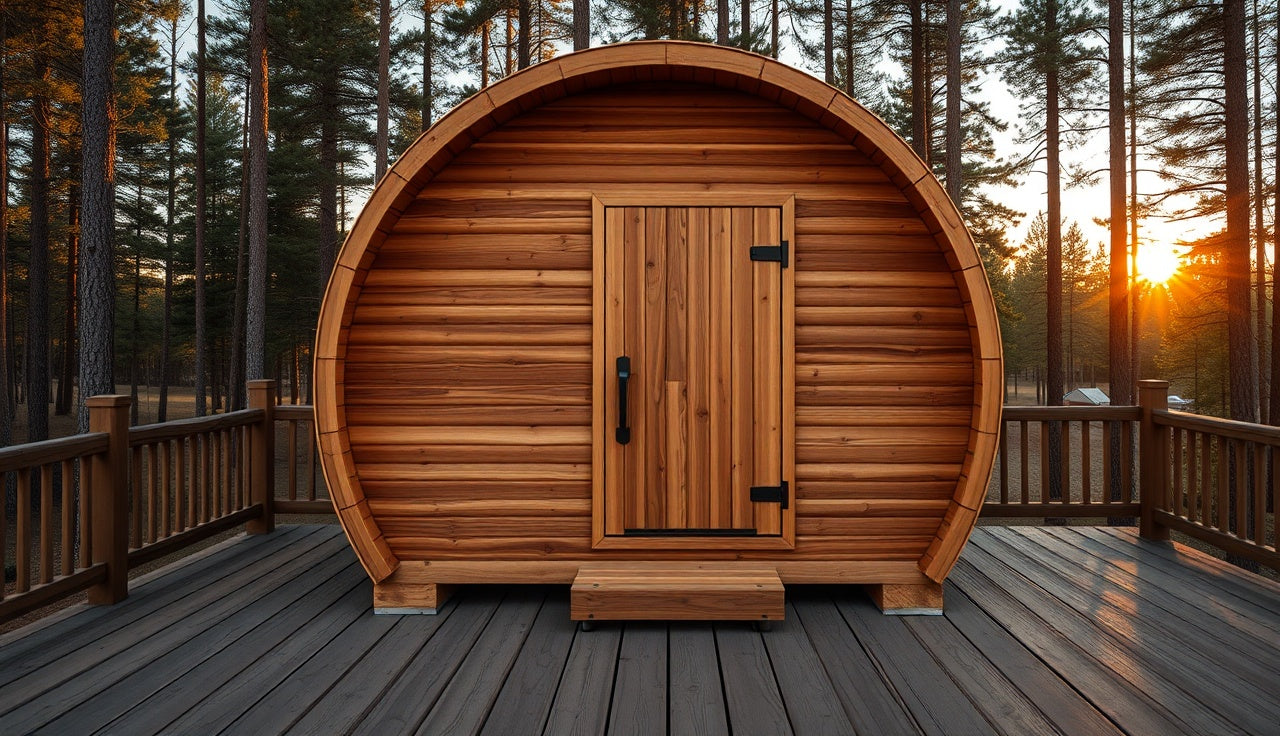
For outdoor sauna builds, this zone split matters most. A barrel sauna on a gravel pad still needs a base that won't rot out in two years. That base is exactly where pressure treated earns its keep.
What wood should you use for sauna benches and walls instead?
Several species handle sauna conditions well with zero chemical treatment. You want low thermal conductivity (so the bench doesn't scald you), stability through heat and moisture cycles, low resin content (resin turns tacky and can burn hot), and tolerance for sweat and humidity.
The workhorse sauna woods:
Western red cedar is the North American default. Naturally rot and insect resistant, a pleasant smell (some people are sensitive to cedar aromatics), and it stays cool to the touch thanks to low density. Cedar covers both bench boards and interior paneling.
Nordic spruce (sold as "sauna spruce" or Finnish spruce) is the traditional Finnish choice. Light, stable, very low resin, neutral smell. Less naturally rot-resistant than cedar, but inside a well-ventilated sauna it lasts decades.
Aspen is the pick for chemical-sensitive people or anyone who wants no smell at all. Essentially odorless, extremely low resin, good thermal behavior. Softer than cedar and more prone to sweat staining over time, but plenty of people prefer it.
Thermally modified wood (thermowood) is regular wood heated to 180 to 215°C in a low-oxygen chamber, which drives out moisture, breaks down hemicellulose, and makes a much more stable, rot-resistant board with no added chemicals [6]. It costs more than standard cedar but stays dimensionally put, and it's showing up more in outdoor builds. Peer-reviewed work confirms thermowood holds far less moisture and resists biological decay better than untreated controls, without preservatives [11].
Basswood works for ceilings and upper walls where heat peaks. Low density, pale, resin-free.
For a home sauna build: untreated cedar or aspen inside, thermally modified or naturally rot-resistant species anywhere near moisture, and pressure treated only for exterior substructure at ground contact.
What about the floor? Can you use pressure treated wood there?
Sauna flooring is a special case. The floor is the coolest surface in the room (heat rises) and takes the worst of the water, sweat, and foot traffic. It also has to drain.
Many saunas run a slatted wood floor with drainage gaps sitting over a sloped concrete base or a drain pan. The slats themselves should be untreated cedar, teak, or thermally modified wood, since bare feet ride on them. Teak carries naturally high oil content and shrugs off wet conditions, though the price stings.
The subfloor or concrete base underneath can use standard construction materials, including pressure treated framing if it sits at or near grade. That substructure never touches skin and never enters the heated air space.
Putting an outdoor sauna straight on a wood deck? Build the deck from pressure treated framing with composite or cedar decking, then set the sauna on top. The sauna's own floor is a separate system sitting above the deck, not part of it.
One mistake to skip: using pressure treated 2x4s as interior floor sleepers under a removable slat floor. The slats sit an inch above the treated wood, but steam and condensation will carry anything off-gassing from those sleepers straight into the floor-level air. Not worth the few dollars saved.
Does sealing or painting pressure treated wood make it safe for sauna use?
Sealing is a partial mitigation, not a fix. A coat of polyurethane or an exterior sealant over treated wood does slow surface compound migration somewhat. It doesn't stop off-gassing from the heated wood itself, and sealants carry their own VOC problems at sauna temperatures.
The EPA recommends washing hands after handling treated wood and letting surfaces dry and cure before skin contact, but it doesn't endorse painting or sealing as a way to make treated wood acceptable where it's otherwise discouraged [2].
Don't seal a treated board, use it for a bench, and call the problem solved. Heat eventually breaks down the coating, and any crack becomes a direct exposure point. The real fix is putting the right wood in the right place.
For exterior sauna components, sealing treated wood with a water repellent finish is a reasonable maintenance step. That's about weathering and lifespan, not about making the interior exposure profile any safer.
What do building codes say about pressure treated wood near heat sources?
Most residential codes follow the International Residential Code (IRC), which governs wood framing, fire resistance, and moisture management. The IRC doesn't call out sauna construction in most sections, but several provisions apply.
The IRC requires wood in ground contact or high-moisture conditions to use lumber rated for those conditions, which is exactly what ground-contact pressure treated lumber (UC4B) is [8]. Using it for a sauna foundation or skids is code-compliant and usually what the inspector expects to see.
Fire codes matter too. Pressure treated wood does not resist fire better than untreated wood, and some older boron-based treatments actually reduce char resistance. The IRC requires combustible materials to keep specific clearances from heat-producing appliances. Sauna heaters (kiuas) are listed appliances that ship with minimum clearance requirements in their manuals. Those clearances apply to all wood, treated or not.
Some states pile on requirements for accessory structures, sauna permits, and heater electrical code. California's Title 24 energy code, for one, has provisions that affect how sauna structures get insulated [10]. Check your local jurisdiction before you cut a single board.
Shopping for a pre-built or kit sauna? Products from reputable manufacturers arrive with listed components and specified materials. SweatDecks carries home sauna options where the interior materials come pre-specified and documented, which takes the guesswork out.
How do you identify old CCA-treated wood if you're buying reclaimed lumber?
This matters because budget builders often eye reclaimed decking, old dock lumber, or salvaged fence posts. A lot of that material is pre-2004 CCA.
Visually, CCA-treated wood often carries a greenish tint, though it fades. More reliably, use an inexpensive arsenic test kit from a hardware store on a wood shaving. The reagent changes color when arsenic is present. It's not quantitative, but it tells you yes or no.
Find any end-tag or treatment stamp and look for "CCA," "CCA-C," or a treatment date code. Any lumber tagged CCA should be handled as hazardous waste per EPA guidance: not burned (burning releases arsenic into the smoke) and not used in enclosed spaces [2]. CPSC testing on CCA playground equipment confirmed measurable arsenic could be dislodged from the wood onto children's hands, which helped drive the phase-out [12].
Reclaimed lumber from interior residential construction (old studs, joists, trim) is almost never pressure treated. Reclaimed deck boards, dock pilings, and utility poles are the higher-risk categories.
Can't verify the treatment type? Don't use it for a sauna. The gap between salvaged unknown lumber and a known cedar board isn't worth the uncertainty.
What's the safest overall approach for building a sauna on a budget?
Here's what experienced builders actually do when they're balancing cost and safety.
The substructure (foundation, skids, ground-contact beams, the deck under an outdoor unit) gets pressure treated ground-contact rated lumber. Safe, because it's away from the heated space, and correct structurally. Skip it and rot kills a sauna build in five to ten years.
The framing inside the thermal envelope uses standard kiln-dried lumber. SPF (spruce-pine-fir) framing is fine. It doesn't need treatment because a well-built sauna interior, with vapor barriers on the cold side of the insulation, never sees the prolonged moisture that rots untreated wood.
The interior surfaces (benches, backrest boards, wall paneling, ceiling) use the species above. Cedar is the most cost-effective in North America. An 8x10 interior might need 200 to 300 board feet of 1x4 or 1x6 cedar, roughly $150 to $400 depending on grade and region. Not a budget-breaker.
For the floor, the cheapest working solution is a sloped concrete base with a removable cedar slat floor on top. The concrete costs almost nothing extra if you're already pouring a pad, and the slats pull out easily to dry.
Want to skip the material decisions entirely? A portable sauna or a kit is a legitimate route. Most quality kits specify interior cedar or Nordic spruce and use standard exterior-grade materials for the structure.
Going for the full recovery setup? Pairing your sauna with a cold plunge is the contrast approach a lot of serious users run. The material safety math for a plunge is different (no heat-driven off-gassing), but the tub's interior finish and material still matter for water quality. Separate conversation, worth reading at SweatDecks.
Summary: the pressure treated wood decision tree for sauna builders
One simple way to run the decision:
Will the wood sit inside the heated space, or get touched by someone in the sauna? If yes to either: no pressure treated wood, full stop. Use cedar, aspen, thermally modified wood, or another appropriate species.
Is the wood part of the exterior substructure, at or near grade, outside the sauna's thermal envelope? If yes: pressure treated ground-contact lumber (UC4B rated) is the right call, both safe and code-appropriate.
Is the wood structural framing inside the sauna walls, behind complete interior paneling with a proper vapor barrier? Genuine judgment call. Most builders avoid treated lumber here as a precaution even though the exposure risk runs lower than for benches. Untreated KD framing with good moisture management is the better answer.
Do you have wood of unknown provenance or possible pre-2004 origin? Test it or don't use it. The arsenic risk from old CCA lumber is real and well documented.
The most common mistake is using treated lumber for interior bench framing or sleepers because it's what's already in the truck. The savings are trivial. The extra effort to use the right material is minimal. Don't compromise here.
Frequently asked questions
Can I use pressure treated wood for the base or skids under an outdoor sauna?
Yes. The exterior foundation and skids are exactly where pressure treated lumber belongs. Ground-contact rated lumber (UC4B or UC4C) is the right spec for any wood sitting at or near grade. It won't reach sauna temperatures, it won't touch your skin, and it outlasts untreated wood in ground contact by decades. Structurally correct and safe.
Is modern pressure treated wood (ACQ or CA) safe compared to old CCA lumber?
Meaningfully safer, not problem-free. The EPA's 2004 phase-out pulled arsenic out of residential lumber. Modern ACQ and CA preservatives use copper compounds and azole fungicides instead. Copper doesn't volatilize at sauna temperatures the way arsenic does, but the azole co-biocides are under ongoing regulatory scrutiny. For interior sauna surfaces, avoid all treated lumber regardless of formulation.
What wood is best for sauna benches?
Western red cedar is the North American favorite: naturally rot-resistant, low thermal conductivity so it doesn't burn you, widely available. Aspen is the best pick for chemical sensitivities because it's essentially odorless and resin-free. Nordic spruce is traditional in Finnish saunas. Thermally modified wood costs more but performs extremely well. Avoid any pressure treated, painted, or stained wood for benches.
Will a sauna heater off-gas toxins from nearby treated wood framing?
The heater doesn't change the equation much, but proximity does. Sauna heaters run hot (a kiuas surface can top 300°C) and radiate heat into nearby wood. Any framing within the heater's clearance zone gets much hotter than ambient sauna air. Using pressure treated lumber near the heater, even in framing, is a bad idea. Heater manufacturers specify minimum clearances to combustible materials, and those zones should use clean, untreated lumber.
Can I burn scrap pressure treated wood to heat my sauna or fire it in a wood-burning kiuas?
No. Burning pressure treated wood releases toxic compounds straight into the air, including copper oxides from modern ACQ/CA lumber and, if it's old CCA, arsenic oxide. The EPA explicitly warns against burning treated wood in any residential setting. This covers wood-burning sauna heaters, outdoor fire pits, and any other combustion. Treat scrap treated lumber as construction waste, not firewood.
How do I tell if lumber is pressure treated?
Look for an end tag or ink stamp on the end grain. It shows the preservative type (ACQ, CA, CCA), the retention level, and a use category (UC3B, UC4A, and so on). Treated wood often has a slight greenish tint when new, though it fades. It usually carries small incision marks along the surface from the treatment process. No tag and unknown history? Test for arsenic before using it anywhere near a sauna.
Does the type of sauna matter? Is it different for steam rooms vs. dry saunas?
Steam rooms add sustained high humidity on top of heat. That combination is harder on both wood and the migration of surface compounds from treated wood. Same rule applies (no treated wood on interior surfaces), and if anything steam rooms strengthen the case for naturally rot-resistant or thermally modified wood because the moisture load is higher. For a sauna vs steam room comparison on materials, the principle is identical: keep treated lumber out of the breathing and contact zone.
Is thermally modified wood worth the extra cost for a sauna build?
For interior use, it's a premium option rather than a necessity, since standard cedar or aspen does the job well. Thermally modified wood earns its price in two spots: exterior components where you want rot resistance without chemicals, and high-humidity environments like steam rooms where dimensional stability matters. For a standard dry sauna with proper vapor barriers, cedar is the better value.
How should I dispose of old CCA pressure treated wood if I'm demolishing an old sauna?
Never burn it. Old CCA lumber goes to a landfill that accepts construction waste with treated wood, or to a hazardous material drop-off if your municipality offers one. EPA guidance is explicit that burning CCA wood is hazardous. Cutting it generates dust you should handle with an N95 mask or better. Wash hands and exposed skin thoroughly afterward, and never use sawdust from CCA wood as mulch.
What if a pre-built sauna kit uses pressure treated wood somewhere in its structure?
Ask the manufacturer for the material spec sheet. A reputable kit maker documents interior materials, and some use pressure treated lumber for external base framing by design. The question is always: where exactly is it, and does it touch the interior heated air or your skin? Treated lumber in an exterior substructure under the sauna floor panel is generally fine. Treated lumber in the bench framing is not.
Are there specific use categories for pressure treated lumber and how do they apply to saunas?
The American Wood Protection Association (AWPA) Use Category system rates treated lumber from UC1 (interior, dry) to UC5C (saltwater immersion). For sauna substructure: UC4A covers above-ground exterior use, UC4B covers ground contact in critical applications. The sauna interior, despite high heat and humidity, is neither a ground-contact nor an exterior environment, one more reason interior surfaces don't need treatment. Match the UC rating to the actual exposure.
What sauna benefits am I missing if I cut corners on interior wood quality?
The sauna benefits most people want, including cardiovascular stress response, relaxation, and recovery, depend on comfortable sustained exposure. In a poorly built sauna with materials that smell, off-gas, or irritate skin, you won't stay in long enough to get the effect. Interior wood quality is more than a safety issue; it shapes the experience. Cedar's natural smell is part of the atmosphere most users enjoy.
Can I use composite decking materials for a sauna floor or bench?
Composite decking (wood-plastic composites like Trex) is designed for exterior ambient temperatures, not sustained 80 to 95°C sauna heat. Most composite products off-gas more VOCs when heated well above their design range, and the surface can soften or warp. Manufacturers don't rate them for sauna use. Stick to solid wood for any surface inside the heated envelope, and save composites for the exterior deck the sauna sits on.
Sources
- Finnish Institute of Occupational Health (Työterveyslaitos): Traditional Finnish saunas operate at 150 to 195°F (65 to 90°C) with relative humidity between 5 and 30 percent, creating conditions where wood surfaces absorb and radiate heat continuously.
- U.S. Environmental Protection Agency, Chromated Copper Arsenate (CCA): The EPA and industry agreed to phase out CCA for most residential uses effective January 1, 2004; EPA guidance states CCA-treated wood should not contact food and recommends hand-washing after handling; EPA also warns against burning treated wood due to toxic combustion products.
- Environmental Science & Technology (ACS journal), Stilwell and Gorny, Arsenic in CCA-Treated Wood: Arsenic transfer from CCA-treated wood surfaces to skin was measurable, and transfer rates increased with moisture and surface pressure, both conditions present in sauna environments.
- International Agency for Research on Cancer (IARC), World Health Organization: IARC evaluations flag several azole fungicides as compounds of concern in animal studies; regulatory limits for tebuconazole and propiconazole are set for food-use exposure, not heated-wood-surface inhalation.
- American Wood Protection Association, AWPA Use Category System: Ground-contact rated lumber is classified UC4B or UC4C under the AWPA Use Category system and is the appropriate specification for structural members in soil contact or near-grade exterior applications such as sauna foundation skids.
- USDA Forest Service, Forest Products Laboratory: Thermally modified wood is produced by heating lumber to 180 to 215°C in a low-oxygen environment, which breaks down hemicellulose and significantly improves dimensional stability and rot resistance without added chemicals.
- International Code Council, International Residential Code (IRC): The IRC requires lumber in ground contact or high-moisture conditions to be rated for those conditions; it also requires combustible materials to maintain minimum clearances from heat-producing appliances.
- California Air Resources Board (CARB): Burning treated or painted wood in residential appliances is prohibited in California; California Title 24 also contains building energy standards that affect sauna structure insulation.
- National Library of Medicine, PubMed (thermal modification of wood literature): Peer-reviewed literature confirms thermally modified wood (thermowood) shows significantly reduced equilibrium moisture content and improved biological durability compared to untreated controls, without chemical preservatives.
- U.S. Consumer Product Safety Commission (CPSC): CPSC studies on CCA playground equipment confirmed measurable arsenic dislodgeable from wood surfaces onto children's hands, contributing to the 2003-2004 phase-out decision for residential CCA applications.

Share:
How deep should a gravel base be for an outdoor sauna?
How to anchor a sauna on a skid foundation (step-by-step)