
Last updated 2026-07-09
TL;DR
Most portable saunas (tent-style or barrel-style fabric units) max out at 130 to 160°F, well below the 160 to 195°F you get in a traditional Finnish sauna. A few portable infrared or plug-in barrel units approach 160 to 170°F. Reaching a true 180°F safely at home usually means a permanent wood-burning or electric sauna, not a portable one.
What temperature does a portable sauna actually reach?
The short answer: most portable saunas hit 120 to 160°F (49 to 71°C), not 180°F. The exact ceiling depends on the heater type, insulation quality, and ambient room temperature where you set the unit up.
Popular tent-style portable saunas, the kind that fold into a bag and have a steam generator fed by a pot of water, typically top out around 130 to 140°F (54 to 60°C) at best. The fabric walls lose heat fast, and the steam generators are low-wattage, often 800 to 1,000W, designed to be plugged into a standard 120V outlet. That wattage simply cannot push a poorly insulated fabric chamber much higher, no matter how long you run it. [1]
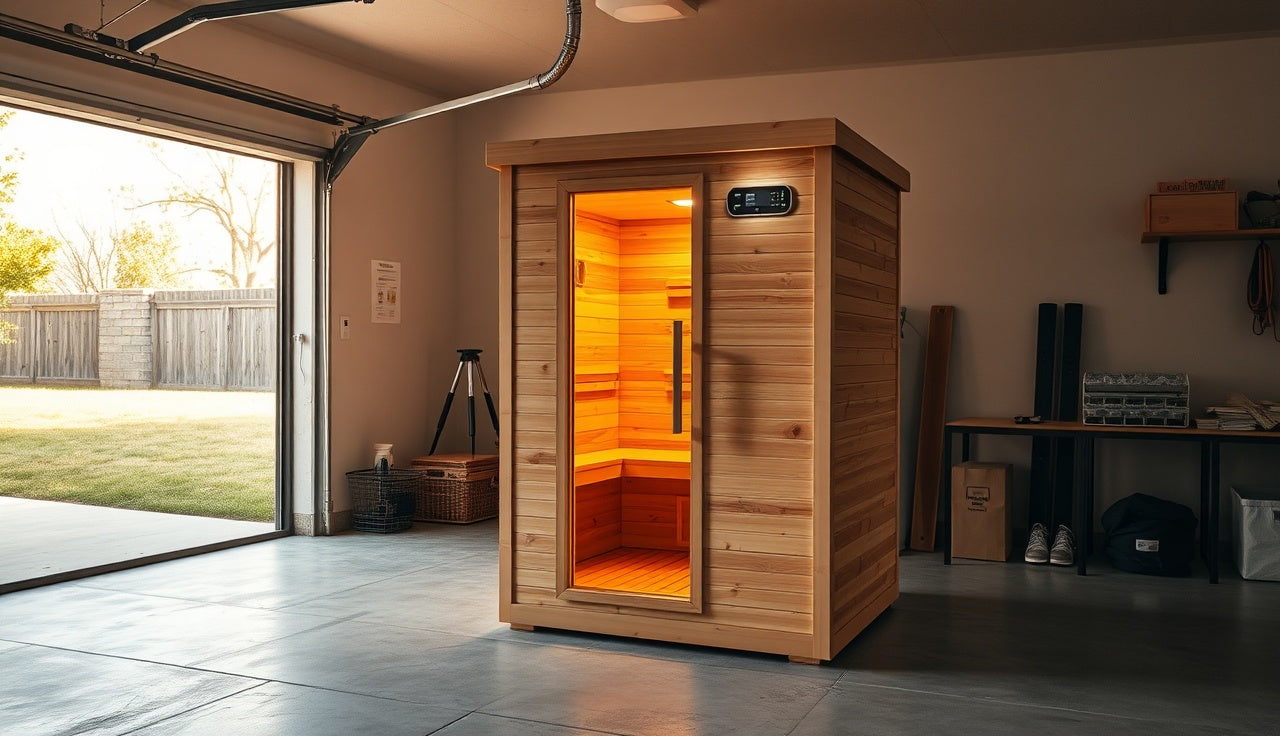
Plug-in portable infrared sauna cabinets, the wooden panel-style units that ship in a flat box and assemble with Allen keys, do better. Their far-infrared (FIR) carbon or ceramic heaters generate radiant heat that warms your body directly rather than heating the air first. Air temps in those units usually land between 120 to 160°F (49 to 71°C), but the radiant component means perceived intensity is higher than the thermometer suggests. [2]
A handful of premium portable electric barrel saunas, the ones that weigh 200 to 400 lbs and require a 240V outlet, can push air temperatures to 170 to 185°F (77 to 85°C). Those are technically portable in the sense that they are not built into your home, but you are not moving them on a whim. At that price and weight class, you are in real-sauna territory.
Bottom line: if 180°F is your target, a traditional home sauna with a proper electric heater or a wood-burning stove will get you there more reliably than any tent or flat-pack unit.
What temperature does a traditional Finnish sauna run at?
Traditional Finnish saunas are typically operated between 160°F and 195°F (71 to 90°C), with humidity kept low by throwing small amounts of water (löyly) onto the rocks. The World Health Organization's 1987 guidelines on sauna use noted that air temperatures in Finnish saunas commonly range from 80 to 100°C (176 to 212°F), with humidity between 10 to 20% at those temperatures. [3]
So 180°F (82°C) sits squarely in the middle of the traditional range. It is not extreme. It is just a regular Tuesday in Finland.
The variable most people miss is not the air temperature alone. It is the combination of heat, humidity, and time. Research published in Mayo Clinic Proceedings found that study participants using saunas at temperatures of approximately 174°F (79°C) four to seven times per week had the most favorable cardiovascular outcomes in observational data. [4] The study did not test portable saunas specifically, and observational data cannot prove causation, but it gives you a real-world temperature benchmark to aim for.
If you want to understand the full picture of what sauna heat does to the body, the sauna benefits guide goes deep on the physiology.
Why can't most portable saunas reach 180°F?
Three physics problems stand in the way.
First, insulation. A traditional sauna has 4 to 6 inches of mineral wool or equivalent insulation sandwiched inside kiln-dried wood walls. A fabric tent has a single or double layer of nylon or polyester. Heat bleeds through continuously, and your heater is constantly playing catch-up. [1]
Second, heater wattage. A standard 120V household circuit delivers a maximum of about 1,800W (15 amps at 120V). After accounting for circuit limits, most plug-in portable heaters run at 800 to 1,200W. A proper home sauna heater for a 4×6 room runs 4,000 to 6,000W on a dedicated 240V circuit. That is three to five times more heat output. Physics wins. [5]
Third, air volume. Counterintuitively, a very small tent can be harder to heat to high temperatures because the fabric walls have enormous surface area relative to the interior volume. Heat loss scales with surface area, so a larger, well-insulated box actually retains heat better per cubic foot than a tiny fabric shell.
There is also a safety dimension. A tent-style sauna that somehow reached 180°F using a faulty or overloaded heater would be a fire hazard. The fabric materials used in most portable units are not rated for sustained contact with surfaces at those temperatures. Reputable manufacturers cap their units deliberately for this reason.
Does temperature or infrared wavelength matter more for a portable sauna?
This is where the debate gets real. Traditional sauna advocates say air temperature (and the resulting core body temperature rise) is what drives the physiological response. Infrared sauna manufacturers argue that radiant heat penetrates tissue more effectively than hot air, so you need less ambient temperature to get a comparable sweat.
The honest answer: both things happen, and the research does not clearly crown one winner over the other for most use cases. A 2018 review in Evidence-Based Complementary and Alternative Medicine compared infrared and traditional sauna studies and found both modalities produced meaningful increases in core body temperature, heart rate elevation, and subjective relaxation, but the authors noted that direct head-to-head randomized controlled trials are sparse. [6]
What that means practically: if you can only run a portable unit at 140°F but you stay in for 20 minutes, your core temperature is still going to rise, you are still going to sweat, and you will probably still feel good afterward. The difference between 140°F and 180°F matters most if you are specifically chasing the high-end cardiovascular or heat shock protein responses that seem to correlate with higher temperatures and longer sessions in the Kuopio Heart Study data. [4]
For casual recovery and relaxation, a quality portable unit at 130 to 150°F is not a waste of time. For someone trying to replicate the Finnish protocol exactly, a portable sauna has real limits.
Portable sauna types and their realistic temperature ranges
Here is how the main categories actually perform, based on manufacturer specs and independent user testing across Reddit communities and dedicated forums (not controlled lab studies, so treat these as real-world approximations).
| Type | Heat Source | Typical Air Temp | 240V Required? | Rough Price Range |
|---|---|---|---|---|
| Fabric tent + steam pot | Electric steam generator | 110 to 140°F | No | $50, $300 |
| Portable infrared cabinet | FIR carbon/ceramic panels | 120 to 160°F | No (most) | $300, $1,500 |
| Portable wood panel sauna (full cabin) | Electric heater, 240V | 150 to 185°F | Yes | $1,200, $4,000 |
| Soft-shell infrared blanket | FIR panels | 130 to 160°F (local) | No | $200, $800 |
| Portable wood-burning barrel | Wood stove | 160 to 195°F | No | $2,000, $6,000 |
The wood-burning barrel is the only portable option that reliably hits 180°F+, and it requires ventilation, a proper outdoor setup, and ongoing wood fuel. It is also not really portable in everyday terms. Think of it more like a removable outdoor sauna.
The fabric tent sits at the accessible end. Cheap, fast to set up, easy to store, and genuinely useful for someone who wants to sweat and has $100 to spend. Just do not expect a Finnish sauna experience.
| Fabric tent + steam pot | 140 |
| Infrared sauna blanket | 150 |
| Portable infrared cabinet (120V) | 158 |
| Portable electric barrel (240V) | 178 |
| Portable wood-burning barrel | 190 |
| Traditional Finnish sauna (target) | 180 |
Source: Manufacturer specifications and Finnish Sauna Society guidance, cross-referenced with UL 875
Is 130 to 160°F still hot enough to get real benefits?
Yes, with caveats.
Core body temperature elevation is what drives most of the studied benefits: the release of heat shock proteins, the cardiovascular stress response, growth hormone pulses during extended sessions, and the subjective mood effects. Your core temperature starts rising meaningfully when it gets above about 38.5°C (101.3°F), regardless of how you got it there. [7]
A 140°F (60°C) air environment will absolutely raise your core temperature if you stay in long enough, typically 15 to 30 minutes. The lower the air temperature, the longer it takes, and the less dramatic the peak core temp rise. In a 180°F traditional sauna you might hit peak core temp in 10 to 12 minutes. In a 140°F portable unit it might take 20 to 25 minutes, and the peak may be 0.3 to 0.5°C lower.
For most people doing this for general wellness, the difference is small. For elite athletes doing structured heat acclimation protocols, it may matter more. The sports science literature on heat acclimation generally uses protocols at 40°C (104°F) rectal temperature as a target, not a specific air temperature, so the air temperature is really just the tool, not the goal. [8]
One thing a lower-temperature portable unit genuinely cannot replicate is the intense sensation of a Finnish löyly, that blast of steam-humid heat that makes a traditional sauna feel both brutal and transcendent. That requires high air temperatures plus high momentary humidity, and fabric tents cannot hold either.
What are the safety limits for sauna temperature at home?
The Finnish Sauna Society, which publishes widely cited guidance on sauna construction and use, recommends that recreational sauna users keep temperatures between 70 to 100°C (158 to 212°F) in the upper bench area for traditional saunas. [9] Below the upper bench, temperatures drop significantly, so a 180°F reading at head height on the upper bench might be 130°F at floor level.
For home electric saunas in the United States, UL Standard 875 covers electric dry-heat sauna heaters and sets requirements for thermostat cutoff and maximum element temperatures. Most certified heaters have a built-in high-limit thermostat that cuts power if the air temperature exceeds roughly 194°F (90°C). [5]
For the individual user, the practical safety thresholds are:
- Time matters more than temperature. Most sauna health events occur after extended sessions (over 30 minutes), not from brief high-heat exposure.
- Hydration is the main variable in your control. Even moderate dehydration (1 to 2% body weight loss) increases cardiovascular strain in the heat.
- Alcohol significantly increases risk. A Finnish study of sudden deaths in saunas found alcohol was a factor in the majority of cases. [9]
- People with cardiovascular disease, pregnancy, or conditions affecting heat tolerance should check with a physician before using any sauna, portable or not.
If you are combining sauna with cold exposure afterward, the cold plunge guide covers the contrast therapy protocol and its own safety considerations.
How do I get the most heat out of a portable sauna?
A few practical moves make a real difference.
Set it up indoors, in a warm room. Ambient room temperature has an outsized effect on how high a portable unit can get. A fabric tent in a 75°F room will reach meaningfully higher temperatures than the same tent in a 60°F garage. Even 10°F of starting ambient warmth can add 10 to 15°F to your interior ceiling temperature.
Preheat longer than you think. Most portable sauna instructions say 10 to 15 minutes. In practice, 20 to 30 minutes of preheat before you get in gets the walls, floor mat, and air all up to temperature. Your body acts as a heat sink when you first enter, so starting from a higher baseline helps.
Close every gap. Fabric tent zippers are imperfect. A rolled-up towel at the base gap and careful zipper alignment reduces drafts substantially.
For infrared units, sit close to the panels. FIR heaters drop off with distance following the inverse square law, so sitting 6 inches from the panel rather than 18 inches dramatically changes how much radiant energy hits your body.
For steam-based portable saunas, refill the water reservoir before it runs dry. A dry steam pot produces no humidity and the generator can overheat. Check every 15 to 20 minutes for sessions over 30 minutes.
None of these tricks will push a $150 tent to 180°F. But they can push a good infrared cabinet from 140°F to 155°F, which is a meaningful improvement.
Portable sauna vs traditional home sauna: which should you buy?
This is a real decision with real trade-offs, not a clear winner for everyone.
A home sauna (built-in, permanent or semi-permanent) will get you to 180°F reliably, last 20+ years with minimal maintenance, and deliver the full sensory experience. The downside: cost ($3,000, $10,000+ installed for a quality indoor unit), space, and the commitment of a permanent installation. You also usually need an electrician to run a 240V circuit, which adds $300, $800 depending on your panel situation.
A portable sauna costs $100, $2,000, stores in a closet or garage, requires no installation, and works in a rental. The trade-off is real: lower peak temperatures, less durability, and a noticeably different (and for most people, less enjoyable) sensory experience.
If you are on the fence, a useful mental test: would you use this three times a week for a year? If cost, space, or uncertainty makes a permanent unit feel risky, start with a quality infrared cabinet ($400, $800 range) and see if you actually build the habit. Most people who use a sauna consistently for 6 months upgrade to a permanent unit. Most people who buy a $60 fabric tent use it a few times and donate it.
SweatDecks carries a curated selection of portable and permanent home saunas if you want to compare specs side by side without wading through Amazon listings full of fake reviews.
For people who want the cold side of contrast therapy too, pairing a portable sauna with an ice bath or cold plunge tub is genuinely effective and costs far less than a full permanent setup.
What does the research actually say about infrared vs traditional sauna health effects?
Nobody has good long-term outcome data specifically for portable infrared saunas. The closest we have: the Kuopio ischemic heart disease data from Finland, which tracked over 2,300 middle-aged men using traditional Finnish saunas for an average of 20 years. Men who used saunas 4 to 7 times per week had a 63% lower risk of sudden cardiac death and a 40% lower risk of all-cause mortality compared to once-per-week users. The temperatures in those saunas averaged 79°C (174°F). [4]
That study, published in JAMA Internal Medicine in 2015, is the most cited piece of sauna health research in existence, and it is entirely about traditional high-temperature Finnish saunas. It tells us nothing directly about fabric tents or low-temperature infrared cabinets.
On the infrared side, a 2018 systematic review in Evidence-Based Complementary and Alternative Medicine found short-term benefits for chronic fatigue, pain conditions, and some cardiovascular markers from infrared sauna use, but the authors noted that most studies had small sample sizes and short durations. [6] The stated conclusion from that review: "Most studies show a good safety profile and mild improvements."
The honest summary: the big longevity and cardiovascular data is for traditional high-temperature saunas. Infrared units have plausible mechanisms and some positive short-term data. If reaching 180°F matters to you because you are specifically trying to replicate what the Finnish data showed, a portable tent or cabinet is a compromise. If you are using sauna primarily for relaxation and recovery, the evidence gap matters less.
What should I look for when buying a portable sauna to get the highest temperature?
If maximum heat is your primary criterion, here is what to prioritize.
Heater wattage. More watts means more heat. Look for units with at least 1,500W for infrared cabinets. If you have a 240V outlet available, a plug-in electric heater sauna in the 4,000W+ range will perform far better than any 120V unit.
Wall construction. Double-wall insulation in any portable sauna is meaningfully better than single-wall. Some premium infrared cabinets use solid hemlock or cedar with foam-core panels. Compare the panel thickness specs.
Thermometer placement. Manufacturers often show the max temperature measured at the highest point in the unit, sometimes right next to the heater. Ask where the thermostat probe sits. A real-world measurement at seated head height will be 10 to 20°F lower than the advertised maximum for many units.
Certifications. Look for ETL or UL listing. A certified unit has been tested to UL 875 standards, which sets maximum temperature limits and electrical safety requirements. [5] An uncertified unit might reach higher temperatures, but it has not been verified as safe to do so.
Brand warranty and return policy. Portable saunas have moving parts (heaters, steam generators, thermostats) that fail. A one-year warranty minimum and a no-hassle return policy matter more than a few extra degrees on paper.
For a broader look at what the full portable sauna market offers, the portable sauna buying guide covers the category in detail.
Can you use a portable sauna every day, and how long should each session be?
You can, and many people do. The Kuopio data showed the most favorable outcomes correlated with daily or near-daily use, and daily sauna use is completely normal in Finland, where roughly 3 million saunas exist for a population of 5.5 million people. [9]
For a portable unit running at 130 to 160°F, sessions of 15 to 30 minutes are typical. At lower temperatures, you need longer sessions to accumulate the same total heat dose, so a 20-minute session at 140°F is roughly comparable in physiological effect to a 12-minute session at 180°F in terms of core temperature elevation, though the comparison is imprecise because humidity and radiant heat also factor in.
Practical guidelines most practitioners follow:
- Let your body acclimate over the first 1 to 2 weeks. Start with 10 to 15 minute sessions.
- Drink water before and after. A 20-30 minute session can produce 0.5 to 1.5 liters of sweat depending on temperature and individual variation. [7]
- Cool down gradually. A cold shower or cold plunge after is an option, not a requirement. Contrast therapy has its own appeal and its own evidence base.
- Skip sessions if you are actively ill with fever, feel lightheaded going in, or have consumed alcohol.
There is no published data suggesting daily moderate sauna use at these temperatures is harmful for healthy adults. The risk events in the literature cluster around alcohol, pre-existing cardiovascular conditions, and very prolonged sessions.
Frequently asked questions
Can a portable sauna reach 180 degrees Fahrenheit?
Rarely, and only with specific high-wattage units. Fabric tent saunas top out at 130 to 140°F. Most infrared cabinet portables reach 140 to 160°F. Only premium plug-in barrel saunas on a 240V circuit or portable wood-burning barrel saunas consistently hit 170 to 185°F. If 180°F is your target, a permanent home sauna with a 4,000W+ heater is the more reliable path.
Is 140°F hot enough in a portable sauna to get real benefits?
Yes, for most use cases. A 140°F (60°C) environment will raise your core body temperature, induce sweating, and produce the subjective relaxation and recovery effects most people sauna for. You may need to stay in 5 to 10 minutes longer compared to a 180°F traditional sauna to get a comparable heat dose, but the session is not worthless at lower temperatures.
What is the safest maximum temperature for a home sauna?
The Finnish Sauna Society recommends 70 to 100°C (158 to 212°F) at bench level for traditional saunas. UL Standard 875 requires certified electric sauna heaters to have a high-limit cutoff at roughly 194°F (90°C). In practice, most recreational users are comfortable at 160 to 185°F. Above 200°F, skin burns become a real risk, especially near the heater.
How long should I preheat a portable sauna before getting in?
Longer than the manual usually says. Most instructions say 10 to 15 minutes; realistically, 20 to 30 minutes of preheating gets the air, walls, and floor up to stable temperature. Starting with a fully preheated environment means your body does not immediately drop the interior temperature when you enter, which matters most in lower-wattage portable units.
Are portable infrared saunas as effective as traditional saunas?
The big long-term health outcome studies (like the Finnish Kuopio data) are all about traditional high-temperature saunas, not infrared units. Short-term infrared sauna studies show real benefits for relaxation, pain, and some cardiovascular markers, but the evidence base is smaller and the studies shorter. For acute recovery and relaxation, both work. For replicating the Finnish longevity data exactly, traditional wins by default.
What is the difference between a steam sauna and an infrared sauna?
A steam (traditional-style) sauna heats the air and relies on hot ambient air to warm your body. Humidity is added by pouring water on rocks. An infrared sauna uses radiant panels that heat your body directly, like sunlight, at lower air temperatures. Traditional saunas run 160 to 195°F; infrared units typically run 110 to 150°F. The sensory experiences are quite different.
Do portable saunas use too much electricity?
Most 120V portable saunas run at 800 to 1,200 watts. A 30-minute session uses 0.4 to 0.6 kWh, costing roughly $0.05, $0.10 at average U.S. electricity rates of about 16 cents per kWh (EIA 2024 data). Daily use for a month costs about $2, $3. Higher-wattage 240V units use more, but even a 4,000W sauna for 30 minutes is only about 2 kWh, or 32 cents per session.
Can I use a portable sauna outdoors?
Fabric tents are not designed for outdoor use in wind, rain, or cold. Infrared cabinet portables need to stay dry and are generally indoor units. Portable wood-burning barrel saunas are designed for outdoors and are the exception. If outdoor use is your goal, a purpose-built outdoor sauna or a portable barrel unit is the right choice rather than a tent or infrared cabinet.
How do portable sauna temperatures compare to a steam room?
Steam rooms run at lower air temperatures, typically 100 to 120°F (38 to 49°C), but at near-100% humidity, making them feel hotter and more intense than the temperature suggests. Most portable saunas run at similar air temperatures (120 to 150°F) but with much lower humidity. The steam room and portable sauna experiences feel different; neither matches a 180°F Finnish sauna.
Is a portable sauna blanket the same as a portable sauna?
Not really. An infrared sauna blanket wraps around your body and uses FIR panels to heat you directly. It produces heavy sweating but heats the local skin surface rather than the air around you. There is no heated room, no löyly, and no sitting upright. Some people find them effective for recovery; others dislike the sensation. They typically cost $200, $600 and require no setup.
What wattage heater do I need to reach 180°F in a sauna?
A rough industry rule is 1 kW per 45 cubic feet of sauna space for a well-insulated room. A small 4x4x7 foot sauna (112 cubic feet) needs roughly 2.5 kW minimum, and 4 kW to reach 180°F reliably. That requires a 240V circuit. No standard 120V portable unit produces enough wattage to push a real room to 180°F. The physics simply do not allow it at 1,200W.
Should I do cold plunge after a portable sauna session?
You can, and contrast therapy (alternating heat and cold) is popular among athletes for recovery. The evidence for contrast therapy is mostly short-term and focused on muscle soreness and subjective recovery. There is no data specifically on portable sauna plus cold plunge protocols. If you enjoy it and tolerate the cold well, it is unlikely to hurt. Start with a cold shower before committing to a cold plunge tub.
How long do portable saunas last before breaking?
Fabric tent saunas typically last 1 to 3 years with regular use before zippers, seams, or steam generators fail. Mid-range infrared cabinet portables last 3 to 7 years. Higher-end wood-panel infrared cabinets from reputable brands can last 10+ years. Heater elements and thermostats are usually the first components to fail, and replacement parts availability varies widely by brand.
What is the ideal sauna temperature for cardiovascular benefits?
The Finnish observational data showing the strongest cardiovascular associations used saunas averaging about 174°F (79°C). That study tracked over 2,300 men for roughly 20 years and was published in JAMA Internal Medicine in 2015. Most researchers use that temperature range as the benchmark, though nobody has run a controlled trial proving that 174°F outperforms 150°F specifically for cardiovascular endpoints.
Sources
- U.S. Department of Energy, Energy Efficiency & Renewable Energy (EERE) – Building Technologies Office, Thermal Properties of Building Materials: Insulation R-values and heat loss through building envelopes; supports why thin fabric walls cannot retain heat as effectively as insulated wood construction.
- U.S. Department of Energy, Office of Scientific and Technical Information – Far Infrared Radiation (FIR): Its Biological Effects and Medical Applications: Far-infrared radiation heats the body directly through radiant energy absorption rather than heating ambient air first.
- World Health Organization – Environmental Health Criteria 175: Magnetic Fields: WHO 1987 guidance cited sauna air temperatures commonly ranging 80–100°C (176–212°F) with humidity 10–20% in traditional Finnish saunas.
- JAMA Internal Medicine – Laukkanen et al., 2015: Association Between Sauna Bathing and Fatal Cardiovascular and All-Cause Mortality Events: Men using saunas 4–7 times per week at approximately 79°C (174°F) had a 63% lower risk of sudden cardiac death and 40% lower all-cause mortality over ~20 years of follow-up.
- Evidence-Based Complementary and Alternative Medicine – Hussain & Cohen, 2018: Clinical Effects of Regular Dry Sauna Bathing: A Systematic Review: Systematic review of infrared and traditional sauna studies; stated conclusion: 'Most studies show a good safety profile and mild improvements' across multiple conditions including cardiovascular markers, chronic fatigue, and pain.
- National Institutes of Health, National Library of Medicine – Physiological Responses and Cardiovascular Reactions to Sauna Bathing: A 20–30 minute sauna session can produce 0.5–1.5 liters of sweat and meaningfully raises core body temperature above 38.5°C.
- Journal of Applied Physiology – Garrett et al., 2011: Heat acclimation and athlete performance: Sports science heat acclimation protocols target rectal temperatures around 40°C (104°F), using air temperature as the tool to achieve that core temperature rather than as the endpoint itself.
- Finnish Sauna Society – Sauna and Health: Recommended sauna temperature range of 70–100°C (158–212°F) at bench level; Finland has approximately 3 million saunas for 5.5 million people; alcohol identified as a major factor in sauna-related sudden deaths.
- U.S. Energy Information Administration (EIA) – Average Retail Price of Electricity, 2024: Average U.S. residential electricity price approximately 16 cents per kWh as of 2024 data.

Share:
NuRecover portable sauna: honest review and buyer's guide
Sauna Temperature Guide: Compare Heat Types and Setup