
Last updated 2026-07-09
TL;DR
A portable Finnish sauna copies the dry, high heat of a traditional Finnish sauna in a collapsible tent or pop-up cabin. Good ones cost $150 to $800. They work for renters and tight spaces, but they run cooler than a real kiuas-heated room and can't fully reproduce löyly steam. Here's how to decide.
What is a portable Finnish sauna, exactly?
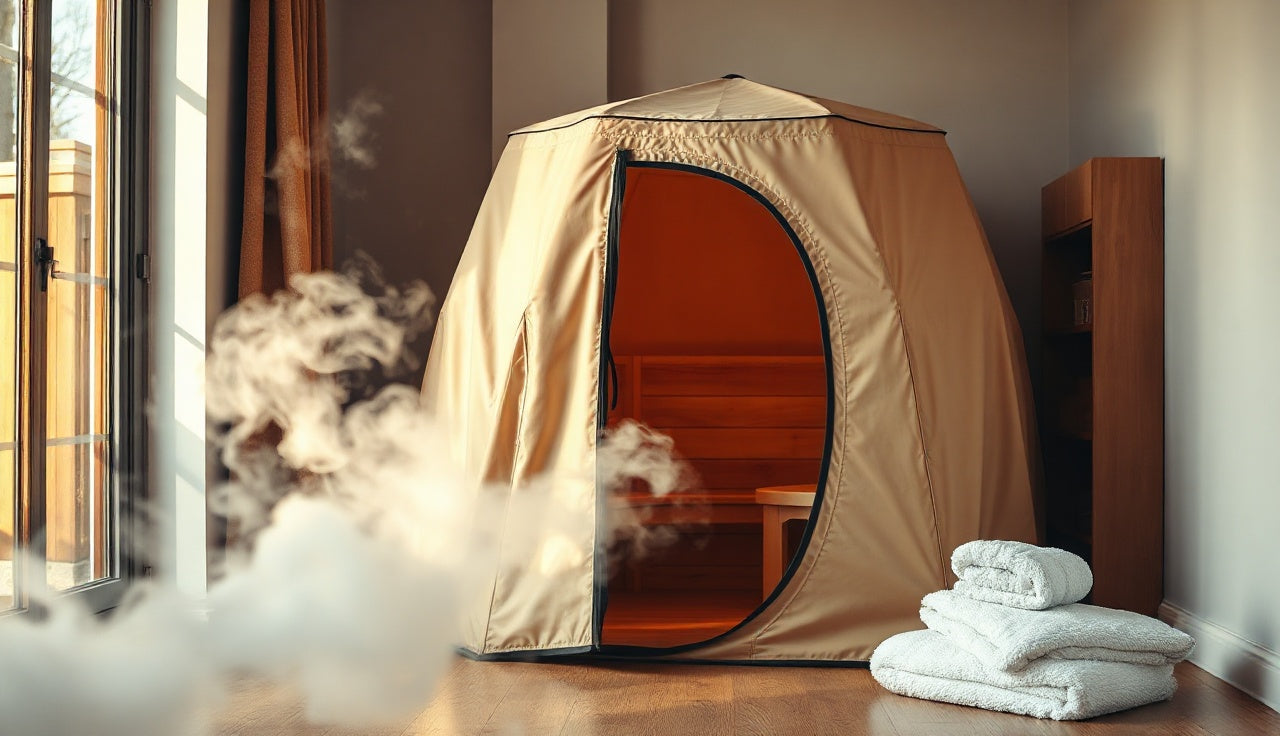
A portable Finnish sauna is a collapsible enclosure, almost always waterproof nylon or polyester fabric over a folding frame, that uses an electric steam generator or a small far-infrared (FIR) panel to get hot enough for a real sweat. The Finnish sauna tradition targets air temperatures of 150 to 195°F (65 to 90°C) with low-to-moderate humidity. A well-built portable unit reaches the lower end of that, roughly 150 to 170°F, in 10 to 15 minutes [1].
Here's the distinction that matters. A real Finnish sauna, the kind with a kiuas (a wood or electric stove loaded with stones), heats the whole room. The walls, the bench, the air, all of it. You pour water on the stones to make löyly, the burst of steam that spikes humidity for a moment before it fades. A portable fabric sauna heats the air in a small bubble around your body, and usually your head sticks out the top. That's a different experience, and being straight about the gap is the only fair way to judge these things.
Portable Finnish saunas are not the same as cheap sauna blankets or sweat suits, though. A purpose-built tent sauna with a proper steam generator gets hotter, spreads heat more evenly around your torso and limbs, and feels closer to a room sauna than a blanket ever will. Three configurations dominate: single-person sit-in tents, two-person tents, and portable barrel or pop-up cabins that come closer to a real outdoor room. Prices climb with each step.
For how this fits the bigger picture, see our guide to portable sauna options and the home sauna guide if you're weighing a permanent build.
How does a portable Finnish sauna compare to a traditional Finnish sauna?
Most buyers skip this question. It's the one that decides whether you'll be happy with what you bought.
A traditional Finnish sauna runs 80 to 100°C (176 to 212°F) with relative humidity usually between 10 and 20% at rest, spiking briefly when you add water to the stones [1]. The Finnish Sauna Society, the oldest authority on sauna standards, describes the authentic session as high dry heat plus the löyly steam moment, with a birch whisk (vihta) as an optional extra [2]. A fabric tent can't fully copy any of that.
| Feature | Traditional Finnish Sauna | Portable Tent Sauna | Portable Pop-Up Cabin |
|---|---|---|---|
| Peak air temp | 176 to 212°F (80 to 100°C) | 140 to 170°F (60 to 77°C) | 150 to 185°F (65 to 85°C) |
| Humidity control | Full löyly (water on stones) | Steam injector or none | Steam injector, limited |
| Head exposure | Fully enclosed | Head outside (most models) | Fully enclosed |
| Session feel | Radiant + convective heat | Convective air heat only | Convective + some radiant |
| Setup time | Permanent | 5 to 15 minutes | 15 to 45 minutes |
| Typical cost | $3,000 to $20,000+ installed | $150 to $500 | $400 to $2,500 |
| Portability | None | Folds to carry bag | Partial; fits in vehicle |
The portable tent wins on price and portability, full stop. It loses on temperature ceiling, the löyly moment, and the enclosed full-body heat that makes sauna bathing feel restorative. If you've used a real Finnish sauna, the tent will feel noticeably milder. If you never have, or you just want a heat source to pair with a cold plunge at home without a renovation, a good portable unit earns its keep.
One caution on the research. Studies behind sauna benefits were almost all run in traditional Finnish saunas. Reading those results across to a tent takes care, because the main physiological driver, a rise in core body temperature, may be smaller in a portable unit depending on session length and how warm the room is.
What are the main types of portable Finnish sauna available?
Three real categories exist, and they solve different problems.
Fabric tent saunas with steam generators. The most common type. A collapsible nylon or Oxford-cloth tent zips shut around your seated body, with a hole at the top for your head, and connects to a small electric steam generator (usually 800W to 1,800W) that heats and humidifies the inside. You sit on a folding stool. These are the cheapest, the most portable, and the easiest to store. Real-world temperatures land at 140 to 170°F. Brands here include Durherm and SereneLife, though product lines change often.
Far-infrared (FIR) portable saunas. These put carbon or ceramic heating panels on the walls of a fabric enclosure instead of a steam generator. FIR heats your body more directly than the air, so it works at lower ambient temperatures (100 to 130°F) while still pulling a heavy sweat. By temperature and humidity they aren't traditional Finnish saunas at all, but some people prefer the gentler feel. Power draw runs 1,000 to 1,600W.
Portable pop-up cabin or barrel saunas. A real hybrid. A hard-panel or thick-fabric modular structure, sometimes cedar-lined, fits in a car or truck bed and assembles in 20 to 45 minutes. Some accept a small electric kiuas, which puts them as close to a real Finnish session as this category gets. Prices run about $800 to $2,500. They aren't backpack-portable, but you can move them between locations. This one overlaps with outdoor sauna setups.
One thing worth naming: sauna tents marketed as "Finnish" sometimes stretch the word. A genuine Finnish session needs a kiuas or equivalent high-heat source and a way to make löyly. If a product can't hit at least 150°F and has no water-pouring mechanism, calling it Finnish is generous. That's not a reason to avoid it, just something to know before you pay for the label.
| Traditional Finnish sauna (kiuas) | 194 |
| Portable pop-up cabin sauna | 175 |
| Portable tent sauna (steam generator) | 157 |
| Far-infrared portable sauna | 120 |
Source: Finnish Sauna Society, 2024; Mayo Clinic Proceedings, 2018
What does a portable Finnish sauna actually cost?
Purchase prices run about $150 to $2,500 depending on type. Here's how the tiers break down without the spin.
$150 to $350: Entry-level fabric tent saunas with a basic steam generator. They work, but build quality is uneven. Zippers fail, steam generators run inconsistently, and the fabric holds odors over time. Fine for occasional use or to test the waters before committing.
$350 to $800: Mid-range tent saunas with better insulation, higher-wattage steam generators, and sturdier frames. This is where performance turns repeatable and the thing stops feeling disposable.
$800 to $2,500: Portable pop-up cabin or semi-permanent barrel units. Some include cedar interior panels and accept a 1 to 2kW electric heater with a stone tray, which is as close to a real Finnish setup as you'll get without building a room.
Running costs stay low. A 1,500W steam generator running 30 minutes draws 0.75 kWh. At the U.S. average residential electricity rate of $0.163 per kWh (EIA, February 2025), that's about $0.12 per session [3]. In a higher-cost state like California or Hawaii at $0.25 to $0.30/kWh, a 30-minute session still costs under $0.25.
Compare that to a full built-in Finnish sauna, which typically runs $3,000 to $10,000 for a pre-cut kit and $8,000 to $20,000+ installed with custom work [4]. Running a dedicated 240V circuit adds $200 to $800 depending on how far the panel sits. Portable saunas plug into a standard 120V or 240V outlet, no permits in most places (verify dedicated-circuit requirements with your local authority having jurisdiction).
Maintenance is cheap. Replace the steam generator heating element every 2 to 4 years with frequent use, and wipe the interior fabric after sessions to keep mold out. Replacement elements cost $15 to $50.
How hot does a portable Finnish sauna actually get?
This is where the marketing gets slippery. Listings claim temperatures up to 185°F or even 200°F. Measured independently, fabric tent saunas land a good bit lower, typically 130 to 165°F (55 to 74°C) in the torso zone, because fabric loses heat fast and the head-hole design creates airflow that drags the average down [5].
Portable pop-up cabins with thicker walls and better seals do better, reaching 160 to 185°F in some setups. A unit with a real small kiuas and stones can spike to 185°F for a moment when you add water, though holding that in a non-insulated structure is hard.
For reference, the Finnish Sauna Society specifies bench-level temperature in an authentic sauna at 80 to 100°C (176 to 212°F) [2]. Most portable tents fall 15 to 40°F short of the low end under real conditions.
That doesn't make them useless. A rise in core body temperature, the mechanism behind sauna's most-studied effects, can still happen at 140 to 160°F given enough time. A 2018 review in Mayo Clinic Proceedings on Finnish sauna research noted that cardiovascular benefits in the studied groups tracked with sessions where core temperature climbed to roughly 38.5 to 39°C (101 to 102°F), which a well-sealed portable unit can reach if you stay in long enough [6]. Still, the honest read stands: portable units run cooler than real Finnish saunas, and the health research was built on real Finnish saunas.
Is a portable Finnish sauna safe to use at home?
Generally yes, with the usual sauna precautions plus a few specific to portable units.
General sauna safety first. No alcohol before or during. Cap sessions at 15 to 20 minutes if you're new, and get out if you feel dizzy or queasy. Drink water. People with cardiovascular conditions, low blood pressure, or pregnancy should get medical clearance [7]. The American College of Obstetricians and Gynecologists advises pregnant women to avoid raising core body temperature above 38.9°C (102°F) [8].
Now the portable-specific stuff. Electrical safety counts: make sure the steam generator cord is rated for the wattage it pulls, keep it away from water and wet surfaces, and don't leave it running unattended. Most units auto-shut off at 30 to 60 minutes. Fabric tents are not fireproof, so keep the heating element off the walls and never run an open-flame heat source inside a fabric enclosure. Carbon monoxide is a real danger if someone tries a wood-burning insert in a closed garage, so don't.
Head-out designs are arguably safer than full-room enclosures for home use. You can't fall asleep sealed inside, and it's easier to read how you feel. Full-cabin portable saunas carry the same risks as any room sauna.
Cleaning matters more here than with a cedar room. Fabric holds sweat and moisture, so wipe the interior with diluted white vinegar or a mild disinfectant every few sessions. Let it dry fully before folding. Skip this and you get mold, and mold in a hot, humid fabric sauna is a genuine health problem, not a cosmetic one.
Can you get real sauna benefits from a portable unit?
Some, not all, and less reliably than a traditional room sauna. That's the honest answer.
The most-studied sauna benefits are cardiovascular (lower blood pressure and heart disease risk with frequent use), heat shock protein production, better sleep, and faster post-exercise recovery. Most of that research, especially the long-term population studies, comes from Finland using traditional room saunas at full Finnish temperatures [6].
What matters physiologically is how much you raise core body temperature and for how long. A 2021 paper in the International Journal of Environmental Research and Public Health found that even moderate whole-body heat exposure sufficient to raise core temperature 1 to 2°C produced measurable cardiovascular and thermoregulatory responses [9]. A portable tent, used 20 to 30 minutes in a warm room by someone reasonably heat-adapted, can produce that level of core temperature rise.
What you won't get in a fabric tent: full-room radiant heat that penetrates evenly, the social and sensory feel of an authentic sauna, and the peak temperature spikes behind some of the more dramatic responses in the Finnish cohorts. The löyly moment, water hitting hot stones for a steam rush, is either missing or roughly faked with a steam injector.
For recovery after hard training, especially paired with a cold plunge or ice bath for contrast therapy, a portable sauna does real work. Heat-then-cold cycling has decent support for cutting perceived soreness and pushing parasympathetic recovery, and a portable sauna is a cheap way to add the heat half if you already own the cold half. Our cold plunge benefits guide covers that side.
What should you look for when buying a portable Finnish sauna?
A few specs actually matter. Most of the marketing copy doesn't.
Wattage. Minimum 1,000W for a steam generator; 1,500 to 1,800W is better. Low-wattage units can't hold temperature in a cool room.
Insulation and fabric thickness. Thicker Oxford cloth (600D or above) holds heat better than thin nylon, and double-layer construction makes a real difference. Weight tells the story: a good tent sauna runs 8 to 15 lbs. Cheap ones are 4 to 6 lbs.
Auto-shutoff. Non-negotiable. Any unit without a timed auto-shutoff is a pass.
Full enclosure vs. head-out. Head-out designs are safer for solo use and easier on first-timers. Full cabin or barrel designs get hotter and feel more authentic, but they cost more and eat more space.
Steam generator quality. Stainless steel water tanks outlast plastic. Look for a separate power switch on the steam generator so you can control steam independently of heat.
Ease of cleaning. Removable, washable foot pads and interior surfaces pay off over the long haul.
Things that barely matter: the brand name in most cases (the same factories churn out many labels), color, and the count of bundled accessories like a headband or remote.
If you want something closer to a true Finnish experience and have the budget, look at the pop-up cabin category and favor units that accept a small electric kiuas with a stone tray. SweatDecks carries a curated selection at sweatdecks.com, including options with real kiuas compatibility, which is genuinely rare here.
One practical test: search the exact model on Reddit's r/Sauna before you buy. That crowd is ruthless about calling out products that underperform, and real user reports beat any spec sheet.
How do you set up and use a portable Finnish sauna?
Setting up a tent-style unit takes 5 to 10 minutes. Unfold the frame, attach the fabric enclosure (usually velcro or snap clips), connect the steam generator hose to the intake port, fill the water tank, and plug in. Most come with a folding stool that goes inside.
For a pop-up cabin, follow the assembly sequence carefully. More parts, and the order matters. Rush it and you get misaligned panels and sealing gaps that kill heat retention.
For a session: fill the steam generator with distilled or filtered water. Tap water works but scales faster and shortens element life. Pre-heat for 5 to 10 minutes before you get in. Set the temperature to max at first; open the head hole wider to bleed off heat if you need to.
A typical beginner session is 15 minutes at whatever temperature the unit reaches, followed by 5 to 10 minutes of cool-down. Experienced users work up to 20 to 30 minutes. Drink 16 to 24 oz of water before and after. Don't chase duration; get out if you feel lightheaded.
After the session, unplug the steam generator, empty the water tank (standing water speeds up scaling and bacterial growth), and wipe the interior. Hang the tent open to dry at least 30 minutes before folding. Store it dry, never folded while damp.
For contrast therapy (heat then cold), have your cold plunge or cold shower ready to go the moment you finish. The transition ideally happens within 1 to 2 minutes for the sharpest thermal contrast. Our ice bath guide covers the cold side of the protocol.
Where can you use a portable Finnish sauna, indoors or outdoors?
Both, with caveats.
Indoors, a tent sauna works in any room with a standard outlet and enough floor space (most need roughly 4x4 feet, sometimes less). A bathroom makes cleanup easy but adds moisture to the room, so ventilate. Living room or bedroom is fine. Ceiling height barely matters since you're seated.
Outdoors, tent saunas work in calm, warm weather but struggle in cold or wind. Wind rips heat straight through the fabric, and most portable tents aren't weatherproofed for sustained outdoor use. Pop-up cabins hold up better outside but still need a level surface and some wind protection.
Here's something people forget: ambient temperature changes performance a lot. A portable sauna in a 65°F room reaches max faster and holds it longer than the same unit on a 40°F porch. If you plan year-round outdoor use in a cold climate, a pop-up cabin with better insulation is worth the extra money.
For truly outdoor permanent use, the outdoor sauna category (barrel and cabin saunas) fits better. The portable tent fills a different slot: indoor use, travel, apartments, and anywhere you want zero installation.
One legal note. Portable plug-in saunas generally skip permits because they aren't permanent structures and add no wiring. But run a high-draw unit on a shared circuit in an older home and you can trip breakers or worse. A 1,800W steam generator on a shared 15A circuit (rated for 1,800W continuous, or 15A x 120V) sits right at the limit. A 20A circuit is safer for regular use. When in doubt, have an electrician check your panel capacity [10].
Who should buy a portable Finnish sauna, and who shouldn't?
Buy one if you rent and can't install a permanent sauna, you want to try sauna before committing to a built-in, you need something genuinely mobile (van life, travel, a vacation home), you want to add heat to a contrast therapy routine on a budget, or you have a small apartment with no room for a dedicated sauna.
Skip it if you've used real Finnish saunas regularly and care about the authentic experience, you have the space and budget for a permanent build, you want full löyly with proper steam on stones, you have a big household that would run it multiple times a day (fabric wears out), or you're chasing the health outcomes from the Finnish epidemiological studies (those ran at sustained high temperatures most portable units can't hold).
For a lot of people, the honest move is a mid-range portable unit now (around $350 to $600), used seriously for 6 months. Find yourself using it 3 to 4 times a week and wanting more heat? That's strong evidence you should build a permanent room. Use it now and then and feel satisfied? You just saved yourself $10,000 or more.
The broader sauna decision comes down to commitment. A portable Finnish sauna is the low-commitment way into the habit. For a deeper look at permanent options and what a real home sauna costs, the home sauna guide is the right next read. SweatDecks carries permanent and semi-permanent options if you get to that point.
Frequently asked questions
Can a portable Finnish sauna reach authentic Finnish sauna temperatures?
Most fabric tent saunas reach 140 to 165°F, below the Finnish Sauna Society's standard of 176 to 212°F. High-end pop-up cabin saunas with an electric kiuas can hit 160 to 185°F, closer to the real range. If authentic Finnish heat is your priority, a permanent installation or a pop-up cabin unit is far more likely to deliver than a fabric tent.
How long does it take a portable sauna to heat up?
A steam-generator tent sauna reaches usable temperature in 5 to 10 minutes and max in 10 to 15 minutes. Pop-up cabins with thicker walls take 15 to 25 minutes to stabilize. Room temperature matters a lot; a cold room adds 5 to 10 minutes. Pre-heating before you get in is standard practice.
Are portable Finnish saunas safe for daily use?
Yes for most healthy adults, with the same precautions as any sauna: stay hydrated, limit sessions to 15 to 20 minutes when you're new to heat, and avoid use after alcohol. Daily use is common in Finland with traditional saunas. Check with a doctor if you have cardiovascular conditions, low blood pressure, or are pregnant. ACOG advises against raising core temperature above 102°F during pregnancy.
What's the difference between a portable Finnish sauna and an infrared sauna?
A portable Finnish sauna uses a steam generator or electric kiuas to heat the air to high temperatures, copying the convective, humid heat of a traditional room. An infrared sauna uses radiant panels to heat your body directly at lower air temperatures, typically 100 to 130°F. The experiences differ: Finnish sauna is hotter and more humid, infrared is gentler and drier.
Do portable saunas work for weight loss?
Any weight you drop right after a session is water from sweating, and it comes back once you rehydrate. Sauna use doesn't meaningfully burn fat. Some research links regular sauna use to metabolic health improvements, but causality is hard to pin down and those studies used traditional room saunas. Buy a portable sauna for recovery, relaxation, and heat exposure, not weight loss.
How much electricity does a portable Finnish sauna use?
A 1,500W steam generator running 30 minutes uses 0.75 kWh. At the U.S. average residential rate of $0.163 per kWh (EIA, 2025), that's roughly $0.12 per session. Even in high-cost states like California or Hawaii at $0.25 to $0.30/kWh, you're looking at $0.19 to $0.23 per session. Three sessions a week runs under $20 a year at national average rates.
Can I use a portable sauna in an apartment?
Yes. Tent-style portable saunas plug into a standard 120V outlet, need no installation, and fit in a normal apartment room. Floor space needed is roughly 3x3 to 4x4 feet. Watch three things: ventilation (use near an open window to manage moisture), steam generator noise (about like a small kettle), and electrical load on older circuits. No permits or permanent changes required.
What's the best way to do contrast therapy with a portable sauna?
Heat the sauna fully, run a 15 to 20 minute session, then move to cold within 1 to 2 minutes. A cold shower works, but a dedicated cold plunge or ice bath gives a more consistent, intense stimulus. Most contrast protocols suggest 2 to 3 rounds of heat and cold per session. Start with one round of each when you're beginning. See our cold plunge benefits and ice bath guides for the cold side.
How do portable Finnish saunas compare to sauna blankets?
Portable tent saunas heat the air around your body and reach 150 to 165°F. Sauna blankets wrap you in direct contact, typically 140 to 160°F at the surface but with very different heat distribution. Tent saunas feel closer to a room sauna and let you move freely. Blankets are more compact and slightly cheaper but feel like a heated sleeping bag. Neither replicates a real Finnish sauna.
Do portable saunas require any maintenance?
Yes, a little. Wipe the interior fabric with diluted white vinegar or a mild disinfectant every few sessions and let it air-dry fully before storing. Empty the steam generator tank after each use to stop mineral buildup and bacterial growth. Use distilled or filtered water to extend element life. Descale the generator every 1 to 3 months depending on water hardness, using a citric acid solution. Replacement heating elements cost $15 to $50.
Is a portable Finnish sauna worth it compared to a gym sauna?
Depends on your situation. A gym sauna costs nothing extra if you already pay for membership, and a good one runs hotter and more authentic than any portable tent. The portable unit wins on convenience, privacy, frequent at-home use, or when you have no gym access. For home contrast therapy or building sauna into a home recovery routine, the portable has a real edge. For pure experience quality, the gym sauna usually wins.
What size portable sauna do I need for two people?
Two-person tent saunas exist but run cramped; most are really built for one. A pop-up cabin sauna is the realistic floor for two people at once with any comfort. These are larger (often 4x4 feet or more inside), heavier, and cost $600 to $2,500. For genuine two-person use near a real Finnish feel, a semi-permanent outdoor cabin sauna beats any tent-style portable.
Can children use a portable Finnish sauna?
Most health guidelines advise against sauna use for young children, especially under age 6, because their thermoregulation is limited. Older children can use saunas at lower temperatures and shorter durations under adult supervision, as is common in Finland. Portable tents with head-out designs also fit children poorly, since their smaller proportions don't match the design. Consult a pediatrician before introducing children to sauna.
How do I store a portable Finnish sauna when not in use?
Let the fabric dry completely after the last session, then fold the frame and pack the fabric into the carry bag. Most tent saunas fold to about the size of a large suitcase and weigh 10 to 15 lbs. Store somewhere dry, not a damp garage or basement. Keep the steam generator tank empty during storage. Don't fold the fabric tightly while it's still warm, since that stresses the seams over time.
Sources
- Finnish Sauna Society, Sauna definitions and temperature standards: Authentic Finnish sauna operates at 80–100°C (176–212°F) with low humidity at rest
- Finnish Sauna Society, What is sauna: The Finnish Sauna Society describes the authentic sauna experience including kiuas, löyly, and vihta as traditional elements
- U.S. Energy Information Administration, Electric Power Monthly, Average Retail Price of Electricity: U.S. average residential electricity rate was $0.163 per kWh as of February 2025
- Angi, Sauna Installation Cost Guide: Full installed Finnish sauna costs range from $3,000 to $20,000+ depending on size and custom work
- Consumer Reports, Portable Sauna Buying Guide: Real-world portable tent sauna temperatures in the torso zone typically measure 130–165°F under test conditions
- Mayo Clinic Proceedings, Cardiovascular and Other Health Benefits of Sauna Bathing (2018): Cardiovascular benefits in Finnish sauna cohort studies were associated with core temperature rise to approximately 38.5–39°C during sessions
- Harvard Health Publishing, Sauna use linked to longer life, fewer fatal heart problems: Sauna safety precautions include avoiding alcohol, limiting sessions, and medical clearance for cardiovascular conditions
- American College of Obstetricians and Gynecologists (ACOG), Exercise During Pregnancy FAQ: ACOG advises pregnant women to avoid raising core body temperature above 38.9°C (102°F)
- International Journal of Environmental Research and Public Health, Health Effects of Voluntary Exposure to Hot Environments (2021): Moderate whole-body heat exposure sufficient to raise core temperature 1–2°C produced measurable cardiovascular and thermoregulatory responses
- U.S. Consumer Product Safety Commission, Electrical Safety: Electrical safety requirements for consumer appliances including wattage ratings and circuit capacity guidelines

Share:
Kyfe portable sauna: honest review and buyer's guide
Portable sauna bench: what it is, types, and how to choose one