
Last updated 2026-07-09
TL;DR
Kyfe sells one-person steam-style portable saunas that fold flat, heat up in about 10 minutes, and cost roughly $100 to $300. They make you sweat and loosen tight muscles, but they cannot touch the dry heat or temperature of a barrel or infrared cabin. Good pick for renters and travelers. Weak choice for serious heat training.
What is the Kyfe portable sauna and how does it work?
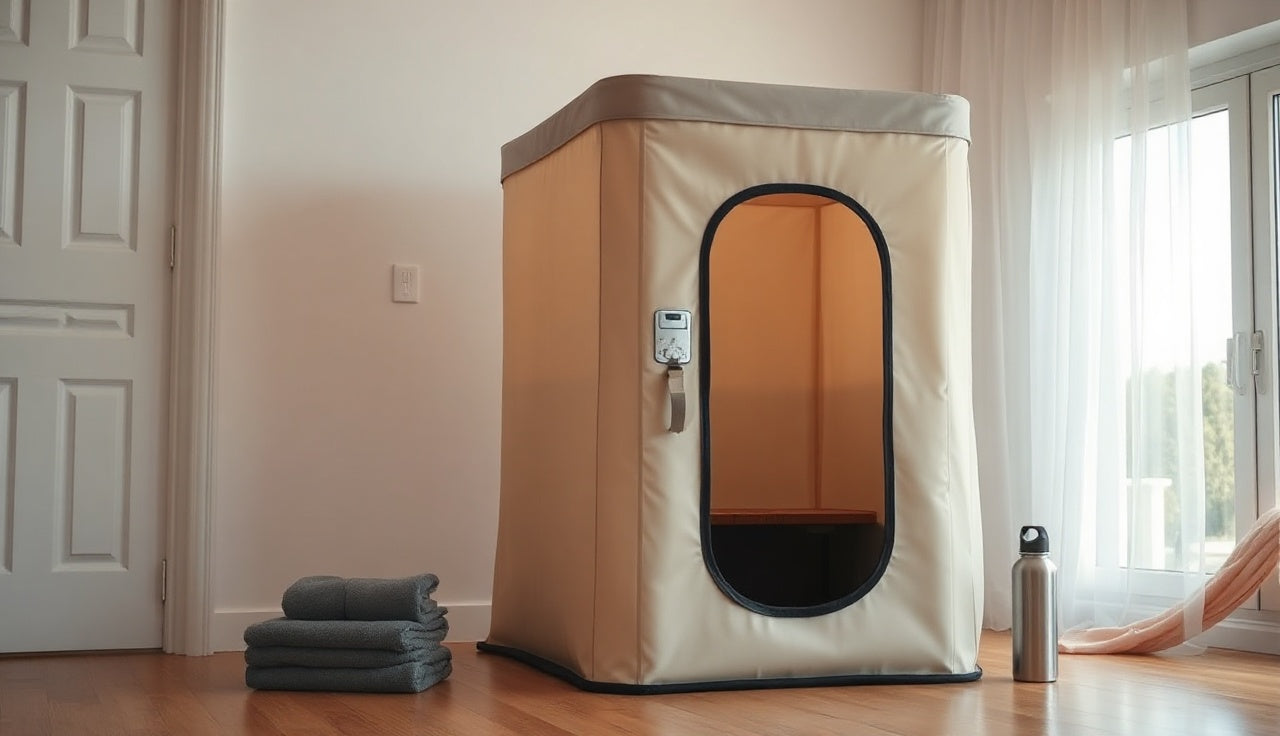
Kyfe is a consumer brand that sells personal steam tents, marketed as portable saunas. The core product is a collapsible fabric enclosure sized for one seated person, paired with a steam generator you fill with water. You sit inside with your head poking out through a neck hole, the generator pumps steam in, and the humidity raises your skin temperature over a few minutes.
This is steam therapy, not dry sauna heat. That distinction matters. A traditional Finnish sauna runs between 150°F and 195°F (65°C to 90°C) with low humidity [1]. A portable steam tent usually reaches air temperatures of 105°F to 115°F (40°C to 46°C) because the fabric walls leak heat and the gap around your neck bleeds steam the whole time. You still sweat, but the mechanism differs: humid air slows evaporative cooling from your skin rather than heating your core through convection.
Setup is genuinely fast. Most Kyfe units unfold like a pop-up laundry hamper, the steam hose clicks into one connection, and the generator takes about 10 minutes to reach working pressure from cold. Teardown runs about the same. Portability is the real reason to buy one, and that part is not marketing fluff.
For context on what a proper home sauna looks like, see our portable sauna guide and the broader home sauna overview.
What temperatures does a Kyfe portable sauna actually reach?
A Kyfe steam tent reaches air temperatures of about 104°F to 118°F at seated chest height. That is roughly half the temperature of a traditional sauna, and it is the number the marketing copy tends to skip. Kyfe and similar brands often advertise "up to 140°F," but that figure describes surface temperature near the steam inlet, not the ambient air your body sits in.
Independent thermal gun tests of comparable consumer steam tents (Durherm, SereneLife, and Kyfe-branded units come out of near-identical factories in some cases) have consistently measured air temperatures in the 104°F to 118°F range at chest height. At those temperatures, a healthy adult sweats noticeably within 15 to 20 minutes. That produces some of the mild-heat effects people want, but it sits well below the 160°F to 180°F range where most cardiovascular adaptation research was done [2].
Generator wattage is the main variable. Most Kyfe units ship with an 800W or 1000W generator. A 1000W unit heating a small tent makes more steam faster than an 800W one, but neither matches the radiant output of a 1400W to 2000W infrared panel or the convective heat of a 4.5 kW electric sauna heater.
So here is the honest version: you will sweat, your muscles will loosen, and you will feel relaxed. You will not replicate the cardiovascular stress of a real sauna session. That is a trade-off, not a defect, and whether it matters depends on what you actually want out of the thing.
How much does a Kyfe portable sauna cost?
Kyfe portable saunas sell for $100 to $300 depending on the model, generator wattage, and accessories like a folding chair or herbal basket. Tent-only configurations sit around $100 to $150. Bundles with a higher-wattage generator, a remote timer, and a carrying bag climb toward $250 to $300.
That range tracks the broader portable steam tent market. SereneLife, Durherm, and similar brands live in the same $80 to $280 band on major retail sites. None are premium goods. They are mass-manufactured fabric and plastic tents with a commodity steam generator bolted on.
Compare that to other home heat options:
| Option | Typical price range | Setup time | Max temp |
|---|---|---|---|
| Kyfe portable steam tent | $100 to $300 | 10 min | ~115°F air |
| Infrared sauna blanket | $150 to $600 | 5 min | ~150°F surface |
| 1-person infrared cabin | $900 to $2,500 | 1 to 3 hours (assembly) | 130°F to 150°F |
| 2-person infrared cabin | $2,000 to $5,000 | 2 to 4 hours | 130°F to 150°F |
| Traditional barrel sauna (outdoor) | $3,000 to $10,000+ | days (build/install) | 160°F to 190°F |
If budget is your hard limit, a Kyfe unit is one of the cheapest ways to get a dedicated sweat session at home. If you can stretch to $500 or more, an infrared sauna blanket gives you higher surface temperatures and more even heat with similar portability. See our sauna guide for the full spectrum.
| Kyfe portable steam tent | 115 |
| Infrared sauna blanket (surface) | 145 |
| 1-person infrared cabin | 140 |
| Traditional Finnish sauna (Laukkanen study) | 174 |
| Traditional Finnish sauna (max range) | 195 |
Source: Finnish Sauna Society; JAMA Internal Medicine, Laukkanen et al. 2015
Is a Kyfe portable sauna good for health and recovery?
Honest hedging is required here. The research on sauna health benefits is built almost entirely on traditional Finnish dry saunas, not steam tents. The most cited work is the Kuopio Ischemic Heart Disease Risk Factor Study, which followed 2,315 middle-aged Finnish men and found sauna use four to seven times per week was linked to a 50% reduction in cardiovascular mortality compared to once-weekly use [2]. The JAMA Internal Medicine paper reporting that data states the association held "after adjustment for cardiovascular risk factors." Those sessions averaged 15 minutes at 79°C (174°F), a very different thermal dose than 20 minutes at 110°F in a fabric tent.
For muscle relaxation and subjective recovery, lower-temperature heat has support. A 2013 review in Rehabilitation Research and Practice found moist heat improved tissue extensibility and lowered muscle stiffness at temperatures in the 40°C to 45°C range [3]. Steam tents land right in that window. So for post-workout loosening, mild stress relief, and skin sweating, a portable steam tent probably does something real.
Cardiovascular conditioning at the level the Finnish research documented? That is where the evidence gap gets wide and honest. Nobody has good data specifically on portable steam tent outcomes. The closest we can do is extrapolate from general hyperthermic therapy literature, and that extrapolation only stretches so far.
Stay conservative. A Kyfe sauna is a relaxation and mild recovery tool. Do not buy one expecting the cardiovascular payoffs of a traditional sauna protocol. If that is the goal, read sauna benefits and consider a proper cabin or barrel unit.
How long should you sit in a Kyfe portable sauna per session?
Sit for 15 to 30 minutes per session. Most manufacturers, including Kyfe's own product documentation, suggest that range, and it is reasonable. At the air temperatures these tents produce, a healthy adult is unlikely to overheat in 30 minutes. Push past 45 minutes in a humid enclosed space with restricted head positioning and you can get lightheaded from dehydration and prolonged skin vasodilation.
Practical guidelines for steam tent use:
- Drink 16 to 24 oz of water before a session and keep water within reach during it.
- Keep your head out of the steam enclosure. The tent is built for this, so use it as designed.
- Start at 15 minutes and see how you feel before extending.
- Do not use a portable steam tent if you have cardiovascular disease, are pregnant, or have any condition that affects heat regulation without clearing it with a physician first. NIH research notes that heat exposure raises heart rate and cardiac output significantly [4].
- Exit immediately if you feel dizzy, nauseous, or your heart rate feels irregular.
Daily use is generally considered safe for healthy adults at these temperatures, though no study looks specifically at daily steam tent frequency. Most heat therapy protocols in the literature run three to five sessions per week.
What do you actually get in the box and how easy is assembly?
A typical Kyfe kit includes the collapsible tent (polyester or nylon fabric over a wire frame), a steam generator (800W or 1000W), a flexible hose linking the two, a remote or manual timer, a folding stool, and sometimes a foot basin or herbal box.
Assembly is fast. The tent pops open from a folded figure-eight, like a pop-up laundry hamper. You set the stool inside, feed the steam hose through the access port at the bottom, attach it to the generator sitting outside the tent, fill the reservoir (typically 1.5 to 2 liters), and switch it on. Cold start to steam output is roughly 8 to 12 minutes.
The chair that ships with cheaper kits is often flimsy. A plastic step stool from a hardware store, $12 to $20, is worth swapping in. The Kyfe tent itself has a decent zipper and an adjustable neck collar to cut steam escape. The generator controls are basic: a temperature dial and a timer, nothing more.
The weak point across this whole category is the generator's heating element. These are the same style used in cheap clothes steamers, and they scale up with mineral deposits over time. Fill with distilled water instead of tap water and you meaningfully extend generator life. Nobody guarantees these generators past a year of regular use, and that is a real limitation of the category, not a knock on Kyfe specifically.
How does a Kyfe portable sauna compare to an infrared sauna blanket?
These are the two most common portable heat options under $500, and they work in different ways. A steam tent puts you inside a humid enclosure with your head out. An infrared sauna blanket wraps around your body, arms and legs included, with your head fully out, and it heats by direct far-infrared radiation to your skin rather than through ambient air or steam.
Infrared blankets like those from HigherDOSE reach surface contact temperatures of 130°F to 150°F, a higher thermal dose than a steam tent's ambient air. They run $150 to $600, overlapping Kyfe's price range, and pack down to about the size of a rolled sleeping bag. Steam tents fold smaller in two dimensions but stay bulkier in the third. For travel, blankets are usually easier.
The steam tent wins on one thing: sensory experience. The humid heat feels more spa-like, your skin stays moist instead of dry, and many people find it more relaxing for the upper body and face. The blanket wins on thermal dose, limb coverage, and packing size.
Want heat on your upper body and face, for sinus congestion, facial sweating, or shoulder tension? The steam tent is the better pick. Want whole-body heat that gets closer to what the research covers? The blanket is nearer the mark. Neither one replaces a home sauna cabin for true high-temperature sessions.
Can you use a Kyfe portable sauna in an apartment or small space?
Yes, and this is the clearest reason to own one. A folded Kyfe steam tent measures roughly 24 inches across as a flat disc, easy to slide under a bed or into a closet. Set up, it takes a footprint of about 3 by 3 feet at most, which fits in nearly any room.
Apartment-specific things to think about:
The generator pushes humidity into the room. In a small bathroom or bedroom, a 20-minute session will noticeably raise ambient humidity. That is fine in most apartments, but if moisture worries you (old painted walls, tight space with poor airflow), run a bathroom fan or crack a window.
Electrical draw is modest. An 800W to 1000W generator pulls about what a hair dryer on low does. Standard 15-amp household outlets handle it without a problem.
Floor protection is worth a thought. The generator sits on the floor, and if the reservoir seal is not tight, small drips happen. Put a towel or rubber mat under it. The tent itself does not wet the floor in normal use.
For renters who cannot install a permanent sauna, a portable steam tent is one of the few genuine options, alongside sauna blankets and sweat suits. No electrical work, no permits, no changes to the property.
What are the main complaints and limitations of the Kyfe portable sauna?
Real limitations, stated plainly.
The neck collar gets uncomfortable on long sessions. Most users find it workable at 15 to 20 minutes, then it starts to chafe or press past 30 minutes. This is a category-wide issue, not unique to Kyfe.
The generator is the durability weak point. Cheap elements scale and corrode. Use distilled water. Even then, expect 12 to 24 months of regular use before element performance drops off. Replacement generators run $20 to $40 if you buy a compatible unit, though tracking down an exact match for a specific Kyfe model takes some digging.
You cannot move during a session. You are seated, wrapped in a tent, arms often inside. Fine for relaxation, but you cannot stretch, hold a yoga pose, or do anything active. An infrared cabin or barrel sauna lets you shift around and do light movement.
The fabric does not breathe and smells like plastic when new. Air it out for a day or two before first use and the smell fades after several sessions.
Temperature is not steady. The steam cycles on and off as the generator holds pressure, so you get waves of heat followed by slight cool-offs instead of a stable ambient temperature. A proper sauna heater keeps things far steadier.
None of these kill the deal at $100 to $200. Every one of them would at $1,000. The product is priced for what it is.
How does contrast therapy work with a portable sauna?
Contrast therapy alternates heat exposure with cold exposure, and it has a real evidence base for recovery, especially for reducing delayed onset muscle soreness and improving subjective recovery scores after exercise [5]. A portable sauna plus a cold plunge or ice bath at home is a fully working contrast setup.
A practical protocol: 15 to 20 minutes in the steam tent, then 2 to 5 minutes in a cold plunge or cold shower (the shower is less effective but easy to access), rest 5 minutes, repeat one to three times. Research has not locked in a single ideal set of temperatures and timings, but the general pattern holds: the hotter the heat phase and the colder the cold phase, the bigger the vascular response.
Here is the honest caveat. Portable steam tents run cooler than traditional saunas, so the vascular dilation going into the cold plunge is weaker than in a 180°F sauna-to-cold sequence. You still get the contrast effect, just at a smaller amplitude.
For the cold side, see our cold plunge guide and cold plunge benefits. For a full setup, an ice bath paired with a portable or cabin sauna is worth reading about.
SweatDecks carries cold plunge and portable sauna options if you want to build a contrast setup, and the buying guides there are honest about trade-offs at each price point.
Who should buy a Kyfe portable sauna and who should skip it?
Buy it if you rent and cannot install a permanent sauna. Buy it if you travel a lot and want a sweat option in hotel rooms or at a relative's house. Buy it if your budget is under $200 and you want something this week without building, assembling, or wiring anything. Buy it if you want mild heat for muscle relaxation and stress relief and have no ambitions for high-temperature cardiovascular protocols.
Skip it if you are serious about heat training and want the cardiovascular benefits documented in high-temperature sauna research. Skip it if you are buying for two or more people. Skip it if you have a health condition where heat exposure needs a doctor's clearance you have not gotten. Skip it if you have the space and budget for a real infrared or traditional cabin, because you will probably want to upgrade within a year anyway.
The middle case is the person who wants to test whether they will actually use a home sauna before dropping $2,000 to $10,000. A Kyfe unit at $150 is a cheap way to find out if you will realistically do three sessions a week at home. If you do, you have earned the data to justify a real cabin. If you do not, you are out $150 instead of $5,000.
For what a serious permanent setup looks like at various prices, our outdoor sauna guide covers everything from prefab barrels to full custom builds.
Frequently asked questions
Is the Kyfe portable sauna the same as brands like SereneLife or Durherm?
Kyfe, SereneLife, Durherm, and several other brands sell steam tents built from nearly identical factory components, differing mainly in fabric color, accessory bundles, and generator wattage. Build quality and performance are comparable across brands at the same price. Choosing between them usually comes down to which has the better current price and return policy where you are buying.
How much electricity does a Kyfe portable sauna use per session?
An 800W generator running 20 minutes uses about 0.27 kWh. At the U.S. average residential rate of roughly 16 cents per kWh in 2024, that is under 5 cents per session [6]. A 1000W unit for 30 minutes is about 0.5 kWh, or roughly 8 cents. Electricity cost is essentially nothing for portable steam tents.
Can you add essential oils or herbs to a Kyfe portable sauna?
Some Kyfe models include an herbal basket or fragrance box that attaches to the steam inlet, so herbs or oils ride into the tent with the steam. Do not add essential oils directly to the water reservoir. Oils can damage the heating element. If your model has no dedicated herbal attachment, a few drops of eucalyptus or peppermint oil on a small cloth placed inside the tent works fine.
How do you clean a Kyfe portable sauna between uses?
Wipe the interior fabric with a damp cloth after each use and let it air dry fully before folding. Fold it wet and you get mold in the seams fast. Empty and rinse the generator reservoir after each session. Descale the generator every two to four weeks with a 50/50 white vinegar and water solution run through a cycle, then flush with clean water.
Does a Kyfe portable sauna help with weight loss?
Any weight drop right after a session is water weight from sweating, and it returns once you rehydrate. Chronic heat exposure shows a small positive association with metabolic markers in some studies, but that evidence rests on higher-temperature traditional saunas, not steam tents. Do not buy one for weight loss. The effect, if any, is modest and indirect.
Can two people use a Kyfe portable sauna at the same time?
No. These are single-occupancy units. The footprint is roughly 3 feet by 3 feet with one seat. Some brands sell two-person steam tents, but Kyfe's standard line is one-person only. For a shared sauna at home, you need a cabin-style infrared or traditional sauna with a bench long enough for two.
How hot does a Kyfe portable sauna get compared to a traditional sauna?
Ambient air inside a Kyfe steam tent typically measures 104°F to 118°F at seated chest height. A traditional Finnish sauna runs 150°F to 195°F. The gap matters therapeutically. The Finnish population studies linking frequent sauna use to lower cardiovascular mortality used sessions averaging around 174°F. A steam tent is roughly half that temperature.
Is a portable steam sauna safe to use every day?
For healthy adults at the temperatures a steam tent produces, daily sessions of 15 to 30 minutes are generally considered safe. Stay hydrated before and during. If you feel dizzy, lightheaded, or nauseous, exit and cool down. People with cardiovascular disease, low blood pressure, pregnancy, or conditions affecting heat regulation should consult a physician before any regular heat exposure.
What is the difference between a steam sauna and an infrared sauna?
A steam sauna heats by humidity: moist air slows your body's evaporative cooling. An infrared sauna heats by radiation: infrared wavelengths penetrate skin and raise tissue temperature directly. Infrared delivers a higher thermal dose at lower air temperatures and covers the whole body including limbs. Steam tents focus heat on the torso and give a more spa-like humid feel.
Where can I buy a Kyfe portable sauna?
Kyfe portable saunas are sold on major online retailers including Amazon and the Kyfe website directly, at roughly $100 to $300 depending on the model. Specialty wellness retailers sometimes carry comparable portable options with better return policies and support than general marketplaces, which is worth weighing given the generator durability limits of the category.
Can I use a Kyfe portable sauna outdoors?
You can use it outdoors in calm, dry weather. Wind strips heat from the fabric tent fast and drops temperatures noticeably. The steam generator is an electrical appliance and should never run in rain or on wet ground. Outdoor use also means the enclosed warmth escapes faster. It works better indoors, but a covered patio or garage on a warm day is a reasonable setup.
How long does a Kyfe portable sauna last before needing replacement?
The fabric tent can last several years with proper drying and storage. The generator's heating element is the bottleneck. With tap water, scaling can degrade performance in 6 to 12 months. Distilled water plus regular descaling stretches that to 18 to 24 months for most users. Replacement generators compatible with most steam tent brands cost $20 to $40 online.
Sources
- Finnish Sauna Society, sauna temperature and humidity guidelines: Traditional Finnish sauna temperature range of 65°C to 90°C (150°F to 195°F) with low relative humidity
- JAMA Internal Medicine, 'Association Between Sauna Bathing and Fatal Cardiovascular and All-Cause Mortality Events', Laukkanen et al. 2015: Sauna use 4 to 7 times per week associated with 50% reduction in cardiovascular mortality vs once-weekly use; sessions averaged 15 minutes at 79°C (174°F)
- Rehabilitation Research and Practice / National Library of Medicine, review of moist heat therapy and tissue extensibility: Moist heat therapy increased tissue extensibility and reduced muscle stiffness at temperatures of 40°C to 45°C
- National Institutes of Health, National Library of Medicine, heat stress and cardiovascular physiology: Heat exposure raises heart rate and cardiac output significantly, relevant to contraindications for heat therapy
- Journal of Athletic Training, contrast water therapy and DOMS meta-analysis, 2009: Contrast therapy (alternating heat and cold) associated with reduced delayed onset muscle soreness and improved subjective recovery scores after exercise
- U.S. Energy Information Administration, average retail electricity prices by state 2024: U.S. average residential electricity rate approximately 16 cents per kWh in 2024
- National Center for Complementary and Integrative Health, NCCIH, sauna and heat therapy overview: General health guidance on heat exposure safety, contraindications including cardiovascular disease and pregnancy
- Harvard Health Publishing, Harvard Medical School, sauna health benefits overview: Review of sauna health research noting most evidence base derives from traditional high-temperature Finnish sauna studies

Share:
How to clean a portable sauna (step-by-step guide)
How to clean a portable sauna (step-by-step guide)