
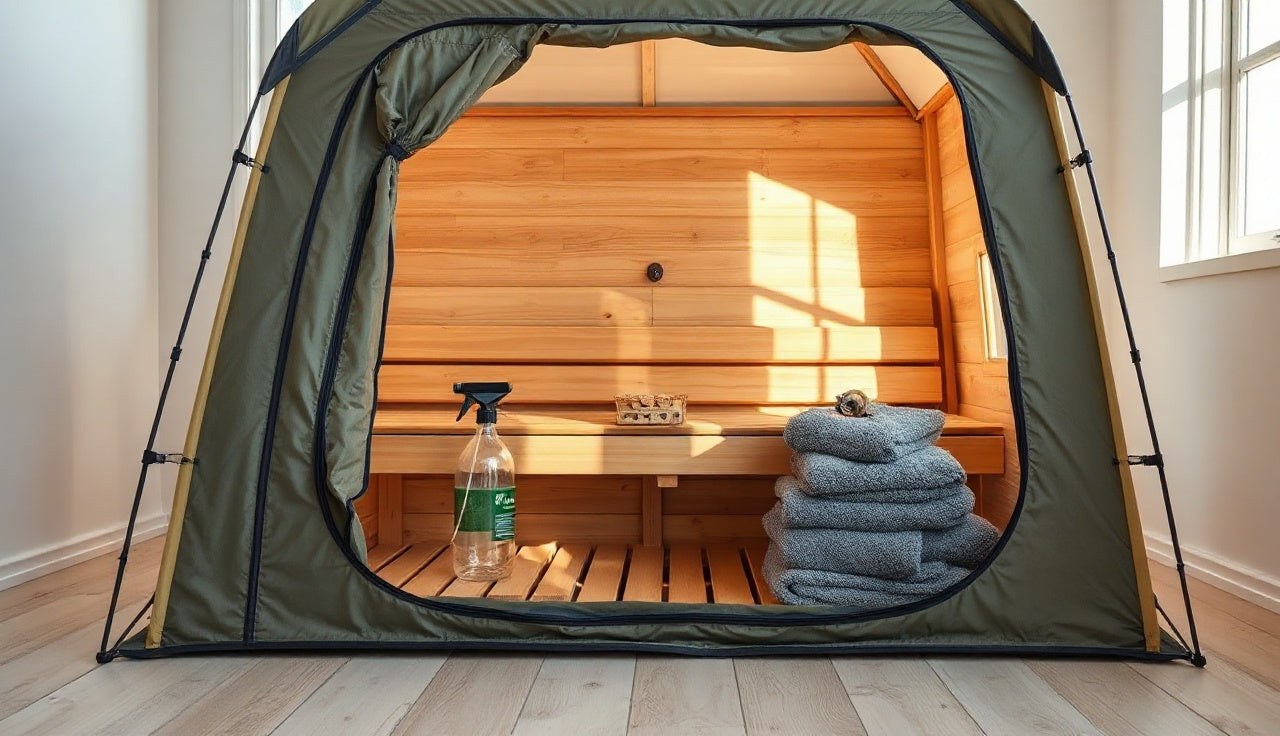
Last updated 2026-07-09
TL;DR
Wipe the interior fabric and poles after every session with a damp cloth and diluted white vinegar or a mild enzyme cleaner. Deep clean the whole unit monthly, including the chair, foot pad, and steam head. Let everything dry all the way before packing. Mold is the real threat, and humidity trapped inside a zipped-up bag is what causes it.
Why does a portable sauna get dirty so fast?
You sweat a lot in a sauna. A 20-minute session at typical portable-unit temperatures (around 110-130°F for fabric steam saunas) can produce roughly 0.5 to 1 liter of sweat, and most of it lands on the interior walls and seat [1]. That sweat carries salt, skin oils, and dead cells. Left in a warm, closed fabric space, it feeds bacteria and mold within 24 to 48 hours.
Portable saunas have a second problem that barrel or cabin saunas don't. They get packed into a bag right after use. That seals the moisture inside. The outside can look bone dry while the folded interior stays humid for hours, and that humidity is exactly what Stachybotrys and Aspergillus species need to colonize fabric [2].
The steam generator head and the hose are the parts people neglect most. Mineral deposits from tap water build up inside the boiler chamber, cutting steam output and slowly corroding the seals. Hard water (above 120 mg/L as calcium carbonate, which describes much of the US Southwest and Midwest) speeds this up a lot [3].
None of this is hard to manage. It just needs a routine.
What supplies do you actually need to clean a portable sauna?
You don't need anything expensive or specialized. Here's what works:
| Cleaning task | Product | Notes |
|---|---|---|
| Interior fabric wipe-down | White vinegar diluted 1:1 with water | Kills bacteria and light mold, safe on most polyester fabrics |
| Deep fabric scrub | Enzyme laundry cleaner (e.g., OxiClean Free) dissolved in water | Breaks down protein-based sweat residue |
| Plastic chair and frame poles | Mild dish soap and warm water | Avoid abrasives |
| Foot pad / mat | Dish soap or diluted vinegar, then rinse well | Air-dry flat |
| Steam generator descaling | White vinegar run through a full cycle | Standard descaling method for small appliances [4] |
| Odor control | Baking soda left open inside overnight | Absorbs residual odor before storage |
Skip these: bleach on fabric (it degrades polyester fibers over time and the fumes in an enclosed space are a real hazard), alcohol above 70% concentration (it can crack plastic fittings), and any petroleum-based product near fabric seams.
A spray bottle, two microfiber cloths, and a soft-bristle brush cover 95% of the work. That's the whole kit.
How to clean a portable sauna after every session
This is the routine that prevents everything else. It takes about five minutes if you do it while the unit is still slightly warm, because it's easier to wipe and the residue hasn't dried hard yet.
Step 1: Unzip and open fully. Leave the flaps wide open. This part is non-negotiable. Every minute you leave it closed after a session adds to the mold risk.
Step 2: Remove the chair, foot pad, and any towel you used. Shake or wipe the foot pad outdoors.
Step 3: Spray the interior walls lightly with diluted white vinegar (half vinegar, half water). You're not soaking the fabric, just misting it. Wipe with a microfiber cloth in circular motions, top to bottom.
Step 4: Wipe the plastic poles and zipper tracks with a damp cloth. Zippers grab salt residue and will corrode if you ignore them.
Step 5: Wipe the collar opening (the neck hole) especially well. That spot gets heavy sweat contact.
Step 6: Leave everything open to air dry for at least 30 minutes before you even think about packing it up. An hour is better if you have the space. A small fan pointed at the interior cuts the drying time a lot.
Don't pack the chair or foot pad back inside until they're dry too. They hold moisture longer than the fabric walls do.
| Pacific Northwest | 40 |
| Southeast | 80 |
| Northeast | 95 |
| Midwest | 200 |
| Texas | 260 |
| Southwest (AZ/NV) | 290 |
Source: USGS, Water Science School (Citation 3)
How to do a deep clean of a portable sauna (monthly)
Once a month, do the full version. Also do it after any session where you sweated more than usual, were sick, or lent the unit to someone else.
Step 1: Take everything apart. Poles out, chair disassembled, steam head disconnected, hose separated.
Step 2: Mix an enzyme cleaner solution. OxiClean Free or a comparable unscented enzyme detergent at about 1 tablespoon per quart of warm water works well. Don't use scented versions unless you want that fragrance baked into your fabric for good.
Step 3: Scrub the interior fabric with the solution and a soft brush. Focus on seams and corners, where mold starts first. The fabric on most portable steam saunas is a non-woven polyester or nylon and handles light scrubbing without damage.
Step 4: Rinse by wiping several times with a clean cloth dampened with plain water. You can't run this through a washing machine (the steam port and reinforced structure block it on most models), so thorough cloth-rinsing is the substitute.
Step 5: Clean the chair. Plastic chairs can go in a bathtub with warm soapy water. Rinse well. Wipe dry.
Step 6: Descale the steam generator. Fill it with a 50/50 white vinegar and water solution, run a full heating cycle until steam comes out (usually 10-15 minutes), empty it completely, then run one plain water cycle to flush [4]. Mineral scale inside the boiler is the number one cause of steam generator failure in portable units. Scale buildup speeds up sharply once water hardness passes 7 grains per gallon [3].
Step 7: Clean the steam hose. Run warm soapy water through it, rinse with plain water, then hang it vertically to drain and dry.
Step 8: Once every component is fully dry (give it 2-3 hours, or a full day if your home is humid), pack it up. Drop a small open container of baking soda inside the storage bag if odor has been an issue.
How do you get rid of mold in a portable sauna?
First, confirm it's actually mold. Black or green spotting in corners or along seams that won't wipe off with a dry cloth is mold. A musty smell with no visible spots usually means early growth in seams or inside folds you haven't checked yet.
For surface mold on fabric, start with white vinegar (undiluted, or at most 10% water) brushed on and left to sit for 10 minutes before scrubbing. The CDC notes that vinegar's acetic acid is effective against many common household mold species [10]. Do this outdoors if you can, because mold spores go airborne when you disturb them.
For stubborn spots, use 3% hydrogen peroxide (the standard drugstore bottle) applied directly and left for 10-15 minutes before scrubbing. It's more aggressive than vinegar without the fabric damage that comes with bleach.
If mold has worked deep into non-woven fabric seams and neither method clears the visible growth after two treatments, the unit is a health risk. A portable sauna with heavy mold penetration should be replaced. The EPA recommends discarding porous materials with significant mold rather than trying to salvage them [5]. A new portable unit runs $100 to $400 for most models, which is not worth breathing mold byproducts.
Prevention here is far easier than cleanup. The one rule that matters: never pack a portable sauna away wet.
How often should you clean a portable sauna?
The honest answer depends on how often you use it. Here's a schedule by usage.
| Usage frequency | Post-session wipe | Deep clean | Steam generator descale |
|---|---|---|---|
| Daily | Every session | Every 2 weeks | Monthly |
| 3-4x per week | Every session | Monthly | Every 6 weeks |
| Weekly | Every session | Monthly | Every 2 months |
| Occasional (1-2x/month) | Every session | Every 3 months | Every 3 months |
The post-session wipe is non-negotiable no matter how often you use it. Skip it once and pack the unit, and you've built the conditions for mold in under 48 hours, especially in warm storage.
Sharing the unit changes the math. If family members or clients use it, treat every session like the last person was a stranger. Do the full post-session wipe plus a light enzyme spray before the next use.
Athletes running a portable sauna as part of a recovery protocol alongside a cold plunge sweat harder and leave more residue per session, so lean toward more frequent deep cleans.
Is it safe to use chemical cleaners inside a portable sauna?
This question matters more for portable steam saunas than for barrel or infrared cabins. The fabric walls stay wet, absorb cleaners more readily, and you sit inside them at close range.
White vinegar and enzyme cleaners show up consistently on the EPA's Safer Choice list as low-toxicity cleaning agents [6]. They're the right defaults.
Bleach is the common mistake. It works against mold, but the off-gassing in an enclosed fabric space irritates airways even at low concentrations. The CDC's mold remediation guidance specifically cautions against bleach use in enclosed, poorly ventilated spaces [2]. Beyond the safety issue, bleach breaks down polyester fabric over repeated applications and whitens colored fabric.
Any cleaner you use inside the sauna should be wiped out with plain water before your next session. Running an empty, well-ventilated steam cycle after cleaning helps clear residual volatiles from the interior.
Scented fabric sprays and essential oil cleaners seem appealing but often leave residues that irritate airways once heated. If you want aromatherapy, add it to the steam generator per the manufacturer's guidance, never to the fabric walls.
How do you clean and maintain the steam generator specifically?
The steam generator is the most mechanically fragile part of a portable sauna, and it's the part most people forget entirely until it dies.
After every session: unplug it, let it cool fully, then empty any remaining water. Water sitting in the chamber speeds up mineral buildup and can grow bacteria.
Weekly (if you use it often): wipe the exterior and the steam nozzle opening with a damp cloth. Scale flakes off the nozzle over time and can blow into the sauna interior.
Monthly descale: fill the chamber with a 50/50 white vinegar and water mix. Run it on heat until steam comes out steadily (roughly 10-15 minutes for most 1-2 liter portable units). Turn it off, let it cool, empty it, then run one full cycle with plain water. This is the same descale method small appliance standards bodies recommend for electric kettles and humidifiers [4].
If your unit uses distilled water (some manufacturers recommend it), descaling needs drop dramatically. Distilled water has essentially zero mineral content, so scale never builds. The tradeoff is the ongoing cost and hassle of sourcing distilled water.
Here's the scale of the problem. The US Geological Survey has mapped water hardness across the country, and large parts of Texas, Arizona, Nevada, and the Midwest sit above 250 mg/L as calcium carbonate [3]. At those levels, skip descaling and you'll see steam output fall off within a few months of regular use.
One warranty note: most portable sauna makers void the steam generator warranty if scale damage shows up and there's no sign of regular maintenance. Keep a simple log if you're inside a warranty window.
How do you store a portable sauna to prevent odor and mold?
Storage is where most portable sauna cleaning routines fall apart. The session's over, you feel great, you zip it up and shove it in a closet. Two weeks later it smells like a locker room.
The rules are short:
1. Dry it completely before storage. That means at least 30-60 minutes open with airflow. If your home runs humid (above 60% relative humidity), give it longer or use a fan. Indoor relative humidity above 60% sharply raises the risk of mold on fabric [7].
2. Store it in a breathable bag or loosely folded, never in an airtight container. Most portable saunas come with a carry bag, and those work fine as long as no moisture is trapped inside.
3. Store it in a cool, dry spot. A garage in summer heat and humidity is one of the worst choices. A temperature-controlled interior room beats it easily.
4. Tuck a small sachet of activated charcoal or an open box of baking soda inside the folded unit. It pulls residual humidity and odor during storage.
5. Storing for more than a few weeks? Do a full clean and complete dry-out first. Don't store with residue present.
Running a portable sauna next to other recovery gear like an ice bath or cold plunge? The same principles cover all soft goods: dry first, store open or breathable, clean before long storage.
What's the difference in cleaning a portable steam sauna vs a portable infrared sauna?
Most portable saunas are steam saunas: a fabric tent with a steam generator. Portable infrared saunas also exist, usually pop-up fabric units with low-EMF infrared panels sewn into the walls.
The cleaning approach for the fabric exterior and chair is identical. The difference is the heat source.
With a steam sauna, the interior gets wet. Steam condenses on the walls, the floor, everything. That's why the vinegar wipe and the thorough drying routine matter so much.
With an infrared sauna, the interior stays dry during use. Infrared heats your body directly, not the air or walls. You still sweat plenty, and that sweat still lands on the fabric walls, but there's no condensation layer sitting on top of it. Cleaning is similar, and the mold risk from moisture is a bit lower if you ventilate right away.
Don't clean the infrared panels with liquid. If dust builds up, wipe gently with a dry microfiber cloth. Moisture near the electrical connections is a safety problem.
Still deciding which type to buy? The portable sauna guide covers the full comparison, and the home sauna guide covers permanent options if you're thinking about an upgrade.
SweatDecks carries a selection of portable units if you want to see specific models with known build quality. That matters, because better fabric and more accessible seams make cleaning much easier.
Common cleaning mistakes that damage portable saunas
A few things that seem fine but aren't:
Packing while still warm. The unit feels dry to the touch, but internal humidity is still up. Close it and you've built a sealed greenhouse. Wait the extra 30 minutes.
Using a pressure washer or soaking in a bathtub. The non-woven fabric on most portable saunas can't take saturation. Soaking wrecks the laminate backing that makes it steam-resistant. Spot cleaning and wiping is the right method.
Cleaning the steam generator with coffee-machine descaling tablets. Some of these carry citric acid at higher concentrations than you need, plus additives that leave residue in the steam path. Plain vinegar is cleaner and cheaper.
Skipping the neck hole and zipper. These are the two areas with the heaviest direct contact and salt concentration. They're also the areas most likely to show early mold and zipper corrosion when ignored.
Using the same cloth inside and out. Dragging outdoor grime into the interior is a small but real concern. Keep a dedicated set of cloths for sauna cleaning.
Running the steam generator dry. If the water chamber empties mid-session, some units shut off automatically and some don't, and the heating element can burn. Check the water level before every use. This isn't strictly a cleaning issue, but it's the top cause of steam generator failure that gets blamed on bad maintenance.
One session puts real cardiovascular and thermal stress on your body, which is part of why the sauna benefits research has grown so much lately. The equipment takes equivalent stress every single session, so treat it like it earns the upkeep.
How long does a portable sauna last with proper cleaning?
Honest answer: the range is wide, and manufacturer claims tend to run optimistic.
A portable steam sauna with consistent post-session wiping and monthly deep cleans can realistically last 3-5 years with regular use (3-4 sessions per week). With no cleaning routine at all, fabric degradation and steam generator failure usually show up within 12-18 months of regular use.
The limiting factors on lifespan, in order:
1. Steam generator failure (mineral scale, running dry, electrical) 2. Zipper failure (salt corrosion, physical stress from repeated setup and teardown) 3. Fabric seam separation (stress plus moisture cycling) 4. Odor that can't be cleaned out (usually from prolonged mold)
Replacement steam generators are available for most common portable sauna brands at $30 to $80, which can add real life to an otherwise good unit.
Weighing whether to keep maintaining a portable sauna versus upgrading to a permanent outdoor sauna or full home sauna? The ongoing maintenance gap is real. Permanent saunas with cedar or hemlock interiors are naturally antimicrobial, don't trap moisture the same way, and are much easier to wipe down and ventilate. A portable unit costs you more cleaning per session, plain and simple.
The SweatDecks buying guides on permanent home saunas cover cost and build quality in detail if you're eyeing that jump.
Frequently asked questions
Can you put a portable sauna fabric cover in the washing machine?
Most portable sauna fabric shells can't go in the washing machine. The non-woven polyester is bonded to a waterproof laminate layer that separates when it's saturated and agitated. A few models with detachable fabric covers specify machine-washable fabric, so check your manual. For most units, spot cleaning with a damp cloth and diluted vinegar is the correct method.
What kills mold inside a portable sauna without damaging the fabric?
Undiluted white vinegar applied to the moldy area, left to sit for 10 minutes, then scrubbed with a soft brush and wiped clean is the best first step. For stubborn spots, 3% hydrogen peroxide from the drugstore works without bleaching fabric or leaving harmful residue. Bleach kills mold too, but it degrades polyester over repeated use and poses inhalation risks in enclosed spaces.
How do you get the smell out of a portable sauna?
Smell comes from bacteria breaking down sweat residue and, if it's present, mold. Clean the interior with a diluted enzyme cleaner (stronger than vinegar for heavy odor), then leave the unit fully open to dry for several hours. Baking soda left open inside overnight absorbs what's left. If the smell survives two full cleanings, check the seams and folded areas for hidden mold.
How do you descale a portable sauna steam generator?
Fill the water chamber with a 50/50 mix of white vinegar and water. Run a full heating cycle until steam comes out steadily (about 10-15 minutes for most 1-2 liter units). Unplug, let it cool, empty it completely, then run one full cycle with plain water to flush the vinegar. Repeat monthly if you use tap water. Switching to distilled water reduces scaling dramatically.
How long should you let a portable sauna dry before packing it up?
At least 30 minutes with the unit fully open in a room-temperature, ventilated space. An hour is better. If your home is humid (above 60% relative humidity) or you had an especially sweaty session, point a fan at the interior to speed things up. Never pack it while any part of the interior feels cool and damp. Trapped moisture causes mold within 24-48 hours.
Can you use essential oils to clean or freshen a portable sauna?
Essential oils are fine in the steam generator if your manufacturer allows aromatherapy (check the manual). They're a poor cleaning agent on their own because they don't kill bacteria or mold. Applied straight to fabric walls, they leave an oily residue that attracts more dirt. For freshening between cleans, baking soda or activated charcoal in the storage bag works better and leaves no residue.
How do you clean a portable infrared sauna differently from a steam sauna?
The fabric exterior and chair get cleaned the same way. The difference is that infrared panels must not get wet: wipe them only with a dry microfiber cloth to remove dust. Since infrared units don't steam the interior, condensation isn't an issue, but sweat still lands on the walls and needs the same post-session wipe. The mold risk from moisture is a bit lower, but the routine is otherwise identical.
Is white vinegar safe to use every session inside a portable sauna?
Yes, for most portable sauna fabrics. Diluted 1:1 with water, white vinegar is mild enough for regular use on polyester and nylon without causing damage. It kills surface bacteria and light mold, and it evaporates cleanly with no residue. Wipe with a plain damp cloth after applying and let the unit air dry before your next session so you're not sitting in a vinegar-scented space.
How do you clean the zipper on a portable sauna?
Wipe the zipper teeth and slider with a damp cloth after every session. Salt from sweat builds up in the teeth and speeds corrosion, especially on metal sliders. For a monthly deep clean, scrub the teeth with a soft toothbrush and mild soapy water, then rinse with a damp cloth and dry. A light application of zipper lubricant (beeswax or a zipper-specific product) every few months keeps it running smoothly.
What should you do if your portable sauna steam generator stops producing steam?
First check: is there water in the chamber? Running dry is the most common cause of sudden steam loss. Second: descale it. Scale buildup on the heating element is the second most common cause. Run a full vinegar descale cycle. If neither fixes it, check the steam hose for kinks or blockages. If it still produces no steam after descaling and refilling, the heating element may have burned out and the generator likely needs replacement.
Can you use a portable sauna if it has a mild musty smell?
A mild musty smell means early bacterial or mold growth is already there. Using it without cleaning first means sitting in a humid enclosed space with airborne mold spores. Clean thoroughly with an enzyme cleaner, check seams for visible mold, and do a complete dry-out before using again. For anyone with asthma or respiratory sensitivity, the EPA recommends not occupying a space with active mold growth until it's fully remediated.
How do you clean a portable sauna chair?
Most portable sauna chairs are plastic and fully water-resistant. Wipe them with soapy water after each session. For a monthly deep clean, take the chair apart if it disassembles and wash each piece in a bathtub or outdoors with dish soap, rinse thoroughly, and dry completely before reassembly and storage. Check where the chair legs contact the floor pad for trapped moisture, a common mold starting point.
Does cleaning a portable sauna void the warranty?
Using the manufacturer-recommended cleaning methods (usually mild soap and water or diluted vinegar) does not void warranties. Using bleach, abrasive chemicals, or machine washing when it's not specified can void fabric warranties. For steam generators, failure to descale and the resulting scale damage is often cited by manufacturers as grounds to deny claims. Keep a simple record of your descale dates if you're inside a warranty window.
How do you clean a portable sauna foot mat or floor pad?
The foot pad gets the most contact with bare feet and standing water from steam condensation. Wipe it with diluted vinegar or soapy water after every session. For a deep clean, scrub with a brush and enzyme cleaner, rinse well with a damp cloth, and air-dry flat. Don't fold and store it while damp. If the pad develops permanent odor or visible mold that survives two cleaning attempts, replace it. They're usually cheap and sold separately.
Sources
- Harvard Health Publishing, Harvard Medical School: A sauna session can produce 0.5 to 1 liter of sweat, depositing significant salt and organic material on surfaces.
- CDC, Mold Prevention and Remediation: Mold can begin growing on organic materials within 24-48 hours of moisture exposure; CDC guidance cautions against bleach use in enclosed poorly ventilated spaces.
- USGS, Water Science School (Water Hardness): Large portions of the US Southwest and Midwest have water hardness above 250 mg/L as calcium carbonate, accelerating mineral scale buildup in appliances.
- NSF International, Small Appliance Care Guidelines: Descaling small appliances with a 50/50 white vinegar and water solution followed by a plain water flush cycle is the standard recommended method.
- EPA, Mold and Moisture: Significant mold penetration into porous materials like fabric poses an exposure risk; the EPA recommends discarding heavily mold-contaminated porous materials.
- EPA, Safer Choice Program: White vinegar and enzyme-based cleaners are recognized as low-toxicity cleaning agents appropriate for household use on soft surfaces.
- EPA, Indoor Air Quality (Mold and Moisture): Indoor relative humidity above 60% significantly increases the risk of mold growth on fabric and organic materials in enclosed spaces.
- CDC, Facts About Mold and Dampness: The CDC notes that vinegar's acetic acid content is effective against many common household mold species.

Share:
Kyfe portable sauna: honest review and buyer's guide
Kyfe portable sauna: honest review and buyer's guide