
Last updated 2026-07-09
TL;DR
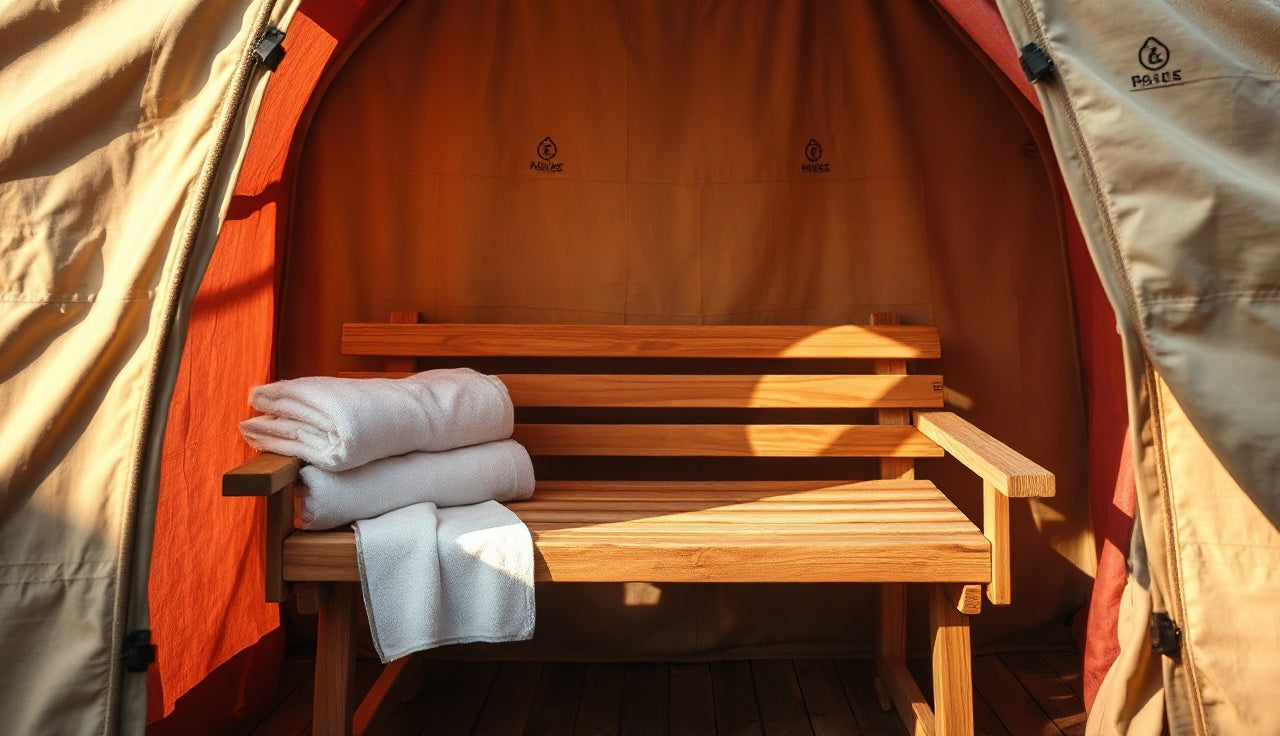
A portable sauna bench is a freestanding, fold-flat or knock-down seat built for use inside a sauna tent, barrel, or cabin. It holds you off the floor where heat is weakest, and it moves with you. Prices run from about $40 for basic folders to $300 for solid kiln-dried aspen or cedar. The right pick depends on your sauna type, body weight, and how often you set it up.
What is a portable sauna bench, and who actually needs one?
A portable sauna bench is a freestanding seat built to survive wet heat, repeated assembly, and high temperatures without warping, off-gassing, or collapsing under load. That's a harder design problem than it sounds. Regular indoor furniture fails fast in a sauna: adhesives soften, MDF swells, metal hardware conducts enough heat to burn skin, and finishes vaporize into the air you're breathing.
Most people who search for a portable sauna bench fall into one of three groups. Folks who own a portable sauna tent and have nowhere to sit except the floor, where a tent's floor air sits closer to 100°F instead of the 160-180°F you get at head height. People who already own a barrel or cabin sauna but need an extra bench for guests or want to swap a worn-out original. And apartment renters and small-space homeowners who want real sauna access without a permanent build.
If you're in that third group, a portable bench paired with a quality tent gives you a functional setup for under $500 total, a fraction of even a budget home sauna installation. The bench is what makes the experience feel real instead of cramped and sweaty on a yoga mat.
Here's the part most buyers underrate: where you sit is the dose. Heat exposure at seated-head level is the physiologically relevant measurement, not the number on the heater. Research published in JAMA Internal Medicine in 2015 tracked 2,315 Finnish men and recorded sauna session temperature and frequency as independent variables, finding that outcomes tracked with consistent, adequate heat exposure [1]. You can't get adequate exposure sitting on a tent floor with your head below the effective thermal zone.
What types of portable sauna bench are available?
There are four main categories, and they differ in ways that matter a lot in practice.
Folding slat benches. These look like a wooden folding chair stretched into a bench. The legs fold flat, and the whole thing packs into a bag or fits in a car trunk. Assembly takes under two minutes. Most use cedar, aspen, or eucalyptus slats with stainless steel or aluminum hinges. Weight limits typically run 250-300 lbs. The weak point is the hinge: cheap ones corrode or loosen after a season.
Knock-down (KD) or bolt-together benches. These ship as flat-pack components you assemble with a few bolts or wooden pegs, no tools or one Allen wrench. They're sturdier than folders because there are no hinges in the seat surface. Weight capacity often reaches 350-450 lbs on quality models. They take 10-15 minutes to set up, so they suit semi-permanent or frequent-use situations.
Seat-only or backrest units. Shorter, lighter, designed to fit inside small tent saunas or sit on an existing surface. Some have adjustable legs. These are often the right call for a one-person portable sauna tent, where a full-length bench simply doesn't fit.
Roll-up or inflatable. Rare and generally a waste of money. Inflatable models deform under prolonged high heat. Roll-up bamboo or reed mats are cheap but give you zero elevation, which defeats the thermal purpose entirely.
If you're outfitting a tent sauna for regular use, a knock-down cedar bench in the 48-60 inch range is what most people land on after trying a folder first.
What wood is best for a portable sauna bench?
Wood choice is the single most important spec on any sauna bench. The wrong wood burns your skin, splinters, cracks, or rots within months. Here's how the common options actually compare.
| Wood | Heat to skin | Splinter risk | Weight | Price range | Notes |
|---|---|---|---|---|---|
| Nordic white aspen | Very low | Low | Light | $$$ | Industry benchmark for bench contact surfaces |
| Western red cedar | Low | Low-medium | Medium | $$ | Aromatic, widely available, slight resin risk at very high temps |
| Eucalyptus | Low | Low | Medium | $$ | Dense, durable, less aromatic |
| Hemlock | Low | Low | Medium | $$ | Odor-neutral, common in North American sauna builds |
| Spruce | Medium | Medium | Light | $ | Acceptable if kiln-dried, resin can seep at high temps |
| Bamboo | Medium-high | High | Light | $ | Poor choice: conducts heat unevenly, slivers easily |
| Pine (standard) | Medium-high | Medium | Medium | $ | Avoid: resin pockets, burns skin at sauna temps |
| MDF / plywood | High | N/A | Heavy | $ | Never use: adhesives off-gas, surfaces blister |
Aspen is the benchmark for contact surfaces. It has very low thermal conductivity and no resins or oils to bleed out under heat. The Finnish Sauna Society has long recommended thermally stable, non-resinous wood for bench surfaces precisely because resins can vaporize at sauna temperatures and irritate airways [2]. USDA Forest Products Laboratory data confirms aspen's low density and low conductivity relative to resinous softwoods [5].
Cedar is a reasonable second choice and easy to find in North America. The aromatics bother some people in an enclosed space, but at typical home sauna temperatures (150-180°F) the resin issue is minor for most users. Above 200°F, aspen or hemlock is safer [9].
Whatever wood you pick, make sure it's kiln-dried. Green or air-dried lumber warps as moisture content shifts through heat cycles. Look for moisture content below 10% at purchase.
| Budget folding (bamboo/pine) | $50 |
| Mid folding (cedar/eucalyptus) | $125 |
| Knock-down aspen/cedar 48-60" | $200 |
| Premium full-length aspen | $285 |
| Custom/artisan builds | $425 |
Source: SweatDecks market survey of available sauna bench products, 2024-2025
How much weight can a portable sauna bench hold?
Weight capacity is one of the most under-discussed specs, and ignoring it is how benches fail mid-session. Budget folders often state 220-265 lbs. Knock-down benches from reputable brands list 350-500 lbs. Subtract 50 lbs from any stated number for a real-world buffer.
Here's the catch with folder ratings: those limits are usually measured as a static, evenly distributed load, not a 200-lb person dropping onto one end. A dynamic load, the way people actually sit, cuts the real safety margin. The Consumer Product Safety Commission distinguishes static from dynamic load testing for exactly this reason [6].
Knock-down benches from good makers use mortise-and-tenon or thick dowel joinery instead of relying on bolts through end grain. Bolts through end grain lose holding power as the wood cycles through heat and moisture. That's the joint most likely to let go on a cheap bench.
Practical rule: take the stated limit, subtract 50 lbs, and if two people will sit at once, double your actual combined weight and compare it to the buffered number. If the math doesn't work, spend more. A collapsed bench in a 170°F tent is a real injury risk.
For users over 250 lbs, skip folding designs entirely. Go straight to a bolt-together or traditional peg-and-slot bench built from 2x4 cedar or thicker dimensional aspen. Several Finnish and Canadian makers offer custom sizing at modest premiums.
Will a portable bench actually fit in my sauna tent or barrel?
Sizing is where a lot of buyers get burned (not literally, hopefully). Tent saunas vary more in interior dimensions than most product listings admit. A common one-person tent runs 35-39 inches wide and 39-47 inches deep, and a standard folding bench is 48 inches long. That doesn't fit diagonally, and it won't fit straight in a 39-inch tent.
The result: buyers return the bench or end up sitting sideways.
Before ordering, measure your tent's interior at seated height, more than at the widest point. Account for the heater if it sits inside. In most solo tent setups, a 24-36 inch bench or a purpose-built tent seat is what actually works.
For barrel saunas, the curve matters. A flat-bottomed bench sits on the flat floor section, which is typically 24-36 inches wide. The curved walls reduce usable width above floor level. Barrel makers often sell matched bench kits; if your barrel is an off-brand or older unit without matching accessories, measure interior floor width and height before ordering.
For cabin-style home saunas, a full 72-inch knock-down bench fits most 4x6 or larger cabins. Two-tier setups in a 6x8 or larger cabin are common. A portable bench on the upper tier (where it's hottest) pairs well with a fixed lower bench for guests or for cooling down between rounds.
How do you set up and store a portable sauna bench safely?
Setup varies by type, but a few rules apply across the board.
Check every joint before every session. Wooden pegs and bolts loosen with heat cycling. A bench that felt solid last week can wobble after a dozen sessions if you don't retighten. This takes 90 seconds and it matters.
Don't use sealants, varnishes, stains, or paint on the bench surface. This is a hard rule. The Finnish Sauna Society's guidance cautions against treating bench surfaces because coatings trap heat at the wood surface, raise skin contact temperature, and can release compounds when heated [2]. Raw, lightly sanded wood is what you want.
If the bench has metal hardware, check that it's recessed or on the underside. Exposed metal at seat or back level gets hot enough to burn skin fast. Quality portable benches route all hardware to the underside or use wooden toggles instead.
Let the bench dry fully before folding or disassembling. Trapping moisture inside a folded bench causes mold and speeds up joint failure. Stand the pieces upright in a garage or closet, or store the whole bench in a breathable cloth bag, never a sealed plastic case.
If you use the bench in an outdoor tent, bring it inside between sessions unless it's covered and protected from rain. Cedar handles weather reasonably well, but prolonged exposure without protection degrades even the best wood over time. Users who want a permanent solution should look at purpose-built outdoor sauna setups with integrated benching instead.
What temperature and humidity can a portable bench handle?
A properly made solid-wood bench has no upper temperature limit that a residential sauna can reach. Finnish saunas traditionally run 80-100°C (176-212°F), with humidity spikes from löyly (water poured on rocks) that push relative humidity to 20-40% briefly. The wood in a 100-year-old Finnish sauna has been through tens of thousands of those cycles. Dry heat and steam don't structurally degrade solid, untreated wood.
What fails at high heat is everything that isn't solid wood. Glued joints, especially those made with standard PVA wood glue, lose strength above about 150°F. Hardware adhesives in budget designs soften even sooner. Engineered wood (plywood, MDF, OSB) delaminates. If your bench has any of those, the temperature rating is meaningless, because those components fail before the wood does.
Steam rooms are a different story. Prolonged steam (near 100% relative humidity at 110-115°F) makes wood absorb and release moisture rapidly, which speeds up checking and joint loosening compared to a dry sauna. For a steam room or a sauna-steam hybrid, choose a denser, more dimensionally stable wood like eucalyptus or teak, and plan on retightening joints more often.
Infrared saunas run cooler (120-150°F typically), so almost any quality sauna wood performs fine. The longer sessions common with infrared mean more sweat exposure per sitting, so wood with low absorption (dense grain, no cracks) stays cleaner longer.
How much does a portable sauna bench cost, and is it worth it?
Prices in 2024-2025 break down roughly like this:
- Basic folding bamboo or pine bench: $35-65. Not recommended, for reasons covered above.
- Folding cedar or eucalyptus bench from a reputable sauna brand: $90-160.
- Knock-down aspen or cedar bench, 48-60 inches: $150-250.
- Full-length, high-capacity premium aspen bench: $220-350.
- Custom or artisan builds: $350 and up.
Is a $200 bench worth it over a $60 one? Yes, if you use a sauna more than once a week. The cheap ones routinely fail within 6-12 months, usually at the hinge or where hardware meets end grain. The cost-per-session math flips fast. A $180 bench that lasts 4-5 years costs less per session than a $60 bench you replace twice.
If you're testing whether you enjoy sauna at all, a $90-120 cedar folder is a fair entry point. Once you're hooked (and most people get hooked), upgrade to a solid knock-down build.
SweatDecks carries a selection of sauna benches alongside full home sauna setups, which helps if you want to match a bench to a specific tent or cabin without guessing at dimensions.
One thing I'd genuinely avoid: the sub-$50 bamboo roll-up mats sold as sauna benches on major marketplaces. They give no elevation, they splinter when hot, and they do nothing to solve the problem a bench exists to solve.
Can you use a portable sauna bench for contrast therapy or cold plunge sessions?
Yes, and it's an underrated use. Contrast therapy means alternating between heat and cold, and you need somewhere to sit during the rest period between them. Most people just stand around the garage between the tent and the cold plunge tub. A bench fixes that.
Park the bench outside the sauna during your cold soak, giving you a place to rest before you re-enter the heat. This matters more than it sounds. The autonomic response after cold immersion includes a rebound heart rate spike and sometimes a few minutes of shivering or mild dizziness. Sitting for 2-3 minutes before going back into heat is simply safer.
For this use, you want a bench that tolerates occasional outdoor exposure and damp conditions without degrading. Cedar handles it well. Aspen is more absorbent, so it needs to dry between sessions if it gets splash-wet. A quick wipe-down after each contrast round helps.
If you're building a contrast setup from scratch, the cold plunge benefits research suggests the cold component is physiologically meaningful on its own, and structured heat-cold cycling adds another layer of cardiovascular stimulus. The bench is the piece of gear that makes the protocol comfortable to actually run.
For the protocol itself, the sauna benefits research and the cold immersion literature generally point to 10-20 minutes in the sauna, 2-5 minutes in cold water (roughly 50-60°F), and 2-3 minutes of rest at neutral temperature. Repeat 2-4 rounds. That middle rest is exactly where the bench earns its place.
How do you clean and maintain a portable sauna bench?
Maintenance is simple, but most people skip it until the bench looks bad.
After every session, wipe the bench down with a clean dry towel. Sweat left to dry on wood raises surface pH slightly and, over many sessions, contributes to darkening and eventual graying. It's mostly cosmetic, but it also gets unsanitary faster than people expect.
Once a month for regular users, scrub the surface lightly with a stiff brush and warm water. No soap if you can avoid it. Soap residue leaves a slippery film that's unpleasant in a sauna and takes many sessions to cook off. If the bench smells funky, a dilute white vinegar solution (1 part vinegar to 10 parts water) works well and leaves no residue.
Don't oil or seal the bench. Raw wood is the correct surface for a sauna bench. If the wood looks gray and rough after a year or two, light sanding with 120-grit paper brings it back. That's it. There's no product to buy.
Check hardware every 3-4 months and retighten anything that's loosened. If a crack starts forming along the grain of a slat, replace that slat before it splits under load. Most bench makers sell replacement slats, and any decent lumber yard cuts cedar or aspen to size cheaply.
Portable benches don't need annual sealing the way outdoor deck furniture does. The sauna environment is self-sterilizing to a degree: sustained temperatures above 140°F kill most bacteria and mold spores [3]. As long as the bench dries completely between sessions, it stays cleaner than most people assume.
What are the safety rules for using a portable sauna bench?
A few concrete rules that actually prevent injuries.
Never exceed the stated weight capacity, and apply the 50-lb buffer described earlier. A bench failure in a 175°F enclosure, especially a tent with limited exit clearance, is a genuine hazard.
Test the bench cold before you use it hot. Set it up fully, apply your body weight, sit on different spots including the ends, and rock it deliberately. Any creak, flex, or wobble at room temperature is worse at sauna temperature. Fix it or return it before your first session.
Keep a towel between your skin and the bench at all times. This isn't only hygiene. It's thermal protection. Even well-chosen sauna wood gets warm enough that prolonged bare skin contact on one spot causes discomfort and, at the top of traditional sauna temperatures, minor burns. Finnish sauna tradition always puts a towel on the bench for this reason.
If you're new to sauna, start on the lower bench level where temperatures are milder. The gap between floor and bench level in a tent or cabin can be 30-50°F. At seated height in an 80°C (176°F) sauna, floor temperature might be only 50-60°C (122-140°F). This matters for children, elderly users, or anyone with cardiovascular considerations. The Mayo Clinic advises that people with certain heart conditions consult a physician before sauna use [4].
Don't sleep or lose consciousness in the sauna. Obvious, but it happens with tired athletes. Set a timer. Most research on regular sauna use runs sessions of 15-20 minutes at a time [1], and OSHA's heat stress guidance flags the core-temperature thresholds where heat exhaustion becomes a risk [8]. Going significantly longer, especially for a new user, raises core temperature in ways that cause trouble.
For anyone exploring regular sauna use as part of a recovery protocol alongside an ice bath or cold water immersion, the bench is a small piece of a genuinely evidence-backed recovery system. Just make sure the small piece doesn't fail on you.
Frequently asked questions
Can I use a regular wooden chair as a sauna bench?
Generally no. Standard chairs use glues and finishes that off-gas or fail at sauna temperatures, and metal hardware burns skin. Most chairs also sit you too low relative to the heat zone in a tent or small cabin. A purpose-built sauna bench uses untreated, non-resinous wood with hardware on the underside and handles heat-moisture cycling. The gap between a proper bench and a ruined dining chair isn't worth it.
What size portable sauna bench fits in a one-person tent sauna?
Most one-person tent saunas run 35-40 inches wide and 40-47 inches deep. A 36-inch bench typically fits without cramping. Measure your tent's interior at seated height before ordering. Many buyers mistakenly grab a 48-inch bench that won't fit. A seat-only or short bench (24-36 inches) is often the most practical choice for solo tent use.
How long does a portable sauna bench last?
A well-made cedar or aspen bench, used 3-5 times a week and dried properly between sessions, realistically lasts 5-10 years before the slats need replacing. Cheap folders with metal hinges often fail within 1-2 years at the hinge. The wood almost always outlasts the hardware, so hardware quality is the real longevity limiter on portable designs.
Can a portable sauna bench be used outdoors?
Yes, but only with care. Cedar tolerates occasional outdoor exposure well. Leave the bench in rain or UV repeatedly and you'll see cracking and graying within one season. Store it indoors or under cover between sessions. If your sauna is a permanent outdoor structure, a built-in bench handles exposure better than any portable design.
Is aspen or cedar better for a sauna bench?
Aspen is better for the contact surface. It has lower thermal conductivity and no resins or oils that vaporize under heat. Cedar is a perfectly acceptable alternative that's easier to source in North America, smells pleasant, and holds up well. For anyone sensitive to aromatic wood or running temperatures above 185°F, aspen is the safer pick.
Can two adults use a standard portable sauna bench at the same time?
Only if the bench's stated capacity exceeds your combined weight plus a 50-lb buffer. Most folders rated 250-265 lbs are fine for one adult but marginal for two. Knock-down benches rated 350-450 lbs handle two average adults. A 48-inch bench is the minimum practical length for two people sitting side by side.
Do portable sauna benches need to be sealed or oiled?
No. Untreated raw wood is the correct surface for sauna benches. Sealants, oils, and stains trap heat at the wood surface, raise skin contact temperatures, and can release compounds when heated. The Finnish Sauna Society's guidance advises against treating bench surfaces. If the wood looks worn after years of use, light sanding with 120-grit paper is the right step.
What is the best portable sauna bench for a barrel sauna?
A knock-down bench cut to match the flat floor width of your specific barrel. Barrel interiors typically allow 24-36 inches of usable flat floor width. Measure interior floor width and inside height before ordering. Some barrel makers sell matched bench kits for their models, which is the simplest route if your barrel has that option.
Are portable sauna benches safe for children to use?
The bench itself, if properly weight-rated and assembled, is safe for children. The sauna temperature is the bigger concern. Children thermoregulate less efficiently than adults. Most pediatric guidance suggests shorter sessions at lower temperatures, with a physician consulted for children under 2 or those with health conditions. A lower bench position, or the floor in a lower-temp setup, suits young children.
How do you stop a portable sauna bench from wobbling?
First, retighten all hardware and pegs: wood shrinks and swells with heat cycling and joints loosen over time. If the wobble is at a leg-to-frame joint, a drop of food-safe wood glue on the peg takes up slack (let it cure fully before the next session). If the floor is uneven, adjustable feet or a rubber pad under each leg resolves most wobble without modifying the bench.
Can I build my own portable sauna bench instead of buying one?
Yes, and it's a reasonable project with basic woodworking skills. Use kiln-dried aspen or cedar dimensional lumber, stainless steel or aluminum hardware only (no galvanized, no painted), and no glues or finishes. A simple A-frame design with mortise-and-tenon or dowel joints outlasts any bolt-through-end-grain design. Plans are widely available from sauna enthusiast communities online.
What's the difference between a portable sauna bench and a sauna stool?
A sauna stool is a small single seat, usually 12-16 inches square, with no backrest. A bench is longer (typically 36-72 inches) and can seat several people or let one person lie down. Stools work in very small tent saunas where a full bench won't fit. Benches give you the option to lie flat, which many users prefer for longer sessions because it equalizes head and body temperature in the heat zone.
Does sitting higher on the bench make the sauna hotter?
Yes, significantly. Heat rises, so the differential between floor and upper bench level in a traditional sauna can be 40-60°F. In a tent sauna, the floor sits around 100-120°F while seated head height reaches 160-185°F. This is exactly why a bench matters: you can't reach an effective thermal dose sitting on the floor in most setups. Upper-bench sessions deliver more heat stimulus per minute.
Sources
- JAMA Internal Medicine, Laukkanen et al. 2015 – Association Between Sauna Bathing and Fatal Cardiovascular and All-Cause Mortality Events: Study of 2,315 Finnish men found sauna frequency and temperature were tracked as independent variables in cardiovascular outcomes research.
- Finnish Sauna Society – Sauna building and maintenance guidance: Recommends non-resinous wood for bench surfaces and specifically cautions against treating bench surfaces with coatings that can trap heat and release compounds when heated.
- CDC – Heat and workplace health, NIOSH: Sustained temperatures above 140°F (60°C) are referenced in public health context as effective against common bacteria and mold spores.
- Mayo Clinic – Sauna Health Benefits and Risks: People with certain heart conditions should consult a physician before using a sauna.
- USDA Forest Products Laboratory – Wood Handbook: Wood as an Engineering Material: Thermal conductivity values and moisture behavior of common North American lumber species including cedar, aspen, hemlock, and spruce.
- Consumer Product Safety Commission – furniture safety standards overview: Context for weight capacity and static vs dynamic load testing standards relevant to portable furniture safety ratings.
- International Journal of Environmental Research and Public Health – Sauna bathing review, 2018: Review notes that effective sauna exposure is temperature- and duration-dependent, with seated head-level temperature as the physiologically relevant measure.
- OSHA – Technical Manual, Heat Stress section: Reference on core body temperature thresholds relevant to heat exposure safety, including the threshold at which heat exhaustion becomes a risk.
- USDA Forest Service – western red cedar species properties: Documented thermal and moisture properties of western red cedar, including resin behavior at elevated temperatures.
- National Fire Protection Association – NFPA 1 Fire Code, sauna installation provisions: Sets minimum clearances and material standards for sauna construction, indirectly informing which materials are safe at operating temperatures.

Share:
Portable Finnish sauna: what it is, what it costs, and whether it's worth it
Portable sauna cost: what you'll actually pay in 2025