
Last updated 2026-07-09
TL;DR
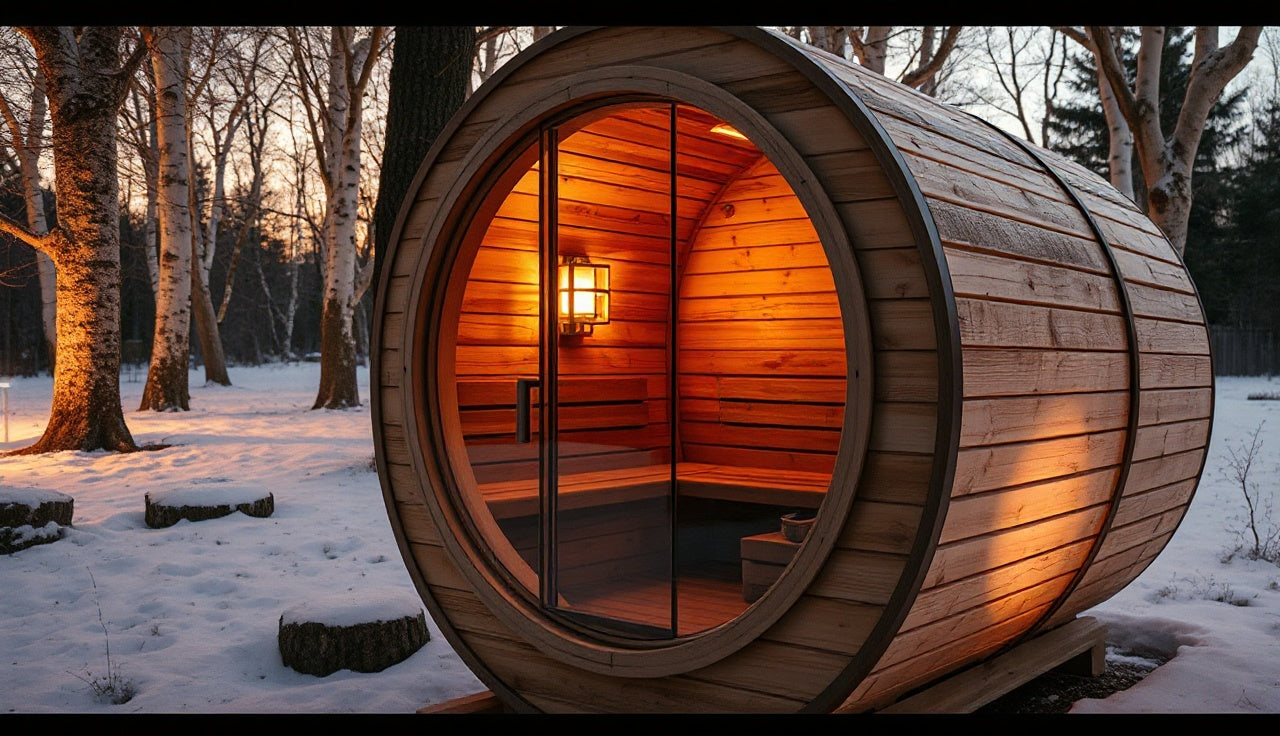
A panoramic barrel sauna is a round-stave cedar or pine barrel with a large glass wall on one end, so you get an outdoor view while you sweat. Installed prices run $3,000 to $12,000. They heat faster than square cabins, hold up outdoors year-round, and look great. The catch: glass loses heat faster than wood, so a fenced-in view isn't worth the upgrade.
What exactly is a panoramic barrel sauna?
A panoramic barrel sauna is a cylindrical wooden sauna built from curved staves, the same construction you'd recognize from a wine barrel, with one addition: the front wall or end cap is mostly or entirely glass. That glass panel is the 'panoramic' part. Instead of stepping into a dark cedar box, you face a wide view of your yard, trees, mountains, or whatever you've got outside.
The barrel shape does more than look good. Curved walls push hot air in a circular convection pattern, so heat moves around the room more evenly than in a rectangular cabin with a flat ceiling. Air rises to the crown of the barrel, travels down the curved walls, and recirculates. Most people find this cuts the harsh stratification you feel in a box sauna, where your head roasts and your feet stay cool.
The glass changes the thermal character a bit. Single-pane glass loses heat far faster than an equivalent area of insulated wall, so good panoramic saunas use tempered double-pane or even triple-pane glass to keep the heater from running flat-out [1]. Better manufacturers spec glass with a low-emissivity coating that reflects infrared back into the cabin.
Construction is almost always tongue-and-groove stave assembly, curved planks fitting tightly together without nails. The barrel sits on a cradle base, usually two curved timber runners, which lets the whole unit rest on almost any flat surface and lets the wood expand and contract seasonally without cracking. If you want the wider picture, our outdoor sauna guide compares barrel, cabin, and pod styles side by side.
How does a panoramic barrel sauna heat up, and how long does it take?
A typical panoramic barrel in the 6-to-8-foot diameter range, with an electric heater around 6 to 9 kW, reaches 170 to 190°F (77 to 88°C) in 30 to 45 minutes from a cold start [2]. That beats most rectangular home cabins of the same interior volume, which usually need 45 to 60 minutes. The reason is simple: a barrel's curved crown holds less stagnant dead air at the top than a flat-topped room does.
Wood-burning barrels take longer, usually 45 to 60 minutes. Plenty of people prefer them anyway, for the dry radiant heat and the ritual of tending a fire. No electrical hookup nearby? Wood-burning is often the practical answer.
The glass front creates one real trade-off. It bleeds heat faster when it's cold outside. On a 20°F winter night, a panoramic sauna with a modest heater fights harder to hold temperature than an all-wood barrel would. Size the heater generously. Roughly 1 kW per 45 cubic feet of interior volume is the safe rule for any barrel with a large glass panel.
What sizes do panoramic barrel saunas come in, and how many people fit?
| Diameter | Length | Approx interior volume | Comfortable capacity | Common heater size |
|---|---|---|---|---|
| 4 ft | 6 ft | ~75 cu ft | 2 people | 4 to 6 kW |
| 6 ft | 7 ft | ~175 cu ft | 3 to 4 people | 6 to 8 kW |
| 7 ft | 8 ft | ~250 cu ft | 4 to 6 people | 8 to 10 kW |
| 8 ft | 8 ft | ~330 cu ft | 6 to 8 people | 10 to 12 kW |
Most home buyers land on the 6-foot diameter, 7-foot length barrel. It fits 3 to 4 people on the two interior benches, heats up in under 40 minutes, and clears a standard gate or side yard with careful handling on delivery.
The panoramic panel is usually the entire front end cap, 4 to 7 square feet of glass on a 6-foot barrel. Some models split the front into a glass upper section and a solid lower panel, which cuts heat loss while still giving you a wide view from the bench.
Length matters as much as diameter for the view. A 6-foot barrel puts you right up against the glass. A 9-foot barrel gives you the full bench-and-glass feel where the panorama really opens up, plus room for a dressing area at the back.
| Panoramic barrel (6 ft, 8 kW) | 37 |
| Standard barrel (6 ft, 8 kW) | 32 |
| Cabin pod (electric, 9 kW) | 55 |
| Barrel, wood-burning | 52 |
| DIY outdoor shed sauna | 60 |
Source: Finnish Sauna Society guidelines and manufacturer specifications, 2024
What materials are panoramic barrel saunas made from, and which is best?
Western red cedar is the most common material and the one worth paying for if you want the sauna to last outdoors. Cedar has natural oils that resist moisture, insects, and rot with no treatment. Its low density means it absorbs less heat from the heater, so the walls come up to temperature fast and don't scorch you when you touch them [3].
Nordic spruce (sometimes sold as 'white wood') costs less and shows up in many Scandinavian-made entry-level barrels. It's fine indoors or in mild climates but grays and checks faster outdoors in wet or freeze-thaw weather. Not a bad pick on a tight budget, as long as you'll apply an exterior UV oil every couple of years.
Thermo-treated wood, heat-treated to change its cell structure and improve moisture resistance, keeps gaining ground. Thermo-aspen and thermo-spruce are popular for interior benches because they stay cooler to the touch than cedar at the same air temperature [4]. Some premium barrels run thermo-wood on the exterior staves and cedar inside.
For the glass, tempered safety glass is the floor. Look for glass certified to ANSI Z97.1 or CPSC 16 CFR Part 1201 [5], the U.S. standards for safety glazing in buildings. Those certifications matter because the constant heating and cooling in a sauna stresses glass, and annealed glass can shatter. Double-pane units add real insulation; the gap between panes is typically 0.5 to 1 inch of dead air.
The heater is its own call. Electric heaters from Finnish makers like Harvia and HUUM are the most reliable, with global parts availability. A wood-burning stove has to match the interior volume and vent so the flue exits the roof of the barrel cleanly, which some barrel designs handle better than others.
How much does a panoramic barrel sauna cost, including installation?
Pricing splits into three tiers.
Entry-level barrels, usually Nordic spruce with a partial glass panel, a basic heater, and few accessories, run $3,000 to $5,000 for the unit. Delivery and a simple gravel-pad base add $300 to $800.
Mid-range cedar barrels with a full-glass front, a 6 to 9 kW quality heater, double-pane glass, and finished interior benches run $5,000 to $8,500. Most serious buyers land here.
Premium models from established brands, with larger diameters, triple-pane glass, thermo-wood benches, an integrated changing room, and designer heaters, reach $9,000 to $12,000 before installation. Electrical work to run the 240V circuit most electric barrels need typically costs $300 to $800, depending on how far the panel sits from the sauna [6].
Installation labor for the barrel itself is usually $200 to $600. These units arrive flat-packed or in a kit, and two people take 4 to 8 hours to assemble on a prepared base. A concrete pad or compacted gravel base costs another $500 to $1,500 depending on size and local rates.
All-in for a mid-range 6-foot cedar panoramic barrel: figure $7,000 to $11,000. That's more than a basic home sauna kit and less than a custom-built indoor sauna room.
For a sense of the low end of the market, the Costco sauna options give you a ballpark on entry-level pricing.
Do panoramic barrel saunas need a permit or have electrical requirements?
It depends entirely on your municipality, so call your local building department before you buy. Here's the general pattern.
Most jurisdictions treat a freestanding outdoor sauna as an accessory structure. The International Residential Code (IRC), which most U.S. cities and counties adopt with local tweaks, exempts accessory structures of 200 square feet or less from permit requirements [7]. A standard 6x7 barrel has roughly 33 square feet of floor area, so it usually clears that bar. Some jurisdictions set the limit at 100 or 120 square feet. Others require a permit for any structure with electrical connections, no matter the size.
Setbacks matter too. Most residential zones require accessory structures to sit 5 to 10 feet from property lines and 10 to 20 feet from the main house. Read your local zoning ordinance, which controls here more than the IRC.
Electrical rules are more standardized. A 6 kW heater draws 25 amps at 240V and needs a dedicated 30-amp, 240V circuit with a weatherproof disconnect within sight of the sauna [8]. Bigger heaters need bigger circuits. In the U.S., the National Electrical Code (NEC) Article 424 covers fixed electric heating equipment, including sauna heaters [8]. A licensed electrician should pull the permit and do the wiring. This is not a DIY job for most homeowners.
Wood-burning barrels dodge the electrical permit but may need a separate approval for the flue depending on local fire code. Some HOAs ban outdoor wood-burning appliances outright.
Is a panoramic barrel sauna worth buying compared to a traditional barrel sauna?
If you have a view, yes. A glass front turns the experience from a dark heat box into a place you actually want to sit for 20 minutes. Looking out at a snowy yard or a stand of trees while you sweat has a real psychological pull, and that pull is what gets you using the sauna week after week.
If your backyard faces a fence or a neighbor's wall six feet away, skip the glass. You'll pay extra for a panel that frames nothing and lose more heat for the privilege. A solid cedar end cap insulates better and costs less.
Here's the honest version: a panoramic barrel with no view is a worse sauna than the same barrel without glass, purely on thermal grounds. Glass fronts cost manufacturers more, get marked up, and add a maintenance point. The silicone seals around the glass need a look every few years for drafts.
For health and recovery, the format of the sauna, barrel versus cabin, matters far less than temperature, duration, and how often you go. The research tracks time spent at 80°C or above, not architectural shape [9]. A traditional sauna and a panoramic barrel at the same temperature produce the same cardiovascular and thermoregulatory responses. The panoramic design is about experience and getting you in there more often, not about different physiological effects.
What health benefits are associated with regular sauna use?
Sauna research is stronger than most of the wellness category, though it leans hard on Finnish studies using dry heat at 80 to 100°C. A 2018 study in Mayo Clinic Proceedings found that men who used a sauna 4 to 7 times a week had a 50% lower risk of fatal cardiovascular events over a 20-year follow-up compared to once-a-week users. The authors were careful to call it an observational association, not proof of causation [9].
A 2021 systematic review in Complementary Therapies in Medicine found that regular sauna bathing was linked to lower systolic blood pressure across several controlled trials, with the caveat that populations were often small and protocols varied widely [10].
For athletes, the evidence that sauna use raises plasma volume and cuts perceived soreness is reasonably consistent. A 2007 study in the Journal of Science and Medicine in Sport found that post-exercise sauna bathing for 30 minutes over three weeks increased run time to exhaustion by an average of 32% in well-trained runners, tied partly to a 7.1% jump in plasma volume [11]. The mechanism matters: heat stress pushes blood plasma up, which improves cardiovascular efficiency.
Nobody has good data comparing panoramic barrel saunas to other sauna types on health outcomes, because nobody has funded that study. Physiology follows temperature exposure, not barrel geometry.
Keep the claims in perspective. These are associations and mechanisms, not prescriptions. Anyone with cardiovascular disease, pregnancy, or blood pressure issues should talk to a physician before starting regular high-heat sessions. Our sauna benefits article goes deeper on what the research actually supports.
A common pairing is contrast therapy: alternating sauna heat with cold exposure. If that interests you, the cold plunge guide and the cold plunge benefits piece cover the evidence on the cold side.
How do you maintain a panoramic barrel sauna and how long will it last?
A cedar barrel, cared for reasonably, lasts 15 to 25 years. The staves weather and silver if you leave the exterior untreated. That's fine structurally; cedar's oils protect it even as it grays. To keep the golden color, apply an exterior UV-blocking wood oil every 1 to 2 years. Never put paint or a film-forming stain on the exterior. Those trap moisture and rot the staves from the inside.
The interior needs almost nothing. After each session, prop the door open for 20 to 30 minutes so the cabin dries out fully. Wipe the benches with a damp cloth if needed. Skip harsh chemical cleaners inside; they off-gas when the sauna heats and smell awful.
The glass panel wants an annual check. Run your hand around the perimeter where the glass meets the frame or silicone gasket and feel for drafts. Replace any cracked or separated silicone with a high-temperature sealant rated for sauna use (look for a product good to at least 400°F / 200°C).
Electric heaters from Harvia, HUUM, or Tylo usually run 10 to 15 years before needing service, and the heating elements are replaceable. Keep the sauna rocks (kiuas stones) clean, and swap them every 3 to 5 years if they crumble or start discoloring the steam.
The cradle base is the most vulnerable spot for moisture damage. Keep the ground under the barrel clear of leaves and standing water. On a gravel pad, rake the gravel now and then to keep drainage open. On concrete or a deck, make sure the cradle runners have small standoffs or feet so the wood doesn't sit on a wet surface.
How does a panoramic barrel sauna compare to other outdoor sauna options?
| Sauna type | Avg price (installed) | Heat-up time | Best for | View possible? |
|---|---|---|---|---|
| Panoramic barrel sauna | $7,000 to $12,000 | 30 to 45 min | Scenic backyards, aesthetics | Yes, full glass front |
| Standard barrel sauna | $4,000 to $8,000 | 25 to 40 min | Pure function, cold climates | Small window only |
| Cabin/cabin pod sauna | $5,000 to $15,000+ | 45 to 70 min | Larger groups, custom interior | Window possible |
| Portable sauna | $200 to $1,500 | 10 to 20 min | Renters, small spaces | No |
| DIY sauna room (outdoor shed) | $4,000 to $10,000 labor + materials | 40 to 60 min | High customization | As designed |
A portable sauna sits in a different category entirely, basically a fabric tent around a person, and it doesn't belong in the same conversation as a permanent barrel.
The closest rival to a panoramic barrel is a cabin-style outdoor pod with a large window or glass wall. Those can offer more interior flexibility (flat walls mean standard benching, square corners, easier lighting), but they take longer to heat because rectangular cabins hold more dead air near the ceiling and the walls are slower to radiate heat back at you.
SweatDecks carries a selection of barrel and cabin-style outdoor saunas if you want to compare specific models with real specs.
Still deciding between dry heat and humid heat? The sauna vs steam room article is worth a read.
What should you look for when buying a panoramic barrel sauna?
Start with the glass. Ask the manufacturer whether it's tempered and what the pane count is. Single-pane tempered is the bare minimum. Double-pane is better for any climate that drops below 40°F regularly. Ask for the U-factor of the glass assembly if they'll give it to you. A lower U-factor means better insulation.
Check the stave thickness. Exterior staves should be at least 1.75 inches thick for a quality build. Thinner staves (1.5 inches or below) are cheaper, show up on entry-level kits, insulate less, and check (develop small surface cracks) faster as the wood moves through the seasons.
Look at the heater brand and whether U.S. replacement parts exist. A no-name heater that dies in year three with no replaceable elements is an expensive headache. Harvia, HUUM, Narvi, and Tylo all have North American distribution and parts.
Ask about the door. Tempered glass doors on panoramic barrels are heavy, 50 to 80 pounds on a full-glass end cap. Confirm the hinges are stainless steel or powder-coated, not plain steel that rusts. The door seal matters too; a magnetic or compression seal holds heat far better than a wood-on-wood fit.
Finally, check the cradle. Wide runners (at least 4 inches) spread the weight and resist sinking into soft ground. Planning to set the barrel on grass or dirt? Budget for a proper gravel or concrete base. Skipping it is how barrels end up sitting in puddles and rotting from the bottom.
For a fuller breakdown of what separates a good outdoor sauna from a cheap one, the outdoor sauna buying guide covers these points in more detail.
Frequently asked questions
Can you use a panoramic barrel sauna year-round in cold climates?
Yes, but size the heater right. In climates that regularly drop below 10°F, a 6-foot panoramic barrel should have at least a 9 kW heater to offset the extra heat loss through the glass. Owners in Minnesota, Canada, and northern Europe report year-round use with no issues. The barrel shape and thick cedar staves hold heat well even in deep cold; the glass is the weakest thermal link, so double-pane is worth the money in these climates.
How much electricity does a panoramic barrel sauna use per session?
A 6 kW heater running 45 minutes to heat up, then cycling through a 30-minute session, uses roughly 4 to 5 kWh total. At the U.S. average residential rate of about 16 cents per kWh (EIA, 2024), that's about $0.65 to $0.80 per session. A larger 9 kW heater, or one fighting cold weather through a glass front, could run $1.20 to $1.80 per session. For most households it's a minor operating cost.
Does the glass front make a panoramic barrel sauna harder to clean?
Not really. The interior glass collects little because saunas are dry inside. A damp cloth once a month handles any mineral residue from löyly steam. The exterior faces weather and does well with a standard glass cleaner a few times a year. The one maintenance point that matters is the silicone seal around the glass perimeter, which you should inspect yearly and reseal with high-temperature silicone if you feel any drafts or spot cracking.
Can I install a panoramic barrel sauna on a deck?
Yes, if the deck can carry the load. A finished 6x7 cedar barrel weighs roughly 800 to 1,200 pounds depending on build, and with two to four people inside it can hit 1,800 to 2,200 pounds total. Residential decks are typically engineered for 40 pounds per square foot live load; a barrel covering about 33 square feet should be fine on a well-built deck, but have a contractor verify your specific structure first. The cradle runners should span multiple joists.
What is the difference between a panoramic barrel sauna and a sauna pod?
A barrel sauna uses curved cylindrical stave construction. A sauna pod usually means a broader category of freestanding outdoor shapes, including oval, egg, and rectangular. Both can have glass fronts. The thermal difference is mostly ceiling shape: a barrel curve moves heat by convection differently than a flat ceiling. Pods often allow more interior customization because flat walls are easier to bench and finish. Price overlap is heavy in the $5,000 to $10,000 range.
How do I choose between a wood-burning and electric heater for a panoramic barrel sauna?
Electric heaters are easier to control, can be timed remotely, need no wood storage, and are mandatory in some HOA or municipal settings. Wood-burning stoves put out a drier, more radiant heat that many sauna purists prefer. Easy access to firewood and no restrictions? A wood stove is a fine choice. Want to preheat remotely before stepping outside on a cold night? Electric wins. Most panoramic barrels support either; confirm which flue exit the roof design accommodates.
Is a panoramic barrel sauna worth it for just one or two people?
A smaller 4-foot diameter panoramic barrel heats fast, costs less to run, and is right-sized for one or two regular users. The glass view doesn't require a big barrel; even a compact unit with a full glass front gives you the panorama. If you regularly host four or more, size up. But for a couple using the sauna three to five times a week, a 4x6 or 6x6 unit is the practical pick and often the better value.
Do panoramic barrel saunas require a foundation?
No poured concrete foundation is required, but a flat, stable, well-drained base is. Compacted gravel (4 to 6 inches of crushed stone) is the most common solution and costs less than concrete. A concrete pad works just as well. Setting a barrel on bare ground or grass wicks moisture into the cradle runners and speeds up rot. Some manufacturers include adjustable leveling feet on the cradle; they help on slightly uneven ground but don't replace proper base prep.
How long does it take to assemble a panoramic barrel sauna kit?
Most 6-foot diameter panoramic kits take two adults 5 to 8 hours from flat-packed components, assuming the base is already prepped. The tongue-and-groove stave assembly is the longest step. Installing the glass end panel and hanging the door usually takes 1 to 2 hours and goes better with a third set of hands given the weight of the glass. The electrical connection should be done by a licensed electrician after the barrel is assembled and positioned.
Can I add a cold plunge next to my panoramic barrel sauna for contrast therapy?
Yes, and it's a popular pairing. The standard contrast protocol, 10 to 20 minutes of heat at 80°C or above followed by 2 to 5 minutes of cold immersion, works with any sauna format. A freestanding cold plunge tub or ice bath within a few steps of the barrel door makes the transition easy. Research on contrast therapy points to cardiovascular and recovery benefits, though protocols vary. The cold plunge and ice bath guides on this site cover setup options.
Are there any safety concerns specific to panoramic barrel saunas?
The glass panel is the main one. Make sure it's tempered safety glass (ANSI Z97.1 or CPSC 16 CFR Part 1201 certified) so it crumbles rather than shards if it ever breaks. The heavy glass door should have properly rated stainless hinges and should open outward, a code requirement for sauna doors in most jurisdictions so an incapacitated person can be reached from outside. Keep a bucket of water and a thermometer inside, and never latch the door from the inside.
What is the best exterior wood finish for an outdoor panoramic barrel sauna?
A penetrating UV-blocking oil, products like Sikkens Cetol or Osmo UV Protection Oil, is the right choice for cedar or spruce exteriors. Apply it to raw wood before first exposure and reapply every 1 to 2 years depending on sun and rain. Avoid film-forming finishes like paint, varnish, or alkyd stain; they stop the wood from breathing and trap moisture in the stave, which leads to rot. Metal hardware and the glass frame should be stainless or powder-coated and may need a separate rust-inhibiting treatment.
Will a panoramic barrel sauna add value to my home?
Anecdotally yes, but hard data is thin. Outdoor saunas are classified as accessory structures, and their value contribution swings by market. In Scandinavian-influenced markets (Minnesota, the Pacific Northwest, parts of New England) a well-built outdoor sauna is a genuine selling point. Elsewhere it may be neutral or even a perceived liability for buyers who don't want it. A sauna on a proper base, with permitted electrical work and in good condition, will at minimum not hurt your appraisal and will likely improve buyer interest in the right market.
Sources
- U.S. Department of Energy, Energy Saver: Windows, Doors, and Skylights: Single-pane glass loses heat far faster than an insulated wall assembly; double-pane glass with a low-emissivity coating substantially reduces that heat loss.
- Finnish Sauna Society, Sauna Construction and Use Guidelines: Traditional sauna temperature range of 80–100°C (176–212°F) is standard; electric sauna heaters sized at approximately 1 kW per cubic meter of interior volume are recommended for adequate heat-up performance.
- USDA Forest Service, Wood Handbook: Wood as an Engineering Material (chapter on thermal properties of wood): Western red cedar has low density and low thermal conductivity, meaning it heats up quickly and does not retain heat that can cause surface burns on contact.
- VTT Technical Research Centre of Finland, ThermoWood Handbook: Thermally modified wood has significantly improved moisture resistance and dimensional stability compared to untreated wood, and remains cooler to the touch in high-heat environments such as saunas.
- U.S. Consumer Product Safety Commission, Safety Standard for Architectural Glazing Materials (16 CFR Part 1201): CPSC 16 CFR Part 1201 sets the standard for safety glazing materials in architectural applications, requiring tempered or laminated glass where breakage could cause injury.
- Angi, Cost to Install an Electrical Circuit (national average data): Installing a dedicated 240V electrical circuit typically costs $300 to $800 depending on panel distance and local labor rates.
- International Code Council, International Residential Code (IRC) Section R105.2, Work Exempt from Permit: The IRC generally exempts accessory structures of 200 square feet or less from permit requirements, though local amendments frequently lower this threshold.
- National Fire Protection Association, National Electrical Code (NEC) Article 424, Fixed Electric Space Heating Equipment: NEC Article 424 covers fixed electric heating equipment including sauna heaters in the U.S., requiring dedicated circuits, proper disconnect placement, and weatherproofing for outdoor installations.
- Mayo Clinic Proceedings, 'Sauna Bathing and Fatal Cardiovascular and All-Cause Mortality Events: A Prospective Cohort Study' (Laukkanen et al., 2018): Men who used a sauna 4 to 7 times per week had a 50% lower risk of fatal cardiovascular events over a 20-year follow-up compared to once-a-week users, described by the authors as an observational association.
- Complementary Therapies in Medicine, 'Effects of sauna bathing on cardiovascular risk factors: A systematic review' (2021): Regular sauna bathing was associated with reduced systolic blood pressure in several controlled trials, though studies were often small and protocols varied.
- Journal of Science and Medicine in Sport, 'Sauna use as a novel post-exercise recovery tool in competitive cyclists' (Scoon et al., 2007): Post-exercise sauna bathing for 30 minutes over three weeks increased run time to exhaustion by an average of 32%, attributed partly to a 7.1% increase in plasma volume.
- U.S. Energy Information Administration, Electricity data and average retail prices: The U.S. average residential electricity rate was approximately 16 cents per kWh as of 2024.

Share:
Aleko SB3CED-AP outdoor cedar barrel sauna: full review
Barrel sauna plans: what to build, buy, or skip in 2026