
Last updated 2026-07-09
TL;DR
Barrel sauna plans range from free PDF downloads to $150 engineered kits. A typical 6-foot-diameter outdoor barrel seats 4 people, uses 1.5-inch tongue-and-groove cedar or hemlock staves, and costs $1,800, $4,500 to build yourself versus $4,000, $12,000 for a pre-built unit. Build time is 1 to 3 weekends with two people and basic carpentry skills.
What exactly is a barrel sauna, and why do people build them?
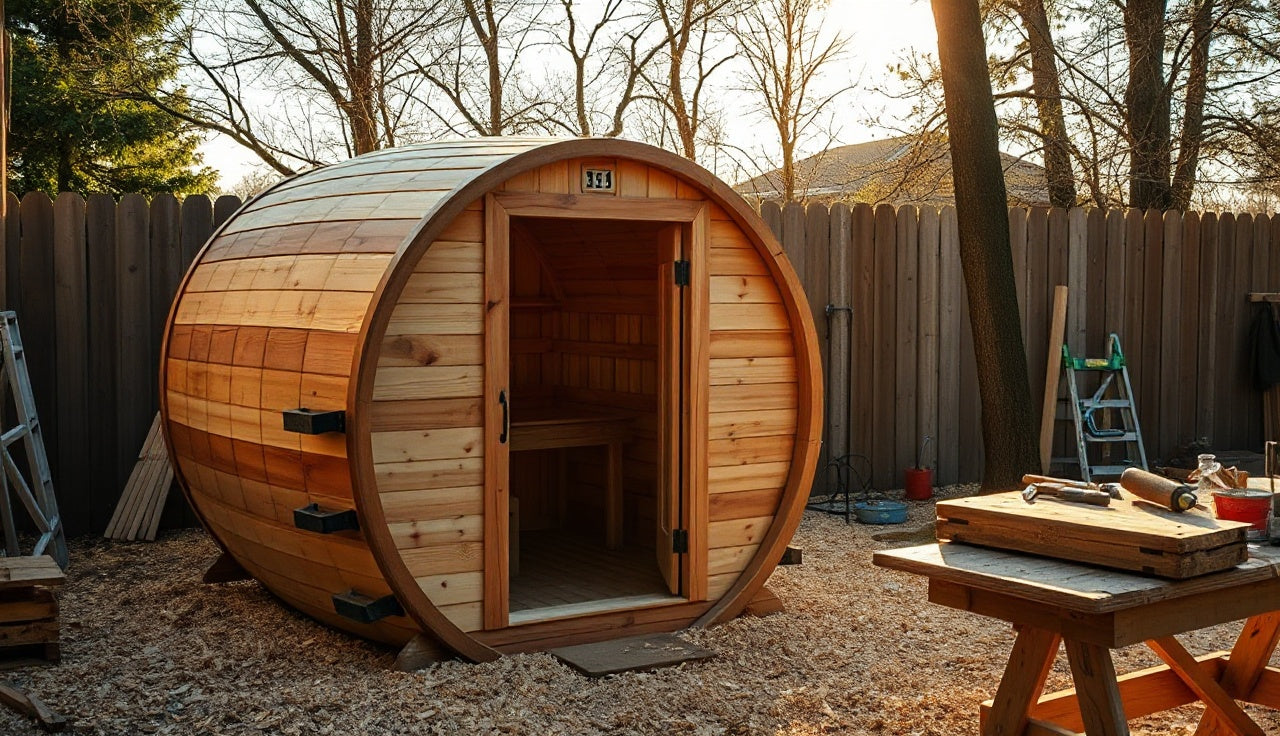
A barrel sauna is a cylindrical wood structure, usually 5 to 8 feet in diameter, built from curved staves banded together like a wine barrel. The shape is more than aesthetic. The curved walls and ceiling reduce the interior air volume compared to a rectangular box of the same floor footprint, so the heater works less to get the room up to temperature, and the natural convection loop pulls hot air off the ceiling and down the walls in a smooth circle rather than stratifying into a hot-top, cold-bottom gradient.
Most builds use Western red cedar, Nordic spruce, or eastern white cedar (often called hemlock in Canadian catalogs). Cedar resists moisture, resists cracking under thermal cycling, and smells great. Hemlock is slightly denser, takes longer to heat, but costs 10 to 20% less in most North American markets.
People build their own barrel saunas for a few overlapping reasons. Cost is the obvious one. A good pre-built barrel delivered and installed runs $4,000, $12,000 depending on size and brand [1]. A self-built version of the same size lands at $1,800, $4,500 in materials if you source lumber carefully. The other reason is fit: a standard 6-foot barrel is 7 feet long and seats 4 people lying down, but a yard that is 40 feet long and 12 feet wide might want something different, and plans let you dial in the dimensions before you order wood.
For more background on how barrel saunas compare to traditional Finnish-style box saunas, see our home sauna guide.
What size barrel sauna should you build?
Diameter is the most consequential decision you make before you draw a single cut line.
The interior of a 4-foot-diameter barrel is tight. Two people can sit on a single bench facing each other with their knees nearly touching. Good for a solo-plus-partner setup, but the heater has to be small or it overwhelms the space in minutes. The 5-foot diameter is the most popular DIY size for couples or small families: it fits a 7-inch heater, seats 3 people comfortably on a single curved bench, and can be built by one person with a helper in a weekend. The 6-foot diameter is the "step up" option that most kit manufacturers default to because it fits two bench levels, a proper wood-burning or electric stove, and 4 adults without anyone touching elbows.
Length (the barrel's depth) is more flexible. Most plans go 6 feet or 7 feet. 6 feet lets a 5-foot-10 person lie flat on a lower bench. 7 feet adds a small change/cool-down vestibule if you partition the front section, or simply gives more bench room if you do not.
| Diameter | Typical length | Seating (seated) | Heater range | Approx. material cost |
|---|---|---|---|---|
| 4 ft | 5 to 6 ft | 1 to 2 | 3 to 4.5 kW | $900, $1,600 |
| 5 ft | 6 to 7 ft | 2 to 3 | 4.5 to 6 kW | $1,400, $2,400 |
| 6 ft | 7 to 8 ft | 4 to 6 | 6 to 9 kW | $2,200, $4,500 |
| 7 ft | 8 to 9 ft | 6 to 8 | 9 to 12 kW | $3,500, $6,500 |
Those material cost ranges come from current cedar and hemlock pricing across North American suppliers as of early 2026; hemlock lands toward the lower end, clear-grade Western red cedar toward the upper end [2].
One number worth internalizing: every additional foot of diameter adds roughly 1.5 to 2 kW of required heater output, because the volume of a cylinder scales with the square of the radius. A 6-foot barrel has about 78% more interior volume than a 4-foot barrel of the same length. That matters a lot for your electrical or propane budget.
What materials do barrel sauna plans call for?
The stave wood is the headline item but it is only part of the bill of materials.
Staves are the curved tongue-and-groove boards that form the barrel wall. Most plans specify 1.5-inch thickness for a 5- or 6-foot diameter. Thinner staves (1.25 inches) work but flex more during temperature swings and can show gaps after a few seasons. Thicker (2 inches) adds mass, slows heat-up, and adds real weight (a 6-foot 2-inch-stave barrel can weigh 1,200 to 1,500 lbs without benches or a heater). The stave width is usually 3.5 to 4.5 inches. Wider staves mean fewer pieces to cut and fit; narrower staves follow the curve more naturally and show less tendency to cup.
Banding is the steel or galvanized strapping that holds the staves under compression the same way a barrel cooper uses metal hoops. Most plans call for 1.5-inch flat bar steel, 3/16 or 1/4 inch thick, bent to the barrel's circumference. You will need 4 to 6 bands on a 7-foot-long barrel. Pre-bent bands are available from most kit suppliers and are worth buying rather than bending yourself unless you have a metal brake.
The cradle is the base the barrel sits on. Two curved wooden cradle pieces (sometimes called rockers) or a treated lumber or steel frame are common. The cradle holds the barrel off the ground, allows drainage, and prevents the bottom staves from sitting in standing water. This is one of the most neglected parts of free plans online. A bad cradle design is why barrels rot from the bottom after 4 to 6 years.
Door and window framing, bench lumber (usually 2x4 cedar or aspen slats), the heater surround, and the vent system round out the material list. A complete 6-foot DIY build typically uses 250 to 350 linear feet of stave material, 15 to 25 lbs of stainless or galvanized fasteners, and 40 to 50 board-feet of bench lumber [2].
For a full picture of outdoor sauna siting and installation issues (drainage, permits, electrical), the linked guide covers that in detail.
| DIY from free plans (materials only) | $2,500 |
| DIY from paid plans + materials | $2,700 |
| DIY from materials kit | $3,850 |
| Pre-built, self-assembled | $5,500 |
| Fully installed pre-built | $8,750 |
Source: Almost Heaven Sauna manufacturer pricing and Random Lengths lumber index, 2026
Where can you find barrel sauna plans, and are free plans worth using?
You have three real options: free PDFs, paid downloadable plans, and plans that come bundled with a materials kit.
Free plans exist all over the woodworking forums and YouTube channels. The quality is wildly uneven. The better free plans come with a dimensioned cut list, an exploded view showing how staves, bands, and end-walls assemble, and notes on heater clearances. The worse ones are essentially a photo with measurements annotated over it. The specific risk with free plans is that they often omit the structural details that matter most for safety: the heater clearance distances required by NFPA 31 and NFPA 211, the ventilation sizing, and the electrical rough-in specs. The National Fire Protection Association's NFPA 31 sets minimum clearance distances between heaters and combustible surfaces, and most manufacturers' installation manuals reference it directly [3].
Paid downloadable plans ($40, $150) usually come from small woodworking studios or from professional sauna builders who have done multiple builds. The good ones include structural drawings, materials specs, a heater clearance diagram, and sometimes a cut optimization sheet that tells you how to orient pieces on standard lumber dimensions to minimize waste. Rockler, several Etsy sellers, and dedicated sauna plan websites sell these.
Kit-bundled plans are the third option. Several North American manufacturers (Almost Heaven, TheraSauna, and others) sell DIY barrel kits that include pre-milled staves, pre-bent bands, door, and a full illustrated assembly manual. The plan is built around their specific components, so the dimensional accuracy is high, but you cannot easily substitute lumber if you want a different wood species. These kits typically run $2,200, $6,000 for materials before heater and shipping [1].
Here's the honest read: if you have solid carpentry experience and can read a technical drawing, a good paid plan is enough. If you have never done a project with compound curves or radial geometry, the kit route saves 15 to 20 hours of problem-solving the first time.
How hard is it to actually build a barrel sauna from plans?
Harder than a deck. Easier than most people assume once they understand the geometry.
The cylindrical geometry is the core challenge. Staves have to be milled with a slight bevel on each edge so they close up into a circle without gaps. If you buy pre-milled kit staves, this problem is already solved. If you are milling your own from rough lumber, you need a table saw with an accurate bevel stop, and you need to understand that the bevel angle depends on the number of staves and the diameter. For a 6-foot diameter barrel using 3.5-inch staves, you need approximately 64 staves, each beveled to about 2.8 degrees per edge. The math is straightforward (360 degrees divided by number of staves, divided by 2), but the execution requires consistent cuts.
The end-walls (the flat circular pieces at each end of the barrel) are the next tricky part. These are typically laminated from 2x6 boards glued and stacked to form a blank large enough to cut a circle from. A router with a circle jig handles this well. Many builders get these pre-cut from a local millwork shop for $80, $150, which is often worth it.
Assembly sequence matters. Most experienced barrel builders assemble the staves around a temporary interior form (a plywood circle cut to the interior diameter), tighten the bands with a come-along or ratchet strap, set the end-walls, and then remove the form. Trying to freehand-assemble staves without a form is the most common mistake beginners make from incomplete plans.
Two people working steadily can frame the shell of a 6-foot barrel in 6 to 8 hours if the staves are pre-milled. Installing benches, the door, vent hardware, and the heater surround takes another 4 to 6 hours. Electrical rough-in (for an electric heater) is a separate task that most builders hand off to a licensed electrician, which is required by most state and local codes for anything above 240V/20A [4].
Realistic timeline: one weekend for the shell, one weekend for finishing and heater install, assuming you have all materials on site before you start.
What permits do you need to build a backyard barrel sauna?
This question gets a vague answer from most guides. Here is the honest picture.
In most U.S. jurisdictions, a barrel sauna is treated as an accessory structure. Whether it requires a building permit depends primarily on two factors: the floor area (most jurisdictions exempt structures under 120 or 200 square feet from a building permit) and whether it has electrical service. A barrel sauna on a simple wood cradle with no permanent electrical connection often falls under the permit threshold in many states. The moment you wire in a 240V heater, you almost always trigger an electrical permit and inspection requirement regardless of structure size [4].
Local zoning also matters separately from building permits. Setback requirements (how far the structure must sit from property lines, fences, and the primary dwelling) apply even to unpermitted structures in most municipalities. Typical residential setbacks are 5 to 10 feet from property lines, but this varies widely. Before you plan the placement, a 15-minute call to your local building department is worth the time.
The International Residential Code (IRC), which most states have adopted in some version, addresses permanent sauna installations. It sets ventilation requirements, maximum temperature limits for controls, and heater clearances. Your local inspector will likely reference this or a state equivalent [4].
If you are in a HOA-governed community, add that layer too. HOAs can restrict outbuildings regardless of what the municipality allows.
One practical note: some homeowners skip permits for small backyard saunas and never have a problem. Others hit trouble when they sell the home and the unpermitted structure shows up during inspection. Pulling the permits properly adds cost and time but avoids that headache.
What heater should a DIY barrel sauna use?
The heater is the most consequential equipment decision in the whole build, and the plans you choose should specify it clearly.
For most residential backyard barrel saunas, the choice is between a wood-burning stove (Harvia or similar cast iron sauna stoves), an electric hardwired unit (6 to 9 kW for a 6-foot barrel), or a propane-adapted wood stove. Electric is the most common choice for suburban yards because it needs no wood storage, produces no smoke (no HOA or air-quality complaints), and runs on a timer. The downside is electrical infrastructure cost: a 6 kW / 240V heater needs a dedicated 30-amp circuit minimum, and an 8 kW unit needs 40 amps. Running a new circuit from a main panel 50 feet to a backyard structure can cost $400, $900 in electrician labor and materials depending on your market.
Wood-burning stoves give a more traditional experience and the authentic löþly (the steam burst when water hits hot rocks). They do not require electrical service to the structure, which simplifies the build and cuts cost. The trade-offs: you need to store dry wood, you need a proper chimney flue through the barrel end-wall (with the correct clearances per NFPA 211), and you cannot precisely control temperature the way you can with a thermostat-equipped electric unit [3].
Heater sizing rule of thumb: 1 kW per 45 cubic feet of interior volume is a widely cited starting point, but most builders go slightly oversized (1 kW per 35 to 40 cubic feet) to account for cold-weather heat loss through the stave walls. A 6-foot-diameter, 7-foot-long barrel has roughly 198 cubic feet of interior volume, suggesting 4.5 to 5.5 kW at minimum. Most installers put a 6 to 7 kW unit in this size.
If you want to pair your sauna with a cold plunge after sessions, our cold plunge guide covers the options that work well in outdoor setups.
How do you ventilate a barrel sauna properly?
Ventilation is where a lot of DIY plans cut corners, and where a lot of headaches come from.
A sauna needs both intake and exhaust venting. The intake vent is typically a 4-inch to 6-inch round or adjustable louvered vent placed low on the end-wall behind or below the heater, so incoming cool air gets heated before it enters the bather's breathing zone. The exhaust vent is placed high on the opposite end-wall or in the barrel's top quadrant, allowing hot, humid air to escape. Without an exhaust vent, humidity builds to the point where the wood stays wet between sessions and begins to degrade.
The cross-sectional area of the exhaust vent should be at least equal to, and ideally 1.5 times, the area of the intake vent. A 4-inch intake with a 6-inch exhaust is a common and functional combination.
For electric heaters, there is no combustion to vent (the heater's heat goes into the rocks and the air, not out a flue). For wood-burning stoves, the flue is a separate system from the ventilation vents, and it must be sized and installed per NFPA 211 with proper clearance to combustibles [3]. This is not optional and not something to improvise.
Many barrels also include a simple adjustable vent on the door itself, or a gap at the bottom of the door, that acts as a secondary intake. This is fine as long as it is controllable so users can reduce airflow once the barrel is up to temperature.
A well-ventilated 6-foot barrel at 180°F should feel hot but breathable. If users feel a burning sensation in the throat after 5 to 6 minutes, the intake is undersized or closed.
How much does it cost to build versus buy a barrel sauna?
The numbers vary enough that a table is the most honest way to show it.
| Path | Typical cost range | What's included | Timeline |
|---|---|---|---|
| DIY from free plans | $1,800, $3,200 | Materials only (lumber, bands, hardware) | 2 to 4 weekends |
| DIY from paid plans | $1,950, $3,400 | Plans + materials | 2 to 4 weekends |
| DIY from a materials kit | $2,200, $5,500 | Pre-milled kit + plans | 1 to 2 weekends |
| Pre-built, DIY-assembled | $3,500, $7,500 | Factory-built unit, you assemble on site | 1 day |
| Fully installed pre-built | $5,500, $12,000 | Delivery, assembly, electrical connection | 1 to 2 days of your time |
Cost sources: North American barrel sauna kit and pre-built pricing from manufacturer published pricing and lumber cost data from the Random Lengths lumber price index [1][2].
The largest variable in DIY cost is lumber species and grade. Clear Western red cedar at retail is roughly $5, $9 per linear foot for stave-grade material (1.5 x 3.5 inch profile) as of early 2026. Hemlock or Nordic spruce runs $3, $5.50. If you can buy direct from a sawmill or through a lumber broker, you can shave 20 to 30% off the retail price but need to plan 4 to 6 weeks ahead for drying time on green-cut lumber.
Electrical and foundation costs are often left out of "build cost" estimates. A proper gravel-drainage pad or concrete footings for the cradle can add $200, $600. A dedicated electrical circuit, as covered above, adds $400, $900. Budget for both.
The honest comparison: if your time is worth more than $30/hour to you, a pre-built unit often pencils out. If you enjoy building things and have the tools, the DIY route is genuinely satisfying and saves real money. A $2,800 materials-only build producing something you use 3 to 4 times a week is hard to argue against on financial grounds.
What are the most common mistakes in DIY barrel sauna builds?
Every experienced barrel builder has a list. These come up over and over on the forums and in builder communities.
Underestimating the cradle. The cradle is not decorative. It holds 800 to 1,500 lbs of wood in a curved shape above the ground and needs to be both strong and drainage-friendly. Treated lumber cradles that sit directly on soil wick moisture and rot in 3 to 5 years. The better approaches: a gravel pad under the cradle, or a concrete or paver foundation.
Buying unseasoned lumber. Green or partially dried cedar staves shrink as they dry and can leave visible gaps or loosen band tension. Kiln-dried material with a moisture content below 15% is what you want. Ask your supplier for a moisture content specification before ordering.
Skipping the test-fit. Before permanently setting end-walls and installing interior hardware, most experienced builders do a dry assembly, tighten the bands, and walk away for 24 hours to see if any staves shift. One afternoon saved can prevent a full disassembly later.
Under-sizing the electrical circuit. Running a 6 kW heater on a 20-amp circuit is a code violation and a fire risk. The National Electrical Code (NEC) Article 422 covers fixed electric heating equipment, and a heater at 240V/6 kW draws 25 amps, requiring a 30-amp circuit at minimum (per the 80% continuous load rule, the circuit must be rated at 125% of the continuous load) [4].
Ignoring the heater clearances in the plan. The heat output of a sauna stove is intense. Most manufacturers specify 3 to 6 inches of clearance from combustibles in all directions, sometimes more. A plan that puts the bench closer than the heater manual specifies is a fire hazard. Always default to the heater manufacturer's installation manual over the plan's drawings if they conflict.
Not planning for drainage. Water hits the floor every session, whether from ladle-splashing, sweat, or users rinsing off. The floor of a barrel sauna needs to drain. A simple cedar-slat floor with gaps over the curved barrel bottom is the most common solution, and it works well if the barrel's lowest stave has a drain hole or if the barrel is slightly pitched on the cradle toward a drain channel.
Are there barrel sauna plan options specifically for small yards or decks?
Yes, and this is a more interesting design challenge than most generic guides acknowledge.
For a deck installation, the structural concern is load. A 6-foot barrel fully loaded (structure, heater, 4 people, benches) can weigh 2,500 to 3,000 lbs. A deck built to the standard residential 40 psf live load may not support that without additional blocking or beam reinforcement beneath. Plans for deck-mounted barrels should include a load calculation or at least a note flagging this issue. If yours does not, consult a structural engineer or at minimum check your deck's joist and beam sizing against span tables from the American Wood Council before placing the barrel.
For small yards with only 8 to 10 feet of clearance, a 4-foot-diameter, 6-foot-long barrel is genuinely functional for 1 to 2 people and can be placed on a 6x8 gravel pad. The per-session experience is not as luxurious as a 6-footer but the heat-up time drops to 20 to 30 minutes versus 45 to 60 minutes for a larger unit, and the fuel or electricity cost per session is noticeably lower.
Some builders also rotate the traditional orientation and build a "stand-up" barrel, using the same stave construction but with the barrel vertical like a whiskey barrel. These seat 1 to 2 people, take up very little floor space, and heat remarkably fast. Plans for these are less common but do exist, and the stave geometry is the same; only the banding pattern and the end-wall configuration change.
For a broader comparison of small-footprint home sauna options, the portable sauna guide covers the trade-offs between barrel, box, and tent-style units.
What maintenance does a barrel sauna need after you build it?
Less than most people expect, but there are a few things that genuinely matter.
Band tension is the first thing to check after the first 3 to 4 heat cycles. Wood expands and contracts with temperature and humidity, and new staves can settle slightly. Most bands have an adjustment bolt; a half-turn of tightening after the first season is normal. After that, check annually.
The exterior takes weathering. Untreated cedar will gray naturally, which many owners like. If you want to preserve the color, a penetrating oil (teak oil or a dedicated wood exterior oil, not a film-forming varnish) applied every 1 to 2 years works well. Never use a film-forming finish on the interior surfaces because it traps moisture in the wood and can off-gas at sauna temperatures.
The cradle and any ground-contact wood are the highest-risk elements for rot. Inspect annually, especially at the contact points between the barrel and the cradle. If you see soft wood or discoloration suggesting moisture retention, address it immediately. A barrel that sits properly on a well-drained cradle can last 20 to 30 years. One that sits in standing water after rain will show structural problems within 5 to 7 years.
The heater needs its own maintenance. For wood-burning stoves, clean the firebox and flue annually per the manufacturer's instructions and per NFPA 211 guidance. For electric units, there is minimal maintenance aside from cleaning the rocks (replace them if they start crumbling, typically every 3 to 5 years depending on use frequency) and checking that the element is not corroded.
For readers who want to understand what regular sauna use actually does for the body, the sauna benefits guide covers the current evidence without overpromising.
Where to find the best barrel sauna plans and kits in 2026
The options have improved substantially over the past five years.
For free plans, the best starting point is the community at SaunaForum.net (a long-running English and Finnish language sauna enthusiast forum). Members post detailed build logs with photos, cut lists, and lessons learned. The quality of the community's feedback on posted plans is genuinely high.
For paid downloadable plans, Etsy has a concentrated set of small-business woodworking plan sellers focused on saunas. Search "barrel sauna plans PDF" and sort by review count. The top sellers with 200+ reviews and 4.8+ star ratings are generally worth the $40, $80 price. Look specifically for plans that include heater clearance diagrams, a ventilation detail, and a cut optimization sheet.
For materials kits, Almost Heaven Sauna, TheraSauna, and several smaller Canadian manufacturers sell North American-sourced cedar kits with illustrated assembly guides. Lead times in 2026 are typically 3 to 6 weeks for standard sizes. If you want to comparison-shop pre-built options alongside DIY kits, SweatDecks carries a curated selection of outdoor sauna options including barrel formats with transparent spec sheets that make it easier to compare materials and heater specs side by side.
One thing worth emphasizing before you commit to any plan or kit: call your local building department first. 20 minutes of conversation there can save you from placing a structure in the wrong spot, undersizing an electrical circuit, or building something you have to tear down. No plan is worth more than your local code requirements.
If you end up building a traditional finish-style sauna rather than a barrel, the sauna guide covers that build path in comparable depth. And if contrast therapy (alternating heat and cold) is part of your plan, the cold plunge benefits page is a good companion read once your sauna is running.
Frequently asked questions
Can I build a barrel sauna without woodworking experience?
With a quality kit (pre-milled staves, pre-bent bands, illustrated manual), yes, with a caveat: you need to be comfortable following detailed instructions, working with a helper for heavy lifting, and making accurate cuts for end-walls. The stave geometry is handled by the kit. Budget an extra weekend for learning-curve time and do not start electrical work yourself unless you hold a license.
How long does a DIY barrel sauna last?
A well-built cedar or hemlock barrel sauna on a proper drainage cradle and with basic annual maintenance typically lasts 15 to 25 years. The biggest life-shorteners are poor drainage (bottom stave rot), band corrosion from using non-galvanized or non-stainless hardware, and leaving the door sealed closed between uses (which traps moisture). Leave the door cracked after every session and the wood will stay in good shape.
What is the best wood for a DIY barrel sauna?
Western red cedar is the most-used choice: naturally rot-resistant, stable under thermal cycling, and fragrant. Eastern white cedar (hemlock in Canadian trade) is a close second at lower cost. Nordic spruce is common in European kits and works well in drier climates. Avoid pressure-treated lumber entirely for any interior surface; the preservative compounds off-gas at sauna temperatures.
Do barrel saunas need a foundation?
Not a poured concrete foundation, but they need a stable, level, well-drained base. A 4-inch compacted gravel pad sized to the cradle footprint is the most common and cost-effective solution ($150, $400 in materials). Concrete pavers or a concrete slab also work. Never place the cradle directly on bare soil or lawn; ground moisture will accelerate rot and the soft ground will allow settling and leveling problems.
How much does it cost to run a barrel sauna per session?
For an electric heater at average U.S. electricity rates (roughly $0.16/kWh as of 2025 EIA data), a 6 kW heater running for 1 hour to heat up and 1 hour of use costs about $1.92. In high-rate states like California or Hawaii the same session runs $3.50, $5. Wood-burning sessions cost essentially the wood fuel, which varies widely but is often under $1 per session if you buy cord wood in volume.
Can a barrel sauna stay outside year-round in cold climates?
Yes. Barrel saunas perform well in cold climates; the insulating mass of 1.5-inch staves plus the tight cylindrical geometry handles winter temperatures effectively. The main care points: drain any plumbing (if you have a cold-rinse shower attached), ensure the door seals well to prevent snow intrusion, and expect longer heat-up times in sub-zero weather (add 15 to 20 minutes versus summer). Many Scandinavian-style users consider cold-weather use part of the appeal.
How do barrel sauna plans handle the door?
The door is a flat panel, usually solid tongue-and-groove cedar or a framed-and-panel design, set into a flat section of one end-wall. Most plans call for a low-thermal-conductivity door (no metal edges exposed to the interior) and a simple wood latch rather than a metal knob to avoid burns. Door dimensions are typically 24x54 inches or 22x52 inches for smaller barrels to maintain structural integrity in the curved end-wall.
What is the minimum electrical requirement for a barrel sauna heater?
A 6 kW / 240V electric heater draws 25 amps and, under NEC Article 422's 80% continuous load rule, requires a 30-amp dedicated circuit. An 8 kW unit draws 33 amps and needs a 40-amp circuit. These circuits require a licensed electrician in most jurisdictions and a dedicated breaker in the main panel. Running a sauna heater on a shared circuit or an undersized breaker is both a code violation and a fire risk.
Are barrel sauna plans different for wood-fired versus electric heaters?
Yes, in two important ways. A wood-burning stove requires a chimney flue penetration through the end-wall or barrel wall with fire-rated clearances per NFPA 211, plus a non-combustible hearth pad under the stove. An electric heater needs a conduit penetration and proper wire sizing, but no flue. The bench layout may also differ because a wood stove takes up more floor footprint than an electric unit of equivalent output.
How do I keep the interior of a barrel sauna smelling good over time?
The wood itself does most of the work. Cedar's natural oils produce the characteristic sauna scent for years. Keep the interior dry between uses (leave the door ajar), clean the bench surfaces with a mild soap-and-water wipe monthly, and sand lightly with 120-grit paper once a year or whenever the benches look gray and weathered. Never use chemical cleaners or sealants on the interior wood; they off-gas unpleasantly at high temperatures.
Can barrel sauna plans be scaled up to a larger size than 6 feet?
Yes, and 7-foot and 8-foot diameter barrels are built regularly for commercial settings or large families. The geometry scales proportionally. The main practical challenges at larger diameters are the weight (easily 2,000+ lbs for a fully built 8-foot barrel), the heater sizing (12 kW or more), and the increased difficulty of sourcing pre-bent bands for non-standard diameters. Most DIY plan sources max out at 6 to 7 feet; above that, custom engineering is often warranted.
What is the difference between a barrel sauna and a traditional Finnish sauna?
The main differences are shape, heat-up time, and interior air volume. A barrel's cylindrical geometry reduces dead air space and creates a natural convection loop, which shortens heat-up time and creates a more even temperature distribution. A traditional Finnish box sauna (rectangular room with an insulated wall and ceiling) typically has a larger benching area and can seat more people, but takes longer to heat and often uses a larger stove. Both use dry heat and can produce löyly with water on stones.
Do I need to treat or finish the exterior of a barrel sauna?
You do not have to, but it helps longevity. Untreated cedar weathers to an attractive silver-gray naturally without structural harm. If you prefer to keep the warm cedar color, a penetrating exterior oil (teak oil, linseed oil, or a dedicated hardwood deck oil) applied every 1 to 2 years works well. Avoid film-forming varnishes or polyurethane on any part of the exterior; they peel under UV exposure and trap moisture at the wood surface.
How do barrel sauna plans address safety for children or older adults?
Good plans include a note to mount the heater guard securely (keeping it at least the manufacturer-specified distance from all benches), specify a door that opens outward and can be operated without a knob (push-bar or simple latch), and avoid a threshold step that could cause tripping in a humid environment. Temperature controls on electric heaters that cap at 185 to 190°F align with the American College of Sports Medicine's general guidance on avoiding thermal stress at extreme temperatures.
Sources
- National Fire Protection Association – NFPA 211, Standard for Chimneys, Fireplaces, Vents, and Solid Fuel-Burning Appliances: NFPA 211 specifies clearance distances between wood-burning heaters/flues and combustible surfaces; sauna stove flue installations must comply with this standard.
- U.S. Energy Information Administration – Average Retail Electricity Prices: Average U.S. residential retail electricity price approximately $0.16/kWh as of 2025, used for per-session operating cost calculations.
- American Wood Council – Span Tables for Joists and Rafters: Deck load capacity for residential construction is typically designed to 40 psf live load; barrel sauna weights of 2,500–3,000 lbs on a small footprint may exceed this and require structural review.
- U.S. Department of Energy – Building Technologies Office: Electric sauna heater sizing and energy use context; baseline heater sizing recommendations reference interior volume calculations.
- National Fire Protection Association – NFPA 31, Standard for the Installation of Oil-Burning Equipment: NFPA 31 specifies minimum clearance distances between heaters and combustible surfaces; referenced in most sauna heater installation manuals for combustible clearance requirements.
- Forest Products Laboratory, USDA – Wood Handbook: Wood as an Engineering Material: Kiln-dried lumber below 15% moisture content specification; wood moisture content and dimensional stability under thermal cycling relevant to stave construction.
- Mayo Clinic – Sauna use: health benefits and risks: General conservative health guidance on sauna temperature thresholds and session safety for older adults and those with cardiovascular considerations.
- U.S. Consumer Product Safety Commission – Home Heating Safety: Guidance on heater clearance distances, fire hazard prevention for fixed electric heating appliances in residential settings.

Share:
Panoramic barrel sauna: everything you need to know before buying
Aleko SB3CED-AP outdoor cedar barrel sauna: full review