
Last updated 2026-07-09
TL;DR
An outdoor home sauna is a permanent or semi-permanent heat structure built on your property, separate from the house. Barrel, cabin, and pod styles are most common. Costs run $3,000 to $20,000+ installed depending on size and heating type. Most jurisdictions require a permit. Wood-burning and electric models each have real trade-offs worth understanding before you spend anything.
What is an outdoor home sauna and how is it different from an indoor one?
An outdoor home sauna is a heat chamber built outside your home, usually in a backyard, on a deck, or at the edge of a property. It sits on its own foundation or platform, has its own electrical or wood-burning heat source, and is exposed to weather on at least three sides. That last part matters a lot.
Indoor saunas get insulation help from the surrounding house. Outdoor ones have to hold heat against cold air on all sides, which means wall thickness, insulation R-value, and door seals matter more. A sauna that works fine indoors in Minnesota will struggle to hit 180°F outside in January without a heater sized up for that heat loss. [1]
The upside is that being outside changes the whole thing. You can roll out of the sauna into a cold plunge, a pool, or a garden hose. You can go year-round without giving up bathroom or basement space. You can build something that looks intentional and adds to the property. Most people who own both an indoor and an outdoor sauna reach for the outdoor one more often.
For a broader look at the different formats, see our guide to home sauna options before narrowing down to outdoor specifically.
What are the main types of outdoor home saunas?
There are four formats worth knowing. Each has a real use case and real drawbacks.
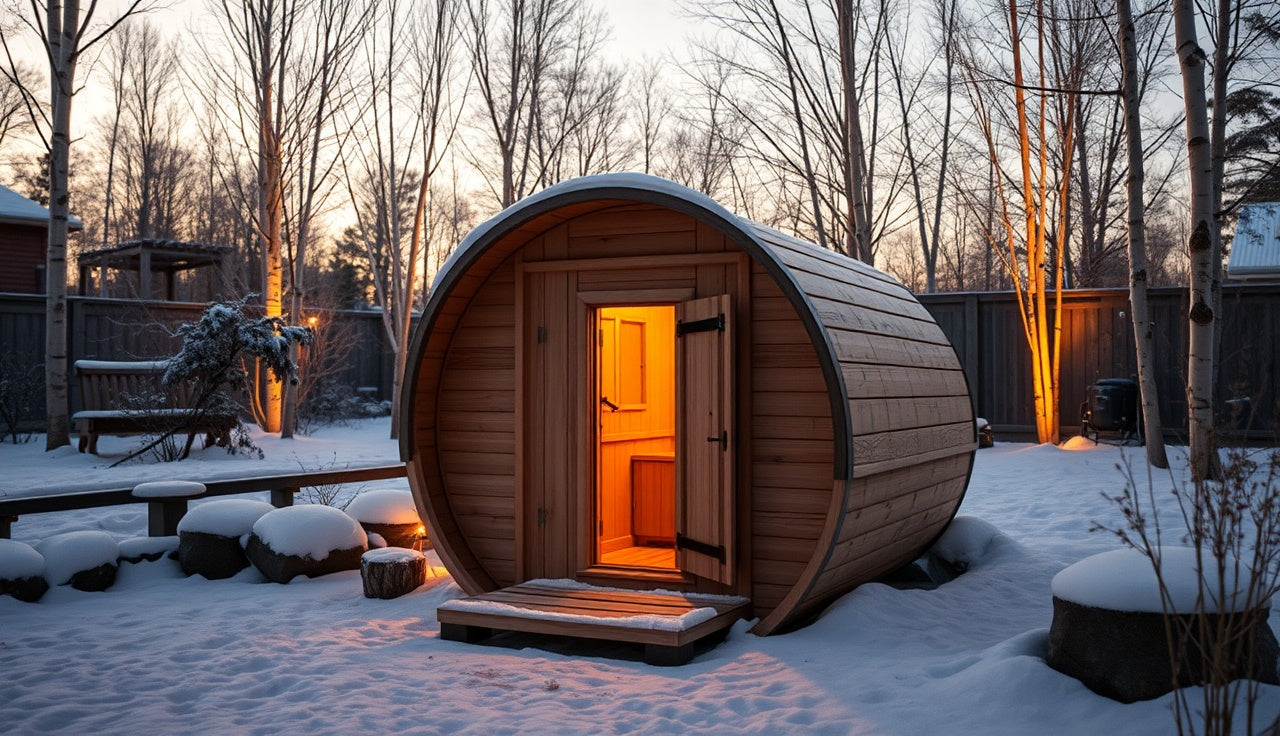
Barrel sauna. A cylinder of tongue-and-groove cedar or Nordic spruce, lying on its side on cradle supports. The shape is efficient: it has less dead air volume than a square room, so it heats faster. Most barrel saunas reach temperature in 30 to 45 minutes with a decent heater. They look good in a yard. The downside is that curved walls eat usable bench space at the edges, and sizes top out around 7 feet in diameter, so large families feel cramped. Pre-cut barrel kits start around $3,000 to $5,000 before heater and shipping. [2]
Cabin sauna (also called a pod or square sauna house). A true small building with straight walls, proper insulation, and a real door. These feel most like a Finnish sauna. You can go bigger, 8x10 or 10x12 interior is common, and you can add changing rooms or covered porches. They cost more to build correctly, often $8,000 to $20,000+ installed, but they hold heat better in extreme cold and last longer if built right. [2]
Prefab modular sauna. Factory-built panels you assemble on site. Quality swings wildly. The best modular systems use thick wall panels (75mm or more) with proper vapor barriers and ship with a heater included. The worst are thin, leak air, and look cheap inside a year. If you go prefab, check the wall panel thickness and the warranty on the wood.
Converted shed or custom build. Some people buy a garden shed and gut it, adding sauna-grade insulation, a vapor barrier, cedar lining, and a heater. Done right, this is the most cost-effective cabin-style sauna. Done wrong, you get mold and a fire hazard. It takes a competent contractor or real DIY skills.
For a comparison to portable alternatives, see our portable sauna guide.
What does an outdoor home sauna cost, and what drives the price?
The range is genuinely wide. A basic barrel sauna kit with a budget electric heater, self-installed, lands around $3,500 to $5,000 all in. A custom-built cabin sauna with a wood-burning stove, changing room, and contractor labor can run $25,000 or more. Most people end up somewhere in the $7,000 to $15,000 range for a quality prefab or contractor-assembled cabin sauna. [2]
Here is what actually moves the number:
- Size. A 2-person barrel is far cheaper than a 6-person cabin sauna. Every square foot adds cost in materials and heater capacity.
- Heater type. A wood-burning sauna stove (kiuas) costs $500 to $2,500 for the unit but nothing to run. A quality electric heater costs $600 to $2,000 but adds to your electricity bill, around $1 to $3 per session depending on kilowattage and local rates. [3]
- Wood species. Clear western red cedar is the standard and runs $4 to $8 per board foot. Nordic spruce and thermally modified aspen are alternatives at different price points. Keep pressure-treated lumber off every interior surface; it off-gasses chemicals when heated. [12]
- Foundation and platform. A proper concrete pad or pressure-treated deck frame adds $500 to $3,000 before the sauna itself goes up.
- Permit fees. These vary by municipality, but budget $100 to $500 for a straightforward accessory structure permit. [4]
- Labor. Contractor assembly for a prefab kit runs $500 to $2,000. A custom build is billed hourly, $50 to $120 per hour depending on region.
One honest note: the cheapest options on Amazon and big-box sites often use thin hemlock or spruce panels with minimal insulation. They work, but they take longer to heat and the wood warps faster in wet climates. Spending $1,000 to $2,000 more on a quality kit usually pays back over several years of lower heating costs and less maintenance.
| Barrel sauna (2–4 person, DIY install) | $4,500 |
| Prefab cabin sauna (4–6 person, contractor install) | $11,000 |
| Custom cabin sauna (6–8 person, full build) | $20,000 |
| Infrared prefab panel sauna (2–3 person) | $5,500 |
Source: Angi/HomeAdvisor, Sauna Installation Cost Guide, 2024
Do you need a permit to build an outdoor sauna at home?
Almost certainly yes, at least in most U.S. jurisdictions. The rules fall into a few buckets, and skipping any one of them can get your finished sauna red-tagged.
Building permits apply when you add a permanent structure. Most municipalities treat an outdoor sauna cabin the same as any other accessory structure: you need a permit once the structure passes a certain square footage, often 120 to 200 square feet depending on local code. Some jurisdictions require permits for anything with a foundation, regardless of size. [4]
Electrical permits are separate from building permits. Any 240-volt sauna heater needs a dedicated circuit and, in most states, an electrical permit and inspection. The National Electrical Code (NEC) covers sauna wiring under Article 424 (fixed electric space heating) and Article 680 for proximity to water. [5] Your electrician will know this, but confirm they pull the permit rather than assuming.
Setback rules decide how close to property lines or structures your sauna can sit. A common rule is 5 to 10 feet from property lines and 10 feet from the main house, but this varies a lot. Check your local zoning code before you buy anything.
Wood-burning sauna stoves that vent outside also have to meet local fire codes and usually require specific chimney clearance from the roof and from combustible materials.
Call your local building department before you order. It takes 10 minutes and can save you a forced teardown. Some HOAs stack another approval layer on top of municipal permits, and it's far better to know that before your kit shows up on a flatbed.
Where should you put an outdoor sauna on your property?
Placement decides how often you use the thing. Get it wrong and the sauna becomes inconvenient enough that it turns into an expensive shed.
Proximity to the house. The closer to your back door, the more you'll actually use it, especially in cold weather. Running across a dark yard in winter in a towel is not as romantic as the Instagram photos suggest. A covered walkway or a lit path makes a real difference in year-round use.
Drainage. Saunas make humidity, and when people pour water on the stones (löyly), some of it hits the floor. The area outside the door gets wet from sweaty bodies and cold plunge runoff too. Build on ground that drains naturally, or install a gravel base. Sitting water under a wood structure speeds up rot.
Sun exposure. A south or west-facing door is nice in winter since the sun warms the entry side. Direct summer sun on a sauna roof can stretch out the pre-heat phase (more heat soaks into the walls before you even start). Partial shade from trees or a privacy fence splits the difference.
Privacy. You're going to be in a towel or less. Think about sight lines from neighbor windows, the street, and your own back windows. A fence section or a few evergreen shrubs solves most of this.
Cold plunge proximity. If you plan to pair your sauna with a cold plunge, keep them within 10 feet of each other. Contrast therapy depends on moving fast between hot and cold, and a long walk between them wrecks the protocol. We make the full case for pairing them in our guide to cold plunge benefits.
Electrical access. Running conduit from your panel to a far corner of the yard gets expensive fast. Every 50 feet of conduit adds real cost. Pick a spot that shortens the electrical run without giving up the factors above.
Electric vs. wood-burning outdoor sauna heater: which is better?
This is the most argued-over choice in the outdoor sauna world, and the honest answer is that your situation decides it, not some abstract quality ranking.
Electric heaters are convenient. You set a temperature, start a timer on your phone, and the sauna is ready when you walk out. They're cleaner, they skip the wood supply, and they clear local fire codes more easily. The main knock is that purists argue the heat is drier and less authentic than wood. That's partly true and partly preference. A quality electric heater with a large stone capacity throws excellent löyly. [6]
Sizable electric outdoor saunas usually need a 240-volt, 40 to 60-amp dedicated circuit. Running that circuit from your panel costs $400 to $1,500 depending on distance and local labor rates.
Wood-burning stoves take longer to heat (45 to 75 minutes typically) and make you tend a fire, but the radiant heat off a big mass of hot stones over a real fire genuinely feels different. The humidity is easier to control with a large rock bed. The experience is closer to what you'd find in Finland, where the sauna dates back thousands of years and sits at the center of daily life. [7] You also pay nothing per session in electricity.
The downsides of wood: you need a dry wood supply, a chimney that meets code, and the willingness to manage a fire. In dry climates or fire-restriction zones, you may not be able to run a wood stove legally during certain seasons.
Infrared panels are a third path. They heat your body directly instead of heating the air, so the cabin stays at a lower ambient temperature (110 to 140°F versus 160 to 195°F for traditional). Some people prefer this for joint recovery. Others feel it's a different product entirely. Infrared is cheaper to install and run, but if you want true high-heat Finnish sauna, it won't get you there. See our broader comparison in the sauna overview.
| Heater type | Typical temp range | Heat-up time | Operating cost | Installation cost |
|---|---|---|---|---|
| Electric traditional | 160 to 195°F | 20 to 40 min | $1 to 3/session | $400 to $1,500 (circuit) |
| Wood-burning | 160 to 200°F | 45 to 75 min | Cost of wood | $500 to $2,000 (stove + chimney) |
| Infrared panels | 110 to 140°F | 10 to 20 min | $0.50 to 1.50/session | $200 to $800 (dedicated circuit) |
What health benefits does using an outdoor sauna actually have?
The research on sauna use is genuinely interesting, but be clear about what the evidence shows and what it doesn't.
The most cited body of work comes from Finland, where researchers followed large cohorts over decades. A 2018 study in Mayo Clinic Proceedings found that frequent sauna use (4 to 7 sessions per week) was associated with a lower risk of cardiovascular events compared to once-weekly use. The authors wrote that "long-term sauna bathing was associated with a reduced risk of fatal cardiovascular disease." [8] That's an association, not proof of cause, and sauna users in Finnish cohorts tend to carry other healthy-lifestyle markers.
For musculoskeletal recovery, heat exposure raises blood flow to muscles and may cut delayed onset muscle soreness (DOMS). A small 2015 study in the Journal of Science and Medicine in Sport found heat therapy reduced perceived soreness at 24 and 48 hours post-exercise. [9] Nobody has run a large randomized trial specifically on outdoor sauna use for athletic recovery, so the exact benefit size stays fuzzy.
Paired with cold exposure, the picture gets more nuanced. Contrast therapy (heat followed by cold) appears to support cardiovascular adaptations and reduce soreness better than either alone in some studies, but the protocols vary widely. See sauna benefits for a detailed breakdown of what the research actually says.
Here is a conservative summary. Regular sauna use appears safe for most healthy adults and links to measurable cardiovascular and recovery effects. It is not a treatment for any medical condition. If you have hypertension, heart disease, or you're pregnant, talk to a doctor before starting regular sessions.
What wood is best for an outdoor sauna, and how long does it last?
The exterior and interior woods are two different problems, and confusing them is how people end up with a warped, splintery box.
Exterior. Your sauna's outer shell has to handle rain, UV, freeze-thaw cycles, and in some places, salt air. Western red cedar is the standard because its natural oils resist moisture and insects. [12] Thermally modified wood (pine or ash heat-treated to strip out sugars and moisture) is a newer alternative with strong weather resistance and a dark color. Pressure-treated pine works for structural framing but never belongs on any interior surface.
Interior. The interior lining (walls, ceiling, benches) needs a low-resin, low-splinter wood that stays comfortable to touch even near 190°F. Your options:
- Clear western red cedar. The most common. Smells good, naturally antimicrobial, handles heat well. Darkens slightly over time from the heat.
- Nordic spruce. The traditional Finnish choice. Lighter in color, a bit cheaper than cedar, holds up fine.
- Aspen. Very light, almost no resin, good for anyone sensitive to wood scent. Less warm-looking but practical.
- Basswood. Similar to aspen, popular in North America, low resin content.
Avoid pine, fir, and redwood for interior surfaces. Pine and fir carry too much resin and can drip or cause burns at high temperatures.
How long does an outdoor sauna last? A well-built cedar cabin sauna on a proper foundation, oiled or stained every 2 to 3 years, can last 20 to 30 years. Barrel saunas with the wood touching the ground or sitting in poor drainage can rot in 10 to 15 years without maintenance. The biggest longevity killers are ground contact, poor roof drainage, and a wet interior that never gets a chance to dry.
How do you maintain an outdoor sauna year-round?
Outdoor sauna maintenance is simple but relentless. Skip a few seasons and a beautiful cedar structure turns into a moldy box.
After each use. Leave the door open for 30 to 60 minutes after your session so the interior dries out. If your heater is electric, leave it on low for a few minutes after your last pour to help evaporate surface moisture. Wipe down benches if you've poured a lot of water. Don't use soap or chemical cleaners on interior wood; they absorb and off-gas when heated.
Monthly. Check the door seal and hinges. Sauna doors take a beating from thermal cycling. Clean the rocks if you run a wood burner, and knock off any ash buildup. For electric heaters, make sure nothing (ladle, bucket) has fallen against the elements.
Seasonally (exterior). Inspect the roof, especially around any chimney penetration. Check the foundation or cradle supports for moisture damage. Apply a UV-protective oil or stain to exterior cedar once a year or every other year depending on your climate and the product's recommended interval.
Winter use. Outdoor saunas are built for winter; that's the Finnish model. Just size your heater for your climate. Below 10°F, a heater sized for summer might struggle to hit 180°F without extra time. Some owners let a light layer of snow settle over a barrel sauna in winter, which actually adds insulation. If you're in a very cold climate and leaving the sauna idle for weeks, turn on the heater's frost protection mode if it has one, and winterize any water line for a nearby shower or cold plunge.
What's the best outdoor sauna for home use, and how do I choose?
There's no single best outdoor home sauna. The right one depends on how many people use it, your climate, your budget, and the experience you actually want. But a few decision filters cut through the noise.
Start with occupancy. A 1 to 2 person barrel sauna is plenty for a solo user or a couple. For families of four or more who want to sauna together, a cabin sauna with 6 to 8 person capacity earns the extra cost.
Match the heater to your reality. If you travel a lot, an electric heater with smartphone control beats a wood burner. If you're home most evenings and enjoy the ritual, wood is great. Don't pick wood because it sounds more authentic if you won't actually tend a fire.
Verify wall thickness. Minimum 45mm walls for mild climates, 68mm or more for cold climates. Cheap kits often use 38mm walls with thin insulation that photograph fine and underperform in practice.
Check the heater-to-room ratio. A rough guide: 1 kilowatt of heater power per 45 cubic feet of sauna volume for well-insulated spaces, more for outdoor use in cold climates. Most manufacturers publish this; trust their numbers if the company is reputable.
SweatDecks carries a vetted selection of outdoor saunas checked for wall thickness, wood quality, and heater compatibility, which helps if you'd rather skip the research rabbit hole on individual manufacturers.
Brands that come up over and over in the enthusiast community include Almost Heaven, Dundalk Leisurecraft, and Finnleo for prefab units. The Sun Home Luminar is a prefab infrared/traditional hybrid that has drawn attention for material quality; it uses Class A panels and a dual-mode heater, which makes it a reasonable pick if you want both heat types without building custom.
Don't over-buy on size. A 4-person sauna used by 2 people heats faster and costs less to run than a 6-person sauna. Sauna size upselling is real.
Can you use an outdoor sauna with a cold plunge or ice bath?
Yes, and this pairing is the main reason a lot of people pick an outdoor setup over an indoor one. Contrast therapy, alternating hot and cold, is far easier to run when both units sit outside with space between them.
The typical contrast protocol: 10 to 20 minutes in the sauna at 160 to 190°F, then a cold plunge or ice bath at 50 to 59°F for 1 to 3 minutes, then rest, then repeat two to four rounds. The research on this exact sequence is growing, though most studies use hospital or gym equipment rather than backyard rigs. A 2021 review in the British Journal of Sports Medicine found contrast water therapy reduced perceived muscle soreness compared to passive rest across multiple trials, though effect sizes varied. [10]
Practically, keep the cold plunge within easy walking distance of the sauna door, ideally on a non-slip surface. A garden hose works in a pinch, but a dedicated plunge tub with temperature control gives you consistent cold and takes the guesswork out of whether the hose water is actually cold enough. Plunge water at 50°F is meaningfully colder than 60°F for the physiological effect.
See our cold plunge benefits guide for what the cold exposure evidence actually shows, and ice bath for the practical setup side.
How much does it cost to run an outdoor sauna per month?
Running costs are easy to underestimate when you're staring at the purchase price.
For an electric sauna, the math is clean. A typical 6 kW heater running for 1 hour per session at an average U.S. electricity rate of $0.16 per kWh (the 2024 U.S. residential average was roughly $0.16/kWh, per the U.S. Energy Information Administration) costs about $0.96 per session. [3] Add the 30 to 40 minute pre-heat and you're at roughly $1.50 per session. Five sessions per week works out to around $30 per month. In states with higher rates (California, Hawaii, and Massachusetts average $0.25 to $0.35/kWh), that number roughly doubles. [3]
For wood-burning saunas, the cost tracks your wood supply. A cord of seasoned hardwood runs $200 to $400 in most of the U.S., and a typical wood sauna session burns roughly 5 to 10 pounds, so cost per session runs $1 to $3 if you're buying wood. If you have a woodlot or free splits, operating cost is essentially zero.
Infrared panels are the cheapest to run. A typical 3 kW far-infrared system for 45 minutes costs about $0.36 per session at $0.16/kWh. Remember you're also getting a lower-temperature, shorter-duration experience.
Beyond energy, budget a small annual amount for exterior wood treatment ($30 to $80 for a quality oil or stain), occasional rock replacement (sauna rocks last 5 to 10 years before cracking), and door hardware. Total annual maintenance for a well-built unit should run $100 to $300.
Does an outdoor sauna add value to your home?
The honest answer: probably, but not dollar-for-dollar, and it depends heavily on your market.
Real estate appraisers don't have a standardized line item for "outdoor sauna" the way they do for a finished basement or a pool. The value gets folded into "outdoor living improvements" and appraised against comparable sales in your area. In markets where buyers chase outdoor amenities (Pacific Northwest, upper Midwest, mountain towns), an outdoor sauna is a real selling point. In suburban Florida, it may draw fewer buyers.
A 2021 report from the National Association of Realtors on home features and buyer interest found outdoor living spaces ranked among the highest priorities for recent buyers, though saunas specifically were not broken out. [11] The reasonable expectation: a quality outdoor sauna adds some resale value but likely returns 50 to 70 cents on the dollar at sale, in line with most backyard improvements.
The more reliable return is personal use. Use your sauna three to five times a week and the cost per session after 5 years on a $10,000 unit lands around $7 to $10 at 500 sessions, less than a single gym drop-in. The value calculation comes down entirely to how much you'd actually use it.
One practical note: if you sell and leave the sauna in place, document its specs (heater model, electrical circuit, maintenance history) for the buyer. That adds perceived value and heads off questions during inspection.
Frequently asked questions
How long does it take to heat up an outdoor sauna?
Electric outdoor saunas typically reach 160 to 180°F in 20 to 40 minutes. Wood-burning models take 45 to 75 minutes. Infrared saunas are ready in 10 to 20 minutes but run at lower temperatures (110 to 140°F). Cold weather adds 10 to 20 minutes to any of these times, so factor that in if you're in a northern climate and want to sauna on a whim rather than planning ahead.
What size outdoor sauna do I need for a family of four?
A cabin-style sauna with at least 6 feet by 8 feet of interior space, or a barrel sauna 6 feet in diameter or larger, seats four adults comfortably. The 6-person benchmark is common for families who want to sauna together without feeling crowded. Smaller 2 to 4 person units work for families who plan to use it in shifts rather than all at once.
Can an outdoor sauna stay outside in winter?
Yes. Outdoor saunas are designed for year-round use, including below-freezing temperatures. Quality units with 68mm or thicker walls and good door seals handle temperatures well below 0°F. The main considerations are sizing your heater for cold-climate performance and keeping the exterior wood sealed against moisture. Some people let snow settle on a barrel sauna for extra insulation in deep winter.
Do I need a foundation for an outdoor sauna?
Almost always yes. A concrete pad, pressure-treated deck frame, or compacted gravel base keeps the sauna level and stops ground moisture from wicking into the wood. Direct ground contact speeds up rot. Most manufacturers specify their foundation requirements; if yours doesn't, a 4-inch concrete slab or a deck-style platform on concrete footings is a safe default. Skip this step and you'll pay for it in 5 to 8 years.
What's the difference between a barrel sauna and a cabin sauna for outdoor use?
Barrel saunas are cylindrical, heat faster thanks to lower dead air volume, and install easily because they need no framing, just cradle supports. Cabin saunas are square or rectangular, offer more bench space, and perform better in extreme cold because straight walls hold more insulation. Barrel is ideal for 1 to 4 users on a budget. Cabin is better for families, serious users, or anyone in a very cold climate.
Is the Sun Home Luminar outdoor sauna worth buying?
The Sun Home Luminar is a prefab unit that offers both traditional and infrared heating modes in one box. It uses what the company calls Class A full-spectrum infrared panels alongside a traditional electric heater, which gives you flexibility. It sits in the $8,000 to $15,000 range depending on configuration. If hybrid heating matters to you and you want a high-material-quality prefab, it's worth comparing. If you're committed to pure traditional Finnish heat, a purpose-built traditional unit may perform better dollar-for-dollar.
How do I clean the inside of an outdoor sauna?
After each session, leave the door open to dry for 30 to 60 minutes. Wipe benches with a damp cloth and a mild non-soap solution (diluted baking soda works) if they need scrubbing. Never use chemical cleaners or bleach on interior wood; they soak into the grain and off-gas when heated. Sand the bench boards lightly once or twice a year to remove gray staining or surface buildup. Replace or flip bench slats when they show deep cracking.
Can I build an outdoor sauna myself, or do I need a contractor?
A barrel sauna kit is genuinely DIY-friendly. Most come with cut lumber and hardware and go together with two people in a weekend. Cabin sauna kits ask for basic carpentry skills but stay manageable. The electrical work for a 240-volt heater almost always requires a licensed electrician unless you have the skills and permits to do it yourself. A wood-burning stove with chimney work also benefits from professional installation for safety and code compliance.
What's the best outdoor sauna for small backyards?
A 2-person barrel sauna with a 4-foot diameter footprint is the most space-efficient option for small yards. Corner-mounted designs and compact cabin saunas around 4 by 6 feet interior can also work. The main constraint in tight spaces is clearance from fences and structures per local setback rules, often 5 to 10 feet. Measure those setbacks first, then see what fits.
How often should I use my outdoor sauna to get benefits?
The Finnish cohort studies that showed cardiovascular associations used 4 to 7 sessions per week as the high-frequency group. Even 2 to 3 sessions per week showed benefit compared to once weekly. There's no established minimum for recovery use, but most sports medicine practitioners who recommend sauna suggest at least 2 to 3 sessions per week of 15 to 20 minutes each. Nobody has good data on the optimal dose; the Finnish research is the closest large-scale evidence available.
What permits do I need to install an outdoor home sauna?
Most U.S. jurisdictions require a building permit for any permanent accessory structure over roughly 120 to 200 square feet. A separate electrical permit is usually required for the 240-volt heater circuit, regardless of structure size. Wood-burning stoves need chimney inspection and must meet local fire codes. HOAs may add approval requirements on top of municipal permits. Call your local building department before buying; the process is usually quick and saves expensive problems later.
How is an outdoor sauna different from a steam room?
A traditional sauna uses dry heat (10 to 30% relative humidity) at 160 to 195°F. A steam room uses 100% humidity at lower temperatures, typically 110 to 120°F. The physiological effects are broadly similar but feel very different. Sauna purists say the ability to control humidity by pouring water on the stones (löyly) is the point. Steam rooms are less common in outdoor residential installations because the plumbing adds complexity. See our full sauna vs steam room comparison for more detail.
What temperature should an outdoor sauna be set to?
Traditional Finnish sauna runs 170 to 195°F (77 to 90°C) at bench level. Beginners usually find 160°F more comfortable and should work up gradually. The traditional range often cited is 80 to 100°C (176 to 212°F). Humidity from löyly changes perceived heat a lot; a 175°F sauna with a big pour of water feels hotter than a 185°F sauna with dry air.
Is outdoor sauna use safe for people with heart conditions?
The Finnish longitudinal research suggests regular sauna use links to cardiovascular benefits in healthy adults, but people with existing heart conditions, uncontrolled hypertension, or serious arrhythmias should consult a cardiologist before starting. Sauna raises heart rate to levels similar to moderate aerobic exercise. For most healthy people, that's fine. For anyone with an active cardiac condition, it's not a question to answer from an article; it needs a clinical conversation.
Sources
- U.S. Department of Energy, Energy Saver - Insulation: Outdoor structures lose heat through all exterior surfaces and require proper insulation R-values to maintain interior temperatures, unlike indoor spaces that benefit from surrounding building thermal mass.
- Angi - Sauna Installation Cost Guide: Outdoor sauna installation costs range from approximately $3,000 for a basic barrel kit to $20,000 or more for a custom cabin sauna with labor and electrical work included.
- U.S. Energy Information Administration - Electricity data and monthly reports: The average U.S. residential electricity rate in 2024 was approximately $0.16 per kWh, with states like California, Hawaii, and Massachusetts averaging $0.25 to $0.35 per kWh.
- U.S. Department of Housing and Urban Development: Most U.S. municipalities require a building permit for accessory structures exceeding 120 to 200 square feet, and electrical permits for any new 240-volt circuit installation.
- National Fire Protection Association - NFPA 70, National Electrical Code: The National Electrical Code covers fixed electric space heating under Article 424 and equipment near water under Article 680, both relevant to sauna heater wiring.
- Finnish Sauna Society - Sauna and Health: A quality electric sauna heater with sufficient stone capacity can produce effective löyly comparable to wood-burning stoves, according to Finnish Sauna Society guidelines on heater selection.
- Finnish Heritage Agency (Museovirasto): The sauna is a Finnish cultural institution dating back thousands of years and remains central to Finnish daily life and social tradition.
- Mayo Clinic Proceedings - Laukkanen et al., sauna bathing and cardiovascular disease (2018): The study authors wrote that 'long-term sauna bathing was associated with a reduced risk of fatal cardiovascular disease' in a Finnish cohort, with 4 to 7 sessions per week showing the strongest association.
- Journal of Science and Medicine in Sport: Heat therapy applied after exercise reduced perceived muscle soreness at 24 and 48 hours post-exercise compared to control conditions in a small controlled study.
- British Journal of Sports Medicine: A 2021 review found that contrast water therapy (alternating hot and cold water immersion) reduced perceived muscle soreness compared to passive rest across multiple trials, though effect sizes varied by protocol.
- National Association of Realtors - 2021 Remodeling Impact Report: Outdoor Features: Outdoor living spaces ranked among the highest priority features for recent homebuyers, supporting the resale value case for outdoor amenity investments including saunas.
- USDA Forest Products Laboratory - Wood Handbook: Western red cedar has natural oils that resist moisture, decay, and insects, making it a standard exterior and interior wood for sauna construction. Pressure-treated lumber contains chemical compounds that off-gas when heated and should not be used on interior sauna surfaces.
Share:
Are ice baths good for you? What the science actually says
Dry sauna benefits: what the research actually shows