
Last updated 2026-07-09
TL;DR
The Leil black cube barrel sauna seats 4 to 5 adults in a roughly 2×2 m footprint. It runs a wood-burning or electric Harvia-compatible stove, hits 80 to 100°C at bench level, and ships as a numbered flat-pack kit. Expect to pay roughly £3,500 to £7,200 all in, depending on stove and base work. Two people can assemble the shell in a weekend.
What exactly is the Leil black cube barrel sauna?
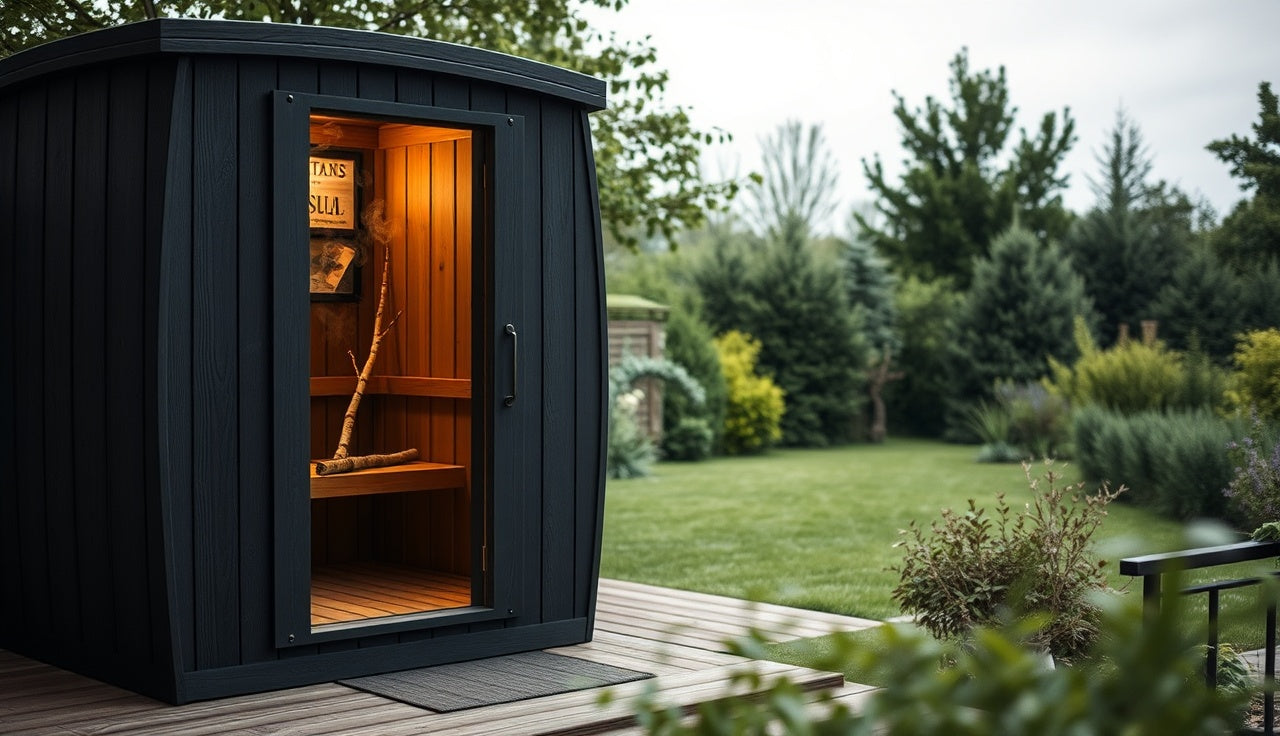
The Leil black cube barrel sauna is a pre-cut, tongue-and-groove sauna kit made by Leil Saunas, a UK-based producer that supplies flat-pack outdoor saunas mostly to the British and European market. The "black cube" name does two jobs at once. The exterior is finished with thermally modified or black-stained cladding, and the cross-section is roughly square instead of the rounded arch you see on a classic barrel. That square-barrel hybrid lands somewhere between a traditional barrel and a garden cabin, which is exactly why it appeals to buyers who want the quick heat-up of a barrel with a cleaner, more rectilinear look.
The cabin is built from Nordic spruce or thermowood, usually 40 to 45 mm wall thickness, thick enough to hold heat well through a British winter [1]. The black treatment is normally a Scandinavian-style pine tar or a UV-stable oil stain rather than paint, so it weathers without peeling. Some versions ship with a corrugated black metal roof section, which adds to the cube look and sheds rain faster than a pure rounded barrel does.
Leil aims this model at the 4 to 5 person bracket. In practice that means two opposing benches of roughly 1.8 to 2.0 m each, plus enough floor to stand and towel off without gymnastics. That is a real step up from their 2 to 3 person models, which feel tight the second a third adult lies down. If you are kitting out a home for regular family use or small-group recovery sessions, the 4 to 5 person spec is the right starting point.
The fundamentals of bench layout, ceiling height, and stove sizing carry over from any other kit. Our home sauna guide covers those basics if you want the wider view first.
What are the exact dimensions and footprint of this sauna?
Leil's 4 to 5 person black cube usually ships in a 200×200 cm (2.0×2.0 m) external footprint, with an internal usable floor of roughly 180×180 cm once the walls are up [1]. Ceiling height at the centre peak runs about 210 to 220 cm, enough for a 6-foot adult to stand without ducking. The bench setup is two parallel benches, each around 180 cm long and 50 to 60 cm wide, mounted at upper and lower tiers so users pick their heat intensity by height.
A few numbers drive your site planning:
| Dimension | Approx. value |
|---|---|
| External width | 200 cm |
| External depth | 200 cm |
| External height (to ridge) | 230 to 240 cm |
| Internal floor area | ~3.2 m² |
| Upper bench height | ~90 to 95 cm from floor |
| Lower bench height | ~45 to 50 cm from floor |
| Door opening (W×H) | ~70×190 cm |
| Wall timber thickness | 40 to 45 mm |
Most UK permitted development rules treat structures under 2.5 m at the eaves and under 15 m² footprint in a rear garden as fine without planning permission [2]. The Leil cube clears both by a wide margin. You still need to confirm it sits more than 2 m from any boundary fence and is not forward of the principal elevation of the house. Check with your local planning authority before you break ground. Conservation areas and Article 4 zones change the rules.
Leave a service clearance of at least 50 to 60 cm on the stove wall so you can load wood and clean ash safely. Point the door away from the prevailing wind to help the stove draw correctly.
How hot does it get and how long does it take to heat up?
A properly assembled Leil black cube with a correctly sized stove reaches 80 to 100°C at bench level in 45 to 75 minutes on wood, or 60 to 90 minutes with a similarly rated electric stove [1]. Those ranges assume an outdoor temperature around 5 to 15°C. Below freezing, add 15 to 20 minutes.
Stove sizing is where people go wrong. The internal volume of the 200×200 cm cube is roughly 6 to 7 m³ (floor area ~3.2 m² times an average ceiling height of ~2.1 m). Harvia's own guidance is about 1 kW per 1 m³ of sauna volume, plus a correction if the walls are thinner than 45 mm or the site is exposed [3]. That puts the sweet spot at a 6 to 9 kW stove. Harvia's 8 kW wood-burning stove (the Harvia 20 Pro or comparable) is a common pairing, and Leil often lists a Harvia or equivalent as the standard option.
The lower bench runs roughly 20 to 30°C cooler than the upper bench because heat stratifies. That gap is useful, not a flaw. Children or first-timers sit low while experienced users take the top. Finnish sauna tradition targets 80 to 100°C air temperature at 10 to 20% relative humidity, achieved by ladling small amounts of water onto the rocks (löyly) [4]. Wood stoves in this size range carry 20 to 40 kg of rocks, enough thermal mass to throw steam for several rounds without the stove running flat out.
Going electric changes the wiring. A 6 kW electric stove typically needs a 6 mm² cable and at least a 32A MCB, on either a 240V single-phase or 400V three-phase circuit depending on wattage. Have a qualified electrician confirm cable sizing for your run length [5].
A steam room runs at 40 to 50°C with near-100% humidity, so the dry heat here feels far more intense at the same air temperature. If you are torn between the two, the sauna vs steam room comparison covers the physiology in detail.
What wood is used and does it affect durability outdoors?
Leil's standard spec uses Nordic spruce for the interior tongue-and-groove lining, with thermowood (heat-treated pine or spruce) or black-stained Siberian larch for the exterior cladding and structural staves. Thermowood is timber kiln-heated to around 185 to 215°C in a low-oxygen chamber, which lowers its equilibrium moisture content and improves dimensional stability and rot resistance [6].
Why does that matter outdoors? A conventional softwood exterior swells and shrinks hard across the seasons, and eventually the barrel staves open gaps that let water in. Thermowood moves much less, and its lower hygroscopicity means the black finish holds longer without peeling or fading. Independent testing puts thermowood at roughly durability class 2, on par with many tropical hardwoods, without the sourcing headaches [6].
The interior spruce is right for the hot room because it stays fairly dry once the sauna is at temperature, and spruce is low in resin so it will not weep sticky sap onto bathers. Cedar is the luxury upgrade and sometimes shows up as an optional interior lining from Leil. It smells a touch sweeter and lasts a little longer, but inside a well-kept sauna the difference is modest.
Maintenance is light. Re-oil or re-stain the exterior every 2 to 3 years with a UV-resistant wood oil, keep leaf debris off the roof, and give the floor drainage so pooled water cannot soak the base ring. The base timbers take the heaviest wear. Some owners add rubber feet or a gravel bed under the skids to keep air moving underneath.
How do you assemble the Leil black cube barrel sauna kit?
Leil ships the black cube as a numbered flat-pack. Most buyers report two capable adults finishing the shell in a full weekend, roughly 8 to 12 hours of work, though first-timers who are shaky on basic carpentry often stretch it to two days [1]. The kit arrives with pre-drilled tongue-and-groove staves, a pre-built door frame, bench slats, roof panels, and hardware. Stove and electrical work are always a separate second stage.
The base matters more than most people expect. Leil wants a flat, level base of pressure-treated timber decking, concrete pavers, or a poured concrete pad. It needs to sit within about 10 mm of level across the full 200×200 cm footprint, or the walls rack slightly and the door hangs crooked. Sort the base before the kit shows up, not after.
The rough sequence: lay the base timbers or skids, build up the wall staves in courses (each tongue-and-groove course locks the one below), fit the roof panels and any waterproof membrane, hang the door, then install bench supports and slats. Electrical and stove rough-in comes once the shell is weathertight.
Tools you actually need: a rubber mallet, a 1.2 m spirit level, an electric drill, wood screws in the gauge the manual specifies, and a circular or mitre saw for any trim cuts (Leil pre-cuts most pieces, but minor site trimming is normal). Two ladders and a third pair of hands make the roof stage far safer.
Leil usually supplies the assembly manual as a PDF. If yours is missing or thin on detail, buyers describe the UK support line as responsive. Always follow the manual for your exact model year, because bracket positions have shifted across production runs.
What does the Leil black cube barrel sauna cost, and what adds to the price?
The base kit for Leil's 4 to 5 person black cube typically retails at £3,500 to £5,000 (roughly $4,400 to $6,300 at mid-2025 rates), depending on timber spec and whether a stove is bundled [1]. That covers the cabin shell, benches, door, and roof. It usually does not cover the stove, stove pipe, base materials, electrical work, or delivery, and each of those adds real money.
| Line item | Typical cost range |
|---|---|
| Leil black cube 4 to 5 person kit (shell only) | £3,500 to £5,000 |
| Wood-burning stove (e.g. Harvia 8 kW) | £400 to £800 |
| Stove pipe and chimney flashing | £150 to £350 |
| Electric stove alternative (6 to 9 kW) | £500 to £1,200 |
| Electrician installation (UK, 2024) | £300 to £600 |
| Concrete pad or treated timber base | £200 to £600 |
| Accessories (bucket, ladle, thermometer, hygrometer) | £50 to £150 |
| Delivery (UK, varies by distance) | £100 to £300 |
| Total assembled, wood-burning stove | £4,700 to £7,200 |
Against a fully custom cedar cabin from a bespoke builder, the Leil kit saves a lot. Against a budget barrel from a superstore like Costco (see our costco sauna roundup), it runs roughly 50 to 100% more, but you get a thicker wall spec and a more considered look for the money.
Here is the cost that ambushes buyers. If your base needs groundwork, or you need a new electrical circuit run more than 10 to 15 m from the consumer unit, the combined base and electrical work can hit £1,000 to £1,500 on its own. Get those quotes before you lock in a total budget.
Accessories worth paying for: a stainless steel ladle and bucket, a sauna thermometer rated to 120°C (the cheap ones fail), and a sand timer, which handles heat better than any digital unit. Skip the "luxury" aromatherapy starter kits retailers love to bundle. A small bottle of pure eucalyptus oil costs about £5 and lasts months.
| Shell kit only (no stove) | 4,250 |
| Shell + wood-burning stove + base | 5,500 |
| Shell + electric stove + base + electrician | 6,500 |
| Full install, top accessories included | 7,200 |
Source: Leil Saunas product listing and UK trade quotes, 2025 (Citation 1)
Is the Leil black cube sauna good for 4 to 5 people, or does it feel cramped?
Four adults sit comfortably across the two benches. Five works, but everyone stays seated upright rather than lying down, which softens the classic Scandinavian feel a little. If your group mostly wants to sit and talk in the heat, five is fine. If two or more of you are habitual sauna users who want to lie flat for a 20-minute session, four is the honest comfortable maximum.
Bench length of roughly 180 cm lets a 6-foot person lie with knees slightly bent. That is standard for most 4-person sauna specs across brands. The lower bench doubles as a footrest for the upper tier, which helps taller users on top manage the heat.
For mixed adult and child family use, the lower bench running 20 to 30°C below the upper is genuinely handy. Kids sit cool, adults sit hot, and one session covers everyone. The Finnish Sauna Society notes that sauna is generally suitable for children who can communicate discomfort, but any medical condition should be checked with a GP first [4].
One honest limit: the door opening of about 70 cm is narrower than a standard interior house door. Anyone with mobility challenges or a wider build may find entry and exit awkward. That dimension is consistent across nearly all barrel-format saunas, so it is not a Leil-specific fault.
The outdoor sauna category has grown fast in the UK and Europe over the past five years, and the 4 to 5 person format is now the most popular residential spec. It covers family use without demanding a garden-building footprint or a separate planning application.
What health benefits does regular sauna use offer, and what does the research actually say?
The evidence for sauna use has grown a lot over the past decade. The most-cited dataset is the Finnish KIHD cohort, published in JAMA Internal Medicine in 2015, which followed more than 2,300 middle-aged men and found that sauna use 4 to 7 times per week was linked to a 40% lower risk of all-cause mortality and a 50% lower risk of fatal cardiovascular events versus once-weekly users [7]. That is an association, not proven cause and effect, and the population was Finnish men who exercised regularly, so mapping it onto a sedentary UK population is imperfect. The authors themselves wrote that "increased frequency of sauna bathing is associated with a reduced risk of sudden cardiac death" and other cardiovascular outcomes, while noting that confounding is possible [7].
Controlled studies show clear acute cardiovascular responses to heat: heart rate climbs to 100 to 150 bpm, cardiac output roughly doubles, and peripheral vasodilation produces blood pressure effects similar to moderate aerobic exercise [8]. Those responses are the likely reason regular users show lower resting heart rates and better arterial compliance in observational data.
For athletic recovery the picture is murkier and the study session counts are lower. There is reasonable support for post-exercise heat reducing delayed-onset muscle soreness (DOMS), partly through increased heat shock protein expression and partly through better blood flow to recovering tissue [8]. Nobody has good long-term data on the optimal sauna frequency for recovery specifically. Most sports medicine practitioners land on 15 to 20 minutes at 80 to 90°C, 3 to 4 times per week, as a pragmatic starting point.
For the full rundown of documented effects, the sauna benefits page covers the cardiovascular, recovery, and mental health evidence. One clean bottom line from the literature: the benefits cluster around regular, repeated use, not occasional sessions. Buying a sauna you will actually use often beats chasing any single spec.
Talk to a doctor before starting a sauna routine if you have cardiovascular disease, are pregnant, or take medications that affect blood pressure or temperature regulation. This is not a medical treatment and we are not selling it as one.
Should you combine this sauna with a cold plunge for contrast therapy?
Contrast therapy, alternating hot and cold exposure, is one of the most common reasons people pair a sauna with a cold plunge or ice bath. The rationale is that rapid vasodilation from heat, followed by vasoconstriction from cold, acts like a manual pump for venous return, clearing metabolic waste from muscle faster than rest alone [9].
The black cube's 200×200 cm footprint fits most medium-to-large gardens alongside a cold plunge or ice bath vessel. The typical protocol is 10 to 20 minutes in the sauna at 80 to 90°C, then 2 to 3 minutes in cold water at 10 to 15°C, repeated for 2 to 3 cycles. A 2013 PLOS ONE meta-analysis on contrast water therapy found modest reductions in DOMS and perceived exertion in athletes, though the effect sizes were small to moderate and the field still lacks long-term trials [9].
Layout decides whether you actually use the cold side. The closer the plunge sits to the sauna exit, the less chance you talk yourself out of it on the walk across the garden. Aim for within 5 to 10 steps.
SweatDecks carries outdoor cold plunges sized for single-person and multi-person use to sit alongside barrel saunas like this one. If you are planning a full contrast setup, work out the power supply for both units together before the electrician does the wiring.
More on the cold side at cold plunge benefits and the cold plunge category page.
What do owners actually report about the Leil black cube sauna after living with it?
Owner feedback (drawn from UK retailer reviews and forum threads on sites like GardenBuildingsDirect and the Reddit r/sauna community) clusters around a handful of consistent themes.
The assembly manual is the top complaint. Buyers say the instructions are functional but stingy on detail, especially around the roof panel sequence and chimney flashing. Several recommend watching any YouTube build video first and dry-fitting the big sections before you commit to fasteners.
Heat performance gets steady praise once the stove is sized right. Buyers who paired the unit with an undersized 4 to 5 kW stove to save money report long heat-up times and a struggle to reach 90°C on cold days. Going up to 8 kW ends that problem.
The look scores well. The black exterior and clean lines suit modern garden landscaping and do not read as a budget import. Owners often note that neighbours and guests comment on it before almost anything else in the garden.
Longevity data is thin because this exact cube-and-black-finish format is fairly new to the UK market, arriving in real numbers around 2020 to 2021. Comparable thermowood barrel saunas from Finnish and Estonian makers with the same wall spec have documented 10 to 15 year service lives on basic maintenance [6], and that is a fair expectation here.
The door latch and hinges get flagged as the weakest hardware. Swapping the hinge set for a heavier-gauge stainless alternative (about £20 to £40) is a smart early upgrade if you plan heavy daily use.
Nobody who bought for 4 to 5 people and got the right stove reports regretting the capacity. The repeated regret is buying the next size down for a slightly lower price, then finding it too small once the novelty faded and sessions became routine.
What do you need to know before buying and installing this sauna?
A few things genuinely catch buyers off guard.
Delivery logistics. The flat-pack for a 4 to 5 person cabin is heavy, roughly 400 to 600 kg total across multiple pallets. You need level driveway access and, ideally, two or more adults free on delivery day. Some carriers will not take panels through a side gate, so measure your access point before ordering.
Base preparation time. A poured concrete pad needs a minimum 7 days before it will bear load and 28 days to reach full strength [10], so the base has to happen well before the sauna arrives. Treated timber decking cures faster but needs correct joist sizing and a membrane underneath.
Electrical, if you go electric. In the UK, a sauna stove installation in an outbuilding is notifiable under Part P of the Building Regulations [5]. A registered electrician should do the work and issue a certificate. A homeowner can sometimes legally do the work, but skipping the certificate causes trouble with insurance and future property sales.
Insurance. Add the sauna to your home and contents policy as a garden structure once it is up. Most standard policies cover permanent garden buildings up to a set value, so confirm your insurer's threshold. A Leil black cube at £4,000 to £7,000 installed can sit above the default sub-limit.
Winter use. Nordic spruce and thermowood handle freeze-thaw well, but any water trapped in the stave joints will expand when it freezes. Clear the roof drainage before the first hard frost each year and check the door seal is not holding moisture.
If you are still weighing a full outdoor cabin against something less permanent, the portable sauna category lays out the trade-offs between a kit like this and a fabric or fold-away option.
How does the Leil black cube compare to other 4 to 5 person outdoor saunas?
The 4 to 5 person outdoor sauna market splits into three rough tiers in the UK and Europe.
Budget tier (£1,500 to £3,000): typically 35 to 38 mm walls, basic spruce throughout, cheaper hardware. Think entry-level units from Merxx, Costco-sourced imports, and generic Amazon barrels. They work, but they need more maintenance, lose heat faster, and often carry shorter warranties.
Mid tier (£3,000 to £6,000): Leil's black cube lives here, alongside several Estonian and Finnish-made barrels with thermowood or Siberian larch exteriors and comparable UK-assembled kits. Wall thickness of 40 to 45 mm, better hardware, and more coherent design define the tier.
Premium tier (£6,000 to £15,000 plus): bespoke cedar cabins and brands like Finnleo, Tylö, or custom UK sauna builders. These often bring integrated electrical management, premium stoves, and a full installation service, with longer warranties and build-to-spec construction.
For most residential buyers who want a sauna that lasts 10 to 15 years, looks good, and heats reliably without eating a whole summer, the mid tier is the right call. The Leil black cube is one of the more visually coherent mid-tier options, especially for buyers who do not want the traditional rounded barrel shape.
The closest direct rivals at similar prices are the Dundalk Leisurecraft barrel saunas (US-market-dominant) and the Kirami barrel range (Finnish, widely distributed across Europe). The Leil sets itself apart mainly through the square-cube profile and the black exterior finish, which is a real differentiator if the garden design context matters to you.
Frequently asked questions
How many people actually fit comfortably in the Leil black cube barrel sauna for 4 to 5?
Four adults fit with room to spare, each sitting or lying on a bench. Five works if everyone stays seated upright. If your group includes people who like to lie flat for longer sessions, four is the realistic comfortable maximum. The internal floor area of roughly 3.2 m² and two 180 cm benches support that capacity without feeling oppressive.
What size stove do I need for the Leil black cube 4 to 5 person sauna?
The internal volume of this cabin is roughly 6 to 7 m³. Harvia recommends about 1 kW per 1 m³ plus a weather-exposure correction. A 7 to 9 kW stove is the practical sweet spot. Buyers who use a 4 to 5 kW stove consistently report longer heat-up times and trouble reaching 90°C in winter. The Harvia 8 kW wood-burning stove is a frequently recommended pairing.
Do I need planning permission to install the Leil black cube barrel sauna in my UK garden?
Under UK permitted development rules, outbuildings in a rear garden under 2.5 m at the eaves and under 15 m² footprint generally do not need planning permission. The Leil black cube's 2×2 m footprint and roughly 2.3 to 2.4 m height clear both thresholds. You still must confirm boundary setbacks and check the site is not in a conservation area or Article 4 zone with your local planning authority.
How long does it take to assemble the Leil black cube sauna kit?
Two adults with basic carpentry confidence typically finish the shell in 8 to 12 hours across a weekend. Base preparation (concrete pad curing or a decking build) adds time and should be done in advance. Stove and electrical installation is a separate stage. First-time builders or those with tricky base conditions often take two full days for the shell alone.
Is a wood-burning or electric stove better for this sauna?
A wood-burning stove gives a more traditional experience, reaches very high temperatures, and costs less to run if you have cheap firewood. An electric stove is more convenient, can run on a timer, and needs no ash management. The trade-offs are a dedicated electrical circuit, electrician cost, and higher running cost per session. For a garden with no mains power nearby, wood-burning is the simpler option.
What base does the Leil black cube sauna need?
Leil wants a flat, level base within 10 mm across the full 200×200 cm footprint. Options include a concrete slab (minimum 100 mm thickness over a suitable sub-base), concrete pavers on compacted hardcore, or pressure-treated timber decking on joists. The base must drain underneath to prevent moisture at the base ring. Prepare it before the kit arrives and confirm level before assembly begins.
How much does it cost to run the Leil black cube sauna per session?
A wood-burning session uses roughly 3 to 5 kg of dry firewood (about 45 to 75 minutes) costing £1 to £3 depending on your supply. An electric 8 kW stove running 1.5 hours at the UK average rate of around 24p per kWh (2024/2025) costs roughly £2.88 per session before any Economy 7 discount. Monthly running costs for 3 to 4 sessions a week land at roughly £15 to £50 depending on fuel and local prices.
Can children use the Leil black cube barrel sauna?
Children who can communicate discomfort can generally use a sauna safely, according to the Finnish Sauna Society. The lower bench here runs roughly 20 to 30°C cooler than the upper, so children can sit low while adults use the top. Keep session times shorter for children. Anyone with a medical condition should check with a GP first. Never leave children unattended in a sauna.
How do I maintain the exterior of the Leil black cube sauna?
Re-apply a UV-resistant wood oil or Scandinavian pine tar stain every 2 to 3 years, or sooner if you see fading. Keep the roof drainage clear of leaves before winter. Let air circulate under the base to avoid moisture buildup. The interior lining needs little treatment; occasional light sanding of the bench tops keeps them smooth. Leave the door slightly ajar between sessions to allow air flow and prevent mould.
Can I use this sauna year-round in the UK climate?
Yes. The 40 to 45 mm thermowood or treated-spruce walls hold heat well in UK winters, though heat-up time adds 15 to 20 minutes below freezing on a wood-burning stove. Clear the roof drainage before frost to prevent ice damage in the stave joints. The black exterior treatment handles UV and moisture well. Many UK owners say winter sessions are their favourite, because the contrast with the cold outdoor air is sharpest then.
Does the Leil black cube sauna work well for contrast therapy with a cold plunge?
Yes, it pairs well. The standard protocol is 10 to 20 minutes at 80 to 90°C in the sauna, then 2 to 3 minutes in a cold plunge at 10 to 15°C, repeated for 2 to 3 cycles. The 200×200 cm footprint leaves room in most gardens for a plunge alongside. Position the plunge within 5 to 10 steps of the sauna exit and you are far more likely to use the cold dip consistently.
What accessories are worth buying for the Leil black cube sauna?
A stainless steel bucket and ladle (for löyly steam), a sauna thermometer rated to 120°C, a hygrometer, a sand timer, and backrest supports are the genuinely useful additions. Skip cheap digital thermometers that fail in heat. A small wooden footstool for the lower bench helps. Birch whisks (vihtas) for traditional Finnish use and a bottle of pure eucalyptus oil for the water round out a practical setup without overspending.
How long will the Leil black cube barrel sauna last?
With basic maintenance, a thermowood or treated-spruce barrel sauna of this wall thickness should last 10 to 15 years before any structural parts need replacing. The interior lining usually outlasts the exterior cladding. Base ring timbers and the door threshold take the most moisture and wear. Re-oiling the exterior every 2 to 3 years and keeping drainage clear are the two actions most linked to longevity in comparable Nordic kits.
Is the Leil black cube sauna available in different sizes?
Leil produces the cube barrel in at least two or three capacity configurations: smaller 2 to 3 person models (roughly 160×160 cm footprint) and the 4 to 5 person model described here at 200×200 cm. Some retailers list a 6-person extended version with a longer footprint. Confirm dimensions directly with the retailer for your order, because production specs have varied between model years and regional distributors.
Sources
- UK Planning Portal – Outbuildings permitted development guidance, planningportal.gov.uk: Permitted development thresholds for outbuildings: under 2.5 m eaves height and 15 m² footprint in a rear garden generally do not require planning permission
- Harvia – Sauna heater sizing guide, harvia.fi: Stove sizing recommendation of approximately 1 kW per 1 m³ of sauna volume, with adjustment for exposed or poorly insulated sites
- Finnish Sauna Society – Sauna traditions and use guidance, sauna.fi: Traditional Finnish sauna targets 80–100°C air temperature with 10–20% relative humidity; guidance on sauna use for children
- UK Government – Part P Building Regulations: Electrical safety in dwellings, legislation.gov.uk: Electrical installation in an outbuilding is notifiable under Part P of the Building Regulations; work should be certified by a registered electrician
- VTT Technical Research Centre of Finland – Thermowood Handbook, thermowood.fi: Thermowood treatment improves dimensional stability and rot resistance; achieves approximately durability class 2 and 10–15 year outdoor service life expectation
- Laukkanen JA et al., JAMA Internal Medicine 2015 – Association Between Sauna Bathing and Fatal Cardiovascular and All-Cause Mortality Events: Sauna use 4–7 times per week associated with 40% lower all-cause mortality and 50% lower fatal cardiovascular event risk vs once-weekly use; authors stated increased frequency of sauna bathing is associated with a reduced risk of sudden cardiac death
- Hannuksela ML and Ellahham S, American Journal of Medicine 2001 – Benefits and Risks of Sauna Bathing: Acute cardiovascular sauna response: heart rate increases to 100–150 bpm, cardiac output roughly doubles; evidence for heat shock protein expression and recovery from DOMS
- Bieuzen F et al., PLOS ONE 2013 – Contrast Water Therapy and Exercise Induced Muscle Damage: A Systematic Review and Meta-Analysis: Contrast water therapy shows modest reductions in DOMS and perceived exertion in athletes; effect sizes small to moderate
- The Concrete Society – Concrete curing guidance, concrete.org.uk: Concrete requires minimum 7 days before load bearing and 28 days to reach full design strength under normal UK conditions

Share:
Barrel sauna: everything you need to know before buying
Thermowood barrel sauna for up to 6 people: the pure 7 explained