
Last updated 2026-07-09
TL;DR
A barrel sauna is a cylindrical outdoor sauna built from rot-resistant wood, usually cedar, spruce, or thermowood. The curved walls kill the cold corners of a box sauna and cut heat-up time to 20-30 minutes. Prices run $2,000 to $10,000-plus depending on size and heater. Most homeowners install one without a building permit, but electrical and setback rules vary by town.
What exactly is a barrel sauna?
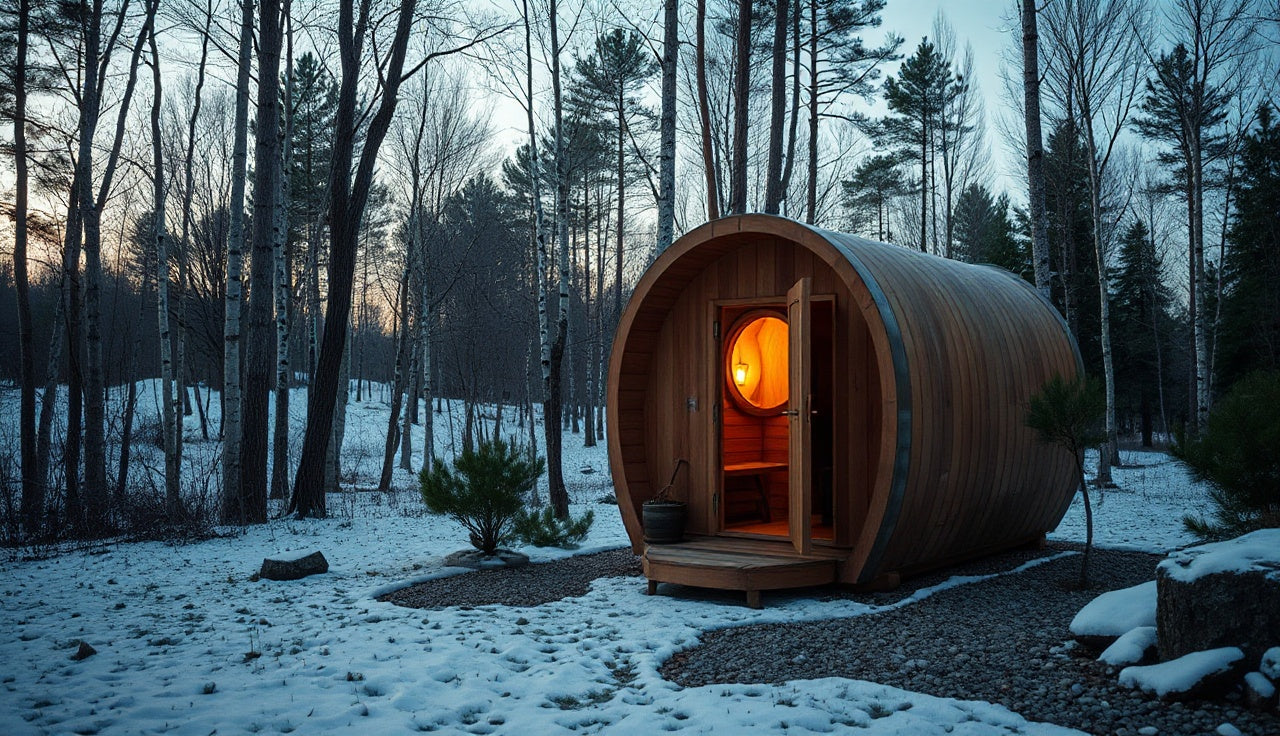
A barrel sauna is a sauna built in the shape of a barrel, with curved stave walls arranged around a circular cross-section. The design started in Scandinavia, where people needed outdoor structures that could take freeze-thaw cycles without warping or cracking. It heats fast, it sheds snow, and it assembles from a kit.
The geometry is the whole point. A square or rectangular sauna has four corners that fill with cool air and take forever to heat. A barrel has none. Hot air from the heater rises, follows the curved ceiling, and cycles back down the walls. That convection loop is tighter and more efficient than anything you get in a box-shaped room.
Barrel saunas are almost always built for outdoor use. They sit on a simple foundation, usually gravel, pavers, or a small concrete pad, and they do not need to tie into a building. That makes them easier to permit (or in many places, permit-exempt) compared to an addition or a full outdoor structure. The outdoor sauna guide covers the full range of formats if you want to compare.
The wood stave construction also means the sauna breathes. The boards are not glued. They are held in tension by steel hoops, the same way a wine barrel works. As the wood swells with moisture and heat, the seams tighten. When it cools and dries, they relax. Done right, that cycle extends the life of the structure rather than degrading it.
How does a barrel sauna compare to a traditional rectangular sauna?
The performance gap between a barrel and a box sauna comes down to volume and airflow. A typical 6-foot-diameter barrel has about 28 square feet of floor space, but the curved ceiling leaves far less dead air above head height than a flat-roofed rectangular room. Less air to heat means faster heat-up.
Here is how the two formats stack up on the factors buyers actually weigh:
| Factor | Barrel sauna | Rectangular sauna |
|---|---|---|
| Heat-up time | 20-30 min | 30-60 min |
| Typical indoor/outdoor use | Outdoor | Both |
| Cold corner problem | None | Yes |
| Foundation required | Minimal (gravel/pavers) | Often concrete slab |
| Installation complexity | Low-moderate (kit) | Moderate-high |
| Price range | $2,000-$10,000+ | $1,500-$20,000+ |
| Custom sizing | Limited | Very flexible |
| Interior aesthetic | Curved, cozy | Spacious, more headroom |
For most people buying their first home sauna, the barrel wins on simplicity and outdoor fit. If you want a large social sauna or you need ADA-accessible space, a rectangular room makes more sense.
One honest downside. The curved walls mean you cannot push a bench flat against the wall and have it sit level. Most barrel saunas come with benches pre-engineered for the curve, and changing the interior layout is harder than in a rectangular room. You work with what the manufacturer designed.
What wood is a barrel sauna made from, and why does it matter?
Wood choice drives smell, durability, heat retention, and price. Three species show up most often: western red cedar, Nordic spruce, and thermowood. Each behaves differently outdoors.
Western red cedar is the classic North American pick. It has natural oils that resist rot and insects, it smells incredible when it heats up, and it stays cool enough to touch at high temperatures. Cedar usually runs 10-20% more than spruce at equivalent quality. It can last 20-25 years outdoors with minimal upkeep [1].
Nordic spruce is denser and tighter-grained than most North American softwoods, and it is the traditional Scandinavian barrel material. It lacks cedar's natural oils, so it weathers a bit faster if left untreated, but it takes periodic oiling well. Spruce costs less and dominates Finnish-made kits.
Thermowood is regular wood (usually spruce or pine) heat-treated in an oxygen-starved kiln at roughly 185-215°C. The process drives out moisture, cuts the sugars that feed rot fungi, and stabilizes the wood against swelling and shrinking. A 2012 review in Wood Science and Technology reported that thermal modification cuts wood equilibrium moisture content by 40-50%, which translates directly to better dimensional stability outdoors [2]. Thermowood shows up more and more in European barrel saunas and earns its keep in wet winter climates.
Skip pressure-treated lumber anywhere inside the sauna. The preservative chemicals off-gas when heated, and the fumes are genuinely hazardous. This is not a fringe worry. The EPA and most state building codes flat out prohibit pressure-treated wood in enclosed heated spaces [3].
| Entry-level (thin stave, basic heater) | $2,750 |
| Mid-range (1.75"+ stave, 6-9kW heater) | $5,250 |
| Premium (2"+ stave, Finnish import, wood option) | $8,500 |
| Large social sauna (7-8 ft dia, vestibule) | $12,500 |
Source: SweatDecks market survey of barrel sauna kits, 2024; contractor estimates from Angi [5]
What sizes do barrel saunas come in?
Barrel saunas are sized by diameter and length. Diameter sets how many people sit comfortably. Length decides whether you can lie down flat.
The most common diameter is 6 feet (about 1.8 meters). That gives two adults room to sit on opposing benches without their knees touching. A 4-foot diameter exists and costs less, but it feels cramped for anyone over 5'8". At 7 to 8 feet in diameter, you get into large social saunas that seat 6 to 8.
Length usually runs 6 to 10 feet. A 6-foot barrel handles sitting sessions. An 8 or 9-foot barrel lets a 6-foot person stretch out flat, which matters if you follow a longer protocol like the ones studied in the University of Eastern Finland cohort, where sessions ran up to 57 minutes in some analyses [4]. Lying down makes long sessions bearable.
Most manufacturers offer a "2-person" (6' x 6' or 6' x 7'), a "4-person" (6' x 8' or 6' x 9'), and a "6-person" (7' x 9' or 8' x 10') configuration. These person counts run optimistic. Size down one category from the manufacturer's claim if you want elbow room.
A few brands build barrel "rooms" that stretch longer, with a changing vestibule on one end. These reach 12 to 14 feet and usually need a concrete pad. They look great and cost real money, often $8,000 to $15,000 before installation.
How much does a barrel sauna cost?
A barrel sauna costs $2,000 to $10,000-plus all in. Price ranges are wide because the category spans thin-walled import kits and thick-stave Finnish-built units with premium heaters. Most buyers land between $3,500 and $7,000.
At the low end, $2,000 to $3,500 buys a basic 2-person kit, usually with 1" to 1.5" stave thickness, a low-wattage electric heater, and few accessories. These work. But the thin staves bleed heat in cold weather and the heaters are often undersized.
The mid-range, $3,500 to $7,000, is where most people land. You get 1.75" to 2" stave thickness, a quality Harvia or Finlandia heater in the 6-9kW range, proper benching, and weatherproofing on the hoops and hardware. Cedar construction at this price is typical for North American brands.
Above $7,000, you pay for thicker staves (2"-plus), longer lengths, wood-burning heater options, custom exterior stain, and a manufacturer who answers the phone. Some Finnish imports with correctly sized heaters and 20-year frame warranties live here.
Installation adds cost. Professional assembly runs $500 to $2,500 if you do not do it yourself. Most kits are built for two people with basic tool skills to assemble over a weekend; the stave-and-hoop system is not complicated. A gravel foundation with lumber footings costs $300 to $800 in materials. A poured concrete pad runs $1,500 to $4,000 depending on local labor [5].
Electricity is the ongoing line item. A 6kW heater running one hour uses 6 kWh. At the U.S. average residential rate of about $0.16 per kWh (EIA, 2024), that is roughly $0.96 a session [12]. Three sessions a week comes to about $150 a year. Wood-burning heaters skip the power bill but eat a cord of wood per season at typical use.
SweatDecks stocks a curated selection of barrel saunas if you want to compare specific models side by side.
Do you need a permit to install a barrel sauna in your backyard?
It depends on your municipality, and you need to check before you buy. The structure itself is often permit-exempt. The 240V electrical hookup usually is not.
Most jurisdictions treat a freestanding outdoor sauna like a shed or accessory structure. Under a certain square footage (commonly 120 to 200 sq ft, but this varies by city and county), it may need no building permit. A 6-foot by 8-foot barrel has about 48 square feet of floor print, which falls under nearly every exemption threshold [6].
The electrical connection is the more likely trigger. Running a 240V line from your panel to feed a 6-9kW heater usually requires an electrical permit and inspection regardless of the structure. That permit typically costs $50 to $200 and requires a licensed electrician for the panel connection in many states. Do not skip it. A miswired 240V circuit is a real fire risk.
Wood-burning barrel saunas sidestep the electrical issue but can run into rules on open-fire appliances, especially in fire-prone states like California and Colorado where wood-burning restrictions apply seasonally or year-round [7].
Setbacks are almost always in play: how far the sauna must sit from your property line, house, and other structures. Typical residential setbacks for accessory structures run 5 to 10 feet from property lines, and some HOAs demand more. Check your local zoning code and your HOA rules before you pick a spot. Putting a sauna in the wrong place and having to move it is an expensive lesson.
For HOA situations, get written approval before you buy, not after. Some HOAs prohibit any outdoor structure without architectural committee sign-off.
Electric heater or wood-burning stove: which is better for a barrel sauna?
Both work well. The choice comes down to how you want to use the sauna and where it sits. Electric is the pragmatic pick for most suburban backyards. Wood wins for off-grid cabins and people who want the ritual.
Electric heaters are easier. Set the temperature, walk away for 20-30 minutes, come back to a ready sauna. They are cleaner, need no wood storage, and hold temperature precisely. Harvia and Finlandia make the most common electric units in barrel kits. A 6kW heater works for a 2-3 person barrel; a 9kW handles a larger 4-6 person format. The rule of thumb most heater makers use is 1 kW per 50 cubic feet of sauna volume, though barrels tend to need a touch less thanks to the efficient airflow.
Wood-burning stoves give you a different session. The heat is softer and more radiant, the smell of burning wood adds atmosphere, and you get the ritual of building and tending a fire. Plenty of people find a wood-fired sauna closer to the Finnish tradition. The tradeoffs: start the fire 45 to 60 minutes before you want it, keep dry wood stored nearby, and get the chimney inspected every year.
For safety, a wood-burning stove in an enclosed barrel needs proper clearances from combustible surfaces. NFPA 211 covers chimney and venting requirements and is worth following whether or not your local code specifically mandates it [8].
If you have a gas line nearby, propane or natural gas heaters are a third option in some outdoor barrels. They heat fast and hold temperature without electricity, but they are less common in residential setups and need proper venting like a wood stove.
For most buyers with an accessible electrical panel, electric is the sensible answer. For a remote cabin or anyone who genuinely wants a low-tech, off-grid experience, wood is hard to beat.
What are the health benefits of using a barrel sauna?
The research on sauna use is real and growing, though most of it was done in traditional Finnish saunas, not barrels specifically. The barrel shape does not change the physiology. What matters is the heat exposure, and a properly built barrel delivers identical conditions.
The most cited work comes from the University of Eastern Finland. A 2018 study in BMC Medicine followed a large cohort of middle-aged Finnish men and women and linked frequent sauna use to lower cardiovascular mortality and reduced hypertension risk compared to once-a-week bathing [4]. That is an association, not a controlled trial, and the authors flag confounding factors, but the signal holds across several analyses from the same cohort.
A 2021 meta-analysis in the International Journal of Environmental Research and Public Health reviewed 40 studies and concluded that repeated sauna bathing improves arterial compliance, lowers systolic blood pressure by 3 to 4 mmHg on average, and raises heart rate much like moderate aerobic exercise [9].
For muscle recovery, the mechanism is clearer. Heat exposure increases blood flow to skeletal muscle, which speeds metabolite clearance. Heat shock proteins, produced during heat stress, help repair damaged proteins in muscle tissue. A 2012 study in the Journal of Science and Medicine in Sport examined post-exercise immersion and recovery markers in trained athletes [10].
The psychological effects are documented too. A rise in core temperature triggers dynorphin release, which produces the discomfort you feel during intense heat. The body answers by upregulating opioid receptors, which may partly explain the mood lift people report afterward. The peer-reviewed literature on this specific pathway is still thin, so treat it as a plausible mechanism rather than settled fact.
Nobody should use a sauna to treat a medical condition without talking to a doctor first. The studies above are associational or short-term; long-term causal evidence is limited. People with cardiovascular conditions, pregnancy, or medications that affect blood pressure should get medical clearance. The sauna benefits guide goes deeper on what the evidence actually says.
Contrast therapy, alternating the sauna with a cold plunge, is increasingly popular and has its own body of research. The cold plunge benefits page covers what that evidence shows.
How long does a barrel sauna last, and what maintenance does it need?
A quality barrel sauna in cedar, spruce, or thermowood, maintained properly, lasts 15 to 25 years outdoors. Some Finnish-made barrels from the 1990s are still in use. Neglect cuts that to 8 to 12 years. The whole maintenance routine takes 2 to 3 hours a year.
Three things kill a barrel: moisture wicking into the end caps, UV degradation on the exterior staves, and rust on the steel hoop bands.
End caps are almost always flat wood, and they are the first place water sneaks in. Check them every spring and apply a water-repellent sealer or exterior oil. If you see blackening or soft spots, treat them before the rot spreads.
Steel hoops need a rust check every spring, especially in coastal air. Most makers use galvanized or stainless steel; galvanized costs less but eventually rusts in wet climates. Touch up any rust with a rust-converting primer and repaint. Stainless hoops are worth the premium near salt air.
Exterior staves want a UV-stable wood oil every 1 to 3 years depending on sun exposure. Never use paint or film-forming sealers. They trap moisture inside the wood. The interior should never be stained, painted, or coated with anything that off-gasses when heated. Leave the interior wood bare and wipe it down after sessions.
The heater has its own routine. Electric elements should be checked annually. Rocks on any sauna heater crack and absorb minerals over time, so swap them every 1 to 3 years. A wood stove chimney needs annual inspection and cleaning; creosote buildup is a genuine fire hazard.
Hoop tension should be checked once or twice a year. The bands have adjustment bolts. Keep them snug but not cranked tight. Over-tensioning can split staves.
Can you use a barrel sauna in winter?
Yes, and many people think winter is the best time. Stepping out of a 180°F barrel into cold air or snow is the whole point of the Finnish tradition, and it is genuinely invigorating. The cold-climate details just take a little planning.
Stave thickness carries the load in a hard freeze. Below 20°F, a thin-staved barrel (1" to 1.25" thick) struggles to reach or hold temperature with a smaller heater. Staves at 1.75" and above make a clear difference in heat retention. If you buy in a northern climate, do not cheap out on stave thickness.
Drainage matters in winter. The floor and any drainage channels need to stay clear so water from steam and sweat does not freeze in the drain and back up. Some barrels have open-slat floors for exactly this reason; make sure yours drains.
The electrical connection needs weatherproof conduit rated for burial or outdoor use. A standard extension cord is never acceptable for a 240V sauna heater, and it is even more dangerous in wet winter conditions.
A fitted canvas cover protects the exterior from UV and moisture year-round, but especially in winter. Snow load is rarely a problem for a properly built barrel, since the curved shape sheds snow on its own, but check the manufacturer's specs if you live where snowfall exceeds 100 lbs per square foot.
Paired with a cold plunge or a roll in the snow, a winter barrel session is one of the better ways to spend a Saturday afternoon. The ice bath guide covers cold exposure basics if you want the physiology before you jump into a snowbank.
How do you install a barrel sauna?
Most barrel saunas sold as kits are genuinely DIY-installable by two people over a weekend, assuming the site is prepped. The stave-and-hoop system is not complicated mechanically. The one job to hand off is the 240V electrical hookup.
Site prep comes first. The sauna needs a level, well-drained surface. In order of cost and permanence: compacted gravel with pressure-treated lumber skids (cheapest, most flexible), concrete pavers or stepping stones, or a poured concrete pad. For most 2-4 person barrels, gravel with skids is plenty and easiest to level and drain.
The assembly sequence for a standard kit goes like this. Lay the foundation skids. Stand up and bolt together the two end caps. Thread the stave boards one by one between the end caps. Drop the steel hoops over the assembled barrel and tension them. Install the door frame, door, and benching. The heater goes in last and, for electric models, needs the electrical connection.
For a 240V electric heater, a licensed electrician should run the branch circuit from your panel in most jurisdictions. This is not safety theater. A miswired 240V circuit can arc and start a fire inside a wood structure. The electrician typically installs a GFCI-protected outdoor outlet or a dedicated disconnect near the sauna as the National Electrical Code requires [11].
Site the sauna somewhere you can actually reach at night and in bad weather. A lit path from the house is worth planning before you pour any pad. Think about privacy too. If your neighbors can see straight into the door, you will use the sauna less.
For a fuller comparison of outdoor formats before you commit to a barrel, the outdoor sauna article covers cabin-style, pod, and modular options alongside the barrel.
Is a barrel sauna worth it compared to other sauna types?
For most people who want an outdoor sauna they can install themselves, use year-round, and maintain without hiring a carpenter every few years, a barrel is worth it. The per-session cost over a 15-year life comes in under $5.00, which beats almost any gym or spa alternative.
The efficiency advantage is real. The curved walls genuinely cut heat-up time and energy use compared to a same-volume rectangular room. Kit-based assembly lowers the install cost sharply versus a custom-built structure. And the outdoor-native design means you are not fighting the moisture problems a badly ventilated indoor room throws at you.
Where it falls short: if you want interior flexibility, a social sauna with theater-style benches, or a room that handles multiple uses (sauna, steam, infrared), a rectangular build gives you more room to work. If budget is the top priority, some portable sauna options cost $300 to $800, though the experience is not comparable.
If you have looked at big-box options, the Costco sauna guide does a direct comparison of what you get at that price versus a dedicated retailer. The gap in materials and heater quality is real and worth understanding.
SweatDecks carries a range of barrel saunas from entry-level to premium Finnish builds if you want to compare specs directly. Either way, knowing your site dimensions, your electrical situation, and your preferred heater type before you contact any retailer will save you a pile of back-and-forth.
The honest bottom line: a $4,000 to $6,000 barrel with a quality heater, installed on a well-drained site and used three or four times a week, is one of the higher-return additions you can make to a home wellness setup.
Frequently asked questions
How long does it take a barrel sauna to heat up?
Most barrel saunas reach 150-180°F in 20-30 minutes with a properly sized electric heater. Wood-burning stoves take 45-60 minutes. The curved walls cut dead air volume compared to rectangular saunas, which is why heat-up is faster. In very cold weather (below 20°F), add 10-15 minutes, especially if your staves are thinner than 1.75 inches.
What size barrel sauna do I need for two people?
A 6-foot diameter by 7-foot length barrel is comfortable for two adults. Manufacturers often label a 6x6 as "2-person," but the extra foot of length is the difference between feeling cramped and enjoying a 30-minute session. If you want to lie down, go 8 to 9 feet long. A 6kW heater fits a 2-person barrel in this size range.
Can a barrel sauna stay outside year-round?
Yes. Barrel saunas are built for year-round outdoor use. Cedar and thermowood handle freeze-thaw cycles well. The main precautions: keep drains clear so water does not freeze inside, check hoop tension in spring after winter expansion, oil or seal end caps annually, and cover the unit when it sits unused for long stretches. A fitted cover protects the exterior wood and hardware.
What foundation does a barrel sauna need?
The minimum is two pressure-treated lumber skids on compacted gravel, set level. That costs $300 to $600 in materials and drains well. Concrete pavers are a step up and work for most residential installs. A poured concrete pad ($1,500 to $4,000 depending on size and local labor) is the most permanent option and makes sense for a large sauna or one with a changing vestibule.
How much electricity does a barrel sauna use?
A 6kW heater running one hour uses 6 kWh. At the U.S. average residential rate of about $0.16 per kWh (EIA, 2024), that is roughly $0.96 per session. A 9kW heater costs about $1.44 an hour. Three sessions a week adds up to roughly $150 to $225 a year, depending on session length and your local rate.
Do barrel saunas require any special maintenance?
Annual maintenance takes about 2 to 3 hours. Oil or seal the exterior staves every 1 to 3 years. Treat end caps with water repellent each spring. Inspect and tighten hoop bands seasonally. Replace sauna rocks every 1 to 3 years. Electric heaters need their elements tested annually. A wood stove chimney needs cleaning and inspection once a year to clear creosote buildup.
Is a barrel sauna better than an infrared sauna?
They do different jobs. A barrel sauna is a traditional Finnish-style dry or steam sauna running 150-190°F at low-to-moderate humidity. Infrared saunas run cooler (120-140°F) and heat body tissue directly instead of the air. The cardiovascular and heat shock protein research is largely based on traditional high-heat use. Infrared is easier to tolerate for people who find 180°F overwhelming. Neither is universally better.
Can I use a barrel sauna if I have heart problems?
Talk to your doctor first. Sauna use raises heart rate and temporarily shifts blood pressure, which is exactly why it turns up in cardiovascular research. The University of Eastern Finland cohort studies linked frequent sauna use to lower cardiovascular risk in healthy middle-aged adults, but those were observational studies in people without acute cardiac conditions. Anyone with uncontrolled hypertension, a recent heart attack, or arrhythmia needs medical clearance before regular use.
What is the best wood for a barrel sauna?
Western red cedar is the top choice for North American buyers: natural rot resistance, low thermal conductivity (stays cool to the touch), and a distinctive smell. Nordic spruce is the traditional Finnish option, slightly denser, slightly less rot-resistant, and usually cheaper. Thermowood offers the best dimensional stability and rot resistance in very wet climates. Skip pressure-treated wood entirely; the preservatives off-gas dangerously at sauna temperatures.
How does a barrel sauna compare to a steam room?
A barrel sauna runs 150-190°F at 10-20% humidity (higher if you pour water on the rocks). A steam room runs 100-115°F at near 100% humidity. The felt heat is similar but the physiology differs. Sauna use has a larger base of cardiovascular research. Steam rooms are easier on the respiratory system for some people. Neither is inherently superior; it depends on preference. The sauna vs steam room article covers this in detail.
Can I finance or deduct the cost of a barrel sauna?
Financing is available through most sauna retailers and home improvement loan products. On deductions, the IRS does not generally allow a sauna as a medical deduction unless a physician prescribes it and it meets strict criteria under IRC Section 213, which requires medical expenses to exceed 7.5% of adjusted gross income [13]. A sauna can add home value, but it is rarely deductible as a home office or business expense for most buyers. Consult a tax professional.
How many people fit in a barrel sauna?
Manufacturer capacity claims run optimistic. A 6-foot diameter barrel comfortably seats 2 to 3 adults on opposing benches. A 7-foot diameter fits 4 without contact. An 8-foot diameter is a genuine 6-person social sauna. Lying-down use costs you one seat per person lying down. Deduct one from any manufacturer's stated capacity to set realistic expectations.
Does a barrel sauna add value to my home?
It can, but nothing is guaranteed. A well-built, attractive outdoor sauna appeals to buyers who value wellness amenities, especially in cold climates. Agents in Scandinavian-influenced markets like Minnesota and the Pacific Northwest report outdoor saunas as a selling point. A cheaply built or badly located barrel can read as neutral or a slight negative. Construction quality and placement matter more than the sauna category itself.
What temperature should I set my barrel sauna to?
Most barrel users target 160-185°F (71-85°C) at bench level. Finnish tradition typically runs 80-100°C at the upper bench. The University of Eastern Finland studies used sessions around 79°C (174°F). Start lower, around 150-160°F, if you are new, and raise it as you acclimate over several weeks. Session length matters too: 15-20 minutes is a reasonable starting point.
Sources
- USDA Forest Service, Wood Handbook: Wood as an Engineering Material (Chapter 3, Physical Properties): Western red cedar has natural decay resistance properties that contribute to outdoor durability of 20-25 years with minimal treatment
- Wood Science and Technology (Springer), 'Effect of thermal modification on hygroscopic properties of wood', 2012: Thermal modification at 185-215°C reduces wood equilibrium moisture content by 40-50%, improving dimensional stability outdoors
- U.S. Environmental Protection Agency, Overview of Wood Preservative Chemicals: Pressure-treated wood preservatives are regulated and unsuitable for enclosed heated living spaces due to off-gassing concerns
- BMC Medicine (2018), 'Sauna bathing is associated with reduced cardiovascular mortality and improves risk prediction in men and women', University of Eastern Finland: Frequent sauna use associated with lower cardiovascular mortality and reduced hypertension risk compared to once-per-week use in a large Finnish cohort
- Angi, Concrete Slab Cost Guide (2024 national averages): Poured concrete pad installation costs $1,500-$4,000 for a residential project depending on size and local labor rates
- International Code Council, International Building Code, Section 105.2 Accessory Structure Exemptions: Many jurisdictions exempt accessory structures under 120-200 square feet from building permit requirements under IBC model code provisions
- California Air Resources Board (CARB), Wood-Burning Regulations and Spare the Air: California and other fire-prone states impose seasonal and episodic restrictions on wood-burning appliances including outdoor stoves
- National Fire Protection Association, NFPA 211: Standard for Chimneys, Fireplaces, Vents, and Solid Fuel-Burning Appliances: NFPA 211 governs clearances, venting, and chimney requirements for wood-burning appliances in enclosed and outdoor structures
- International Journal of Environmental Research and Public Health (2021), meta-analysis on health effects of exposure to hot environments: 40-study meta-analysis found repeated sauna bathing reduces systolic blood pressure by 3-4 mmHg on average and improves arterial compliance
- Journal of Science and Medicine in Sport (2012), study on post-exercise immersion and recovery markers: Post-exercise heat exposure examined for effects on recovery markers and delayed-onset muscle soreness in trained athletes
- National Fire Protection Association, NFPA 70: National Electrical Code, outdoor installation and GFCI provisions: NEC requires GFCI protection and dedicated disconnect for outdoor 240V sauna heater installations
- U.S. Energy Information Administration (EIA), Electric Power Monthly, Average Retail Price of Electricity 2024: U.S. average residential electricity rate approximately $0.16 per kWh as of 2024
- IRS Publication 502, Medical and Dental Expenses (Section 213 deduction thresholds): Medical expense deductions under IRC Section 213 require expenses to exceed 7.5% of adjusted gross income; sauna equipment is rarely deductible
How long does a barrel sauna take to heat up?
Most barrel saunas reach 150 to 185 degrees F (65 to 85 C) in 20 to 40 minutes, depending on stove power, outdoor temperature, and barrel size. That beats most equivalent box saunas, which often need 45 to 60 minutes.
The reason is geometry. A 6-foot diameter barrel that's 7 feet long holds roughly 197 cubic feet of air. A box sauna with the same floor area but an 84-inch ceiling holds more dead air up top that takes time and energy to heat. The barrel's curved ceiling keeps hot air circulating close to the benches where you want it.
A 6kW electric stove is the practical minimum for a 2-person barrel. An 8kW or 9kW unit is better for a 4-person barrel, especially in cold climates. Manufacturers sometimes underspec the included stove to keep the price competitive, so check the stove's rated cubic footage against your actual barrel volume before you buy.
In genuinely cold climates (below 20 degrees F / -6 C), heat-up times stretch to 45 to 60 minutes even with a properly sized stove. Stave thickness helps here. Barrels with 1.75-inch or 2-inch staves hold heat noticeably better than the 1.5-inch staves common in budget models.
For a broader look at how saunas work and what temperatures to expect, the sauna overview is worth reading before you settle on a format.
| Budget (hemlock/pine, basic stove) | $2,750 |
| Mid-range (cedar, decent stove) | $5,000 |
| Premium (cedar/thermowood, Finnish stove) | $8,250 |
| High-end/custom | $12,500 |
Source: SweatDecks market survey of major North American barrel sauna retailers, 2025
How does a barrel sauna compare to a traditional box sauna?
The core differences come down to shape, placement, and heating behavior. Everything else is secondary.
A box sauna has vertical flat walls and a horizontal ceiling. That shape is easier to insulate and better for indoor installs where you're building it into a room. Flat walls also make it simpler to add benches in different layouts and to wire lighting and controls into the framing. If your priority is an indoor sauna that blends into a basement or spare room, a cabin-style sauna wins on flexibility.
A barrel sauna is built for outdoors. The round shape drains itself, sits low, and holds its own weight without a floor frame. It heats faster per unit of energy, which matters if you're using it four or five times a week and paying the electric bill. Assembly is DIY-friendly for most adults: the stave-and-hoop build goes together with basic tools in 4 to 8 hours for a standard two-person unit.
Where barrels lose is interior space. A 6-foot diameter barrel sounds roomy until you're inside with two other adults and the curved walls eat bench space at both ends. A 7-foot diameter or longer unit fixes most of that. The round floor is also an awkward shape. Changing clothes, stretching, or lying down feels tighter than in a box sauna of similar footprint.
On longevity, the two formats are comparable when the wood is quality cedar or thermowood and the stove is maintained. Budget barrels with thin staves and untreated softwood can crack or warp within 5 to 7 years in harsh climates. Quality units genuinely last 15 to 25 years.
Still deciding? Comparing a sauna vs steam room or looking at outdoor sauna options more broadly can help narrow the field.
What size barrel sauna do I need?
Barrel saunas come in three standard diameters: 4 feet, 5 feet, and 6 feet (7 feet for custom or commercial units). Length is the other variable, usually 6 feet to 10 feet or more in 2-foot increments.
For most buyers, 6 feet in diameter and 7 to 8 feet in length is the sweet spot. That fits two adults comfortably lying down, three sitting, and gives the stove enough room to work without the space feeling cavernous and slow to heat.
A 4-foot diameter barrel is cramped for anyone over 5'8". It works as a solo unit in a small yard, but two adults will feel it. The 5-foot diameter adds real usability, especially if you want to stretch or lie on the lower bench.
Length matters mostly for the bench layout. Longer barrels allow a full-length lower bench running end to end, which is a genuine luxury. Shorter barrels use L-shaped or opposing bench setups that feel pinched.
For families of 3 to 4 or anyone who expects social sessions, a 6-foot diameter barrel at 8 to 9 feet long is the right call. The stove scales with the space: roughly 1kW per 45 to 50 cubic feet is a workable rule of thumb, though ratings vary by brand.
If outdoor space is tight, a portable sauna is worth considering before you commit to a permanent barrel install.
What kind of stove does a barrel sauna use?
Barrel saunas run on either an electric stove (kiuas in Finnish) or a wood-burning stove. Each has real advantages and real drawbacks, and the right one depends on your situation more than your preference.
Electric stoves are easier. You set a temperature, you get that temperature. They work with smartphone timers and remote controls, so you can preheat the sauna before you get home from the gym. Installation is a one-time cost: a dedicated 240V circuit. Electric stoves are allowed in nearly any jurisdiction without special permits. The main downside is running cost. A 6kW stove running for an hour costs roughly $0.60 to $1.20 depending on your local rate (the national average was about $0.163 per kWh in early 2025, per the U.S. Energy Information Administration [4]).
Wood-burning stoves feel different. The heat has more variation, more life to it. You can do proper loyly, the Finnish practice of throwing water on hot stones for steam, with more dramatic effect because the stones get hotter. Building a fire is a ritual many people love. The downsides are real: you need dry firewood on hand, you start 45 to 60 minutes before you want to use it, you manage ash and cleaning, and you check local fire codes. Some municipalities and HOAs ban wood-burning outdoor appliances outright.
For rural or semi-rural buyers with easy access to firewood, a wood-burning stove in a barrel is a great setup. For urban and suburban buyers, electric almost always makes more sense.
A third option, less common but worth knowing, is a wood-burning stove with an exterior firebox. You feed wood from outside the barrel while you're sitting inside, which keeps the mess and smoke out of the sauna.
How do I install and set up a barrel sauna?
Most barrel saunas ship as a kit built for DIY assembly. The job takes one or two adults 4 to 8 hours, assuming the site is prepped.
Site prep is the step people underestimate. The barrel needs a level surface. It doesn't need a concrete slab (though that works well), but it does need something stable: compacted gravel, concrete piers, a deck, or pressure-treated sleepers. The cradles that hold the barrel off the ground have to sit level, or the whole thing twists over time and stresses the stave joints.
Assembly itself is straightforward. Staves interlock like a tongue-and-groove floor. You build them around the circular end pieces, then tighten the metal bands that hold everything under tension. The bands are the step that matters: too loose and you get gaps, too tight and you crack staves. Most kits include a torque spec. After that, the benches bolt together, the stove goes in, and the chimney or electrical connection is the last step.
For electric stoves, you need a licensed electrician. This is not optional and not a DIY job. A dedicated 240V, 40 to 60 amp circuit is required for most 6 to 9kW stoves, and your panel needs the capacity. Budget $300 to $800 for the electrician, more if conduit has to run a long way from the panel.
For wood-burning stoves, the chimney pipe exits through the barrel roof via a heat-rated thimble. Check your local building department for setbacks: most jurisdictions require wood-burning appliances to sit 10 to 25 feet from any structure, but it varies.
Ground clearance drives longevity. Sitting directly on soil traps moisture against the bottom staves. Cradles that lift the barrel 4 to 6 inches off the ground allow airflow and add years to the wood.
How do I maintain and protect a barrel sauna?
A barrel sauna with minimal care lasts 15 to 25 years. A neglected one shows cracks and blackened wood in 5 to 7 years. The maintenance isn't complicated, but it has to be consistent.
The exterior is the main concern. Raw cedar weathers to a gray patina that many people find attractive, but without sealant it eventually turns porous and lets moisture in. An exterior wood sealant or UV-protective oil once every 1 to 2 years keeps the wood from drying out and cracking. Products made for cedar or outdoor furniture work fine. Avoid film-forming finishes like polyurethane on the interior, which off-gas when heated.
The interior should not be sealed or stained. The wood needs to breathe. Wipe down benches after sessions with a damp cloth to clear sweat, and leave the door cracked after use so moisture escapes. Mold rarely develops in a well-ventilated barrel because the heat is intense enough to prevent it, but it can appear if you seal the sauna airtight while it's wet.
The stove needs seasonal attention. For wood-burning stoves, clear ash after every few uses and inspect the flue pipe annually for creosote. For electric stoves, wipe down the stones (kiuas rocks) now and then and check the element for scaling, especially if you use mineral-heavy water for loyly.
The metal bands holding the staves need a check once a year. They loosen as the wood expands and contracts through the seasons. Most have a tightening nut or bolt that takes two minutes to adjust. Catch it early and you avoid gaps; miss it and water works into the joints.
A breathable outdoor cover during long stretches of non-use (a month or more) adds real protection without trapping moisture the way an airtight cover would.
Can I pair a barrel sauna with a cold plunge?
Yes, and it's one of the better home wellness setups you can build. Heat plus cold, often called contrast therapy, is used widely by athletes and increasingly by general wellness users. The barrel handles the heat side; the cold is a separate piece of equipment.
The basic protocol is simple. Spend 10 to 20 minutes in the sauna, get straight into cold water (50 to 60 degrees F / 10 to 15 C is the common target), stay 1 to 3 minutes, then rest or head back to the sauna. Repeat the cycle 2 to 4 times a session. This is standard in Nordic wellness culture and forms the basis for most contrast therapy research.
A dedicated cold plunge unit beats a cold shower or garden hose by a wide margin. A quality home plunge holds temperature on its own and fits full immersion, which drives a stronger physiological response than a cold shower at the same temperature. Whole-body cold immersion triggers a more complete cold shock response, including a bigger release of norepinephrine [5].
For a backyard, a barrel sauna within 10 to 20 feet of a cold plunge is ideal. You want the transition fast so your body doesn't warm back up on the walk. Setting both on the same deck or patio keeps the logistics clean.
If cold therapy interests you on its own, the ice bath and cold plunge benefits articles cover the research in more depth.
SweatDecks carries outdoor barrel saunas alongside cold plunge units because the contrast pairing is what most buyers are actually building toward.
Are there any safety or code requirements for barrel saunas?
Barrel saunas sit in a regulatory gray zone in most U.S. jurisdictions. The short answer: check with your local building department before you buy.
Most municipalities classify a barrel sauna as an accessory structure. If it's permanent (connected to electrical, on a foundation, or over a certain size), it usually needs a building permit. Size thresholds vary: some jurisdictions exempt structures under 120 square feet, others under 200, others require permits regardless. A barrel's footprint is typically 30 to 60 square feet, which often falls below permit thresholds, but the electrical connection can trigger a separate permit.
HOA rules are a different issue from municipal codes. Many HOAs restrict outdoor structures, accessory buildings, or wood-burning appliances. Read your covenants before you spend money.
Electrical safety is non-negotiable. The National Electrical Code (NFPA 70) Article 422 governs fixed electric appliances including sauna heaters, and any wet or outdoor location requires GFCI protection [6]. A licensed electrician who knows outdoor appliance installs is the right person for this work.
For wood-burning stoves, NFPA 211 covers chimney, fireplace, and venting systems and sets clearance requirements and installation standards [7]. Many local fire codes adopt NFPA 211 directly or with tweaks. The standard clearance from combustible structures is typically 36 inches, but verify locally.
Property insurance is worth a call to your agent. Most homeowner policies cover permanent structures on your property, but some insurers exclude saunas or require a rider. A sauna may nudge your premium up, though it typically also adds assessed value.
On the health-safety side, the American College of Cardiology says sauna use in healthy people is generally safe, but recommends skipping alcohol before or during sessions and keeping sessions to 5 to 20 minutes at temperatures above 170 degrees F (77 C) [8].
What are the best barrel sauna brands worth knowing?
This isn't an exhaustive ranking, but knowing the major players helps you read the market and spot which budget units cut corners.
Finnish and Scandinavian brands carry the most credibility by history. Helo and Harvia are the two dominant Finnish stove makers, and their stoves show up in many higher-end barrel kits even when the barrel itself comes from somewhere else. A barrel with a Helo or Harvia stove is usually a decent signal on the heating component.
Dutch Tub and Kirami are European brands with premium materials and pricing to match. You're paying for thermowood barrels, thicker staves, and better-documented manufacturing. These units run $6,000 to $12,000-plus in the U.S. market.
North American brands like Almost Heaven, Dundalk Leisurecraft, and Canadian Timber Collection dominate the $2,500 to $6,000 middle market. Quality varies by model within each brand. Almost Heaven and Dundalk have the widest distribution and the most third-party reviews to cross-reference. Solid mid-range products, not premium, but not junk.
Budget units from lesser-known importers turn up on Amazon and big-box sites in the $1,500 to $2,500 range. Some are fine for occasional use in mild climates. The risk is thin staves (sometimes 1.25 inches), weak metal bands, and undersized stoves paired with oversized barrels. If the stove that ships with a 6-person barrel is rated at 4.5kW, that's a red flag.
One thing to check regardless of brand: the warranty on the wood versus the warranty on the stove. Good manufacturers separate the two because wood failures and electrical or mechanical failures are different animals. A 1-year warranty on everything is a budget signal. Better brands offer 5 years on the barrel structure.
Is a barrel sauna worth the money for a home buyer?
For most buyers who'll actually use it regularly, yes. The math works out better than people expect.
A quality mid-range barrel at $5,000 installed, used four times a week, costs roughly $22 per use amortized over five years (ignoring operating cost). Gym or spa sauna memberships run $30 to $100 per month, and you're sharing equipment and working around their hours. Owning the sauna also kills per-session friction, which matters more than it sounds: research on behavior change consistently shows proximity and convenience are the biggest predictors of whether a habit sticks.
Resale value is real but modest. A well-maintained outdoor sauna adds to property value, especially in markets where outdoor living carries weight. Real estate agents in Nordic-influenced markets (Minnesota, Michigan, the Pacific Northwest) treat saunas as a positive selling point. Hard data is thin here. The closest credible source is the National Association of Realtors, which surveys home feature preferences but doesn't publish sauna-specific appreciation numbers [9].
The case weakens for buyers who travel constantly, live where outdoor use is limited to 4 or 5 months, or aren't sure they'll use it more than once a week. A $5,000 purchase used twice a month for two years before interest fades is an expensive mistake.
Genuinely undecided? A portable sauna at $300 to $700 is a low-commitment way to test whether you'll build the habit before you commit to a permanent barrel.
For buyers who've already decided on outdoor heat therapy and want something that looks good, heats fast, and lasts decades with reasonable care, a barrel sauna is one of the cleaner home wellness buys out there. SweatDecks carries a curated range of barrel saunas and cold plunge units if you want to compare specific models side by side.
More Frequently asked questions
How long does a barrel sauna last?
A quality cedar or thermowood barrel sauna lasts 15 to 25 years with basic maintenance: annual exterior sealing, keeping the metal bands tight, and setting the unit on cradles that allow airflow underneath. Budget barrels with thin staves and untreated softwood can deteriorate in 5 to 7 years in wet or freeze-thaw climates. The stove usually outlasts the barrel if properly maintained.
How much electricity does a barrel sauna use?
A 6kW electric stove running one hour uses 6 kWh. At the U.S. average rate of $0.163 per kWh (U.S. Energy Information Administration, 2025), that's about $0.98 per session. A larger 9kW stove costs around $1.47 per hour. Monthly cost for four sessions a week runs $15 to $25 for most users, depending on stove size and local rates.
Can a barrel sauna stay outside year-round?
Yes. Cedar and thermowood barrel saunas are built for year-round outdoor exposure, and the curved shape sheds snow load naturally. In climates with hard freezes, leave the drain open so trapped water doesn't expand and crack the wood. Some owners put a breathable cover over the barrel during stretches of non-use in deep winter, which cuts UV exposure and extends the exterior finish.
Do I need a permit for a barrel sauna?
Probably, but it depends on your municipality. Most jurisdictions treat permanent saunas as accessory structures needing a building permit, especially once they're connected to electrical. Some exempt structures under 120 to 200 square feet. The electrical connection almost always requires a separate electrical permit pulled by a licensed electrician. Check with your local building department and, if it applies, your HOA before purchasing.
What temperature should a barrel sauna reach?
Most barrel saunas target 150 to 195 degrees F (65 to 90 C) at bench level. Traditional Finnish culture uses the high end, around 176 to 194 degrees F (80 to 90 C). Most of the cardiovascular research ran at temperatures in this range. For beginners, starting at 150 to 160 degrees F and working up is more comfortable and still drives meaningful physiological responses.
How many people fit in a barrel sauna?
A 4-foot diameter barrel fits one adult comfortably. A 5-foot diameter fits two. A 6-foot diameter fits two adults lying down or three to four sitting. Length matters too: longer barrels allow full-length bench setups that seat more people. For regular family use with 3 to 4 people, a 6-foot diameter barrel at 8 to 9 feet long is the practical minimum.
What's the difference between cedar and spruce for barrel saunas?
Western red cedar resists rot naturally, weighs less, and holds its shape through humidity swings better than spruce. It smells pleasant when heated. Nordic spruce is denser and less aromatic. It's a fine wood but more prone to moisture damage over time without treatment. Cedar costs more but earns it for outdoor use, where the wood cycles through wet and dry seasons over and over.
Can I use a barrel sauna if I have high blood pressure?
Sauna use causes a temporary blood pressure drop during the session, followed by normalization after. In healthy people this is generally safe. In people with uncontrolled hypertension or significant cardiac disease, the cardiovascular stress from heat carries real risk. The American College of Cardiology recommends consulting your physician before starting regular sauna use if you have any cardiac history. Never use a sauna after drinking alcohol.
What's the best way to set up a barrel sauna on a deck?
The deck has to carry the weight: a fully assembled 6-foot diameter, 8-foot long cedar barrel with a stove weighs 800 to 1,200 lbs. Verify your deck's load rating with a contractor before installation. Set the barrel on the provided cradles, align them across deck joists rather than just decking boards, and route the electrical through weatherproof conduit. Leave 12 to 18 inches of clearance on all sides for airflow and access.
Is a barrel sauna better for contrast therapy than an indoor sauna?
Not inherently, but the outdoor placement makes pairing with a cold plunge more practical. Proximity is the point: a barrel 15 feet from a cold plunge means a fast hot-to-cold transition, which is the key to effective contrast therapy. An indoor sauna forces a longer walk to an outdoor plunge, letting your body warm up before immersion. For dedicated contrast setups, outdoor barrel plus cold plunge is a natural pairing.
Can I build a barrel sauna myself from scratch?
Technically yes, but it's a serious woodworking project. Cooperage (barrel-making) needs specialized tools to cut staves at the right bevel angle so they fit without gaps. Most DIYers buy a kit and assemble it rather than fabricating from raw lumber. Kit assembly takes 4 to 8 hours with basic tools. True from-scratch work requires a stave saw, a croze cutter, and real woodworking experience. The savings over a kit rarely justify the complexity.
How does a barrel sauna perform in a cold climate like Minnesota or Canada?
Very well, with the right setup. Thick staves (1.75 to 2 inches) hold heat far better than 1.5-inch staves in sustained sub-freezing temperatures. A properly sized stove (8 to 9kW for a 6-foot diameter barrel) reaches target temperature in 45 to 60 minutes even at 0 degrees F (-18 C). Many of the most enthusiastic barrel sauna users live in exactly these climates, where the contrast between outdoor cold and sauna heat is most dramatic.
What maintenance does a wood-burning barrel sauna need?
Ash removal after every few sessions, a full chimney inspection and creosote check once a year, and annual tightening of the metal bands on the exterior. The firebox grates may need replacement every 3 to 5 years depending on use. Exterior sealant every 1 to 2 years extends stave life. Keep the area around the firebox clear of debris, and confirm your local fire code's rules on seasonal use restrictions or permit renewals.
Additional sources
- Mayo Clinic Proceedings, Laukkanen et al. 2018, 'Cardiovascular and Other Health Benefits of Sauna Bathing: A Review of the Evidence': Frequent sauna use (4-7 times per week) associated with roughly 50% lower risk of fatal cardiovascular disease vs once-weekly use; sauna bathing produces hemodynamic changes similar to moderate- to vigorous-intensity exercise
- National Center for Biotechnology Information (NIH), review of sauna bathing and post-exercise recovery: Sauna use associated with reduced muscle soreness and faster recovery after exercise
- Finnish Sauna Society, sauna health guidelines: Recommends consulting a doctor before regular sauna use for individuals with cardiac history
- U.S. Energy Information Administration, Electric Power Monthly, 2025: U.S. average retail electricity price approximately $0.163 per kWh as of early 2025
- National Center for Biotechnology Information (NIH), Shevchuk 2008, 'Adapted cold shower as a potential treatment for depression': Cold water immersion triggers robust norepinephrine release as part of the cold shock response
- National Fire Protection Association, NFPA 70 National Electrical Code (NEC), Article 422: NEC Article 422 governs fixed electric appliances including sauna heaters; outdoor and wet locations require GFCI protection
- National Fire Protection Association, NFPA 211: Standard for Chimneys, Fireplaces, Vents, and Solid Fuel-Burning Appliances: NFPA 211 specifies clearance requirements and installation standards for wood-burning stove chimney systems
- American College of Cardiology, Cardiovascular Benefits and Risks of Sauna Bathing, 2018: ACC recommends limiting sauna sessions to 5-20 minutes at high temperatures and avoiding alcohol before or during sauna use
- National Association of Realtors, Home Features and Buyer Preferences surveys: NAR surveys home feature preferences; outdoor living features consistently rank as positive selling points in relevant markets
- Centers for Disease Control and Prevention, heat and health guidance: Heat exposure raises core temperature and cardiovascular load; hydration and time limits reduce risk of heat illness

Share:
Combination hot tub cold plunge: the complete buyer's guide
Leil black cube barrel sauna for 4 to 5 people: full buyer's guide