
Last updated 2026-07-09
TL;DR
A combination hot tub cold plunge puts a heated soaking tub and a cold-water vessel side by side so you can cycle between them in one session. Research on contrast water therapy shows modest but real benefits for muscle soreness and circulation. Budget $3,000 to $30,000 depending on whether you pair two separate units or buy an all-in-one dual-chamber pod.
What is a combination hot tub cold plunge setup?
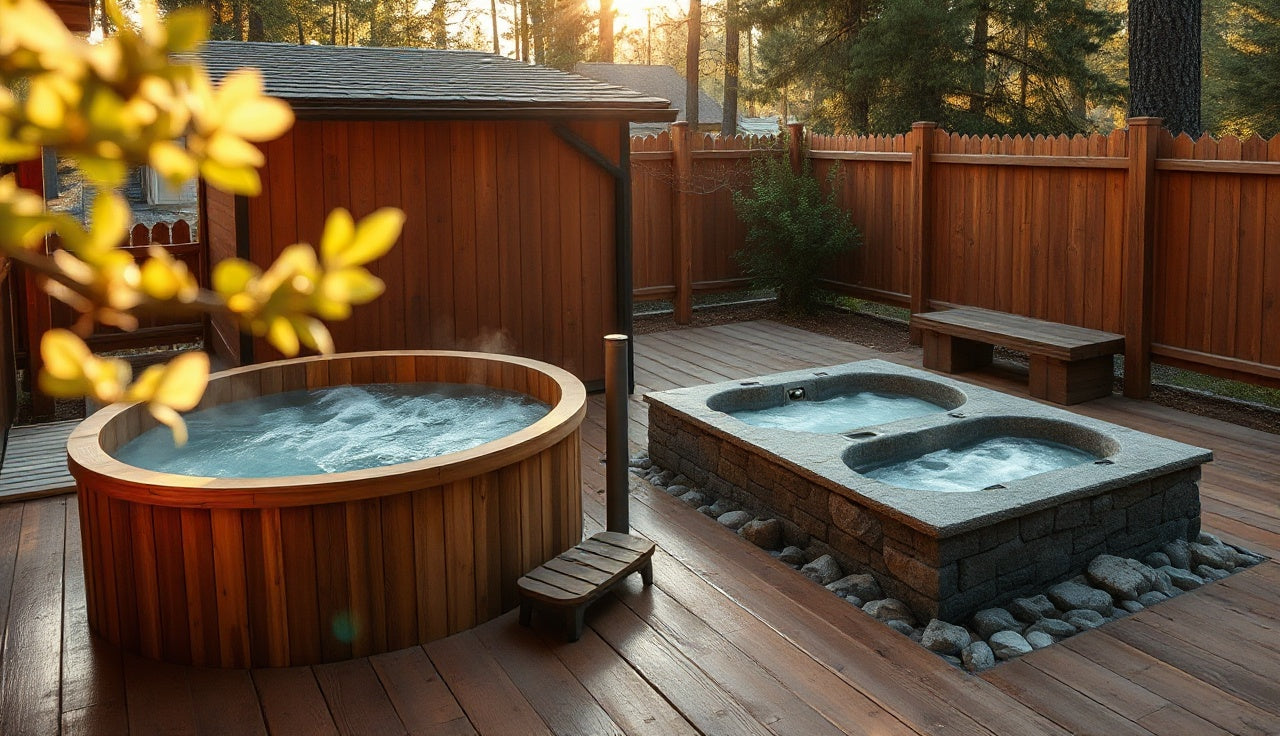
A combination hot tub cold plunge is a hot soaking vessel and a cold immersion vessel placed together so you can move between them in seconds. Some ship as a single dual-chamber pod split into a heated zone and a chilled zone. Others are two separate products, a hot tub and a dedicated cold plunge tub, set close together on a deck, patio, or inside a pool house.
The practice goes by several names: contrast water therapy (CWT), contrast hydrotherapy, or hot-cold cycling. The protocol is simple. Soak in the hot side for a few minutes, get out, drop into the cold side for one to three minutes, then repeat two to five times. The final immersion is usually cold. That's the template, though timing and temperature vary by person and by what the research actually supports.
Hot tubs run 100°F to 104°F (38°C to 40°C) for most adults. Cold plunges target 50°F to 59°F (10°C to 15°C), though some users push into the high 40s. The gap is the whole point. Your body responds to that swing in ways it would not respond to either temperature alone.
If you're already eyeing a cold plunge or a home sauna, a combination setup is the natural next step toward a full contrast therapy station.
Does contrast water therapy actually work? What does the research say?
The evidence is real but not overwhelming, and most studies are small. Here is what the better research shows.
A 2013 systematic review and meta-analysis in the Journal of Strength and Conditioning Research analyzed 14 studies comparing CWT to passive rest for post-exercise recovery. Contrast water therapy significantly reduced muscle soreness and fatigue in the days after intense exercise compared to passive recovery [1]. The effect sizes were modest, not dramatic, but consistent across exercise types.
A 2022 review in the International Journal of Environmental Research and Public Health, covering studies on cold water immersion, noted that water temperatures between 10°C and 15°C (50°F to 59°F) are the most commonly studied range for recovery, with immersion durations of 11 to 15 minutes total per session frequently cited [2]. The same review noted that cardiovascular and hormonal responses to cold immersion, including norepinephrine release, are well-documented in healthy adults.
Here is the nuance most people miss. Cold immersion immediately after strength training may blunt muscle protein synthesis when applied within one to two hours of a hypertrophy session [3]. If your goal is building muscle size, timing matters. If your goal is reducing soreness, speeding up between-session recovery, or feeling readier for the next workout, the evidence leans in your favor.
Nobody has clean data on the optimal hot-to-cold ratio. The closest comparison studies use protocols from 1:1 (one minute hot, one minute cold) to 3:1 (three minutes hot, one minute cold). Both produce similar subjective recovery gains.
What temperatures should a hot tub cold plunge combo run at?
Hot side: keep it at or below 104°F (40°C). The Consumer Product Safety Commission recommends that residential hot tubs not exceed 104°F, and most manufacturers cap the thermostat there [4]. Most users soak between 100°F and 104°F. If you have a cardiovascular condition, high blood pressure, or you're pregnant, 100°F or lower is the usual physician guidance. Ask your doctor before you start.
Cold side: 50°F to 59°F (10°C to 15°C) is the range in most published CWT studies. Below 50°F you hit diminishing returns for recovery and raise the risk of cold shock response, a real physiological event with involuntary gasping, a fast heart rate spike, and possible arrhythmia in susceptible people. Above 60°F many users say the cold feels weak, though some research still shows measurable effects up to 68°F (20°C).
The engineering challenge for a dual unit is holding both temperatures at once and independently. Cheaper all-in-one units cut corners here, running the cold side at 65°F to 70°F because the chiller is undersized for the chamber. Ask any vendor two questions: what is the chiller's BTU rating, and what ambient temperature range is it rated for. A unit sold for a Phoenix summer needs a far stronger chiller than the same unit sold for Minnesota.
| Temperature Zone | Fahrenheit | Celsius | Common Use |
|---|---|---|---|
| CPSC hot tub max [4] | 104°F | 40°C | Upper recommended limit for residential spas |
| Typical hot soak | 100-104°F | 38-40°C | Standard contrast therapy hot side |
| CWT research cold range [2] | 50-59°F | 10-15°C | Most studied range for recovery |
| Cold shock risk threshold | Below 50°F | Below 10°C | Caution for general use |
| Mild cold plunge | 60-68°F | 15-20°C | Beginners, some measurable effect |
What does a combination hot tub cold plunge cost?
Plan for $3,000 to $30,000. The spread is real, not a marketing trick, and it comes down to how polished you want the setup to be.
At the low end, you can build a working dual setup for $3,000 to $6,000. Pair a basic entry-level hot tub ($2,500 to $4,500) with a chest freezer conversion cold plunge ($200 to $400 in parts) or a stock tank plus aftermarket chiller ($800 to $2,000). This works. Plenty of serious athletes use exactly this. It just takes more assembly and a tolerance for rougher looks.
Mid-range purpose-built cold plunge units with chillers run $3,000 to $7,000 for the cold side alone [5]. Add a mid-tier hot tub at $5,000 to $10,000 and you're at $8,000 to $17,000 for a proper two-unit setup.
All-in-one dual-chamber systems, where the hot and cold sides are built as one connected unit, typically start around $10,000 and reach $25,000 to $30,000 or more for large wellness pods aimed at commercial spas and high-end homes.
Installation adds cost. A hot tub needs a dedicated 240V GFCI-protected circuit in most jurisdictions; expect $500 to $2,000 for the electrical work depending on distance from your panel and local labor rates. A ground-level cold plunge with a built-in chiller often runs on a standard 120V outlet, but confirm with the manufacturer.
Permitting depends on your municipality. In-ground installs almost always need a permit. Freestanding above-ground units sometimes don't, but check your building department. In California, portable spas that hold water 24 inches deep or less are generally not subject to the same permit rules as permanent in-ground pools, but that line gets fuzzy once electrical work enters the picture [6].
| Hot tub only, well-insulated, cool climate | $7 |
| Hot tub only, poorly insulated, warm climate | $29 |
| Cold plunge chiller, cool climate | $5 |
| Cold plunge chiller, warm/summer climate | $14 |
| Combined setup, best case | $15 |
| Combined setup, worst case (warm climate) | $50 |
Source: U.S. Department of Energy, Energy Saver; U.S. EIA Electric Power Monthly, 2025
What are the different types of dual hot tub cold plunge systems?
Four configurations cover almost everything people buy.
Two separate units, placed side by side. The most common home setup. Buy a hot tub and a cold plunge independently, set them close together, and run the protocol between them. Maximum flexibility. You can upgrade either side on its own. The cost is footprint and looks, since two units eat more space and may not match.
All-in-one dual-chamber pod. A single manufactured unit with a hot chamber on one side and a cold chamber on the other, sometimes joined by a bench so the transition is one step. Clean looks, one-piece install. The catch: if the chiller fails, the whole unit is down. These also cost more per functional gallon than two separate units.
Hot tub with a built-in cold zone. Some hot tub makers offer a dedicated cold-water section plumbed into the same cabinet on a separate circuit. Rarer, and usually a small cold seat rather than a full immersion tub. Fine for legs and lower body. Not ideal if you want cold up to your shoulders.
Sauna plus cold plunge. Some buyers use a sauna as the heat source instead of a hot tub. Dry sauna heat is more intense (160°F to 195°F vs. 104°F for a hot tub), which some people prefer and which the Finnish tradition has used for centuries. The sauna benefits are well-documented on their own. With the space and budget, a three-piece setup (sauna, hot tub, cold plunge) gives you the most room to shape your heat-cold protocol.
What size hot tub and cold plunge do you actually need?
For the cold side: most solo users are fine with 100 to 200 gallons, roughly 4 feet long by 2 to 2.5 feet wide. You want enough depth to reach shoulder level seated, or waist level kneeling. Planning to plunge with a partner at the same time? Size up to at least 300 gallons.
For the hot side: a two-to-four person hot tub in the 250 to 400 gallon range covers most household contrast therapy. Bigger jets and more seats add cost and chemical upkeep without adding anything to the protocol itself.
Weight is the part people underestimate. A hot tub with 300 gallons of water weighs roughly 3,000 to 3,500 pounds loaded (water alone is 8.34 pounds per gallon). Most residential decks are built to a live load of 40 to 60 pounds per square foot [7]. A 6x6 foot hot tub footprint needs a deck rated for that concentrated load. Get a structural engineer to review your deck before you place anything large on it. A concrete pad at ground level is the simpler answer.
Tight on space or budget? A portable sauna paired with a compact cold plunge tub delivers comparable contrast therapy in roughly 6 to 8 square feet of combined footprint.
How do you actually run a hot tub cold plunge routine?
There is no single correct protocol, but the research and common practice converge on a clear template.
A recovery routine looks like this: 1. Enter the hot tub at 100°F to 104°F. Soak 3 to 5 minutes. Breathe normally and let your heart rate settle. 2. Get out and move straight to the cold plunge at 50°F to 59°F. Immerse 1 to 2 minutes. Control your breath. The cold shock response hits in the first 30 seconds, and breathing through it is the skill. 3. Repeat 3 to 5 cycles. Total session runs 20 to 40 minutes. 4. End on cold for recovery. End on hot if relaxation is the point.
New to cold immersion? Start warmer (60°F to 65°F) and shorter (30 to 45 seconds), then work toward 50°F to 59°F over a few weeks. There is nothing to prove by jumping into the coldest setting on day one.
Hydration matters more than people expect during hot-cold cycling. You sweat in the hot side even while submerged. Drink water before and during. Skip alcohol in the hours before a session; it impairs thermoregulation and is a documented risk factor in hot tub-related incidents [4].
Anyone with cardiovascular disease, arrhythmia, hypertension, Raynaud's disease, or who is pregnant should talk to a physician before either extreme immersion. The cardiovascular load of rapid temperature cycling is real.
What maintenance does a combination setup require?
The hot tub side runs on standard spa water chemistry. Test pH (target 7.4 to 7.6), total alkalinity (80 to 120 ppm), and sanitizer (free chlorine 1 to 3 ppm or bromine 3 to 5 ppm) at least twice a week. Drain and refill every three to four months depending on use. Clean the filter monthly. Budget roughly $50 to $100 per month for chemicals, plus filter replacements once or twice a year.
The cold plunge side depends on the system. Cold water with a chiller and no ozone or UV treatment needs more frequent chemical intervention, because pathogens grow more slowly in cold water but still grow, and biofilm develops in plumbing lines. If your cold plunge has UV sanitation or an ozone system (most purpose-built units above $3,000 do), chemical demand drops. Test and dose weekly at a minimum. Drain and clean the vessel every one to three months.
Electricity is a real ongoing cost. A hot tub held at 100°F to 104°F uses roughly 1.5 to 6 kWh per day depending on insulation, ambient temperature, and how often you run it [8]. A cold plunge chiller holding 55°F uses about 1 to 3 kWh per day, more in summer heat. At the U.S. average residential rate of roughly 16 cents per kWh in early 2025, the combined setup runs about $15 to $50 per month, driven heavily by climate and equipment efficiency [8].
Insulation is the single biggest lever on those bills. A hot tub cover is not optional. Leave a hot tub uncovered and it dumps heat overnight, forcing the heater to run almost constantly.
Are there health risks with hot tub cold plunge use?
Yes. They're worth understanding clearly, not waving off.
Hot side: the CPSC reports roughly 700 to 800 hot tub-related emergency room visits per year in the U.S., with hyperthermia (overheating) and drowning as the leading causes of serious injury [4]. Long soaks above 104°F, alcohol, and using the tub alone with nobody nearby are the main hyperthermia risk factors. Children under five should not use hot tubs at standard adult temperatures.
Cold side: cold shock response is the acute concern. Sudden cold immersion triggers an involuntary gasp reflex, hyperventilation, and a sharp cardiovascular spike. For healthy people it's uncomfortable but manageable. For people with heart conditions it can set off arrhythmia. A 2015 review in Experimental Physiology described cold shock as the primary cause of sudden death in cold water immersion, driven by the cardiac and respiratory responses in the first 30 seconds [9]. As the review put it, the initial responses to cold water immersion, not hypothermia, present "the greatest risk to life."
Contrast cycling also loads the cardiovascular system as vessels dilate in the heat and constrict in the cold, over and over. That's part of what may drive the cardiovascular training effect, but it's a meaningful load for anyone with compromised cardiac function.
Four rules that are not hypothetical: never plunge alone, keep a phone within reach, start with shorter durations and warmer cold temperatures, and check with your doctor when in doubt.
What should you look for when buying a combination hot tub cold plunge?
Here is what matters, in order.
Chiller capacity on the cold side. Underpowered chillers are the top complaint in user reviews of combo units and standalone plunges. Look for the rated BTU output and ask what outdoor temperature the unit is designed for. A 1/3 horsepower chiller that copes in a 70°F garage will struggle in a 95°F backyard. For year-round use in warm climates, you want at least a 1 HP chiller on a 200-gallon vessel.
Insulation quality on both sides. Full-foam insulation in a hot tub cabinet makes a real dent in monthly electricity. Thin-wall cold plunge tubs with poor insulation make the chiller work harder and cost more to run.
Filtration and sanitation. UV-C or ozone sanitation cuts chemical costs and keeps water cleaner between treatments. Worth paying for.
Build material. Acrylic, fiberglass, and high-density polyethylene are the common choices. Acrylic looks best and handles UV well outdoors. Stainless steel liners, common in commercial plunges, are extremely durable. Cedar is beautiful but needs more upkeep and usually shows up only as the outer cabinet on quality units.
Warranty terms. Hot tub shells are typically warranted for 5 years; some premium brands cover the shell for life. Pumps and heaters usually get 1 to 2 years. Cold plunge chillers often get just 1 year, which is short given the replacement cost. Read the warranty before you buy.
SweatDecks carries a selected range of purpose-built cold plunge units and contrast therapy setups if you want to compare specs side by side without wading through general spa retailers.
For deeper reading before you buy, the cold plunge benefits guide and the ice bath breakdown pair well with this one.
Can you build a DIY combination hot tub cold plunge setup?
Yes, and it works well if you're willing to put in the work.
The common DIY approach: buy a used or refurbished hot tub for $500 to $2,000 (Craigslist and Facebook Marketplace have a steady supply from people moving), then build or buy a cold plunge from a chest freezer conversion or a purpose-built tub.
A chest freezer cold plunge uses a small submersible pump to circulate water through the freezer's cooling coils or an aftermarket inline chiller. Parts run $200 to $500. It holds temperature and it looks DIY, which bothers some people and not others. If you're comfortable with basic plumbing and don't need a polished product, this is a genuine option.
The more serious DIY path is a stock tank (galvanized steel livestock tanks from agricultural supply stores, roughly $150 to $300) with a dedicated aquatic chiller. Those stores stock tanks in 100 to 300 gallon sizes. Add a small pump, an inline filter, and a UV sanitation unit, and you have a working cold plunge for under $1,500 including the chiller.
The hot tub side is harder to DIY from scratch. Hot tub electrical and plumbing involve 240V wiring, pressure-tested fittings, and GFCI protection that is genuinely safety-critical. Unless you are a licensed electrician, hire one for the hot tub connection. The cold plunge side is far more forgiving, since most setups run on standard 120V.
Where should you put a dual hot tub cold plunge at home?
Three realistic locations: an outdoor deck or patio, an indoor pool room or dedicated wellness room, or a covered pergola or gazebo.
Outdoor placement is the most common and works in most climates with the right equipment. Watch four things: a level, weight-bearing surface (see the deck load notes above), access to a GFCI-protected circuit, and drainage. Hot tubs need a way to drain during water changes. So do cold plunges. Plan drainage before installation, not after.
Indoor placement is ideal for year-round use in cold climates and gives you the most comfortable transition between units. You need good ventilation, because hot tub humidity will damage unprotected surfaces, framing, and insulation over time. A vapor barrier, exhaust fans, and water-resistant flooring (tile or concrete, not wood) are required for an indoor setup to survive long term.
Covered outdoor structures split the difference. A solid roof protects the units from UV and rain, both of which extend equipment life, while the open sides handle ventilation naturally. For most homeowners this is the best practical choice.
Zoning matters too. Setback requirements from property lines, fences, and utility easements vary by municipality. The typical residential setback for a spa or hot tub is 5 to 10 feet from the property line, but confirm with your local building or zoning department before you commit to a spot [6].
Adding a sauna to the mix? The outdoor sauna guide covers placement, venting, and foundation requirements in detail.
Frequently asked questions
How long should you stay in each side during a hot tub cold plunge session?
Most CWT research uses 3 to 5 minutes on the hot side and 1 to 2 minutes on the cold side per cycle. Beginners should start at 30 to 60 seconds in the cold. Total session length is typically 20 to 40 minutes across 3 to 5 cycles. End on cold for recovery, or end on hot if the goal is relaxation before sleep.
What temperature should the cold plunge be for contrast therapy?
The most-studied range for contrast water therapy is 50°F to 59°F (10°C to 15°C). That's cold enough to trigger vasoconstriction and norepinephrine release without dropping below the threshold where cold shock becomes a serious concern. Beginners often start at 60°F to 65°F and work down over several weeks.
Can a combination hot tub cold plunge help with muscle recovery?
A 2013 meta-analysis in the Journal of Strength and Conditioning Research found contrast water therapy significantly reduced post-exercise muscle soreness and fatigue compared to passive rest across 14 studies. The effect is real but modest. Note that cold immersion may reduce muscle protein synthesis when applied right after hypertrophy training, so timing matters if muscle growth is your main goal.
How much does an all-in-one dual hot tub cold plunge unit cost?
All-in-one dual-chamber pods that ship as one unit typically start around $10,000 and reach $25,000 to $30,000 or more for large premium models. You can build a functionally equivalent two-unit setup for $8,000 to $17,000 mid-range, or under $6,000 with used and DIY parts. Installation and electrical work add $500 to $2,000 depending on your site.
Is a hot tub or a sauna better as the heat source for contrast therapy?
Both work. Saunas run much hotter (160°F to 195°F vs. 100°F to 104°F for hot tubs), which some users find more intense. Hot tubs are gentler and easier for longer soaks. The research does not clearly favor one over the other for recovery. Pairing a sauna with a cold plunge is the traditional Scandinavian method and has the most historical use behind it.
Do I need a permit for a hot tub cold plunge at home?
Almost always for the electrical work, since 240V hot tub circuits require a permit and inspection in most U.S. jurisdictions. In-ground installations need a permit nearly everywhere. Freestanding above-ground units sometimes avoid building permits, but check local rules. California has carve-outs for portable spas, but electrical work is always permitted. Contact your local building department before installation.
How much electricity does a hot tub and cold plunge combination use per month?
A hot tub uses roughly 1.5 to 6 kWh per day depending on insulation, climate, and use. A cold plunge chiller uses about 1 to 3 kWh per day. At the U.S. average rate near 16 cents per kWh, combined monthly electricity runs roughly $15 to $50, more in hot climates where the chiller works harder. Good covers and full-foam insulation make the biggest difference.
Can you use a cold plunge and hot tub if you have high blood pressure?
Talk to your doctor first. Both extreme heat and sudden cold immersion cause cardiovascular responses, including blood pressure spikes, and contrast cycling adds a real load. For people with well-controlled hypertension, many physicians allow hot tub use at lower temperatures (below 100°F), but the safety research for CWT in people with hypertension is limited. Do not skip the medical consultation.
How often should you drain and refill a cold plunge tub?
For a cold plunge used 4 to 7 times per week without UV or ozone sanitation, drain and refill every 4 to 8 weeks. With UV or ozone and steady chemical maintenance, many manufacturers recommend every 2 to 3 months. Cloudiness, smell, or trouble keeping pH stable means a water change is overdue. Heavier use or multiple users shorten the interval.
What is the best cold plunge temperature for beginners?
Start at 60°F to 65°F (15.5°C to 18°C) and stay 30 to 60 seconds. The first few sessions are about managing the cold shock breathing response, not hitting a target temperature. Over two to four weeks, most people work down toward 55°F and stretch to 2 minutes. There is no benefit to forcing extreme cold before your nervous system adapts.
Can you put a dual hot tub cold plunge on a deck?
Yes, if the deck is rated for the load. A typical residential deck is built to 40 to 60 pounds per square foot live load. A filled 300-gallon hot tub can concentrate more than 100 pounds per square foot in its footprint. Have a structural engineer assess your deck before placing any large water-filled unit on it. A ground-level concrete pad avoids the issue entirely.
Is ending on hot or cold better for sleep and recovery?
End on cold for daytime recovery sessions. It reduces acute inflammation and leaves the body alert and vasoconstricted. End on hot before sleep, because the vasodilation and warmth support relaxation. Most athletic recovery protocols end cold; most spa relaxation protocols end warm. Pick based on when you're doing the session.
What is the difference between a cold plunge and an ice bath?
In practice, very little. An ice bath is usually a tub or vessel filled with water and ice to reach 50°F to 59°F, filled once with no filtration. A cold plunge is a dedicated vessel with a chiller that holds the target temperature continuously without ice. Cold plunges are more convenient for regular use; ice baths are cheaper to set up but need repeated ice buys.
How many people can use a dual hot tub cold plunge at the same time?
It depends on the units. Most standalone cold plunges are built for one person at a time. Some larger vessels (300+ gallons) fit two. Hot tub capacity ranges from two-person to eight-person models. If you and a partner want to cycle together, buy a two-person-rated cold plunge and confirm the plunge side of any combo unit is sized for two, since many all-in-one pods have a single-person cold chamber.
Sources
- International Journal of Environmental Research and Public Health, cold water immersion review 2022: Water temperatures of 10°C to 15°C (50°F to 59°F) and immersion durations of 11 to 15 minutes total are frequently cited ranges in CWI recovery research; norepinephrine release in cold immersion is well-documented.
- The Journal of Physiology, Roberts et al. 2015, post-exercise cold water immersion and anabolic signalling: Cold water immersion applied within one to two hours of strength training may attenuate muscle protein synthesis and hypertrophic adaptations.
- U.S. Consumer Product Safety Commission, Swimming Pool and Spa Safety: CPSC recommends residential hot tubs not exceed 104°F (40°C); approximately 700 to 800 hot tub-related ER visits occur per year in the U.S.; alcohol use is a documented risk factor in hot tub-related incidents.
- SweatDecks, cold plunge collection pricing reference (internal retail data): Purpose-built cold plunge units with integrated chillers retail in the $3,000 to $7,000 range at specialty wellness retailers as of 2025.
- California Department of Housing and Community Development, residential spa and pool regulations: In California, portable spas that hold water to a depth of 24 inches or less are generally not subject to the same permit requirements as permanent in-ground pools, but electrical work still requires permitting.
- American Wood Council, Prescriptive Residential Wood Deck Construction Guide (DCA6): Most residential decks are built to a live load of 40 to 60 pounds per square foot; concentrated loads from water-filled hot tubs can exceed this and require structural review.
- U.S. Energy Information Administration, Electricity data and Electric Power Monthly: The U.S. average residential electricity rate was approximately 16 cents per kWh as of early 2025; hot tub and chiller daily energy use varies with insulation and climate.
- Experimental Physiology, Tipton et al. 2015, 'Cold water immersion: kill or cure?': The 2015 review describes cold shock response, involving an involuntary gasp reflex and cardiovascular spike in the first 30 seconds of cold water immersion, as the primary cause of sudden death in cold water immersion, and states the initial responses present the greatest risk to life.

Share:
The Plunge Original cold plunge tub: full review and buyer's guide
Mayo Clinic sauna benefits, risks, how long, and temperature