
Last updated 2026-07-09
TL;DR
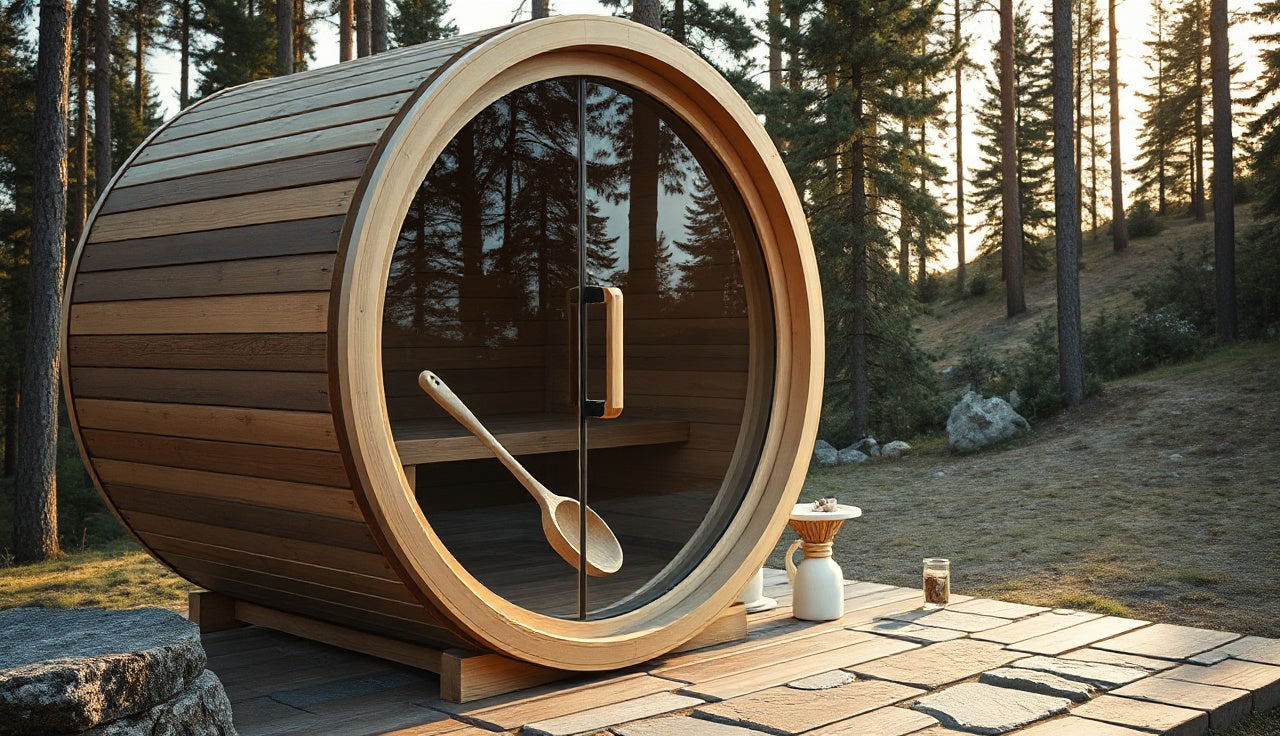
The Pure 7 thermowood barrel sauna is a roughly 7-foot-diameter outdoor barrel built for five to six bathers. Thermowood's heat treatment makes spruce or pine dimensionally stable and rot-resistant with no chemical preservatives. Expect to pay $4,000 to $9,000 depending on the manufacturer, heater package, and accessories. You need a flat base, a 240V circuit for electric heaters, and about half a day to assemble.
What exactly is the Pure 7 thermowood barrel sauna?
"Pure 7" is a label several Nordic and North American manufacturers use for a barrel sauna whose stave diameter sits at or near 7 feet (about 213 cm). The "Pure" part usually signals a clean, accessory-light package: the barrel shell, benches, interior lighting, and a heater bracket, with everything else priced separately. At that diameter you get genuine six-person capacity, though five bathers is the comfortable real-world number for a proper Finnish-style session.
Barrel saunas have been around for decades. They caught on with homeowners in the early 2010s as an outdoor sauna option that didn't require building a whole outbuilding. The cylindrical shape braces itself, so manufacturers can use thinner staves and ship the unit as a flat-pack kit. A 7-foot barrel typically has an interior floor width of about 4.5 to 5 feet and a peak height of roughly 6 feet, which gives taller bathers enough room to sit upright on the upper benches.
The "thermowood" part matters more than most buyers realize. Full explanation comes in the next section, but here's the short version: it's the same species you already know (usually spruce or pine), treated with heat and steam to change its cellular structure. No chemicals. The result resists moisture cycling far better than untreated lumber, and moisture cycling is the main enemy of any outdoor sauna.
Comparing barrel saunas to traditional cabin or shed-style builds? Our overview of outdoor sauna options shows how the categories stack up.
What is thermowood and why does it matter for a barrel sauna?
Thermowood (sometimes written ThermoWood, a trademarked process name owned by the Finnish ThermoWood Association) is wood thermally modified at 185°C to 230°C (365°F to 446°F) in a steam atmosphere [1]. The process drives out the hemicellulose sugars that bacteria and fungi feed on, drops the wood's equilibrium moisture content, and lowers its hygroscopic response. Translation: the wood takes on and gives off moisture more slowly and to a smaller extreme than untreated stock [1].
That is a big deal for a barrel. A barrel's structure depends on the staves staying consistently sized. If each stave swells and shrinks on its own through seasonal moisture swings, the hoops loosen and gaps open up. Thermowood staves move less, so the barrel stays tight. The Finnish ThermoWood Association reports that thermal modification cuts the equilibrium moisture content of wood by roughly 40 to 50% compared to untreated stock [1].
The treatment also turns the wood a warm brown that many buyers like. That color fades to silver-gray outdoors unless you apply a UV-protective oil every year, same as any exterior wood product.
One honest caveat: thermowood is a little more brittle than untreated wood, so it splits at screw holes more easily if a builder skips careful pre-drilling. A good kit accounts for this. Thermowood's thermal resistance is slightly better than untreated wood too, but the gain is small enough that it won't change your heater math.
For broader context on what makes a good home sauna, wood choice is one factor alongside heater type, ventilation, and insulation.
How big is a Pure 7 barrel sauna and how many people does it actually fit?
Manufacturers using the Pure 7 label cluster around these numbers: exterior diameter 213 cm (84 inches), interior diameter roughly 185 to 195 cm (73 to 77 inches) depending on stave thickness, and interior length 220 to 240 cm (87 to 94 inches). Floor width at the flat-cut base runs 140 to 160 cm (55 to 63 inches).
Here's what those numbers mean in practice. Two bench tiers, each running the full length of the barrel, hold four bathers lying down or six seated. Six adults seated is cozy but doable. Five is comfortable. If your regular users run broad-shouldered or over 6 feet tall, plan on four as your relaxed capacity.
The lower bench in a properly built Pure 7 sits about 40 cm (16 inches) off the floor. The upper bench sits at roughly 95 to 100 cm (37 to 39 inches). Temperature stratification in a barrel runs about 10 to 15°C (18 to 27°F) between floor level and upper-bench level, which is typical for any sauna [2]. Taller bathers on the upper bench get the hottest air. The lower bench is gentler for beginners or children.
| Dimension | Typical Pure 7 range |
|---|---|
| Exterior diameter | 200 to 220 cm (79 to 87 in) |
| Interior floor width | 140 to 160 cm (55 to 63 in) |
| Interior length | 220 to 240 cm (87 to 94 in) |
| Upper bench height | 90 to 100 cm (35 to 39 in) |
| Bathing capacity (comfortable) | 4 to 5 adults |
| Bathing capacity (maximum) | 6 adults |
| Approximate kit weight | 550 to 750 kg (1,200 to 1,650 lb) |
A Pure 7 is meaningfully bigger than the common 5-foot and 6-foot barrels, which top out at two to four bathers. Buying for a household of two or three that occasionally hosts? A smaller barrel is cheaper and heats faster. The Pure 7 earns its keep for four or more regular users, or for anyone who wants real lying-down bench space.
What heater should you use in a Pure 7 barrel sauna?
A Pure 7 runs roughly 6 to 8 cubic meters (210 to 280 cubic feet) inside, depending on barrel length and stave thickness. Standard heater sizing from the North American Sauna Society and most manufacturers calls for about 1 kW per 45 to 50 cubic feet of room in a well-insulated space [3]. A barrel's curved walls and modest insulation mean you size up: plan for 1 kW per 35 to 40 cubic feet.
For a Pure 7, that math lands you in the 6 kW to 10 kW range. The common choices:
Electric heaters (6 to 9 kW): Harvia, Finnleo, and HUUM all make wall- or floor-mount units in this range. A 9 kW heater on a 240V/40A circuit brings a Pure 7 to 80 to 90°C (176 to 194°F) in 45 to 60 minutes. Easy to install, no wood storage, no ash to manage.
Wood-burning heaters: A wood sauna stove rated at 12 to 18 kW output heats the barrel faster and gives you the smoke-and-birch experience. The tradeoff is local fire codes, chimney installation, and starting the fire 60 to 90 minutes before you bathe. Some jurisdictions require a spark arrestor and a minimum clearance from structures. Check with your local fire marshal before you commit.
Infrared panels: A few manufacturers offer infrared barrel configurations, but pure infrared works poorly in an open barrel because the panels need to sit close to your skin. Skip infrared for a six-person barrel.
Going electric? Hire a licensed electrician to run a dedicated 240V circuit. NEC Article 424 covers fixed electric space heating equipment, and heaters in wet or damp locations require GFCI protection [4]. Your inspector will want to see it.
What does a thermowood barrel sauna Pure 7 cost?
Pricing swings more than most buyers expect because the category is fragmented. You have Finnish and Estonian brands selling through importers, Canadian and US manufacturers building domestically, and a growing pile of Chinese-made kits sold under various names.
As of mid-2025, here's an honest range:
| Configuration | Price range (USD) |
|---|---|
| Basic kit (shell + benches, no heater) | $3,500 to $5,500 |
| Kit with electric heater package | $4,500 to $7,000 |
| Kit with wood-burning stove package | $4,800 to $7,500 |
| Premium Finnish-made with accessories | $7,000 to $12,000+ |
| Delivery and assembly (pro install) | $500 to $2,500 |
| Electrician (circuit run) | $400 to $1,200 |
Three things drive the spread: wood quality and stave thickness (35 mm vs 45 mm staves make a real structural difference), heater brand, and whether you assemble yourself or hire out. A quality 45 mm thermowood barrel from a reputable Finnish or North American source usually starts around $5,500 to $6,500 landed with a heater. Anything under $3,500 for a six-person barrel deserves hard questions about stave thickness, hoop quality, and wood sourcing.
A traditional outdoor sauna cabin or pod in the same capacity typically runs $8,000 to $20,000 installed, so the barrel format saves real money at the entry level.
Shipping is a line item you can't ignore. A Pure 7 ships as a pallet or two of bundled staves and hardware. Freight from a Finnish or Estonian manufacturer adds $600 to $1,800 depending on where you live. Domestic manufacturers usually ship cheaper but may charge more for the unit itself.
On resale: the used market for quality outdoor saunas is decent. Buyers of used thermowood barrels in good shape typically recover 50 to 70% of the original price, which beats most home fitness equipment.
What base and site preparation does a Pure 7 barrel sauna need?
A barrel sauna doesn't need a full concrete foundation, which is one of its real appeals. It does need a level, stable, well-drained surface. The barrel rests on two or more wooden cradles (usually included in the kit) that sit on whatever base you prepare.
Your practical options:
Concrete patio or slab: The easiest long-term base. Pour a slab at least 8 feet wide by 9 feet long to cover the barrel footprint plus door swing. A 4-inch slab with rebar or mesh is enough. You don't need a deep frost footing for a free-standing structure in most climates, but check with your local building department.
Gravel pad: A compacted gravel pad 6 to 8 inches deep works well and drains naturally. Use crushed stone, not pea gravel, so it compacts. The cradles settle a bit over the first year, so plan to re-level them once.
Deck or platform: Possible, but verify your deck joists can carry the load. A fully assembled Pure 7 with six bathers, water, and accessories weighs well over 1,000 kg (2,200 lb). A structural engineer's eye is worth the cost before you set it on an existing deck.
Grass or soil: Fine temporarily. Over time the cradles shift and the ground compacts unevenly. Going this route? Lay down landscape fabric and a layer of gravel under the cradles.
Leave at least 18 to 24 inches of clearance on all sides for airflow and maintenance access. Using a wood stove? Your local fire code sets minimum setbacks from structures and combustibles. Three feet is a common minimum, but confirm your jurisdiction.
Most municipalities classify a barrel sauna as an accessory structure. If the value passes your jurisdiction's threshold (often $1,500 to $5,000, depending on the ordinance), you'll need a building permit [5]. Some HOAs also have rules about outbuildings. Worth a five-minute call before you order.
How do you assemble a Pure 7 barrel sauna kit?
Most Pure 7 kits arrive as numbered staves, pre-cut benches, hardware bags, hoop clamps, and an instruction booklet. The usual sequence: lay out the two cradle frames, stand the floor staves, add the wall staves around the circle, thread the metal hoops, tighten, install benches and interior framing, hang the door, connect the heater.
Two adults with basic carpentry experience can assemble most kits in 4 to 8 hours. The most tedious part is tightening the hoops evenly so the barrel comes out perfectly round. Manufacturers typically call for 20 to 35 Nm of torque on hoop bolts, tightened in a cross-pattern rather than one end to the other, so pressure spreads evenly.
What goes wrong, and how to avoid it:
Gaps between staves top the complaint list. They usually happen because the barrel wasn't fully tightened before the wood acclimated, or because the staves arrived very dry and need moisture to swell into their final fit. Most manufacturers tell you to soak the exterior with a garden hose for an hour or two after assembly, before the first heat-up, so the staves swell before you apply heat stress.
The door frame is the second common headache. It needs to be plumb and square even though it sits in a curved barrel face. Follow the shimming instructions exactly.
Hire a licensed electrician for the heater even if you're comfortable with DIY electrical work. Sauna heater installs require GFCI protection and, in many jurisdictions, a permit and inspection. The inspection fee is trivial next to the cost of a fire or a voided homeowner's policy.
Your first heat-up should be gradual. Run a lower temperature (around 70°C/158°F) for the first session so the wood cures evenly. Don't pour water on the rocks until after the second or third session.
How long does a thermowood barrel sauna last and what maintenance does it need?
A well-built thermowood barrel sauna, properly maintained, should last 15 to 25 years. Some caveats come with that number: the hoop hardware is often the first thing to fail, the door hinges take wear, and the benches see more abrasion than the shell. Budget for bench replacement every 8 to 12 years in a heavily used sauna.
Maintenance is genuinely low next to other outdoor wood structures. The interior needs no sealing or staining. Sauna wood should stay unfinished so it breathes. The exterior is a different story: give it an annual coat of UV-protective exterior wood oil, especially the top of the barrel where sun and rain hit hardest. Skip it for a few years and the thermowood grays out and eventually checks (surface cracks) more aggressively than oiled wood would.
The hoops need an inspection and re-tightening every spring. Wood moves through winter, and a barrel tight in September may have a few loose hoops by March. Fifteen minutes with a wrench.
For the heater, follow the manufacturer's schedule. Electric heaters usually need an annual rock-bed cleaning (pull the rocks, wash them, replace any that cracked) and a check of the element resistance. Wood stoves need a chimney cleaning at least once per heating season, more if you burn resinous woods.
Scrub the benches with a mild sauna cleaner or diluted vinegar and warm water every few months. Never use bleach inside a sauna. It volatilizes at sauna temperatures and creates fumes. Sandpaper (80 to 120 grit) brings discolored bench surfaces back to clean wood.
What are the health benefits of regular sauna use?
The research on sauna use is genuinely interesting and genuinely limited, because most of the big studies are observational, not randomized controlled trials. That shapes how hard you should lean on the findings.
The most-cited dataset is the Kuopio Ischemic Heart Disease Risk Factor Study from Finland, which followed 2,315 middle-aged men for an average of 20 years. Men who used a sauna four to seven times a week had a 40% lower risk of all-cause mortality than once-weekly users in that cohort [6]. The researchers couldn't fully rule out confounding (healthier men may also sauna more), but the association held after adjusting for major cardiovascular risk factors.
A 2018 review in Mayo Clinic Proceedings summarized the cardiovascular evidence: "Regular sauna bathing is associated with reduced cardiovascular and all-cause mortality, and the evidence suggests that the cardiovascular effects of sauna bathing are largely mediated through its hemodynamic effects" [7]. Read that carefully: association, not proven cause.
On recovery, a 2015 paper in the Journal of Human Kinetics found that post-exercise sauna use reduced delayed onset muscle soreness scores compared to passive recovery in a small study (n=27) [8]. Nobody has great data on the size of that effect at scale. The closest large study found sauna reduces subjective fatigue scores but didn't measure performance outcomes.
During a session, core body temperature rises about 1 to 2°C, heart rate climbs to 120 to 150 bpm (similar to moderate aerobic exercise), and plasma volume expands for a while [7]. These are real physiological changes, not placebo. They don't mean sauna replaces exercise, and they don't mean every bather benefits equally. People with uncontrolled hypertension, recent cardiac events, or pregnancy should talk to a physician before regular sauna use.
Conservative summary: regular sauna use is associated with real cardiovascular benefits in observational data, modestly cuts perceived muscle soreness, and appears safe for healthy adults. More on the broader sauna benefits picture is worth reading before you settle on a protocol.
Planning to pair sauna with cold plunge sessions for contrast therapy? Our guide to cold plunge benefits covers what the research actually shows on the cold side.
| Once per week (reference) | 0% |
| 2–3 times per week | 22% |
| 4–7 times per week | 40% |
Source: JAMA Internal Medicine, Kuopio Ischemic Heart Disease Risk Factor Study (Laukkanen et al., 2015)
How does a barrel sauna compare to other outdoor sauna types?
Buyers shopping for an outdoor six-person sauna usually weigh four formats: barrel, pod/cube, traditional cabin, and prefab modular panel. Here's an honest comparison.
| Feature | Barrel (Pure 7) | Pod/cube | Cabin/shed | Modular panel |
|---|---|---|---|---|
| Price (6-person, mid-range) | $5,000 to $8,000 | $7,000 to $14,000 | $12,000 to $25,000+ | $6,000 to $12,000 |
| Assembly time (DIY) | 4 to 8 hours | 6 to 12 hours | 1 to 3 days | 1 to 2 days |
| Foundation needed | Gravel pad or patio | Gravel pad or patio | Concrete footer | Concrete slab |
| Insulation quality | Moderate | Good | Excellent | Good |
| Aesthetics | Rustic, distinctive | Modern | Traditional | Modern |
| Heat-up time (electric) | 40 to 60 min | 35 to 50 min | 30 to 45 min | 35 to 55 min |
| Durability (maintained) | 15 to 25 years | 20 to 30 years | 30 to 50 years | 20 to 30 years |
| Resale/move portability | High | Medium | Low | Medium |
The barrel wins on price, assembly speed, and portability. A cabin wins on durability and insulation. If you want something that looks like it belongs in a modern backyard, a pod or cube may suit you better than a barrel.
One thing barrels genuinely do worse than cabins: ceiling height. Even a 7-foot barrel gives you about 6 feet of headroom at the peak. Taller users are fine seated but can't stand fully upright at the center. A cabin sauna typically has 7-foot ceilings.
For a full comparison of the broader category, our home sauna guide covers the trade-offs in more detail.
What should you look for when buying a Pure 7 thermowood barrel sauna?
Here's what I'd actually check before buying, after going through the specs and the market.
Stave thickness. Thirty-five millimeter staves are the minimum acceptable for a 7-foot barrel. Forty-five millimeter staves are meaningfully better for rigidity and heat retention. If a manufacturer won't tell you the stave thickness, walk away.
Hoop material and count. Stainless steel hoops earn their premium over galvanized, especially in wet climates. A Pure 7 should have at least four hoops. Five or six is better. Check that the tension hardware is accessible and replaceable.
Door type. A tempered glass door with a wooden frame is the standard. Full wood doors are fine but don't let you check the inside at a glance. Skip any manufacturer using standard residential door hardware. It corrodes fast in sauna conditions.
Thermowood certification. Ask whether the wood carries a ThermoWood Association certificate [1]. Some sellers use the word "thermowood" generically to mean "heat-treated wood" with no matching quality controls. Certified product comes with documented treatment temperatures and duration.
Ventilation. A proper barrel sauna has a floor-level intake vent near the heater and an adjustable exhaust vent at the opposite end. If a kit ships without vents or lists them as optional add-ons, that's a red flag. Poor ventilation makes for a stale session and can build up CO if you run a wood stove.
Warranty. Expect at least one year on the structure and two to five years on the thermowood shell. Heater warranties run separately (Harvia, for example, offers two years on most residential units).
SweatDecks carries a selection of outdoor barrel saunas including thermowood options, so their outdoor sauna collection is a useful place to compare configurations side by side.
One last thing: buy from a seller with real customer support that holds US or Canadian inventory or has a clear import process. Freight damage on large pallet shipments is common, and you want a seller who can ship replacement staves without a six-week wait.
Is a Pure 7 barrel sauna worth it for most buyers?
It depends on how many people you bathe with and how often.
A household of two using a sauna three or four times a week? The Pure 7 is overkill. A 5- or 6-foot barrel, or a 2-person indoor sauna, heats faster, costs less, and takes up less yard. The big barrel's advantage evaporates when two people rattle around inside it.
Regularly have four to six people in the sauna together? The Pure 7 is the right tool. You can't fake capacity in a sauna. Cramming four adults into a two-person unit is miserable. The jump from a 6-foot to a 7-foot barrel is more than an extra foot of diameter. It's the difference between two bench tiers at full width and two bench tiers where someone's always shifting to make room.
For athletes or households that take recovery seriously, pairing a barrel sauna with a cold plunge is a legitimate protocol with real physiological logic. The contrast between 80 to 90°C sauna and 10 to 15°C cold water drives cardiovascular responses neither practice creates alone [7]. A Pure 7 gives you the group capacity to make that a social ritual instead of a solo habit.
My take: with a flat yard, four or more regular users, and a budget of $6,000 to $8,000 all-in (unit plus electrician plus base prep), the Pure 7 thermowood barrel is a sensible buy that's still in service a decade out if you maintain it. Miss one of those conditions and you should go smaller or pick a different format.
Still weighing whether a barrel is the right format at all versus a traditional cabin or a portable sauna? The comparison section above lays out the honest trade-offs.
Frequently asked questions
How long does it take to heat a Pure 7 thermowood barrel sauna?
With a properly sized 8 to 9 kW electric heater, a Pure 7 reaches 80 to 90°C (176 to 194°F) in 45 to 60 minutes from a cold start. A wood-burning stove in the 12 to 16 kW range gets there in 60 to 90 minutes because you need to build a coal bed before heat output peaks. Ambient temperature matters: expect an extra 10 to 15 minutes in sub-freezing conditions.
What is the difference between thermowood and regular cedar or pine for a barrel sauna?
Cedar is naturally rot-resistant thanks to its oils and is a traditional sauna wood. Thermowood spruce or pine reaches similar moisture resistance through heat treatment instead of natural oils, and usually costs less than cedar at equal thickness. Thermowood also has lower equilibrium moisture content (roughly 40 to 50% lower than untreated wood, per the Finnish ThermoWood Association), so it stays more dimensionally stable across seasons. Both are legitimate; cedar has a slight edge on natural fragrance.
Does a barrel sauna need a building permit?
Usually yes, if the structure's value or footprint passes your local threshold. Many jurisdictions treat a barrel sauna as an accessory structure and require a permit when the value exceeds $1,500 to $5,000, or when it's permanently wired to an electrical circuit. Always check with your local building department before installation. An unpermitted sauna can create trouble with homeowner's insurance claims and property sales.
Can a Pure 7 barrel sauna stay outside year-round in cold climates?
Yes. Thermowood is chosen for outdoor use in cold, wet climates, and barrel saunas run year-round across Finland, Canada, and the northern US. The main jobs are keeping the hoops tight (re-check each spring) and applying UV-protective oil to the exterior annually. The interior should not be oiled or sealed. Drain any water from the heater rocks after each session in freezing weather.
What electrical circuit does a barrel sauna heater require?
Most 6 to 9 kW electric sauna heaters need a dedicated 240V circuit, typically 40 to 60 amps depending on wattage. The National Electrical Code requires GFCI protection for heaters in wet or damp locations (NEC Article 424). You need a licensed electrician in nearly all US jurisdictions, and the work usually requires a permit and inspection. Budget $400 to $1,200 for the electrical work depending on how far the panel sits from the install site.
How many people can realistically use a Pure 7 barrel sauna at once?
The manufacturer maximum is typically six, based on seated bench capacity. The comfortable real-world number is four to five adults for a genuine Finnish-style session with room to shift positions. Six adults works for shorter social sessions. If any regular users run over 6 feet tall or broad-shouldered, plan on five as your practical maximum to avoid bench crowding.
How do you maintain and clean a thermowood barrel sauna?
Scrub interior benches and floors every few months with a mild sauna cleaner or diluted vinegar and warm water. Never use bleach inside a sauna. The exterior needs annual UV-protective oil to prevent graying and surface cracking. Check and re-tighten the hoop bolts each spring. Clean the heater rock bed once a year and swap out cracked rocks. For a wood stove, clean the chimney at least once per heating season.
Is a barrel sauna better than a cabin sauna for outdoor use?
Barrel saunas win on cost, assembly speed, and portability. They can move with you if you sell your home and typically cost 30 to 50% less than a comparable cabin. Cabin saunas win on insulation, ceiling height, and long-term durability. For groups of four to six on a mid-range budget, a quality thermowood barrel is the better value. For permanent installation with a premium budget and tall users, a cabin is the better long-term choice.
Can you use a wood-burning stove in a Pure 7 barrel sauna?
Yes, and many buyers prefer it for the experience. You need a stove sized for the barrel volume (typically 12 to 18 kW output for a Pure 7), a proper chimney through the barrel wall or roof cap, and compliance with local fire codes including setback distances and chimney height. Heat-up runs longer than electric (60 to 90 minutes) and you have to manage a fire, but the dry radiant heat is noticeably different.
What is the best base or foundation for a Pure 7 barrel sauna?
A compacted gravel pad (6 to 8 inches of crushed stone) is the most practical, cost-effective base. A concrete patio or slab is also excellent. The barrel rests on two wooden cradle frames included with most kits, so you skip a poured foundation. Avoid placing cradles directly on grass or soil long-term, since uneven settling racks the barrel out of round. Keep the area well-drained to stop water pooling under the cradles.
How does sauna use affect cardiovascular health?
Observational data from the 20-year Kuopio Ischemic Heart Disease Risk Factor Study found that men using a sauna four to seven times a week had 40% lower all-cause mortality than once-weekly users. A 2018 Mayo Clinic Proceedings review noted the cardiovascular effects of sauna are "largely mediated through hemodynamic effects," including heart rate rising to 120 to 150 bpm. These are associations, not proven causal links, and the findings come mostly from Finnish men.
Should you combine a barrel sauna with a cold plunge for contrast therapy?
Contrast therapy (alternating sauna and cold immersion) is a popular recovery protocol with real physiological logic. The cardiovascular oscillation between heat vasodilation and cold vasoconstriction is measurable. Research on performance recovery outcomes is mixed and mostly small-scale. Most practitioners use cycles of 10 to 15 minutes in the sauna followed by 2 to 5 minutes in cold water (10 to 15°C). A Pure 7 pairs well with an outdoor cold plunge tub for group sessions.
How long does a thermowood barrel sauna last?
A well-maintained thermowood barrel sauna should last 15 to 25 years. The hoop hardware and door hinges usually wear first; the thermowood shell is the most durable component. Annual exterior oiling extends the life of the wood significantly. Interior bench wood may need replacement every 8 to 12 years under heavy use. Heater elements in electric units typically last 5 to 10 years before needing replacement.
Is thermowood certified and how do you verify it?
The Finnish ThermoWood Association runs a certification program for thermally modified wood processed to their published standards (treatment temperatures of 185°C to 230°C in a steam atmosphere). Ask a manufacturer or supplier for their ThermoWood Association certificate or a third-party thermal modification certificate. Some sellers use the word generically with no certification; certified product comes with documented treatment parameters that generic "heat-treated" claims may lack.
Sources
- Finnish ThermoWood Association, ThermoWood Handbook: Thermal modification at 185–230°C in steam reduces equilibrium moisture content by roughly 40–50% compared to untreated wood and eliminates hemicellulose sugars that support fungal and bacterial growth.
- Finnish Sauna Society, Sauna Guidelines: Temperature stratification in a properly built sauna runs approximately 10–15°C between floor level and upper bench level.
- North American Sauna Society, Heater Sizing Guidance: Standard sauna heater sizing calls for approximately 1 kW of heater capacity per 45 to 50 cubic feet of well-insulated sauna room.
- National Fire Protection Association, NFPA 70 National Electrical Code Article 424: NEC Article 424 covers fixed electric space heating equipment; GFCI protection is required for heaters in wet or damp locations including sauna installations.
- U.S. Department of Housing and Urban Development: Most municipalities classify a barrel sauna as an accessory structure and require a building permit when the structure's value exceeds the local threshold, often $1,500–$5,000 depending on jurisdiction.
- JAMA Internal Medicine, Kuopio Ischemic Heart Disease Risk Factor Study (Laukkanen et al., 2015): Men who used a sauna four to seven times per week had a 40% lower risk of all-cause mortality compared to once-weekly users over 20 years of follow-up in a cohort of 2,315 Finnish men.
- Mayo Clinic Proceedings, Cardiovascular and Other Health Benefits of Sauna Bathing (Laukkanen et al., 2018): "Regular sauna bathing is associated with reduced cardiovascular and all-cause mortality, and the evidence suggests that the cardiovascular effects of sauna bathing are largely mediated through its hemodynamic effects." Heart rate increases to 120–150 bpm and core body temperature rises 1–2°C during a typical session.
- Journal of Human Kinetics, Effects of Sauna Bathing on Delayed-Onset Muscle Soreness (Pilch et al., 2015): Post-exercise sauna use reduced delayed onset muscle soreness scores compared to passive recovery in a study of 27 participants.
- USDA Forest Service, Wood Handbook: Wood as an Engineering Material: Wood's equilibrium moisture content and hygroscopic response are documented material properties that govern dimensional stability in outdoor structures; thermal modification reduces these values.
- International Code Council, International Residential Code, Section R105 Permits: The International Residential Code requires permits for structures that meet or exceed applicable value or size thresholds; accessory structures including saunas are covered under these provisions.
Share:
Leil black cube barrel sauna for 4 to 5 people: full buyer's guide
Hot sauna temperature: what ranges are safe and effective