
Last updated 2026-07-09
TL;DR
A barrel sauna is worth it for most homeowners who want an outdoor sauna that heats fast, looks good, and lasts 15 to 25 years with light maintenance. Budget $2,000 to $10,000 for the unit plus $500 to $3,000 for install. The curved shape cuts heat-up time by 20 to 30% versus a box sauna of the same volume, and the round bottom drains rain and snow better than a flat-roofed cabin.
What exactly is a barrel sauna and how does it work?
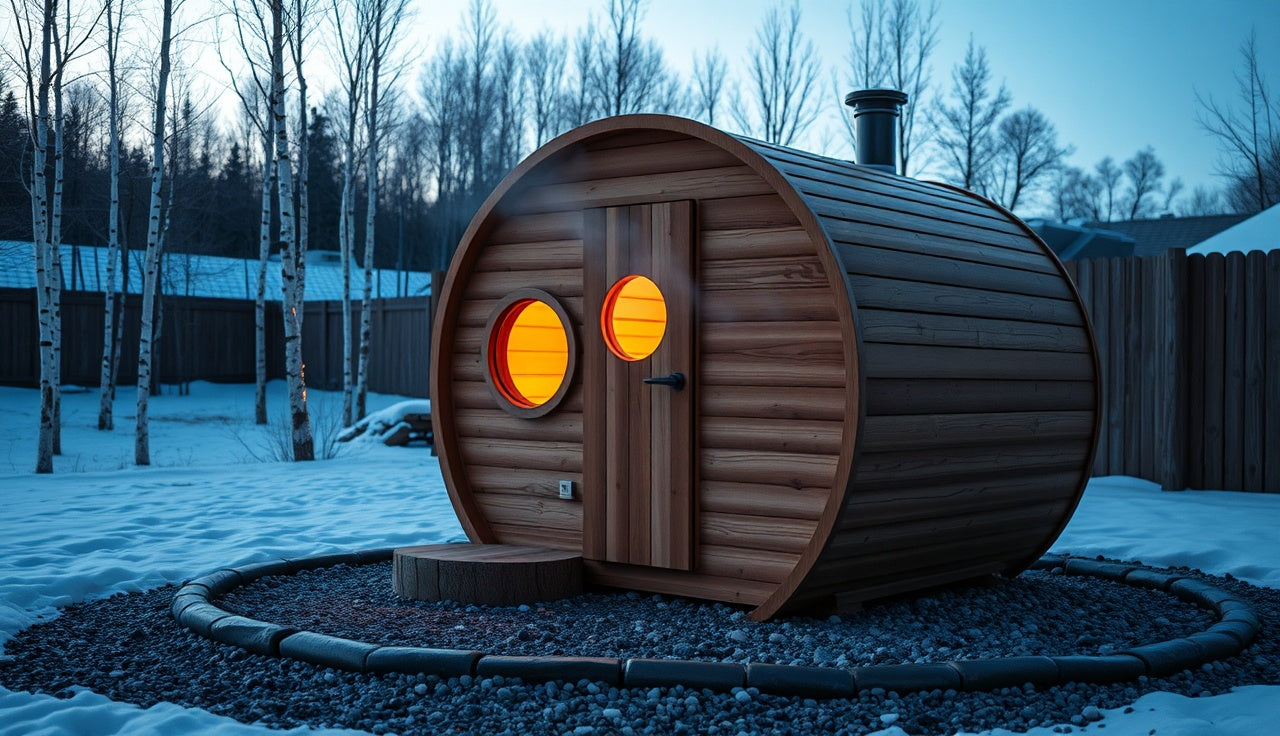
A barrel sauna is a cylindrical wooden structure, usually 5 to 8 feet in diameter and 6 to 8 feet long, built from curved tongue-and-groove staves the same way a wooden wine barrel is built. Galvanized steel or stainless hoops hold the staves together instead of fasteners, so the wood itself does all the structural work.
The shape matters more than it sounds. Hot air rises, and in a box sauna it pools at the ceiling while the floor stays cool. In a barrel, the curved ceiling pushes that rising air back down along the walls, creating a natural convection loop. You get an even temperature from floor to bench to ceiling with no mechanical help. The air volume inside a barrel is also smaller than a rectangular room with the same floor footprint, so the heater has less cubic footage to warm.
Most barrel saunas sit on two wooden cradles outdoors. The round bottom means rainwater, snow melt, and condensation all drain away from the wood on their own. A flat-roofed outdoor cabin needs flashing and roofing to avoid rot. A barrel is its own roof.
Heaters are usually electric (6 to 9 kW for most residential barrels) or wood-burning. The heater mounts at one end, and the benches run lengthwise inside like a pair of shelves. Ventilation comes from an adjustable vent near the floor at the heater end and another near the ceiling at the opposite end. That's the whole system. Nothing complex to fail.
How much does a barrel sauna cost?
A solid mid-range barrel sauna with an electric heater lands at $5,500 to $9,500 installed. That's the honest number to budget. Prices sort into three tiers, and most buyers fall neatly into one.
Entry-level barrels (usually 4 feet in diameter, thin-stave cedar or hemlock, basic electric heater included) run $2,000 to $3,500. These ship flat-packed from overseas and the wood quality varies. Stave thickness is often 1 inch or less, so the barrel feels the cold more in winter and may warp faster in wet climates.
Mid-range barrels (5 to 6 feet diameter, 1.5-inch staves, Canadian red cedar or Nordic spruce, better heater) cost $4,000 to $7,000. This is the sweet spot. You get real durability, two full-length benches, and room for two or three people.
Premium barrels (7 to 8 feet diameter, 2-inch or thicker staves, thermally modified wood options, a changing-room vestibule, a Harvia or Huum heater) run $7,000 to $10,000 or more before site work.
Then add the costs the product listing rarely mentions upfront:
- Delivery: $200 to $600 depending on distance and whether a liftgate truck is needed
- Concrete pad or gravel base: $300 to $1,500 depending on size and local labor rates
- Electrical rough-in (electric models): $500 to $2,000 for a dedicated 240V circuit from your panel
- Permits: varies wildly by municipality, often $0 to $500 for a structure this size
| Tier | Unit price | Typical diameter | All-in estimate |
|---|---|---|---|
| Entry | $2,000 to $3,500 | 4 ft | $3,000 to $5,000 |
| Mid-range | $4,000 to $7,000 | 5 to 6 ft | $5,500 to $9,500 |
| Premium | $7,000 to $10,000+ | 7 to 8 ft | $9,000 to $14,000+ |
How does a barrel sauna compare to a traditional box sauna?
The barrel versus box question comes down to four things: heat-up time, space, looks, and longevity. The barrel wins two of them clearly and ties on the rest.
Heat-up time goes to the barrel. Because the interior air volume of a barrel is roughly 20 to 30% smaller than a rectangular room with the same floor footprint, the heater reaches sauna temperature (150 to 195°F / 65 to 90°C) faster [1]. Owners commonly report 20 to 30 minutes to temperature versus 40 to 50 minutes for a comparable box sauna. If you want a spontaneous after-work session without planning an hour ahead, that gap matters.
Space efficiency goes to the box. A barrel's curved walls cost you usable bench area at the edges. The benches run lengthwise and are flat, so you're not wasting the space you do use, but a 6x8 foot box sauna seats more people than a 6-foot-diameter barrel of similar length. For a family of four, a cabin may be the better call.
Looks are subjective, but barrel saunas photograph well in a backyard, and real estate agents who handle outdoor amenities say they draw buyer interest. That's anecdotal. It's consistent enough to mention.
Longevity comes down to wood quality and maintenance, not shape. A well-kept cedar barrel with tight hoops should last 15 to 25 years outdoors. A well-kept cedar cabin lasts just as long. The barrel's self-draining shape does cut standing-water exposure, a real rot-prevention edge in wet climates.
For a broader comparison of sauna types, the outdoor sauna guide covers cabin, barrel, and pod options side by side. Still deciding between a sauna and a steam room? The sauna vs steam room breakdown covers the humidity and health differences.
| Entry-level (4 ft, basic heater) | $4,000 |
| Mid-range (5–6 ft, cedar, quality heater) | $7,500 |
| Premium (7–8 ft, thermowood, vestibule) | $11,500 |
Source: SweatDecks market research, 2025; cost ranges reflect U.S. retail and installer pricing
What wood is best for a barrel sauna?
Cedar is the default for good reason. Western red cedar has natural oils that resist moisture and slow the mold and bacteria that thrive in hot, humid air. It stays dimensionally stable as it cycles wet and dry, which is exactly what a sauna does every session. It smells good. It stays relatively cool to the touch at sauna temperatures, so you're less likely to burn a shoulder against the wall [2].
Nordic spruce is the most common wood in Scandinavian saunas. It's denser than cedar, takes longer to heat, and holds heat longer. It has less natural oil than cedar, so it needs a bit more attention in wet climates. If you're buying a Finnish-style sauna from a Scandinavian brand, spruce is legitimate, not a compromise.
Hemlock is the budget option. It's harder than cedar, has almost no natural oils, and doesn't smell as nice. It works, but it needs more diligent maintenance and checks (small surface cracks) more readily over time.
Thermally modified wood (thermowood) is heat-treated at 185 to 215°C to drive out moisture and change the cell structure, which makes it more stable and more decay-resistant [11]. It costs more but performs better in extreme weather. In a very wet climate like the Pacific Northwest, it's worth the premium.
Stave thickness matters as much as species. Go with at least 1.5 inches. Thinner staves lose heat faster in cold weather and flex more under hoop tension, which opens gaps over time.
Do barrel saunas actually deliver the health benefits of sauna use?
The health research on sauna use is real and growing, but it's almost entirely done in Finnish-style traditional saunas, not barrels specifically. The shape doesn't change the mechanism: you're exposing your body to dry heat at 150 to 195°F for 10 to 20 minute sessions.
The most cited work is a long-running Finnish cohort study (the Kuopio Ischaemic Heart Disease Risk Factor Study) published in JAMA Internal Medicine in 2015. Researchers followed 2,315 middle-aged Finnish men for an average of 20 years and found that men who used a sauna 4 to 7 times per week had a 40% lower risk of fatal cardiovascular events than once-a-week users [3]. These are observational associations, not causal proof, and the authors said so plainly.
A 2018 review in Mayo Clinic Proceedings summarized the broader evidence and concluded that "sauna bathing is associated with a reduced risk of vascular diseases such as high blood pressure, cardiovascular disease, and neurocognitive diseases" along with "reduced risk of pulmonary diseases" and "reduced risk of mental health disorders such as psychosis" [4]. The authors noted that most studies are observational and randomized trial data stays limited.
For muscle recovery and soreness, the evidence is thinner. A 2015 study found infrared sauna use reduced delayed-onset muscle soreness in athletes, but infrared is a different mechanism than traditional dry heat [5]. Direct evidence for traditional sauna cutting DOMS is weak.
Use your barrel several times a week and the accumulated research points to real cardiovascular benefit over the long term. Nobody can promise that. But the evidence is more solid than for most wellness products. The sauna benefits guide goes deeper into the literature.
One safety note for all sauna types: reviews of the research note that people with certain cardiovascular conditions should use caution, and that alcohol during sauna bathing carries documented risks of arrhythmia and sudden death [6]. Talk to your doctor if you have a cardiac history.
What are the biggest downsides of a barrel sauna?
The curved walls mean you can only stand up straight in the center aisle. For tall people (6'2" and up), that gets old fast. A box sauna gives you full headroom everywhere.
Barrel saunas are almost always outdoor-only. You can't put a curved cylinder in a basement or garage without losing the drainage advantage that makes the design work outside. For an indoor install, a traditional home sauna cabin is the practical choice.
The hoop system needs occasional attention. Galvanized hoops rust in coastal or very wet climates unless they're stainless. Even stainless hoops need tightening once or twice a year as the wood dries out seasonally. It takes about 10 minutes with a wrench. Not a big deal, but it isn't zero maintenance.
Entry-level barrels from discount retailers have a bad track record for stave gaps. When thin staves dry and shrink, the hoops can't always keep up, and you get visible gaps that kill heat retention and look terrible. This is the single biggest risk of going cheap.
Resale and relocation are awkward too. A barrel can be disassembled and moved, but it takes time and care. Want to take it with you when you sell? Plan for a half-day of careful work. Many buyers just fold it into the home sale.
What size barrel sauna do I actually need?
Match the size to how you'll actually use it, then ignore the marketing capacity. A barrel listed as "4-person" usually fits 2 adults comfortably on lengthwise benches.
For one or two people: a 5-foot diameter, 6-foot length is the sweet spot. It heats fastest, costs less, and gives you room without wasted air volume.
For two to four people regularly: go 6-foot diameter, 7 to 8 feet long. That gives you two full benches plus room to stretch out or lie flat, which is how Finnish sauna is meant to work.
For families or social sauna groups: a 7 to 8 foot diameter barrel, or one with an attached changing-room vestibule. At this size you're paying cabin money, and a cabin might serve the space better.
One underrated factor: bench height. A single-tier barrel isn't as functional as a double-decker, because the top bench runs at 160 to 190°F while the lower bench runs 20 to 30°F cooler. You want the option to drop down when the heat gets intense.
Is an electric or wood-burning heater better for a barrel sauna?
For most suburban buyers, electric is the right call. You can set a timer, pre-heat remotely with a smart controller, and hold a precise temperature. No ash to clean, no wood to haul. The install is a dedicated 240V circuit. If you want to use your sauna after work without prep, electric is the answer.
Wood-burning wins on experience and off-grid ability. Building a fire, the smell, the crackle, the different quality of steam you get when you pour water over wood-heated rocks. Plenty of sauna purists say there's no comparison. If you have a good wood supply and enjoy the process, wood-burning gives you a more traditional session.
The practical tradeoff: wood-burning needs a chimney through the barrel end or top, which complicates installation, and many municipalities require a permit and clearance inspection for a wood-burning outdoor structure. Electric needs a licensed electrician to run the circuit, which costs money upfront but has no ongoing regulatory friction once it's in.
Rural property with a wood supply and a traditional mindset? Wood-burning is worth the setup effort. For everyone else, electric.
Do I need a permit to install a barrel sauna?
Usually not for the structure itself, but almost always for the electrical. This varies by municipality with no universal answer, so the safe move is a 5-minute call to your local building department.
Most barrel saunas on cradles (not attached to the house, not on a permanent foundation) fall below the threshold for a building permit in most US jurisdictions. Many cities exempt detached accessory structures under a set floor area, often 120 to 200 sq ft. The International Residential Code, Section R105.2, exempts detached accessory structures "not exceeding 200 square feet" from a building permit in jurisdictions that adopt it, though local amendments vary [7]. A standard 6x7 foot barrel has a footprint of roughly 28 square feet, well under any of those numbers.
The electrical is a different story. A 240V circuit requires an electrical permit and inspection in most US jurisdictions no matter what it powers [10]. Skipping it isn't just a code violation. It can affect your homeowner's insurance if something goes wrong. Budget for a licensed electrician.
In an HOA? Read the CC&Rs before you order anything. Some HOAs restrict outdoor structures by height, street visibility, or material. A barrel sauna is hard to hide.
For wood-burning models, check with your local fire authority about ember clearance and any seasonal burn restrictions.
How do barrel saunas hold up in cold climates?
Better than most people expect. Once a barrel with thick cedar staves is up to temperature, the wall mass holds heat well. The round shape sheds snow load without the structural stress a flat roof takes.
Stave thickness is the key. In a climate with regular sub-freezing temperatures, 1.5-inch staves are the minimum and 2-inch is better. Thin-stave barrels lose heat quickly and cycle through freeze-thaw harder, which stresses the wood and widens gaps between staves over time.
Hoops should be stainless steel where there's road salt in the air or steady wet-freeze cycling. Galvanized hoops are fine in dry climates but rust faster under repeated freeze-thaw moisture.
For Minnesota, Quebec, or Norway-level winters, some owners add a thin mineral wool or ceramic fiber blanket under a protective outer shroud to cut heat-up time and fuel cost. It isn't a standard product; it's a DIY modification. Done right, it works. Done sloppily, it traps moisture against the wood.
Nordic spruce barrels have run through Finnish winters for generations with no special modification. A quality barrel handles cold just fine.
Is a barrel sauna a good investment for home value?
Buy it for the use, not the appraisal. In markets where outdoor living space commands a premium, such as the Pacific Northwest, Colorado mountain towns, and Scandinavian-influenced parts of the upper Midwest, a quality outdoor sauna is a real selling point. Agents in those markets say a barrel adds perceived value and speeds up buyer interest. That's anecdotal.
On hard dollar return, sauna-specific ROI data is thin. Remodeling Magazine's annual Cost vs. Value report doesn't break out saunas as a line item [8]. The closest comparable data is on outdoor kitchens and decks, which typically return 60 to 80% of cost at resale in strong outdoor-living markets.
The honest framing: don't buy a barrel sauna expecting it to add $10,000 to your appraised value. Buy it because you'll use it consistently and value the experience. The health research on regular sauna use, especially for cardiovascular risk, is more compelling than any ROI argument.
If you're also eyeing a cold plunge to round out a contrast-therapy setup, that pairing genuinely raises the appeal of a backyard wellness area as a whole. The cold plunge and cold plunge benefits guides cover what that addition involves.
What should I look for when buying a barrel sauna?
Start with stave thickness. Anything under 1.5 inches is a compromise. Ask the seller for the exact measurement, not "thick" or "heavy-duty" marketing language.
Wood species and sourcing come next. Real Western red cedar or Nordic spruce from a named source, not "premium cedar-type wood." Reputable brands will name their supplier region.
Hoop material. Stainless steel over galvanized. For coastal climates, this is non-negotiable.
Heater brand and warranty. Harvia, Huum, Narvi, and Finlandia are established makers with real parts availability and service networks [9]. Generic heaters from unknown brands are a gamble on support and longevity.
Interior bench configuration. Two-tier benches are standard and important. Confirm the upper bench sits 36 to 40 inches from the floor, which puts your body in the hottest air.
Ventilation design. Adjustable floor-level intake and an upper exhaust vent. Without proper ventilation the heat distributes unevenly and the air goes stale.
Warranty terms. A legitimate barrel should carry at least a 2-year warranty on the structure and 1 year on the heater. Some premium makers offer 5 years on the barrel.
SweatDecks carries a selection of barrel saunas with verified stave thickness and named wood sourcing, which makes the comparison easier if you're at the research-to-purchase stage.
For a broader look at the category and what other formats exist, the home sauna guide is a good next read.
How long does a barrel sauna last and what maintenance does it need?
A quality cedar barrel should last 15 to 25 years outdoors with basic maintenance. The weak links are the hoops and the wood end panels, not the staves.
Yearly tasks:
- Tighten the hoops in late summer or early fall, after the hottest, driest months when the wood has contracted the most. It takes 10 to 15 minutes.
- Inspect the end panels for checking or cracking. Small checks are normal. Deep cracks through an end panel can let water in and should be filled with an exterior wood filler rated for sauna temperatures.
- Clean the interior with a mild sauna cleaner or diluted white vinegar every few months. No bleach or harsh chemicals; they off-gas when heated.
- Lightly sand the bench surfaces once a year if they roughen from salt and body oils.
Every 3 to 5 years:
- Apply a sauna-specific wood treatment to the exterior. Standard deck sealers off-gas chemicals when the wood heats up. Use a product rated for sauna exteriors.
- Replace the hoop tension bolts if you see any corrosion.
Never seal or stain the interior wood. Leaving it untreated is intentional. It breathes, and any coating off-gasses at sauna temperatures.
If you set the barrel on two wooden cradles directly on soil, expect the cradle feet to rot faster than anything else. Set the cradles on gravel, concrete pads, or rubber feet to extend their life.
Frequently asked questions
How long does a barrel sauna take to heat up?
Most residential barrel saunas with a properly sized electric heater reach 150 to 175°F in 20 to 35 minutes. Wood-burning models vary more depending on fire size and ambient temperature. In cold weather (below 20°F), add 10 to 15 minutes for an outdoor barrel. The cylindrical shape and smaller air volume compared to a box sauna of equal footprint speeds up heat-up time by roughly 20 to 30%.
Can a barrel sauna stay outside year-round?
Yes. Barrel saunas are built for permanent outdoor use. The round shape sheds snow and rain, and quality cedar or spruce handles freeze-thaw cycles well. In very cold climates, use stainless steel hoops and 1.5-inch or thicker staves. No winterizing or cover is required, though some owners add an exterior protective cover in the off-season to reduce UV and debris exposure on the wood.
How many people fit in a barrel sauna?
Manufacturer claims are almost always optimistic. A 5-foot diameter barrel comfortably fits 2 adults. A 6-foot diameter barrel fits 3 to 4 people on two lengthwise benches, though lying flat (traditional Finnish style) limits capacity to 2. For regular group use of 4 or more, a 7-foot or larger barrel or a cabin-style sauna is a better fit.
Is a barrel sauna cheaper than a traditional sauna cabin?
At comparable quality levels, barrel saunas and cabin saunas cost roughly the same. A mid-range barrel runs $4,000 to $7,000 for the unit; a comparable-quality indoor or outdoor cabin sits in the same range. The barrel's outdoor-only design saves money if you don't need an indoor install, but adds electrical and site-prep costs that a cabin installed indoors may avoid.
What heater size do I need for a barrel sauna?
The standard rule is roughly 1 kW per 50 cubic feet of interior volume. A typical 6-foot diameter, 7-foot long barrel holds about 160 to 170 cubic feet, so a 6 to 9 kW heater fits. Sizing up slightly (9 kW for a mid-size barrel) is worth it for faster heat-up, especially in cold climates. Check the heater maker's specific sizing chart for your model.
Do I need electricity for a barrel sauna?
Only if you use an electric heater. Wood-burning barrel saunas need no electricity at all, though you may want a light and a timer, which use a simple low-voltage circuit. Electric heaters require a dedicated 240V, 40 to 60 amp circuit, which means hiring a licensed electrician. Budget $500 to $2,000 for the electrical rough-in depending on how far the circuit runs from your panel.
Are barrel saunas good for recovery and sore muscles?
The evidence for sauna use and general recovery is positive but modest. A 2015 study found infrared sauna use reduced delayed-onset muscle soreness in athletes, though that's a different heat mechanism than traditional dry heat. The cardiovascular and relaxation benefits of traditional sauna are better documented. Regular use several times per week is linked to meaningful cardiovascular benefit in long-term observational studies, particularly the 20-year Finnish cohort study published in JAMA Internal Medicine.
Can I put a barrel sauna on a deck?
Sometimes, but check your deck's load capacity first. A fully assembled 6-foot diameter barrel weighs 600 to 900 lbs empty, plus occupants and the heater. Most residential decks are built for 40 to 60 lbs per square foot, and a barrel on two cradles concentrates load on a small area. Have a structural engineer or contractor evaluate your deck before installation. Ground-level gravel or concrete pads are simpler and safer for most setups.
How do I clean and maintain a barrel sauna?
Wipe interior surfaces with a diluted white vinegar solution or a sauna-specific cleaner every few months. Never use bleach or solvents. Sand benches lightly each year if they feel rough. Tighten the metal hoops once a year in late summer or fall. Treat the exterior wood every 3 to 5 years with a sauna-rated exterior product, not a standard deck sealer. Leave the interior wood untreated permanently.
What is the best wood for a barrel sauna in a wet climate?
Western red cedar is the top choice for wet climates thanks to natural oils that resist moisture and mold. Thermally modified wood (thermowood) performs even better in very wet conditions and is worth the extra cost in Pacific Northwest or Nordic-style climates. Hemlock and untreated spruce are riskier in high-rainfall areas and need more diligent maintenance to avoid rot at the end panels and cradle contact points.
Is a barrel sauna worth it compared to a gym membership or spa access?
If you use a sauna 3 to 4 times per week, a mid-range barrel pays for itself in 3 to 5 years compared to regular spa or gym sauna access at $30 to $60 per month. The bigger advantage is convenience: you're far more likely to use a sauna 20 steps from your back door than one across town. Frequency matters a great deal for the health benefits, and convenience drives frequency.
Can I add a cold plunge or ice bath next to my barrel sauna for contrast therapy?
Yes, and it's one of the best reasons to buy a barrel sauna. Heat exposure followed by cold immersion is a common recovery protocol. Alternating 10 to 15 minutes of sauna heat with 2 to 3 minutes in cold water (around 50 to 59°F) is a typical contrast session. The ice bath and cold plunge guides cover what to look for in a cold immersion setup.
How does a barrel sauna compare to a portable sauna?
A portable sauna costs $100 to $500 and is easy to store, but reaches much lower temperatures (usually 120 to 140°F maximum) and delivers a fundamentally different experience from a full-size barrel. A barrel at 170 to 190°F with a proper rock heater produces a heat and steam response a canvas tent can't match. If budget or space is a hard constraint, a portable sauna beats nothing, but it's a different product. See the portable sauna guide for a full comparison.
Sources
- National Center for Biotechnology Information (NCBI) / PubMed: Hussain & Cohen (2018), Mayo Clinic Proceedings, 'Health Effects of Voluntary Exposure to Hot Environments': Cylindrical sauna geometry reduces interior air volume relative to floor footprint, contributing to faster heat-up times compared to rectangular cabins of equivalent footprint.
- USDA Forest Service, Wood Handbook: Wood as an Engineering Material: Western red cedar has naturally occurring extractives (thujaplicins) that resist decay and biological attack, making it appropriate for high-moisture applications.
- JAMA Internal Medicine, 2015: Laukkanen et al., 'Association Between Sauna Bathing and Fatal Cardiovascular and All-Cause Mortality Events': Men who used a sauna 4–7 times per week had a 40% lower risk of fatal cardiovascular events compared to once-a-week users over a 20-year follow-up period.
- Mayo Clinic Proceedings, 2018: Hussain & Cohen, 'Health Effects of Voluntary Exposure to Hot Environments (Saunas)': Review concluded that sauna bathing is associated with reduced risk of vascular diseases, neurocognitive diseases, pulmonary diseases, and certain mental health disorders; authors noted most evidence is observational.
- SpringerLink / Journal of Athletic Training, 2015: Mero et al., 'Effects of far-infrared sauna bathing on recovery from strength and endurance training sessions in men': Infrared sauna use post-exercise reduced delayed-onset muscle soreness in male athletes compared to control; study used infrared heat, not traditional dry heat.
- National Center for Biotechnology Information (NCBI): Laukkanen et al. (2018), 'Cardiovascular and Other Health Benefits of Sauna Bathing': Alcohol consumption during sauna use is associated with increased risk of arrhythmia and sudden cardiac death; individuals with certain cardiovascular conditions should use caution.
- International Code Council (ICC), International Residential Code (IRC) Section R105.2, Exemptions from Building Permits: The IRC exempts detached accessory structures with a floor area not exceeding 200 square feet from building permit requirements in many jurisdictions, though local amendments vary.
- Remodeling Magazine / JLC, Cost vs. Value Report (annual): Remodeling Magazine's Cost vs. Value report does not include a standalone sauna line item; outdoor kitchen and deck projects return approximately 60–80% of cost at resale in strong outdoor-living markets.
- Harvia Group (Finnish sauna heater manufacturer), product specifications: Harvia is an established Finnish sauna heater manufacturer with published product warranties, parts availability, and a named service network referenced by the sauna industry.
- U.S. Department of Energy, Office of Energy Efficiency & Renewable Energy: Electrical Wiring and Permits: 240V electrical circuits require a dedicated permit and licensed inspection in most U.S. jurisdictions regardless of the appliance being powered.
- USDA Forest Service, Forest Products Laboratory: Thermal Modification of Wood: Thermally modified wood treated at 185–215°C shows improved dimensional stability and decay resistance compared to untreated wood, making it suitable for outdoor high-moisture applications.

Share:
Four person barrel sauna: what to know before you buy
Inside a barrel sauna: what it looks like, feels like, and costs