
Last updated 2026-07-09
TL;DR
A barrel sauna interior is a curved, wood-lined cylinder roughly 4 to 8 feet in diameter. You get tiered cedar or Nordic spruce benches, a small heater on one end, a vent system that cycles hot air top-to-bottom, and a tight, intimate heat envelope that warms faster than most rectangular saunas. Typical interior temps run 160 to 195°F. Entry-level units start around $2,500; well-built ones run $5,000 to $10,000.
What does the inside of a barrel sauna actually look like?
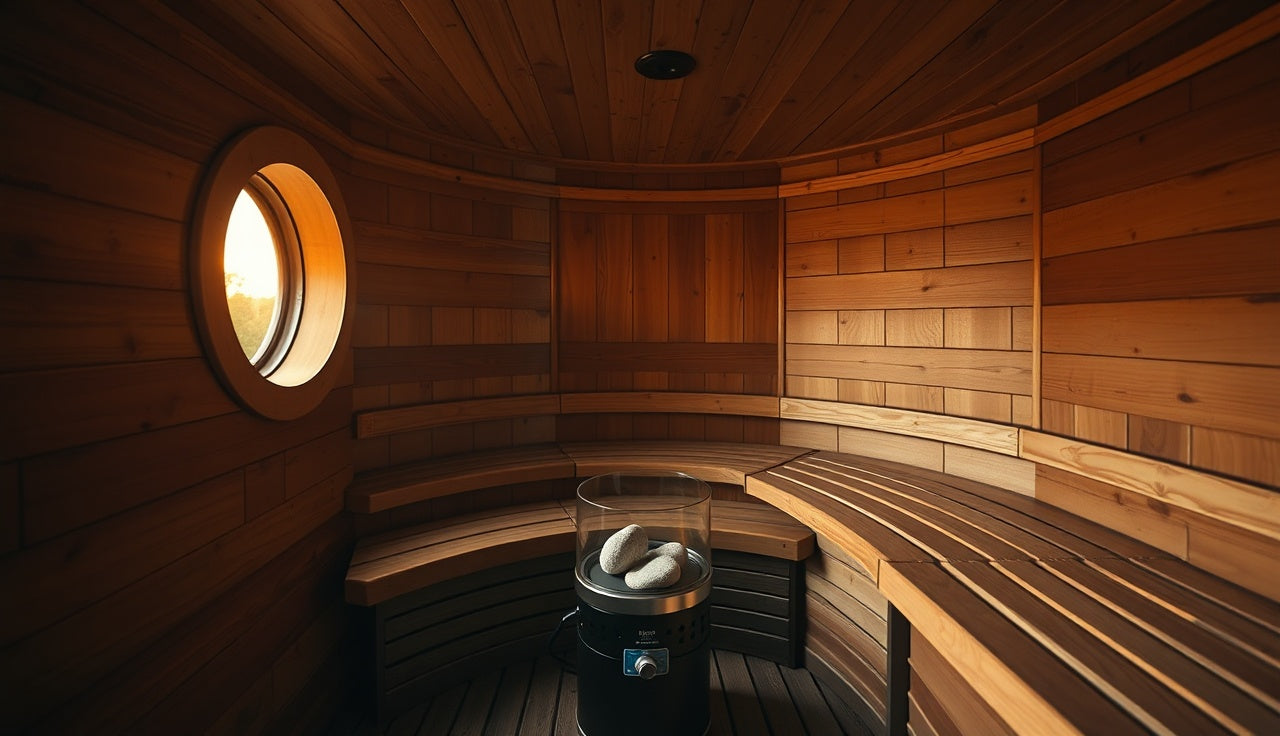
Picture a wine barrel scaled up to human size, then step inside. The ceiling curves overhead and meets the walls without a corner, which gives the space a cave-like, enveloping feeling that rectangular saunas never produce. Every surface is tongue-and-groove wood planking, typically cedar or Nordic white spruce, running lengthwise along the barrel so the grain lines lead your eye toward the door. There is no drywall, no insulation board showing, nothing that looks like a construction project mid-way. It is wood, curved, and warm from the first moment you sit.
The floor is usually the same species as the walls, though some manufacturers use a different softer wood for grip or thermal comfort underfoot. A few higher-end units add removable slatted floor boards that sit above a drainage channel, which matters if you are splashing water on the rocks. The heater, either a wood-burning stove or an electric unit, anchors one end. Its flue or cord exits through a purpose-built penetration so there is no improvised hole in the wood. The other end is typically a solid wall or, in two-door configurations, a second door.
Light comes from one or two small windows, often circular to match the barrel aesthetic, or from a strip of tempered glass panels cut into the door. Some interior shots look dramatically lit because of LED strips tucked along the bench risers, but natural wood tone and amber light is the baseline most people receive. The benches are the dominant interior feature. You will see them the moment you open the door.
How are the benches arranged inside a barrel sauna?
Most barrel saunas ship with two bench tiers. The lower bench sits somewhere between 18 and 24 inches off the floor. The upper bench is usually 12 to 16 inches above that. Because the ceiling curves rather than rises vertically, sitting upright on the upper bench puts your head much closer to the apex than it would be in a box sauna with the same stated interior diameter. A 6-foot 2-inch person on the top bench of a 6-foot-diameter barrel should sit with some caution; head clearance on the upper tier is tighter than it looks in product photos.
Benches run the length of the barrel on both sides or, in narrower units (4 feet in diameter), on one side only with the heater opposite. Two-person bench configurations are common in 5-foot-diameter units. Four-person or six-person capacities generally require a 6-foot-diameter barrel, and the benches wrap or angle at the end wall. Some manufacturers offer an L-shaped bench that lets one person lie flat, which is where the barrel sauna earns real points for recovery sessions.
Bench depth matters more than most buyers realize. A 16-inch-deep bench is functional for sitting. A 20-inch-deep bench lets you sit comfortably cross-legged or lean back against the curved wall without your knees hanging in space. If lying down is your goal, look for units advertising a full-length bench, usually the lower tier extended, running the whole 6 to 8 feet of interior length.
For comparison with other formats, our home sauna guide covers bench layouts across indoor units.
What wood is used inside barrel saunas, and does it matter?
The wood choice matters more than most marketing copy admits. The three most common options are Western red cedar, Nordic white spruce (sometimes called Nordic spruce or Scandinavian spruce), and hemlock. Each behaves differently under heat.
Western red cedar is aromatic, naturally resistant to moisture and decay, and has a low density that keeps it cool enough to sit on even at 190°F. That natural oil also means it weathers outdoor exposure without as much maintenance. The downside is cost. Cedar commands a premium, and the aromatic compounds, pleasant to most, can irritate people with sensitivities.
Nordic white spruce is what most Finnish and Scandinavian saunas have used for generations. It has very low resin content, which means it does not get tacky or sticky under heat the way some lower-grade softwoods do. It is lighter in color than cedar and has almost no scent, which some people prefer. It is generally less expensive than cedar.
Hemlock sits between the two. It has no aroma, takes stain evenly if you ever want to alter appearance, and holds up well under repeated heat-cool cycles. It is harder than spruce, which means it resists surface denting from bench use better.
One thing worth knowing: the wood you see is structural and cosmetic at the same time. In a barrel sauna there is no frame behind the planking. The staves are the structure, so lower-grade wood with more knots or inconsistent grain is more than an aesthetic issue, it is a structural one. Tight, clear-grained staves hold moisture cycles and the tension of the hoops better than knotty lumber.
| Wood type | Aroma | Moisture resistance | Typical cost premium | Best for |
|---|---|---|---|---|
| Western red cedar | Strong, pleasant | Excellent | High | Outdoor, aromatic preference |
| Nordic white spruce | None | Good | Low-medium | Traditional feel, sensitive noses |
| Hemlock | None | Good | Medium | Durability, neutral look |
How hot does the inside of a barrel sauna get, and how fast?
A well-sealed barrel sauna with an appropriately sized heater reaches operating temperature faster than most rectangular saunas of similar capacity. The physics are straightforward: the curved shape has a smaller total interior surface area than a rectangular room of the same volume, which means less wood to heat and a tighter air envelope that retains warmth. Owners commonly report preheat times of 20 to 45 minutes for a 6-foot-diameter unit, where a comparably sized traditional box sauna might take 45 to 60 minutes.
Operating temperatures in Finnish-style dry saunas typically run 160 to 195°F (71 to 90°C) at bench level [1]. The hottest air pools at the apex of the barrel, which is why the upper bench is meaningfully hotter than the lower one, sometimes by 20 to 30°F across a vertical span of just 12 to 16 inches. This temperature gradient is one of the defining characteristics of the experience. Moving between benches is how most users self-regulate intensity without leaving the room.
Humidity inside a barrel sauna depends on how aggressively you throw water on the rocks, a practice called loyly in Finnish tradition. Without any water, a wood-fired barrel sauna might sit at 5 to 15% relative humidity. With regular water throws, you can push that to 30 to 40%, which significantly changes how the heat feels on skin. Electric heaters with smaller rock beds produce less dramatic steam response, though all heaters marketed as sauna heaters are designed to accept water.
The safety ceiling matters here. The Finnish Sauna Society, which publishes guidelines based on decades of sauna research, notes that properly built saunas are safe for healthy adults at these temperatures, with individual tolerance varying widely [2]. If you want a deeper look at the physiological side, our sauna benefits article covers what the research actually shows.
How does ventilation work inside a barrel sauna?
Ventilation in a barrel sauna is a gravity-driven convection loop, not a forced-air system. Cold fresh air enters low, near the floor on the heater wall. It heats up, rises to the apex of the barrel, circulates across the ceiling, and exits through an adjustable vent cut into the lower section of the opposite wall, usually below the lower bench. This exit vent also doubles as the place the stale, depleted air leaves.
Getting this loop calibrated correctly matters. If the intake and exhaust vents are both wide open, the room loses heat too fast and struggles to hold temperature. If both are closed, CO2 builds up uncomfortably within a few sessions. The practical tuning most barrel sauna manufacturers recommend is to keep the intake vent 30 to 50% open once the sauna is up to temperature, and adjust the exhaust based on how stuffy the air feels. This is empirical and personal, not a precise science.
Wood-burning barrel saunas have an additional convection system in the flue. The draw of the chimney creates a slight negative pressure inside the stove firebox, which does not directly pull air from the sauna interior but does affect overall room airflow. This is one reason wood-fired units often feel airier and fresher despite higher temperatures: the chimney passively encourages air movement in a way an electric element cannot replicate.
One practical note: if you are placing a barrel sauna indoors (a garage, for instance), ventilation design becomes critical and should involve a building professional. Indoor placement of wood-burning units requires a full chimney penetration, combustion air supply, and potentially carbon monoxide detection. Electric-only units are more practical for true indoor installation.
What size is the inside of a barrel sauna, and how many people fit?
Barrel saunas are sold by interior diameter and interior length. The diameter determines headroom and bench width. The length determines how many people can sit side by side.
A 4-foot-diameter barrel is tight. Two adults can share it if neither is large, and the upper bench sits low enough that sitting tall is comfortable only for shorter users. These are genuinely solo or couples units.
A 5-foot-diameter barrel is the most common residential choice. Interior bench length is typically 6 to 7 feet. This comfortably seats two adults on each bench tier, for a four-person stated capacity, though the real comfortable social capacity is two to three people.
A 6-foot-diameter barrel with a 7 or 8 foot interior length is where you get genuine group capacity. Upper bench headroom is good even for tall adults. You can fit four to six people without everyone touching, and one person can lie flat on the lower bench while others sit.
These numbers track with general architectural guidance on minimum sauna dimensions, which suggests at least 2 square feet of bench space per person, though that minimum is quite tight by comfort standards [3].
| Diameter | Capacity (stated) | Comfortable capacity | Good for |
|---|---|---|---|
| 4 ft | 1-2 | 1 | Solo use, small yards |
| 5 ft | 2-4 | 2-3 | Couples, most residential buyers |
| 6 ft | 4-6 | 3-5 | Families, frequent group use |
| 7-8 ft | 6-8 | 5-7 | Frequent entertaining, commercial |
Length adds capacity without changing headroom or bench width. A 5-foot-diameter barrel in an 8-foot length gives you more bench real estate on each tier without the cost jump of going to 6 feet in diameter.
| 4 ft diameter | 1.5 |
| 5 ft diameter | 2.5 |
| 6 ft diameter | 4 |
| 7-8 ft diameter | 6 |
Source: General manufacturer sizing guidelines and CPSC sauna design guidance
What heater options work inside a barrel sauna?
You have two real choices inside a barrel sauna: a wood-burning stove or an electric heater. Both sit on the same floor position at one end of the barrel, usually on a protective heat shield.
Wood-burning stoves are the traditional choice and produce a noticeably different experience. The heat is radiant and direct from the fire mass, the humidity is easier to push high with water, and the sensory package (smell of wood, sound of the fire, natural light from the firebox glass) adds something intangible. The downsides are real: you need dry firewood on hand, preheat takes longer, you cannot walk up and push a button for an after-work session, and indoor or suburban-lot placement is complicated by flue requirements.
Electric heaters are simpler. Most residential barrel saunas that ship with electric heaters use units in the 3 to 9 kilowatt range, with larger diameter barrels requiring more power. A 6 kW heater is common for a 5-foot-diameter unit. These require a 240V circuit, which is not a standard household outlet, so factor electrician costs into your budget if you do not already have a 240V feed available near your install site. The National Electrical Code (NEC) Article 424 governs fixed electric space heating installations, and a dedicated circuit with appropriate amperage for the heater rating is a code requirement [4].
Infrared heaters are marketed for barrel saunas occasionally, but most purists and most of the published research on sauna physiology are based on convective-radiant heat, not infrared. Infrared units in barrel configurations tend to run at much lower temperatures (110 to 140°F) and produce a fundamentally different experience. If you want the Finnish sauna protocol, stick with a wood-burning or traditional electric heater.
For sizing guidance, heater manufacturers typically rate their units by cubic footage of sauna interior. Measure your barrel's interior volume (roughly pi times radius squared times length) and match it to the heater's rated capacity with some headroom [10].
What does a barrel sauna cost, inside and out?
Entry-level barrel sauna kits with basic cedar or spruce interiors, a small electric heater, and minimal accessories start around $2,500 to $3,500. At this price you are getting a functional unit but probably thinner stave wood, fewer interior accessories, and a heater that is undersized for cold climates.
Mid-range units from established manufacturers run $4,500 to $8,000. This is where you get clear-grained cedar or Nordic spruce, a properly sized heater, better ventilation hardware, and interior accessories (a ladle, a wooden bucket, a thermometer/hygrometer, a backrest). Most residential buyers land here and are satisfied.
Premium or custom barrel saunas from Scandinavian manufacturers or high-end North American builders run $8,000 to $15,000 or more. The difference is often in wood quality (truly knot-free, kiln-dried, tight-grained staves), precision milling (tighter barrel geometry means better sealing and heat retention), heater quality (Finnish brands like Harvia or Helo at the appropriate kW rating), and interior detail like integrated chromotherapy lighting or custom bench configurations.
Installation adds cost: a concrete pad or gravel base runs $300 to $1,500 depending on size and local labor. Electrical work for a 240V circuit averages $300 to $800 nationally, though this varies significantly by region and the distance from your panel. Permits may be required; the permit cost itself is usually modest ($50 to $200) but the inspection process adds time.
Operating costs depend heavily on whether you chose electric or wood-burning. A 6 kW electric heater running 1.5 hours per session at the U.S. average residential electricity rate of about 16 cents per kWh (as of the most recent EIA monthly data) costs roughly $1.44 per session [5]. Wood costs vary by region but a cord of dry hardwood runs $200 to $400 and might supply 40 to 80 sauna sessions depending on how efficiently you fire the stove.
If you are comparing this against a full outdoor sauna build with a custom structure, the barrel sauna typically wins on installed cost and timeline, though a custom shed or cabin sauna can offer more interior flexibility.
SweatDecks carries a curated selection of barrel saunas and heaters if you want to compare options side by side.
What accessories come inside a barrel sauna, and what should you add?
A standard barrel sauna kit includes the structural elements (staves, hoops, end walls, door) and the heater. Interior accessories vary by manufacturer and price point. Most mid-range and up kits include a wooden ladle, a wooden water bucket, and a thermometer/hygrometer. A basic backrest (a curved or angled cedar rest that leans against the curved wall) is common at mid-range.
What you will likely want to add, or upgrade, fairly quickly:
A good backrest is more important in a barrel than in a box sauna because the curved wall is not ergonomically neutral. Without a backrest, you are leaning against a curved surface that pushes into your spine at one point. A well-designed backrest distributes contact and makes 20-minute sessions much more tolerable.
A hygrometer/thermometer combo that is accurate matters for dialing in your session. Many units ship with inexpensive glass thermometers that are barely calibrated. A quality bi-metal or digital unit tells you what is actually happening in the room.
Sauna stones are sometimes undersupplied in included heaters. The rocks on a sauna heater serve as a heat reservoir and the surface for steam. More quality stones (kiln-dried igneous rock, usually olivine diabase or peridotite) means more stable heat and better steam response when you pour water. You can add stones to most heater baskets easily.
A cold plunge or cold shower nearby completes the contrast therapy loop. Research on cardiovascular response to repeated heat-cold cycling, including work from the University of Jyväskylä in Finland, suggests meaningful effects on circulatory adaptation with regular practice [6]. A dedicated cold plunge or even a garden hose and a tub of cold water makes the whole setup meaningfully more therapeutic.
Floor mats, non-slip bath-style mats inside the door, reduce slip risk when exiting, particularly if you are sweating heavily.
How do you maintain the inside of a barrel sauna?
The interior of a barrel sauna does not need sealing, painting, or staining. This is one of the advantages of the format. The dense, close-pored wood in a properly built unit handles its own moisture regulation through the heat cycle.
What you actually need to do:
Wipe down the benches after heavy sweating sessions. Sweat left to dry and bake repeatedly will gray and discolor wood faster than anything else. A damp cloth after each session takes 90 seconds.
Check the hoops annually. Metal bands loosen as the wood swells and contracts across seasons, especially in climates with significant humidity variation. Most manufacturers include a tensioning system (a bolt or turnbuckle on each hoop). A quick snug in spring and fall is standard practice.
Air out the interior after use. Leave the door propped or cracked for 20 to 30 minutes post-session. This lets residual moisture evaporate rather than sit against the wood. A barrel with good ventilation design does this passively if you open the vents fully after your last session.
If you see mold or mildew starting (typically a gray or black discoloration in corners or on the bench undersides), a diluted hydrogen peroxide solution applied and scrubbed, then heat-dried with a full sauna cycle, handles most cases. Never use bleach or household cleaners inside a sauna. The heat will vaporize the residue directly into the air you breathe.
The heater stones should be replaced every two to four years or when they start crumbling. Degraded stones do not hold heat evenly and can crack and spit under water. This is an inexpensive, easy task.
Can you put a barrel sauna inside your home or garage?
You can, with caveats. Barrel saunas are designed primarily as outdoor structures, but nothing in the structural design prohibits indoor placement. The real constraints are practical.
For an electric barrel sauna indoors, the requirements are a 240V circuit within reach, enough headroom (a 6-foot-diameter barrel needs at least 6.5 feet of ceiling clearance for placement, plus working room), a floor that can handle the unit's weight (a large cedar barrel with a heater can weigh 800 to 1,200 pounds), and adequate ventilation of the surrounding space. The interior of the barrel vents moisture, and that moisture goes somewhere. In a garage, it goes into the garage air. In a finished basement, it can create condensation problems on walls and structure over time.
For a wood-burning barrel sauna indoors, the requirements jump dramatically. You need a full chimney penetration through the building envelope, combustion air supply to the firebox, clearances to combustibles around the stove body as specified by the stove manufacturer and local code, and carbon monoxide detection. The International Residential Code (IRC) Section R1006 governs interior fire features including sauna heaters in some jurisdictions, and local amendments vary significantly [7]. This is not a DIY situation; involve a licensed contractor and pull permits.
Most people who want the barrel format inside a garage or outbuilding are better served by an electric unit with a proper dedicated circuit, a vapor barrier behind the barrel if it is against a finished wall, and a simple box fan or exhaust vent in the garage to manage humidity. It works well and the setup is simpler than it sounds.
For a comparison of the barrel format against more traditional indoor configurations, the home sauna guide has a full breakdown.
Is a barrel sauna better than a traditional box sauna inside?
Better depends on what you care about, and the honest answer is that they are genuinely different in ways that matter.
The barrel wins on heat-up speed. The curved interior geometry means less surface area per unit of volume compared to a rectangular box. Less wood to heat means faster preheat and better heat retention once you reach temperature. In a cold climate where you want the sauna ready in 30 minutes after a day of skiing, this matters.
The barrel loses on layout flexibility. You get tiered benches along the long axis of the cylinder. That is basically it. A rectangular sauna can have an L-bench, a changing room partition, a custom bench height, or a layout that accommodates eight people in a 10-by-12 interior. The barrel is what it is.
The barrel wins on installation simplicity. It arrives as a kit, assembles in a day or two without a building foundation in most configurations, and needs only electrical service (if electric) or a gravel pad and firewood. A custom box sauna is a construction project.
The barrel often wins on aesthetics in an outdoor setting. The cylindrical form reads as a thoughtful design object in a yard or garden in a way that a cedar box simply does not, though this is subjective.
The barrel loses on insulation. Most barrel kits have 1.5 to 2 inches of solid stave wood as their only thermal layer. A well-built indoor box sauna with fiberglass batt insulation between the studs and a foil vapor barrier performs significantly better in very cold climates, both in preheat time and in how much energy it takes to hold temperature through a long session.
Most residential buyers who want an outdoor setup ready to use without a construction project should get the barrel. It makes sense. For serious daily users in very cold climates who care about efficiency over time, or for anyone who needs a large group capacity, a properly built outdoor sauna structure is worth the extra investment.
You can also look at our sauna overview to understand where the barrel format sits among sauna types.
Frequently asked questions
What does the inside of a barrel sauna smell like?
Cedar barrel saunas have a warm, resinous cedar scent that intensifies with heat. Nordic spruce and hemlock interiors are nearly odorless. The smell fades somewhat after the first dozen or so sessions as the surface wood oils stabilize under repeated heat cycles. If you are sensitive to wood aromatic compounds, spruce or hemlock interiors are worth seeking out specifically.
How long does it take for a barrel sauna interior to reach temperature?
Most 5- to 6-foot-diameter barrel saunas with appropriately sized heaters reach 160 to 180°F in 30 to 45 minutes. Wood-burning stoves can take slightly longer, 40 to 55 minutes, because you are building a fire rather than switching on an element. Electric units with oversized heaters for the barrel size can hit temperature in as little as 20 minutes, though running the heater at full blast for a short time is not always the most efficient approach.
Do barrel saunas have windows inside?
Many do, though not all. The most common configuration is a small circular porthole window in the end wall opposite the heater, or a strip of tempered glass panels integrated into the door. A true interior window between the main chamber and a changing room vestibule is found in longer barrel saunas with a dual-chamber design. Natural light makes the space feel less cave-like, which some users strongly prefer.
What is the floor like inside a barrel sauna?
The floor is usually the same tongue-and-groove wood as the walls, either cedar, spruce, or hemlock. Some units include removable slatted floor boards that raise your feet above the floor surface, which helps with drainage if you are using a lot of water. A non-slip mat near the door is a practical addition. Unlike some traditional Finnish saunas, most barrel units do not have floor drains unless specifically built for it.
Can you stand up inside a barrel sauna?
In a 6-foot-diameter barrel, most adults can stand near the center of the barrel where the ceiling apex is highest. In a 4- or 5-foot-diameter unit, standing upright is only comfortable for shorter users. The entry door area, where the ceiling curves down toward the end wall, is always the lowest-clearance point. If full standing room matters to you, specify your height when talking to a manufacturer and ask for interior clearance measurements, more than diameter.
Is the inside of a barrel sauna safe for people with heart conditions?
The published research on sauna and cardiovascular health is cautiously positive for healthy adults, but people with heart conditions, uncontrolled hypertension, or who are pregnant should consult a physician before use. A 2018 review in Mayo Clinic Proceedings noted associations between regular sauna use and cardiovascular health outcomes in a Finnish population cohort, but also flagged that acute heat exposure raises heart rate significantly and is not appropriate for everyone [8]. Your doctor is the right person to ask, not a sauna retailer.
What is the inside of a barrel sauna like in winter?
Cold-climate barrel sauna use is one of the format's best applications. The solid wood stave construction holds heat well once up to temperature, and stepping out of a 185°F barrel into cold winter air is a genuinely dramatic contrast experience. Preheat takes slightly longer in freezing temperatures, maybe 10 to 15 extra minutes compared to summer. Some owners in very cold climates (below -20°F) insulate the exterior of the barrel with a weatherproof wrap during the coldest months to improve efficiency.
How many people can comfortably sit inside a barrel sauna?
A 4-foot-diameter barrel seats 1 to 2 people comfortably. A 5-foot-diameter model seats 2 to 3. A 6-foot-diameter model seats 3 to 5. Stated manufacturer capacities are usually optimistic; real comfort capacity is typically one fewer than the listed maximum. Length matters too: an 8-foot interior gives you more bench real estate than a 6-foot interior at the same diameter, and that extra length can mean the difference between sitting and lying flat.
Do barrel saunas have changing rooms inside?
Standard barrel saunas are a single chamber. Some longer barrels (8 to 10 feet in interior length) are designed as dual-chamber units with a small anteroom or vestibule at one end where you can undress, store a towel, and leave your water bottle without it baking in the sauna. These are more expensive and less common, but they are a real option. Most buyers use a separate outdoor space, a covered deck, or a small adjacent shed as a changing area.
What is the best wood for the inside of a barrel sauna?
Nordic white spruce is the traditional choice for authenticity and performance in a dry sauna environment. It has low resin content, stays cool enough to touch at sauna temperatures, and has no aromatic compounds that might irritate sensitive users. Western red cedar performs similarly but costs more and has a strong scent some people find overpowering. For outdoor durability, cedar edges out spruce. For pure interior sauna performance and cost, Nordic spruce is hard to beat.
Can you pair a barrel sauna with cold plunge therapy?
Absolutely, and many users consider this the point. The contrast protocol, alternating heat in the sauna with cold immersion, is rooted in Finnish and Nordic sauna traditions. Research from the University of Jyväskylä suggests that heat-cold cycling produces meaningful circulatory responses. A dedicated cold plunge tub or even a cold shower adjacent to the barrel makes the transition fast and practical. Our cold plunge benefits guide covers the evidence on what contrast therapy actually does.
How much does it cost to run a barrel sauna per session?
For an electric unit, the math is straightforward. A 6 kW heater running 1.5 hours at the U.S. average residential electricity rate of roughly 16 cents per kWh (EIA 2024 data) costs about $1.44 per session. Larger or longer sessions cost proportionally more. Wood-burning units depend on local firewood costs; a typical session uses 0.5 to 1 cubic foot of dry hardwood, which might cost $1.50 to $4.00 depending on your region and wood source.
Sources
- Finnish Sauna Society, Sauna Temperature Guidelines: Operating temperatures in Finnish-style saunas typically run 70 to 90°C (160 to 195°F) at bench level
- Finnish Sauna Society, Health and Safety Guidance: Properly built saunas are safe for healthy adults; individual tolerance varies and caution is warranted for those with medical conditions
- U.S. Consumer Product Safety Commission, Home Heating and Sauna Safety: General design and safety guidance for saunas including minimum occupant space and heating appliance safety
- National Fire Protection Association, NFPA 70 National Electrical Code Article 424: NEC Article 424 governs fixed electric space heating installations including sauna heaters and requires dedicated circuits at appropriate amperage
- U.S. Energy Information Administration, Electric Power Monthly, Average Retail Electricity Price: U.S. average residential electricity rate is approximately 16 cents per kWh as of recent EIA monthly data
- University of Jyväskylä, Research on Sauna and Cardiovascular Adaptation: Regular heat-cold cycling produces meaningful circulatory adaptation responses in study populations
- International Code Council, International Residential Code (IRC) Section R1006: IRC Section R1006 addresses interior fire features including sauna heater installation requirements, with local amendments varying by jurisdiction
- Mayo Clinic Proceedings, Sauna Bathing and Cardiovascular Health review (2018): A 2018 review in Mayo Clinic Proceedings noted associations between regular sauna use and cardiovascular health outcomes in a Finnish cohort, and flagged that acute heat exposure raises heart rate significantly
- National Institutes of Health, MedlinePlus Heat and Cold Exposure Health Information: Acute heat exposure raises heart rate and blood pressure response; individuals with cardiovascular conditions should consult a physician before heat therapy
- Harvia (sauna heater manufacturer), Product Specifications and Installation Requirements: Electric sauna heater sizing recommendations reference cubic footage of sauna interior; typical residential barrel sauna heaters run 3 to 9 kW

Share:
Four person barrel sauna: what to know before you buy
Is a barrel sauna worth it? An honest look before you buy