
Last updated 2026-07-09
TL;DR
A four-person barrel sauna runs 6 to 8 feet in diameter and 7 to 8 feet long, seats four adults on two facing benches, and costs $3,000 to $9,000 depending on wood and heater. Most homeowners set one on a level gravel pad or deck without a building permit, but the electrical work almost always needs one, and local rules vary.
What exactly is a four-person barrel sauna?
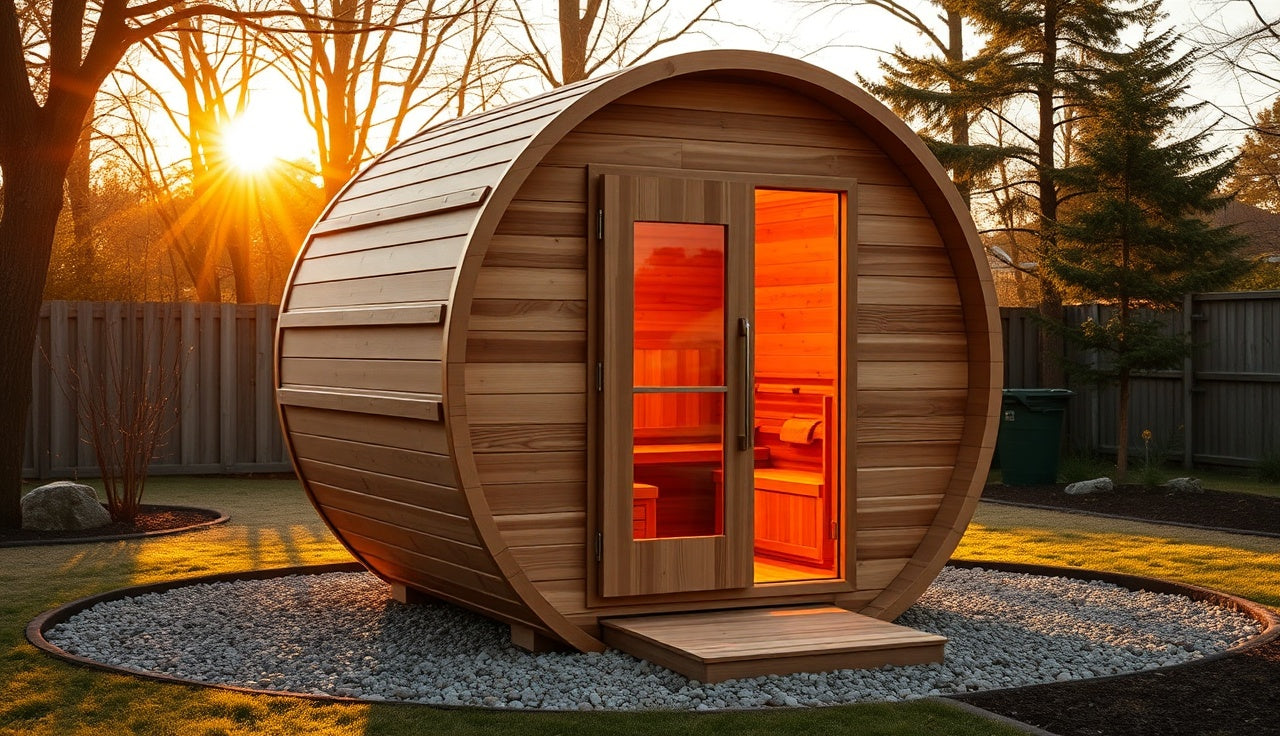
A barrel sauna is a cylinder built from staves of kiln-dried wood, the same construction logic as a wine barrel, curved walls and all. The shape matters more than it looks. Because the ceiling arcs down toward the floor, hot air pools right above the benches instead of collecting in a flat dead zone near a high ceiling. The usable heat volume is smaller, which is a good thing here: the room heats faster and holds temperature better than a comparable box sauna. [1]
A four-person model typically runs 5.5 to 6.5 feet in diameter and 6 to 8 feet long. Two facing benches run the length of the interior. Four average adults fit without touching elbows. But "four person" is a manufacturer label, not a regulated standard, so measure the bench length yourself. One brand's "4-person" barrel might give you 36 inches of bench per side. Another might give 48. That gap decides whether your group sits comfortably or packs in like sardines.
Most barrels ship as pre-cut stave kits. You or a crew stacks the staves, installs the steel banding, drops in a floor frame and benches, and adds the heater. Two people usually finish assembly in 4 to 8 hours. [2] The cylinder also sheds wind far better than a shed-style build, which matters on an exposed deck or anywhere winters get serious.
If you're still weighing formats, the outdoor sauna guide puts barrel, cabin, and pod designs side by side.
How much does a four-person barrel sauna cost?
A four-person barrel sauna costs $3,000 to $9,000 depending mostly on wood and heater. Entry-level kits in hemlock or spruce start around $2,800 to $3,500 with a basic 6 kW electric heater. Mid-range cedar lands at $4,500 to $6,500. Premium builds in Nordic white spruce, clear western red cedar, or thermowood push $7,000 to $9,000 and up once you add a wood stove, tempered glass door, or porch extension.
Here's roughly where the money goes:
| Component | Typical share of total cost |
|---|---|
| Wood stave kit (walls, floor, benches) | 50 to 60% |
| Heater (electric or wood-burning) | 15 to 25% |
| Assembly hardware and bands | 5 to 10% |
| Electrical work (for electric heaters) | 10 to 20% (separate contractor cost) |
| Optional accessories (rocks, lighting, porch) | 5 to 15% |
Electrical work is the line item most buyers forget. A dedicated 240V, 40 to 60 amp circuit from your panel to the sauna often runs $300 to $800, more if the panel needs an upgrade in an older home. [3] Wood-burning heaters skip that cost but need a proper stovepipe and clearance from combustibles per local fire code.
Shipping is its own variable. A four-person kit weighs 500 to 900 pounds crated. Freight to a residential address usually adds $200 to $600 depending on distance from the distribution point. Some brands include it. Most don't. Ask before you compare final prices.
If budget is tight, the costco sauna guide breaks down what club-store pricing actually includes.
What wood type should you choose for a barrel sauna?
Wood choice drives how the sauna smells, how long it lasts outdoors, and how much you pay. Four species show up in four-person barrel kits sold across North America and Europe.
Western red cedar is the popular choice for outdoor saunas in North America. Its natural oils resist moisture, insects, and decay, and it stays dimensionally stable through freeze-thaw cycles. It smells great. The catch: clear, tight-grained cedar is expensive and getting harder to source, so cheap cedar kits often use knotty wood that weeps resin when it heats up. Those resin spots burn bare skin on contact. [4] Ask about the grade before buying.
Nordic white spruce (sometimes sold as Finnish spruce) is the traditional Finnish sauna wood. It's lighter in color, lower in resin than pine, and stays cooler to the touch at high heat because it's less dense. It has no natural rot resistance, so it needs a penetrating exterior oil once a year if it's exposed to weather.
Thermowood is spruce or pine heat-treated at 180 to 230 degrees Celsius in a low-oxygen chamber, which drives out resins and breaks down the sugars that rot fungi feed on. [5] The result is stable, decay-resistant wood that needs no chemical preservative. It's dark brown, almost walnut-colored, and holds up outdoors without annual treatment.
Hemlock is the budget entry. It's stable, low in resin, and machines cleanly into staves. It lacks cedar's rot resistance, so hemlock barrels do better under a roof or in a dry climate. For the price gap (often $800 to $1,500 less than cedar for the same barrel), hemlock is a fair tradeoff if you'll seal the exterior every couple of years.
| Hemlock (entry) | $3,500 |
| Nordic white spruce | $4,800 |
| Western red cedar (knotty) | $5,500 |
| Western red cedar (clear) | $7,200 |
| Thermowood | $8,500 |
Source: Manufacturer pricing data and contractor estimates, 2024 (ranges consistent with USDA Forest Products Laboratory wood grade classifications)
What size do you actually need to seat four people?
Spec sheets mislead buyers hardest right here. Manufacturers count occupancy by assuming adults sit bolt upright with zero elbow room. Real sauna use means leaning back, stretching out, sometimes lying flat, sometimes the dog climbing in with the family.
For four adults who actually feel comfortable, look for:
- Barrel length: 7 feet minimum, 8 feet preferred
- Interior bench length: at least 42 inches per side (two facing benches)
- Interior diameter: 5.5 feet minimum, 6 feet better at high heat so your shoulder isn't pressed against the curved wall
A 6-foot diameter, 8-foot long barrel has a footprint of roughly 6 x 8 feet plus the door swing, so plan a cleared area of at least 7 x 9 feet. Adding an exterior porch or antechamber? Add another 3 to 4 feet to the length. Those porches are common in Nordic setups because they give you somewhere to cool down between rounds without crossing the yard in a towel.
Bench height matters too. The lower bench usually sits 18 inches off the floor. The upper bench should sit 38 to 42 inches up. In a 5.5-foot barrel, the upper occupant's head sits near the apex of the curve, which is the hottest air pocket in the room. That's fine for experienced users chasing intense heat. It's rough on beginners. Buying for a mixed group? A 6-foot diameter gives the vertical clearance that keeps everyone happy.
Electric heater vs. wood-burning stove: which is better for a four-person barrel sauna?
There's no universal answer, but there's usually a right answer for your setup. Electric is the practical pick for regular, spontaneous use. Wood-burning wins for weekend-ritual users who enjoy the process.
Electric heaters run off a dial or a digital panel. Set the temperature, walk away for 30 to 45 minutes, and it's ready. A four-person barrel wants a 6 to 9 kW unit. The Finnish Safety and Chemicals Agency (Tukes) and major sauna standards suggest roughly 1 kW per cubic meter of room volume as a starting point. [6] A 6-foot diameter, 7.5-foot long barrel holds around 12 to 14 cubic meters, so 6 kW is borderline. An 8 kW gives headroom, heats faster, and recovers quicker after the door opens.
Electric heaters need a dedicated 240V circuit. Quality units from Harvia, Tylö, or EOS run $400 to $1,200. They're easy, near maintenance-free, and legal in neighborhoods that ban open fire or exposed chimneys.
Wood-burning stoves throw a different quality of heat. Many longtime sauna users call it softer and more enveloping. Part of that is subjective, part of it is real: wood stoves often drive higher rock surface temperatures, which produces denser steam when you throw water (löyly). Building the fire is half the appeal for a lot of people. The downsides are concrete. You need a 30 to 60 minute lead time to build heat, dry wood to source and store, and a stovepipe that adds $200 to $600 to the project. Some municipalities and HOAs ban outdoor wood-burning appliances outright. Check the ordinances before you commit.
The home sauna guide walks through heater sizing math for specific barrel dimensions if you want to run the numbers.
Do you need a permit to install a four-person barrel sauna at home?
It depends on three things: your municipality, whether the sauna attaches to the house, and what heater you use. Freestanding electric barrels usually skip the building permit but almost always need an electrical permit.
Freestanding outdoor barrels on a gravel pad or deck count as accessory structures in most U.S. jurisdictions. Many towns exempt accessory structures under a set size (often 120 to 200 square feet of footprint) from building permits. A four-person barrel covers 48 to 60 square feet, so it usually clears the exemption. Confirm with your local building department before you assume. [7]
Electrical work almost always requires a permit. A licensed electrician pulling that permit is standard practice and the right call no matter how confident you are, because unpermitted electrical work can void your homeowner's insurance if it starts a fire. [3]
HOA rules are a separate layer. Even where your town wants no permit, your HOA may ban freestanding structures, wood-burning appliances, or both. Check both.
Building on or attaching to an existing deck usually reads as a deck modification, which may trigger a permit. The threshold varies by town. A ten-minute call to your building department settles it and saves a much bigger headache later.
Where should you place a four-person barrel sauna outdoors?
Placement decides how much you actually use the sauna, how long the wood lasts, and whether your neighbors develop opinions. Drainage is the factor that matters most.
Barrel saunas breathe moisture out their floor and walls during and after a session. On soil that holds water, the bottom staves and floor frame rot early, often within 3 to 5 years. Set the sauna on a gravel base (4 to 6 inches of compacted crushed stone), concrete pavers, or pressure-treated deck framing. The goal is airflow under the floor frame and water draining away from the structure. [8]
Sun exposure is the second factor. Direct afternoon sun in a hot climate pre-heats the exterior and can crack staves over time as the outside dries faster than the inside. Partial shade, or morning sun with afternoon shade, treats the wood gently. In cold climates, southern exposure helps the barrel shed snow and dry out after use.
Distance to cold water is underrated. The contrast routine (hot sauna, cold plunge, rest, repeat) is one of the most studied recovery protocols available to home users. [9] Put your barrel and a cold plunge or ice bath within 30 feet of each other and you'll run the combination far more often than if they sit on opposite ends of the yard.
Think about the walk from your house, too. People use a sauna they can reach easily in bare feet or a towel. A short, lit path and a nearby hook for robes drives real usage way up. It sounds obvious, yet plenty of people optimize for the view and end up with a sauna they never touch in winter because getting there is a chore.
How long does a barrel sauna take to heat up?
A well-insulated, properly sized four-person barrel with an electric heater hits 160 to 185°F (70 to 85°C) in 30 to 45 minutes from cold in moderate weather. Below 20°F, add 10 to 20 minutes. [1]
The barrel shape is a real advantage. The curved ceiling makes convective air circulation more efficient than a rectangular room of the same volume. There are no cold corners. The room heats evenly, and the thermal mass of a cedar barrel holds heat after you cut power.
A few things slow heat-up meaningfully: a heater undersized for the volume (see the 1 kW per cubic meter guideline), a leaky door seal, wet wood from rain, or a barrel that's been sitting through a long cold spell. If yours takes 75 minutes or more to reach temperature, the heater is probably undersized or the door gasket needs replacing.
Some users preheat 45 minutes, then throw water on the rocks to spike humidity before entering. That's standard Finnish practice. The rocks need 20 to 30 minutes at temperature to store enough thermal mass to produce good steam (löyly) without dropping the air temperature. Factor that in if you want the full steam experience.
How do you maintain a four-person barrel sauna?
Barrel saunas are low-maintenance next to most outdoor structures, but a handful of habits decide how long yours lasts. Ventilating after every session is the single one that matters most.
Interior wood should never be stained, painted, or sealed. It needs to breathe moisture in and out. A film-forming finish traps moisture and speeds rot. Some manufacturers suggest a light coat of interior sauna oil (usually paraffin-based) on the benches once a year to keep the wood from drying and splintering, but plenty of purists skip even that and just keep the benches clean. [10]
Exterior wood should get treated. Depending on species, apply a penetrating exterior oil or UV-resistant finish once a year, or every two years for cedar and thermowood. Skip deck stain, which film-forms on the surface and traps moisture. Use products rated for exterior sauna or unpainted wood.
Ventilate after every session. Leave the door ajar for 30 to 60 minutes after use so moisture escapes and the interior dries. This one habit extends the life of the interior wood dramatically and keeps mildew away.
Check the steel banding every spring. The bands holding the staves can loosen a little over the first year's freeze-thaw cycles as the wood settles. A wrench adjustment (usually 1/4 to 1/2 turn per band) is a 15-minute job that keeps the barrel tight and the staves from separating.
Electric heater upkeep is minimal: brush the rocks with a dry brush once a year and replace any cracked stones flaking into the element. Sauna stones typically need replacing every 3 to 5 years of regular use. [11]
What are the health benefits of regular sauna use?
The research on sauna use has filled in a lot over the past decade, though the strong data comes from traditional Finnish sauna (dry heat, 80 to 100°C, several sessions a week), not barrel saunas specifically. The heat exposure is what's under study, and the mechanisms hold regardless of the structure it happens in.
The most cited dataset is the Kuopio Ischemic Heart Disease Risk Factor Study, which tracked over 2,300 Finnish men for 20 years. Men who used the sauna 4 to 7 times a week had a 40% lower risk of all-cause mortality than once-weekly users. [12] That's a correlation, not proof the sauna caused the benefit, and the authors flagged confounding factors, but the signal held across adjustments.
Acute cardiovascular effects are well documented: core body temperature rises 1 to 2°C during a typical session, heart rate climbs to 100 to 150 bpm (on par with moderate aerobic exercise), and cardiac output rises roughly 60 to 70%. [13] For most healthy adults this is benign and may help. For people with uncontrolled hypertension, recent cardiac events, or pregnancy, the American College of Cardiology guidance is to talk to a physician first. [13]
Heat shock proteins (HSPs) rise in response to the thermal stress of sauna use. These proteins help repair damaged or misfolded proteins inside cells and appear to have a role in muscle recovery and cellular resilience, though translating HSP research into practical outcomes is still a work in progress. [14]
The sauna benefits article covers the mechanisms in detail, including the contrast therapy research that applies when you pair a barrel sauna with a cold plunge.
One honest caveat: nobody has good data on optimal session length, temperature, or frequency for barrel sauna users outside Scandinavia. Most study protocols use 15 to 20 minute sessions at 80 to 100°C with a rest between rounds. Starting there is a reasonable default.
What should you look for in a four-person barrel sauna kit?
Once you've settled size and wood, the spec-level details separate a sauna you'll love from one you'll regret. Stave thickness and door seal are the two that quietly ruin cheap kits.
Stave thickness. Wall staves should be at least 1.5 inches (38mm) thick. Thinner staves flex more, seal worse, and hold heat poorly. Some budget kits drop to 1.25 inches to cut cost. Not catastrophic, but you'll feel it in heat retention and lifespan.
Door construction. A tempered glass door lets light in and makes the room feel less closed-in, which helps first-timers. Solid wood doors are more traditional. Either works, but inspect the seal, which should be a continuous foam or silicone gasket around the full perimeter. A leaky door is one of the most common causes of heat loss and slow heat-up.
Bench design. Benches should be slatted for airflow underneath and removable for cleaning. Bench wood should be a low-resin species (aspen, alder, or the barrel interior's own species). Avoid benches with metal fasteners exposed on the sitting surface. They get hot and burn skin.
Roof design. Most barrels use a rounded cedar shingle or thermowood panel roof following the barrel's curve. Cheaper kits use asphalt shingles, which off-gas at high temperatures if the roof ever heats in the sun. Cedar or thermowood roofing is worth paying for.
Warranty. Solid manufacturers offer 5 to 10 years on the structural wood and 1 to 3 years on the heater. A 90-day warranty on a $5,000 sauna is a red flag.
SweatDecks carries four-person barrel saunas from manufacturers we've vetted for stave thickness, heater sizing, and warranty terms, which saves you from spec-checking each brand yourself.
For the wider category, including indoor barrel options and prefab cabins, the home sauna guide is a useful next stop.
How does a barrel sauna compare to other outdoor sauna styles?
If you're not set on the barrel form, a direct comparison helps. Barrels win on heat-up speed, price-to-quality, and looks. They lose on interior layout and headroom for very tall users.
| Style | Typical 4-person footprint | Heat-up time | Price range | Key tradeoff |
|---|---|---|---|---|
| Barrel sauna | 6x8 ft | 30 to 45 min | $3,000 to $9,000 | Fast heat, curved walls limit bench layout |
| Cabin/pod sauna | 8x8 ft | 45 to 60 min | $5,000 to $14,000 | More layout flexibility, higher cost |
| Prefab modular sauna | 6x6 ft | 35 to 50 min | $4,000 to $10,000 | Easiest install, less traditional feel |
| Custom built-in | Variable | 45 to 75 min | $10,000 to $25,000+ | Best ceiling quality, highest cost |
The curved walls mean no right-angle bench extensions, so layout is fixed. Headroom is limited too. If you're 6'4" and want to stand fully upright in the middle of the room, a cabin style fits better.
For outdoor placement without a deck or foundation, the barrel's cylinder-on-cradle-mounts design sits more stably and drains better than a flat-bottomed cabin on pavers.
The outdoor sauna guide runs this comparison at more length if you're still choosing between styles.
Frequently asked questions
How many people actually fit in a four-person barrel sauna?
Four adults fit on two facing benches in a 4-person barrel, but comfort rides on bench length. Look for at least 42 inches of bench per side so four people sit without pressing together. If anyone wants to lie down mid-session, you need a longer barrel (8 feet or more). "Four person" is a marketing label, not a regulated measurement, so always check the actual bench dimensions.
Can a four-person barrel sauna stay outside year-round?
Yes. Cedar, thermowood, and Nordic spruce barrels are built for all-climate outdoor use. In heavy-snow areas, confirm the cradle supports are rated for the load and that the roof sheds snow instead of piling it. Winter use is normal and carries no structural risk. Apply exterior oil in spring once freeze-thaw cycling settles down for the season.
What temperature should a barrel sauna reach?
Traditional Finnish sauna runs 80 to 100°C (176 to 212°F) at bench level. Most North American home users prefer 70 to 90°C (158 to 194°F). Humidity is the key variable: at lower temperatures with frequent löyly (water thrown on the rocks), the perceived heat can beat a drier, hotter session. Start at 70°C and adjust up based on comfort.
How long do sessions in a barrel sauna typically last?
Most research protocols and traditional Finnish practice use 15 to 20 minute rounds, followed by a cooling period of equal or longer length, repeated 2 to 3 times. Beginners often start with 8 to 10 minute rounds. Total active sauna time per session usually lands at 30 to 60 minutes. Staying over 20 minutes per round isn't recommended, especially for new users.
Is a barrel sauna worth the money compared to a gym sauna membership?
A four-person barrel at $5,000 installed amortizes to about $500 a year over a 10-year lifespan. A gym membership with sauna access runs $40 to $80 a month, or $480 to $960 a year, per person. For a household using the sauna 3 or more times a week, a home barrel is cheaper per session within 2 to 4 years, and there's no commute.
Do I need to seal or stain the inside of a barrel sauna?
No. Interior sauna wood should never be painted, stained, or sealed with a film-forming finish. The wood needs to absorb and release moisture freely. Sealed interior wood traps moisture and speeds rot and mold. Some manufacturers suggest a light annual coat of interior sauna oil on bench surfaces only, but many users skip that entirely and just keep the interior clean and dry between sessions.
Can I use a four-person barrel sauna as a steam room?
Not the same way as a dedicated steam room. Barrel saunas produce löyly, a burst of steam from water poured on heated rocks, which spikes humidity briefly. Steam rooms use a continuous generator to hold 100% humidity at lower temperatures (40 to 50°C). A barrel can reach high humidity with aggressive water throwing, but it's no substitute for a true steam room. See the sauna vs. steam room guide for a direct comparison.
What foundation or base does a barrel sauna need?
A barrel sauna needs a firm, level, well-drained base. Compacted crushed gravel (4 to 6 inches deep) is the most common and cheapest option. Concrete pavers, a poured concrete pad, or pressure-treated deck framing all work. The key is that the cradle supports sit level and water drains away from the structure. Never set a barrel directly on soil, which rots the cradle contact points.
How much electricity does a four-person barrel sauna use?
A 6 to 9 kW electric heater running for 1 hour uses 6 to 9 kWh. At the U.S. average residential rate of roughly $0.16 per kWh in 2024, a typical session costs $0.96 to $1.44 in electricity. A household using the sauna 4 times a week spends about $20 to $30 a month, varying a lot by local rates. [15]
What's the difference between a 5-foot and 6-foot diameter barrel sauna?
A 6-foot diameter barrel gives roughly 15 to 20 percent more interior volume and meaningfully more headroom over the upper bench. For four adults, the 6-foot is noticeably more comfortable, especially at high heat when everyone sits upright. A 5-foot diameter can fit four but feels cramped for anyone but lean adults. If budget allows, the 6-foot is the better call for a four-person group.
Can I pair a barrel sauna with a cold plunge at home?
Yes, and it's one of the best ways to use the setup. Contrast therapy (alternating heat and cold) is well studied for perceived recovery and cardiovascular response. Placing a cold plunge or ice bath within 20 to 30 feet of the barrel keeps the hot-to-cold transition quick enough to sustain the protocol. The cold plunge and ice bath guides cover sizing and temperature management for home use.
How long does a barrel sauna last?
A well-maintained cedar or thermowood barrel should last 15 to 25 years. The limiting factors are moisture management (keeping the floor frame dry), exterior wood treatment, and heater replacement. Interior staves rarely need replacing. Heaters typically last 10 to 15 years with normal use. The weakest point is usually the floor frame, which is why a proper draining base matters so much at install.
Are there any safety precautions specific to barrel saunas?
Keep a water ladle and bucket inside for löyly, but don't overpour (a cup at a time, not a full flood). Never use the sauna alone if you're new to heat exposure. Keep rounds to 20 minutes or less. The American College of Cardiology recommends against sauna use right after intense exercise, with alcohol, or during illness. Always keep a timer and water available inside the room.
What accessories are actually worth buying with a barrel sauna?
A thermometer/hygrometer combo (so you actually know your temperature), a wooden ladle and bucket, a sand or mechanical timer, and a good exterior light are all genuinely useful. An exterior porch add-on earns its cost if you do multiple rounds and want somewhere to cool down. Chromotherapy lights and Bluetooth speakers are popular but optional. Skip the essential oil dispensers that mount on the heater guard; most aren't rated for that heat.
Sources
- Laukkanen JA et al., Mayo Clinic Proceedings, 2018 (PMID 29728204): Barrel/sauna shape efficiency and heat-up time advantages from reduced dead-air volume; cardiovascular response data from Finnish sauna research
- Canadian Wood Council, Wood Construction Technology: Typical assembly time for prefabricated wood panel and stave structures, 4 to 8 hours for two-person crew
- U.S. Consumer Product Safety Commission, Electrical Safety at Home: Dedicated 240V circuit requirements for high-draw appliances and permit requirements for electrical work
- USDA Forest Service, Wood Handbook: Wood as an Engineering Material (FPL-GTR-190): Western red cedar natural decay resistance, resin content, and dimensional stability in outdoor applications
- Finnish Thermowood Association, ThermoWood Handbook: Thermowood heat-treatment process at 180 to 230°C and resulting decay resistance without chemical preservatives
- Finnish Safety and Chemicals Agency (Tukes), Sauna Heater Safety Guidelines: Recommended sauna heater sizing of approximately 1 kW per cubic meter of sauna room volume
- International Code Council, International Residential Code (IRC), Section R105: Accessory structure permit exemptions; many jurisdictions exempt structures under 120 to 200 square feet
- USDA Forest Products Laboratory, Preventing Decay in Wood Structures: Ground contact and poor drainage as primary causes of premature wood decay; recommendation for gravel base and airflow under floor framing
- Tipton MJ et al., Journal of Physiology, 2017 (PMID 28555483): Contrast therapy (alternating hot and cold exposure) and cardiovascular/recovery response mechanisms
- Finnish Sauna Society (Suomen Saunaseura), Sauna Construction and Maintenance Guidelines: Interior sauna wood should not be sealed; interior oiling guidance for bench surfaces
- Harvia Plc, Sauna Heater User Manual and Maintenance Guide: Sauna stone replacement recommendation every 3 to 5 years under regular use
- Laukkanen T et al., JAMA Internal Medicine, 2015 (PMID 25705824): Kuopio Ischemic Heart Disease Study: men using sauna 4 to 7 times per week had 40% lower all-cause mortality vs. once-weekly users over 20-year follow-up
- American College of Cardiology, CardioSmart Patient Resource: Acute cardiovascular effects of sauna (heart rate 100 to 150 bpm, 60 to 70% increase in cardiac output); guidance for patients with cardiac conditions
- Cell Stress and Chaperones (journal), 2018 (PMID 29516407): Heat shock protein upregulation in response to thermal stress and role in cellular repair
- U.S. Energy Information Administration, Average Retail Price of Electricity, 2024: U.S. average residential electricity rate approximately $0.16 per kWh in 2024

Share:
Is a barrel sauna worth it? An honest look before you buy
Inside a barrel sauna: what it looks like, feels like, and costs